Universality and Beyond
D. R. Phillips1,2,a
1 Department of Physics and Astronomy, Ohio University, Athens, Ohio 45701, USA
2 Helmholtz-Institut f¨ur Strahlen- und Kernphysik, Universit¨at Bonn, D-53115, Bonn, Germany
Abstract. I discuss the impact of a finite effective range,r, on systems with a large two-body scattering length,
a. In particular, I show how observables can be written as an expansion around the “universal”, or large-scattering-length limit. The parameter governing this expansion is the ratior/a. In few-nucleon systems the ratior/ahas a value of about 1/3, and so such corrections are essential in producing good agreement between theory and data. Hence, I first show how these effects range play a key role in making the so-called “pionless” effective field theory a successful descriptor of low-energy processes in the NN system. I then move to the NNN system, and review predictions for the energy-dependence of observables there. However, the beautiful Efimov physics associated with the presence of a large scattering length is not fully revealed in the NNN system, precisely becauser/acorrections are large. I therefore turn to cold atomic gases and show that there are some important recent experiments where physics “beyond universality” affects the data. In the process I demonstrate that an additional piece of short-distance physics is necessary to renormalize scattering-length-dependent observables in the three-body system once corrections∼rare considered. Finally, I discuss recent initial efforts to computer/a
corrections to the predictions of universality for the four-body system.
1 Introduction
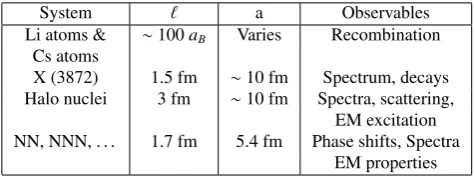
In the context of few-body systems, “universality” refers to two-, three-, and four-body systems that have proper-ties which are independent of the details of the underly-ing interaction. This universality emerges in systems with a two-body scattering lengtha that is large compared to the range of the interaction `. Under such circumstances the details of the interaction play only a sub-leading role in determining the observable quantities. Under the rubric of “universality” we collect systems as diverse as cold atoms, the X(3872), halo nuclei, and few-nucleon systems. We see that their bound (and, in some cases, low-energy scatter-ing) states share certain common features, even though the microscopic interactions are quite different in all cases. Ta-ble 1 collects these systems and showcases the hugely dif-ferent length scales involved. What Table 1 makes clear, though, is that in all these systems`/|a|is a small parame-ter.
This means that observables can be expanded in this small parameter. The leading-order prediction for observ-ables is then given by the limit `/|a| = 0. The predic-tions for this limit are discussed at length in the review of Ref. [1] as well as in the contribution of Braaten to this conference [2]. I will touch on this beautiful physics only briefly here, since my focus will be on the corrections that take us beyond the “universal” predictions. Those correc-tions are manifest in a variety of different observables, with the pertinent observables depending on the system under examination. In few-nucleon physics we are fortunate to
a e-mail:[email protected]
Table 1.Some systems in which the presence of large scattering lengths results in observables displaying “universal” features.`is the “characteristic length scale” of the interaction—the range of the force in the nuclear case, whileais the scattering length, and here and throughoutaBdenotes the Bohr radius. Note that in this
table the scattering length and range given for the NN system are taken from the3S1 channel. The X(3872) will not be discussed further in this talk, but was covered in the contribution of Mehen to this meeting [3].
System ` a Observables
Li atoms & ∼100aB Varies Recombination
Cs atoms
X (3872) 1.5 fm ∼10 fm Spectrum, decays
Halo nuclei 3 fm ∼10 fm Spectra, scattering, EM excitation NN, NNN, . . . 1.7 fm 5.4 fm Phase shifts, Spectra
EM properties
have a wealth of experimental data, including phase shifts and electromagnetic properties, all of which allow us to look at the effects of finite-`on the low-energy properties of NN, NNN, and even NNNN systems.
These data are, however, restricted to a fixed value ofa. In contrast, at low temperatures certain types of atoms (e.g. those listed in the first lines of Table 1) can be examined at different scattering lengths. The observables there are fea-tures in the recombination rates (and therefore losses) mea-sured in trapped, cold gases of these species. Cold atomic gases therefore provide a complementary way to investi-gate corrections to universality. In few-nucleon systems we
DOI:10.1051/epjconf/201002002
tend to examine observables as a function of energy, but at fixeda, while in atomic recombination we work at fixed (or, to be more precise, some average) energy but variable a. Both kinds of investigation provide useful ways to look for effects beyond universality.
Such effects are important because universality tells us how these diverse systems are similar, while the effects due to the finite range of the interaction illuminate their dif-ferences. Determining how to systematically incorporate those differences in the predictions for few-body-system observables is the subject of this talk. We will begin with the two-body system.
2 The two-body system
Since we are interested in systems for which the details of the interaction are not important we are free to work with interactions which are easy to calculate. In particular, we take the leading-order Lagrangian to be [4, 5]:
L=ψ† i∂t+ ∇ 2
2m !
ψ−C0 2 (ψ
†ψ)2, (1)
withmthe (equal) mass of the two particles in the two-body system, andψthe matter field1. The two-body poten-tial here is a three-dimensional delta function of strength C0. That coefficient in front of that delta function is set by the two-body scattering length,a. Computation of the scattering amplitude, via the sum of diagrams depicted in Fig. 1, using, e.g. dimensional regularization with minimal subtraction [6] to calculate the loops2, leads to the series:
t02B= 4π m
a−ia2k−a3k2+. . .. (2)
Herek= √mEis the momentum of the two colliding par-ticles in the center-of-mass frame.
Fig. 1.The sum of diagrams needed to compute the leading-order two-body amplitudet2B
0 . The vertices represent theC0contained in the leading-orderL(1).
In Eq. (2) we see that quantum corrections to the tree-level amplitude are important as soon as k ∼ 1/a, and,
1 For particles with spin there are, in fact, two independent op-erators that can be written down. This is related to the presence of both a total-spin zero and a total-spin one channel. Since we will move back and forth between discussions of bosons and fermions we will obscure this technical detail in what follows, and assume that there is only a single channel for low-energy scattering, as is the case in bosonic systems.
2 Other schemes yield a more “natural” value forC0, but the same physical amplitude.
once that regime is reached, all terms in the series are of the same order. Summation of the series produces:
t02B= 4πa M
1
1+iak, (3)
an amplitude that will be valid forka∼1, butk`1. Note that this amplitude predicts a pole atk=i/a, hence there is a two-body bound state with binding energyB=1/ma2 ifa>0, and a low-energy pole but no bound state ifa<0 (as occurs, e.g. in the1S0channel of NN scattering).
Eq. (3) is the “universal” result fort2B. It gives the
am-plitude if only the scattering length is known. To obtain predictions “beyond universality” we need to incorporate the effects of the finite range of the two-body potential int. Sixty years ago, Bethe showed thatt2B(E) could be written in the form [7]:
t2B(E)=−4π m
1
kcotδ(k)−ik; (4)
kcotδ(k)=−1 a+
1 2rk
2+O(`3k4), (5)
withk = √mE once again. The latter equation is known as the effective-range expansion, and is valid fork` < 1. (More precisely, it is valid with a radius of convergence de-fined by the nearest singularity of the two-body potential.) In most quantum scattering situations|r| ∼ `, and here we simply assume|r| |a|. Then, provided thatk∼1/a, we may writetas:
t02B(E)+t12B(E)= 4πa m
1 1+iak
" 1+1
2 rk2 1+iak +. . .
# , (6)
where the second term in square brackets is the next-to-leading order (NLO) correction to the next-to-leading-order (LO) result. Note that Eqs. (4) and (5) only provide a more ac-curate representation oft2B(E) thant20B(E)+t21B(E) if|r|is somehow appreciably larger than`.
An effective field theory (EFT) that reproduces the am-plitude (6) order-by-order in an expansion in the ratior/a∼ rkwas set up in Refs. [8–12]. The leading-order Lagrangian in this EFT is Eq. (1). At sub-leading orders, interactions with more derivatives are inserted. For instance, insertions of:
L(2)=C2 8 (ψ
†ψ)(ψ†↔ ∇ 2
ψ)+h.c. !
, (7)
between the LO amplitude (3) in perturbation theory pro-duce the second term in Eq. (6) [8, 9]. This EFT is the “pio-nless EFT” in few-nucleon physics, but in this paper it will be used more generally than that, so hereafter we refer to it as “large-scattering-length EFT”. This theory provides a way to systematically compute the effects of r/a correc-tions to the universal prediccorrec-tions obtained from Eq. (1).
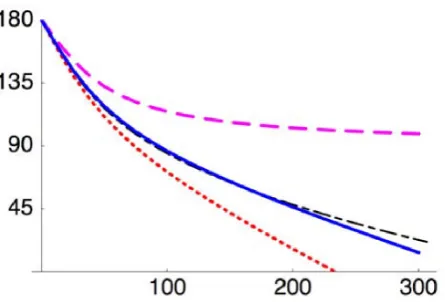
Fig. 2.NN scattering phases in the3S1channel (in degrees) ver-sus center-of-mass momentumk (in MeV). Results are shown at LO (dashed line), NLO (dotted line), NNLO (solid line). The dot-dashed line represents the result of the Nijmegen phase-shift analysis [13]. Figure taken from Ref. [14].
success is really only proof that, as claimed, a re-expansion of the effective-range expansion is a useful tool.
To see the predictive power of the large-scattering-length EFT in the NN system one must examine electromagnetic (or, more generally, electroweak) reactions. Since we have an EFT, this can be straightforwardly done by adding to the Lagrangians (1), (7) etc. the terms required by mini-mal substitution, together with terms which contain oper-ators that are gauge-invariant by themselves (e.g. nucleon magnetic moment operators). Diagrams for a given elec-tromagnetic process can then be calculated, and the order of each one computed using the scalingk∼1/a.
A quite successful example of this is the deuteron elec-tromagnetic polarizability. This observable, denoted byαE0, measures the extent to which the nucleus will develop an induced dipole moment in an applied electric field.αE0can be computed to four orders in ther/aexpansion, yielding to an accuracy of 1%, if input solely from NN scattering data is employed [15]. For this purpose we use an alterna-tive, slightly more efficient expansion of the NN3S
1 am-plitude. That expansion is made around the deuteron pole by writingkcotδ(k)=−γ+ρ(γ2+k2)+. . .and expanding in powers ofρ. At leading orderγ=1/aandρ=r. But, the higher-order terms are different when this expansion is employed, as compared to what was written in Eq. (6). Nu-mericallyρ=1.7 fm andγ=0.23 fm−1, soγρis the small parameter in this expansion, as seen explicitly in the result forαE0[16]:
αE0= αemm
32γ4 1+ργ+ρ
2γ2+ 2γ 2
3m2 +. . . !
, (8)
withαem=e2/(4π~c).
In the NN sector it is in electromagnetic reactions (see, in particular, Refs. [15, 16]) that the physics of universality can be in probed in an unambiguous way. The fact that the leading-order prediction forαE0(and several other quanti-ties too) depends only onγ∼1/ais a direct manifestation of universality, and suggests a universal result for the polar-izability of any two-body bound state with a small binding
energy. But the post-universal corrections to the deuteron polarizability are of order 1/3, and so to truly check that the deuteron belongs to this set of universal bound states the inclusion ofργcorrections is mandatory. By the time the NNLO corrections written in Eq. (8) are included, this is quite an accurate description.
A prominent example of this kind of success is the cal-culation of the reactionγd→np, relevant for Big-Bang Nu-cleosynthesis, to 1% accuracy [17]. That calculation was carried out to next-to-next-to-next-to-leading order (N3LO) in the large-scattering-length EFT. From this calculation it is very clear that`/|a|corrections are crucial to getting an accurate description of the energy dependence of the deuteron photodisintegration cross section in the photon energy range from threshold up to 10 MeV. But, once these corrections are accounted for, and both the E1 and M1 tran-sitions considered, the predictions of the EFT were consis-tent with all extant data in that energy range at the level of accuracy expected given that the first omitted correction is of order (r/a)4.
3 The three-body system: as a function of
energy
We now turn our attention to the three-body system. An ex-tensive review of the leading-order predictions of the large-scattering-length EFT for three-body systems can be found in Ref. [1], and these predictions were also discussed by Braaten in his contribution to this conference [2]. Here we summarize the LO predictions we need for our discussion of`/|a|corrections, and then move on to explain how those corrections are computed.
3.1 Leading order in the large-scattering-length EFT
In Ref. [18] Bedaque, Hammer, and van Kolck considered the case of three bosons interacting via the Lagrangian (1). They calculated the amplitude for one of the bosons scattering from a bound state of the other two. In atomic physics this is the “atom-dimer scattering amplitude”. In nuclear physics it is the “neutron-deuteron scattering am-plitude”. Hereafter the S-wave projected amplitude for this process, with scattering from relative-momentum state k into relative-momentum state p, at energy E, will be de-noted byt3B
0 .
Ref. [18] showed that the Lagrangian (1) was incom-plete, because the integral equation obtained from it that describes atom-dimer scattering yields results that are un-stable with respect to the cutoffin the integral. I.e., those results depend on model assumptions about short-distance physics. To remedy this Bedaque et al.proposed an aug-mented LO Lagrangian, which is:
L=ψ†
i∂t+
− → ∇2 2m
ψ−C0 2 (ψ
†ψ )2− H0
6Λ2(ψ †ψ
This yields the equation for the atom-dimer scattering am-plitde:
t30B(p,k;E)= 1
pk "
lnp
2+pk+k2−mE−i
p2−pk+k2−mE−i +
2H0(Λ)pk Λ2
#
+2πZ Λ
0 dqq
p "
lnp
2+pq+q2−mE−i
p2−pq+q2−mE−i +
2H0(Λ)pq Λ2
#
× t
3B
0 (q,k;E)
−1/a+p3q2/4−mE−i. (10)
IfH0=0 then this is the equation first derived by Sko-rnyakov and Ter-Martirosian more than fifty years ago. It describes the three-body system interacting via zero-range two-body forces [19]. As has been known for many years (see, e.g., Ref. [20]), this equation is not well behaved, with the final result fort3B
0 depending strongly on the value cho-sen forΛ. This is exactly the reason given in Ref. [18] for introducing a“three-body force” H0(Λ), which is itself a function of the cutoff. At a given value ofΛ,H0(Λ) must be chosen to reproduce one three-body observable. Ref. [18] showed that this removes this sensitivity of the low-energy amplitude to the choice of Λ. Afnan and Phillips subse-quently demonstrated that this result can also be obtained by making a subtraction on the original integral equation, in order to render its kernel better behaved [21].
In either case, the conclusion is that a piece of three-body information is needed in order to employ the large-scattering-length EFT in the three-boson system. Not all three-body systems built out of interactions with the same two-body scattering length are the same—even in the|a| → ∞limit.
A standard choice for this piece of three-body input is to fixH0so that the energy of one three-body bound state in the unitary (|a| → ∞) limit is reproduced. We follow Ref. [1] and denote this energy as:
E∗≡ ~ 2κ2
∗
m . (11)
Once this observable is fixed, predictions can be made for all other three-body observables at arbitrary scattering length (provided|a| `,k1/`). In particular, we find that, in the unitary limit, thenth three-body bound-state has bind-ing energy:
En=(e−2π/s0)n−n∗~
2κ2 ∗
m , (12)
withs0 =1.00624..., if then∗th state has energyE∗. In this way all binding energies in the unitary limit are determined once the one piece of three-body data,E∗, is known.
This reprises results of Thomas and Efimov: the three-body system with short-range two-three-body interactions alone is unstable against collapse [22]. But, if a piece of three-body information is added to the calculation, then, stable predictions—notably the prediction of a geometric spec-trum in the unitary limit—are obtained [23]. For the pur-poses of this paper a key consequence of these observa-tions is that the physics of a three-body system built on in-teractions with large two-body scattering lengths depends
primarily on two numbers, aandκ∗. Three-body systems still display “universality”, because the details of the two-body interaction remain sub-dominant at low momenta. But κ∗ must be determined before predictions for three-body observables that are based on the universality of two-body interactions can be made.
In particular, the presence of this input from the three-body system breaks the continuous scale invariance that would otherwise be present in observables in the|a| → ∞ limit. However, since the three-body spectrum in the uni-tary limit is geometric, the universal predictions are invari-ant under a rescaling ofκ∗by a factor ofeπ/s0 ≈22.7. In-variance under rescalings of dimensionful quantities by ap-propriate powers of this number is then a feature of three-body systems built out of two-three-body interactions with large scattering lengths. Such invariance is a prediction of uni-versality: one we shall return to in what follows.
This invariance under rescaling by factors ofeπ/s0is
re-flected in the asymptotic form of the atom-dimer scattering amplitude. Forp|a|,p/k1, the amplitudet30B(q,k;E) is:
t30B(q,k;E)=N k Λ
! (1 qsin
" s0ln q
κ∗ !#
+8γ|C−1| q2 sin
" s0ln q
κ∗ !
+arg(C−1) #
+... )
.
This form holds for allqsuch thatq/k1 andq|a| 1. The dominant term here is the first one, 1/qsin[s0ln(q/κ∗)]. The log periodicity of this dominant piece is the manifesta-tion of discrete scale invariance in this quantity. However, the overall normalization oft0is a function of the on-shell momentum,k:N(k/Λ). Meanwhile the sub-leading term in the large-qlimit involves a complex numberC−1 that can be calculated from the Mellin transform of the asymptotic form of the kernel of the integral equation in Eq. (10) [24].
3.2 Perturbation theory at NLO
The first attempt to calculate range corrections to the LO three-body amplitudet3B
0 was made in Ref. [25] by Ham-mer and Mehen. They inserted the O(r) correction from Eq. (6) between the leading-order three-body amplitude, and so computed the effects of that piece of (6) on the three-body system in first-order perturbation theory. In our notation the insertion is encoded as a “dimer” propagator:
D1(q0,q)=−4πi mg2
rs
2
1/a+ p−mq0+q2/4−i −1/a+p−mq0+q2/4−i , (13) In Ref. [25] the constant piece of this propagator was not included in the analysis. It will be taken into account here. Projecting onS-waves we get:
t31B(k,k;E)= Z Λ
dq rq 2 π
1/a+p3q2/4−mE−i −1/a+ +p3q2/4−mE−it
3B
0 2
(k,q)
+2H1Λ2(Λ) 1+2 π
Z Λ
dq q
2t3B
0 (k,q) −1/a+p3q2/4−mE−i
!2 .
Fig. 3.The diagrams that need to be evaluated to yield the NLO amplitude in the three-body sector.t1represents the NLO 3B amplitude, andt0the LO amplitude. The vertex denoted by a “1” in the first diagram produces the∼rpiece of the two-body propagator,D1, while the interactions labelled “1” in subsequent diagrams are proportional toH1.
These terms are depicted in Fig. 3. The first of these dis-plays a divergence that has to be canceled with the energy-independent three-body force H1(Λ) that appears in the second term—as was shown in Ref. [25]. The diagrams on the second line of Fig. 3 have to be evaluated for this purpose.
For fixed scattering length the new three-body force does not introduce an additional three-body parameter, since H1(Λ) is fixed by the renormalization condition that the NLO amplitude gives zero contribtion to the observable that was used for renormalization at leading order.
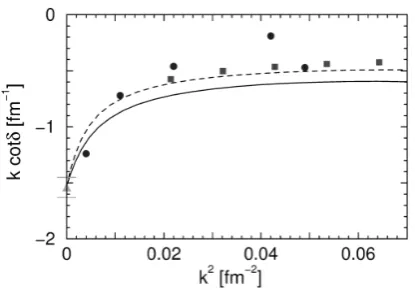
In Ref. [25] this approach was used to compute the NLO shift in the neutron-deuteron phase shifts in theS = 1/2 channel. The expression obtained there is slightly more complicated than Eq. (14), since one must consider NN scattering in both the1S0 and3S1 channels, but the prin-ciple is the same. The three-body observable used to fix κ∗ in Ref. [25] is the three-body scattering length in this S = 1/2 channel,a1/2 The results of this calculation are shown in Fig. 4. The NLO improvement is of the expected size, and brings the theory into better agreement with the data.
Fig. 4.Results for S-wave nd scattering in the spin-1/2 channel. The solid line is the LO result obtained in Ref. [18]. The dahsed line includes ther/acorrections, calculated as described in this section. The squares are the result of a sophisticated potential-model calculation and the circles result from an older phase-shift analysis. Figure from Ref. [25], with permission.
3.3 Some results at NNLO
As yet this analysis of corrections tot03Border-by-order in the r/a expansion has not been extended to NNLO. In-stead, in Ref. [24] the expansion of Eq. (6), carried out up toO(r2), was inserted as the NN amplitude in Eq. (10) in place of the leading-order two-body amplitude used there. The integral equation was then solved to obtaint30B+t13B+ t32B+. . .. We note that this technique is only reliable for a range of cutoffsΛthat obeyΛ` <1. However, within this range Bedaqueet al.performed an analysis, based on the asymptotic properties of the kernel, as well as numerical evidence, that demonstrated that another three-body input was needed at NNLO for renormalization. They useda1/2, together with the triton binding energy, as these three-body inputs. WIth these two numbers, together with NN input on aandrin the1S
0and3S1channels, in hand they predicted nd phase shifts fork<mπwith considerable precision.
This calculation showed that in nuclear systems NNLO corrections can be∼10%. A recent NNLO calculation of the threshold cross section for the process nd→tγ, places similar emphasis on how important such effects beyond universality are for reproducing data [26]. Whereas the LO (or “universal”) prediction for the threshold cross section isσ=0.485 mb, the NNLO computation of Ref. [26] ob-tainedσ=0.503±0.003 mb. This is in excellent agreement with the experimental resultσ = 0.508±0.015 mb [27]. But the discrepancy would be several standard deviations if we stopped with the universal prediction. In this, capture reaction, effects “beyond universality” are seen too.
In contrast to these works, Refs. [28, 29] showed that if the cutoff is taken to infinity in Eq. (10) witht02B re-placed byt20B+t21B+t22B, then a second three-body datum is not needed for renormalization. Only one three-body input (e.g.κ∗) is required up to this order. This suggests that in situations where|r| `the predictive power of the theory is greater than is implied by the analysis of Ref. [24].
4 The three-body system: as a function of
scattering length
4.1 Next-to-leading-order analysis in the large-scattering-length EFT
effective range. Asais varied in the two-body system the energies at which three-body bound states change occur. Away from the unitary limit we may write the binding en-ergies as:
En = ~2κ2n
m "
F 1 κna
!
+κ∗rsGn
1 κ∗a
!
+. . .#, (15)
whereκn =κ∗e−(n−n∗)π/s0andF(0) =1 by construction, so that this formula agrees with Eq. (12) in the unitary limit. As was discussed by Braaten at this meeting [2], the dis-crete scale invariance in the unitary limit persists to finite abecause states with differentnhave binding energies re-lated by factors ofeπ/s0 ≈22.7 ifais rescaled by a factor
ofeπ/s0. The functionF was computed by Efimov, and is
parameterized in Ref. [1].
In Ref. [30] we showed rigorously thatGn(0) =0 for
alln, i.e. there is no shift in anyκn in the unitary limit3.
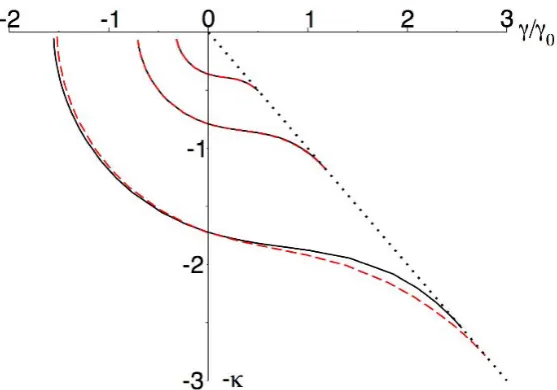
This is a consequence of the discrete scale invariance of the leading-order wave functions. We then extended the Efimov plot to NLO by solving Eq. (10) withtup to first order (see Eq. (6)) as input. The results of this exercise are shown in Fig. 5. A contemporaneous study by Thøgerson et al.used a potential model to produce results that were in qualitative and quantitative agreement with ours [31].
One might think that the results of Ref. [30] would be reproduced by a strictly perturbative analysis of the NLO shift in the Efimov spectrum, and that is true in the limit |r| `. However, in a perturbative analysis the second term in Eq. (14) generates divergences:
t31B∼r Z Λ
dq q2 1/a+ √
3q/2 −1/a+√3q/2t
3B
0 2
(k,q)
∼rΛ+r
alog(Λa)+. . . , (16)
as Λ → ∞. The linear divergence is renormalized away, by a piece toH1 that ∼ rΛand is independent ofa. The binding energies of states in the unitary limit are hence unaffected by the NLO correction, as shown in Ref. [30]. But the presence of the log divergence proportional tor/a means thatH1mustalsohave ana-dependent piece. Hence another three-body datum—one besidesκ∗—is needed to predict the a-dependence of the spectrum of three-body states at NLO. Furthermore, that three-body datumcannot be determined from unitary limit observables, because it is only probed at|a|,∞. One non-unitary-limit observable in the three-body system is needed in order to completely determine the NLO correction. Hence, Eq. (15) above is incomplete.
The existence of such ana-dependent three-body force can also be understood by considering the Lagrangian of the EFT with contact interactions alone. This Lagrangian should include all terms allowed by the symmetries of the system. In our problem there is no symmetry that precludes the presence of terms proportional to 1/a. Thus, beyond
3 This conclusion holds as long asκ
∗is the observable used for
renormalization.
LO, the three-body term in Eq. (9) must be augmented to:
H0 6Λ2(ψ
†ψ)3+r a
˜ H1,1 6Λ2(ψ
†ψ)3+r a
2 H2˜ ,2 6Λ2(ψ
†ψ)3+. . . . (17)
The presence of sucha-dependent three-body interactions is analogous to the need to consider the pion-mass de-pendence of the short-range part of the NN interactions in chiral effective theories [6, 8, 9]. And as with the mπ -dependent NN forces of the chiral EFT, the a-dependent three-body forces in the large-scattering-length EFT are mandatory for correct renormalization.
If` |r|, then the renormalized part ofH1,1,H1(r,)1 is small if evaluated at scale 1/`. This justifies the treatment of Ref. [30] in that limit, since the rest of the 1/a depen-dence of observables is described by long-distance physics at this order. If` |r| |a|, Eq. (15) is valid once more, since the additional three-body datum needed at NLO has only a parameterically small impact on observables. But, if|r| ∼`, then the effects ofH1,1must be considered.
4.2 Application to data on recombination in cold atomic gases
These effects can be discerned experimentally in the a -dependence of various features in recombination experi-ments with cold atoms. As described further in various pre-sentations at this meeting, the use of Feshbach resonances allows us to take trapped atomic gases, and then vary atom-atom scattering lengths over wide ranges by adjusting the magnetic field. Monitoring the atomic loss rate as a func-tion of that magnetic field then provides informafunc-tion on the spectrum of three-body “Efimov” states, since we can thereby trace the rates of atomic recombination processes that drive these losses.
Three features in the recombination rate have received particular attention. First, the atom-dimer threshold can be observed through a resonance feature in recombination, and the scattering length at which this occurs is denoted bya∗. Second, there is a maximum in the recombination rate at the negative scattering length for which the three-body bound state has zero energy, as then recombination is enhanced because it can proceed through capture into this bound state. That particular scattering length is denoted bya0in what follows. Conversely, there is a minimum in the recombination rate at a positive scattering length, a0, where t3B = 0. This zero in the scattering amplitude is sometimes understood as being due to destructive interfer-ence of two different recombination-reaction pathways.
In the limitr=0 the EFT discussed above can be used to predict “universal relations” between these three diff er-ent scattering lengths. We have [1]
a0/a0=−4.88enπ/s0; a0/a
∗=−0.9727enπ/s0. (18)
Fig. 5.The bound-state spectrum of the three-body system with short-range interactions. The solid lines denote the LO results, and the dashed lines give the NLO result for the casers=0.01 (in arbitrary units). Here the scale has been altered as per Ref. [1], withγ=1/a
andκfirst rewritten asγ =γ0Hcosζand|γ=γ0Hsinζand then the quantitiesH1/4cosζand−H1/4sinζdisplayed here. The dotted line denotes the point at which three-body bound states become unstable against breakup to a two-body bound state and a free particle. Figure after Ref. [30].
The relationships (18) are borne out fairly well in ex-periments with Lithium-7 atoms [32], which yield:
a0=−264(11)aB; a0≈1160aB, (19)
withaBthe Bohr radius. However, the experiments of the
Innsbruck group [33, 34] with Cesium atoms found values which do not obey (18) so well:a0 ≈210aB,a∗ ≈367aB,
anda0 ≈ −850aB. While the LO prediction works quite
nicely for the results (19), in the case of Ref. [33] it is not very well obeyed. The first equation in (18) would predict:
a0=−1025aB (20)
based on the measured value of a0. But a0 = 210aB is
not much larger than the van der Waal’s scale in Cesium ` ∼ 70aB. Therefore, it seems important to discuss how
NLO corrections in the theory with large scattering lengths modify predictions for recombination in Cesium.
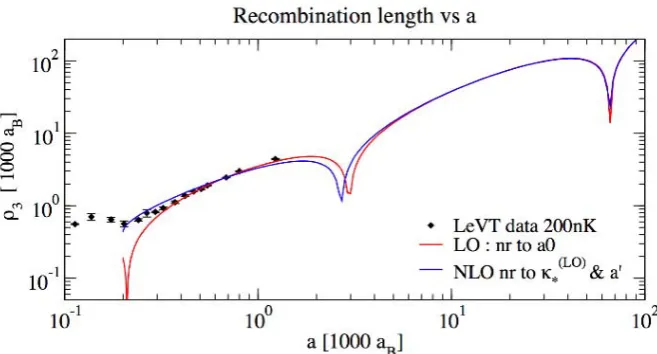
In Fig. 6 we show a LO and NLO prediction for the recombination lengthρ3for Cesium atoms. This is related to the recombination rateα, by:
ρ3=
2
√ 3α
~
1/4
. (21)
The data shown is from Ref. [33]. The LO prediction is ad-justed to give the valuea0 =210aBextracted in Ref. [33].
This corresponds to a value ofκ∗of 1.52×10⁻³~a−B1. At
NLO we adjustH0to keep this same value ofκ∗. But, with-out a non-zero H1,1, the result for this observable is not cutoffindependent. So,H1,1(Λ) is tuned to reproduce the value ofa0. NLO corrections go asr/ain this renormaliza-tion scheme.
Three things are clear from Fig. 6. First, in the vicin-ity of the recombination minimum the NLO correction to
the LO result is of order 100%. Of course, minima are always hard to reproduce, because by definition the am-plitude vanishes there, and so effects that are small else-where can make a big difference in the observable there. But, the NLO correction does not become a small pertur-bation to the LO result untila≈300–400aB. This leads us
to our second point: data onρ3at scattering lengths larger than that are quite well reproduced by the NLO result. Thus, the predictions of the large-scattering length EFT at values of a which are large enough that the EFT can be trusted are in accord with the observation ofa0 =−850a
B
and the leading-order value ofκ∗. We therefore conclude that NLO corrections may well account for the difference between these data and the universal prediction based on the measureda0, Eq. (20). Third, noting the difference be-tween the second minimum in the red curve and the first one in the blue curve we see that the LO prediction of the EFT for the position of the recombination minimum ata∼3000aBis appreciably affected by higher-order
cor-rections. The different recombination minima are no longer separated by a factor ofeπ/s0inaonce NLO corrections are
considered, because NLO corrections toρ3 break discrete scale invariance. Indeed, if we had chosen a renormaliza-tion scheme where a0 anda∗ (say) were both exactly re-produced at NLO there would be an NLO shift even in the limit|a| → ∞. In such a scheme the recombination mini-mum ata0∼80,000aBis also shifted by NLO corrections.
The optimal renormalization scheme at NLO is the one that minimizes still higher-order corrections to observables. The scheme that satisfies that criterion is yet to be deter-mined. At NLO one can work in different schemes and produce predictions for theρ3 vsacurve. The differences between the results in different schemes then give an esti-mate of the uncertainty due to NNLO effects.
dramat-Fig. 6.Predictions at LO and NLO for the “recombination length”ρ3compared with data from Ref. [33]. The red line is the leading-order result, in whicha0is taken as the three-body datum, and the blue curve is the NLO result, in which we have renormalized to the sameκ∗
as at LO, and the value ofa0
measured in Ref. [33]. The value ofrwas chosen to ber=100aB.
ically with magnetic field, withr→ −∞whena=0. The data taken in Ref. [33], and displayed in Fig. 6, were taken in the vicinity of such a zero, and so, fora ≈100–200aB
the value ofrcan be much larger than 100aB, and of
oppo-site sign. A full treatment of these data therefore requires us to include the impact of an effective range that varies with magnetic field onρ3. The fact that data in the vicinity of the recombination minimum are not well described in Fig. 6 is therefore not of concern, given that such effects were not accounted for there.
The curves shown in Fig. 6 also do not contain correc-tions for the effects of finite temperature or deep dimers. Effects due to the latter will, for instance, fill in the recom-bination minima and make the predictions much smoother as a function ofa. One way to look at the theory predic-tion without having to worry about this issue is to ask how linear-in-reffects modify the universal relations (18). The answer to this question depends somewhat on renormaliza-tion scheme, but to derive these relarenormaliza-tions here we work in a renormalization scheme wherea0 is fixed at LO, and at NLO we keep the samea0andκ∗.
The pattern of NLO corrections then depends on the value ofn chosen in Eq. (18), because range corrections break discrete scale invariance, and so they affect the dif-ferent states in the Efimov spectrum differently. Forn=−1 we find, for instance:
a0=−0.215a0+1.18r+O(r2/a0). (22)
It is not clear that we can apply such an equation—even if we choose one for a differentn—to relate thea0 anda0 measured in Ref. [33], since those two quantities are con-nected through a zero of the scattering length. The correct value ofrto insert is thus not clear. (It is also not clear that we can use the same three-body parameterκ∗on both sides of the pointa=0.) We can, however, apply Eq. (22) to the findings of Ref. [32]. There, recombination features were measured on either side of a Feshbach resonance where
|a| → ∞andr=−15aB[35]. For thea0given in Eq. (19),
and using this effective range, we have:
a0=(−249−17+. . .)aB. (23)
This shows that the range corrections in the Lithium-7 sys-tem help to improve the agreement between theory and the experimentally measureda0quoted above.
The effect of range corrections in these data is not large, because the|r|is appreciably smaller than `in the vicin-ity of the broad Feshbach resonance used by Grosset al. for this experiment [36]. But, with accurate determinations of a0 anda0, the impact of the term proportional to rin Eq. (22) will become discernible. A proper treatment of those terms necessitates the inclusion of the piece of short-distance, three-body, physics encoded in the parameterH1,1.
5 Some words on the four-body system
We now move on to consider effects beyond universality in the four-body system. As discussed elsewhere in these pro-ceedings [2, 37], the prediction of universality—or, equiva-lently, the leading-order prediction in the large-scattering-length EFT—is that near|a| = ∞there will be two four-body bound states for each three-four-body bound state. More-over, the binding energies of these states will be related to that of the three-body state,B, by [39, 40]:
B4,0≈5.0B;B4,1≈1.01B. (24)
This prediction has recently been confirmed in four-body recombination data [38].
Platter, Hammer, and Meißner showed that this correlation was a prediction of the large-scattering-length EFT at lead-ing order. It can be used to predict the bindlead-ing energy of the Helium-4 nucleus, if the binding energy of the triton is given. With only the binding energy of the A=2 and A=3 nuclides and the1S0scattering length as input Platteret al. predictB4,0 = 27±2 MeV for A=4, in remarkably good agreement with experiment.
The shallower of the two four-nucleon bound states predicted by universality will be rendered unbound by the Coulomb interaction. Thus it can only be probed in scatter-ing experiments or through electromagnetic observables. Future investigations that combine theory and experiment in order to check the extent to which the prediction (24) is obeyed by the strong interactions in the A=4 system could be extremely fruitful.
One aspect of such investigations will be a proper treat-ment of r/a corrections. Recently, Kirscher et al. made the first examination ofr/acorrections to four-nucleon ob-servables in the large-scattering-length EFT. They find that these corrections narrow the correlation band betweenB4,0 andB3 and produce similarly tight correlation bands be-tween the triton binding energy and the Helium-3-neutron scattering length (see Fig. 7). Measurements of the latter quantity can serve to identify the presence ofr/a correc-tions to the “universal” correlacorrec-tions between three- and four-body system observables in systems with large scat-tering length.
Fig. 7.Predictions at NLO for the correlation between the triton binding energy and the real part of the neutron-Helium-3 scatter-ing length. The different numbered points correspond to different implementations of the NLO EFT calculation, while the points labelled AV18 and AV18+UIX indicate the results of sophisti-cated potential-model calculations with and without three-body forces, respectively. The plus and the cross indicate the results of two recent experiments. For details see Ref. [42].
6 Conclusion
Universality links gases of cold atoms, few-nucleon sys-tems, halo nuclei, and hadronic molecules. These syssys-tems,
although their energy scales are vastly different, have in common that they all involve large two-body scattering lengths. They differ from one another in the pattern of their r/acorrections: the way they manifest effects “beyond uni-versality”.
In few-nucleon systems (and in halo nuclei too, see Refs. [43, 44]) understanding such corrections is manda-tory if an accurate description of data is to be obtained. In contrast, the gross features of atomic losses near Feshbach resonances due to three- and four-body recombination are already surprisingly well explained by the predictions of universality.
These predictions constitute the LO results in the large-scattering-length EFT developed in Refs. [8–12, 18]. But, range corrections are key to systematic control of effects in different atomic systems. While such corrections are small for the data obtained in Ref. [32], they can be expected to be sizeable in the vicinity of the recombination minimum observed in Ref. [33]. A key finding reported here is that an extra three-body datum is needed to fully constrain the scattering-length dependence of these range corrections.
A study ofr/acorrections in the context of four-body recombination in atomic systems would help identify how far the exciting observations reported at this meeting [37, 38] are a result of “universality” in systems with large scat-tering length, and how far they are specific to the Cesium gas used for those experiments. The formalism to carry out such calculations “beyond universality” already exists. It is a straightforward extension of the techniques already im-plemented in Refs. [41, 42], and would be a useful applica-tion of the next-to-leading-order two-body and three-body interactions described in this talk.
This contribution provides only a short and selective introduction to the way universality and its corrections drive physics in few-nucleon systems and cold atomic gases. A more extensive discussion along these lines can be found in the recent review [45].
Acknowledgments
It is a pleasure to acknowledge my collaborators in the work that constitutes the bulk of the new results presented here: Chen Ji and Lucas Platter. I am also grateful to Lucas for many conversations and much education on recombina-tion in cold atomic gases. I also thank Eric Braaten, David Canham, Harald Grießhammer, and Hans-Werner Hammer for discussions on the topics I have presented here. This work is supported by the US Department of Energy DE-FG02-93ER-40756 and by the Mercator programme of the Deutsche Forschungsgemeinschaft.
References
1. E. Braaten and H.-W. Hammer, Phys. Rept.428(2006) 259.
2. E. Braaten, these proceedings. 3. T. Mehen, these proceedings.
5. S. Weinberg, Nucl. Phys. B363,(1991) 3.
6. D. B. Kaplan, M. J. Savage and M. B. Wise, Nucl. Phys. B478(1996) 629.
7. H. A. Bethe, Phys. Rev.76(1949) 38.
8. D. B. Kaplan, M. J. Savage and M. B. Wise, Phys. Lett. B424(1998) 390.
9. D. B. Kaplan, M. J. Savage and M. B. Wise, Nucl. Phys. B534(1998) 329.
10. U. van Kolck, Nucl. Phys. A645(1999) 273; 11. J. Gegelia, Phys. Lett. B429(1998) 227.
12. M. C. Birse, J. A. McGovern and K. G. Richardson, Phys. Lett. B464(1999) 169.
13. V. G. J. Stoks, R. A. M. Klomp, M. C. M. Rentmeester and J. J. de Swart, Phys. Rev. C48(1993) 792. 14. S. R. Beane, P. F. Bedaque, W. C. Haxton,
D. R. Phillips and M. J. Savage, “From hadrons to nuclei: Crossing the border,” in the Borris Ioffe Festschrift, “At the frontier of particle physics: hand-book of QCD”, M. Shifman (ed.), nucl-th/0008064. 15. D. R. Phillips, G. Rupak and M. J. Savage, Phys. Lett.
B473(2000) 209.
16. J. W. Chen, G. Rupak and M. J. Savage, Nucl. Phys. A 653(1999) 386.
17. G. Rupak, Nucl. Phys. A678(2000) 405.
18. P. F. Bedaque, H. W. Hammer and U. van Kolck, Phys. Rev. Lett.82(1999) 463; Nucl. Phys. A 646 (1999) 444.
19. G.V. Skorniakov and K.A. Ter-Martirosian, Sov. Phys. JETP 4, 648 (1957) [J. Exptl. Theoret. Phys. (U.S.S.R.)31, 775 (1956)].
20. G.S. Danilov, Sov. Phys. JETP13, 349 (1961). 21. I. R. Afnan and D. R. Phillips, Phys. Rev. C69(2004)
034010.
22. L. H. Thomas, Phys. Rev.47(1935) 903 23. V. Efimov, Phys. Lett. B33(1970) 563.
24. P. F. Bedaque, G. Rupak, H. W. Grießhammer and H.-W. Hammer, Nucl. Phys. A714(2003) 589.
25. H.-W. Hammer and T. Mehen, Phys. Lett. B 516 (2001) 353.
26. H. Sadeghi, S. Bayegan, H. W. Grießahmmer, Phys. Lett. B643(2006) 263.
27. E. T. Jurney, P. J. Bendt and J. C. Browne, Phys. Rev. C25(1982) 2810.
28. L. Platter and D. R. Phillips, Few Body Syst.40(2006) 35.
29. L. Platter, Phys. Rev. C74(2006) 037001.
30. L. Platter, C. Ji and D. R. Phillips, Phys. Rev. A79 (2009) 022702.
31. M. Thøgersen, D. V. Fedorov and A. S. Jensen, Phys. Rev. A78, 020501 (2008).
32. N. Gross, Z. Shotan, S. Kokkelmans, L. Khaykovich, Phys. Rev. Lett.103(2009) 163202.
33. M. Kraemeret al., Nature440(2006) 315. 34. S. Knoopet al., Nature Physics5(2009) 227. 35. S. Kokkelmans, private communication.
36. E. Braaten, D. Kang and L. Platter, Phys. Rev. A78 (2008) 053606.
37. F. Ferlaino, these proceedings.
38. F. Ferlainoet al., Phys. Rev. Lett.102(2009) 140401.
39. H.-W. Hammer and L. Platter, Eur. Phys. J. A 32 (2007) 113.
40. J. von Stecher, J. d’Incao, C. Greene, Nature Physics 5(2009) 417.
41. L. Platter, H.-W. Hammer and U. G. Meißner, Phys. Lett. B607(2005) 254.
42. J. Kirscher, H. W. Grießhammer, D. Shukla and H. M. Hofmann, arXiv:0903.5538 [nucl-th].
43. D. L. Canham and H.-W. Hammer, arXiv:0911.3238 [nucl-th].
![Fig. 1, using, e.g. dimensional regularization with minimalsubtraction [6] to calculate the loops 2, leads to the series:](https://thumb-us.123doks.com/thumbv2/123dok_us/9036464.1440022/2.595.76.300.541.572/using-dimensional-regularization-minimalsubtraction-calculate-loops-leads-series.webp)