Nuclear lattice simulations
Dean Lee1,a, Evgeny Epelbaum2,3, Hermann Krebs3, and Ulf-G. Meißner3,2,4
1 Department of Physics, North Carolina State University, Raleigh, NC 27695, USA
2 Institut f¨ur Kernphysik (IKP-3) and J¨ulich Center for Hadron Physics, Forschungszentrum J¨ulich, D-52425 J¨ulich,
Ger-many
3 Helmholtz-Institut f¨ur Strahlen- und Kernphysik (Theorie) and Bethe Center for Theoretical Physics, Universit¨at Bonn,
D-53115 Bonn, Germany
4 Institute for Advanced Simulation (IAS), Forschungszentrum J¨ulich, D-52425 J¨ulich, Germany
Abstract. We review recent progress on nuclear lattice simulations using chiral effective field theory. We discuss lattice results for dilute neutron matter at next-to-leading order, three-body forces at next-to-next-to-leading order, isospin-breaking and Coulomb effects, and the binding energy of light nuclei.
1 Introduction
Nuclear lattice simulations based on low-energy effective field theory have been used to study nuclear matter [1] and neutron matter [2–7]. The method has also been applied to very light nuclei A≤4 in pionless effective field theory [8] and chiral effective field theory at leading order (LO) [9]. More recently next-to-leading order (NLO) calcula-tions have been carried out for the ground state of neutron matter [10, 11]. A review of lattice methods and results us-ing effective field theory can be found in Ref. [12]. In this proceedings article we focus on several recent calculations since the writing of the review article.
2 Leading order
At leading order in chiral effective field theory the nucleon-nucleon effective potential is
VLO=V+VI2+VOPEP. (1)
V, VI2 are the two independent contact interactions at leading order in the Weinberg power counting scheme, and VOPEPis the instantaneous one-pion exchange poten-tial. The interactions in VLOcan be described in terms of their matrix elements with two-nucleon momentum states. In the followingqdenotes the t-channel momentum trans-fer whilekis the u-channel exchanged momentum transfer. We useτto represent Pauli matrices in isospin space and σfor Pauli matrices in spin space.
For the two leading-order contact interactions the am-plitudes are
A(V)=C, (2)
A(VI2)=CI2τA·τB. (3)
a e-mail:dean [email protected]
For the one-pion exchange potential,
AVOPEP=− gA
2 fπ
!2
(τA·τB) (q·σA) (q·σB) q2+m2
π
. (4)
Here m is the nucleon mass, mπthe pion mass, fπthe pion decay constant, andgAthe nucleon axial charge.
In Ref. [9] two different lattice actions were considered which were later denoted LO1 and LO2 [10]. The inter-actions in VLO1 include one-pion exchange and two zero-range contact interactions corresponding with amplitude
A VLO1
=C+C
I2τA·τB+A
VOPEP. (5)
The interactions in VLO2 consist of one-pion exchange and two Gaussian-smeared contact interactions,
A VLO2
=C f (q)+C
I2f (q)τA·τB+A
VOPEP, (6)
where f (q) is a lattice approximation to a Gaussian func-tion. The smeared interactions in LO2were used to better reproduce S -wave phase shifts for nucleon momenta up to the pion mass. In Ref. [10] phase shifts were calculated for these two lattice actions using the spherical wall method [13].
In calculations of few- and many-nucleon systems, this “improved” leading-order action is treated non-perturbatively while higher-order interactions are included as a perturbative expansion in powers of momentum, Q/Λ. This is sketched in Fig. 1.
3 Next-to-leading order
At next-to-leading order (NLO) the two-nucleon effective potential contains seven independent contact terms carry-ing two powers of momentum, corrections to the two LO DOI:10.1051/epjconf/20100301001
LO
NLO
NNLO
...
non-perturbative ''improved'' LO perturbativeexpansion in Q/Λ
Fig. 1.The “improved” LO action is iterated non-perturbatively while the remaining higher-order interactions are treated using perturbation theory.
contact terms, and the leading contribution from the instan-taneous two-pion exchange potential (TPEP) [14–18],
VNLO=VLO+∆V(0)+V(2)+VNLOTPEP. (7)
The tree-level amplitudes for the contact interactions are
A∆V(0)=∆C+∆CI2τA·τB (8)
and
AV(2)=C1q2+C2k2+
C3q2+C4k2
(σA·σB)
+iC5 1
2(σA+σB)·(q×k)
+C6(σA·q) (σB·q)+C7(σA·k) (σB·k). (9)
The amplitude for the NLO two-pion exchange potential is [19, 20]
AVNLOTPEP=− τA·τB
384π2f4 π
L(q)
4m2π5g4A−4g2A−1
+q223g4A−10g2A−1+ 48g 4 Am
4 π 4m2
π+q2
− 3g
4 A 64π2f4
π
L(q)h(q·σA) (q·σB)−q2(σA·σB)
i
, (10)
where
L(q)= 1 2q
q
4m2 π+q2ln
p
4m2
π+q2+q
p
4m2
π+q2−q
. (11)
On the lattice the ultraviolet momentum cutoffis in-versely proportional to the lattice spacing,Λ=π/a. In few-and many-nucleon calculations where we use Euclidean-time projection and auxiliary-field Monte Carlo, severe nu-merical problems appear whenΛis very large. To avoid these problems we consider lattice simulations where the cutoffmomentum is only a few times the pion mass. For the lattice calculations discussed here we takeΛ = 314 MeV≈ 2.3mπ, corresponding with a−1 = 100 MeV. For
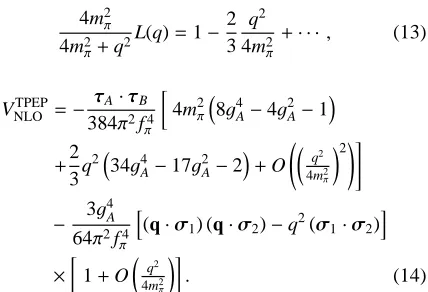
|q|< Λwe can expand the two-pion exchange potential in powers of q2/(4m2
π),
L(q)=1+1 3
q2 4m2
π
+· · ·, (12)
4m2
π+q2 34m2π
VNLOTPEP=− τA·τB
384π2f4 π
4m2π8g4A−4g2A−1
+2 3q
2
34g4A−17g 2 A−2
+O q2 4m2 π 2!#
− 3g
4 A 64π2f4
π
h
(q·σ1) (q·σ2)−q2(σ1·σ2)
i
×
1+O
q2 4m2 π . (14)
This expansion fails to converge only for values of q near the cutoffscaleΛ≈2.3mπ, where the effective theory is al-ready problematic due to large cutoffeffects. Therefore the full non-local structure of VNLOTPEPis not necessary. Instead we simply use
VLO=V(0)+VOPEP, (15)
VNLO=VLO+∆V(0)+V(2), (16)
where the terms in Eq. (14) with up to two powers of q are absorbed as a redefinition of the coefficients∆V(0)and V(2). This same approach can be applied to the two-pion ex-change potential at next-to-next-to-leading order (NNLO) and higher-order n-pion exchange potentials.
4 Dilute neutrons at next-to-leading order
In Ref. [11] the ground state energy for dilute neutron mat-ter was computed using the lattice action LO2and auxiliary-field Monte Carlo. Next-to-leading-order corrections to the energy were also calculated. In this calculation the largest source of systematic error was the large size of NLO corrections for Fermi momenta larger than 100 MeV. The problem is caused by attractive P-wave interactions introduced by Gaussian smearing in LO2that must be can-celled by NLO corrections. In systems with both pro-tons and neutrons this P-wave correction is numerically small when compared with the strong binding produced by S -wave interactions. For pure neutron matter, however, the S -wave interactions produce much less binding due to Fermi repulsion. Therefore on a relative scale, the P-wave interactions are not as small an effect in neutron matter.
These problems were resolved using a new leading-order action LO3[21]. The interactions in VLO3correspond with the amplitude,
A VLO3
=CS
=0,I=1f (q) 1 4−
1 4σA·σB
!
3 4+
1 4τA·τB
!
+CS=1,I=0f (q) 3 4+
1 4σA·σB
!
1 4 −
1 4τA·τB
!
+AVOPEP. (17)
0 0.2 0.4 0.6 0.8 1 1.2
0 50 100 150 200 E0
/
E0
free
kF (MeV) FP 1981 APR 1998 CMPR v6 2003 CMPR v8′ 2003 SP 2005 GC 2007 GIFPS 2008
0 0.2 0.4 0.6 0.8 1 1.2
0 50 100 150 200 E0
/
E0
free
kF (MeV) LO3
NLO3
Fig. 2.Ground state energy ratio E0/Efree0 for LO3and NLO3
ver-sus Fermi momentum kF. For comparison we show results for
FP 1981 [25], APR 1998 [26], CMPRv6 andv8′ 2003 [27], SP 2005 [28], GC 2007 [29], and GIFPS 2008 [30].
contributes in pure neutron matter. Using the LO3 action with NLO corrections, the ground state energy for dilute neutrons has been computed in a periodic box [21].
The calculation is done using auxiliary-field Monte Carlo. One auxiliary field is associated with the total nu-cleon density N†N and three fields for the spin density N†σN. A review of the auxiliary-field Monte Carlo on the lattice can be found in Ref. [12]. The properties of the ground state are extracted using Euclidean-time pro-jection. For spatial lattice spacing a = (100 MeV)−1 and temporal lattice spacing at=(70 MeV)−1simulations were done with 8,12,16 neutrons in periodic boxes with lengths L = 4,5,6,7 in units of the spatial lattice spac-ing. In Fig. 2 we show results for the ratio of the inter-acting ground state energy to non-interinter-acting ground state energy, E0,NLO/Efree0 , as a function of Fermi momentum kF. For comparison we show other results from the literature: FP 1981 [25], APR 1998 [26], CMPRv6 andv8′[27], SP
2005 [28], GC 2007 [29], and GIFPS 2008 [30].
5 Three-body forces at
next-to-next-to-leading order
A number of different phenomenological three-nucleon po-tentials have been investigated in the literature [31–39]. Effective field theory provides a systematic method for es-timating the relative importance of three-body interaction terms. Few-nucleon forces in chiral effective field theory beyond two nucleons were first introduced in Ref. [40]. In Ref. [41] it was shown that three-nucleon interactions at NLO cancel and three-body effects first appear at next-to-next-to-leading order (NNLO). The NNLO three-nucleon effective potential includes a pure contact potential, Vcontact(3N) ,
π
(a) (b) (c)
π π
Fig. 3.Three-nucleon forces at NNLO. Diagrams (a), (b), and (c) show the contact potential, Vcontact(3N) , one-pion exchange potential
VOPE(3N), and two-pion exchange potential VTPE(3N).
one-pion exchange potential, VOPE(3N), and a two-pion exchange potential, VTPE(3N),
VNNLO(3N) =Vcontact(3N) +VOPE(3N)+VTPE(3N). (18)
The corresponding diagrams are shown in Fig. 3.
Similar to our bookkeeping notation for two-nucleon interactions, we write the tree-level amplitude for three-nucleon interactions with three-nucleons A, B, C. We sum over all permutations P(A,B,C) of the labels, andqA,qB,qC are defined as the differences between final and initial mo-menta for the respective nucleons. The amplitudes for Vcontact(3N) and VOPE(3N)are [42, 43]
AhVcontact(3N) i=1 2E
X
P(A,B,C)
(τA·τB), (19)
AhVOPE(3N)i=−gA
8 f2 π
D X
P(A,B,C) qA·σA q2A+m2 π
(qA·σB) (τA·τB).
(20) The coefficients E and D are both cutoffdependent. The coefficient E determines the short distance interactions be-tween three nucleons, while D determines the pion cou-pling to two nucleons. Following the notation introduced in Ref. [43], we define dimensionless parameters cE and cDsuch that
E= cE f4
πΛχ
, D= cD f2
πΛχ
, (21)
and we takeΛχ=700 MeV.
For convenience we separately label three parts of the two-pion exchange potential,
VTPE(3N)=VTPE1(3N) +VTPE2(3N) +VTPE3(3N). (22)
The corresponding amplitudes are
AhVTPE1(3N)i= c3 f2 π
gA 2 fπ
!2
× X
P(A,B,C)
(qA·σA) (qB·σB)
q2
A+m2π q2B+m2π
0 0.10 0.20 0.30 0.40 -0.10 -0.20 0 0.25 0.50 0.75 -0.25 -0.50 -0.75 -1.00 -1.25
p2 (fm-2)
p cot δ (fm -1) nd (exp.) NNLO NLO LO pd (exp.)
Fig. 4.Plot of p cotδversus p2 for the spin-doublet channel in
the center-of-mass frame. For the NNLO calculation we take
cD=1.0 fitted to the physical value for Etriton. The experimental
results are from Ref. [50].
AhVTPE2(3N)i=−2c1m
2 π f2
π gA 2 fπ
!2
× X
P(A,B,C)
(qA·σA) (qB·σB)
q2
A+m2π q2B+m2π
(τA·τB), (24)
AhVTPE3(3N)i= c4 2 f2
π gA 2 fπ
!2 × X P(A,B,C)
(qA·σA) (qB·σB)
q2
A+m2π q2B+m2π
· (q
A×qB)×σC[(τA×τB)·τC]
. (25)
The low-energy constants c1,c3,c4 parameterize the coupling of the nucleon to two pions. These constants have been determined from fits to low-energy pion-nucleon scattering data [44], and the values c1 = −0.81 GeV−1, c3=−4.7 GeV−1, c4=3.4 GeV−1[45] are used.
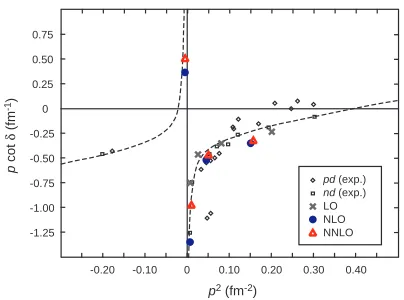
At fixed lattice spacing we constrain the two un-known coefficients by fitting to the triton binding energy and spin-doublet nucleon-deuteron scattering phase shifts via L¨uscher’s finite volume formula [46–48]. The three-nucleon system is sufficiently small that we can use itera-tive sparse-matrix eigenvector methods to compute energy levels on cubic periodic lattices. We fix the coefficient cE as a function of cDby matching the physical triton energy at infinite volume, −8.48 MeV. The value of the cD is then determined from the spin-doublet nucleon-deuteron scattering phase shifts. Results for the doublet nucleon-deuteron scattering phase shift are shown in Fig. 4 using the LO2lattice action for lattice spacing a=(100 MeV)−1 and temporal lattice spacing at = (150 MeV)−1[49] with cD=1.0.
It turns out however that the spin-doublet nucleon-deuteron scattering phase shift provides only a mild con-straint on cD. Currently we are investigating other meth-ods for constraining cD, including one recent suggestion to determine cDfrom the triton beta decay rate [51].
In addition to isospsymmetric interactions, we also in-clude isospin-breaking interactions and Coulomb effects. Isospin breaking (IB) in effective field theory has been ad-dressed in the literature [52–56]. In the following we re-port results from work that is currently being written for publication [57].
In the counting scheme proposed in Ref. [56], the isospin-breaking one-pion exchange interaction and Coulomb potential are numerically the same size as O(Q2/Λ2) corrections at NLO. For the isospin-symmetric one-pion exchange interaction we use mπ=mπ0 in Eq.(4). The isospin-violating one-pion exchange interaction due to pion mass differences is then
AhVOPEP, IBi=− gA
2 fπ
!2
[(τ1)A(τ1)B+(τ2)A(τ2)B]
×(σA·q) (σB·q)
1
q2+m2 π±
− 1
q2+m2 π0 . (26)
On the lattice we treat the Coulomb potential in po-sition space with the usualαEM/r dependence. However this definition is singular for two protons on the same lat-tice site and requires short-distance renormalization via a proton-proton contact interaction. We include all possi-ble contact interactions, namely interactions for neutron-neutron, proton-proton, spin-singlet neutron-proton, and spin-triplet neutron-proton. The two neutron-proton con-tact interactions are already included at NLO and deter-mined from neutron-proton scattering. The other two coef-ficients are determined from fitting to S -wave phase shifts for proton-proton scattering and the neutron-neutron scat-tering length. The results using the1S
0neutron-proton and proton-proton phase shifts are shown in Fig. 5. The lat-tice data is for the LO3action with spatial lattice spacing a =(100 MeV)−1 and temporal lattice spacing a
t =(150 MeV)−1. For comparison we show partial wave results from Ref. [58]. We see that the agreement is quite good for center of mass momenta up to 150 MeV.
The next results we present are for the energy splitting between helium-3 and triton. As noted already, the three-nucleon system is sufficiently small that we can use iter-ative sparse-matrix eigenvector methods for helium-3 and the triton. We consider cubes with side lengths L up to 16 fm and extract the infinite volume limit using the asymp-totic result [46],
E(L)≈E(∞)−C
Le
−L/L0. (27)
0 20 40 60 80 100 120 140
0 20 40 60 80 100 120 140 160
pCM (MeV)
1S 0
δ
(
1 S
0
) (degrees)
LO3
NLO3
PWA93 (np)
0 20 40 60 80 100 120 140
0 20 40 60 80 100 120 140 160
pCM (MeV)
1S 0
δ
(
1 S
0
) (degrees)
LO3
NLO3
PWA93 (pp)
Fig. 5.1S
0neutron-proton and proton-proton phase shifts versus center of mass momentum.
0.5 0.6 0.7 0.8 0.9 1
5 10 15 20 25
EHe-3
−
Etriton
(MeV)
L (fm) lattice physical (infinite volume)
Fig. 6.The energy difference between helium-3 and the triton versus periodic cube length.
7 Results for nuclei
A
=
4,
6,
12
As in the neutron matter simulations, we use projection Monte Carlo with auxiliary fields to compute the energy of nuclei for A ≥4. For the LO3action a total of sixteen auxiliary fields are required. One auxiliary field is asso-ciated with the total nucleon density N†N, three fields for the spin density N†σN, three fields for the isospin density
N†τN, and nine fields for the spin-isospin density N†στN.
In the following we report results from work that is cur-rently being written for publication [57].
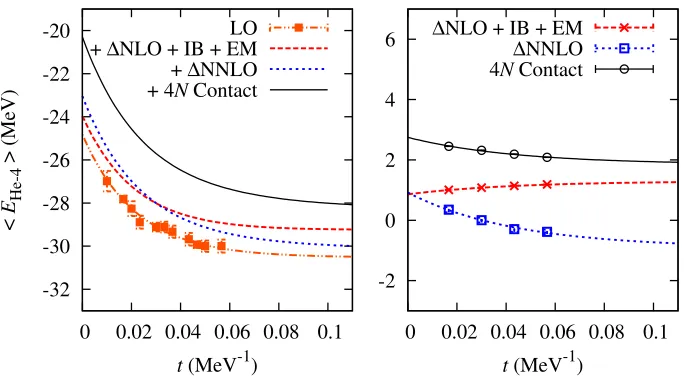
In Fig. 7 we show lattice results for the ground state of helium-4 for periodic box of length 9.9 fm. For the numerical extrapolation in Euclidean time we use the de-caying exponential functions in Ref. [49]. The plot on the left shows the leading-order and higher-order contri-butions added cumulatively. The plot on the right shows the higher-order corrections separately. The plots show re-sults for cD=1. The helium-4 energy decreases about 0.4 MeV for each unit increase in cD. These results are simi-lar to those found in Ref. [49] using the LO2action. As in that analysis we find an overbinding of about 1 to 2 MeV at NNLO, depending on the value of cD.
Given our cutoffmomentumΛ=π/a =314 MeV, an error of 1 to 2 MeV is consistent with the expected size of higher order contributions. Higher order terms beyond NNLO are beyond the scope of this analysis. However if it happens that the higher-order effects are most important when all four nucleons are close to each other, then we should see universal behavior that can be reproduced by an effective four-nucleon contact interaction. We test this universality hypothesis by using an effective four-nucleon contact interaction tuned to give the physical helium-4 en-ergy of−28.3 MeV. The contribution of this interaction in helium-4 is shown in Fig. 7.
-32 -30 -28 -26 -24 -22 -20
0 0.02 0.04 0.06 0.08 0.1
<
EHe-4
> (MeV)
t (MeV-1) LO + ∆NLO + IB + EM + ∆NNLO + 4N Contact
-2 0 2 4 6
0 0.02 0.04 0.06 0.08 0.1
t (MeV-1)
∆NLO + IB + EM
∆NNLO
4N Contact
Fig. 7.Ground state energy for helium-4 as a function of Euclidean time projection.
MeV with an extrapolation error of about 1 MeV. This agrees quite well with the physical value of−32.0 MeV. Extrapolation to infinite volume should move the lattice re-sult upward slightly and closer to the physical value. The data in the plots show results for cD = 1. For each unit increase in cD, the energy decreases about 0.7 MeV with-out the four-nucleon contact interaction and abwith-out 0.3 MeV with the effective 4N contact interaction.
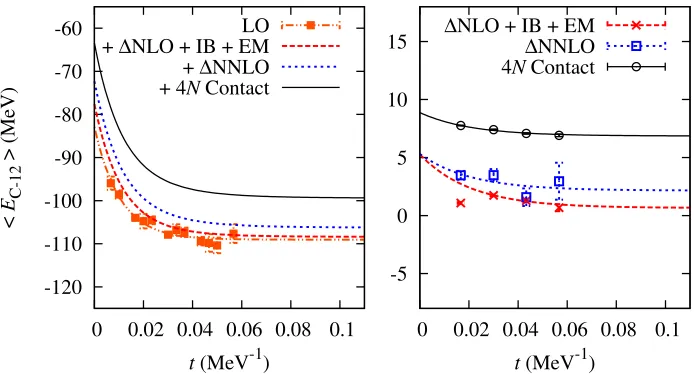
We show lattice results for the ground state of carbon-12 in a periodic box of length 13.8 fm in Fig. 9. Again the data in the plots show results for cD =1. Adding the effective four-nucleon contact contribution to the NNLO result, we obtain an energy of−99 MeV with an extrap-olation error of about 3 MeV. This is in good agreement with the physical value of−92.2 MeV. Extrapolation to infinite volume should move the calculated value upward and closer to the physical value. For each unit increase in cD, the energy decreases about 1.7 MeV without the four-nucleon contact interaction and about 0.3 MeV with the effective 4N contact interaction.
The results for lithium-6 and carbon-12 support the universality hypothesis regarding higher-order interactions. More significantly the accuracy of these lattice calculations are competitive with the most accurate calculations obtain using other ab initio methods. Future lattice studies should look at decreasing the lattice spacing as well as probing large volumes. The computational scaling with the num-ber of nucleons suggests that systems for larger nuclei are also possible.
8 Summary
We have presented several recent results for nuclear lattice simulations using chiral effective field theory. The method
appears numerically quite promising for few-body calcu-lations of nuclei and many-body calcucalcu-lations of neutron matter. At the same time, the method maintains a clear the-oretical connection to effective field theory. All systematic errors are introduced up front when defining the truncated low-energy effective theory. This eliminates approxima-tion errors tied with a specific calculaapproxima-tional tool, physical system, or observable. By including higher-order interac-tions in the low-energy effective theory, one can reasonably expect systematic and systemic improvement for all low-energy observables.
Acknowledgements
Partial financial support from the Deutsche Forschungs-gemeinschaft (SFB/TR 16), Helmholtz Association (con-tract number VH-NG-222 and VH-VI-231), and U.S. De-partment of Energy (DE-FG02-03ER41260) are acknowl-edged. This work was further supported by the EU Hadron-Physics2 project “Study of strongly interacting matter”. The computational resources for this project were provided by the J¨ulich Supercomputing Centre at the Forschungszen-trum J¨ulich.
References
1. H. M. M¨uller, S. E. Koonin, R. Seki, and U. van Kolck, Phys. Rev.C61, (2000) 044320.
2. D. Lee and T. Sch¨afer, Phys. Rev.C72, (2005) 024006. 3. D. Lee, B. Borasoy, and T. Sch¨afer, Phys. Rev.C70,
(2004) 014007.
-36 -34 -32 -30 -28 -26 -24 -22 -20
0 0.02 0.04 0.06 0.08 0.1
<
ELi-6
> (MeV)
t (MeV-1) LO + ∆NLO + IB + EM + ∆NNLO + 4N Contact
-4 -2 0 2 4 6 8
0 0.02 0.04 0.06 0.08 0.1
t (MeV-1)
∆NLO + IB + EM
∆NNLO
4N Contact
Fig. 8.Ground state energy for lithium-6 as a function of Euclidean time projection.
-120 -110 -100 -90 -80 -70 -60
0 0.02 0.04 0.06 0.08 0.1
<
EC-12
> (MeV)
t (MeV-1) LO + ∆NLO + IB + EM + ∆NNLO + 4N Contact
-5 0 5 10 15
0 0.02 0.04 0.06 0.08 0.1
t (MeV-1)
∆NLO + IB + EM
∆NNLO
4N Contact
Fig. 9.Ground state energy for carbon-12 as a function of Euclidean time projection.
6. T. Abe and R. Seki, Phys. Rev.C79, (2009) 054002. 7. T. Abe and R. Seki, Phys. Rev.C79, (2009) 054003. 8. B. Borasoy, H. Krebs, D. Lee, and U.-G. Meißner,
Nucl. Phys.A768, (2006) 179.
9. B. Borasoy, E. Epelbaum, H. Krebs, D. Lee, and U.-G. Meißner, Eur. Phys. J.A31, (2007) 105.
10. B. Borasoy, E. Epelbaum, H. Krebs, D. Lee, and U.-G. Meißner, Eur. Phys. J.A35, (2008) 343.
11. B. Borasoy, E. Epelbaum, H. Krebs, D. Lee, and U.-G. Meißner, Eur. Phys. J.A35, (2008) 357.
12. D. Lee, Prog. Part. Nucl. Phys.63, (2009) 117.
13. B. Borasoy, E. Epelbaum, H. Krebs, D. Lee, and U.-G. Meißner, Eur. Phys. J.A34, (2007) 185.
14. C. Ordonez and U. van Kolck, Phys. Lett. B291, (1992) 459.
15. C. Ordonez, L. Ray, and U. van Kolck, Phys. Rev. Lett. 72, (1994) 1982.
16. C. Ordonez, L. Ray, and U. van Kolck, Phys. Rev. C53, (1996) 2086.
Phys.A671, (2000) 295.
19. J. L. Friar and S. A. Coon, Phys. Rev.C49, (1994) 1272.
20. N. Kaiser, R. Brockmann, and W. Weise, Nucl. Phys. A625, (1997) 758.
21. E. Epelbaum, H. Krebs, D. Lee, and U.-G. Meißner, Eur. Phys. J.A40, (2009) 199.
22. D. Lee, Phys. Rev.C71, (2005) 044001.
23. J.-W. Chen, D. Lee, and T. Sch¨afer, Phys. Rev. Lett. 93, (2004) 242302.
24. D. Lee, Phys. Rev. Lett.98, (2007) 182501.
25. B. Friedman and V. R. Pandharipande, Nucl. Phys. A361, (1981) 502.
26. A. Akmal, V. R. Pandharipande, and D. G. Ravenhall, Phys. Rev.C58, (1998) 1804.
27. J. Carlson, J. Morales, J., V. R. Pandharipande, and D. G. Ravenhall, Phys. Rev.C68, (2003) 025802. 28. A. Schwenk and C. J. Pethick, Phys. Rev. Lett. 95,
(2005), 160401.
29. A. Gezerlis and J. Carlson, Phys. Rev. C77, (2008) 032801.
30. S. Gandolfi, A. Y. Illarionov, S. Fantoni, F. Ped-eriva, and K. E. Schmidt, Phys. Rev. Lett.101, (2008) 132501.
31. J. Fujita and H. Miyazawa, Prog. Theor. Phys. 17, (1957) 360.
32. B. H. J. McKellar and R. Rajaraman, Phys. Rev. Lett. 21, (1968) 450.
33. S.-N. Yang, Phys. Rev.C10, (1974) 2067.
34. S. A. Coon, M. D. Scadron, and B. R. Barrett, Nucl. Phys.A242, (1975) 467.
35. S. A. Coon et al., Nucl. Phys.A317, (1979) 242. 36. S. A. Coon and W. Gloeckle, Phys. Rev.C23, (1981)
1790.
37. J. Carlson, V. R. Pandharipande, and R. B. Wiringa, Nucl. Phys.A401, (1983) 59.
38. H. T. Coelho, T. K. Das, and M. R. Robilotta, Phys. Rev.C28, (1983) 1812.
39. B. S. Pudliner, V. R. Pandharipande, J. Carlson, S. C. Pieper, and R. B. Wiringa, Phys. Rev. C56, (1997) 1720.
40. S. Weinberg, Nucl. Phys.B363, (1991) 3. 41. U. van Kolck, Phys. Rev.C49, (1994) 2932.
42. J. L. Friar, D. Huber, and U. van Kolck, Phys. Rev. C59, (1999) 53.
43. E. Epelbaum, A. Nogga, W. Gl¨ockle, H. Kamada, U.-G. Meißner, and H. Witala, Phys. Rev.C66, (2002) 064001.
44. V. Bernard, N. Kaiser, and U.-G. Meißner, Int. J. Mod. Phys.E4, (1995) 193.
45. P. B¨uttiker and U.-G. Meißner, Nucl. Phys. A668, (2000) 97.
46. M. L¨uscher, Commun. Math. Phys.104, (1986) 177. 47. M. L¨uscher, Commun. Math. Phys.105, (1986) 153. 48. M. L¨uscher, Nucl. Phys.B354, (1991) 531.
49. E. Epelbaum, H. Krebs, D. Lee, and U. G. Meißner, Eur. Phys. J.A41, (2009) 125.
50. W. T. H. van Oers and J. D. Seagrave, Phys. Lett.B24, (1967) 562.
Lett.103, (2009) 102502.
52. U. van Kolck, J. L. Friar, and J. T. Goldman, Phys. Lett.B371, (1996) 169.
53. U. van Kolck, M. C. M. Rentmeester, J. L. Friar, J. T. Goldman, and J. J. de Swart, Phys. Rev. Lett. 80, (1998) 4386.
54. E. Epelbaum and U.-G. Meißner, Phys. Lett. B461, (1999) 287.
55. J. L. Friar, U. van Kolck, G. L. Payne, and S. A. Coon, Phys. Rev.C68, (2003) 024003.
56. E. Epelbaum and U.-G. Meißner, Phys. Rev. C72, (2005) 044001.
57. E. Epelbaum, H. Krebs, D. Lee, and U.-G. Meißner. 58. V. G. J. Stoks, R. A. M. Kompl, M. C. M. Rentmeester,
![Fig. 2. Ground state energy ratioFP 1981 [25], APR 1998 [26], CMPRsus Fermi momentum E0/Efree0for LO3 and NLO3 ver- kF](https://thumb-us.123doks.com/thumbv2/123dok_us/9035324.1439942/3.595.76.269.100.294/ground-state-energy-ratiofp-cmprsus-fermi-momentum-efree.webp)