Study of High Energy Emission from Relativistic Jets with VERITAS
R. Mukherjee1,afor the VERITAS Collaboration
1Department of Physics and Astronomy, Barnard College, Columbia University, NY 10027, USA
Abstract.VERITAS is an imaging atmospheric Cherenkov telescope array carrying out observations of the gamma-ray sky at energies above 100 GeV. Located in southern Arizona, VERITAS consists of an array of four telescopes, and carries out a comprehensive observing program for Galactic and extragalactic high energy sources. Observations of astrophysical objects in the TeV band are sensitive probes of highly energetic processes occurring in these sources. The majority of the extragalactic sources detected at TeV energies are active galaxies of the blazar class, sources where we view the jet nearly along its axis. In this report we present recent results from the VERITAS extragalactic program, focusing on blazars.
1 Introduction: VERITAS
VERITAS (Very Energetic Radiation Imaging Telescope Array System) is an imaging atmospheric Cherenkov tele-scope array: it detects Cherenkov radiation from ener-getic particles, produced by the interaction of a gamma-ray primary in the atmosphere, using large optical reflec-tors on the ground. VERITAS operates at the base camp of the Fred Lawrence Whipple Observatory (FLWO) in southern Arizona. There are four 12m-diameter telescopes of Davies-Cotton design in the VERITAS array, with a camera comprising 499 photomultiplier tubes (PMTs) ar-ranged in a hexagonal pattern, at the focal plane of each telescope. The total field of view has a diameter of 3.5◦. Gamma-rays interact in the Earth’s atmosphere
be-fore reaching the ground, producing electromagnetic cas-cades of relativistic electron-positron pairs which gener-ate short-lived but bright flashes of Cherenkov radiation. Cosmic rays, the principal source of background, also produce showers of charged particles and Cherenkov ra-diation but at a rate much higher than that of gamma-ray showers. Imaging Atmospheric Cherenkov Telescopes (IACTs) such as VERITAS utilize the Cherenkov light emitted from these air showers to form an image of the longitudinal development of the air shower on the camera-plane. The use of the four VERITAS telescopes in com-bination helps to increase the collection area and obtain a stereoscopic image of the particle showers to reduce cos-mic ray background. VERITAS has a sensitive energy range from 85 GeV to 30 TeV and an angular resolution of<0◦.1 at 1 TeV. Spectral reconstruction begins at∼150
GeV with an energy resolution∼15% - 20%. Figure 1 is a photograph of the VERITAS observatory, showing the ar-ray of four telescopes. Details of the VERITAS telescopes are provided elsewhere [1]. Observations performed with VERITAS have led and will continue to lead to significant
ae-mail: [email protected]
Figure 1. The four VERITAS telescopes located at the base camp of the Whipple Observatory in southern Arizona.
progress in our understanding of the accelerators of very high energy particles in the universe.
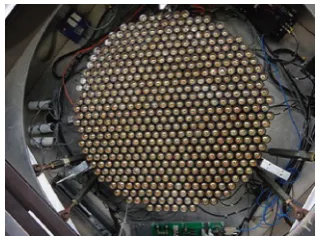
VERITAS started four-telescope operations in 2007, and typically collects more than∼1100 hours of data per year (including∼200 hours data taken in moderate moon-light). A 30% improvement in sensitivity was achieved in 2009 when one of the telescopes was relocated to provide a more symmetric array layout, and a new alignment sys-tem was used which improved the instrument point spread function [2]. In this new telescope arrangement, VERI-TAS is able to detect a source with a Crab Nebula-like spectrum and a flux of 1% Crab Nebula strength in about 25 hours. In the summer of 2012 the VERITAS cameras were replaced with new high-quantum efficiency (hQE, QE >32%) photomultiplier tubes [3] that increased the photon detection efficiency of each camera by approxi-mately 50%. This is part of a series of upgrades and im-provements that have been implemented on the VERITAS observatory since 2007 (see [4] for details on the gamma-ray detection sensitivity of the upgraded VERITAS obser-vatory). Figure 2 is a photograph of one of the VERITAS cameras showing the new hQE PMTs.
VERITAS is normally operated using the full four-telescope array. A multi-level trigger system is employed C
Owned by the authors, published by EDP Sciences, 2013
Figure 2.Photograph of one of the VERITAS cameras showing the new hQE PMTs (July 2012).
Figure 3.The VERITAS sky map of detected sources as of May 2013, in Galactic coordinates. The shaded area shows the region of visibility for VERITAS above 50 degree elevation. The ma-jority of the detected sources offthe Galactic plane are blazars (shown in red).
to eliminate background noise – at the array-level, a trig-ger requires simultaneous Cherenkov images in at least two telescopes, within a 50 ns time window, which then causes a readout of the 500 MSample/s Flash-ADC data acquisition system for each pixel [5]. To date VERITAS has detected 46 Galactic and extragalactic sources, includ-ing blazars, pulsar wind nebulae (PWNe), supernova rem-nants (SNR), binary systems, a starburst galaxy and the Crab Pulsar. Figure 3 shows all sources detected by VER-ITAS, in a galactic projection. In this article, we review some of the results from VERITAS focusing on blazars and extragalactic sources.
2 Extragalactic TeV Gamma-ray Sources
detected by VERITAS
The majority of the extragalactic sources detected by VERITAS are active galaxies of the blazar class. Active galactic nuclei (AGN) are cores of galaxies believed to contain supermassive black holes (SMBHs) accreting mat-ter and generating non-thermal emission which often out-shines the host galaxy. Relativistic jets are extremely pow-erful outflows of collimated plasma that appear in active galactic nuclei. In addition to AGN, relativistic jets also
Source Name Class Redshift
(Extragalactic) z
Mrk 421 HBL 0.030
Mrk 501 HBL 0.034
1ES 2344+514 HBL 0.044
1ES 1959+650 HBL 0.047
1ES 1727+501 HBL 0.055
BL Lacertae LBL 0.069
W Comae IBL 0.102
VER J0521+211 IBL/HBL 0.108
RGB J0710+591 HBL 0.125
H 1426+428 HBL 0.129
B2 1215+303 IBL/HBL 0.130?
1ES 0806+524 HBL 0.138
1ES 0229+200 HBL 0.140
1ES 1440+122 IBL/HBL 0.162
RX J0648.7+1516 HBL 0.179
1ES 1218+304 HBL 0.182
RBS 0413 HBL 0.190
1ES 1011+496 HBL 0.212
1ES 0414+009 HBL 0.287
1ES 0502+675 HBL 0.341?
1ES 0647+250 HBL ∼0.45
PG 1553+113 HBL 0.43<z<0.47
3C 66A IBL 0.444?
PKS 1424+240 IBL/HBL >0.6035
M87 FR I 0.0044
M82 Starburst 3.9 Mpc
Table 1: Extragalactic sources of TeV gamma-ray emission detected by VERITAS. Some redshifts are considered uncertain.
appear in stellar-mass black holes in X-ray binaries and GRBs. They are scaled-down versions of the jets seen in AGN. The observed similarity (in morphology and spec-trum) of jets from black holes of different mass suggests that they share a common physical origin. VHE observa-tions of AGN provide the opportunity to explore a large range of scientific topics, such as the study of the proper-ties of SMBHs and their environments, indirect studies of the central engine and particle acceleration in relativistic jets. Open questions in AGN physics include the nature of particle acceleration and emission in jets, the structure and composition of jets, and with broad band blazar ob-servations, we wish to constrain models of jet formation, acceleration, and collimation. Blazars are the best extra-galactic probes of the extraextra-galactic background light via their interaction with TeV photons traveling cosmologi-cal distances. Blazar observations have also been used to constrain the weak intergalactic magnetic fields (IGMF) (e.g. [6]), and test the validity of the Lorentz Invariance principle at high energies [7]. Blazars observations form a large part of the VERITAS program which includes a combination of planned blazar observations as part of a key science plan, long term monitoring of certain blazars, a discovery program for detecting new TeV blazars, and target-of-opportunity observations for flaring sources.
sources. A large fraction of the sources are high frequency peaked objects (HBLs), in which the peaks in the spectral energy distribution (SED) lie in the X-ray and TeV bands. In fact, the TeV blazar population is largely dominated by high-frequency peaked BL Lacs, but also includes low fre-quency peaked objects, flat spectrum radio quasars, and radio galaxies. In HBL objects, strongly correlated TeV and X-ray emission has been observed on many occasions, lending support to models in which the low-energy peak is explained by synchrotron emission from a population of ultra relativistic electrons, and the high-energy peak arises from inverse-Compton scattering of the synchrotron pho-tons by the same population of electrons. Given better sensitivities than earlier imaging atmospheric Cherenkov telescopes, low synchrotron peaked blazars are becoming more common in TeV catalogs and several such sources are on the VERITAS blazar list. Typically, such blazars are detected mostly during flaring episodes/high flux states. Figure 4 shows a sky map of three blazars detected by VERITAS in the same field of view, illustrating the ca-pability of VERITAS to detect faint gamma-ray sources at only a few percent of the Crab Nebula flux [8]. The three blazars shown in the figure are: W Comae, the first IBL detected at TeV energies [9], the HBL 1ES 1218+304 [10] and B2 1215+30 [11]. The blazars detected by VERITAS are predominantly nearby, with the range of red shifts from 0.03 to at least 0.60 with the upper limit coming from the recently discovered redshift of PKS 1424+240 (0.6035) [12]. In the following we describe five particular results from VERITAS. A more complete review of the VERITAS blazar program may be found in some recent publications ([13], [14]).
Radio Galaxy M 87: Among non-blazar extragalactic
sources, the giant radio galaxy M 87 provides an unique opportunity to study VHE emission in close proximity to a super-massive black hole. M 87 is one of only four known VHE AGN with weak-to-moderate beaming; the other three are the radio galaxies Cen A, IC 310, and NGC 1275. The source has exhibited three distinct VHE flares with similarities in the VHE behaviour, but no unique multi-wavelength correlation. Figure 5a shows the mul-tiwavelength light curves of M 87 over ten years of obser-vations [15]. The exact location of the VHE gamma-ray-emitting region in M 87 remains elusive. 43 GHz VLBA radio observations of the inner jet regions indicate no in-creased flux in 2010 [16], unlike the observations in 2008 where the VHE flare coincided with an enhancement of the radio flux of the innermost core regions. A flare in M87 in 2010 was jointly observed at VHE energies by VERITAS, MAGIC [17] and H.E.S.S. [18] and triggered an exten-sive multiwavelength campaign at lower energies. Figure 5b shows results from the coordinated observation with VERITAS, H.E.S.S., and MAGIC during the bright VHE flare in 2010 [15]. This TeV flare was very well sampled, and the light curve shows a single isolated flare character-ized by two-sided exponential decayτrise ∼1.7 days and
τdecay ∼0.6 days. Such day-scale variability is rarely seen in weakly-beamed sources.
Figure 4. Significance map showing three blazars in a single VERITAS field of view. 1ES 1218+304 (upper left) is an HBL, while 1ES 1215+303 (upper right) and W Comae are lower-frequency- peaked BL Lacs. The color scale (shown on the right) gives the significance of detection. Note that the apparent exten-sions of the sources are due to saturation on the color scale; each blazar actually appears point-like at TeV energies. (Figure from [8]).
BL Lacertae: A recent highlight from VERITAS is the
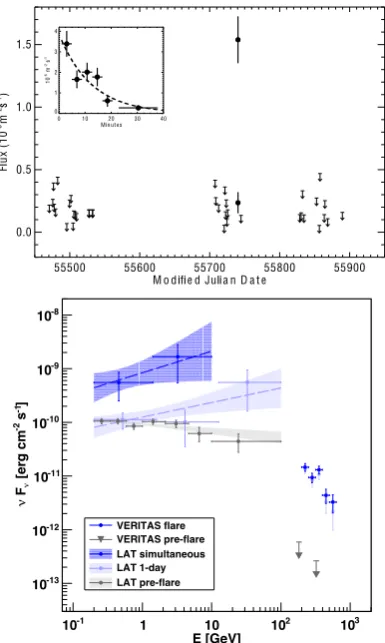
detection of the eponymous blazar BL Lac during a very bright, short-lived flare in 2011 June, the first detection of minute-scale variability in a low-frequency peaked BL Lac. The source is at a redshift of 0.069 and VHE emis-sion from the source was discovered by MAGIC in 2005. VERITAS measured a flux of ∼125% of the Crab Neb-ula flux (> 200 GeV) during the flare, and a gamma-ray spectral index ofΓ =3.8±0.3. Although the rising edge of the flare was not observed, during the short exposure of
∼35 min, the flux was found to decay by factor of∼3 in
Time (MJD) -0.50.50
1 1.52 2.53 3.5
ΦVHE
(
10
−
11 cm
−
2 s
−
1) H.E.S.S.
MAGIC VERITAS
2001 2002 2003 2004 2005 2006 2007 2008 2009 2010 2011
Year 01 2 3 4 5
ΦHE
(
10
−
9 cm
−
2 s
−
1) Fermi-LAT
0.00.2 0.4 0.60.8 1.0 1.2 1.4
ΦX−ra
y
(k
eV
/s) Chandra - core
0 2 4 6 8 10 12
ΦX−ra
y
(k
eV
/s) Chandra - HST-1
0.00.2 0.4 0.60.8
ΦUV/O
(m
Jy)
HST STIS/F25QTZ - core HST ACS/F220W - core HST ACS/F250W - core HST STIS/F25QTZ - HST-1 HST ACS/F220W - HST-1 HST ACS/F250W - HST-1
LT - (core + HST-1) / 10
0.00.5 1.0 1.5 2.0
ΦRad
io
(J
y)
VLBA 43 GHz - 1.2mas VLBA 43 GHz - peak VLBA 43 GHz - jet
1.0 1.5 2.0 2.5 3.0 3.5
ΦRad
io
(J
y)
VLA 22GHz - core VLA 15GHz - core MOJAVE 15GHz - peak EVN 5GHz - core VLBA 2.3GHz - core VLBA 1.7GHz - core
52000 52500 53000 53500 54000 54500 55000 55500 MJD 0.00 0.05 0.10 0.15 0.20 0.25 0.30 0.35 0.40
ΦRad
io
(J
y)
VLA 22GHz - HST-1 x 4.6 VLA 15GHz - HST-1 x 3.7 EVN 5GHz - HST-1 x 1.9 VLBA 2.3GHz - HST-1 x 1.2 VLBA 1.7GHz - HST-1 x 1.0
55275 55280 55285 55290 55295 55300 55305 55310 Time (MJD) -0.5 0 0.5 1 1.5 2 2.5 3 3.5 ΦVH E ( 10 −
11 cm
−
2 s
− 1) 2010 H.E.S.S. MAGIC VERITAS Fit: Φ0e−|t−t0|/∆tr/d
Figure 5. (a) (Top) Multiwavelength light curve of M 87 for a ten year period. The top panel shows the VHE gamma-ray flux calculated above an energy threshold of 350 GeV, as detected by VERITAS, MAGIC and H.E.S.S. For details on the data analysis and references see [15]. (b) (Bottom) A bright VHE flare in M 87 in 2010 recorded by VERITAS in a joint campaign with MAGIC and H.E.S.S., showing a variability timescale of∼1 day. The solid curve is the results of the fit of an exponential function to the data. (Both figures are from [15]).
100 GeV range. The LAT data show evidence for spectral hardening during the VERITAS flare.
VER J0521+211: The discovery of VER J0521+211
by VERITAS is an example of successfully finding new blazars behind the Galactic plane with the help of aFermi -LAT trigger. A number of unidentifiedFermisources are expected to be blazars behind the Galactic plane. The characterization of blazars at low galactic latitudes is a difficult task because of optical extinction and the diffuse Galactic gamma-ray background. VHE telescopes such
0 10 20 30 40
Minut es
0 1 2 3 4 10
-6 m -2 s
-1
55500 55600 55700 55800 55900 M o difie d Julia n D a t e
0.0 0.5 1.0 1.5
F l ux ( 10 -6m -2s -1) E [GeV] -1
10 1 10 102 103
]
-1
s
-2
[erg cm!
F ! -13 10 -12 10 -11 10 -10 10 -9 10 -8 10 VERITAS flare VERITAS pre-flare LAT simultaneous LAT 1-day LAT pre-flare
Figure 6.(a) (Top) VERITAS lightcurve of BL Lac in June 2011 (> 200 GeV). The inset shows the day scale variability in BL Lac. For details see [19]. (b) (Bottom) Broadband gamma-ray spectrum of BL Lacertae. For VERITAS, the flare spectrum with EBL correction is shown as blue points, with uncertainties, and the spectrum without EBL correction is shown as lighter blue points. TheFermi-LAT data shows hardening of the spectrum during the flare. (Both figures are taken from [19]).
mea-IC 443
3C 66A
RBS 0413
1ES 1218+304
VER J0521+211
Crab Vela X 1ES 1011+496
1ES 2344+514
RGB J0136+391 MAGIC J2001+435 1ES 0502+675
RX J0852.0-4622
PKS 0447-439 PKS 1424+240
PG 1553+113
PKS 2005-489
PKS 2155-304 Mrk 501 S5 0716+714
1ES 0033+595 1ES 1959+650
Mrk 421
/ Hz) ν log (
8 10 12 14 16 18 20 22 24 26 28
)
-1
s
-2
/ erg cmν
F
ν
log (
-15 -14 -13 -12 -11 -10
0.01
±
= 0.16 r
α
VERITAS Oct 22-30 VERITAS Nov 27 LAT Oct 22-Jan 16 XRT Oct 27-30 XRT Nov 27 MDM Oct 27 Archival data log (E / eV)
-6 -4 -2 0 2 4 6 8 10 12 14
-15 -14 -13 -12 -11 -10
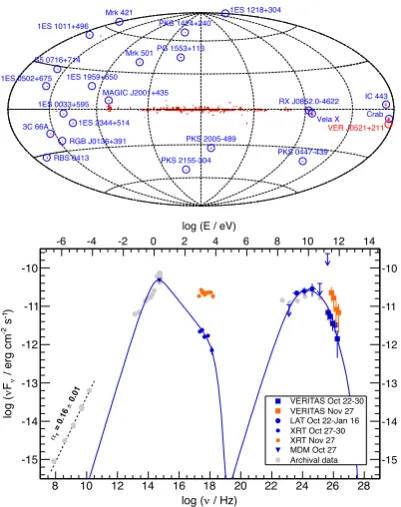
Figure 7. (a) (Top) Map in Galactic coordinates showing the arrival directions of all diffuse class photon events with zenith angle<105◦
recorded byFermi-LAT in the first year of obser-vations between 2008 Aug 4 and 2009 Aug 25, with energies greater than 30 GeV [21]. (b) (Bottom) Broadband spectral en-ergy distribution of VER J0521+211 during the VERITAS de-tection in 2009. The orange markers correspond to the flare data. The solid blue curve represents a one-zone SSC emission model with parameters adjusted to describe the low-state data. For de-tails on the broadband data and modeling results, see [21]. Both figures are taken from [21].
surements during a “low” state (2009 October) suggest that VER J0521+211 has synchrotron properties similar to those of the known IBLs, although the synchrotron com-ponent shows HBL-like properties during the X-ray and TeV flare of 2009 November. A simple one-zone lep-tonic relativistic jet model which calculates the emission as synchrotron self-Compton radiation indicates a particle-dominated jet with a bulk Lorentz factor of 30, requiring a relatively weak magnetic field of∼0.01 G.
Mrk 421: The well-known blazar Mrk 421 was the first
VHE-detected extragalactic source and is typically the brightest blazar in the VHE band. The source is a sub-ject of the VERITAS long-term blazar monitoring program and major flares were detected in 2008 and 2010 [22]. These initiated large multi-wavelength campaigns. Multi-ple outbursts have been observed to reach∼10 times Crab Nebula flux, allowing for studies with a high signal-to-noise ratio. In 2010 February VERITAS detected a strong, long-duration flare at ∼ 8 Crab Nebula flux units when the gamma-ray flux was characterized in two-minute time bins. Recently in 2013 April, flaring was detected in the source during a multi-wavelength campaign with NuSTAR [23] and Swift [24], and the TeV flux was high over
sev-eral nights, with strong intra-night variability. Analysis of this data set is underway.
1ES 0647+250 and 1ES 1011+496: Both these blazars
were detected by VERITAS after the camera upgrade in 2012 and during observations carried out in partial moon-light [13]. VERITAS observations confirmed the prior dis-covery of these blazars as TeV sources by MAGIC. 1ES 0647+250 was a promising VHE target based on its hard spectrum seen in theFermi-LAT data. VERITAS observa-tions yielded a detection at 2.9% of the Crab Nebula flux (> 140 GeV). In the case of 1ES 1011+496, VERITAS observed a flux∼6.3% Crab Nebula flux above 150 GeV.
Summary
This article presents a brief summary of the VERITAS results on blazars from the past four years of observations. The population of VHE blazars detected by VERITAS is growing and VERITAS is expected to continue operations with the upgraded instrument for at least another five years with a strong focus on blazar observations. In addition, VERITAS has a coordinated effort to collect multi-wavelength data on blazars. Long term monitoring of a sample of northern VHE blazars will help in the study of spectral and flux variability. The observational goals of VERITAS are to catch fast flares (to study the size of the emission region), measure the SEDs of the brightest blazars and increase sensitivity to weak sources (to study emission mechanisms in blazars), and detect new soft-spectrum sources that may be accessible with the upgraded camera (to increase the number count and carry out blazar population studies). Studies of relativis-tic jets in blazars will remain a high priority for VERITAS.
This research is supported by grants from the U.S. Department of Energy Office of Science, the U.S. National Science Foundation and the Smith-sonian Institution, by NSERC in Canada, by Science Foundation Ireland (SFI 10/RFP/AST2748) and by STFC in the U.K. We acknowledge the excellent work of the technical support staffat the Fred Lawrence Whip-ple Observatory and at the collaborating institutions in the construction and operation of the instrument.
References
[1] J. Holder, Proc. 32nd ICRC, Beijing, China (2011); arXiv:1111.1225.
[2] A. McCann et al.,Astroparticle Physics,32, 325 (2010). [3] A. N. Otte, Proc. 32nd ICRC, Beijing, China (2011);
arXiv:1110.4702.
[4] D. Kieda Proc. 33rd ICRC, Rio de Janeiro (2013); arXiv:1308.4849.
[5] J. Holder et al.,Astroparticle Physics,25, 391 (2006). [6] T. Arlen & V. V. Vasiliev, 2012 Fermi Symposium
proceed-ings, eConf C121028 (2012); arXiv:1303.2121.
[7] N. Otte et al., White paper submitted to Snowmass 2013, CF6 Cosmic Particles and Fundamental Physics (2013); arXiv:1305.0264.
[8] W. Benbow, Proc. 32nd ICRC, Beijing, China (2011); arXiv:1110.0038.
[10] V. A. Acciari et al.,ApJL,695, 1370 (2009). [11] T. Arlen et al.,ApJsubmitted.
[12] A. Furniss et al.,ApJL,768, 31 (2013).
[13] J. Dumm,Proc. 33rd ICRC, Rio de Janeiro, Brazil(2013); arXiv:1308.0287.
[14] W. Benbow, Proc. 32nd ICRC, Beijing, China (2011); arXiv:1110.0038.
[15] A. Abramowski et al.,ApJ,746, 151 (2012).
[16] V. A. Acciari, et al.,Science,325, 444 (2009). Also, VLBA: http://www.vlba.nrao.edu/.
[17] MAGIC: https://magic.mpp.mpg.de/.
[18] H.E.S.S.: http://www.mpi-hd.mpg.de/hfm/HESS/. [19] T. Arlen et al.,ApJ,762, 92 (2013).
[20] Fermi-LAT: http://www-glast.stanford.edu/.