39 | P a g e
HOME AUTOMATION THROUGH E-MAIL
Y Swetha
1, M Saritha
2 1Pursuing M.Tech (ES), Working as Assistant Professor
Visvesvaraya College of Engineering and Technology (VCET), M.P.Patelguda, Ibrahimpatnam,
RangaReddy, Telangana, (India)
ABSTRACT
The Home automation become more popular nowadays and refers to the application of the computer and new technology for control the domestic features and home appliances. In this paper we are introducing the new technology using Ethernet connection, the ARM7 based lpc2148 microcontroller used in this project. Whenever the person need to control the devices in the home the user need to send an email to the mail id assign to the Home system. Microcontroller is interface to the control devices and personal computer connected via serial port, the personal computer will have the Visual basic software and it is connected to the internet. When the user sent an email then the pc will receive that mail and forward to the microcontroller unit by using the vb software, the information received by the controller it will continue with the device switching operations.
Keywords:
Internet, Email, Visual Basic,and Micro Controller.
I.
INTRODUCTION
The popularity of network enabled home automation has been increasing greatly nowadays because of
simplicity and much higher affordability. Moreover, with the long expansion of the Internet technology, there is
increasing the demand for the remote control and monitoring of such network enabled appliances. However, the
new and exciting technologiesare increase the connectivity of devices within the home for the purpose of home
automation through internet are yet to be explored.
Home automation becomes to the application of computer and information technology for control of home
appliances and domestic features. The application varies from simple remote control of lighting to complex
computer/micro-controller based networks involving varying degrees of intelligence and automation. Home
automation system results in convenience, energy efficiency, expenses and safety benefits leading to improved
quality of life.Home automation is becoming more and more popular day by day due to its numerous
advantages. This paper aims at designing a basic home automation application on ARM7TDMI through reading
the subject of E-mail and the algorithm for the same has been developed in visual basic (VB) environment
which is the default programming created by the MICROSOFT. Results show the efficient implementation of
proposed algorithm for home automation.
In this paper we developing the home automation system through email by using ARM7TDMI here we are
interfacing the microcontroller with PC it consists of visual basic software and which is connected to the internet
connection. Visual basic is a programming language and development environment created by Microsoft, and
visual basic provides a graphical user interface GUI that allows the developer drag and drop objects in to the
40 | P a g e
Visual Basic is a Graphical user interface language, this means that a VB software will always show somethingon screen that the user can interact with to get a job done.
II.
LITERATURE
REVIEW
To implement the Home automation through email control system the study has done on different researches.
In the existing System the Home automation can be done by using the remote operating and sms based,but
nowadays the internet technology increasing rapidly so we have to concentrate on the controlling system using
Ethernet. In the previous system the home automation can be done in wireless communication only but the
distance will be limited by using the TSOP etc. and GSM based home automation system it also one of the
wireless communication system it can be useful for longer distances also.
The most important objective of the paper is to design and develop a Home automation systemthrough email for
home appliance and domestic features. In the proposed system we are implementing the arm7 based home
automation system using Ethernet. Here we are interfacing the controller with the devices to be controlled and
visual basic software through pc with the internet connection.
III.
HARDWARE
DESIGN
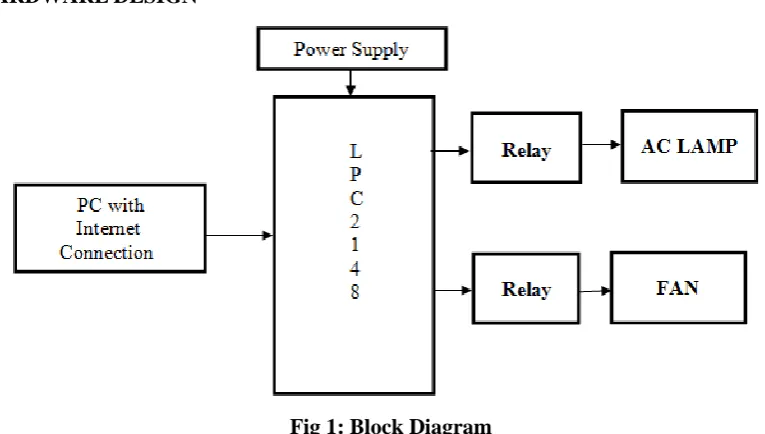
Fig 1: Block Diagram
The Home automation through Email using Ethernet technology consists of different hardware and software
modules. The following block diagram shows the overview of hardware components included in the system.
3.1 LPC2148 Microcontroller
The LPC2148 microcontroller board based on a bit/32-bit ARM7TDMI-S CPU with real-time emulation,
16-bit/32-bit ARM7TDMI-S microcontroller in a tiny LQFP64 package, 8 kB to 40 kB of on-chip static RAM and
32 kB to 512 kB of on-chip flash memory; 128-bit wide interface/accelerator enables high-speed 60 MHz
operation, In-System Programming/In-Application(ISP), Single 10-bit DAC provides variable analog output,
Two 32-bit timers/external event counters (with four capture and four compare channels each), PWM unit (six
outputs) and watchdog, Low power Real-Time Clock (RTC), Multiple serial interfaces including two UARTs
41 | P a g e
3.2 Relay
Relay is a device which provides connection between two or more points or device in response to the input
given to the relay.The other using of relay provide isolation between the controller and the device as we know
devices may work on AC as well as on DC. Thus therelay provides isolation between the controller and the
device it may work on AC as well as on DC. It will receive signals from microcontroller which works on DC
hence we require a relay to bridge gap. Relay is extremely useful when you need to control a large amount of
voltage or current with small electrical signal.
Relay working is simple, when power is applied to relay current start flowing through the control coil then the
electromagnetic starts energizing. It consists of threeHear points A, B, C are used as control points. When power
is supplied to input terminal due to electromagnetic effect, B and C are connected thus closes the contacts
causing a short circuit for the power to the load. If the relay was already de-energized when the contacts gets
closed, then the contact move opposite and make an open circuit.
3.3 AC LAMP
The incandescent light bulb is an electric light which produces light with a wire filamentheated to a high
temperature by an electric current passing through it, until it glows. The hot filament is protected from oxidation
with a glass or quartz bulb that is filled with inert gas or evacuated. In a halogen lamp, filament evaporation is
prevented by a chemical process that redeposits metal vapour onto the filament, extending its life.
3.4 Fan
The fan is a machine used to create flow within a fluid, typically a gas such as air. Fan consists of a rotating
arrangement of blades which act on the fluid. The rotating assembling of blades and hub is known as a rotor.
Usually, it is contained within the some form of housing or case. This may be direct the airflow or increase
safety by providing objects from contacting the fan blades. Most fans are powered by electric motors, but
different of power may be used, includinginternal combustion engines and hydraulic motors. Fans produce
flows with high volume and low pressure air flow, as opposed to compressors which produce high pressures at a
comparatively low volume.
IV.
SOFTWARE
DESIGN
In this proposed system, as we used LPC2148 we need to use following software tools to program for it.
1. Keil uVision
2. Flash Magic
3. Visual Basic
The Keil uVision is an IDE for Embedded C language. In this IDE, we need to import the utilities and libraries
according to the controller we are using. This IDE is very simpler and in user friendly manner to use. It includes
all the C/C++ compilers, assemblers, and debuggers in it. It simplifies the process of embedded simulation and
testing along with Hex file generation.
The flash magic is a programming utility. The C/C++ program written in IDE will be processed into Hex file i.e.
42 | P a g e
The visual basic is a high level programming language it is evolved from the earlier disk operating systemversion called basic. Basic means the all beginners usesymbolic instruction code. It is easy programming
language to learn. Visual Basic is a tool that allows you to develop Windows (Graphic User Interface - GUI)
applications. The applications have a familiar appearance to the user.
V.
WORKING
DESCRIPTION
The project will starts from when powered up to the microcontroller and pc, thecontroller wait for the email
and pc also whenever the email is received by the pc it will be forward to the controller through vb, according to
the instruction received by the user the controller will configures the device operation. The pc will connect to the
internet connection then the email will be received by the vb will be perfect and according to the configuration of
the controller developed by the developer then the devices which are connected to the controller get controlled.
VI.
RESULTS
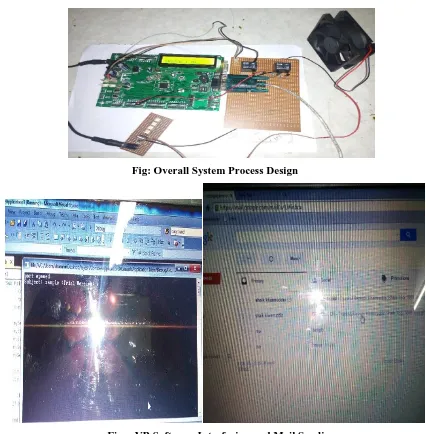
Fig: Overall System Process Design
43 | P a g e
VII.
CONCLUSION
In this computation world, where directly or indirectly everything is dependent on computation and information
technology. This paper discuss with a basic application of home automation using ARM 7 processor which can
be easily implemented and used efficiently. The code provided by the application is generic and flexible in a
user friendly manner and can be extended for any future applications like power control, surveillance, etc. and
also this technique is better than other home automation methods is several ways. For example, home
automation through DTMF, the call tariff become huge disadvantage, which is not the case in proposed method.
Also, in Web server based home automation, the design of server application and the placement is eliminated by
this method, because it simply uses the already existing web server application provided by theG-mail.
After the code is Programmed in to the controller and powered up then the pc and controller waits for the
message and execute the code by operating devices which are connected to the controllerand according to the
configuration the device performs its operation and here we are developing a conventional system for the
Efficient usage of the home and offices and for the emergency conditions.
REFERENCES
[1]. AI-Ali A. R. and AI-Rousan M., "Java-based home automation system",IEEE Transactions on Consumer
Electronics,vol. 50, no. 2,pp. 498- 504,2004.
[2]. Ali M., V laskamp J.H.A, Eddiny N.N. , Falconer B. and Oram c., "Technical Development and
Socioeconomic Implications of the Raspberry Pi as a Learning Tool in Developing Countries", 5th
Computer Science and Electronic Engineering Conference (CEEC),pp. 103- 108,2013.
[3]. Ardam H. and Coskun I., "A remote controller for home and office appliances by telephone", IEEE
Transactions on Consumer Electronics,vol. 44,no. 4,pp. 1291-1297,1998
[4]. Baudel T. and Beaudouin-Lafon M., "Charade: remote control of objects using free-hand gestures",
Communications of the ACM, vol. 36,no. 7,pp. 28-35,1993.
[5]. Bromley K., Perry M., and Webb G. "Trends in Smart Home Systems Connectivity and Services",
www.nextwave.org.uk,2003
[6]. Kushiro N. Suzuki S., Nakata M., Takahara H. and Inoue M., "Integrated home gateway controller for
home energy management system", IEEE International Conference on Consumer Electronics,pp.
386-387,2003.
[7]. Ok S. and Park H, "Implementation of initial provisioning function for home gateway based on open
service gateway initiative platform", The 8th International Conference on Advanced Communication
Technology,pp. 1517-1520,2006.
[8]. Saito T., Tomoda I., Takabatake Y., Ami J. and Teramoto K., "Home Gateway Architecture And Its
Implementation", IEEE International Conference on Consumer Electronics, pp. 194-195,2000.
[9]. Sriskanthan N. ,Tan F. and Karande A. , "Bluetooth based home automation system", Microprocessors
and Microsystems,Vol. 26,no. 6,pp. 281-289, 2002.
44 | P a g e
[10]. YoonD BaeD Ko H. and Kim H., "Implementation of Home Gateway and GUI for Control the HomeAppliance", The 9th International Conference on Advanced Communication Technology,pp. 1583-1586,
2007.
AUTHOR DETAILS
Y SWETHA, Pursuing Mtech (ES) from Visvesvaraya College of Engineering and
Technology (VCET), M.P.Patelguda, Ibrahimpatnam, RangaReddy, Telangana,
INDIA.Her area of interest includes embedded systems interrelated with different types
of microcontrollers.
M SARITHA,working as Assistant Professor from Visvesvaraya College of
Engineering and Technology (VCET), M.P.Patelguda,Ibrahimpatnam, RangaReddy.She