www.orientjchem.org
An International Open Free Access, Peer Reviewed Research Journal
2016, Vol. 32, No. (4): Pg. 1823-1829
Electrodeposition of Platinum Nanoparticles on Polyaniline
Modified Electrode and its Electrocatalytic Activity towards
the Oxidation of Methanol
ALI PARSA*, SEYEd AMIR MIRSHAFIEYAN, AzAdEH SHAkERI
and SARA AMANzAdEH-SALOUT
Department of Chemistry, College of Science, Yadegar -e- Imam Khomeini (RAH) Shahre-rey Branch, Islamic Azad University, Tehran, Iran.
*Corresponding author E-mail: [email protected] http://dx.doi.org/10.13005/ojc/320410 (Received: June 10, 2016; Accepted: July 17, 2016)
ABSTRACT
In this research, we reported the electrosynthesis of platinum nanoparticles on Polyaniline (PAni) modified electrode. The modified electrodes were prepared by incorporation of aniline and platinum salt [H2 (PtCl6), 6H2O] in phosphoric acid medium with KCl solution on composite
graphite (CG) surface via cyclic voltammetry (CV) method. The synthesized platinum nanoparticles were characterized by using scanning electronic microscopy (SEM) and energy dispersive X-ray spectroscopy (EDX). The electro oxidation of methanol was investigated at the surface of these modified electrodes using CV method. It was found that methanol was oxidized with platinum embedded on the surface of PAni modified electrodes during the anodic potential sweep. Moreover, several impact factors such as scan rate, potential and concentration of methanol were studied on the oxidation of methanol toward electrosynthesized electrodes.
keyword: Electrodeposition; Electrocatalytic oxidation;
Platinum nanoparticle; Methanol; Polyaniline.
INTROdUCTION
More demand for applying conducting polymers has led to improve the technology of synthesis them as the materials with wide applications. A thin film of conducting polymer on the electrode may improve the electro-catalytic activity and so, it may be increased1-6. The conducting
during the electrochemical oxidation of alcohols on Pt surface 7. PAni is one of the most extensively
studied conducting polymers due to its easy synthesis, high conductivity, environmental stability and reversible redox catalytic properties 8-15. The
energy from the combustion of hydrogen or organic compounds, than other sources 20-22. Up to know,
Pt is a good catalyst for methanol oxidation, but, because of the poisoning by CO absorption it has low stability. Some research was accomplished to study of CO adsorption and Methanol oxidation on Pt electrodes modified by electrodeposition of PAni film 23-25. In those researches PAni is specified as
the context for electro oxidation of hydrogen and methanol by applying the metal catalysts because of increasing the catalytic area for incorporating the metallic particles 26-28. The PAni/Pt nanoparticles
electrode has exhibited excellent catalytic activity for methanol oxidation in various mediums 27, 29-32. In this
research the Pt nanoparticles were electrodeposited on PAni/CG electrodes with the noble condition of synthesis (during and after the formation of PAni films in phosphoric acid medium and KCl supporting electrolyte), and the electrocatalytic oxidation of methanol on modified electrodes was investigated with the purpose of improving highly active sites of electrodes.
MATERIALS ANd METHOdS
Aniline (Merck, Germany) was distilled under low pressure in the atmosphere and liquid nitrogen at a temperature of 5 ºC until color was maintained. Methanol (MeOH) (BDH Chemicals, UK) was also in pure form. The hexachloro platinic (IV) acid hexahydrate [H2 (PtCl6) 6H2O] (Sigma Chemicals, USA), potassium chloride (KCl) (Fluka
Chemicals, Switzerland) and phosphoric acid (H3PO4) (Sigma Chemicals, USA) were used without purification.
Equipment
The electrochemical analysis for the synthesis and characterization of nano-composite electrodes was carried out by a potentiostat/ galvanostat compactstat (Ivium Technologies, Netherlands). SEM, model VEGA Corporation (TESCAN) Czechoslovakia equipped with EDX detector has been used to investigate the morphology and size of the Pt nanoparticles on PAni modified electrodes. The composite 2B pencil graphite (CG) (o.d. 1.8 mm) (Staedtler Lumograph, Germany) was used as working electrode against pseudo Ag/AgCl reference electrode.
Procedure
The electrochemical synthesis of PAni was done by 50 mM aniline in 10 mL of 1 M H3PO4 and 0.5 M KCl as a supporting electrolyte, on the working electrode (CG) by sweeping the potential continuously between -0.2 V to +1.00 V vs. Ag/AgCl with a scan rate of 100 mVs-1. Also the Pt particles
were incorporated by electrochemical deposition from a solution containing 0.01% wt. [H2 (PtCl6). 6H2O] in 1 M H3PO4 on working electrode.
RESULTS ANd dISCUSSIONS
Electrodeposition
Electrodeposition of PAni on CG (PAni/CG)
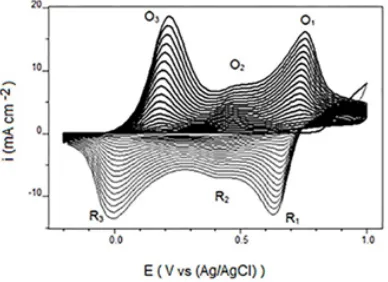
The cyclic voltammograms (CVs) for the deposition of PAni on CG electrode from the 50 mM
Fig. 1: CVs of 50 mM Ani in 1 M H3PO4 containing 0.5 M kCl on CG electrode.
The scan rate is 100 mVs-1
Fig. 2: SEM and EdX analysis of electrosynthesized PAni in 1 M H3PO4 containing 0.5 M kCl on CG electrode, (a) SEM
aniline in aqueous medium of 10 mL of 1 M H3PO4 and 0.5 M KCl is shown in Fig.1. The three pairs of redox peaks are the result of aniline configuration conversions observed in the potential range of -0.2 V to +1.0 V. The first pair of redox peaks denoted as O3/R3 corresponds to the interconversion of the completely PAni reduced form, leucoemeraldine (LE) state, to the half-oxidized emeraldine base (EB) state. The second pair of redox peaks denoted as O1/R1 is due to oxidation of EB to the completely oxidized pernigraniline (PN) state and vice-versa. The O2/ R2 peaks are attributed to oxidation of segments of PAni chain to benzoquinone (Bq) species, whose peak potentials are very close to one another and tend to disappear after several successive scans
33. Fig. 2a shows the surface morphology of PAni
film on CG electrode. In the EDX analysis (Fig. 2b) the existence of phosphate ions is shown. This confirms that the doping of aniline with phosphate during polymerization has occurred on the surface of graphite electrode.
Electrodeposition of Pt nanoparticles on PAni/ CG electrode (NPPt/PAni/CG)
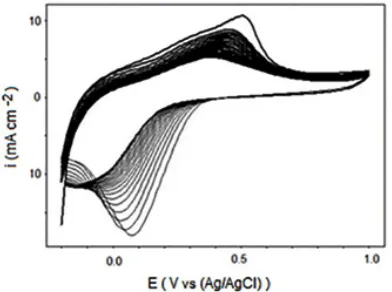
The Platinum nanopar ticles were incorporated by electrochemical deposition on PAni/CG electrode from H2PtCl6 6H2O solution (0.01% w/w) containing 1 M H3PO4 and 0.5 M KCl (Fig. 3). The CVs reveal one pair of redox peaks that represent the electrodeposition of Pt(IV) to metallic Pt on the surface of PAni/CG film in accordance with reaction (1) 27.
PtCl6 -2 + 4e - → Pt + 6Cl - ...(1)
Fig. 4a shows a fully homogenized surface of electrode. This confirms that distribution of Pt on PAni film is completely uniform. Also it shows the Pt nanoparticles on the PAni/CG electrode (Fig. 4b). EDX spectrum confirms the uniform presence of Pt nanoparticles on the surface of electrode (Fig. 4c).
Simultaneous electrodeposition of Pt and PAni on CG (Pt-PAni/CG)
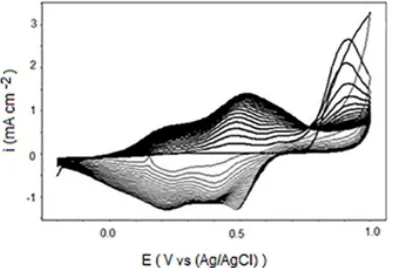
The platinum nanoparticles and PAni were, simultaneously, electrodeposited on CG from a solution of H2PtCl6 6H2O (0.01% w/w), 50 mM aniline, 1 M H3PO4 and 0.5 M KCl. As shown in Fig. 5 the CVs have two redox peaks. In this case, it is seen that PAni is in the conducting emeraldine salt (ES) form which undergoes the oxidation to the PN form, providing electrons for the reduction of PtCl6 -2
to metallic Pt.
Fig. 6a and b shows that, spherical Pt is in context with PAni after the simultaneous deposition. As compared to NPPt/PAni/CG, the distribution and dispersal is less. The absence of Pt in depth of 4 microns was confirmed by EDX analysis (Fig. 6c). As is evident the nanostructure can be changed with monomer displacement, i.e., the conductivity of PAni
Fig. 3: The cyclic voltammogram obtained during electrodeposition of Pt nanoparticles on (PAni/CG) electrode in 1 M H3PO4 containing
Fig. 4. SEM and EdX analysis of Pt nanoparticles on modified (NPPt/PAni/CG) electrode in 1 M H3PO4 containing 0.5 M kCl.
(a) and (b) SEM image of (NPPt/PAni/CG) electrode at different magnifications (c) EdX
Fig. 5: Cyclic voltammogram of Simultaneous electrosynthesis of Pt nanoparticles and PAni at on CG electrode in a solution of 1 M H3PO4 containing 0.5 M kCl, H2PtCl6 6H2O (0.01% w/w)
and 50 mM aniline. The scan rate is 100 mVs-1
Fig. 6: SEM and EdX analysis of Pt nanoparticles on modified (Pt-PAni/CG) electrode in 1 M H3PO4 containing 0.5 M kCl. (a) and (b) SEM image of (Pt-PAni/CG) electrode at different magnifications (c) EdX
analysis of (Pt-PAni/CG) electrode
Fig. 7: CVs of, (a) (Pt-PAni/CG) and (b), (NPPt/ PAni/CG) electrodes in 1 M H3PO4 solution containing 0.5 M methanol at scan rate of 100 mVs-1. Inset: CV of unmodified CG electrode in
1 M H3PO4 solution and 0.5 M methanol at scan rate of 100 mVs-1
Fig. 8: CVs of (NPPt/PAni/CG) prepared in 1 M H3PO4 and 0.5 M methanol at different scan
rates (a) 20, (b) 60, (c) 100, (d) 200, (e) 400, (f) 600, (g) 800 mVs-1 in the potential range of -0.2
V to 1.0 V. Inset the calibration plot of current
vs. square root of scan rate
can play important role in doping and polymerizing of PAni with platinum ions. This result may also be attributed to the higher conductivity and faster charge transfer of PAni film in the intermediate oxidation state. It must be pointed out that the catalytic current is greatly in-creased with increase in the amount of deposited Pt 34.
Electrocatalytic oxidation of methanol
Fig. 7a and b shows the CVs of Pt-PAni/ CG and NPPt/PAni/CG electrodes in 1 M H3PO4
containing 0.5 M methanol at a scan rate of 100 mVs-1, respectively. The methanol oxidations of
Table 1: CVs data of (NPPt/PAni/CG) and (Pt-PAni/CG) electrode
Electrode Charge of max anodic H2 absorption peak current (Ipa)
(NPPt/PAni/CG) 3.14 mC /cm2 19.32 mA /cm2
(Pt-PAni/CG) 2.07 mC /cm2 10.09 mA /cm2
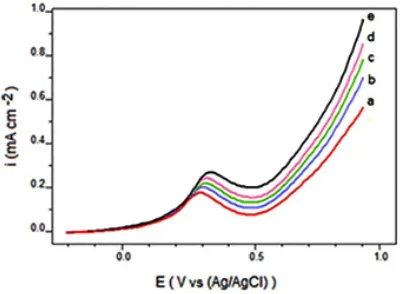
Fig. 9: LSVs of (NPPt/PAni/CG) prepared in 1 M H3PO4 with different concentration of methanol
(a) 0.5 M, (b) 1 M, (c) 2 M, (d) 3 M, (e) 4 M in potential range of -0.2 V to +1.0 V
electrochemical oxidation of methanol on Pt surface occurs in two steps 35. . The first step is methanol
dehydrogenation in which, methanol is oxidized to become adsorbed COads species. The second step is the removal of COads which proceeded via adsorbed OHads to produce CO2. The adsorbed OHads is produced from water dissociation process on Pt catalyst sites. The overall processes are summarized in reactions (below):
CH3OH → COads + 4H+ + 4e- ...(2)
H2O → OHads + H+ + e- ...(3)
OHads + COads→ CO2 + H+ + e- ...(4)
It is known that the integrated intensity of hydrogen absorption represents the number of Pt sites that are available for hydrogen adsorption and desorption 25. To calculate the charge required
for hydrogen absorption on the electrode surfaces, we assume that the double-layer charging current is constant over the whole potential range 36. The
charge required for hydrogen absorption on the NPPt/ PAni/CG surface is 3.14 mC cm-2 which is 1.5 times
larger than that required for hydrogen absorption on the Pt-PAni/CG surface (2.07mC cm-2), (Table
1). Comparing the CV results of NPPt/PAni/CG with Pt-PAni/CG electrodes, have indicated a significantly higher oxidation current toward methanol oxidation for the NPPt/PAni/CG electrode. For instance, in Table 1, the maximum anodic peak current densities (Ipa) for NPPt/PAni/CG and Pt-PAni/CG electrodes are 19.32 mA cm-2 and 10.09 mA cm-2, respectively. A
high surface area for Pt particles in NPPt/PAni/CG is anticipated due to the uniform distribution of Pt particles into PAni which can twist up to form a spatial 3D dimensional matrix. In addition to this, the -CO2H groups in NPPt/PAni/CG may act as a stabilizer for Pt particles, preventing their aggregation. The PAni/ CG matrix acts as a good bed for the deposition of Pt particles, and increases the density of the active sites on the electrode surface.
Effect of scan rate on the oxidation of methanol
Figure 8a to g shows the CVs of NPPt/ PAni/CG in 1M H3PO4 containing 0.5 M methanol at the various scan rates and in the potential range of -0.2V to 1.0 V. This indicates that, increasing the scan rate has led to increase the Ipa and cause to improve the methanol oxidation. In the lower scan rates, i.e. less than 200 mVs-1, two well define redox
peaks are observed. The first Ipa is produced due to the oxidation of freshly chemisorbed species coming from methanol adsorption. The second Ipa is primarily associated with the removal of carbonaceous species not completely oxidized in forward scan rather than caused by freshly chemisorbed species. In the higher scan rates (more than 200 mVs-1) there are three
oxidation peaks, the second and third in the reverse scan is additional, which is due to a combination processes such as surface rearrangement and increase of the heterogeneous non-faradaic reaction rate 37, 28, 38. The plot of I
p vs. square root
of scan rate (inset) is linear, which is indicates that the electrochemical process was under diffusion control
E f f e c t o f m e t h a n o l c o n c e n t r a t i o n o n electrocatalytic activity
observed at high concentration of methanol as shown by the increase of the oxidation peak current (Ipa).
CONCLUSION
The platinum nanopar ticles were successfully electrodeposited onto the surface of PAni/CG electrodes. The NPPt/PAni/CG electrode appeared to have well distribution and dispersal of Pt nanoparticles on the PAni film. The NPPt/PAni/CG electrode exhibited electrocatalytic activity toward methanol oxidation with a higher current density and
at lower onset potential. In view of results, the higher concentrations of methanol and higher scan rates of potential have also enhanced the methanol oxidation. According to the extensive studies in this filed, still further research can complement and corroborate these results.
ACkNOWLEdGEMENTS
This work is supported by the Islamic Azad University,Yadegar -e- Imam Khomeini (RAH) Shahre-rey Branch, Tehran, Iran for Research University (RU) grant -1395/1742:90/07/27
REFERENCES
1. Su, N. Nanoscale Res. Lett. 2015, 10, 1-9 . 2. Campbell, D. K. Synth. Met. 2001, 125,
117-128 .
3. Macdiarmid, A. G. Synth. Met. 1987, 21, 79-83 .
4. Wallace, G. G.; Smyth, M.; Zhao, H. TrAC, Trends Anal. Chem. 1999, 18, 245-251 . 5. Lange, U.; Roznyatovskaya, N. V.; Mirsky, V.
M. Anal. Chim. Acta. 2008, 614, 1-26 . 6. Morteza, E.; Roya, D. Orient. J. Chem. 2015,
31, 1185-1189 .
7. Serra, D.; McElwee-White, L. Inorg. Chim. Acta. 2008, 361, 3237-3246 .
8. MacDiarmid, A.; Chiang, J.; Richter, A.; Epstein, A. Synth. Met. 1987, 18, 285-290 . 9. MacDiarmid, A.; Yang, L.; Huang, W.;
Humphrey, B. Synth. Met. 1987, 18, 393-398.
10. Genies, E.; Boyle, A.; Lapkowski, M.; Tsintavis, C. Synth. Met. 1990, 36, 139-182 .
11. Luzny, W.; Banka, E.; Stochmal-Pomarzanska, E. X-Ray Investigations of Polymer Structures.
2000, 47-50 .
12. Æiriæ-Marjanoviæ, G. Synth. Met. 2013, 177, 1-47 .
13. Kajornkavinkul, S.; Punrat, E.; Siangproh, W.; Rodthongkum, N.; Praphairaksit, N.; Chailapakul, O. Talanta. 2016, 148, 655-660.
14. Ameen, S.; Shaheerakhtar, M. Orient. J. Chem. 2013, 29, 837-860 .
15. Udmale, V.; Mishr, D.; Gadhave, R.; Pinjare, D.; Yamgar, R. Orient. J. Chem. 2013, 29,
927-936 .
16. Han, Y.-K.; Chang, M.-Y.; Ho, K.-S.; Hsieh, T.-H.; Tsai, J.-L.; Huang, P.-C. Sol. Energy Mater. Sol. Cells. 2014, 128, 198-203 . 17. Farghali, A.; Moussa, M.; Khedr, M. J. Alloys
Compd. 2010, 499, 98-103 .
18. Abaci, S.; Nessark, B.; Boukherroub, R.; Lmimouni, K. Thin Solid Films. 2011, 519, 3596-3602 .
19. Lemos, H. G.; Santos, S. F.; Venancio, E. C.
Synth. Met. 2015, 203, 22-30 .
20. Andújar, J.; Segura, F. Renew Sust Energ Rev.
2009, 13, 2309-2322 .
21. Behling, N. H. Fuel Cells. 2013, 423-600 .
22. Sharma, R.; Kar, K. K. Electrochim. Acta.
2015, 156, 199-206 .
23. Wang, Z.; Gao, G.; Zhu, H.; Sun, Z.; Liu, H.; Zhao, X. Int. J. Hydrogen Energy. 2009, 34, 9334-9340 .
24. Yan, R.; Jin, B. Electrochim. Acta. 2014, 115, 449-453 .
25. Gyenge, E. PEM Fuel Cell Electrocatalysts and Catalyst Layers. 2008, 165-287 .
26. Lei, X.; Guo, X.; Zhang, L.; Wang, Y.; Su, Z. J. Appl. Polym. Sci. 2007, 103, 140-147 . 27. Sugano, Y.; Yoshikawa, H.; Saito, M.; Tamiya,
E. Electrochim. Acta. 2011, 56, 9875-9882 . 28. Stejskal, J.; Sapurina, I.; Trchová, M. Prog.
Polym. Sci. 2010, 35, 1420-1481 .
J. Power Sources. 2016, 303, 109-117 . 31. Wang, M.; Song, X.; Yang, Q.; Hua, H.; Dai,
S.; Hu, C.; Wei, D. J. Power Sources. 2015,
273, 624-630 .
32. Wang, Z.; Shi, G.; Zhang, F.; Xia, J.; Gui, R.; Yang, M.; Bi, S.; Xia, L.; Li, Y.; Xia, L.; Xia, Y.
Electrochim. Acta. 2015, 160, 288-295 . 33. Parsa, A.; Ab Ghani, S. Polymer. 2008, 49,
3702-3708 .
34. Cai, L.; Chen, H. J. Appl. Electrochem. 1998,
28, 161-166 .
35. Tripkoviæ, A. V.; Popoviæ, K. D.; Loviæ, J.; Jovanoviæ, V.; Kowal, A. J. Electroanal. Chem.
2004, 572, 119-128 .
36. Wu, T.-Y.; Li, W.-B.; Kuo, C.-W.; Chou, C.-F.; Liao, J.-W.; Chen, H.-R.; Tseng, C.-G.
International Journal of Electrochemical Science. 2013, 10720-10732 .
37. Singh, R.; Awasthi, R.; Tiwari, S. Open Catal. J. 2010, 3, 54-61 .
38. Prabakar, S. J. R.; Kim, Y.; Jeong, J.; Jeong, S.; Lah, M. S.; Pyo, M. Electrochim. Acta. 2016,