P ercep tu a l C entres in S p eech - An A cou stic A nalysis.
bySophie K erttu Scott
T h es is S u b m itte d fo r th e D e g re e o f D o c to r o f P h ilo so p h y U n iv e rs ity C o llege L o n d o n
All rights reserved
INFORMATION TO ALL USERS
The quality of this reproduction is dependent upon the quality of the copy submitted.
In the unlikely event that the author did not send a complete manuscript and there are missing pages, these will be noted. Also, if material had to be removed,
a note will indicate the deletion.
uest.
ProQuest 10016786
Published by ProQuest LLC(2016). Copyright of the Dissertation is held by the Author.
All rights reserved.
This work is protected against unauthorized copying under Title 17, United States Code. Microform Edition © ProQuest LLC.
ProQuest LLC
789 East Eisenhower Parkway P.O. Box 1346
Abstract
Perceptual centres, or P-centres, represent the perceptual moments of
occurrence of acoustic signals - the ‘beat’ of a sound. P-centres underlie the
perception and production of rhythm in perceptually regular speech sequences.
P-centres have been modelled both in speech and non speech (music)
domains. The three aims of this thesis were tdatest out current P-centre models
to determine which best accounted for the experimental datab)to identify a
candidate parameter to map P-centres onto (a local approach) as opposed to
the previous global models which rely upon the whole signal to determine the
P-centre(ÿhe final aim was to develop a model of P-centre location which could
be applied to speech and non speech signals. The first aim was investigated
by a series of experiments in which^speech from different speakers was
investigated to determine whether different models could account for variation
between speakers (^whether rendering the amplitude time plot of a speech
signal affects the P-centre of the signalc^whether increasing the amplitude at the
offset of a speech signal alters P-centres in the production and perception of
speech. The second aim was carried out bya)manipulating the rise time of
different speech signals to determine whether the P-centre was affected, and
whether the type of speech sound ramped affected the P-centre shift b;
manipulating the rise time and decay time of a synthetic vowel to determine
whether the onset alteration was had more affect on P-centre than the offset
manipulationc^and whether the duration of a vowel affected the P-centre, if other
attributes (amplitude, spectral contents) were held constant. The third aim -
modelling P-centres - was based on these results. The Frequency dependent
Amplitude Increase Model of P-centre location (FAIM) was developed using a
modelling protocol, the APU GammaTone Filterbank and the speech from
different speakers. The P-centres of the stimuli corpus were highly predicted by
attributes of the increase in amplitude within one output channel of the
filterbank. When this was used to make predictions of the P-centres for all the
stimuli used in the thesis, 85% of the observed variance was accounted for. The FAIM approach combines aspects of previous, speech and non speech
models (Gordon 1987, Marcus 1981, Vos and Rasch 1981). P-centre were thus
Thanks to: the Speech Group at UGL for providing the all help I needed - Pippa
Bark, Peter Howell my supervisor, Stevie Sackin (for his support and continual
assistance) and Keith Young; Richard Baker at UGL Phonetics Dept for filter
advice; David Galbraith for getting me here in the first place; to all the subjects
who took part, especially David Glynch who was a star; to Gerry Lame and
John Morton for very helpful comments; to Paul Burgess and A.R. Jonckheere
for statistical advice; to Precilla Ghoi, Tom 1 Hartley, Linzi Edwards and William
Gurran for being excellent office-mates; to Suzanne McKeown, Tamar Pincus,
Simon Richardson, John Draper, George Houghton and all the other postgrads
and panto-queens for making this a great three years; to Golin and Ghristine
Scott for their encouragement; and all my love and thanks to Tom Manly whose
support, comments, counsel and care made it possible.
Contents
PageChapter One: Perceptual centres - the psychological moments o f occurrence
of acoustic signals ...6
Chapter Two: Perceptual consequences of the intensity and time variation in
signals...38
Chapter Three: Outline of thesis... ...57
Chapter Four: Methodology - how to determine P-centres in perceptual
tasks 65
Chapter Five: Experiment Two - Perception and production o f rhythmic
sequences 96
Chapter Six: Experiment Three - Different speakers, different P-centres2^^6
Chapter Seven: Experiment Four - Does infinite peak clipping affect the
P-centres of speech signals ? .... 147
Chapter Eight: Experiment Five - Amplitude envelope and P-centre location in
production and perception .... 172
Chapter Nine: Experiment Six - Effect of stimulus rise time on P-centre
location ....192
Chapter Ten: Experiment Seven - A comparison of the effect of ramping the
stimulus onset or offset on P-centre; are onset events more important?....225
Chapter Eieven: Experiment Eight - Effect of vowel duration on P-centre
location ....249
Chapter Twelve: Local model of P-centre location ....271
References ...314
Appendices: Marcus Model implementation ....321
Ho well Model implementation .... 324
Vos and Rasch Model implementation .... 325
P-centre algorithm implementation ....327
Dynamic rhythm setting task code ....337
Oscillogram and spectrogram of "wa " stimuli ....344
Oscillogram o f reference stimulus ....345
List of Tables ....346
Chapter 1- Perceptual Centres
Chapter One
Perceptual centres - the psychological moments
of occurrence of acoustic signals.
Abstract
Perceptual centres, or P-centres, correspond to the psychological moment of occurrence of acoustic signals, and have been hypothesized to form rhythmic centres in perceptually regular rhythms. In this section there will be a description of the perceptual centre phenomena, and the different theoretical approaches to the topic. The relevant experimental work will be addressed in detail, as will the strengths and weaknesses of the various P-centre models.
1.1 Introduction
In a "Theoretical note" Morton, Marcus and Frankish (1976) presented a short
treatise designed to "introduce a new term into the language of....speech
perception" (p405). They wished to describe and define a phenomenon which
they considered to be "obvious" (ibid). This is that an acoustic signal is not
undifferentiated over time, but has a beat, or centre. They stated that the
perceptual centre - or P-centre - of a signal (such as a monosyllabic word)
"corresponds to its psychological moment of occurrence" (ibid). This
phenomenon became noticeable when they were originally preparing speech
stimuli to be presented to a subject in a memory experiment. They wanted to
control for the rate of presentation, and thus spaced the acoustic items at
physically equal onset to onset intervals. They noticed that this physical
regularity did not lead to perceptual regularity; in fact the sequences were not
perceived as at all even. This led them to question what is regular in an even
list, if it is not the signal onsets? They thus defined the P-centre as what is
P-centres
Physical onsets
Perceptual isochrony; P-centres are evenly timeo ( C. = C ), physical onsets are unevenly timed P> P ). The sequence sounos regular.
TIME
p-centres
I ! I Physical onsets
Physical isocnrony: Physical onsets are eveniy timea ( P= PJ, P-centres are unevenly timeo ( C , < C J . The sequence sounos irregular.
Figure 1.1 the difference between perceptual isochrony (top) and physical
Chapter 1- Perceptual Centres
In an experiment designed to establish which aspects of a signal subjects line
up regularly to produce an even sequence, they allowed subjects to adjust the
intervals between two repeating stimuli, until they acheived perceptual
isochrony. Subjects could do this, and were consistent across each other, and
the intervals they consistently set deviated significantly from physical isochrony.
They used the interval settings that the subjects made to calculate the P-centre
of the signals using a least sum of squares fit (see Method chapter for details).
They stated as a null hypothesis that P-centres could be quantified in terms of
the acoustic signal, and provided some evidence about this. It was all negative
however; P-centres did not correspond to the signal onset, the vowel onset or
the point of peak amplitude, neither were they the result of a simple energy
integration function (Marcus 1975). Finally they presented evidence that this
phenomenon was found when subjects produced even sequences of speech,
and hypothesized that analogues of P-centres would be found in the field of
music perception and production, for example in the synchronous playing of
instruments (here they anticipated the work of Vos and Rasch (1981) on
musical beat location - see the next chapter).
Work by Rapp (1971) and Allen (1972), in production and perception
respectively, were precursors to this concept definition. Rapp instructed
subjects to tap along to a sequence of words to determine where the ‘syllabic
stress beat' locations were. He found an asynchrony between where people
tapped and the physical signal.
In Allen’s production experiments subjects produced rhythmic speech in time
to a metronome. They would begin to utter the syllable before the metronome
click, and the longer the prevocalic consonant cluster, the earlier they would
1.2 Marcus’s Model of P-centre location
Marcus (1981) who had been a co-author of the original P-centre paper
published a model of P-centre location. His model specifically discounted any
one acoustic event as a determinant of P-centre location, and instead was
based upon the whole syllable. His model is thus a global model of P-centre
location; it does not map P-centres onto a single acoustic event. A model which
did adopt such an approach would be a local model of P-centre location.
He conducted several experiments in which he varied aspects of the speech
stimuli and measured the effect on the P-centres of the syllables. To do this he
used a general method similar to that described later in the Methodology
chapter. He used an indirect measure of the beat location of signals - the
dynamic rhythm setting task. The assumption of this method is that when a
listener adjusts the intervals in a sequence of sounds to attain perceptual
evenness, they will be using the beats or rhythmic centres of the sounds to set
the even rhythm. The pattern of physical intervals that are set can be used to
calculate where the rhythmic centres are in the signal.
Thus in each dynamic rhythm setting experiment, each individual stimulus is set
to a rhythm against every other stimulus in the experiment. For n stimuli, there
are n X n experimental trials. This method enables the intervals that the
subjects set to be used to determine relative P-centres for the experimental
stimuli (relative to all the other sounds in the experiment). Marcus’s model is
based upon actual P-centres, rather than mean offsets from isochrony. The
intervals between the repeated stimuli were adjusted by the subjects by turning
a knob. The initial interval of the two stimuli was randomised for the start of
every trial, so subjects could not be making stereotypical responses based on
Chapter 1- Perceptual Centres
1.3 Marcus’s experiments
His first experiment determined P-centres for spoken digits, "one" to "nine". In
addition he showed no significant difference between subjects, confirming that
the P-centre phenomenon is one which is not subject to individual variation.
Based on this finding he used only himself as a subject in subsequent
experiments.
His next experiment showed that decreasing the duration of a prevocalic
consonant has a strong effect upon the P-centre of the syllable. He
successively deleted segments of the initial /s/ fricative in "seven". This resulted
in a continuum from "seven" through "tseven" to "deven". This effect of frication
duration reduction altering the perceived phoneme, and in a categorical manner
is a well established finding (Gerstman, 1957). Marcus observed this phonemic
perceptual categorization, but did not test for it formally by using the twin tasks
of identification and discrimination.
This experiment showed that the longer the initial consonant of a syllable, the
later the P-centre. There were no abrupt shifts in P-centre caused by the
categorization of the words in the continuum. The P-centres shifted smoothly,
although the physical amount of energy removed at each level differed a lot
(due to natural ramping of the stimuli).
He next tested the effect that vowel duration had on the P-centre. He did this
by lengthening the vowel in CV syllables (bae, dae, gae); the vowels were pitch
synchronously extended. He found a similar effect to initial consonant duration;
the longer the vowel, the later the P-centre of the syllable. However the effect
of vowel duration was much weaker - P-centres shifted by about a third of the
In his final experiment he extended this investigation of the effect of post
vocalic duration to syllable final consonants. The spoken word "eight" consists
of a vowel followed by a "t" burst. This phoneme is an unvoiced plosive which
is produced by fully occluding the oral cavity whilst increasing pressure in the
mouth. When the pressure is released by lowering the tongue there is a burst
of noise as the trapped air rushes out. Acoustically, there is a period of silence
when the mouth is obstructed, between the vowel offset and the noise burst.
Marcus increased and decreased the duration of the silence before the burst
by 30ms in either direction. He also amplified the final T burst by 4.5 and 9dB
SPL. He thus varied the duration of the stimulus, and the amplitude profile of
the stimulus as two independent variables. He noted that the silence duration
modifications were scarcely noticeable, whilst amplifying the T burst was very
salient. The P-centres of the syllables varied with the silence duration
manipulations; the shortened gap duration leading to an earlier P-centre and
the lengthened gap leading to a later P-centre. Increasing the "t" burst
amplitude had no effect on P-centre, however. In his paper he does not give
means and SD’s for the raw intervals set; certainly for the amplitude increased
T burst stimuli the P-centres vary quite a lot.
1.4 Marcus’s model
Marcus developed a model of P-centre location on these results. It relates P-
centre location to the duration of different portions of a syllable, the onset and
the rhyme. He defined these acoustically, and weighted the signal onset -
acoustic vowel onset portion as more important than the vowel onset - signal
offset portion. His model of P-centre location was defined as:
P-centre = 0.65(A) + 0.25(B) + K
Where
A = duration from signal onset (passes a threshold of -30dB SPL) to vowel
Chapter 1- Perceptual Centres
P-centre
C2
Marcus’s model of P-centre location divides the syllable into two portions, here marked x and y. The X represents the prevocalic 01 duration and y represents the V -0 2 post-vowel onset to I signal offset duration. The Marcus model can be expressed as P = a(x) + b(y) + K, where P is
P-centre location relative to stimulus o n s e t, a and b are parameters of the model and K is an arbitary constant.
Figure 1.2. Schematic illustration of the parameters of Marcus’s P-centre model
B = Duration from vowel onset to signal offset
K = arbitrary constant
Figure 1.2 shows a diagram of the model.
Marcus’s model was termed an acoustic model of P-centre location, though it
could also be regarded as a phonetic model, since its syllable divisions are
phonetically motivated. His model takes the entire signal as having a role in P-
centre location, though not all of equal weighting. He explicitly denies thus that
any one aspect of the syllable affects P-centre location. He also defined P-
centres as free of context sensitivity. His model thus predicts that a syllables
P-centre would not vary with the intensity of presentation, not would it vary with
the tempo of the sequence not the other sounds in a sequence.
1.5 Howeirs Model of P-centre location
Another model of P-centre location was developed by Howell (1984, 1988a).
Howell stated that all simple acoustic factors should first be considered as
determinants of P-centre location before adopting a complex articulatory
approach. Howell defined three criteria for a determinant of P-centre location:
1) "it should vary in alignment across stimuli in the same way as the
perceptual judgments do" (p429)
2) "It should vary in location relative to stimulus onset in the same way
that perceptual alignments vary when the acoustic properties of test
stimuli are altered "(ibid)
3) "The factor should account for ..(P-centres).. in both production and
perception" (ibid).
Howell approached the acoustic modelling of P-centres from the finding that the
Chapter 1 - Perceptual Centres
(Mermelstein, 1975). Previous research into acoustic determinants had looked
for acoustic determinants within the syllable itself (eg. vowel onset as reference
point). Howell used the amplitude envelope as an acoustic factor associated
with the whole syllable.
He highlighted the fact that all of Marcus’s experimental manipulations affected
the amplitude envelope of the signals concerned, and thus it could be that P-
centres are a result of the amplitude envelope contours of a signal. Simply, this
would mean that increasing the amount of energy at the onset of a signal would
shift the P-centre forward in time; increasing the energy at the offset would shift
the P-centre back.
1.6 Howeirs experiment
Howell presented evidence to support his model. He created two fricative-vowel
stimuli ("sha" and "cha") by ramping the onsets of the syllables while keeping
the durations the same. Thus the only difference between the "sha" and the
"cha" stimuli was the rise time of the frication (120ms and 40ms respectively).
The vowel in each stimulus was the same, in duration and linear tapering.
Howell used these stimuli in a rhythm setting task to see if a different pattern
of physical intervals arose from having the two sounds the same ("sha"-"sha")
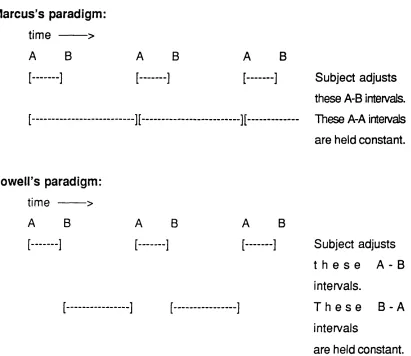
or different ("sha"-"cha"). His method differed from that of Marcus by not having
a constant overall tempo; instead the interval between pairs of sounds was
altered by a subject until perceptual isochrony was reached. The difference in
the two methods is shown schematically in Figure 1.3.
Thus it can be seen that both methods enable subjects to set an even
A - A interval. P-centres for the signals could not therefore be calculated from
these results, but stimuli with different P-centres will still lead to different
settings. The fixed interval was 750ms, and the other interval was always
determined randomly, to eliminate response bias. Six subjects completed the
settings.
Marcus’s paradigm;
time --- >
A B
[ - - - ]
[-
-][-A B
[- ] Subject adjusts
these A-B intervals.
These A-A intervals
are held constant.
Howeirs paradigm:
time --- >
A B
[ ]
B B
[ ] [--- ] Subject adjusts
t h e s e A - B
intervals.
[...] [ ] T h e s e B - A
intervals
are held constant.
Figure 1.3 Comparison of the intervals aligned in different dynamic rhythm task
paradigms (Howeli 1984, Marcus 1981)
Howell found there was a significant difference between the intervals when a
"sha" was set against a "sha", and when it was set against a "cha" sound. This
Chapter 1- Perceptual Centres
differed only in their rise times, he took this as evidence that P-centres are
determined by the amplitude envelopes of the signals.
He repeated this experiment using non speech sounds with similar structures.
They began with a period of white noise followed by a section of saw-toothed
wave excitation. Six subjects (different from the first experiment) performed the
experiment). He found the same pattern of intervals resulting in perceptual
isochrony. He concluded that P-centres were phenomena not confined to
speech sounds.
He later formalized his account of P-centres into a syllabic centre of gravity
model (1988a&b). This relates P-centres to the intensity distribution of a signal
over its entire duration. Alterations to this distribution will shift the P-centre
along with the centre of gravity of the intensity distribution. In terms of the
amplitude envelope this is demonstrated in the diagram Figure 1.4.
Thus by the criteria quoted above, the amplitude envelope of a stimulus is an
acoustic determinant of P-centre location because
1) the changes he caused to it (ramping the onset) led to an
analogous shift in the intervals set by the subjects
2) the changes in intervals set shift in the same direction as the
centre of energy (gravity) of the stimulus
The final criterion he set was that the factor must explain the rhythm setting in
production as well as perception. In the original 1984 paper he also described
data which indicated that speakers produce vowels of different durations at
different intervals. This indicates that the duration of a vowel affects its P-centre
I
abscissa axis orioin
centre of gravity
TIME-Schematic representation of amoiituoe enveioce from wnich a syllabic centre of gravity may be derived. This can be bone by integrating the represented energy, or by using the following form ula:
Centre of Gravity = ((-0.5ah)(a;3) - t\i-a)/2)(l-a)h)/(0.5ah + (l-a)h).
After the centre of gravity has been obtained, it can be represented on the amplitude envelope by measuring from the onset of the envelooe. Thus the syllabic centre of gravity of a signal will shift relative to the physical onset, as a function of the energy distribution of the syllable over time.
Chapter 1- Perceptual Centres
3) the factor affects P-centre in production and perception.
Speakers, he said, regulate their utterances according to
knowledge of the energy distribution of the sounds they are
producing.
Howell’s model is thus an acoustic account, which involves the amplitude of a
signal over its entire duration. Like Marcus’s model, it does not appoint one
acoustic event as the sole determinant P-centres. It is thus a global model of
P-centre location.
1.7 Articulatory Model of Location
While various researchers were modelling P-centres by considering the
perceived and produced signals, a different account of P-centre location -
different both in the level of analysis and the conceptual framework, was
simultaneously being devised in the USA. Carol Fowler and her associates at
Haskins laboratories defined P-centres as resulting from articulatory gestures
in speech. In this account P-centres are speech specific phenomena.
1.8 Fowler’s experiments
Fowler (1979) reported a set of experiments, whose aim was to discount
acoustic interpretations of P-centres and establish them as a result of directly
perceived articulatory gestures. In her first experiment she reported the inter
onset intervals produced by a speaker who either produced homogenous
speech sequences (same word repeated) or sequences of two alternating
words, at an even rhythm. Intervals were measured by hand, with a reported
sensitivity of +/- 7.5ms. No note is made of how the rhythmicity of the
sequences was validated. She found that the intervals between alternate words
condition (prompting the question over subjective assessment of the evenness).
She also found that deviations from absolute isochrony were greater for
syllables with longer prevocalic consonant clusters.
The next experiment in the paper investigated the perception of these same
sequences by listeners, when presented at the ‘naturally’ timed intervals, or
when adjusted by the addition of silence to be physically isochronous. Listeners
chose the natural sequence as more rhythmic at a level above chance. This
was obviously not a P-centre determining exercise, but did establish that
physically isochronous sequences were not perceived as regular by subjects.
Finally she produced results which indicate that when subjects read out a
sentence frame "Jack likes black — wi th one of a number of different
monosyllables inserted, the duration of the offset of voicing of the "k" and the
physical onset of the next word correlated with the prevocalic duration of the
test word. That is, the longer the prevocalic portion, the earlier subjects would
start to say it. This accords with the observations about production of speech
in metronome speech conditions, and is an indication that P-centres may
underlie timing in speech. The experiment was carried out with only one
speaker, and presumably the same sensitivity of measurement.
Fowler gave all of these results an articulatory explanation. Speakers
performing a ‘stress timed speech task’ that is, producing even speech, produce
articulatory regular speech which results in physical anisochronies but is
perceived as regular. A listeners judgment of the evenness of the speech is
based upon information about the articulatory timing; the subjects judge the
articulatory syllable onsets, not the physical onsets.
Fowler concluded that none of the observed anisochronies are a result of
Chapter 1- Perceptual Centres
whenever speech is produced. She tested this by testing subjects’ vocal
reaction times to a list of 20 CV syllables.
The results of this showed an effect of manner of articulation on reaction time,
implying that the longer the prevocalic segment, the longer the reaction time.
An ANOVA showed a significant effect of manner on reaction time (RT).
Scheffe’s test indicated that only the difference between the RT’s for the
affricate and the other RT’s was significant. Fowler stated that the rank ordering
of the means confirmed her hypothesis. Based on these findings she stated
that the reaction times were affected by differences in the manner, class or
articulatory characteristics of a consonant that affect the time at which the
segment has some acoustic consequence other than silence. Variability due to
these factors was responsible for 74% of the variance obtained in the first
experiment (when one subject produced sequences of speech). Despite their
lack of statistical significance, she states that these factors are "what gives the
P-centre phenomenon its character" (1979, p383).
The final experiment, designed to lock P-centres to the onset of articulatory
syllables rather than some acoustic attribute, compared the timings of voiced
and voiceless pairs of syllables. These pairs are dissimilar acoustically, but
similar articulatorily, she stated. Her interpretation of the acoustic models of P-
centre location is that the alternation of voiced/voiceless pairs will lead to
physical anisochronies: whereas the articulatory account predicts no such
anisochronies. This was tested in an experiment in which two subjects read out
lists of either alternating or homogenous CV sequences. The alternating
sequences contained voiced/voiceless plosive pairs ("ba"-"pa", "da"-"ta", "ga"-
"ka"). She found no difference between the intervals when they were measured
from burst to burst, but a difference when they were measured from physical
The articulatory model of P-centres that is stated in this paper relates P-centres
to articulatory syllable onset - specifically the articulatory activity associated with
the vowel onset. Any acoustic marker, therefore, need not be a specific event,
but "a (very large) class of acoustic signals that signify the...onset for
articulatory activity for a vowel"(p 386). This onset of activity she links to
anticipatory coarticulation. She hypothesizes that the "stabilization of a vowel's
effect on the acoustic signal (of) the consonant"(p387) marks the P-centre for
a listener. Her model of P-centre location is thus, at this stage, a local one,
mapping P-centres onto vowel gestures.
1.9 Tuller and FowTer’s experiments
The following year Tuller and Fowler (1980) presented evidence of articulatory
isochrony in perceptually even but physically isochronous sequences. Their
stated aim was to "discover whether any part of the production of
psychologically isochronous utterances is isochronous even when the acoustic
product departs from isochrony" (p278).
They took EMG recordings of subjects producing rhythmic sequences of
homogenous or alternating CV syllables. The syllables were chosen to involve
the orbicularis oris muscle for articulation of either the initial consonant or the
vowel. The orbicularis oris muscle acts to close or protrude the lips and is
associated with the production of labial consonants and lip rounded vowels. The
four subject’s utterances and EMG measures were recorded on separate
channels. No record is given of how the evenness of the produced sequences
was validated.
They found that in the alternating conditions, there was a significant deviation
from physical isochrony in the acoustic intervals. However for the EMG data
Chapter 1- Perceptual Centres
interval values for each sequence were based upon the average for each
sequence - that is, net cn the individual EMG trace intervals. Hcwell (personal
communication) has pointed out that this is more likely to result in a lack of
anisochrony for the EMG data compared to the raw intervals processed for the
acoustic data. Certainly some of the interval difference scores for the EMG data
look quite large. They took this finding of a suggestion of muscle activity
isochrony as evidence for an articulatory basis for P-centres. They fitted this
finding into the motor theory of speech perception (Liberman, Cooper,
Shankweiler and Studdert-Kennedy 1967).
Tuller and Fowler (1981) tested the hypothesis that P-centres are articulatory
gestures, directly perceived by the listener, in a further experiment. This was
designed to show that removing all intensity/time variation in a speech signal
does not affect its P-centre. This was congruent with a direct model of P-centre
location, since it would predict that such a manipulation would not affect the
underlying articulatory gestures and would therefore not affect the P-centre of
a syllable.
They tested this by rendering the amplitude envelope of a signal entirely
invariant via a process called infinite peak clipping. This means that all the
positive amplitude values of a signal are increased to a maximum, all the
negative to a minimum. The rise and fall time of the resulting signal are
immediate, and the amplitude envelope is rectangular. The duration of the
signal and its frequency content are unaffected. The speech remains
comprehensible, although it sounds harsh and noisy (of. guitar fuzz box). Tuller
and Fowler recorded perceptually isochronous alternating sequences of
syllables from a speaker. This was then infinitely peak clipped by amplifying the
signal up to a minimum to create two sets of stimuli - normal and infinitely peak
A visual examination of their stimuli reveals that the speech was not infinitely
peak clipped (Howell 1988a&b). The amplitude envelopes are not rectangular,
the onsets and offsets are ramped, and the durations seem to be different. This
point will be returned to in more detail in Experiment 4.
In common with their previous perceptual work on the P-centres, they did not
perform a rhythm setting task to enable them to determine the P-centres of
signals. Instead they presented subjects with naturally timed sequences, or
artificially rendered physically isochronous sequences. Subjects rated the
naturally timed sequences are more rhythmic, whether or not the sequences
had been infinitely peak~clipped.
Tuller and Fowler concluded, that since gross distortions to the amplitude
envelope do not affect the P-centres of signals, that an articulatory account of
P-centre location is preferable to an acoustic one.
1.10 Cooper Whalen and Fowler’s experiments
Cooper Whalen and Fowler (1986) working from an articulatory basis extended
and amplified Marcus’s experiments. Marcus (1981 ) had found that decreasing
the duration of an initial /s/ segment shifted the P-centre of the resulting
syllables. He mentioned that, as had been found previously (Gerstman, 1957)
the perceptual consequence of this was a continuum between Is/ /ts/ and /d/.
He did not test this categorical perception. Cooper et al extended Marcus's
experiment to distinguish the degree to which the phonetic identity of a syllable
initial consonant affects the P-centre of a syllable. They did this by employing
proper categorisation/discrimination tasks, small steps between levels of the
continua, and phonotactically legal English sounds. They also aimed to test
Howell’s (1984) hypothesis that the amplitude envelope of a signal determines
Chapter 1- Perceptual Centres
They carried out four experiments with the same general pattern. First a forced
choice identification task and an ABX discrimination task were performed. This
was followed by an ‘alignment’ task, "designed to measure the relative P-
centre location of the test stimuli" (p189). In this the test sound was set to a
rhythm against a reference sound (a "ba" syllable 329ms in duration). The A -
B interval was adjustable, as in Marcus’s paradigm, and the initial A - B interval
was always 50ms.
They used two different alignment systems. In one subjects adjusted the A - B
interval by pressing keys on a computer keyboard, which altered the interval in
steps of 1,5 or 15ms in either direction. In the second, adjustments were made
by turning a knob. The smallest possible adjustment was 12.8ms. They
combined the results from the two systems. Both could be criticized however,
for being in the first case rather counterintuitive, and in the second not very
sensitive.
In the firs t experiment they varied the duration of an initial "sh" consonant to
create a continuum which varied across "sha" - "cha" - "ta". They ramped the
onset of the frication, but not to a regular amount. The shorter the frication, the
steeper the rise time. They found that this manipulation resulted in categorical
perception of the "sha" - "cha" - "ta" continuum, and that the offset from
acoustic isochrony (which they equate with P-centre) varied linearly with the
duration of the frication. The category boundaries caused by the variation in
duration did not affect the P-centres abruptly. Therefore, they concluded, the
phonetic identity of a syllable does not affect its P-centre location.
In the second experiment, they amplified the first result by using a different
continuum, one in which the rise time of the stimuli was not affected. Here they
was categorical (as shown by identification and discrimination tasks). They
found the same relationship between the amount of inserted silence and the
offset from isochrony as in the first experiment. Both experiments indicate a
1ms shift in P-centre location for a 1ms experimental manipulation. They
incorrectly interpreted this as disproving Howell’s amplitude envelope model.
This duration extension affected the amplitude envelope, and the P-centre, in
the precise way Howell’s model predicts.
The third experiment controlled for the effects of overall syllable duration by
offsetting the amount of silence insertion by excising an equal amount of
frication. They found that this manipulation did not affect the P-centre of the
resultant syllables, although categorical perception was still observed. The
linear shift of offset observed in Experiment 3 was not therefore due to the gap
duration of the syllable.
In the fourth, final experiment they varied gap duration again, but this time
offset the duration by excising portions of the vowel. This led to categorial
perception of the continuum, and a linear shift in offset with gap duration. The
longer the gap duration, the larger the offset from isochrony. The slope of the
relationship is significantly more shallow than in Experiments 1 and 2. They
interpret this as being in line with Marcus’s original model; the increase in
prevocalic duration caused by the insertion of silence shifts the P-centre back
in time; the shortening of the vowel shifts the P-centre forward in time. Since
the prevocalic portion is more heavily weighted than the vowel portion in P-
centre determination, the P-centre overall shifts back in time, but not as much
as it would had the vowel remained constant. They did not test this by
implementing Marcus’s model to see what predictions it made.
They summarise the findings of all the experiments thus; the P-centres of
Chapter 1- Perceptual Centres
obvious acoustic properties of the signal such as overall duration or gap
duration (despite the large effect of gap duration). They also found that these
results showed that an amplitude envelope model (Howell, 1984) did not
account for shifts in P-centre location, since when the "onset envelope" of a
syllable remained unaltered as in Experiments 2 and 4, the P-centres still
shifted. This is based on an incorrect interpretation of Howell’s model which
applies to the whole envelope, not simply the onset.
What existing evidence was published (Howell 1984, Vos and Rasch 1981)
showing the effects of stimulus rise-time on P-centres, they stated was only
relevant to non-speech stimuli, and therefore not evidence which could account
for P-centres in speech sounds. They place P-centres firmly in the arena of
phenomenon specific to speech. They do however accept that all of their results
can be interpreted in both an articulatory and an acoustic manner.
Cooper Whalen and Fowler (1988) conducted experiments to show that a
syllable’s rhyme acts as a unit in its effect on P-centre location, with a much
smaller magnitude than the effect of the prevocalic segments. The articulatory
model of P-centre location had shifted ground to be more of a global model,
since instead of testing for the effect of vowel gestures on P-centre location,
their investigations were directed towards the effect of segmental durations on
P-centre location.
Their first experiment tested whether the weak effects of vowel duration were
due to it being in the syllable rhyme, or due to it being further away from the
syllable onset. This was done with two continua. The first was constructed by
excising whole pitch periods from a natural vowel, so that there were seven
levels of vowel duration. The second was created by appending natural /s/
"sa" and an "a" continua which were perceived by the authors as sounding
natural.
These stimuli were used in an alignment task, setting the stimuli to a rhythm
against a reference sound (which was a 329ms /ba/ sound). Subjects adjusted
the intervals, which were initially always 50ms, using keys which altered the
interval by 1, 5 or 15ms in either direction.
The results of this experiment are discussed in more detail in experiment 9.
They are very unusual for P-centre experiments in that they show none of the
consistency between subjects which is common (and indeed, possibly an
assumption about P-centres). The subjects show very different results; the
naive subject MRS showing a similar trend of smaller offsets with shorter
vowels for both continua; another subject CAP (one of the authors) showed a
much steeper relationship between offset and vowel length, and the third
subject, AMC (another author) showed diametrically opposite effects of offset
according to continuum, and no effect of vowel duration.
In the face of such disparate results, it might be suggested that not much can
be concluded about vowel duration. Cooper et al state however that since no
subject showed an interaction between continuum type with vowel duration, that
the effect of vowel duration is not due to the temporal location within the
stimulus.
The second experiment was to determine whether the duration of any
segment in the syllable rhyme has the same effect as vowel duration. To do
this they created two more continua both based on the syllable "at". In the first
continuum the vowel duration was decreased by excising whole pitch periods,
to seven levels of duration. In the second continuum, the same stimuli were
Chapter 1- Perceptual Centres
reduction in the duration of the vowel, in the second continuum therefore, the
overall duration of the syllable is constant. If the syllable rhyme behaves as a
unit, then there should be a shift in the P-centre of the first continuum with
vowel duration, but not the second. A centre of gravity account (1988a) would
predict "little difference between the two continua since the silence and release
burst add little to the amplitude profile of the utterance" (p28) (my italics). Again
the results were analyzed separately for each listener, since the degree of
variation for each subject was very large.
The naive subject, MRS, showed no effect of continuum type in ANOVA, but
a significant effect of vowel duration; from examination of the published figures
this effect of vowel duration was not to be in the predicted direction (shorter
vowel leading to smaller offset). Certainly the shift in offset is very small for
both continua.
The second subject, AMC (an author) who in the first experiment showed no
effect of vowel duration in this experiment showed an effect of vowel duration
on the offset - shorter vowel, smaller offset. There was no effect of continuum
type.
The final subject CAP (an author) showed the clearest results, with an effect of
continuum type, vowel duration, and an interaction all at significance. The
offsets of both continua get smaller as the vowel duration decreases, the
duration constant continuum showing greater offsets and a shallower slope. The
result of this subject alone confirm the hypothesis that the syllables rhyme acts
as a unit on P-centre location.
The results of the other two subjects, who showed no effect of continuum type,
the offsets of the three subjects is a source of problems for the whole
experiment. Subject MRS set intervals which varied from isochrony between -
15ms to -40ms. Subject AMC varied from -120m to -60ms. Subject OAF from -
80ms to +5ms. This is simply too great a range of responses to use to reach
any conclusions. They might wish to claim that the subjects are alike enough
in their responses that they are setting their intervals to common trends, but
that the range of the offset can vary. In this case, they need to establish
theoretically, why the trend remains the same while the range varies, especially
since similar experiments have shown no such degree of difference between
subjects. The alternative hypothesis is that the experimental results are to
unreliable to base a finding upon. Responses which vary in one dimension -
range - could theoretically vary in another.
Instead of either of these conclusions, Cooper et al state that the contribution
of segments in the rhyme to P-centre location varies across listeners, and
regard this as the basis for possible future work. Since Marcus carried out his
experiments mainly on himself, the effects of vowel/rhyme duration on P-
centres across subjects cannot be verified.
1.11 Further work on P-centres
Marcus’s experimental findings were replicated by researchers working with
Dutch spoken digits (Eling, Marschall and van Galen 1980). Dutch, like English,
is a so-called ‘stress timed’ language. This is a reference to the supposed
timing of a language, stress timed languages being produced with ‘isochronous’
inter-stress intervals. Syllable-timed languages such'as French are considered
to be timed with ‘isochronous’ inter-syllabic intervals. There is some evidence
that these timing variations are more in the listener’s ear than the physical
Chapter 1- Perceptual Centres
to languages which vary in the manner in which they are considered to be
timed?
Hoequist (1983) investigated the generality of the P-centre phenomena to
different languages. In addition to a so-called stress-timed language (English),
he analyzed the production of rhythmic speech from Japanese speakers (a
mora timed language), and Spanish (a syllable timed language). To reduce
second language problems, his subjects spoke nonsense syllables to an even
rhythm. He found the expected anisochronies produced by all his speakers, and
concluded that "..P-centres (are) an aspect of syllable production, and ... thus
expected to be universal" (1983 p375).
Howell (1984) reported that in production, speakers systematically vary their
timing of vowels with different durations to acheive perceptual isochrony. This
finding was replicated by Fox and Lehiste (1987). They found that as a speaker
produces a longer vowel, the ‘stress beat’ (analogous to the P-centre in
definition) of the syllable moves away from the vowel onset. They found that
these differences between tense (long) and lax (short) vowels disappears in a
perception task, if the durations of the vowels are equalized. They concluded
from this result that the stress beat was influenced by the duration of the vowel.
Spectral cues were not leading to the syllable being expected to be longer, as
they had suspected. Thus the subjects, recognising a tense vowel, did not
make rhythm setting judgements depending on how long they anticipated the
vowel to be. They concluded that the stress beat of a token depends upon its
entire structure. Their experiment thus supports a global model of P-centre
location.
Evidence to support the articulatory approach to P-centres was provided by
rhythmic speech are also shown when prelingually deaf adults produce regular
speech sequences. They interpreted these results as indicating that the deaf
speakers were producing the vowel articulations regularly without acoustic
information, and thus P-centres should be considered as articulatory gestures
rather than attributes of the signals.
1.12 Another model of P-centre location.
In contrast to all the approaches to P-centres described in this chapter,
Pompino-Marschall (1989,1992) developed a model of P-centre location that is
"purely psychoacoustic" (1989 p.175). His experimental findings concluded that,
unlike Marcus’s and Fowler’s findings, the prevocalic and rhyme sections of a
syllable do not act independently on the P-centre. This is in contradiction to
Cooper et al (1988) who stated that the syllable’s rhyme does affect the P-
centre as a unit. Pompino-Marschall provided evidence that the vowel and final
consonant duration are different in their effects; also both effects are non linear.
His final finding was that phonetically different syllables affect the P-centre
differently, and P-centre shifts can be induced without temporal variation in the
signals.
His model is a psychoacoustic one which uses thresholds within loudness
functions within each critical band; it also uses temporal weighting processes
between these ‘partial events’ and integration processes at different levels. The
model is complex, but can be generally expressed as determining a perceptual
syllabic onset and a syllabic centre of gravity, from an integration of the partial
events.
Pompino-Marschall’s model is used to argue against a model of P-centres
Chapter 1- Perceptual Centres
which is applicable to both speech and non speech sounds. This model uses
energy distribution within frequency channels to predict P-centre location.
Unlike any other model of P-centre location, this model is structurally dependent
upon the identification of two perceptual occurrences within a syllable, the
perceptual onset and the perceptual centre of gravity, which are in turn
influenced by the entire syllable. The Pompino-Marschall model is thus ‘semi-
local’; it maps P-centres onto two discrete events, but events that are not
independent of the whole signal in terms of their calculation.
The knowledge that acoustic signals have a perceptual onset which is not the
same as their physical onset is as old as the psychophysical tests designed to
examine the relationship between the two domains. More recently it has been
pointed out that a signals perceptual onset is not necessarily the same as its
perceptual moment of occurrence, or beat (Gordon 1987). Whilst this
separation of physical and perceptual events is clear, it does not necessarily
follow that the P-centre must depend upon the perceptual onset.
Pompino-Marschall (1989) states as evidence in favour of his two-event model
the difficulties in determining P-centres with inexperienced subjects (Marcus
1981, Cooper et al 1988); he suggests this could mean that no one perceptual
event underlies subjects settings. In addition he cites the subject differences
found by Cooper et al (1988) when syllable rhyme duration was varied. This he
suggests indicates a psychologically weaker syllabic centre of gravity and a
stronger perceptual onset. As will be described in Chapter 4, the measurement
of P-centres is predicated upon subjects abilities to perform the dynamic rhythm
setting task. Experiment 1 in this thesis addresses the question of whether a
group of inexperienced undergraduates could perform the rhythm setting task.
While some factors such as tempo affect performance, only one subject was
et al (1986, 1988) results which showed large subject differences in alignment
tasks. In contrast to Pompino-Marschall, the conclusion was drawn that these
differences reflected experimental problems (such as counterintuitive alignment
methods) rather than robust individual differences.
P-centres, as defined and modelled by Pompino-Marschall, are thus different
from the traditional approach; that of Morton et al (1976). No empirical evidence
collected in this thesis was designed to explore further this central assertion
that P-centres are caused by two psychoacoustic events. However the debate
can become circular; P-centres are measured in rhythm setting tasks, models
are developed to account for the P-centres as measured in these tasks, a
failure of a model in adequately accounting for observed variance indicates a
problem with the model. This is not to suggest that Pompino-Marschall is
incorrect in his experimentation or his conclusions. In this thesis however the
standard definition and measurement of P-centres will be used.
1.13 Summary
Acoustic signals have a perceptual moment of occurrence; this perceptual
centre or P-centre is the aspect of a signal that is aligned in a perceptual
rhythm setting task. In a perceptually isochronous sequence, the P-centres of
the stimuli are physically isochronous. No single acoustic event of a signal (eg.
vowel onset) has been found to relate to P-centre location. Various models
have been proposed to account for P-centre location. Their strengths and
weaknesses are described below:
Marcus’s model is global and phonetically motivated, relating P-centre location
to the durations of the prevocalic and syllable rhyme sections.
Chapter 1- Perceptual Centres
1) it fits his data well
2) it is simple and testable; his division of the syllable into two
portions maps onto the psychological divisions of onset and
rhyme
3) it is applicable to both speech and non speech signals, as
Morton et al felt such a model should be. In the case of non
speech signals the Vowel onset’ is replaced by the peak
increment in mid band spectral energy. This is also a benefit from
his definition of vowel onset in acoustic terms.
4) it is based upon the P-centres of signals as calculated using
a least sum of squares fit of all the intervals set in the
experiment; the values are therefore well established, and the
effect of odd or irrelevant outlying points reduced.
The arguments against his model are that:
1 ) His choice of the particular definition of vowel onset is quite arbitrary;
there are other possible definitions, and his choice does not seem to be
driven by the data
2) It is based on speech from only one speaker, and thus his
model may not account for differences between speakers
3) His model locates P-centres firmly as being influenced by the
durations of different sections of a syllable. It thus needs to define
where the sound begins to determine the duration of the first
section. He has for this a threshold function of the sound onset
being when the signal passes -30dB SPL. This is again quite
arbitrary, and means that if in continuous speech the signal never
fell below -30dB SPL a new syllable with a new P-centre would
not be heard. This threshold problem will affect any model of P-
4) His rejection of intensity attributes as affecting P-centre
location was based on one experimental finding, that doubling the
amplitude of a syllable final "t" burst did not affect the P-centre of
the signal. He did not investigate the effect of altering the
intensity attributes at the onset of a signal.
5) Some of his experiments used stimuli which contain
phonotactically illegal sounds. This may have affected his results.
6) Although he used a full P-centre setting paradigm, his lack of
a common reference sound in all his experiments reduces their
comparability.
Howeirs model is an acoustic global model, relating P-centres to the centre
of gravity of the amplitude envelope; the P-centre will thus vary with the
alteration of intensity/time parameters of the syllable.
Positive aspects of Howell’s model:
1) It is simple and testable
2) Aims to account for production and perception data
3) Psychologically plausible (work reviewed in the next chapter
indicates that the parameters he identified affect the perception
of acoustic stimuli at several levels)
4) Uses a parameter which is the principal one connect with
syllables, and also applies to the whole syllable.
4) Aims to be applicable to both speech and non speech
Arguments against Howell’s position:
1) Although Howell’s model predicts most observed P-centre
variations, it is specifically based on two sets of perceptual
experimental data in which only one variable - rise time - was
Chapter 1- Perceptual Centres
2) does not account for all the perception data - eg. lack of effect
of amplified T burst at syllable offset (Marcus, 1981). Howell’s
model predicts this manipulation will have an effect due to the
increased energy at the offset. Marcus found it does not shift P-
centre.
3) the important parameter of the model is the intensity/time
distribution of a signal, and thus it does not address any possible
spectral qualities associated with P-centre location
The articulatory model of P-centres is based on patterns of articulation,
perhaps related to the articulatory vowel onset, but affected by the whole
syllable articulation. Adopts Marcus’s onset/rhyme distinction as accounting for
the observed P-centre variation and is thus overall a global model.
Positive aspects of the articulatory approach are:
1 ) Fits in with her general model of speech event perception and
production.
2) Feels intuitively reasonable when producing rhythmic speech
sequences.
Negative attributes:
1) Not initially based on any actual P-centre measures, but
instead on some unsensitive measurements of produced speech
and forced choice perception tests and non significant reaction
time experiments. What in later experiments are called P-centre
setting alignment tasks are in fact not; they simply involve setting
a syllable to a rhythm with a common reference sound. The nXn
matrix of trials is not performed, and often they did not balance
the ordering of the stimuli. The initial A - B interval was always
of key presses to make adjustments of different sizes and
directions is counter-intuitive compared to Marcus’s potentiometer
knob.
2) Specific to speech. Cannot therefore involve any of the findings
from auditory perception, for example the perception of musical
notes (Gordon, 1987).
3) Involves direct perception. Open therefore to refutation, if, as
is the case, experiments can be carried out which manipulates
the acoustic signal and thus shift the P-centres.
Other work was outlined, which suggests that P-centres are common to all
languages, being a function of syllable structure, and syllables being universal.
Finally the consideration that not one P-centre, but two perceptual attributes of
a signal are responsible for the physical anisochrony/perceptual isochrony
Chapter 2 - Non Speech Stimuli
Chapter Two
Perceptual consequences of the intensity and
time variation in signais
Abstract
The aim of this thesis is to model P-centres in a manner applicable to speech and nonspeech signals. This chapter addresses how the acoustic attributes of non speech sounds affect their perceptual qualities. This chapter considers evidence from physiological and psychological experiments that illuminate how amplitude characteristics such as rise time contribute perceptual experience. The implications of this research for models of P-center location will be considered.
2.1 Introduction
Howell’s model of P-centre location relates the P-centre to attributes of the
intensity time profile of a signal, while Marcus’s model is based upon the
duration of different sections of a syllable. Howell’s model is conceptually
related to Mermelstein’s (1975) identification of the amplitude envelope as the
primary acoustic cue associated with syllable structure.
The aim of this chapter is to consider evidence of the importance of intensity
profile attributes in the perception of acoustic signals. Specifically the envelope
characteristics that Howell’s model integrates, such as rise and decay time of
signals, will be addressed. Perceptual processes from the physiological level
upwards will be covered. Evidence from both speech and non speech fields will
be considered, since one of Howell’s main points is that his model is applicable
to both. The aim of this entire thesis is to model P-centres in a local, non
speech specific manner. A model of P-centre location which defines the
2.2 Physiological Evidence
This section will briefly consider some evidence for the processing of rise time
parameters by the auditory system. The relationship between physiological and
psychological evidence is not always clear; this section is included to establish
that such features are preserved in the encoding of information in the auditory
system.
2.3 Response to rise time in the Inferior Coiiicuius of Bats
Suga (1971) made a study of the responses of Inferior Collicular neurones of
bats to tone bursts with different rise times. He found neurones which were
specialized for the analysis of amplitude modulated sound, especially for the
rising phase of the amplitude change. The response pattern of these phasic on-
response neurones did not change with rise time, although the response
patterns of some neurones changed to inhibitory responses.
The thresholds of responses to the tones increased when the rise time was
lengthened, and the degree of increase varied across the neurones. Neurones
which showed a large increase in threshold were excited by a signal with a
short rise time - that is, a fast increase in amplitude. Some neurones exhibited
an upper threshold, above which they were not excited. This upper threshold
disappeared if the presented tone had a longer rise time.
Increasing the rise time of the presented tone caused changes in the excitatory
areas of the neurones. In some cases it was increased and in others
decreased. This suggests that the neurones concerned are specialized for
responding to tones of different rise times. Rise time changes also led to
changes in the inhibitory area: the change in the inhibitory area of any neurone