INTERNATIONAL RESEARCH JOURNAL OF PHARMACY
www.irjponline.com
ISSN 2230 – 8407
Research Article
EFFECT OF POLYMERS AND PROCESSING METHOD ON PHYSICAL CHARACTERIZATION OF
ORALLY DISINTEGRATING FILM
Kheng Yi-Ing Sim
1, Kai Bin Liew
1,2*, Ashok Kumar Janakiraman
11
Department of Pharmaceutical Technology, UCSI University, 56000 Kuala Lumpur, Malaysia
2
Faculty of Pharmacy, Cyberjaya University College of Medical Sciences, Persiaran Bestari, 63000 Cyberjaya, Selangor,
Malaysia
*Corresponding Author Email: [email protected]
Article Received on: 21/08/18 Approved for publication: 29/09/18
DOI: 10.7897/2230-8407.0910221
ABSTRACT
The aim of this study was to investigate the effect of single polymer and their blends combination polymerand two different drying methodson the physical properties of orally disintegrating films (ODFs). ODFs were prepared by hydroxypropyl methylcellulose (HPMC) or Lycoat RS720 polymer and their blends using the solvent-casting method with Polyethylene glycol (PEG) 400 as a plasticizer. The prepared ODFs were dried by either oven drying (OD) or freeze-drying (FD) method prior to physical properties comparison. ODFs were cut and evaluated in terms of visual aspect, uniformity ofweight, determination of thickness, in-vitro disintegration time, tensile strength, folding endurance, and surface morphology. Freeze drying can be considered as a method of choice to formulate ODFs due to rapid disintegration time of film produced. Formulation F8 from single polymer category and F20 from polymers blend category are chosen as optimum ODFs formulation with desired tensile strength 87.96±5.91 and 89.05±3.72, respectively and shortest in-vitro disintegration time 11.33±0.58 and 53.33±2.08, respectively.
Keywords: Orally disintegrating films, Freeze drying, Oven drying, Hydroxypropyl methylcellulose, Lycoat RS720.
INTRODUCTION
The oral route remains the preferred route of drug delivery up-to-date. It was estimated that 60% formulations are in the solid dosage form. Tablets and capsules are two most common, but preferred dosage forms due to the ease of transportation and manufacturing, accurate dosing and good stability compared to liquid dosage forms.1 However, certain groups of patients such as geriatric, paediatric and bedridden patients might have difficulties in swallowing the conventional oral solid dosage forms.2 As a result, novel oral solid dosage forms such as orally disintegrating tablet and orally disintegrating film were developed to solve the problem.
The orally disintegrating film is a thin film which dissolves in less than a minute when placed on the buccal cavity. The film dissolves rapidly upon contact with saliva to release the active pharmaceutical ingredient.3 The first and foremost fundamental ingredient to form an ODFs is film forming polymer.2 The film is prepared using hydrophilic polymers that rapidly dissolves on the tongue or buccal cavity. The selection of polymer is important as it affects the physical properties of the ODFs formed such as tensile strength, flexibility and disintegration time.4 Other than that, other common adjuvants such as plasticizer, thickening agent and taste-masking agent were also added during the formulation of films.1
ODFs can be manufactured by solvent casting, hot melt extrusion, solid dispersion or rolling method. Solvent casting and hot melt extrusion were reported to be a preferable method as they are easy to be performed.4 Solvent casting method is usually followed by a suitable drying method. Two drying methods namely oven drying and freeze drying have been reported in the formulation of ODFs. Oven drying involves using heat to dry the solvent mixture
of drug whereas freeze drying employs the method of drying without the use of heat with the help of freeze drier. In freeze drying, the solution of a drug will be frozen, and solvent will be removed from the frozen structure by lyophilization process.5 Freeze drying process may be suitable for formulations of ODFs when the drugs are unstable to heat since it involves drying without elevation of temperature. Nevertheless, this technology of drying has not been fully maximized for orally disintegrating film formulation up-to-date. The objective of this study was to investigate and compare the effect of individual and polymers blend on the physical properties of preparedODFs. Furthermore, comparison of oven drying, and freeze-drying technology was explored in this study for solvent removal.
MATERIALS AND METHODS Preparation of ODFs
Various composition of ODFs are presented in Table 1. The polymers were weighed, added to 50 g of distilled water and stirred until the polymer was dispersed completely. For each formulation, 4 g of PEG 400 was added as plasticizer into the polymeric dispersion and then the final weight of the mixture was adjusted to 100 g with distilled water. The polymeric dispersion was mixed until homogeneous, and 10 g of final dispersion was casted on the petri dishes and dried by oven-drying (OD) or freeze-drying (FD) method. The dried films were removed from the petri dishes, cut into size (20 mm x 20 mm) and stored in a desiccator with silica gel at 25±2°C.
Oven-dried method
Freeze-drying method
Polymeric dispersion in petri dishes were stored in ESCO Lexicon II Ultra Low Temperature freezer, Malaysia at -80°C for 18 hours. The frozen samples in the petri dishes were then transferred into a Martin Christ Alpha 1-4 LD Plus freeze dryer, Germany to freeze dry under vacuum suction for 24 hours at -55°C.5
Physical characterization of ODFs
Determination of weight
The weight of each ODFs (20 mm x 20 mm) was measured using a Metler Toledo B154-S analytical balance, USA. Three samples of ODFs were used to determine the weight.6
Determination of Thickness
The thickness of ODFs (20 mm x 20 mm) was measured by using a Mitutoyo micrometer, Japan at the centre point.6
In-vitro disintegration time
The in-vitro disintegration time for ODFs (20 mm x 20 mm) was
determined using an Electrolab ED-2L disintegration tester, India with plastic disks and 800 mL of distilled water at 37.0 ± 0.5°C. The time taken for the ODFs to disintegrate completely is defined as the disintegration time.7
Surface pH
The pH of the ODFs was determined by placing the film (20 mm x 20 mm) in a petri dish and the film was wetted by distilled water. The pH of the film was evaluated by touching the surface of the film with a Jenway 3505pH meter electrode, UK.3
Tensile strength
The ODFs (20 mm x 20 mm) was held vertically between two clamps at 1cm apart. The ODFs was pulled at the rate of 100 mm/min with a contact force of 0.05N. The tensile strength was defined by the maximum load force required to break the ODFs and calculated by dividing the applied load at the rupture with the cross-sectional area of the films.8,9
Tensile strength = Force at break / Strip thickness x strip width
Folding endurance
The ODFs (20 mm x 20 mm) was folded at the same place repeatedly until a crack was seen over the area of bend using a strong light. The total number of folding made before the film cracked was denoted as the value of folding endurance.7
Scanning electron microscopy (SEM)
SEM images were obtained using the Carl Zeis AG - Supra 55VP scanning electron microscope, Germany. The oven-dried films and freeze-dried films were mounted on a metal stub with double-sided adhesive tapes and samples were coated with a thin layer of platinum to improve the conductivity before imaging is done.5
Statistical Analysis
All physical characterizations were performed in triplicate. The results of the studies are presented as mean ± standard deviation (SD). Statistical Procedure for Social Science (SPSS), Ver 20.0 (SPSS Inc., Chicago, IL) was used for statistical analysis. The results collected from physical characterization were analysed
using one-way analysis of variance (ANOVA) statistically. Post hoc Tukey-HSD test was performed when the result has statistically significant difference. Statistically significant difference was considered when p < 0.05.
RESULTS
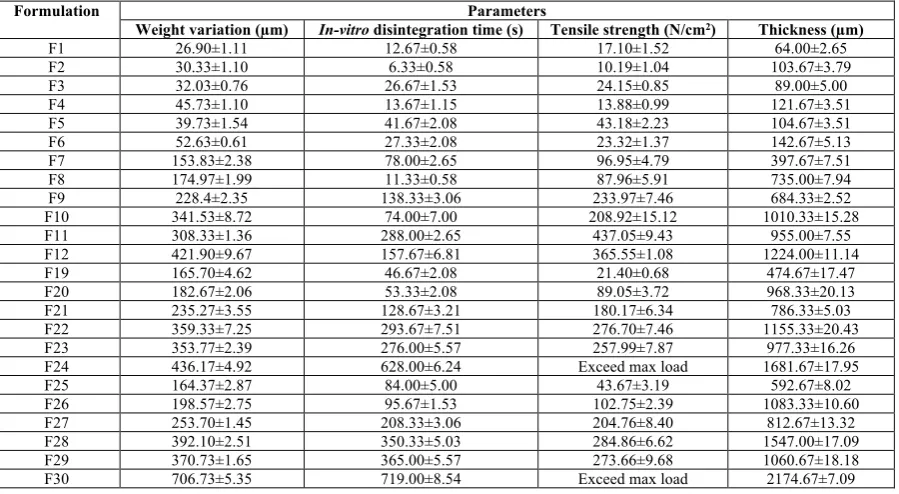
The images of oven-dried and freeze-dried ODFs for HPMC, Lycoat RS720 and combined polymers blend are shown in Figure 1, 2 and 3, respectively. The results of tensile strength, thickness, weight variation and in-vitro disintegration time are presented in Table 2.
Single polymer ODFs
Generally, the weight of the films increased (for both oven-dried and freeze-dried methods) as the concentration of the polymer increased for ODFsL (orally disintegrating films with Lycoat RS720). The weight of ODFsL was found to be higher than ODFsH (orally disintegrating films with HPMC) and the difference was statistically significant (p<0.05). The weight of oven-dried ODFsH did not show any statistical difference between 1% and 3% HPMC was used. On the other hand, freeze-dried ODFsH showed statistical difference between the formulations and the difference were statistically significant (p<0.05). The weight of freeze-dried ODFsL was higher than oven-dried ODFsL (p<0.05). ODFsH also showed variation in weight between oven-dried and freeze-dried ODFs.
The in-vitro disintegration time of ODFsH was significantly lower than ODFsL (p<0.05) for both oven and freeze-dried ODFs. The in-vitro disintegration time of ODFs was observed significantly higher (p<0.05) when the concentration of Lycoat RS720 increased for both oven and freeze-dried films. However, the significant difference was only observed between 1% HPMC and 3% HPMC (p<0.05) for both oven and freeze-dried ODFs. Freeze-dried ODFsL had lower in-vitro disintegration time than oven-dried ODFsL and the difference was statistically significant (p<0.05) but there was no significant difference observed between freeze-dried ODFsH and oven-dried ODFsH.
The tensile strength of ODFsL was significantly higher than ODFsH (p<0.05). The tensile strength was also observed to increase significantly for both oven and freeze-dried ODFs as the concentration of Lycoat RS720 increased (p<0.05). A significant difference (p<0.05) was also found between the tensile strength of oven-dried and freeze-dried ODFs at same concentration for ODFs formulated by ODFsL. ODFsH did not show any significant difference in tensile strength (p>0.05) between an oven and freeze-dried ODFs at the same concentration.
Combined polymers
The weight of combined polymer ODFs increased as the polymer concentration increased (p<0.05) for both oven and freeze-dried ODFs. The weight of freeze-dried ODFs were significantly higher than oven-dried ODFs at same concentration (p<0.05). The time taken for ODFs to disintegrate was observed to increase significantly when the polymer concentration increased for both oven and freeze-dried ODFs (p<0.05). Besides that, time taken for freeze-dried ODFs to disintegrate were also higher than oven-dried films with statistically significant difference (p<0.05) except for 1% HPMC-20% Lycoat RS720 and 2% HPMC-20% Lycoat RS720 oven and freeze-dried ODFs.
Moreover, the tensile strength increased significantly with increasing polymer concentration (p<0.05) for both oven and freeze-dried ODFs. The tensile strength of freeze-dried ODFs was also observed higher than oven-dried ODFs and the difference were statistically significant (p<0.05).
The thickness of freeze-dried ODFs was significantly higher than oven-dried ODFs (p<0.05). Besides that, significant difference (p<0.05) in thickness of ODFs was also observed with increased concentration of polymers for both oven and freeze-dried ODFs. However, the oven-dried and freeze-dried films have poor folding endurance with the folding endurance of 1. It was observed in Figure 5 that the SEM micrograph of freeze-dried ODF at 1% HPMC-20% Lycoat RS720 was porous in nature when compared to oven-dried 1%HPMC-20% Lycoat RS720. However, as the concentration increased to 3% HPMC-40% Lycoat RS720, freeze-dried ODFs loses its porous nature.
DISCUSSION
ODFs has gained recognition as consumer-friendly dosage form since early 21st century when Listerine pocket strips were introduced.10 Besides, they offer the advantages of giving accurate dosage, improving patient compliance and suitable for people who are afraid of swallowing tablets.11
Single polymer
The weight and thickness of ODFsL was higher than ODFsH for both oven and freeze-dried films as higher concentration of Lycoat RS720 was used to formulate the ODFs. Moreover, freeze-dried ODFsL had higher weight and thickness than oven-dried films ODFsL as the polymeric solutions were concentrated to the centre of the petri dishes due to vacuum suction during the freeze-drying process. This was further supported when the peeled films from the petri dishes had shorter diameter for freeze-dried films compared to the oven-freeze-dried films. Hence, the weight and thickness of films were higher after the films were cut into 20 mm x 20 mm size. Besides that, freeze-dried films were more porous than oven-dried films as shown in Figure 4. Hence, the uptake of water by the ODFs was higher as the water molecules can easily penetrate through the pores thereby lowering the in-vitro disintegration of ODFs.5
The tensile strength of ODFsL was significantly (p<0.05) higher than ODFsH. For Lycoat RS720 formulations, oven-dried ODFs had higher tensile strength than freeze-dried ODFs as the tensile strength of the freeze-dried ODFs were reduced due to porous nature of the films.5 Folding endurance of ODFsH was more than 250 for both freeze-dried and oven-dried films. On the other hand, ODFsL were brittle and had poor folding endurance. A study done by Kathpalia H et.al showed that the oven-dried films formulated by Lycoat was brittle and had poor folding endurance.11 Besides that, another study stated the moisture uptake due to plasticizing effect and dryness of Lycoat formulated films have an impact on the ODF’s stickiness and brittleness.
SEM images showed that freeze-dried films were observed being more porous compared to oven-dried films (Figure 4). This further clarified that the reduction of in-vitro disintegration time and tensile strength in the single polymer freeze-dried film may be due to increased porosity of the film. The porous nature of the films was due to release of water molecule from the frozen formulation when subjected to freeze-drying process.5 Liew KB et al. also reported the same finding for an oven and freeze-dried films.7
Combined polymer ODF
The weight and thickness of the films increased when higher concentration of polymers used to formulate ODFs. Besides that, both weight and thickness of freeze-dried films were higher because the polymeric solutions were concentrated to the centre of the petri dishes during the freeze-drying process. In addition, the films became more compact and cross-linked due to combination of HPMC and Lycoat RS720 leading to higher weight and thickness.
Freeze-dried ODFs formulated by combined polymers showed higher in-vitro disintegration time and tensile strength than oven-dried films as the structures of the ODFs became more compact and cross linked by combined polymer. Moreover, a reduction in film’s diameter and increased in thickness of the ODFs were observed as the polymeric solution was concentrated to the centre of petri dish during freeze-drying thereby leading to lesser porosity and longer in-vitro disintegration time. This was further supported by SEM micrograph shown in Figure 5 whereby the porosity of films at higher concentration was reduced when compared to lower concentration. As the porosity of the films decreased, higher load was required to break the films leading to higher tensile strength. In addition, water penetration into the films were hindered as the porosity decreased thus increased the in-vitro disintegration time.
Table 1: Various formulations of ODFs by oven-dried (OD) and freeze-dried (FD) methods
Formulations Ingredients (g/100g)
Drying Method HPMC Lycoat RS 720 PEG 400
F1 OD 1.00 - 4.00
F2 FD 1.00 - 4.00
F3 OD 2.00 - 4.00
F4 FD 2.00 - 4.00
F5 OD 3.00 - 4.00
F6 FD 3.00 - 4.00
F7 OD - 20.00 4.00
F8 FD - 20.00 4.00
F9 OD - 30.00 4.00
F10 FD - 30.00 4.00
F11 OD - 40.00 4.00
F12 FD - 40.00 4.00
F13 OD 1.00 20.00 4.00
F14 FD 1.00 20.00 4.00
F15 OD 1.00 30.00 4.00
F16 FD 1.00 30.00 4.00
F17 OD 1.00 40.00 4.00
F18 FD 1.00 40.00 4.00
F19 OD 2.00 20.00 4.00
F20 FD 2.00 20.00 4.00
F21 OD 2.00 30.00 4.00
F22 FD 2.00 30.00 4.00
F23 OD 2.00 40.00 4.00
F24 FD 2.00 40.00 4.00
F25 OD 3.00 20.00 4.00
F26 FD 3.00 20.00 4.00
F27 OD 3.00 30.00 4.00
F28 FD 3.00 30.00 4.00
F29 OD 3.00 40.00 4.00
F30 FD 3.00 40.00 4.00
Table 2: The weight, in-vitro disintegration time, tensile strength and thickness of the ODFs
Formulation Parameters
Weight variation (µm) In-vitro disintegration time (s) Tensile strength (N/cm2) Thickness (µm)
F1 26.90±1.11 12.67±0.58 17.10±1.52 64.00±2.65
F2 30.33±1.10 6.33±0.58 10.19±1.04 103.67±3.79
F3 32.03±0.76 26.67±1.53 24.15±0.85 89.00±5.00
F4 45.73±1.10 13.67±1.15 13.88±0.99 121.67±3.51
F5 39.73±1.54 41.67±2.08 43.18±2.23 104.67±3.51
F6 52.63±0.61 27.33±2.08 23.32±1.37 142.67±5.13
F7 153.83±2.38 78.00±2.65 96.95±4.79 397.67±7.51
F8 174.97±1.99 11.33±0.58 87.96±5.91 735.00±7.94
F9 228.4±2.35 138.33±3.06 233.97±7.46 684.33±2.52
F10 341.53±8.72 74.00±7.00 208.92±15.12 1010.33±15.28
F11 308.33±1.36 288.00±2.65 437.05±9.43 955.00±7.55
F12 421.90±9.67 157.67±6.81 365.55±1.08 1224.00±11.14
F19 165.70±4.62 46.67±2.08 21.40±0.68 474.67±17.47
F20 182.67±2.06 53.33±2.08 89.05±3.72 968.33±20.13
F21 235.27±3.55 128.67±3.21 180.17±6.34 786.33±5.03
F22 359.33±7.25 293.67±7.51 276.70±7.46 1155.33±20.43
F23 353.77±2.39 276.00±5.57 257.99±7.87 977.33±16.26
F24 436.17±4.92 628.00±6.24 Exceed max load 1681.67±17.95
F25 164.37±2.87 84.00±5.00 43.67±3.19 592.67±8.02
F26 198.57±2.75 95.67±1.53 102.75±2.39 1083.33±10.60
F27 253.70±1.45 208.33±3.06 204.76±8.40 812.67±13.32
F28 392.10±2.51 350.33±5.03 284.86±6.62 1547.00±17.09
F29 370.73±1.65 365.00±5.57 273.66±9.68 1060.67±18.18
Figure 1: The photograph of ODFsH prepared using oven-dried (A) and
freeze-dried (B)
Figure 2: The photograph of ODFsL prepared using oven-dried (A) and
freeze-dried (B)
Figure 3: The photograph of combined polymer blend ODFs prepared using
oven-dried (A) and freeze-oven-dried (B)
Figure 4: SEM micrograph of A (3% OD ODFsH), B (F3% FD ODFsH), C (40% OD ODFsL) and D (40% FD ODFsL)
Figure 5: SEM micrograph of E (1%HPMC-20% Lycoat RS720 OD ODF), F (1% 20% Lycoat RS720 FD ODF), G (3% HPMC-40% Lycoat RS720 OD ODF) and H (3% HPMC-HPMC-40% Lycoat RS720
FD ODF)
CONCLUSION
The results obtained from this work showed that freeze-dried ODFsH and ODFsL showed lower in-vitro disintegration time and tensile strength compared to oven-dried films due to the porous nature of films. Increased HPMC and Lycoat RS720 concentration increases the weight, thickness, in-vitro disintegration time and tensile strength of orally disintegrating films. Folding endurance of ODFsH were better than ODFsL. Formulation F8 from single polymer category and F20 from polymers blend category are chosen as optimum ODFs formulation with desired tensile strength 87.96±5.91 and 89.05±3.72 respectively and shortest in-vitro disintegration time 11.33±0.58 and 53.33±2.08 respectively.
ACKNOWLEDGEMENT
The authors would like to acknowledge Pioneered Scientist Innovation Fund (PSIF) for sponsoring the research material. We thank Faculty of Pharmaceutical Science, UCSI University for providing facilities and Roquette Pharma for providing Lycoat RS720.
REFERENCES
1. Siddiqui MN, Garg G, Sharma, PK. A Short Review on A Novel Approach in Oral Fast Dissolving Drug Delivery System and Their Patents. Advances in Biological Research 2011; 5(6):291-303.
2. Pathare YS, Hastak VS, Bajaj AN. Polymers used for fast disintegrating oral films: a review. Polymer 2013; 14:169-78.
3. Irfan M, Rabel S, Bukhtar Q, Qadir, MI, Jabeen F, Khan. Orally disintegrating films: a modern expansion in drug delivery system. Saudi pharmaceutical journal 2016; 24(5): 537-46. DOI: 10.1016/j.jsps.2015.02.024
4. Nagar P, Chauhan I, Yasir M. Insights into Polymers: Film Formers in Mouth Dissolving Films. Drug Invention Today 2011; 3(12): 280-89.
5. Liew KB, Odeniyi MA, Peh, KK. Application of freeze-drying technology in manufacturing orally disintegrating films. Pharmaceutical development and technology 2016; 21(3):346-53.
https://doi.org/10.3109/10837450.2014.1003657
6. Prabhu SC, Parsekar HD, Shetty A, Monteiro SS, Azharuddin M, Shabaraya AR. A Review on Fast Dissolving Sublingual Films for Systemic Drug Delivery. Int J pharm and chem Sci 2014; 3(2):482-96.
7. Liew KB., Tan YTF, Peh KK. Characterization of oral disintegrating film containing donepezil for Alzheimer disease. AAPS PharmSciTech 2012; 13(1):134-142. doi: 10.1208/s12249-011-9729-4
8. Dixit RP, Puthli SP. (2009). Oral strip technology: overview and future potential. J controlled release 2009; 139(2): 94-107. https://doi.org/10.1016/j.jconrel.2009.06.014
9. Mahboob MB, Riaz T, Jamshaid M, Bashir I, Zulfiqar S. Oral Films: A Comprehensive Review. International Current Pharmaceutical Journal 2016; Nov 18; 5(12):111-17. http://dx.doi.org/10.3329/icpj.v5i12.30413
11.Kaur R, Bala R, Malik D. A novel approach in oral fast dissolving drug delivery system–a review. American Journal of PharmTech Research 2012; 2(1):88-104.
12.Kathpalia H, Sule B, Gupte, A. Development and evaluation of orally disintegrating film of Tramadol Hydrochloride. Asian Journal of Biomedical and Pharmaceutical Sciences 2013; 3(24):27-32.
13.Parissaux X, Joshi AA, Francois A, Lefevre P. Evaluation of a novel modified starch polymer in an easy to formulate
thin-film drug delivery system and comparison with some marketed formulations. Young 2007; 1070 (804): 323.
Cite this article as:
Kheng Yi-Ing Sim et al. Effect of polymers and processing method on physical characterization of orally disintegrating film. Int. Res. J. Pharm. 2018;9(10):33-38 http://dx.doi.org/ 10.7897/2230-8407.0910221
Source of support: Pioneered Scientist Innovation Fund (PSIF), Conflict of interest: None Declared