6567
Development Of Integrated Creative And Critical
Thinking Module In Problem-Based Learning To
Solve Problems
Yee Mei Heong, Nuraffefa Hamdan, Kok Boon Ching, Tee Tze Kiong, Nurulwahida Azid
Abstract: Thinking skills are needed for individuals to come up with new ideas that can prevent failures and better solve problems. Therefore, this study aims to produce a Module of Integrated Creative and Critical Thinking in Problem-Based Learning (PBL). The print module is an individual teaching and learning method that can follow the guidelines and instructions to complete a process or activity. The main objective of this study is to identify the suitability of the format and content as well as the usability of the Integrated Creative and Critical Thinking Module in PBL. The development of this module uses the Sidek Module Development Model, while the content of the module is based on the Universiti Tun Hussein Onn Malaysia (UTHM) publisher guide. Verifying the suitability of the format, content and usability of the module involves three factors: UTHM lecturers with experience in module development, thinking styles and PBL. The study design was a product development and a descriptive survey study using a Likert-scale feedback form as an instrument. The study sample consisted of five lecturers and 10 students from the Faculty of Technical and Vocational Education, UTHM. Data obtained from the lecturers’ and students’ feedback were analyzed using Microsoft Excel 2013 to obtain the frequency and percentage values. Based on the feedback received, the suitability of the format and content and the usability of the module can be used as a guide for lecturers and students to solve problems during the learning and teaching process. Therefore, this module is an additional scientific tool for solving problems in PBL
Index Terms: problem-based learning, creative and critical thinking skills.
————————————————————
1
INTRODUCTION
Higher Education Institutions (HEIs) play an important role in producing highly competitive students and the ideal characteristics of a student. As such, quality students who are also equipped with critical features such as innovation, critical thinking and other high values are directly helping Malaysia become a fully developed nation by 2020. Thinking skills are very important in the process of problem solving and decision making. With an understanding of thinking skills, individuals can explain new ideas and insights when interacting. According to [1], understanding students’ thinking styles can help teachers become more effective and engaged in classroom activities that meet their students’ thinking needs. The importance of thinking style is needed for individuals to generate a variety of new ideas, avoid failure and better solve problems. Thinking style is very important in terms of management, teaching and learning [2]. It is generally known that each individual has his or her own way of thinking. The style in question is the preference of style to thinking. Thinking style is an ability, and how we use our existing abilities. Everyone’s thinking style is different. One of the thinking styles used to solve problems is creative and critical thinking.
Creative thinking is the production of something creative as students are tested on a criterion to determine if the result is truly original or creative. Meanwhile, critical thinking skills are reflective thinking, that is, thinking deeply and giving serious consideration to something [2]. If an individual has a creative and critical thinking style, it can help solve problems in learning. Thinking style is an important dimension of the learning process that defines thinking as a mental activity that can formulate or solve problems [3]. Problem-Based Learning (PBL) is an approach used to help students argue and communicate well. PBL is also an approach that encourages students to work together in groups so that they can share their ideas and solve problems.
2
PROBLEM
STATEMENT
Based on the problem background, most students in schools or institutions have a hard time understanding the learning in the classroom. This results in students having difficulty completing assignments given by the lecturers. In addition, graduates are now less likely to apply creative and critical thinking skills especially in solving problems in the classroom [4]. Moreover, these problems also occur due to graduates’ poor skills in resolving problems [4] and failing to apply critical thinking skills. In addition, students’ critical and creative thinking skill levels are low due to the lack of emphasis on teaching thinking skills during the teaching and learning process. The high unemployment rate in Malaysia is due to the lack of basic skills, expertise, communication skills and knowledge among graduates. The findings from preliminary studies also showed that almost all students are unaware of creative thinking and critical thinking in learning to solve problems. In this regard, this study was conducted to determine whether the format and content of this creative and critical thinking styles’ learning module can be used for all HEIs to solve problems in PBL.
The objectives of this study are as follows:
1. Design the format of the Integrated Creative and Critical Thinking Module to solve problems in Problem-Based ____________________________
• Yee Mei Heong, Faculty of Technical and Vocational Education, University Tun Hussein Onn Malaysia, 86400, Parit Raja, Batu Pahat, Johor, Malaysia. Email: [email protected]
• Nuraffefa Hamdan, Faculty of Technical and Vocational Education, University Tun Hussein Onn Malaysia, 86400, Parit Raja, Batu Pahat, Johor, Malaysia. Email: [email protected]
• Kok Boon Ching, Faculty of Electrical and Electronic Engineering, University Tun Hussein Onn Malaysia, 86400, Parit Raja, Batu Pahat, Johor, Malaysia. Email: [email protected]
• Tee Tze Kiong, Faculty of Technical and Vocational Education, University Tun Hussein Onn Malaysia, 86400, Parit Raja, Batu Pahat, Johor, Malaysia. Email: [email protected]
Learning.
2. Produce the content of the Integrated Creative and Critical Thinking Module to solve problems in Problem-Based Learning.
3. Determine the usability of the Integrated Creative and Critical Thinking Module to solve problems in Problem-Based Learning.
3
RESEARCH
METHODOLOGY
The design of this study is the development of a learning module and is a form of survey study using a quantitative approach. The data was obtained through a feedback form adapted by the researchers and cited by [5] for distribution to the respondents. The population of this study consisted of all institutes of Higher Education students and lecturers. The sample consisted of 5 lecturers and 10 students from the Faculty of Technical and Vocational Education, comprising students in Building and Constructions, Electric and Electronics, General Machining, Air Conditioning and Refrigeration, and Welding and Metal Fabrication courses at Universiti Tun Hussein Onn Malaysia.
3.1 Research Instrument
In this study, the researchers used the test form as a research instrument. This study used a Likert scale with five scale options. The Likert scale method is suited to be used in this study as it is an inventory showing the respondents’ agreement using the scale set from one extreme to the other extreme [6]. The likelihood scale weights are shown in Table 1.
TABLE1
LIKERT SCALE SCORES
Score Scale
1 Strongly Disagree (SD)
2 Disagree (D)
3 Agree (A)
4 Strongly Agree (SA)
3.2 Student’s Feedback
This feedback form was divided into four sections, namely A, B, C and D. The descriptions of the items of the students’ feedback form are shown in Table 2.
TABLE2
FOUR SECTIONS OF THE STUDENT’S FEEDBACK FORM
Section Items No of
Items A Demographics of respondents. 3
B
Is the Integrated Creative and Critical Thinking Module’s format suitable for
solving problems in PBL? 11
C
Is the Integrated Creative and Critical Thinking Module’s content suitable for
solving problems in PBL? 13
D
Is the Integrated Creative and Critical Thinking Module useful for solving
problems in PBL? 7
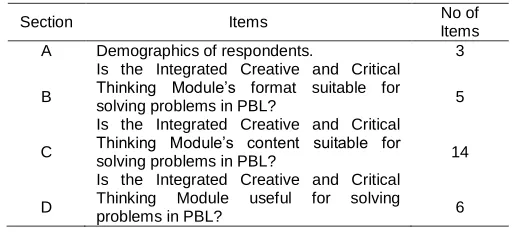
3.3 Lecturer’s Feedback
This feedback form was divided into four sections, namely A, B, C and D. The descriptions of the item of the lecturers’ feedback form are shown in Table 3.
TABLE3
FOUR SECTIONS OF THE LECTURERE’S FEEDBACK FORM
Section Items No of
Items A Demographics of respondents. 3
B
Is the Integrated Creative and Critical Thinking Module’s format suitable for
solving problems in PBL? 5
C
Is the Integrated Creative and Critical Thinking Module’s content suitable for
solving problems in PBL? 14
D
Is the Integrated Creative and Critical Thinking Module useful for solving
problems in PBL? 6
4
DATA
ANALYSIS
Descriptive statistics such as frequency and percentages were used to explain the data distribution as well as to resolve the research objectives. Data analysis was performed in Microsoft Excel 2013.
5
RESULT
AND
DISCUSSION
The following is an analysis of the findings of the three objectives:
5.1 Suitability of the Integrated Creative and Critical Thinking Module’s format in Problem-Based Learning based on the lecturers’ and students’ feedback
The findings show that a majority of lecturers (92.0%) and students (100%) agreed that the format of this module is appropriate. This is because the layout of the module has a high-quality, clear and easy-to-understand description of each step. This is important in the development of a quality module so that students can improve their understanding and mastery of the content on their own. However, two lecturers (8.0%) disagreed with the format of the module regarding the visual element used. This is because some visuals used in the module is unclear. The use of media in the process of presenting information can produce more interesting presentations [7].
TABLE4
SUITABILITY OF INTEGRATED CREATIVE AND CRITICAL THINKING
MODULE’S FORMAT IN PROBLEM-BASED LEARNING BASED ON
LECTURER’S FEEDBACK
Item
Lecturer
D A
f % f %
1 All units have a description of the
logical steps in each learning. 0 0 5 100
2
Learning activities are divided into
small steps. 0 0 5 100
3
All visual elements are integrated
into each learning. 2 40 3 60
4
All the units that make up the steps are organized according to each unit of learning.
0 0 5 100
5
Continuity of learning has been identified with dividers in each
section. 0 0 5 100
Total 0.4 8.0 4.6 92.0
6569
appropriate.
TABLE5
SUITABILITY OF INTEGRATED CREATIVE AND CRITICAL THINKING
MODULE’S FORMAT IN PROBLEM-BASED LEARNING BASED ON
STUDENT’S FEEDBACK
Item
Students
D A
f % f %
1 Module size easy to carry. 0 0 10 100 2 The design of the pages of the
module is interesting. 0 0 10 100
3 The text in the module is easy to
read. 0 0 10 100
4 The number of diagrams in the module is sufficient. 0 0 10 100
5
The diagrams in the module are placed in the right place for reference.
0 0 10 100
6 Photos in the module are placed
in the right place for reference. 0 0 10 100
7 The table in the module is easy
to reference. 0 0 10 100
8 The text order in the module is
easy to follow. 0 0 10 100
9 The instructions in the module are clear. 0 0 10 100 10 The spelling is correct 0 0 10 100 11 The use of punctuation is correct 0 0 10 100
Total 0 0 0 100
5.2 Suitability of the Integrated Creative and Critical Thinking Module’s content in Problem-Based Learning based on the lecturers’ and students’ feedback
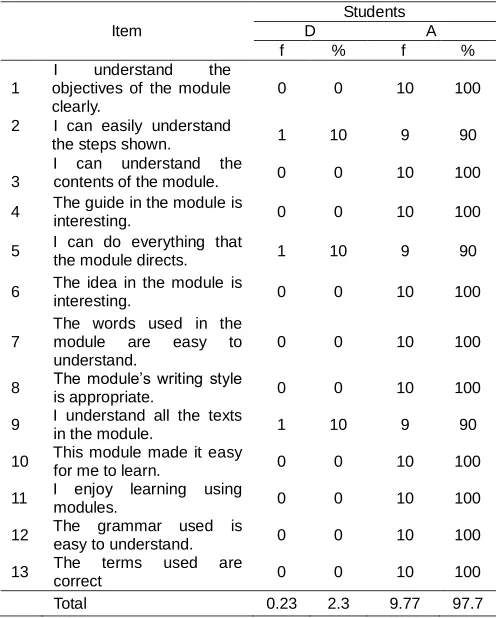
The results of the survey conducted show that 100% of the lecturers and 97.70% of the students agreed that the content of this module is appropriate. This is because the module has appropriate learning objectives, good content and easy-to-understand steps within each module unit. This is supported by [8], who stated that the use of appropriate materials is essential in the content of a module. Good teaching and learning materials are not only effective, but they attract and motivate students to stay engaged in learning [9]. In addition, the modular teaching method is a well-organized and guided teaching method. Planned teaching is a structured content-based learning system according to the sequence or steps of learning [10]. However, three students (2.30%) disagreed with the content of this module. The content may make students find it difficult to understand the steps shown in the module, as well as the use of less understood text. The students may not review every instruction and some of the texts given are too long. According to [11], the content delivery of a reading material should be concise and compact for easy comprehension.
TABLE6
SUITABILITY OF INTEGRATED CREATIVE AND CRITICAL THINKING
MODULE’S CONTENT IN PROBLEM-BASED LEARNING BASED ON
LECTURER’S FEEDBACK
Item
Lecturer
D A
f % f %
1 This module meets the
requirements. 0 0 5 100
2 The purpose of the module has
been explained to all users. 0 0 5 100
3
The introduction of this module
gives a clear picture of the scope. 0 0 5 100
4
The general goals are clearly related to the purpose of the module.
0 0 5 100
5 All objectives tend to clearly
achieve the goals of the module 0 0 5 100
6 All module content is directly
related to the objective. 0 0 5 100
7
The contents of the module have been arranged logically in the order of learning.
0 0 5 100
8 The whole of each module unit is
clearly categorized by category. 0 0 5 100
9
All learning activities fit into the content and objectives of the module.
0 0 5 100
10 All instructions are clear and
understandable. 0 0 5 100
11 All instructions are easy to follow. 0 0 5 100 12 Page layout is well organized. 0 0 5 100
13 Page layout makes the module
interesting. 0 0 5 100
14 Page layouts are easy to learn. 0 0 5 100
Total 0 0 5 100
Table 7 shows the results of the study on the suitability of the learning module based on the students’ feedback
TABLE7
SUITABILITY OF INTEGRATED CREATIVE AND CRITICAL THINKING
MODULE’S CONTENT IN PROBLEM-BASED LEARNING BASED ON
STUDENT’S FEEDBACK
Item
Students
D A
f % f %
1
I understand the objectives of the module clearly.
0 0 10 100
2 I can easily understand
the steps shown. 1 10 9 90
3
I can understand the
contents of the module. 0 0 10 100
4 The guide in the module is
interesting. 0 0 10 100
5 I can do everything that
the module directs. 1 10 9 90
6 The idea in the module is
interesting. 0 0 10 100
7
The words used in the module are easy to understand.
0 0 10 100
8 The module’s writing style
is appropriate. 0 0 10 100
9 I understand all the texts
in the module. 1 10 9 90
10 This module made it easy
for me to learn. 0 0 10 100
11 I enjoy learning using modules. 0 0 10 100
12 The grammar used is
easy to understand. 0 0 10 100
13 The terms used are
correct 0 0 10 100
Total 0.23 2.3 9.77 97.7
on the lecturers’ and students’ feedback
Based on the results of module usability analysis, 100% of the lecturers and 98.57% of the students agreed that the Integrated Creative and Critical Thinking Module in PBL is applicable to the lecturers and students. This is because this module encourages students to engage in creative thinking using diagrams, tables, flow charts and graphs that are used clearly and easily. It can be argued that using diagrams, graphs, charts, maps, pictures, animations and videos in one module can help students during the teaching and learning process [12]. A majority of students said that this module can be used as the main reference for solving problems as it has explained step by step on how to integrate creative and critical thinking styles in PBL to solve problems. However, the information in this module also helps students to master the creative and critical thinking styles as well as solve tasks to solve problems in PBL. The glossary section also helps users to understand the meaning of words that are not understood in the module. Meanwhile, the indexes in the module help users easily find terms. However, one student (1.43%) said this module could not be used throughout the teaching and learning process in the classroom. It is likely that the student felt that the content of this module is not related to the learning syllabus and is not required by the lecturer, so it will not be evaluated in the course’s test.
TABLE8
USABILITY OF INTEGRATED CREATIVE AND CRITICAL THINKING
MODULE’S IN PROBLEM-BASED LEARNING BASED ON LECTURER’S
FEEDBACK
Item
Lecturer
D A
f % f %
1
All learning activities encourage active participation and feedback.
0 0 5 100
2
Diagrams, tables, flow charts and other graphics are used to provide a clear explanation.
0 0 5 100
3
The reinforcement exercises available to each unit of learning are appropriate.
0 0 5 100
4 Overall, this module can
motivate students. 0 0 5 100
5 High-level thinking skills can be
integrated well into the module. 0 0 5 100
6
All aspects of the module can be used as a resource for learning success.
0 0 5 100
Total 0 0 0 100
Table 9 shows the results of the study on the usability of the module based on the feedback from the students.
TABLE9
USABILITY OF INTEGRATED CREATIVE AND CRITICAL THINKING
MODULE’S CONTENT IN PROBLEM-BASED LEARNING BASED ON
STUDENT’S FEEDBACK
Item
Students
D A
f % f %
1
This module can be used as the main reference for solving problems in PBL by
0 0 10 100
using creative and critical thinking styles.
2 I can use this module on
my own. 0 0 10 100
3
I can use this module throughout the teaching and learning process in the classroom.
1 10 9 90
4
The information contained in the module helps me to master the creative and critical thinking styles to solve problems in PBL.
0 0 10 100
5
This module helps me to carry out PBL assignments provided by the lecturers.
0 0 10 100
6
The glossary section of this module helps me to easily find the meaning of a term.
0 0 10 100
7
The indexes in this module help me to easily find terms.
0 0 10 100
Total 0.14 1.43 9.86 98.57
6
CONCLUSION
Overall, the results show that the Integrated Creative and Critical Thinking Module in Problem-Based Learning has been successfully developed. The module is designed to meet the requirements of lecturers and students. In terms of format and content elements, it achieves the research objectives, in which lecturers and students provided positive feedback
ACKNOWLEDGMENT
The The authors would like to thank the Ministry of Higher Education, Malaysia, for supporting this research under the MyRIVET Grant VOT No. K113. In addition, the authors also wish to thank the lecturers and students of the Faculty of Technical and Vocational Education, Universiti Tun Hussein Onn Malaysia, who had given their full cooperation to ensure the success of this study.
REFERENCES
[1]. J.S. Bridle, “Probabilistic Interpretation of Feedforward Classification Network Outputs, with Relationships to Statistical Pattern Recognition,” Neurocomputing— Algorithms, Architectures and Applications, F. Fogelman-Soulie and J. Herault, eds., NATO ASI Series F68, Berlin: Springer-Verlag, pp. 227-236, 1989. (Book style with paper title and editor)
[2]. Jones, K. O. & Reid, J. M. V. (2007). “Modifying Teaching to Address Thinking Styles.” Proceedings of International Conference on Computer Systems and Technologies, CompSysTech 2007, Article No. 79. [3]. Yee, M. H., Adam, N. N. & Tee, T. K. (2009).
Kepentingan Fungsi Gaya Berfikir Sternberg Dalam Institusi Pengajian Tinggi. Universiti Tun Hussein Onn Malaysia.
[4]. Ruggiero, V. R. (2004). The Art of Thinking: A Guide to Critical and Creative Thought. (7th Ed.). New York: Pearson Longman.
6571
http://blog.mohe.gov.my/2012/11/punca-graduan-sukar-dapat-kerja.html
[6]. Yee, M. H (2015). Kesan Manual Pengintegrasian Strategi Pemblejaran dan Kemahiran Berfikir Terhadap Penjanaan Idea Dalam Kalangan Pelajar Teknikal. Universiti Tun Hussein Onn Malaysia: Thesis Ph.D
[7]. Wiersma, W. & Jurs, S. G. (2005). Research Method in Education: An Introduction. Boston, MA: Allyn and Bacon
[8]. Harun, J. & Tasir, Z. (2003). Multimedia dalam pendidikan. Bentong: PTS Publication & Distributors. [9]. Mok, S.S, (2008a). Psikologi pendidikan untuk
pengajaran dan pembelajaran. Selangor: Penerbitan Multimedia Sdn. Bhd.
[10]. Morrison, G. S. (2011). Fundamental of Early Childhood Education. 6th Ed. New Jersey, NJ: Pearson.
[11]. Asran, H., Mustafa, M. Z., &Idris, M. S. (2007). Pedagogi Pendidikan (DBE 1213). Johor: UTHM. [12]. Tengku Zainal, T. Z., Mustapha, R., & Habib, A. R.
(2009). PengetahuanPedagogi Isi Kandungan Guru Matematik bagi TajukPecahan: Kajian Kes di Sekolah Rendah Jurnal Pendidikan Malaysia 34(1), 131-153 [13]. Leavitt, M. (2012). Learning from Visual: How