The Nigerian Prison System: A Study of Abakaliki Prison
Flora Ntunde O (Department of Sociology Enugu State University, ESUT)
Alexander Anichie (Department of Sociology Enugu State University, ESUT ENUGU)
Author (s)
Flora Ntunde O Department of Sociology Enugu State University, ESUT.
Alexander Anichie Department of Sociology Enugu State University, ESUT ENUGU.
The Nigerian Prison System: A Study of Abakaliki Prison
Abstract
This study examines the relationship between government deficit and corporate liquidity (cash holdings). Using data of nonfinancial firms in Taiwan from 1981 to 2009, this study finds that corporate liquidity is lower when government deficit is higher. In addition, corporate liquidity is related with other macroeconomic conditions, such as inflation, short-term interest rate, and economic growth. More precisely, results indicate that inflation and interest rates have a negative impact on corporate liquidity that is aggravated when government deficit is higher. Economic growth has a positive impact on corporate liquidity, and such positive impact is weakened when government deficit is higher.
Introduction
In all capitalist societies like Nigeria wherein the economy is based on private capital and socio-economic life is tired to the dictates of capital, the form and content of law and punishment like all other super structural elements or subsystems of society tend to reflect the imperatives of capitalist development. Within these imperatives are embedded the interests and values of the economically hegemonic class of bourgeois capitalist whoseinterests are advanced at the expense and marginalization of the economically disadvantaged masses.
This dialectical relationship between the economic substructure and the super structure of society is expressed in the Marxist assertion that:
"...the economic structure of society is the real foundation on which rises a legal and political structure and to which corresponds definite forms of social consciousness..."" (Mark and Engels, 1969; Guglbeurne, 1979:3)
commenting along the same line, Spitzer (1975:640) and Santos (1980:380) have emphasized that state control of deviant populations reflects the structure of priorities in specific class societies and how these are
related to class conflict. This means that the state, being part of the super structure is reasonably' constrained by the economic substructure to the extent that it (the state) tends to create laws and penalties, and enforce same, in such a manner as to advance the interest of capital and the capitalist class. The social reality, which emerges from this criminal justice environment is that the penalties prescribed by law, or enforced by the criminal justice system, tend to be at variance with the penalty preferences of the masses that constitute the public opinions.
formulated policies, established institutional structures and committed resources within the limit of its capacity towards the control of crime and the strengthening our criminal justice system. The efficiency of those measures though encouraging, has however not been as effective as a result of the increasing complexity of these crimes.
Moreover, Amnesty International (2007) demanded for urgent criminal justice reforms so as to protect, preserve the rights of prisoners in Nigerian prisons, that limited, legal protection, unequal access to justice perpetuate a situation in which the poor and other helpless individuals or groups are highly susceptible to arrest and subsequently imprisoned. Ojo (2006) admitted that Nigeria system of administration of justice needs to be reform. That there is no doubt that the system of administration of justice in the country is in dire need of reforms as there is wide-spread concern that our criminal law are not responding adequately to the challenges of social and economic development which daily confront the nation.
Amnesty International (2007) sums it by presenting that despite opinions of the public complaint commission, notable individuals as regards the criminal justice, system yet, a quick dispensation of justice is still a dream in respect of the prisoners in the overcrowded prisons in Nigeria, as if there is no way forward and basically the prisons conditions.
Statement of the problem
Crime is a social problem and it is relative to time and place. Clifford (2004), noted that generally, crime includes illicit drug trafficking, urban crimes, advanced fee fraud, corruption, money laundry, human trafficking and receiving stolen property, that is, conducts which cannot be allowed in the society (country) because of public security.
Therefore, it is generally believed that justice delayed is justice denied. Some suspects stay many years in prison custody before their trial, some even die in the hands of the police who torture them so as to get information, nobody i.e. the authorities do not wants to hear out the
public .complaints (opinions) perceive as regards ways on how to ensure solution to criminal issues in Nigeria and prisoners and prisons affairs in particular.
Objectives of the study
The following objectives of the study would be realized in the course of this research study, and it includes:
1. This study will re-awaken the consciousness of government towards the inherent problems of prisoners in Nigeria. 2. The study will help to educate the prisoners the needs why they should turn a new-leave when eventually they get freedom.
3. The study will make some useful recommendations to government about the criminal law and the prisons on how they should handle the issues.
4. This study will also create an avenue to assist government in whichever areas it deemed necessary for its assistance.
The Study area
The study is carried out at the Nigeria prisons, Abakaliki command, Ebonyi State, located in south-Eastern part of Nigeria.
The establishment of prison in Abakaliki could be traced as far back as 1902 during the colonial era. This was necessitated by a task force which was created for the construction of a fence at the provincial Hall. People rallied round and joined' in the construction of this fence and the first six people who refused to work were arrested by the army and were confined right inside this fence. They were being guarded by the army.
In the early 30's between 1936-37 there were serious cases of assault ranging from machete cuts etc and as these were so rampart among the community, it became obviously necessary for a formal establishment of a prison. Mud built houses were erected with thatched roofs where offenders were locked, both males and females.
Garvin and Mr. Butt to name but a few. All the district officers were responsible to Mr. P.N. Rally who was the president of the former Ogoja Province and he was based at Ogoja.
Mr. Igwe Ali Awoke was one of earliest staff of the prison. He was in charge of execution of murderers and later became the first prison contractor in this prison. He is a native of Abomege now in Imo State but formerly under Ogoja province. He later on nationalized in Ntezi-Aba in Abakaliki.
The hierarchy of Abakaliki prison goes thus; Comptroller General of Prison
Deputy Comptroller General of Prison Assistant Comptroller General of prison Comptroller of prison
Deputy Comptroller of prison
Assistant Comptroller of prison Chief superintendent Superintendent Deputy Superintendent Assistant Superintendent 1 Superintendent of prison Assistant 2 Superintendent of prison Inspector of prison Assistant Inspector of prison
Superintendent of prison assistant Prison Assistant 1
Prison Assistant 2 Prison Assistant3
Abakaliki prison was originally located where we have the provincial Hall now. In the year 1945, there was need for expansion of Government Area and the purpose was to accommodate the general Hospital and the New prison. At this motion, the prison was transferred to its allocated site where we now have the prison.
The number of prisoners and categories. In the early 30's the number of prisoner ranged between 50-100. These prisoners were serving sentences not exceeding one year. There used to be a Gallow in the prison and murderers were normally hanged by the hangman. The District Officer and his warrant chiefs were responsible for trial of accused persons and those convicted were hanged accordingly. But in 2008, because of the increase in rate of crime the capacity of inmates is now 708, the males are 649 and female are 59. While the prisons staff are 108. Before 1945 warder wear short sleeve shirt with V-neck, the shirt has two side pockets. They wear this over
short Khaki brown knickers T. 20 to match. After 1945 when Ex-service men returned from second world war, they started to wear short knicker brown type with two pockets and shirt khaki with two breast pockets which was always tucked inside the knicker and used cover or waist bond rolled around the waist and a leather belt on top of the cover bond, while puttees was used in place of hose.
1965 they change the uniform to khaki short and khaki jacket. The chief warders wore always with a Brown Belt (Black). When eventually the warders change to wear brown shirts and jackets, and trousers the chief warders drop the black dress and khaki trousers and jackets (khaki) with Borthea Trousers. The NCO'S and senior NCO'S now called corporals and sergeants used to put two ropes and three rope respectively (stripes) with puttees. Although puttees was common for all the junior staff except the chief warders. The chief warder put on a crown by the left hand side as the badge of rank. The inspectors of prisons now called the superintendents were putting on white jackets on white shorts. The District Officer was assisted by Assistant District commissioners. Prisoners dress used to be white shirt on white but now their uniform, presently prisoners wear up and down blue clothes through those that are awaiting trial wear white and blue stripped clothes but for clarification the prisoners appear on trousers and shirt of the same colour.
Legal provision on criminal offences in Nigeria
Offence is an act or omission which renders the person doing the act or making the omission liable to punishment under this code, or under any Act or Law, is called offences. Offences are of three kinds namely felonies, misdemeanours, and simple offences.
offences, other than felonies and misdemeanours, are simple offences.
This study will be consider under three (3) criminal offences, which includes; Human trafficking, Drug trafficking and Money laundering.
In human trafficking, sections 220-221, 222, 222A, 223, 227 and 369 of the criminal code and sections 271-273.220. It is a defense to a charge of any of the offences defined in the last preceding section to prove that the accused person believed, on reasonable grounds, that the girl was of or I above the age of sixteen years.
221. any person who has or attempts to have unlawful r carnal knowledge of a girl being of or above thirteen years and | under sixteen years of age, or knowing a woman or girl to be an idiot or imbecile, has or attempts to have unlawful carnal knowledge of her, is guilt of a misdemeanour, and is liable to imprisonment for two years. With or without caning. It is a defence to a charge of either of the offences firstly defined in this section to prove that the accused person believed, on reasonable grounds that the girl was of above the age of sixteen years. A persecution for any of the offences defined in this section shall be begin within two months after the offence is committed. A person cannot be convicted of any of the offences defined in this section upon the uncorroborated testimony of one witness.
222. A person who unlawfully and indecently deals with a girl under the age of sixteen years is guilty of a misdemeanour, and is liable to imprisonment for two years, with or without caning. If the girl is under the age of thirteen years, he is guilty of a felony, and is liable to imprisonment for three years, with or without caning. It is a defence to a charge of the offence defined in this section to prove that the accused person believed, on reasonable grounds, that the girl was of or above the age of sixteen years.
The term "deal with" include doing any act which, if done without consent, would constitute an assault as hereinafter defined.
222A. Whoever, having the custody, charge or care of a girl under the age of sixteen
years, cause or encourages the seduction, unlawful carnal knowledge or prostitution of, or the commission of an indecent assault upon, such a girl, shall be liable to imprisonment for two years.
For the purposes of this section, a person shall be deemed to have caused or encouraged the seduction, unlawful carnal knowledge or prostitutions of, or the commission of an indecent assault upon, a girl who has been seduced, unlawfully carnally known, or indecently assaulted, or who has become a prostitute, if he has knowingly allowed her to consort with, or to enter or continue in the employment of, any prostitute or person of. known immoral character.
223. Any person who procured a girl or woman who is under the age of eighteen years to have unlawful carnal connection with any other person or persons, either in Nigeria or elsewhere; or procures a woman or girl to become a common prostitute, either in Nigeria, or elsewhere; or procures a woman or girl to leave Nigeria with intent that she may become an inmate of a brothel elsewhere; or procures a woman or girl to leave her usual place of abode in Nigeria, with intent that she may, for the purposes of prostitution, become an inmate of a brothel, either in Nigeria or elsewhere; is guilty of a misdemeanour, and is liable to imprisonment for two years.
A person cannot be convicted of any of the offences defined in this section upon the uncorroborated testimony of one witness.
227. Any person who conspires with another to induce any woman or girl, by means of any false pretence or other fraudulent means, to permit any man to have unlawful carnal knowledge of her is guilty of a felony, and is liable to imprisonment for three years. The offender cannot be arrested without warrant.
pledge or security for debt whether then due and owing, or to be incurred or contingent, whether under the name of a pawn or by whatever other name such person may be called or known; conveys or induces any person to come within the limits of Nigeria in order or so that such person should be held, possessed, dealt or traded in, purchased, sold, or transferred as a slave, or be placed in servitude as a pledge or security for debt, whether or not a citizen of Nigeria holds or possesses in Nigeria any person as a slave; enters into any contract or agreement with or without consideration for doing any of the acts or accomplishing any of the purpose herein above enumerated; is guilty of slave dealing and is liable to imprisonment for fourteen years.
271. When a peace officer or police officer is proceeding lawfully to arrest, with or without warrant, a person for an offence which is a felony, and is such that the offender may be arrested without warrant, and the person sought to be arrested takes to flight in order to avoid arrest, it is lawful for the peace officer or police officer and for any person lawfully assisting him, to use such force as may be reasonably necessary to prevent the escape of the person sought to be arrested, and if the offence is such that the offender may be punished with death or with imprisonment for seven years or more, may kill him if he cannot by any means otherwise be arrested.
272. When a person who is a peace officer is proceeding lawfully to arrest, without warrant, another person for an offence which is such that the offender may be arrested without warrant, and when any person proceeding lawfully to arrest another person for any cause other than such an offence, and in .either case, the person sought to be arrested takes to flight in order to avoid arrest, it is lawful for the person seeking to arrest him to use force as may be reasonably necessary to prevent his escape.
But this section does not authorize the use of force which is intended or is likely to cause death or grievous harm.
273. When any person has lawfully arrested
another person for any offence, it is lawful for him to use such force as he believes, no reasonable grounds to be necessary to prevent the escape or rescue of the person arrested. But, if the offence is not one which is such that the offender may be arrested without warrant, this section shall be not authorize the use of force which is intended or is likely to cause death or grievous harm.
Human trafficking or trafficking in persons is a form of slavery and it includes the movement of persons who are the victims, and who are subject to violence, deception or coercion for the purpose of sexual exploitation or forced labour. Human trafficking involves a long term exploitation for economic, gain. While human trafficking itself is a crime, it also involves human rights violations against persons who are vulnerable, mostly of the low income, ill-educated, socially deprived, and those in abject poverty. The United Nations Protocol to prevent, suppress and punish trafficking in persons, especially women and children, defined trafficking in persons as, the recruitment, transportation, transfer, harboring or receipt of persons, by means of threat or use of force or other forms of coercion, of abduction, of fraud, of deception, of the use of power or of a position of vulnerability or of the giving or receiving of payments or benefits to achieve the consent of a person having control over another person, for the purpose of exploitation. Exploitation shall include, at a minimum, the exploitation of the prostitution of others or other forms of sexual exploitation, forced labour or services, slavery or practices similar to slavery, servitude or the removal of organs. Following the definition of the UN protocol section 50 of the trafficking in persons (Prohibition) Law Enforcement and Administration Act, 2003 define human trafficking as:
(author's emphasis).
In the Nigeria definition, attempt to commit the acts of human trafficking attracts the wrath of the law. 'Similarly, the issue of bonding is emphasized, especially because of the peculiar nature of human trafficking in Nigeria, in which the victims are bonded through the use of juju or "black magic". AUK based NGO (ECPAT) conducted a research in 2004 and found that in the case of Nigerian children, girls in particular: the children have been made to undergo religious rituals before they leave which may include taking clippings from the nails, hair cuttings or their blood. These tokens are taken to make a curse. If the child breaks the curse, they and their families will come to harm, or so they believe. Many children strongly believe in the curse and therefore submit to the traffickers demands.
According to the US Department of state, 600,000 to 800,000 victims are trafficked across international borders every year. This range of figures does not even include persons estimated to be trafficked within their individual countries. According to UNICEF estimates, in west and central Africa alone up to 200,000 children are trafficked annually. The global profits of traffickers are estimated to be US$7-10billion annually. In 2005 Global Report, the International Labour Organization" (ILO) estimates that more than 2.4million people have been trafficked worldwide.
Women and children are the main victims of human trafficking, and the majority being trafficked into commercial sexual exploitation. According to Amy Richard, "trafficking in women" is the use of force and deception to transfer women into situations of extreme exploitation. The use of offence to hold a victim against his or her will can be both physical and psychological. Women and children are stereotyped as property, commodities, servants, and sexual objects.
Prisons are society answers to a number of social problems.
They house outcasts, misfits and some
highly dangerous people. While prisons provide a part of the answer to the question of crime control, they also face problems of their own. A few of those special problems are described in what follows; A. AIDS: In 1993 the centre for diseases control report confirming 11,565 cases of AIDS among inmates of the nation's prisons an increase of more fire fold since 1987. By the time of the survey, more than 3,500 inmate deaths had been attributed to HIV infection throughout prisons and jails across the nation. Recent surveys, one conducted in 1995, have estimated the number of HIV infected inmates in the nation's prisons at much higher levels some as high 80,000 inmate. Positive Seroprevalence rates have been found to vary from region to region ranging between 2.1% and 7.6% of all men entering prison and between 2.5% and 14.7% of women. Some states have especially high rates. New York, for example, recently reported that 20% of all inmates houses are HIV positive, with slightly less than 10% of those exhibiting symptoms of AIDS. Men account for 95% of all inmates affected by AIDS. Blacks at 58%, comprise the largest racial/ethnic category; 32% those infected are white and 10% are Hispanic. Contrary to popular opinion, AIDS transmission inside of prisons appears minimal. In a test of inmates at US Army military prison, 542 prisoners who, upon admission had tested negative for exposure to the AIDS virus, were retested two years later. None showed any signs of exposure to the virus. On the other hand, some authorities suggest that it is only a matter of time before intravenous drug abuse and homosexual actively inside of prisons begin to make a visible contribution to the spread of AIDS. Similarly, prison staffers fear infection' from AIDS through routine activities, such as cell searches, responding to fights, performing body searches, administering CPR, and confiscating needless or weapons.
Mass screening and inmate segregation, however, may be prohibitively expensive. They may also be illegal. Some states especially prohibit HIV antibody testing without the informed consent of the person tested.
Study population
This study was narrowed to Nigerian prisons Abakaliki. The study population was based on the total numbers of-prisoners or inmate in Nigerian prisons Abakaliki which is 708 in 2008. males are 649 and 59 was convicted, 570 were awaiting trial, 20 death row while females are 69 and 19 was convicted, 35 awaiting trial and 5 on death row.
Sample Size/Sample Techniques
Using sample fraction method in determining the sample size, I the population of the sample area was 708 while researcher used the fraction of \2o x 708/i = 35. Now the researcher
made use of 35 as sample size.
The systematic random sampling was adopted on selecting that sample for this study. Here, the sampling interval was twenty (20). This means that one out of every twenty (20) persons was selected at random out of the total population of the study area.
Analysis
Table 1: knowledge of crime
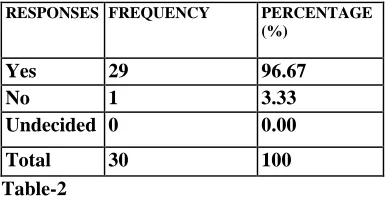
The table-2 shows that, have you heard about crime before, twenty-nine respondents representing (96.67%) were yes and one respondents representing (3.33%) were no/,
zero respondents representing (0.00%) were undecided that is the result of respondents.
Table-2
Table-3 Respondents punished for crime they have committed
Responses Frequency Percentage (%)
Agreed 12 40
Strongly agree
2 6.67
Disagree 7 23.33
Strongly disagreed
5 16.67
Undecided 4 13.33
Total 30 100
The result in table above shows that twelve respondents representing (40%) were agree, two respondents representing (6.67%) were strongly agree, seven respondents representing(23.33%) were disagree, five respondents representing (16.67%) were strongly disagree, while four respondents representing (13.33%) were undecided. In this result it shows that the number of respondents that agree of punishment for the crime they have committed is higher than others.
In the table-4 the result shows that eleven respondents representing (36.67%) agreed, seven respondents representing (23.33%) strongly agreed, three respondents representing (10%) disagreed, and five respondents representing (16.67%) strongly disagreed, while four respondents representing (13.33%) were undecided. The result above shows that respondents who agree that punishment serves its purpose are more than others.
RESPONSES FREQUENCY
PER
PERCENTAGE (%)
Strongly agree
7 23.33
Disagree 3 10
Strongly disagreed
5 16.67
Undecided 2 13.33
Total 30 100
RESPONSES FREQUENCY PERCENTAGE
(%)
Yes 29 96.67
No 1 3.33
Undecided 0 0.00
Table-4 Purpose of punishment
Table-5 The need for prison reforms
In the table-5, eleven respondents representing (36.67%) were agreed, four respondents representing (13.33%) were strongly agreed, nine respondents representing (30%) were disagree and five respondents representing (16.67%) were strongly disagreed, while one respondent representing (3.33%) were undecided. The respondents result above table shows that the highest numbers of respondents is agree, which have
Findings of the Study
In this study, the researcher discovered that males commits crime than females because they are the head of the family which placed on them the responsibility of taking care of the wife and children by feeding, giving them security, clothing them and so on. And also people from the age of 18 to 28years and also singles commit more crime than the married ones because when somebody is single, he may intend to get easily involved in criminal activities. In the respondents section of table 5
shows that 36.67% of criminals are O level students. In this result the researcher found that people in the society are aware of crime which shows in table 7 that 96.67% of total respondents.
It is found that torturing criminals can be a dimension of getting information from them which was supported in table 13, a good members of respondents says Yes which have 53.33% of total respondents.The researcher found that punishment served its purpose that means that any person or group of person's who commit crime will be punished. It was found in table 10 that 36.67% of respondents agreed that punishment for crime is good. That is what triggers off the sanction under criminal law is usually by fines, probation, incarceration or capital punishment. It is also found that the fundamental human rights of prisoners should be protected, in table 17, we can see that 56.67% of respondents supported the idea. The researcher found that public opinion regards prisons reforms is needless, like in the analysis of table 15 shows that 36.67% of respondents supported the idea.
Recommendations
Having carried out an in-depth study of the legal provisions and public opinion on criminal offences in Nigeria, the researcher wishes to summit the following recommendations which he believed will go a long way in alleviating the problems of prisons and prisoners problems. They are as follows:
1. It could range from formalizing the current practice of double bunking inmates as a short term solution to the problem of an increasing prison population to a conscious decision that since there is no money to build more prisons, double bunking is the preferred solution and should be formalized as long term corrections branch policy.
2. Prisons are designed to reflect the standard of treatment of inmates that society considers acceptable.
3. Prisoners should have a say in the management of the prison system
RESPONSES FREQUENCY PERCENT
AGE (%)
Strongly
agree
7
23.33
Disagree
3
10
Strongly
disagreed
5
16.67
Undecided
2
13.33
Total
30
100
RESPONSES FREQUENCY PERCENT
AGE (%)
Agreed 11 36.67
Strongly agree 4 13.33
Disagree 9 30
Strongly disagreed
5 16.67
Undecided 1 3.33
itself, with the prisoners playing the roles of consultants, counselors and mediators.
4. Television, computers, radio and other modern Facilities should be provided for inmates as an incentive to enhance, inform and educate prisoners.
References
Aguene I. N. (1999) "Contemporary social Problems", Prize publishers, Nsukka. Dambazua A. B. (2007) "Criminology and Criminal Justice". Nigerian Defence Academy Press, Kaduna.
Igbo. E. U. M. (1999) "Introduction to Criminology"Afro-orbis Publication Ltd. Olakanmi O. (2004) "Criminal Code and EFCC", Panaf Press, Lagos.
Ogoh S. I. and Onuoha J. (2006) "Peace and Conflict studied in Africa". Jones Communications Publishers Enugu.
Onyeneke, A. (1996) "Doing Sociology", Oguson: Printers Tech, Nsukka.
Reynold, M.O. (1998) NIPA Policy Background 148, August 17, Uwals. M.I., Chon. Justical, Congress on crime Prevention and Treatment of Offenders Viena. 10-7 April 2000.
Amnesty International, February 25, 2008. The problem with Prisons (and the solution) by Joyce Arthur, January 1995.
Nnaba I. (2004) Vanguard, Friday, July 2. 'No.22