IJEDR1704203
International Journal of Engineering Development and Research (www.ijedr.org)
1256
Evaluation of Surface Roughness of Machined
Components using Machine Vision Technique
1
Manjunatha,
2Dr R Rajashekar,
3Dr B M Rajaprakash,
4Naveen S,
5Mohan G
1,4,5P.G. Scholar, 2Assistant Professor, 3Professor and Chairman,
1,2,3,4,5Department of Mechanical Engineering,
1,2,3,4,5University Visvesvaraya College of Engineering, Bangalore University, Bengaluru, India
________________________________________________________________________________________________________
Abstract—The machined components produced by different machining process have different surface roughness characteristics. Surface roughness evaluation is very important for many fundamental problems such as contact deformation, tightness of contact joints and positional accuracy etc.Contact stylus roughness measurement is widely used for measuring surface roughness which may lead to scratches on machined surfaces and more time-consuming inspection process. Machine vision is the one of the noncontact surface roughness measuring technique which is being noncontact, reliable and accurate with low cost. This technique provides imaging based automatic inspection, process control and robot guidance in manufacturing industries. In this work the analysis and measurement of surface roughness of Aluminium-6061-T6 specimens which are prepared on EDM, CNC milling and surface grinding machines by varying input parameters are carried out. The effect of machining parameters on surface roughness of EDM, CNC milling and grinding machined specimens are analyzed by evaluating their surface roughness using contact stylus method. The low-cost noncontact Machine Vision technology was investigated as alternate method for evaluation of surface roughness. The digital images of machined surfaces were captured using suitable lighting and camera. The images are processed to enhance their quality and analyzed to determine image optical parameters such as Standard Deviation, Root Mean Square and Mean to evaluate surface roughness using MATLAB software. The image optical parameters determined to evaluate surface roughness shows good correlation with surface roughness parameter “Ra”, which is determined by contact stylus method. Machine Vision technique can be used as automated inspection method to evaluate surface roughness of machined components either online/offline.
Keywords—EDM, CNC milling, Surface grinding, MATLAB, Machine Vision, Noncontact, surface roughness, Image processing.
________________________________________________________________________________________________________
I.INTRODUCTION
Surface roughness is irregular geometry shape characteristic(error) which includes peaks and valleys on the machined surfaces. Surface roughness is an important measure of product quality since it greatly influences the performance of mechanical parts as well the cost of production. The assessment of surface roughness can be carried out in many number of ways. The most common used stylus method to calculate surface roughness has limitations being contact with machined surfaces. Machine vision technology has maintained tremendous vitality during a ton of fields. New applications still are found and existing applications to expand. Many investigations are done to examine surface roughness of the manufacturing components. Though it's been shown that the surface roughness of a work piece is strongly characterize by the surface image, sensible surface roughness instruments supported machine vision technology are still tough [03].
IJEDR1704203
International Journal of Engineering Development and Research (www.ijedr.org)
1257
preprocessed to eliminate the effects due to improper illumination and noise. Median low pass filter was applied to the captured images to avoid the salt and pepper effect [5].There are many approaches are introduced to evaluate the surface roughness of the machined components, each approach has its own advantages and disadvantages in terms of easiness, accuracy etc. But from the literature research it is cleared that Machine Vision is one of the easiest, low cost and high accurate surface roughness measurement technique.
II.EXPERIMENTAL PROCEDURE
The experiment was mainly focused on the low cost and high accurate, being noncontact surface roughness measurement technique alternate to most commonly used stylus measurement technique. From the research Machine Vision was found an alternate surface roughness measurement technique. The experiment methodology is given in the below Fig1.
Figure1 Methodology of the experiment
Specimen preparation: The specimens of Aluminium-6061-T6 were prepared on EDM, CNC milling and surface grinding machines by varying the machining parameters. The surface characteristics of the specimens are different for different specimens produced by the different machining processes. Parameters considered for preparing specimens are:
EDM: peak current, pulse on time and gap voltage CNC milling: speed, feed and depth of cut Surface grinding: wheel speed and depth of cut
Measurement of surface roughness by stylus instrument: Measured average surface roughness (Ra) of the surfaces of the specimens for further analysis by widely accepted contact stylus (Mitutoyo Surf Test SJ-500) method.
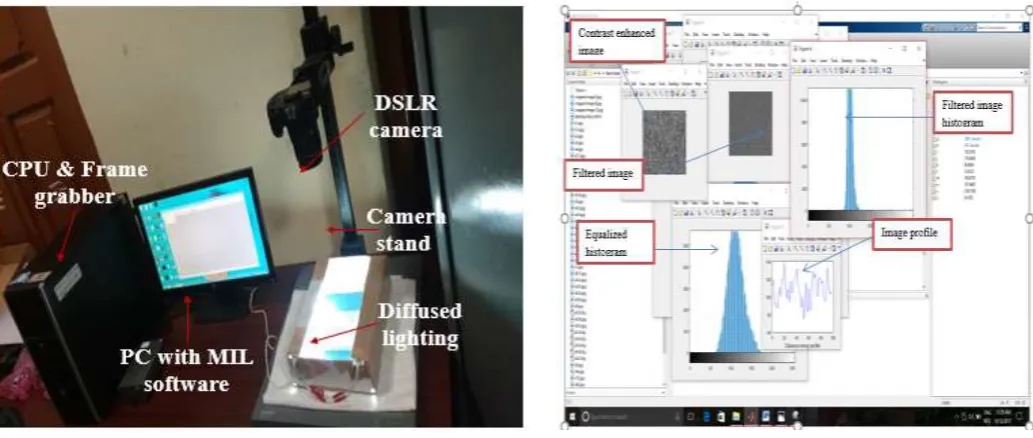
Image acquisition: The analysis of the surfaces requires good quality of images, so to capture good quality of images we should select good camera and suitable lighting arrangement. Lighting is one of the important part of the image acquisition to get good quality of images and different material have different reflectivity therefore lighting position is very important to acquire good quality of images.
Specimen preparation
Image acquisition
Surface roughness measurement by stylus Image processing
Image analysis
IJEDR1704203
International Journal of Engineering Development and Research (www.ijedr.org)
1258
The images of the machined surfaces were captured using canon EOS 1200D camera with diffuse, white light arrangement shown in the Fig.2.The focal length and lighting position was same for all the specimens.Figure 2. Image acquisition using Machine Vision set up Figure 3. Image processing and analysis in MATLAB
Image processing: It is the technique in which it enhances the image quality to extract the useful information from the images. The images of the machined surfaces were processed in MATLAB to evaluate surface roughness of the images grabbed.
The steps were carried out in image processing are:
• The conversion of color images into gray images to easily extract the useful information for surface roughness evaluation of the machined surfaces.
• The noises were removed from the acquired images using median filtering technique. The noises exist in the images due to the dust or impurities on the machined surfaces while image acquisition. These noises may lead to loss of information of the images.
• The contrast of the filtered images was enhanced using histogram equalization technique to extract all the useful information mainly the edges of the irregularities present on the machined surfaces.
Image processing was done for the images of the specimen of the EDM, CNC milled and surface grounded. The resulting images and their histograms are shown in the Table1.
IJEDR1704203
International Journal of Engineering Development and Research (www.ijedr.org)
1259
Image analysis: To analyze the surfaces of the machined surfaces here we have extracted the numerical parameters called as optical parameters from the processed images. These optical parameters are based on the pixel intensity distribution along the lines selected on the ROI of images. Those are given belowThe Mean Value of the pixel intensity distribution is the mean of the light intensity values along the line profile. It was calculated as:
Mean= 1
N ∑ 𝐹𝑖𝑋𝑖 255
i=0 N= total number of pixels in the distribution Fi = intensity value of pixel Xi Xi = pixels along the line (i =0, 1, 2 . . ., 100)
The Standard Deviation of the pixel intensity distribution (SD) provides the variation in the light intensity value along the line profile and was computed using:
𝑆. 𝐷 = √∑ 𝐹𝑖(𝑋𝑖−𝑋)2 𝑁−1 255
𝑖=0
X = Mean value of the pixel intensity distribution
X= Xi /N
The RMS of the pixel intensity distribution is the root mean square height of the pixel intensity distribution and was
computed using:
𝑅𝑀𝑆 = √∑𝐹𝑖 2
𝑁 255
𝐼=0
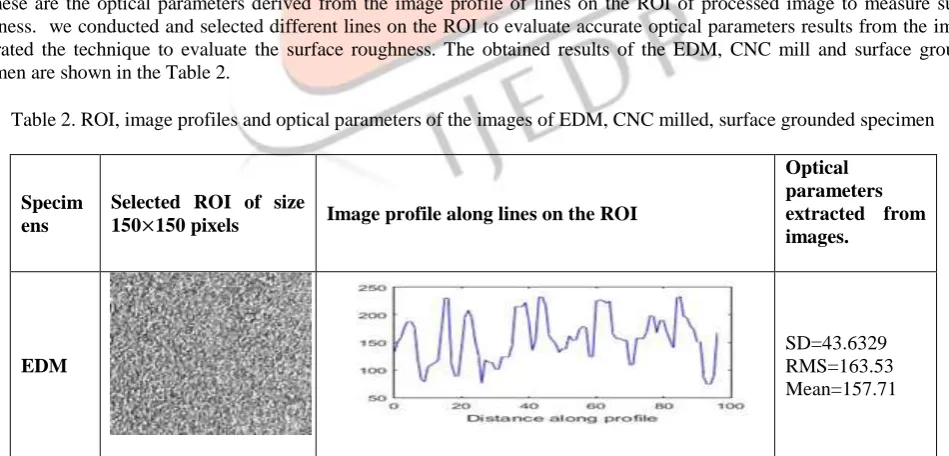
Figure 4. a) ROI (region of interest) of the machined surface image. b) c) d) Image profiles along lines on the ROI
These are the optical parameters derived from the image profile of lines on the ROI of processed image to measure surface roughness. we conducted and selected different lines on the ROI to evaluate accurate optical parameters results from the images. Calibrated the technique to evaluate the surface roughness. The obtained results of the EDM, CNC mill and surface grounded specimen are shown in the Table 2.
Table 2. ROI, image profiles and optical parameters of the images of EDM, CNC milled, surface grounded specimen
Specim ens
Selected ROI of size
150×150 pixels Image profile along lines on the ROI
Optical parameters extracted from images.
EDM
IJEDR1704203
International Journal of Engineering Development and Research (www.ijedr.org)
1260
CNCmilled
SD=56.6 RMS=134.39 Mean=121.98
Ground ed
SD=25.63 RMS=111.21 Mean =109.68
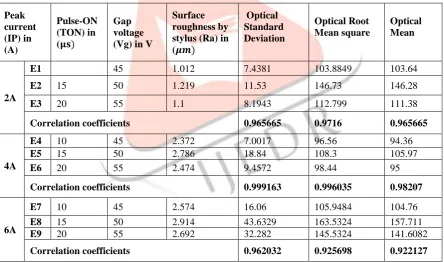
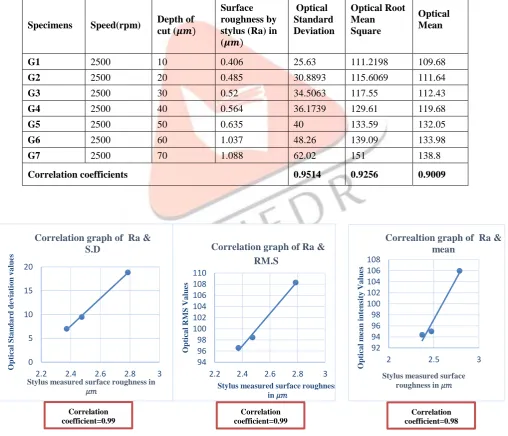
Results and Comparison: The measured Ra values by stylus method and optical parameters standard deviation, root mean square and mean values are tabulated in Table 3 (for EDM specimens), Table 4 (for CNC milled specimens) Table 5 (for Surface grounded specimens) with varied parameters.
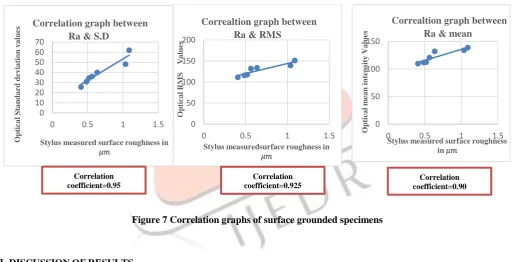
The regression analysis was done to calculate correlation between the optical parameters and stylus measured surface roughness values. The correlation graphs were plotted for stylus measured and optical parameters derived that are shown in the Fig.5, Fig.6, Fig.7
Table 3 Correlation Values between Optical Parameters and Average Surface Roughness of EDM specimens
Table 4 Correlation Values between Optical Parameters and Average Surface Roughness of CNC milled specimens
Constant speed (950RPM)
Feed (mm\rev)
Depth of cut(mm)
Surface roughness by stylus (Ra) in (𝝁𝒎)
Optical Standard Deviation
Optical Root Mean square
Optical Mean
M1 200 0.5 0.617 10.577 88.67 88.35
M2 500 0.5 0.7438 24.415 118.5 112.6
M3 650 0.5 1.018 30.62 120.28 117.4
Peak current (IP) in (A)
Pulse-ON (TON) in (𝛍𝐬)
Gap voltage (Vg) in V
Surface roughness by stylus (Ra) in (𝝁𝒎)
Optical Standard Deviation
Optical Root Mean square
Optical Mean
2A
E1 45 1.012 7.4381 103.8849 103.64
E2 15 50 1.219 11.53 146.73 146.28
E3 20 55 1.1 8.1943 112.799 111.38
Correlation coefficients 0.965665 0.9716 0.965665
4A
E4 10 45 2.372 7.0017 96.56 94.36
E5 15 50 2.786 18.84 108.3 105.97
E6 20 55 2.474 9.4572 98.44 95
Correlation coefficients 0.999163 0.996035 0.98207
6A
E7 10 45 2.574 16.06 105.9484 104.76
E8 15 50 2.914 43.6329 163.5324 157.711
E9 20 55 2.692 32.282 145.5324 141.6082
IJEDR1704203
International Journal of Engineering Development and Research (www.ijedr.org)
1261
M4 800 0.5 1.5755 49.52 145.9 137.226
Correlation coefficients 0.971945 0.9108 0.971945
Constant feed (400 mm/rev)
Speed
(RPM) Depth of cut (mm)
Surface roughness by stylus (Ra) in (𝝁𝒎) Optical Standard Deviation Optical Root Mean Square Optical Mean
M5 650 1.5 1.594 56.6 134.39 121.98
M6 800 1.5 1.374 34.81 118.95 113.29
M7 950 1.5 1.165 30.72 116.47 112.95
M8 1100 1.5 1.08 29.32 103.18 98.96
Correlation coefficients 0.927459 0.94659 0.879148
Table 5 Correlation Values between Optical Parameters and Average Surface Roughness of Grounded specimens
Figure 5 Correlation graphs of EDM specimens (peak current 4A) 0
5 10 15 20
2.2 2.4 2.6 2.8 3
Op ti ca l S ta n d a rd d ev ia ti o n v a lu es
Stylus measured surface roughness in 𝜇𝑚
Correlation graph of Ra & S.D 94 96 98 100 102 104 106 108 110
2.2 2.4 2.6 2.8 3
Opt ic a l RM S Va lu es
Stylus measured surface roughness in 𝜇𝑚
Correlation graph of Ra & RM.S
Specimens Speed(rpm) Depth of cut (𝝁𝒎)
Surface roughness by stylus (Ra) in (𝝁𝒎) Optical Standard Deviation Optical Root Mean Square Optical Mean
G1 2500 10 0.406 25.63 111.2198 109.68
G2 2500 20 0.485 30.8893 115.6069 111.64
G3 2500 30 0.52 34.5063 117.55 112.43
G4 2500 40 0.564 36.1739 129.61 119.68
G5 2500 50 0.635 40 133.59 132.05
G6 2500 60 1.037 48.26 139.09 133.98
G7 2500 70 1.088 62.02 151 138.8
Correlation coefficients 0.9514 0.9256 0.9009
92 94 96 98 100 102 104 106 108
2 2.5 3
O p ti ca l m ea n i n tens it y V a lu es
Stylus measured surface roughness in 𝜇𝑚
IJEDR1704203
International Journal of Engineering Development and Research (www.ijedr.org)
1262
Figure 6 Correlation graphs of CNC milled specimens (constant speed)Figure 7 Correlation graphs of surface grounded specimens
III.DISCUSSIONOFRESULTS
Surface roughness measurements were performed on Aluminum 6061 alloy specimens machined by milling, grinding and electrical discharge machining processes with varying the parameters and their values are presented in the Table 3, 4and 5. After preprocessing the optical parameters defined standard deviation, mean and root mean square values are calculated along the lines selected on the region of interest and the obtained optical parameters are plotted against the stylus measured average surface roughness values and calculated correlation values from the graphs plotted. Those values are presented in the Table 3,4 and 5.
It was observed that optical parameters have good correlation with the stylus measured average surface roughness (Ra) values. Standard deviation has better correlation with the average surface roughness values compare to mean and root mean square values.so standard deviation can be used for surface roughness evaluation.
IV.CONCLUSIONS
This work clearly indicates that the Machine Vision technique can be used to evaluate the surface roughness of the machined components and it is cleared from the results that stylus measured Ra values and optical parameters values have good linear relationship. Among all the optical parameters defined, standard deviation has good correlation with Ra values measured by the conventional and widely accepted stylus instrument of the machined surfaces prepared by the machining processes that are electrical discharge machining, milling and grinding processes. The optical parameters evaluation procedure is same as stylus surface roughness measurement procedure. It is indicating that Machine Vision technique can be used effectively with low cost set up and it yields reliable and high accuracy results.
0 10 20 30 40 50 60
0 1 2
Op ti ca l S ta n d a rd d ev ia ti o n v a lu es
Stylus measured surface roughness in 𝜇𝑚
Correlation graph between Ra & S.D
0 10 20 30 40 50 60 70
0 0.5 1 1.5
O p ti ca l S ta n d a rd d ev ia ti o n v a lu es
Stylus measured surface roughness in 𝜇𝑚
Correlation graph between Ra & S.D
0 50 100 150 200
0 0.5 1 1.5
Op ti ca l R M S V a lu es
Stylus measuredsurface roughness in 𝜇𝑚
Correaltion graph between Ra & RMS
0 50 100 150
0 0.5 1 1.5
Op ti ca l m ea n i n te n si ty V a lu es
Stylus measured surface roughness in 𝜇𝑚
Correaltion graph between Ra & mean
Correlation coefficient=0.90 Correlation coefficient=0.925 Correlation coefficient=0.95 0 50 100 150 200
0 0.5 1 1.5 2
Op ti ca l R M S V a lu es
Stylus measured surface roughness in 𝜇𝑚
Correlation graph between Ra & RMS
0 50 100 150
0 1 2
Op ti ca l m ea n i n te n si ty v a lu es
Stylus measured surface roughness in 𝜇𝑚
Correlation graph between Ra & mean
IJEDR1704203
International Journal of Engineering Development and Research (www.ijedr.org)
1263
REFERENCES[1] B. Ramamoorthy and V. Radhakrishnan, “Statistical Approaches to Surface Texture Classification,” International Journal of Wear 167 (1993) 155-161.
[2] Rajneesh Kumar, P. Kulashekar, B. Dhanasekar and B. Ramamoorthy, “Application of Digital Magnification for Surface Roughness Evaluation Using Machine Vision,” International Journal of Machine Tool and Manufacture 45 (2005) 228-234. [3] Lee, B. Y. and Tarng, Y. S., “Surface roughness inspection by computer vision in turning operations,” Int. Journal of Machine
Tools and Manufacture, Vol. 41, No. 9, pp. 1251-1263, 2001
[4] F. Luk, V. Hyunh and W. North, “Measurement of Surface Roughness by a Machine Vision System,” Journal of Physics E Scientific Instruments 22 (1989) 977-980.
[5] N. Nithyanantham and P. Suresh. “Evaluation of cast iron surface roughness using image processing and machine vision system,” ARPN Journal of Engineering and Applied Sciences J. Clerk Maxwell, A Treatise on Electricity and Magnetism, 3rd ed., vol. 2. Oxford: Clarendon, 1892, pp.68–73.
[6] D. De Voe, L. Knox, G. Zhang. “An experimental study of surface roughness assessment using image processing”. University of Maryland College park.
[7] B. Dhanasekar and B. Ramamoorthy, “Evaluation of Surface Roughness Using a Image Processing and Machine Vision System” MAPAN- Journal of Metrology Society of India, Vol. 21, No.1, (2006).
[8] Richard Chiou. “On-line surface roughness measurement using labview and vision method for e-quality control,” American Society for Engineering Education, 2010
[9] Srinagalakshmi Nammi and B.Ramamoorthy “ Effect of surface lay in the surface roughness evaluation using machine vision,” www.elsevier.de/ijleo
[10]S. Damodarasamy, S. Raman,“Texture analysis using computer vision, Computers in Industry,”16 (1991) 25–34.
[11]G Dilli Babu , K. Sivaji Babu and B. Uma Maheswar Gowd “Evaluation of Surface Roughness using Machine Vision,” 978-1-4244-9005 ©2010 IEEE.
[12]Shivanna D.M, Suraj Jain.M , Bharath Kumar K.K. “Roughness Measurement using Vision System by Geometric Search Approach,” International Journal of Advances in Engineering Science and Technology
[13]B.M. Kumar and M.M. Ratnam “Machine vision method for non-contact measurement of surface roughness of a rotating workpiece,” 35/1 (2015) 10–19 © Emerald Group Publishing Limited [ISSN 0260-2288]