Licensed under Creative Common Page 1
http://ijecm.co.uk/
ISSN 2348 0386
REVIEW OF HETERODOX VIEW ON THE DECISION MAKING
UNDER UNCERTAINTY
Yasushi SUZUKI
Professor of Finance, Ritsumeikan Asia Pacific University, Japan [email protected]
Abstract
The heterodox view on the decision-making under "un-measurable" uncertainty is nearly dead
particularly among the practitioners in financial markets. In particular, the Shacklean theory of
choice of action has disappeared. To critically assess the recent trend called as neo-liberalism
or ugly neologisms - "marketization plus financialization", this paper sheds light on some
important elements in the heterodox theory to be resurrected, while referring to the traditional
Japanese non-algorithmic monitoring style. Our arguments suggest that we aim at a scheme of
direct taxation on the function-less investors with a merely investor's strategy of portfolio
management, simultaneously aiming at a scheme of giving appropriate incentives for the
lenders and investors with a partner's strategy who need a certain buffer or cushion for
responding to fundamental uncertainties.
Keywords: Credit risk management, Financialization, Non-algorithmic monitoring, Shackle, Subjectivists, Uncertainty
INTRODUCTION
Licensed under Creative Common Page 2
view on the decision-making under "unmeasurable" uncertainty is nearly dead particularly among the practitioners in financial markets. In particular, the Shacklean theory of choice of action is almost dead. However, should we leave the almost total lack of utilization of the heterodox theory behind? This paper draws on the traditions of Post-Keynesian and heterodox economics, with its focus on uncertainty (for instance, Davis, 1995; Dymski, 1993; Ford, 1983; Hargreaves Heap, 1992; Keynes, 1936, 1937; Knight, 1921; Minsky, 1975; Shackle, 1949a, 1949b, 1972; Simon 1983, 1996).
In the final chapter of the General Theory (Concluding notes on the social philosophy towards which the General Theory might lead), Keynes discussed about social justice of tackling our economic society's arbitrary and inequitable distribution of wealth and income; "we might aim in practice (there being nothing in this which is unattainable) at an increase in the volume of capital until it ceases to be scarce, so that the function-less investor will no longer receive a bonus; and at a scheme of direct taxation which allows the intelligence and determination and executive skill of the financier, the entrepreneur et hoc genus omne (who are certainly so fond of their craft that their labour could be obtained much cheaper than at present), to be harnessed to the service of the community on reasonable terms of reward" (Keynes, 1936). Our economic society, however, seems not to have come towards the ideal direction in his mind. Rather, the trend of financialization serves that "financial markets become the pace-setters of all markets as wealth effect, positive and negative, play an increasing role in economic cycle" and "gambling with analysis, advice, appraisal, advertising, and commission-charging becomes a major growth industry" (Dore, 2000).
The screening and monitoring actors (the banks as lenders and the investors as fund-providers) are working under conditions of uncertainty and bounded rationality. This means that monitoring activities are not mechanical, and that they are intrinsically based on subjective judgements that are often extremely difficult. Uncertainty is fairly understated in academic arguments on the monitoring activities by the monitoring actors. In order to respond to the trend of financialization, I believe, it is worth reviewing the heterodox theory on the decision-making under uncertainty to shed light on some elements whether to be resurrected.
Licensed under Creative Common Page 3
important but now discarded features of the traditional Japanese non-algorithmic monitoring style. Section 6 puts concluding comments.
THE SHACKLEAN THEORY OF CHOICE OF ACTION
To cast shadow on the foundation of the arithmetic view which is dominant in the social science, G. L. S. Shackle, one of the radical subjectivists, referred to the following episode;
In his novel The Widows of the Magistrate, Keith West tells how certain Chinese official once plotted rebellion against their Emperor. The brief passage that I am going to reproduce describes the thoughts of a certain sentry, who had to decide whether to obey his immediate superior, the treacherous Captain of the Guard, or to stand alone against the rebels in loyal defence of the Emperor‟s representative, the Lady Hibiscus:
In the room above, where the great drum stood, the sentry named Kwong Hui was testing the
stacked bows of mulberry wood and setting the arrows in order.
‘I am a man who seizes opportunity’, he told the admiring women and the sleeping children. ‘If I obey the Captain of the Guard, two things may happen. Either the rebellion succeeds, and I
remain a solder in the guard, or the rebellion fails, when I lose my head. Whereas if I obey the
Lady Hibiscus, two things may happen. Either the rebellion succeeds, I lose my head, or the
rebellion fails, when I shall receive rewards quite beyond my imagination to conceive. Now of
these four possibilities, the last only attracts me. So I shall strive to hold this tower un-entered,
as long as is possible, until the arrival of help from elsewhere. That is the course of wisdom, as
well as the course of courage, and I am deficient in neither wisdom nor courage. ‘
This eminently wise and sensible decision, reached with such incisive logic, might not have been so readily attained had the sentry been acquainted with the theory of probability. For then he might have argued thus; „I find in the record of history a thousand cases similar to my own, wherein the person concerned decided upon treachery, and in only four hundred of these cases the rebellion failed and he was beheaded. On balance, therefore, the advantage seems to lie with treachery, provided one does it often enough.‟
Having one‟s head cut off is, for the person concerned, rather fatal. Had the sentry decided to support the rebellion, he might have had time, just before the axe fell, to reflect that he would never, in fact, be able to repeat his experiment a thousand times, and that thus the guidance given him by actuarial considerations had proved illusory (Shackle, 1949a).
Licensed under Creative Common Page 4
choices by some kind of averaging or 'concertina' process potentially ignores vital information and asks the human psyche to execute an inordinately complex operation (when it aims for simplicity since it is not capable of carrying forward a surfeit of information), he argues that the individual will partition his set of expectational data into a loss/negative yield and a gain/positive yield subset" (Ford, 1983). Shackle's theory of choice uncertainty is based on possibility, which he distinguished from the classical conception of probability.
It is only a man who feels very sure of a given outcome who can be greatly surprised by its non-occurrence. A degree of belief is not in itself a sensation or an emotion; but a high degree of belief is a condition of our being able to feel a high degree of surprise. The concrete mental experience which corresponds to any given degree of belief in some particular hypothesis is, I think, the degree of surprise to which this belief exposes us (supposing it to remain unchanged until the truth will be known) and will subject us in case the hypothesis proves false. Accordingly, we can use the degree of surprise which we judge would be caused to us by the non-occurrence of a given outcome, supposing there had been meantime no change in our relevant knowledge, as an indicator of our degree of belief in this outcome. The range of possible intensities of surprise lies between zero and that intensity which would arise from the occurrence of an event believed impossible, or held to be certain not to occur (Shackle, 1949b).
Let us look further into the subjectivist's theory through the illustration by Professor Ford. According to the Shacklean theory, the investors map out at their discretion the range of returns they believe could occur from investment in the past. After that, they attach a degree of potential surprise to each of those returns instead of a measure of the probability of occurrence. "Now the degree of potential surprise indicates the degree of surprise the investor would feel if a specified asset yield turned out to be true. The size of degree of potential surprise, which reflects the individual's degree of belief in an outcome, can range from zero to some (subjective, of course) maximum value, which would register complete disbelief in the possibility that the outcome to which it was assigned could occur" (Ford, 1983).
Once the degrees of potential surprise have been attached to the possible yields on the asset, the investor separates them into a gain and a loss set. We separate out the potential surprise function into its two branches, that for gains (g) and that for losses (l), if we denoted potential surprise by y.
y = y(g) ; y = y(l)
Licensed under Creative Common Page 5
or (l,y) to arrest the attention of the individual. It is to be seen as a stimulus function and it is usually labelled the ∅-function; so that:
∅ = ∅ 𝑔, 𝑦 ; ∅ = ∅ (𝑙, 𝑦)
So, ∅ = ∅ (𝑟, 𝑦), where r represents either a gain or loss and y denotes potential surprise. ∅ is only dependent upon those two magnitudes. It is assumed by Shackle that ∅r > 0, and ∅y < 0. Since r refers to 'outcome' this means that if gain increases ascendancy will increase; similarly if loss increases then ∅ increases (Ford, 1983).
The larger the expected gains, the higher the degree of disbelief associated with its accomplishment in the future, and then the less its capacity to arrest the attention of the decision-maker. According to Shackle's concept of focus gain and loss, these two elements will, simultaneously considered, determine the best outcome (focus gain). By similar reasoning, the agent develops a focus loss: the worst outcome he can imagine, which is still sufficiently likely to command his attention (Anjos & Chick, 2000). According to Shackle, if one links the points which represent situations which are indifferent for a specific agent, which are equally attractive or equally repellent for an agent with his particular temperament, tastes and material endowments, one can form "gambler indifference curves".
Shackle's theory of choice of action under uncertainty is predicated on his view that the probability approach cannot provide a reliable, rational foundation for action because the application of objective probabilities, relative frequencies, to decision-making is inadmissible, indeed irrelevant, because almost invariably decisions are unique phenomena (Ford, 1983). An outcome may be envisaged as perfectly possible but yet be improbable. An individual, in essence does not have the opportunity to, or the luxury to, indulge in infinitely repeatable 'experiments'. What might happen on the average, or for a large group of individuals taken collectively, is of no importance for the individuals. For the individual, in short, a portfolio choice could be a one-and-for-all choice. What is true for society as a whole is not true for the individual (Ford, 1983).
Licensed under Creative Common Page 6
PRIMARY DRIVERS OF THE INCREASE IN COMPLEXITY OF RISK MANAGEMENT
As economies become more complex, the screening and monitoring activities in lending and investment are intensified. Uncertainty and bounded rationality need to be emphasized as primary drivers of this increase in complexity. We should note the Knightian definition of uncertainty as the subjective assessment of the likelihood of events whose objective probability is not susceptible of measurement. Subjective probability can be distinguished from statistical or objective probability in the sense that uncertainty cannot be reduced to measurable risks. Knightian uncertainty, the same as Keynesian uncertainty, emerges when: (a) stochastic variation is not governed by stable probability distributions; (b) agents lack costless information providing insight into the “true” state of affairs in the economy; (c) agents cannot always determine the extent to which their own actions are responsible for the outcomes they experience; (d) it is impossible to preclude the possibility of systemic risk, because the economy has no parameters (see Dymski, 1993). Uncertainty may be more or less ignored or, alternatively, subjective probabilities may be applied, together with a risk premium to cover unspecified adverse events. Since there is no precise economic theory of how decisions are made under uncertainty, agents tend to observe each other‟s responses and do not deviate widely from the norm regarding which factors should be taken into account and how much weight should be assigned to them. But, “when the crowd is wrong ex-post, there is the making of a financial crisis” (Davis, 1995).
Licensed under Creative Common Page 7
Market failure in credit markets, such as credit rationing in equilibrium, can be caused by information asymmetries between lenders and borrowers (Stiglitz & Weiss, 1981). However, market failures in credit markets can be caused by other types of information problems. For instance, important market failures in credit markets are caused by divergences in the state of confidence of lenders and borrowers in the information used to assess risk or in the reliability of the instruments for measuring risks. The difference in the degree of confidence intrinsically emanates from differenced in the market perspectives of borrowers and lenders. Under conditions of uncertainty, swings of confidence are apt to be substantial and volatile.
“The state of confidence, as they term it, is a matter to which practical men always pay the closest and most anxious attention” (Keynes, 1936). The state of confidence with which one makes a forecast determining the state of long-term expectation is one of the major factors determining the marginal efficiency of capital a la Keynes. We should argue that the volatility stemming from lenders‟ uncertainty in credit risk management is one of the most crucial factors making their monitoring activities difficult and ineffective. Some difference in the degree of confidence between lenders and borrowers will always occur, because their market perspective is intrinsically different. Under these circumstances, a swing of lender‟s confidence in whatever information or instrument for measuring risks under conditions of uncertainty can then result in a type of market failure that is peculiar to credit markets.
Licensed under Creative Common Page 8
modelling creates a misleading homogenization of information flows and can contribute to undermine financial stability by amplifying herd behaviour in lending.
Herbert Simon developed the thesis that economic actors are intendedly rational but limitedly so, partly because of information problems but mainly because of the complexity of computing best strategies. In the real world, instead of trying to work out Nash equilibria or solve complex optimization problems, individuals follow rules of thumb. Simon himself treated the use of rules of thumb as short-cut devices for decision-making. This is not because they are irrational, but it is simply that they economize on a scarce resource, the brain‟s limited computational capacity.
Suppose that the forces of internationalization and technological change in the banking and credit market make lenders (as well as regulators) face even more difficult tasks of monitoring and supervising. As Williamson (1985) and Hargreaves Heap (1992) point out, the increasing cost of monitoring often drives people to use rules of thumb to save the cost of acquiring the information for calculating the optimal course of action. That is, as the complexity of monitoring increases, bounded rationality will induce lenders to use codes for measuring credit risks and externally accepted sources of credit risk information instead of effort- and computation-intensive internal skills and knowledge for monitoring. Perhaps their behavioural pattern aims to be instrumentally rational at the beginning. Then, as more complex risk factors are encountered, the computation becomes too onerous. This results in changing their behavioural pattern to be limitedly instrumental, eventually becoming procedurally rational at best.
Licensed under Creative Common Page 9
and collective interests allows us to identify conceptual limitations and arbitrariness in any codified assessment of credit risks as under the Basel rules as discussed later.
Another salient feature of the Simonian analytical perspective is that due to our bounded rationality, we can greatly enhance our effectiveness by accepting information and advice from social groups to which we belong. Individuals who are docile therefore have a great advantage in fitness over those who are not docile (Simon, 1996). In fact, docility can be taxed by influencing people to take certain actions that are not personally beneficial for them but are beneficial to the group. As far as taxation is not heavy that it cancels out the advantages of docility, the altruistic individual will be fitter than the non-docile individual. This can explain why altruism, as well as opportunism can survive as important human motivations within organizations and institutions. These are insightful observations but Simon does not clearly identify the conditions under which following rules of thumb are actually viable and allow effective solutions to the computation problem.
LIMITATIONS OF THE ALGORITHMIC METHODS OF SCREENING AND MONITORING
The key features of the Anglo-American financial monitoring system, from my perspective, involved reducing bank monitoring to relatively limited classes of loans, which could be monitored using algorithmic methods such as the use of formulae for calculating risk-adjusted returns on capital using credit risks quantified by external agencies. The Basel Capital Accord influenced by the Anglo-American banking experience increasingly became a normative standard for solvency regulation and a further constraint on the behaviour of bank managers.
The Basle Committee on Banking Supervision (BCBS) urged banking regulators to adopt an internationally accepted model for quantifying and aggregating credit risks. At the same time, standard Credit Risk Modelling became increasingly important in banks‟ risk management and performance measurement processes, including performance-based compensation, customer profitability analysis, and risk-based pricing. Although there are a range of practices in conceptual approaches to modelling risk, the BCBS‟s focus is on models that estimate a portfolio‟s current value and the probability distribution of its future value at the end of the planning time horizon. In general, a portfolio‟s expected credit loss can be defined as the difference between the two, and the key issue is how to determine the expected probability of default (often termed the expected default frequencies or EDF) which is a critical model variable.
Licensed under Creative Common Page 10
vary according to its own circumstances and credit strategy. But the Basel regime has encouraged lenders to utilize external rating systems, such as Standard & Poor‟s or Moody‟s ratings for corporate bonds, to justify their own EDF. The BCBS decided, in its New Accord (Basel II) proposal, to promote the replacement of existing approaches with a system that would use external credit assessments for determining risk weights. The Committee wants to ensure that the regulatory capital charge under the internal rating-based approach is determined in a manner that ensures accuracy and consistency with the standardized approach based upon external credit assessments. The standardization of the basic methodology in credit risk models promoted by the BCBS has been driven by US regulators‟ pursuit of a “level playing-field” for US banks subjected to the constraints of Anglo-American financial rules.
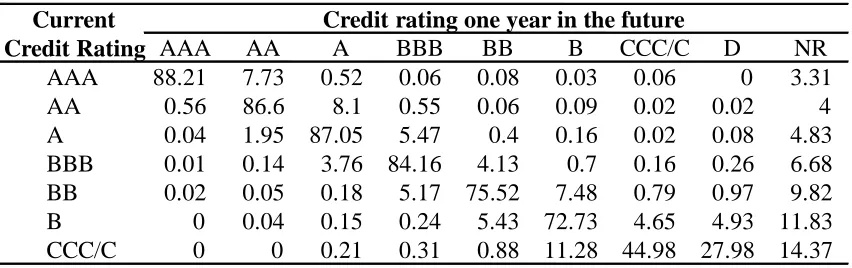
To see how the algorithmic approach works, consider the credit rating transition matrix in table 1 provided by Standard & Poor‟s, which shows the probability of migrating to another rating within one year as a probability percentage. S&P calculates this probability as well as the EDF which is the probability of a particular credit facility defaulting during a time horizon based upon historical statistical data available at a particular point in time. An EDF can be interpreted as a loan‟s probability of migrating from its current rating grade to default within the credit model‟s time horizon. This likelihood is frequently expressed in terms of a rating transition matrix similar to that depicted in the table. Given the customer‟s current credit rating (in each row), the probability of migrating to another grade (shown in the columns) is shown in the intersecting cell. Thus, in the table, the likelihood of a B rated loan migrating to a default state within one year would be 4.93 percent.
The most crucial limitation of the EDF is that it is not appropriate for calculating the probability of default in a long-term loan. The author interviewed an ex-the Long-Term Credit
AAA
AA
A
BBB
BB
B
CCC/C
D
NR
AAA
88.21
7.73
0.52
0.06
0.08
0.03
0.06
0
3.31
AA
0.56
86.6
8.1
0.55
0.06
0.09
0.02
0.02
4
A
0.04
1.95 87.05
5.47
0.4
0.16
0.02
0.08
4.83
BBB
0.01
0.14
3.76 84.16
4.13
0.7
0.16
0.26
6.68
BB
0.02
0.05
0.18
5.17 75.52
7.48
0.79
0.97
9.82
B
0
0.04
0.15
0.24
5.43 72.73
4.65
4.93 11.83
CCC/C
0
0
0.21
0.31
0.88 11.28 44.98 27.98 14.37
Source: Standard & Poor’s (2009)
Current
Credit Rating
Credit rating one year in the future
Licensed under Creative Common Page 11
Bank of Japan (LTCB) staff member who surveyed the so-called “KMV model”, which was provided by KMV Co. and was widely used as a model for calculating the EDF. The KMV Co. was established in 1989 by three key individuals; Stehen Kealhofer (K), John McQuown (M), Oldrich Vasicek (V) and it has now merged with Moody‟s. The model defines a situation where the asset value of a firm falls below the nominal amount of debt as constituting a default. The KMV model calculates the firm‟s probability of default based on the trend of the firm‟s stock price as an indicator of the firm‟s value. According to the ex-LTCB staff, KMV provided banks using the model with a one-year EDF estimate. KMV was confident of the significance of their one-year EDF, but admitted that it would be difficult to use even a 3-year EDF in real applications. Daisuke Nakazato, an ex-the Industrial Bank of Japan (IBJ) staff, reports an almost identical problem with the model in an interview with KMV (Ohno & Nakazato, 2004).
Undoubtedly, some risk management instruments become necessary as economies become more complex. Intensified internationalization and technological change make it more difficult for lenders to undertake the role of monitoring investments, for instance because lending, in the frontier economy, involves making judgements about the viability of different firms to carry out innovations and develop new products. Bounded rationality accordingly encourages lenders to use codes for measuring credit risks and to use external sources of risk assessment whenever possible, instead of trying to relying on in-house skills and knowledge for monitoring. But the codified assessment of credit risks under the Anglo-American system does not necessarily solve the problem of uncertainty. As a complete set of risk markets is necessarily absent, it is impossible in theory to determine a definite value of the EDF without risk of error, even using all available data sets. Thus, even if the credit rating transition matrix (table 1) provided by external rating agencies is statistically significant, it cannot indicate in which direction a particular customer will be migrating. As Simon (1983) reminds us, our existing knowledge cannot provide a basis for the precise calculation of mathematical expectation:
No number of viewings of white swans can guarantee that a black one will not be seen next. … Reasoning processes take symbolic inputs and deliver symbolic outputs. The initial inputs are axioms, themselves not derived by logic but simply induced from empirical observations, or even more simply posited. ... The processes that produce the transformations of inputs to outputs are also introduced by fiat and are not the products of reason. (Simon, 1983)
Licensed under Creative Common Page 12
the fact that, they are required by their banking regulators to adopt normative procedures for calculating capital adequacy requirements as well as for risk-based pricing. In the past, bankers were considered professionals in screening and monitoring, and banks played important roles in mediating stable flows of long-term funds to new industries and enterprises. External-rating agencies played only a very limited role in providing credit profiles of bond issuers for non-professional investors who had limited capacities to assess credit information. As lenders started increasingly to rely on the statistical EDF provided by external rating agencies for publicly rated corporate bonds, bank lending began to conform to investors‟ behaviour in bond markets driven by external risk assessment.
In the US securities market, regulators favour a competitive and less protective framework, based on the neoclassical belief that a market-oriented mechanism backed by a large and diversified base of investors would efficiently allocate financial resources. The existence of a large and diversified base of investors with quite different animal spirits, appetites for risk and judgements about the future is essential for providing relatively stable finance for the entire range of economic activities in a growing and changing economy. As long as this base has the capacity to absorb many different types of risks and uncertainty, the investment market functions well. But this also implies that the Anglo-American financial system is not universally applicable, since other countries may not possess this large and diversified base of investors which is a critical foundation of the system.
THE TRADITIONAL JAPANESE APPROACH TO CREDIT RISK MANAGEMENT
As Ford (1983) points out, the Shacklesque concept of potential surprise is not an operationally useful concept, because it cannot make the distinction between 'perfectly possible' and 'perfectly likely' outcomes. Additionally, it is nothing other than subjective probability in another guise (Ford, 1983). However, how should we respond to the fundamental uncertainty that we always face in our economic life?
Licensed under Creative Common Page 13
Shiro Yokoi, an influential Japanese banker (former Managing Director of the LTCB), pioneered the so-called “limited recourse loan” or “project finance”. In this arrangement, the lender, while coordinating the complicated interests of the concerned parties to a project, bears a portion of the project‟s risk on the condition that the projected cash revenue is pledged as security. This required a great deal of skill as limited recourse loans had to be structured and the risks associated with them had to be assessed. Consequently, higher spread margins were awarded for undertaking higher risks. Interestingly, although Yokoi talks about “risks” in his book on Project Finance, in fact, lender confidence (at least, in a subjective sense) that there is “no risk at all”, was a prerequisite for approving any loan application, including rescue operations (Yokoi, 1985). Indeed, in the heyday of the main bank system, Japanese bankers did not use the concept of probability of default in their screening and appraisal process. The relationship banking based non-algorithmic style encouraged an all or nothing approach to credit risk assessment.
What is the foundation of the non-algorithmic style described above? Herbert Simon‟s concept of bounded rationality recognized that “a great deal of the success of human beings in arriving at correct decisions was due to the fact that they had good intuition or good judgment” (Simon, 1983).
What is intuition all about? It is an observable fact that people sometimes reach solutions to problems suddenly. They then have an „aha!‟ experience of varying degrees of intensity. There is no doubt of the genuineness of the phenomenon. Moreover, the problem solutions people reach when they have these experiences, when they make intuitive judgments, frequently are correct. (Simon, 1983)
Many executives may find Simon‟s account of their intuitive decision processes persuasive. The non-algorithmic nature of decision-making in the relationship-based banking system is closer to what Simon describes as intuition-based decision-making. Under the main bank system, experienced Japanese bankers seemed to have identified credit risks by intuition, whereas more junior lending officers often would not be able to recognize problems with clients whose staffs were later accused of covering up serious losses. Sometimes, in spite of positive recommendations by junior officers, the suspicions of veterans were raised by an examination of the profit and loss account of a firm with a hidden liquidity problem.
Licensed under Creative Common Page 14
only to the “prepared mind” (Poincaré, a French scientist and mathematician, insisted that mathematical reasoning is not based upon logical understanding such as the syllogism but is a kind of creative virtue. See Poincaré, 1952). Second, intensive learning and practice are required to acquire intuitive rationality. Simon referred to empirical data gathered by John R. Hayes, on chess masters, composers, painters and mathematicians. Hayes found that “Almost no person in these disciplines has produced world-class performances without having first put in at least ten years of intensive learning and practice” (Simon, 1983). Both of these conditions were present in the post-war Japanese banking and financial system.
The Japanese monitoring system relied on the cultivation of long-term partnerships. Japanese bank managers based their credit risk assessment largely on the analysis of actual and projected cash flows. Through this process of analysis, they acquired the appropriate knowledge for monitoring their clients. The main banks were in a position to compel their client firms to open checking accounts for clearing almost all of their payment transactions. This arrangement enabled bank managers and officers in charge to monitor their borrowers‟ outflows of funds because their promissory notes and checks for accounts payable were addressed to the bank. At the same time, loan officers usually contacted the clients on an almost daily basis to collect their bills of accounts receivable, enabling them to monitor the borrowers‟ projected inflows of funds. The ability and right to monitor clients‟ flows of funds were presumably very important to the main banks, who otherwise would have been less willing to act as incubators or partners. Most firms consulted their main banks about their cash management and about their working capital needs. The main banks taught cash management skills when necessary and gave warning when clients‟ projections seemed too optimistic. The partnership strategy created by monitoring dynamic flows produced a positive incentive for the Japanese main bank officers and managers to support their client firms. At the same time, the partnership arrangement enabled them to acquire a higher capability of monitoring, which put banks in a better position to make intuitive credit risk assessments (Suzuki, 2011).
The main banks‟ central role in the Japanese economy also enabled them to recruit graduates from elite educational institutions. The quality and morale of their staff were exceptional. The banks cultivated an organizational ethics that encouraged managers and lending officers not only to pursue business profits but also to evaluate the social value of their clients and their businesses and to support clients and projects considered socially beneficial.
Licensed under Creative Common Page 15
theoretical element” (Nishida, 1958). Non-algorithmic methods of assessing investments were acquired through trial-and-error and this approach has traditionally been highly respected in Japan (It is notable that early twentieth century Japanese philosophers and intellectuals such as Nishida Kitaro and Kobayashi Hideo were strongly influenced by French philosophers like Henri Bergson and Henri Poincaré. Bergson criticized efforts to make all the phenomena in the world subject to “causality”, a typical viewpoint of modern natural science. Rather, he insisted on the role of the creative mind and emphasized the internal point of view for understanding reality. See Bergson, 1992. Bergson‟s focus on how real time, whose essence is to flow, eludes mathematical treatment, points to the limitations of algorithmic monitoring solutions. His perspective has much in common with G.L.S. Shackle‟s argument that “time is the denial of the omnipotence of reason”. See Shackle, 1972). On the other hand, non-algorithmic monitoring ran the risk of error, but this is a risk with any method of management, including algorithmic or formula-based methods of assessing risk. The real question is which method is more open to systematic errors. The non-algorithmic system enabled judgements to be made about the quality of management that can often not be reduced to measurable features of the balance sheets or cash flows of companies. Nevertheless, in the Japanese system hopeless borrowers were sometimes carried for much longer than circumstances warranted because bank managers judged their managements to be better than they eventually proved to be. The result was that the cost of the eventual default was sometimes higher than they would have had the loans been terminated earlier. But, bank rents created time and incentives for the Japanese main banks to manage their loans effectively over the long run. Moreover, bank rents facilitated the development of relation-based non-algorithmic monitoring approaches, which require skills of judgement acquired through trial-and-error and the acquisition of knowledge about the qualities of management in different companies. The profits and franchise value which the bank earned through more effective management of their loan portfolios gave their staffs the incentives and time to improve their non-algorithmic monitoring style, which in turn contributed to the profitability and the long-run reputation of the banks.
Licensed under Creative Common Page 16
strategy, and virtually essential for corporate success. Of course, in the post-war keiretsu system, the role of major commercial banks as main banks for those firms and enterprises within their groups was quite unique, stemming from a historical context of a relatively decentralized exclusive group –zaibatsu- banking system (see Aoki et al., 1994). However, throughout the post-war period and the adjustment to slower economic growth from the mid-1970s when many leading Japanese industries reached the international technological and marketing frontier, the main bank was deeply involved as a quasi-partner in mapping out a strategy for its client firms, in particular, firms within its group. The bank often played the role of incubating entrepreneurs, who were considered strategically important for integrating and internalizing supporting industries for its core business in order to enhance the group‟s competitiveness, and occasionally also of rescuing clients in temporary trouble. Presumably, the officers and managers of the main bank acted upon a partner’s strategy, rather than merely an investor’s strategy of portfolio management.
CONCLUDING COMMENTS
Shackle answered in the interview conducted by Richard Ebeling, the Austrian Economics Newsletter, in the fall of 1981 (The Austrian Economic Newsletter, Spring 1983, Ludwig von Mises Institute);
"I will be honest and say that I don't think that economics can yield constants of the kind that physics does. Physicists have constants, e.g., the acceleration due to gravity, the table of atomic weights. I don't believe that economics can have constants like that. You might make measurements which are all right for today. But, there are countless people whose interest it is to make nonsense of those measurements tomorrow. Well, now I have really been quite honest. ... (in reply to the question on what economists should do) I think they should give up giving advice, except on the most hesitant, the most broad grounds. I think they should introduce an ethical element, a more than ethical element. If a man is asked whether public expenditure should be cut or not, he perhaps should say, 'Well, if we cut it, we shall cause a great deal of misery: if we don't cut it, we don't know what the consequences will be, but we can't at least have this misery on our consciences'. This sort of argument is not an economic argument, it's an argument with one's conscience".
Licensed under Creative Common Page 17
availability of sufficient funds, screening and monitoring activities still matter because the failure of monitoring by lenders and investors would exacerbate the principal-agent problem or the general uncertainty from which lenders suffer, and thereby restrict the optimal allocation of risk funds. We should aim at a scheme of direct taxation on reasonable terms of reward for the function-less investors with a merely investor's strategy of portfolio management. Simultaneously we should aim at a scheme of giving appropriate incentives for the lenders and investors with a partner's strategy who need a certain buffer or cushion for responding to the fundamental uncertainty. To design the appropriate scheme, we should more argue the heterodox view on the decision-making under uncertainty which is nearly dead, but I believe, should be resurrected.
This paper also suggests that an ill-planned transition to the Anglo-American and Basel-type approach to monitoring (which we describe as "algorithmic monitoring" because it is based principally on the codification of credit risk) exacerbated the transition problems faced by the Japanese banking system. The adoption of elements of this algorithmic monitoring model neglected the important question of how Japanese lenders were to manage uncertainty given their greater exposure to industrial lending, and given the particular ways in which Japanese banks were intermediating financial resources in the macro economy. Although a full and successful transition to the Anglo-American system is hardly to be expected, the cost to Japan of abandoning the experiment must now be judged extremely high. Further studies on the symptoms of Japan's transition failure should be conducted to explain the direction and pace of its financial system change.
REFERENCES
Aoki, M., H. Patrick & P. Sheard. (1994). The Japanese Main Bank System: An Introductory Overview. In M. Aoki & H. Patrick (Eds.), The Japanese Main Bank System (pp. 1-50). Oxford: Oxford University Press.
Anjos, M., and V. Chick. (2000). Liquidity and Potential Surprise. In P.E.Earl & S.F. Frowen (Eds.),
Economics as an Art of Thought: Essays in memory of G.L.S. Shackle (pp. 242-268). Routledge.
Bergson, H. (1992). The Creative Mind, An Introduction to Metaphysics. A Citadel Press Book.
Davis, E.P. (1995). Debt Financial Fragility and Systemic Risk. Oxford: Clarendon Press.
Dore, R. (2000). Stock Market Capitalism: Welfare Capitalism, Japan and Germany versus the Anglo-Saxons. Oxford: Oxford University Press.
Dore, R. (2011). Kinyu ga nottoru sekai keizai. Tokyo: Chuo-koron shin-sha.
Dymski, G. (1993). Keynesian uncertainty and asymmetric information: Complementary or contradictory.
Journal of Post Keynesian Economics, 16 (1), 49-54.
Licensed under Creative Common Page 18 Hargreaves Heap, S. (1992). Rationality. In S. Hargreaves Heap, M. Hollis, B. Lyons, R. Sugden, & A. Weale(Eds.), The Theory of Choice; A Critical Guide (pp. 3-29). Blackwell.
Keynes, J.M. (1936). The General Theory of Employment, Interest and Money, Volume VII. Macmillan, Cambridge University Press.
Keynes, J. M. (1937). The General Theory of Employment. Quarterly Journal of Economics, 51, 209-23.
Knight, F. H. (1921). Risk, Uncertainty and Profit. Chicago: Chicago University Press.
Koppl, R. (2002). Big Players and the Economic Theory of Expectations. Basingstoke: Palgrave Macmillan.
Minsky, H.P. (1975). John Maynard Keynes. Columbia University Press.
Nishida, K. (1958). Intelligibility and the Philosophy of Nothingness. Tokyo: Maruzen.
Ohno, K., & Nakazato. D. (2004). Kinyuu Gijyutsu Kakumei Imada Narazu. Tokyo: Kinzai.
Poincare, H. (1952). Science and Hypothesis. Dover Publications.
Shackle, G.L.S. (1949a). Probability and uncertainty. Metroeconomica, 1(3), 161-173.
Shackle, G.L.S. (1949b). Expectation in Economics. Westport, Connecticut: Hyperion Press.
Shackle, G.L.S. (1972). Epistemics & Economics, A critique of economic doctrines. Cambridge: Cambridge University Press.
Simon, H.A. (1983). Alternative visions of rationality. In P.K. Moser (Eds.), Rationality in Action: Contemporary approaches (pp. 189-204). Cambridge: Cambridge University Press.
Simon, H.A. (1996). The Sciences of the Artificial (3rd ed.). The MIT Press.
Standard & Poor‟s. (2009). 2009 Annual Asian Corporate Default Study And Rating Transitions.
Retrieved 26 May, 2013, from
http://www2.standardandpoors.com/spf/csv/equity/2009_Annual_Asian_Corporate_Default_Study_And_R ating_Transitions.pdf.
Stiglitz, J., and A. Weiss, A. (1981). Credit Rationing in Markets with Imperfect Information. American Economic Review,71(3), 393-410.
Suzuki, Y. (2011). Japan's Financial Slump: Collapse of the Monitoring System under Institutional and Transition Failures. Basingstoke: Palgrave Macmillan.
Weale, A. (1992). Homo economicus, Homo sociologicus. In S. Hargreaves Heap, M. Hollis, B. Lyons, R. Sugden & A. Weale(Eds.), The Theory of Choice; A Critical Guide (pp. 34-46). Blackwell.
Williamson, O.E. (1985). The Economic Institutions of Capitalism. New York: The Free Press.