2325
Energy Efficient Multipath Routing For Wireless
Sensor Networks
Priyadharshini K S, Nandhini S S, Gunasekaran M
Abstract: Energy efficiency and adaptation to non-critical failure are the two major issues that must be considered for the organization of any Wireless Sensor Network (WSN). Multi-path routing is an effective result to overcome the internal failure of WSNs. In this paper, we propose a method for evaluating the energy of each node involved in WSNs multi-path routing. In the proposed method, directing timetable is set up at the Base Station (BS) which shares it with every one of the hubs in the whole system. The proposed method has an effective result which is determined with different parameters, for instance, separation amongst sender and receiver hubs, separation between next hop hub to the BS and furthermore on the quantity of jumps to send information from next hop hub to the BS. The proposed method is implemented using NS2 simulator and assessed through different execution measurements.
Index Terms: Base Station, Energy-efficient, Internal failure, Multi-path routing, Sensor, Simulator, Wireless Sensor Networks
—————————— ——————————
1.
INTRODUCTION
Wireless Sensor Networks (WSNs) regions has been exceptionally investigated through specialists because of its various real-time applications in recent days, for example, in condition checking, security reconnaissance’s, natural surroundings observing, underground mines, medicinal services etc.,. The real requirement of Wireless Sensor Networks is the constrained intensity of the each sensor hub as they are worked with modest battery. Besides, numerous applications randomly conveyed in cruel condition in which human connection is relatively irrelevant and in this manner it is extremely troublesome for renew their batteries. What's more, the sensor hubs are inclined to be disappointment as they work in unforgiving condition. In this manner alongside Energy effectiveness, the adaptation to non-critical failure of the sensor hubs assumes an essential part for extended run task of Wireless Sensor Networks. Numerous arrangements exist for vitality proficiency and adaptation to internal failure of WSNs. Despite, the productive answer for the same will be energy efficient multipath routing. In multipath routing, an information bundle is steered through at least two ways, and subsequently lessens possibility of information misfortune at the beneficiary end hub BS. In this manner, multipath component is profoundly blame middle of the road than the single way steering. Aside from adaptation to internal failure, multipath steering additionally gives the information security against assaults by diminishing the shot of information bundle being altered or dropped by a malignant sensor hub. In Wireless Sensor Networks, to spare the clustered energy is one of the unmistakable strategies. Among that Clustering methodology or the process, sensor hubs are clustered and the same will be grouped based on a few criteria. In each group, there will be a cluster head (CH) selected among the nodes and part of the sensor hubs constantly promote the detected information to its CHs. The role of the CHs is to collect the received information and forward the same to BS. As earlier said, each of the heads among the clusters are typically chosen from the ordinary sensor hubs and therefore beyond words because of their additional work load, for example, information conglomeration and sending. Hence the ideas of hand-off hubs or entryways were presented by numerous analysts. These transfer hubs/entryways play out the part of CHs. In addition, each cluster heads will be occupied with certain additional energy however; the energy source of the chosen CHs is battery in this way. CHs may die
after certain cycles after specific adjusts because of poor re-directing component. In this manner, the functioning of the CHs will be terminated because of complete energy consumption which is considered as another significant concern. A multi-path routing is used for transfer data based on two level WSNs in which sensor hubs frame the main level and the CHs shape the next level. The calculation depends on GA which is appeared to be energy effective. To make the wireless environment and calculation energy productive, few parameters are considered, for example, separate amongst sending and getting hub, jump tally and separation between next bounce to BS.
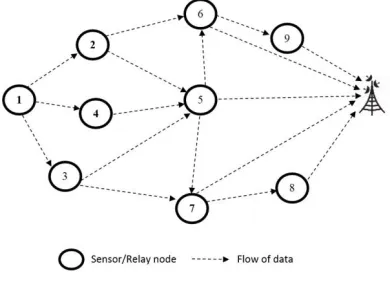
Fig. 1. Path Discovery between nodes
Every one of these parameters is utilized to determine an effective wellness work for the above said calculation. We perform thorough tests of given calculation and break down with different parameters. A case of multipath routing for packet transfer based on Wireless Sensor Network with path is portrayed in Figure 1. In the given figure, there are nine transfer hubs set with a single Base Station. For the source hub/node say 1, there are two unique ways initially is Node 1 → Node 4 → Node 5 → Final BS and second way is Node 1 → Node 2 → Node 6 → Node 9 → the BS. In both ways, there is no regular transitional hub with the exception of source and goal. Thus, we can state that the two ways are hub disjoint in nature.
2
RELATED
WORK
2326 was proposed as a method by Chalermerk Intanagonwiwat
et.al. in 2000 [4]. The system framework comprises of 3 following sections; a) a source, where the transmission of information starts, b) middle hubs, which sense, track and transmit occasions in the territory and c) a sink, where the information are aggregated and transmitted to the final node. DD is an information driven directing convention where every one of the courses are chosen in light of utilization level information. Also, arrange hubs trade messages and produce quality esteem sets. In Direct Diffusion there are about 4 fundamental highlights, interests, gradients, and cache memory and reinforcement way. In Radi M et.al in 2012 [2], a wireless sensor environment is a significant gathering of sensor hubs. In each environment the sensors are restricted with power supply and compelled computational ability. Data packet routing in the real world sensor systems is normally performed through single-hop transmission. During the transmission, the environment faces certain trouble as limited correspondence in range and high thickness of sensor hubs. These can be fixed when the transmission of packets performed through multi-jump packet (information) transmission. In this way, directing in wireless sensor systems has been viewed as a vital field of research over the previous decade. These days, multipath routing methodology is broadly utilized in wireless sensor systems. The same leads to enhance /organize execution through effective usage of accessible system assets. Energy-Efficient and CollisiAware Multipath Routing Protocol (EECA) is a type of on-demand multipath routing protocol [1]. To launch two collision-free paths among source and destination, EECA practiced with the node location information. Since the location information is recorded, the harmful effects among the source and destination node pair will be concentrated. Besides, the path distance between the source and destination is added than the interference range. Initially in the process of route discovery phase, the source node checks for the dissimilar collections of node amongst the source and destination. After detecting the neighboring sets in routing process, the source node in the environment broadcasts a Route-request packet (RREQ) towards the next neighbor nodes. When forwarding the packets in WSNs, a route will be established between two node- disjoint paths. In 2004, Handzinski et. al. introduced an information scattering directing convention joining the advantages of PC passive clustering and DD (PCDD) [5]. During the convention, it additionally contains intrigue message flooding and gradients set up. If a hub has a match on occasion, it turns itself into a source and begins to forward the information to every one of its next neighbors. This information is characterized as "exploratory", and takes after the way between the link with source and sink as indicated by the inclinations. This method basically enhances the information transmission through fortified ways, which are chosen in the last condition of the calculation. The PC technique appoints a part to every hub. A hub can be a CH. It is vital to take note of, that in light of the lead "Customary (non-cluster head) hubs don't forward the intrigue and exploratory information messages that they get" [5], just CHs retransmit information amid the last stage. PC is a more adaptable and lightweight arrangement bringing about an essentially bring down overhead and diminishing the general vitality utilization. This angle is really one of our solid inspirations to complete our examination work. Roghaiyeh Gachpaz Hamed and J.Kalimpour presented few methods to
address an Energy Balancing & Hierarchical Clustering Routing calculation (EBHCR) [4] which is basically a change of the Hybrid Energy-Efficient Distributed bunching convention, (HEED) [5]. Notice presents three stages, to be specific, the revelation of neighborhood node or stage, Calculation of Competence esteem for CH part and declaration of CHs and joining a bunch by non-group head hubs. In the EBHCR convention, the rest of the vitality, hub degree and separation to Base Station parameters are utilized to decide the part of the hub. In the main stage, every hub recognizes each neighbor and figures the vitality cost of correspondence. Each hub has Cluster Head (CH) likelihood to end up the CH of its group. J. Othman and B. Yahya proposed Energy Efficient and QoS-based Multipath Routing Protocol (EQSR) [6] . This convention considers the unwavering quality and delays the prerequisites of real-world applications. The convention gives dependability by sing the lightweight XOR-based Forward Error Correction(FEC) instrument [10], which presents information excess in the information transmission process and satisfy the defer requirements. EQSR utilizes separation strategy by applying a lining model to oversee ongoing and non-continuous activity. It utilizes flooding system amid the neighbor revelation stage and may misrepresent the correct estimation of common impedance between various ways. In [11], creators examined a blame tolerant directing plan. This plan comprises of two sub forms 1) fault recuperation process and2) blame location conspire. In this calculation each sensor hub transmits its information to BS by utilizing most brief way. In addition, if there exists any way or information misfortune at that point blame recuperation is quick and information is sent to BS with least time and vitality misfortune. The cost capacity of proposed work is just in view of the separation. The thought of separation as a parameter for choosing the following jump may prompt uneven use of vitality of sensor hubs, on the grounds that there are some hubs, which bite the dust rapidly because of additional workload regardless of whether there are some hubs which has adequate vitality for transmitting the information.
3
SYSTEM
MODEL
3.1 Energy Model
2327 are a few power-aware routing conventions talked about in the
related work. In these conventions, hubs course information bound at last for the base station through middle of the road hubs. In this manner hubs go about as switches for other hubs' information notwithstanding detecting the earth. These conventions contrast in the manner in which the courses are picked. A portion of these protocols, just consider the energy of the transmitter and disregard the energy dissemination of the receivers in deciding the routes. For this situation, the middle hubs are picked with the end goal that the transmit amplifier energy is limited; in this manner hub A would transmit to hub C through hub B.
Transmit amplifier energy:
2
*
*
)
,
(
k
v
k
v
E
Txamp
amp (1)Nonetheless, for this low transmission-energy (LTE) routing convention, as opposed to only one (high-vitality) transmits of the information, every data message must experience (low-energy) transmits and gets. Depending upon the relative expenses of the transmit speaker and radio gadgets, the aggregate vitality consumed in the framework may really be more noteworthy utilizing LTE routing than guide transmission to the base station.
3.2 Path Discovery
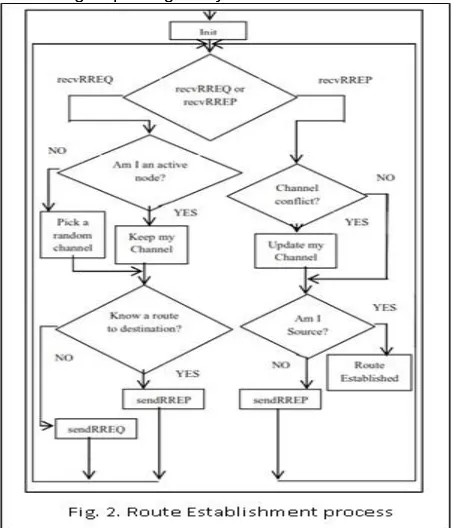
The design process of the path discovery is given in Figure 2 which clarifies how the procedure is followed. The neighborhood data is obtained by every hub in the initialization stage and the data will be utilized in route maintenance and establishment phase. The same data is practiced to locate the following hop node towards the sink. Route discovery process is initiated whenever event is arose in a particular node. Route Request Packet (RREP) will be transmitted by the source node to begin the communication towards the sink node. If a particular node receives a RREQ (recvRREQ) packet from anyone of its neighbor node, it checks whether it is a functioning or impaired node on account of low transmission cost and amplifier energy (path cost will be calculated based on the formula 2) or a new node. If recvRREQ packet is received by a new node, it figures the transmission path cost. The computed transmission path cost will be compared with the previous cost. The route discovery process will be preceded by comparing the new path cost with the previous path cost. The path which is holding the minimum cost will be preferred for route discovery. If the route is known towards to the destination, it will send a sendRREP packet sendRREQ packet will be forwarded. At whatever point, a hub gets RouteReply (recvRREP), it checks for the network conflict. The received node checks for the channel conflict, if the network conflict arises on the source node, the node establishes a route between the source and destination and updates it network. Otherwise, Route reply will be accelerated without updating the network. The same procedure is rehashed until it reaches the source hub/node.
3.3 Path Construction
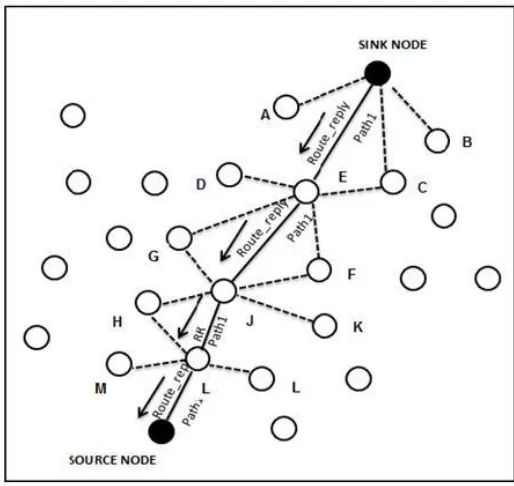
As the path discovery process in the above section explains about the packet transmission between the source and destination. Fig.3 shows the construction of path, where node C overhears the packets from node E and sink node. Whenever a node receives a RREP packet, the packet details should be updated with the new node. The cost calculation happens at each node during the packet transmission
between the source node and destination node.
Fig. 3. Path Construction
3.3 Cost Function
The proposed calculation creates energy effective multi- path from all transfer hub to goal, so for a similar we outline the cost work in view of distance between the sender in routing process with the destination, bounce tally of next jump and separation between next bounce to Base Station which as takes after:
)
(
*
)
,
(
*
)
,
(
1
)
,
(
cos
_
j j
j i j
i
S
dist
s
s
dist
s
base
Hop
S
S
t
path
Path_cost (si, sj) speaks to the acquired cost to send information from si to sj . The determination of next jump by hand-off hub si depends on the Cost capacity and si constantly select that sj for which the estimation of Cost is most extreme. The Cost work is energy proficient in light of the fact that its esteem is most extreme just when both sort of separation is least. As we realize that the energy utilization in sensor arrange is specifically relative to square of the separation.
4 PERFORMANCE
EVALUATION
An inclusive evaluation of the proposed routing process is represented in this section. Performance evaluation metrics are bring together before get into the applied simulation framework and parameter metrics. After that, the simulation results taken from NS2 will be discussed.
4.1 Performance Parameters
o End to End delay / latency will be measured based on the average time taking place during the data packet transmission between the source and destination across the network. It differs from round-trip time (RTT).
2328 4.2 Simulation Parameters
TABLE I
PARAMETERS TAKEN
Parameters Value
Transmission range 250 m
Topology Size 1000m x 1000m
Simulation Time >800s
Number of Sensors 100
Number of sinks 1
Traffic type Constant bit rate
Interference range 550m
Bandwidth 2Mb/s
Transmission range 250m
Energy Threshold 0.001mJ
Initial energy in batteries 10 Joules
Packet size 512 bytes
4.3 Simulation Result
1. End to End Delay: The competence of the proposed protocol to meet the delay requirements is shown in Figure 4. It shows the comparison of end to end delay of proposed protocol with EECA protocol. As the presented load grows, the average queue length at each node increases and data packets suffer longer queuing delays.
Fig. 4. End to End Delay for 50 nodes
Packet Generation Interval is taken as X co- ordinate where Y-axis is End to End delay. As the increase in the interval, EECA increases the end to end delay of progressively to a higher level, whereas the proposed method has low end to end delay.
2) Packet Generation: EECA protocols packet generation with the proposed one are shown in Fig 5.
Fig.5. Packet Generation for 50 nodes
Packet Generation Interval is taken as X co- ordinate whereas generated packet is considered in Y-axis.
5 CONCLUSION
In this paper, we have followed a multi-path routing which is one of the noticeable strategy to endure the fault in sensor organize. Accordingly, in this exploration method we have introduced multi-path routing calculation for WSNs. Here, we have talked about all the essential strides of distance parameters with appropriate case. Besides, for two unique ways we have additionally spoken to the system lifetime regarding round. The graph plotted for the resultant values of the proposed protocol is compared with EECA based on two parameters: Packet generation and End to End Delay. The proposed one accomplished low energy consumption since it employs the available energy resourcefully. In future, we will think about the Quality of Service (QoS) parameters with adjusting the vitality among ways and transfer hubs in both static and portable situation.
REFERENCES
[1] Shuang Li, Raghu KisoreNeelisetti, Cong Liu and Alvin Lim, ―Efficient Multipath protocol for Wireless Sensor Networks‖, In Proc International Journal of Wireless and Mobile Networks (IJWMN), Vol.2, No.1, February 2010.
[2] Jonathan L. Bredin, Erik D. Demaine, Mohammad Taghi Hajiaghayi, and Daniela Rus, ―Deploying Sensor Networks With Guaranteed Fault Tolerance‖, In Proc IEEE/ACM Transactions on Networking, Vol.18, NO.1, February 2010. [3] Lou,W, Liu, W and Zhang,Y. ―Optimizations in Mobile AdHoc‖,
In Proc. Combinator Optimization,2006.
[4] Chaleremek Intanagonwiwat, Ramesh Govindan, Deborah Estrin, "Directed Diffusion: A Scalable and Robust Communication Paradigm for Sensor Network", MOBICOM, 2000.
[5] Radi, M.; Dezfouli, B.; Bakar, K.A.; Lee, M.Multipath Routing in Wireless Sensor Networks: Survey and Research challenges. Sensors 2012, 12, 650-685.
2329 [7] Roghaiyeh Gachpaz Hamed, Jaber Karimpour, "(EBHCR)
Energy Balancing and Hierarchical Clustering Based Routing algorithm for Wireless Sensor Networks", Australian Journal of Basic and Applied Sciences, pp. 1376-1380, 2011.
[8] Ossama Younis, Sonia Fahmy, "HEED: A Hybrid Energy-Efficient Distributed Clustering Approach for Ad Hoc Sensor Networks", IEEE Issue, no. 04, October 2004.
[9] J. Ben-Othman and B. Yahya, ―Energy efficient and qos based routing protocol for wireless sensor networks,‖ Journal of Parallel and Distributed Computing, vol. 70, no. 8, pp. 849–857, 2010.
[10] L. Rizzo and L. Vicisano, ―Rmdp: An fec-based reliable multicast protocol for wireless environments,‖ SIGMOBILE Mob. Comput. Commun. Rev., vol. 2, no. 2, pp. 23–31, Apr. 1998.