4250
Design Of Green Curriculum Implementation In
Learning In Higher Education
Niam Wahzudik, Istyarini , Wardi, Sugeng Purwanto, Basuki SulistioAbstract: The purpose of this study is; (1) Describe the implementation of the green curriculum in learning praxis in the Department of Curriculum and Education Technology, FIP Unnes, and (2) Develop a prototype design of learning models based on conservation values. This research was conducted using the Research and Development design adopting the Borg and Gall model. The results of this study show that the implementation of the green curriculum in the learning process at the Department of Education and Curriculum of FIP Unnes is proven by integrating conservation values in the pursuit and has been going well, but there are some things that need improvement and adjustment, namely variations in learning models. A prototype design of a green curriculum-based learning model has been produced by integrating conservation values in the form of Semester Learning Plans (RPS).
Index Terms: Development, learning models, conservation values, green curriculum, learning plans, curriculum implementation. —————————— ——————————
1
INTRODUCTION
Semarang State University (UNNES) as one of the well-known state universities in Semarang was widely recognized by the declaration in March 2010 as a conservation campus. UNNES is committed to upholding the principles of protection, preservation, use and sustainable development of the nation's precious natural and cultural resources. This is not far from the concept of sustainable development that is applied at the campus area level. Rector of Semarang State University Number 27 of 2012 concerning campus management-based conservation article 3 paragraph 1 and 2 in essence the management of conservation campuses is realized through 7
pillars including: Conservation of biodiversity; Green
architecture and internal transportation system; Waste management; Paperless Policy; Clean energy; Conservation of ethics, art and culture; and regeneration of conservation. Many discourse and conservation programs have been developed and implemented by conservation development institutions through the 7 pillars which are the basic concepts of Unnes realization to become a Conservation University, but there is still no joint effort to make it happen. Conservation discourse still tends to be interpreted by many Unnes residents with the realization of a green campus, regarding the 7 pillars of conservation is still a concept of debate and tends to be absurd based on all limitations, and the system being built. Whereas conservation values consist of 11 conservation values which include religion, honesty, intelligence, justice, responsibility, caring, tolerant, democratic, loving the motherland, tough and polite. In line with the vision, mission and policies as a conservation university, the conservation values agreed upon by Semarang State University academics, especially lecturers, must do learning where integrating conservation values.
The concept of a conservation university is very relevant to the concept of a green curriculum. However, the reality on the ground shows that learning / lectures in the Semarang State University environment, not many lecturers who apply learning by integrating the concept of green conservation values curriculum. This is because it is not easy how to apply and integrate these conservation values in classroom learning. Lecturers have difficulty in determining which conservation values are appropriate to be applied in classroom learning. This of course requires the ability to innovate from the lecturers of a course. Based on this background, it is necessary to develop a learning model based on conservation values in accordance with the characteristics of the curriculum and educational technology of FIP Unnes. The aims of this research program are; (1) describe the application of the green curriculum (conservation value) in learning in the department of Curriculum and Education Technology, FIP Unnes, 2) develop prototype designs of learning models based on green curriculum (integrating conservation values).
2
RESEARCH
METHODS
Referring to the objectives to be achieved, this research program is designed with the "Research and Development" approach, which means that the research program is followed up with a development program for improvement or improvement (Borg and Gall, 2006). The research program is planned to be carried out in three phases with a completion period of three years. Phase I of 2018, with survey research, empirical studies will be carried out factual description of the application of the green curriculum (integrating conservation values) and the development of prototype designs of learning models based on green curriculum (conservation values) in the Department of Curriculum and Education Technology. The study was conducted at the Department of Education and Curriculum FIP Unnes with student samples, data collection was carried out using questionnaire techniques, and field observations. Data analysis was performed descriptively quantitative. Based on the results of empirical studies and relevant theoretical references, prototype designs of learning models and lecture tools based on the green curriculum (integrating conservation values) are compiled in the Department of Curriculum and Educational Technology.
____________________________________
• Niam Wahzudik is Lecture in Department of Curriculum and Educational Technology Universitas Negeri Semarang, Semarang,
Indonesia, PH-+6281227231067. E-mail:
4251
3 RESULTS
AND
DISCUSSION
3.1 Factual Description Of The Implementation Of The Green Curriculum (Integrating Conservation Values) In Learning In The Department Of Curriculum And Educational Technology
Description of the application of the concept of a green curriculum by integrating conservation values in learning in the Department of Education Curriculum and Technology, FIP Unnes is presented in three stages of the learning process, namely learning planning, learning implementation, and learning assessment which is generally practiced in every learning. The description of the description of the application of the green curriculum (conservation value) in the Department of Education Curriculum and Technology is described as follows.
1) Learning planning
Figure 1. Writing conservation values in RPS / course sets
In the early stages of learning planning the first thing that is identified is the presence or absence of writing conservation values in each semester learning device (RPS) compiled and applied by the lecturer. Based on the questionnaire given to the student respondents showed that the respondents stated 26.2% strongly agreed, 63.6% agreed 8.4% quite agreed, 0.9% disagreed and 0.9% stated strongly disagree. Data visualization is presented in Figure 1 above. The next information that researchers explore from respondents is related to lecturers' activities in explaining conservation values at the beginning of lectures (learning). In accordance with the presentation in Figure 2 this study shows that 20.6% of respondents stated strongly agree, 53.3% agreed, 22.4% quite agreed, 2.8% disagreed and 0.9% or only 1 respondent stated strongly disagreed.
Figure 2. The lecturer explains the concept of the green curriculum (conservation values) that is applied during
learning.
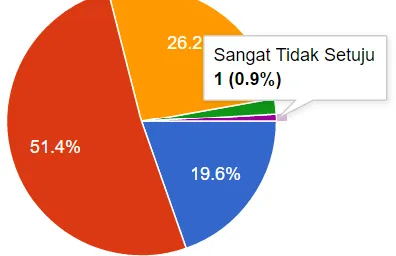
Information on the implementation of the hijaun curriculum (conservation value), the next of which is identification research, which is related to planning the assessment of learning from aspects of conservation values. This study shows that 19.6% of respondents expressed strongly agree, 51.4% agreed, 26.2% quite agreed, 1.9% disagreed, and 0.9%
of respondents stated strongly disagree. Information
visualization can be seen in Figure 3 below.
Figure 3. Lecturer information explaining the green curriculum
(conservation values) to be assessed
2) Learning Implementation
4252
Figure 4. Appropriate Lecturers in choosing learning models in
accordance with the concept of a green curriculum (conservation values)
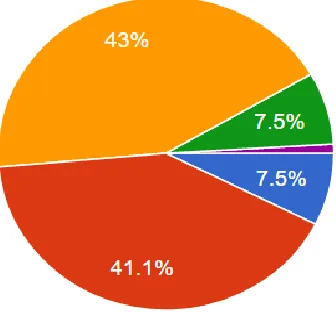
Based on information from research respondents obtained information that during learning lecturers choose learning models that have character in accordance with conservation values. In detail, it can be seen in Figure 4 that shows that 14% of respondents expressed strongly agree, 48% agreed, 35.5% quite agreed and only 1.9% of respondents stated strongly disagree. Other aspects that have been revealed in this study are there are 7.5% of respondents stated strongly agree, 41.1% agreed, and 43% stated quite agree that during the learning of conservation values have been applied well. However, there are 7.5% who disagree and 0.9% strongly disagree if during the learning conservation values have been implemented well. To facilitate understanding can be visualized in Figure 5 below.
Figure 5. The concept of a green curriculum (Conservation
Values) has been implemented well
The next question asked to respondents is to be qualified with the ability of lecturers supporting KTP majors, whether they are adequate in integrating conservation values in learning, the following information is obtained. 17.8% of respondents stated strongly agree, 55.1% agreed, 26.2% stated quite agree. Meanwhile, only 0.9% of respondents stated strongly disagree. An overview of the information can be seen in Figure 6 below.
Figure 6. The ability of lecturers to facilitate in integrating the concept of a green curriculum (conservation values)
Another relevant aspect to be revealed is information about the learning methods applied by the lecturer whether they are varied or monotonous. This study shows that in learning 27.1% of respondents stated strongly agree that the lecturer applies a variety of learning methods during learning. 29.3% agree, 23.4% agree enough. But the other side shows that 10.3% disagree or assume that the learning methods applied by lecturers in learning are not varied or monotonous. Visualization of this information can be seen in Figure 7 below.
Figure 7. Variations in learning methods applied by lecturers
Another thing in the learning process that needs to be revealed to find out whether a learning process is in accordance with the latest learning paradigm (uptodate), which is based on the activities carried out by students during the learning process takes place. In accordance with the characteristics of contemporary / current learning paradigms, namely learning with a student centered learning approach or student-centered learning. The paradigm in this approach requires active student / student activities rather than active teacher / lecturer figures while passive students. With the paradigm of active or student-centered students providing space for creativity, critical power and student innovation in
constructing knowledge in accordance with student
4253 Figure 8. The learning process carried out reflects active
student activities / centered on students
As the characteristics of the paradigm of a contemporary approach to student-centered education, learning that is held in the Department of Education Curriculum and Technology of the Faculty of Education Unnes is believed that during the learning process guided by the lecturer has shown a learning activity that involves student activities, for example by discussion, question and answer, or group work. The results of the study in Figure 9 below prove that learning activities involve student activities.
Figure 9. Learning activities involve student activities
According to Figure 9 above the learning activities show that more than 80% of respondents stated that they were involved in learning activities in class with 25.2% stated strongly agree, 59.8% agreed, 12.1% agreed enough and only 1, 9% said they disagreed and 0.9% of respondents said they strongly disagreed. It also gets support that during the learning process shows the process of interaction between students and students and lecturers with students. Figure 10 shows that 30.8% expressed strongly agree, 50.5% agreed, and 15.9% stated quite agree and only 2.8% of respondents stated disagreed, none of the respondents claimed to strongly disagree or 0% . The high percentage of student interaction processes further reinforces previous information about student involvement in learning.
Figure 10. The percentage of the process of student
interaction in learning
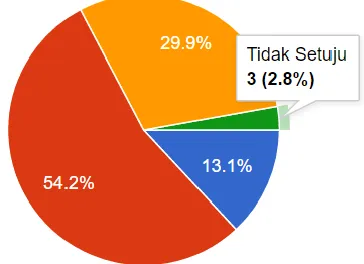
This study tries to explore the opinions of students towards the proposal if learning uses problem based learning learning models and the results show that 13.1% of respondents strongly agree, 54.2% agree, 29.9% quite agree, and only 2.8% which states not agree. The data shows that the problem based learning model is an alternative learning model that is relevant for teaching conservation values in a course. The data visualization is illustrated in Figure 11 below.
Figure 11. Student opinion if the concept of a green curriculum (integrating conservation values) is taught through a
problem-based learning learning model.
1) Learning assessment
4254 learning conducted by lecturers has included conservation
values while 3.7% other respondents disagree. Visualization of the results of this study can be seen in Figure 12 below.
Figure 12. Learning assessment aspects include the concept
of a green curriculum (conservation values)
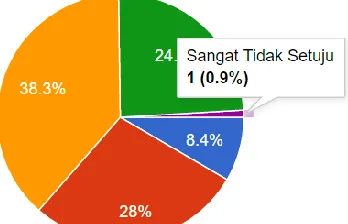
Although conservation values have become aspects of learning assessment, but in relation to learning assessment techniques this research data shows that respondents tend to agree that assessment of learning uses more written test techniques. This study shows that only 0.9% stated strongly disagree, 24% disagreed if the assessment using a written test. Whereas more than 50% of the responses stated agreed if the learning assessment that had been carried out in the department of curriculum and educational technology tended to use written tests with the following details 8.4% stated strongly agree, 25% agreed and 38.3% of the other respondents agreed quite agree that his assessment was by written test. Visualization of research results can be seen in Figure 13 below.
Figure 13. Learning assessment techniques tend to be written
test
Based on the learning process of planning, implementing and evaluating learning that has been carried out this research proves that students have gained the attitude, knowledge and skills to apply conservation values in everyday life. This is indicated by 25.2% of respondents strongly agree, 47.7% agree, 25.2% quite agree, and 1.9% other responses disagree. Visualization of research results can be seen in Figure 14 below.
Figure 14. Students have acquired the attitude, knowledge
and skills to apply conservation values in everyday life.
Student opinion if the assessment of learning outcomes is done through portfolio-based assessment shows a very good response. This is evidenced by 9.3% of respondents saying strongly agree, 37.4% stated agree, 41.1% stated quite agree, while 12% of other respondents disagreed. More detailed response data can be seen in Figure 15 below.
Figure 15. Student responses if the assessment of learning
using portfolio assessment
4255 students and course material. The learning approach chosen
uses the Student Centered Learning (SCL) approach or student-centered learning. Student student-centered states that the learning achievements of graduates are achieved through a learning process that prioritizes the development of creativity, capacity, personality, and needs of students, as well as developing independence in seeking and finding knowledge (Ristekdikti, 2015: 4-52). With this paradigm, the three principles that must exist in SCL learning are (a) looking at knowledge as one thing that is incomplete, (b) looking at the learning process as a process to reconstruct and search for knowledge to be learned; and (c) view the learning process not as a teaching process that can be done classically, and is not a process for carrying out a standardized instruction that has been designed. The learning process is a process in which the lecturer provides a variety of learning strategies and methods and understands the approach of student learning to be able to develop their potential (Ristekdikti, 2015: 4-53). In accordance with the characteristics of the learning paradigm centered on students a variety of learning models that can be adopted in order to instill the values of conservation in learning in the Department of Education Curriculum and Technology FIP Unnes, among others (1) Small Group Discussion; (2) Role-Play & Simulation; (3) Case Study; (4) Discovery Learning (DL); (5) Self-Directed Learning (SDL); (6) Cooperative Learning (CL); (7) Collaborative Learning (CbL); (8) Contextual Instruction (CI); (9) Project Based Learning (PjBL); (10) Problem Based Learning and Inquiry (PBL) and (11) Blended Learning or Online Learning.
7 COCLUSION
Implementation of green curriculum conservation values in the learning process in the Department of Curriculum and Education Technology at FIP Unnes has been going well, but there are a number of things that need improvement and adjustment, namely variations in learning models. A prototype learning model based on conservation values has been produced in the form of a Semester Learning Plan (RPS).
8 REFERENCES
[1] Kisworo, Bagus & Muarifuddin. 2015. Analisis Implementasi 7 Pilar Konservasi Universitas Negeri Semarang Di Fakultas Ilmu Pendidikan. Journal of Nonformal Education.
Volume 1 Nomor 1 tahun 2015. P.9-23.
http://journal.unnes.ac.id/nju/index.php/jne
[2] Peraturan Rektor Universitas Negeri Semarang Nomor 27
tahun 2012 tentang Tata Kelola Kampus Berbasis Konservasi.
[3] Phramesti, R & Yuliastuti, Nany. 2013. Kajian Keberlanjutan Universitas Negeri Semarang (Unnes) Sebagai Kampus Konservasi (Studi Kasus: UNNES Sekaran, Semarang). Jurnal Teknik PWK . Volume 2 Nomor 1 2013. P.183-190. Online : http://ejournal-s1.undip.ac.id/index.php/pwk
[4] Prihanto, Teguh. 2017. Strategi dan Program
Pengembangan Konservasi di Kampus Hijau Universitas Negeri Semarang (UNNES). Prosiding Temu Ilmiah IPLBI 2017. P.029-036.
[5] Suparman, Atwi. 2014. Desain Instruksional Modern
(Panduan Para pengajar dan Inovator pendidikan). Jakarta: Erlangga
[6] Unnes. 2015. Buku Panduan Kurikulum Berbasis