IJSRR, 7(1) Jan. – March, 2018 Page 1
Research article
Available online www.ijsrr.org
ISSN: 2279–0543
International Journal of Scientific Research and Reviews
Implementation of Internet of Things (IoT) Based Smart Logistics for
Food Grain Industry
Murugaiyan Pachayappan*
Assistant Professor, Production and Operations Management, Xavier Institute of Management & Entrepreneurship
Chennai, India
E-mail: [email protected]
ABSTRACT
Logistics plays a vital role for any organization. The logistic companies are focused to implement a best logistic management system for an effective product supply from the factory floor to the customer end. Recently, the logistic systems are incorporated with smarter devices like wireless sensor devices, radio frequency identifications (RFID) tags, temperature monitoring systems, global positioning systems (GPS) etc. to trace and track the product condition and location. By adapting these technologies, the risk factors associated with transportation of goods will be minimized. These technologies are independent to each other and they are decentralized system. The data and information transferred are not integrated to each other and the information control is ineffective. To overcome this problem a new internet based technology called Internet of Things (IoT) is emerged in the recent past. In this paper an IoT enabled smart logistic system for food grain industry is proposed. In the proposed design two-layer network architecture of IoT platform is introduced. The first layer is radio frequency identifications (RFID) act as an asymmetric tag-reader link and second is wireless sensor network (WSN) layer is an ad-hoc network between reader/master nodes. By adapting this smart logistic system achieves live monitoring of goods from shipment to customer place at lower cost of investment. The smart devices are connected via internet and real time data transfer will provide an opportunity for the food grain industry to react immediately if any instant changes required in the logistic process.
KEYWORDS:
Internet of Things (IoT), Food Grain Industry, Smart logistic, RFID tag, Supply chain .*Corresponding author
Murugaiyan Pachayappan
Assistant Professor, Production and Operations Management, Xavier Institute of Management & Entrepreneurship
Chennai, India
IJSRR, 7(1) Jan. – March, 2018 Page 2
INTRODUCTION
The flow of food grain goods has increased tremendously in the outline of varieties in goods,
quality and quantity in goods, just-in-time delivery, globalization of marketing and seasonal
variations etc. The logistic companies have undergone considerable changes in the process of
transportation and needs a technological update in the logistics management. Intelligent logistics is
the critical success factors for manufacturer and retailers. Effective logistics necessitates delivering
the right product, in the right quantity, in the right condition, to the right place, at the right time, for
the right cost and it has a positive impact on the success of the vendors in the supply chain. Tracking
and traceability in the food supply chain have considered as a vital factor in the past few decades 1,2,3. Various food safety and traceability laws exist in several countries. European Union’s General Food
Law entered into force on January 1, 2005. The law included important elements like rules on
traceability and the withdrawal of dangerous food grain products from the market. The important
role of food grain industry is to adapt an accurate traceability and monitoring facility during
transportation. Some food grains should be maintained in an accurate temperature and monitor the
mitigation and risk factors during the transportation of products. In the perspective of consumer
gives emphasis to safety, high quality and sustainability of products. To satisfy the consumer needs
and demand, the companies are trying to adapt new trends in transportation and logistics. The lack of
timely, accurate and inconsistent information transfer during transportation of food grain goods is the
reason for the risk factors like product damage and wastages. As a result, it is difficult to obtain the
real-time visibility and traceability of the current position of the goods in the overall supply chain.
To overcome this difficulty, an Internet of Thing (IoT), a new emerging internet based technology
was introduced. IoT is a global network infrastructure, which links the physical and virtual objects
with the internet cloud. This linkage generates live data from the goods tagged with sensor devices
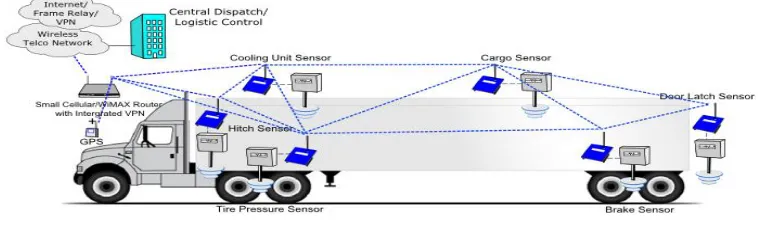
in the smart container as shown in Figure 1 during transportation and communicates the updates to
the concern location.
IJSRR, 7(1) Jan. – March, 2018 Page 3
IoT offers specified object identification system and its current position in the global
network. Radio frequency identification (RFID) and wireless sensing devices are considered as the
key technologies enable IoT as a value creation system. In the future, RFID tags are equipped with
sensors and other value added peripherals for interaction with their network, observe their
surrounding environment as well as their geographical information. Such innovative tags with unique
addressable identification number or IP address are attached on food grain packages. The logistic
companies are really working in this perspective to achieve proper safety and secure distribution
without damage of goods. The companies need to enrich their technological support for smart
logistics. IoT is a viable technology for the food grain industry to trace and track the food grain
package in the supply chain. In this paper two-layer network architecture is introduced to implement
IoT in food grain industry. The rest of paper is organized as, in section 2 a literature review is carried
out based on IoT in food grain sector. Section 3 illustrates an IoT-Architecture for food grain
logistics, continued with sub-section 3.1 introduced a two-layer network architecture for IoT in food
grain industry. Finally, section 5 deals with the conclusion and future research.
LITERATURE REVIEW
The IoT based technologies like RFID and wireless sensor network are the key technologies
used for monitoring and tracking the live condition of the goods, present location of the goods and
the concern delivery point. By adapting this intelligent tracking system achieve live monitoring of
goods at lower cost of investment. The decision makers of the companies can react immediately
based on the live data for any instant changes required in the food grain logistic process. 4 RFID technology grains importance in logistics system, which helps to combine logistics control with
logistics management. By adapting this technology, the efficiency of operating and managing is
increased, enhances system’s processing ability, helps make full use of manpower and decreases
unnecessary loss and 5 discussed the restricting factors for the implementation of IoT in Chinese logistics industry. Author identified the immature of technology in IoT, insufficient information
security support system, implementation cost etc. 6, 7 the basic concept of Internet of Things (IOT) technology was discussed and elaborated its importance and significant for food grain logistics.
Finally, the paper describes the implementation issues in IoT. Starting from the actual situation of the
supply chain management, the article analyzed various aspects of the supply chain, and described the
design of supply chain management system in intelligent logistics. At last, the trends and importance
of the Internet of Things in intelligent supply chain logistics management was described. 8 A methodology to minimize food losses by adapting intelligent food logistics was proposed and further,
IJSRR, 7(1) Jan. – March, 2018 Page 4
communication system for remote quality supervision, gas sensors to detect ethylene as an indicator
of unwanted ripening and volatile components to indicate mould infections. 9 Scheme for logistics tracking and monitoring based on internet of things was proposed to solve the problems of long
transportation time, low transparency degree and high operation costs for logistics vehicle
monitoring and tracking system. 10 Author analyzed requirements and conceptualize monitoring and analytics as a service for grain warehouses, with a focus on Vietnam’s environment. By utilizing the
technologies like cloud computing, data analytics and Internet of Things (IoT) they proposed a
conceptual model to monitor various important information for grain warehouses and present
different data analytics services. From the above literature it’s very clear that many researchers have
focused on developing a smart framework for food grain logistic sector. Many research works
focused on real time monitoring system of food grain goods. There is very fewer research work
focused on incorporation of IoT technology with smart sensory devices for food grain logistics. So,
in this research paper an IoT enabled logistics system for food grain industry is proposed.
IOT – ARCHITECTURE
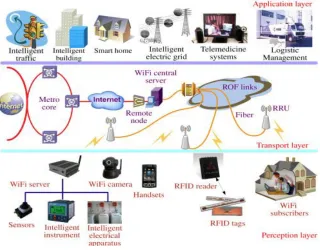
The IoT architecture is generally divided into three layers: the perception layer, the network
layer, and the service layer, as shown in Figure 2. Perception layer: It is the core layer of IoT, it can
also have called as data extraction layer. All kinds of data and information are gathered from the
physical devices, by the technologies of sensors devices, RFID tags and reader-writers, wireless
sensors network (WSN), intelligent terminals, camera, global position system (GPS), electronic data
interface (EDI), mobile etc. Network layer / Transport layer: The data extracted from the perception
layer are sent to the network layer. The network layer is a data transmission layer. The network layer
enriches various technologies like wireless sensor network (WSN), mobile communication network,
radio access network, and other communications equipment, such as global system for mobile
communications (GSM), general packet radio service (GPRS), wireless fidelity (WiFi), worldwide
interoperability for microwave access (WiMax), Ethernet, etc., this layer provide an effective,
IJSRR, 7(1) Jan. – March, 2018 Page 5 Figure 2: IoT Architecture
Service layer / Application layer: The data transferred from the network layer is stored and
managed in the service layer. This layer includes two different layers viz. data management
sub-layer and application service sub-sub-layer. The data management sub-sub-layer process the complex data
and uncertain information, such as screening, restructuring, cleaning and combining, and provides
directory service like market to market (M2M) service, Quality of Service (QoS), geometrics, etc. by
service oriented architecture (SOA), cloud computing technologies, and so on. The application
service sub-layer translates the collected data to meaning full information of content and provides
good user interface for enterprise application and end users, such as logistics and supply, disaster
caution alert, environmental monitoring, agricultural, production, and so forth.
PROPOSED TWO-LAYER NETWORK ARCHITECTURE FOR IOT-FOOD
GRAIN LOGISTIC
To realize the IoT-Food grain logistic system, which is able to constantly monitor and track
the product quality and safety during the whole supply chain from production to customer, there are
several requirements have to be considered. They are visibility, traceability, accuracy and
controllability of the goods should be smartly governed at all levels of packaging or carriers. RFID
with multi capacity in terms of sensing functionalities, energy sourcing and saving capacities,
IJSRR, 7(1) Jan. – March, 2018 Page 6
shown in the Figure 1. According to the nature of the goods and mode of transportation, the RFID
can be either chipless RFID tags, or reusable such as active wireless sensor nodes.
Figure 3: Intelligent RFID Tag
For the IoT platform the traditional RFID cannot cope with these entire configurations. Therefore, a
networked platform which embraces varieties of sensor devices and different classification of tags
with heterogeneous radio interface and functionalities are required.
RFID Tag (Layer 1)
Reader / Master Node (Layer 2)
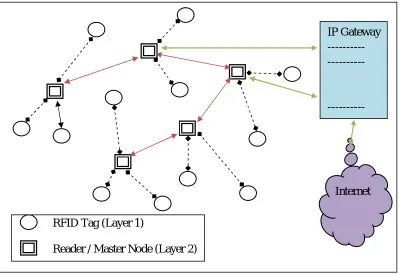
Figure 4: RFID tag and reader node with a hierarchical two-layer network External
Energy
Power Management Energy forage Sensor
Interface
Memory Digital Processor
RFID - Radio Tag Integrated Circuit
Sensors
Display
IP Gateway --- ---
---
IJSRR, 7(1) Jan. – March, 2018 Page 7
The intelligent RFID tag as shown in Figure 3 and the two-layer network architecture are
shown in Figure 4 are distinctive for food grain logistics. In Figure 4, RFID layer is the first layer
which acts as an asymmetric tag-reader link. The second layer is wireless sensor network layer which
act as an ad-hoc network between master nodes. RFID tags are coordinated by master nodes (Layer
2). In layer 2, ad-hoc networks are self-organized between master nodes as a wireless sensor
network. RFID layer is a mixed (heterogeneous) network with asymmetrical links provides a large
range of RFID selections. Smart RFID tags are ideally embedded in grain packages and
communicate with a reader (master) by micro power wireless links. The smart RFID tag as shown in
Figure 3 is normally consists of a power management and energy forage, digital processor, sensor
interfaces and memory and a radio transceiver.
The radio interface in the RFID consists of near-field coupling or far-field backscattering in
high frequency (HF) or UHF bands. For instance, an RFID tag incorporating with Ultra-wideband
(UWB) technologies applicable for high-speed detection, accurate positioning and time-domain
sensing. Even a printed chipless tag with inbuilt sensing characteristics through RF measurements of
the impedance changes as a response to the varying environment.
Tags and sensors (Figure 4) in this layer are inexpensive and energy-efficient under energy
autonomy conditions. The master node is a reader to collect the data from the tag and link to the
Internet cloud through standard air interfaces like WiFi, WiMax, GSM/GPRS and 3G. The master
node should be a superior wireless sensory location, which is regularly equipped with sophisticated
sensors such as imaging sensors and motion sensors as well as GPS for geographical tracking. The
proposed two-layer network architecture links the objects (goods, vehicle etc) via internet to transfer
the real time data for the purpose of realizing intelligent detection of objects, namely object current
location/status, tracking, monitoring and management, with the help of RFID tags, sensor devices,
actuators and positioning devices. By taking this as an advantage, IoT is a unique platform to
monitor the real time status of the grain goods in the value chain. As such, this paper proposes an
intelligent tracking system for the food grain logistics by integrating IoT technologies.
CONCLUSION
The global communication and information technology have shown a vast development. IoT
is an emerging communication technology, which communicates between people and physical things
and even between things themselves. IoT based logistic plays a vital role for vehicle monitoring,
dynamic distribution, monitoring the goods condition during transportation, reducing the damage
IJSRR, 7(1) Jan. – March, 2018 Page 8
addition, the paper proposed two-layer network architecture of IoT platform. The first layer is radio
frequency identifications (RFID) and second is wireless sensor network (WSN) layer. By adapting
the proposed system, the grain logistic companies can easy track and monitor the goods during
transportation. This system will avoid the physical damages and wastages and increase the efficiency
of a logistic system. The future research will be focused on field testing and examines the efficiency
of proposed system.
REFERENCES
1. Carriquiry M, Babcock BA. Reputations, market structure, and the choice of quality
assurance systems in the food industry. American Journal of Agricultural Economics. 2017;
89(1):12-23.
2. Folinas D, Manikas I, Manos B. Traceability data management for food chains. British Food
Journal. 2006; 108(8): 622-633.
3. Jansen-Vullers MH, Van Dorp, CA, Beulens, AJ. Managing traceability information in
manufacture. International Journal of Information Management. 2003; 23(5): 395-413.
4. Er Z, Lian, FY, Lian, JG. An RFID-based Automatic Identification System on Modern Grain
Logistics. In Management of e-Commerce and e-Government. ICMECG'08, 2008; 10-13.
5. Guang-hua, ZHAO. Application of IOT in Logistics Industry: Restricting Factors and
Countermeasures. Logistics Technology. 2011; 17.
6. Xu B, Zhang D. Yang W. Research on architecture of the Internet of Things for grain
monitoring in storage. In Internet of Things. 2012: 431-438.
7. Zhang FZ, He HX, Xia WJ. Application Analysis of Internet of Things on the Management
of Supply Chain and Intelligent Logistics. In Applied Mechanics and Materials. 2013;
2655-2661.
8. Jedermann R, Nicometo M, Uysal I, Lang W. Reducing food losses by intelligent food
logistics. Philosophical Transactions of the Royal Society of London A: Mathematical,
Physical and Engineering Sciences. 2014; http://dx.doi.org/10.1098/rsta.2013.0302
9. Dong CA. scheme for logistics tracking and monitoring based on internet of things.
Computer Modelling and New Technologies. 2014; 18(12b): 283-292
10. Cao TD, Truong HL. Analyzing and Conceptualizing Monitoring and Analytics as a Service
for Grain Warehouses. In Recent Developments in Intelligent Information and Database