THIAMINE: AN OVERVIEW
Rajendra R Dandawate 1, Sunita R Dandawate 2, Avinash Gholap 3, Rahul B Ghuge4
1. Department of Zoology, Arts, Commerce and Science College, Sonai, 414105, (MS)
India
2. Department of Engineering Science (Physics), Sanjivani Rural Education Society’s
College of Engineering, Kopargaon, 423601, (MS) India.
3. Department of Zoology, PVP College of Arts, Commerce and Science College,
Pravaranagar, 413713, (MS) India.
4. Department of Pharmaceutical Chemistry, MET Institute of Pharmacy, Nashik- 03,
(MS) India.
Summary
Thiamine or thiamin, sometimes called aneurin, is a water-soluble vitamin of the B complex
(vitamin B1), whose phosphate derivatives are involved in many cellular processes. The best
characterized form is thiamine pyrophosphate (ThDP), a coenzyme in the catabolism of sugars and amino acids. The present review states the dreadful diseases caused due to deficiency of Thiamine such as Beri- beri, Alcoholic brain disease, HIV-AIDS, Idiopathic paralytic disease in wild birds and Genetic diseases etc. The present review also states the, biosynthesis, absorption, its various derivatives with its functions and research which is been carried out.
Keywords: Beri- Beri, Polyneuritis, Thiamine, Vitamin B1.
Address for Correspondence: Dr. Rajendra R Dandawate
Assistant Professor & HOD
Department of Zoology, Arts, Commerce and Science College, Sonai, 414105, (MS) India A/P: Sonai, Tal- Nevasa, Dist- Ahmednagar, (MS) India.
Introduction
Thiamine or thiamin, 1 sometimes called aneurin, is a water-soluble vitamin of the B complex
(vitamin B1), whose phosphate derivatives are involved in many cellular processes. The best
characterized form is thiamine pyrophosphate (ThDP), a coenzyme in the catabolism of sugars and amino acids. In yeast, ThDP is also required in the first step of alcoholic fermentation. Thiamine is synthesized in bacteria, fungi and plants. Animals must cover all their needs from their food and insufficient intake results in a disease called beriberi affecting the peripheral nervous system (polyneuritis) and/or the cardiovascular system, with fatal outcome if not cured
by thiamine administration.2 In less severe deficiency, nonspecific signs include malaise, weight
loss, irritability and confusion.3 Today, there is still a lot of work devoted to elucidating the exact
mechanisms by which thiamine deficiency leads to the specific symptoms observed Finally, new
thiamine phosphate derivatives have recently been discovered, 4 emphasizing the complexity of
thiamine metabolism and the need for more research in the field.
History
Thiamine was the first of the water-soluble vitamins to be described,2 leading to the discovery of
more such trace compounds essential for survival and to the notion of vitamin. Chinese medical
texts referred to beriberi (a thiamine deficiency disease) as early as 2700 BC.5 It was not until
AD 1884 that Kanehiro Takaki (1849-1920), a surgeon general in the Japanese navy, rejected the previous germ theory and attributed the disease to insufficient nitrogen intake (protein deficiency).In 1897 Christiaan Eijkman (1858-1930), a military doctor in the Dutch Indies, discovered that fowl fed on a diet of cooked, polished rice developed paralysis, which could be
reversed by discontinuing rice polishing.6 He attributed that to a nerve poison in the endosperm
of rice, from which the outer layers of the grain gave protection to the body. Eijkman was awarded the Nobel Prize in Physiology and Medicine in 1929, because his observations led to the discovery of vitamins. An associate, Gerrit Grijns (1865-1944), correctly interpreted the connection between excessive consumption of polished rice and beriberi in 1901: he concluded that rice contained an essential nutrient in the outer layers of the grain that was removed by
polishing.7In 1911 Casimir Funk isolated an antineuritic substance from rice bran that he called a
“vitamine” (on account of its containing an amino group).8 Thiamine (“sulfur-containing
vitamin”) was synthesized in 1936 by the same group 9.It was first named “aneurin” (for
model for understanding how thiamine deficiency can lead to the pathological-physiological symptoms of beriberi. Indeed, feeding the pigeons upon polished rice leads to an easily recognizable behavior of head retraction, a condition called opisthotonos. As no morphological modifications were observed in the brain of the pigeons before and after treatment with thiamine,
Peeters introduced the concept of biochemical lesion11 When Lohman and Schuster (1937)
showed that the diphosphorylated thiamine derivative (thiamine diphosphate, ThDP) was a
cofactor required for the oxydative decarboxylation of pyruvate,12 (a reaction now known to be
catalyzed by pyruvate dehydrogenase), the mechanism of action of thiamine in the cellular metabolism seemed to be elucidated. Presently, this view seems to be oversimplified: pyruvate dehydrogenase is only one of several enzymes requiring thiamine diphosphate as a cofactor, moreover other thiamine phosphate derivatives have been discovered since then, and they may
also contribute to the symptoms observed during thiamine deficiency.13
Chemical properties
Thiamine is a colorless compound with a chemical formula C12H17N4OS. Its structure contains a
pyrimidine ring and a thiazole ring linked by a methylene bridge. Thiamine is soluble in water, methanol, and glycerol and practically insoluble in acetone, ether, chloroform, and benzene. It is
stable at acidic pH, but is unstable in alkaline solutions.2, 14 Thiamine is unstable to heat, but
stable during frozen storage. It is unstable when exposed to ultraviolet light 14 and gamma
irradiation.15, 16 Thiamine reacts strongly in Maillard-type reactions.2
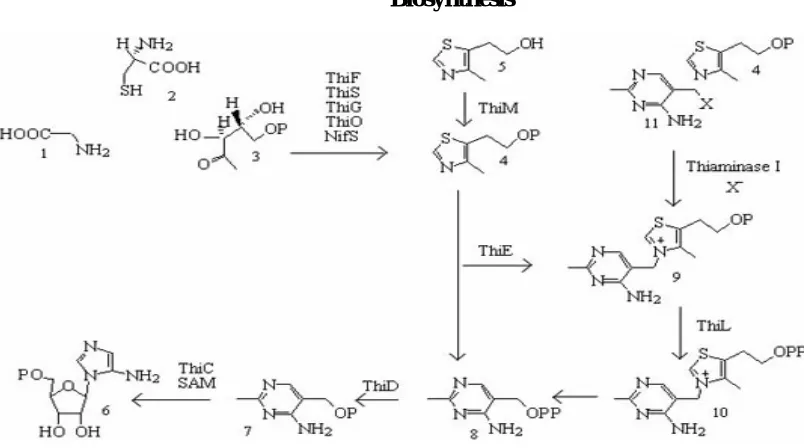
Biosynthesis
Absorption and transport
Absorption
Thiamine is released by the action of phosphates and pyrophosphates in the upper small intestine. At low concentrations the process is carrier mediated and at higher concentrations, absorption occurs via passive diffusion. Active transport is greatest in the jejunum and ileum (it
is inhibited by alcohol consumption and by folic deficiency.2 Decline in thiamine absorption
occurs at intakes above 5 mg .17 The cells of the intestinal mucosa have thiamine
pyrophosphokinase activity, but it is unclear whether the enzyme is linked to active absorption. The majority of thiamine present in the intestine is in the pyrophosphorylated form ThDP, but when thiamine arrives on the serosal side of the intestine it is often in the free form. The uptake of thiamine by the mucosal cell is likely coupled in some way to its phosphorylation/dephosphorylation. On the serosal side of the intestine, evidence has shown that
discharge of the vitamin by those cells is dependent on Na+-dependent ATPase. 3
Bound to serum proteins
The majority of thiamine in serum is bound to proteins, mainly albumin. Approximately 90% of total thiamine in blood is in erythrocytes. A specific binding protein called thiamine-binding protein (TBP) has been identified in rat serum and is believed to be a hormonally regulated
carrier protein that is important for tissue distribution of thiamine.3 Cellular uptake of thiamine
by cells of the blood and other tissues occurs via active transport and passive diffusion.2 About
80% of intracellular thiamine is phosphorylated and most is bound to proteins. In some tissues, thiamine uptake and secretion appears to be mediated by a soluble thiamine transporter that is
dependent on Na+ and a transcellular proton gradient.3
Tissue distribution
Human storage of thiamine is about 25 to 30 mg with the greatest concentrations in skeletal muscle, heart, brain, liver, and kidneys. ThMP and free (unphosphorylated) thiamine is present in plasma, milk, cerebrospinal fluid, and likely all extracellular fluids. Unlike the highly phosphorylated forms of thiamine, ThMP and free thiamine are capable of crossing cell
membranes. Thiamine contents in human tissues are less than those of other species.3, 18
Excretion
Thiamine and its acid metabolites (2-methyl-4-amino-5-pyrimidine carboxylic acid,
4-methyl-thiazole-5-acetic acid and thiamine acetic acid) are excreted principally in the urine.14
Thiamine phosphate derivatives and function
monophosphate (ThMP), thiamine diphosphate (ThDP), also sometimes called thiamine pyrophosphate (TPP), thiamine triphosphate (ThTP), and the recently discovered adenosine
thiamine triphosphate (AThTP) and adenosine thiamine diphosphate (AThDP).19
Thiamine monophosphate
There is no known physiological role of ThMP.
Thiamine diphosphate
The synthesis of thiamine diphosphate (ThDP), also known as thiamine pyrophosphate (TPP) or
cocarboxylase, is catalyzed by an enzyme called thiamine diphosphokinase according to the
reaction thiamine + ATP → ThDP + AMP (EC 2.7.6.2).20 ThDP is a coenzyme for several
enzymes that catalyze the transfer of two-carbon units and in particular the dehydrogenation (decarboxylation and subsequent conjugation with coenzyme A) of 2-oxoacids (alpha-keto acids). Examples include:
Present in most species
pyruvate dehydrogenase and 2-oxoglutarate dehydrogenase (also called α-ketoglutarate
dehydrogenase) branched-chain α-keto acid dehydrogenase 2-hydroxyphytanoyl-CoA lyase
transketolase
Present in some species:
pyruvate decarboxylase (in yeast) , several additional bacterial enzymes
The enzymes transketolase, pyruvate dehydrogenase (PDH) and 2-oxoglutarate dehydrogenase
(OGDH) are all important in carbohydrate metabolism. 21The cytosolic enzyme transketolase is a
key player in the pentose phosphate pathway, a major route for the biosynthesis of the pentose
sugars deoxyribose and ribose. 22The mitochondrial PDH and OGDH are part of biochemical
pathways that result in the generation of adenosine triphosphate (ATP), which is a major form of energy for the cell. PDH links glycolysis to the citric acid cycle, while the reaction catalyzed by
OGDH is a rate-limting step in the citric acid cycle .23 In the nervous system, PDH is also
involved in the production of acetylcholine, a neurotransmitter, and for myelin synthesis.24
Thiamine triphosphate. Thiamine triphosphate (ThTP) was long considered a specific neuroactive form of thiamine. However, recently it was shown that ThTP exists in bacteria,
fungi, plants and animals suggesting a much more general cellular role.25 In particular in E. coli,
it seems to play a role in response to amino acid starvation.26
Adenosine thiamine triphosphate (AThTP) or thiaminylated adenosine triphosphate has recently
been discovered in Escherichia coli where it accumulates as a result of carbon starvation.[4] In E.
coli, AThTP may account for up to 20 % of total thiamine. It also exists in lesser amounts in
yeast, roots of higher plants and animal tissue.27
Adenosine thiamine diphosphate
Adenosine thiamine diphosphate (AThDP) or thiaminylated adenosine diphosphate exists in
small amounts in vertebrate liver, but its role remains unknown.27
Deficiency
Thiamine derivatives and thiamine-dependent enzymes are present in all cells of the body, thus, a thiamine deficiency would seem to adversely affect all of the organ systems. However, the nervous system and the heart are particularly sensitive to thiamine deficiency, because of their high oxidative metabolism. Thiamine deficiency can lead to severe fatigue of eyes and myriad problems including neurodegeneration, wasting and death. A lack of thiamine can be caused by malnutrition, a diet high in thiaminase-rich foods (raw freshwater fish, raw shellfish, ferns)
and/or foods high in anti-thiamine factors (tea, coffee, betel nuts) 28 and by grossly impaired
nutritional status associated with chronic diseases, such as alcoholism, gastrointestinal diseases,
HIV-AIDS, and persistent vomiting. 29 It is thought that many people with diabetes have a
deficiency of thiamine and that this may be linked to some of the complications that can occur.30,
31 Well-known syndromes caused by thiamine deficiency include beriberi and
Beriberi Beriberi is a neurological and cardiovascular disease. The three major forms of
the disorder are dry beriberi, wet beriberi, and infantile beriberi.14
• Dry beriberi is characterized principally by peripheral neuropathy
consisting of symmetric impairment of sensory, motor, and reflex functions affecting distal more than proximal limb segments and
causing calf muscle tenderness.29
• Wet beriberi is associated with mental confusion, muscular wasting,
edema, tachycardia, cardiomegaly, and congestive heart failure in
addition to peripheral neuropathy.2
• Infantile beriberi occurs in infants breast-fed by thiamin-deficient
mothers (who may show no sign of thiamine deficiency). Infants may manifest cardiac, aphonic, or pseudomeningitic forms of the disorder. Infants with cardiac beriberi frequently exhibit a loud piercing cry,
vomiting, and tachycardia.14 Convulsions are not uncommon, and death
may ensue if thiamine is not administered promptly.29
Following thiamine treatment, rapid improvement occurs generally within 24
hours.14 Improvements of peripheral neuropathy may require several months of
thiamine treatment.32
Alcoholic brain disease
Nerve cells and other supporting cells (such as glial cells) of the nervous system require thiamine. Examples of neurologic disorders that are linked to alcohol abuse include Wernicke’s encephalopathy (WE, Wernicke-Korsakoff syndrome) and Korsakoff’s psychosis (alcohol amnestic disorder) as well as
varying degrees of cognitive impairment.33
Wernicke’s encephalop
athy
Is the most frequently encountered manifestation of thiamine deficiency in Western society, though it may also occur in patients with impaired nutrition
from other causes, such as gastrointestinal disease,34 those with HIV-AIDS,
and with the injudicious administration of parenteral glucose or
hyperalimentation without adequate B-vitamin supplementation.35 This is a
striking neuro-psychiatric disorder characterized by paralysis of eye movements, abnormal stance and gait, and markedly deranged mental function.36
Alcoholics may have thiamine deficiency because of the following:
Decreased uptake of thiamine from the GI tract: active transport of thiamine into enterocytes is disturbed during acute alcohol exposure.
Liver thiamine stores are reduced due to hepatic steatosis or fibrosis.37
Impaired thiamine utilization: magnesium, which is required for the binding of thiamine to thiamine-using enzymes within the cell, is also deficient due to chronic alcohol consumption. The inefficient utilization of any thiamine that does reach the cells will further exacerbate the thiamine deficiency.
Ethanol per se inhibits thiamine transport in the gastrointestinal system and
blocks phosphorylation of thiamine to its cofactor form (ThDP).38
Korsakoff Psychosis
Is generally considered to occur with deterioration of brain function in patients
initially diagnosed with WE.39. This is an amnestic-confabulatory syndrome
characterized by retrograde and anterograde amnesia, impairment of
conceptual functions, and decreased spontaneity and initiative.<29Following
improved nutrition and the removal of alcohol consumption, some impairments linked with thiamine deficiency are reversed; particularly poor brain functionality, although in more severe cases, Wernicke-Korsakoff syndrome leaves permanent damage.
In Poultry As most feedstuffs used in poultry diets contain enough quantities of vitamins to meet the requirements in this species, deficiencies in this vitamin does not
occur with commercial diets. This was, at least, the opinion in the 1960s.40
Mature chickens show signs 3 weeks after being fed a deficient diet. In young chicks, it can appear before 2 weeks of age.Onset is sudden in young chicks. There is anorexia and an unsteady gait. Later on, there are locomotor signs, beginning with an apparent paralysis of the flexor of the toes. The characteristic position is called "stargazing", meaning a chick "sitting on its hocks and the head in opisthotonos. Response to administration of the vitamin
is rather quick, occurring a few hours later.41 A therapeutic diagnosis can be
tried by supplementing Vitamin B1 only in the affected bird. If the animals do
not respond in a few hours, Vitamin B1 deficiency can be excluded.42
In ruminants
Polioencephalomalacia(PEM), is the most common thiamine deficiency disorder in young ruminant and nonruminant animals. Symptoms of PEM include a profuse, but transient diarrhea, listlessness, circling movements, star
gazing or opisthotonus (head drawn back over neck), and muscle tremors.43
Table 1: Deficiency of Thiamine
Analysis and diagnostic testing
Oxidation of thiamine derivatives to fluorescent thiochromes by potassium ferricyanide under alkaline conditionsA positive diagnosis test for thiamine deficiency can be ascertained by measuring the activity of the enzyme transketolase in erythrocytes (Erythrocyte Transketolase
Activation Assay). 46Thiamine, as well as its phosphate derivatives, can also be detected directly
in whole blood, tissues, foods, animal feed and pharmaceutical preparations following the conversion of thiamine to fluorescent thiochrome derivatives (Thiochrome Assay) and separation
by high performance liquid chromatography (HPLC). 47, 48 In recent reports, a number of
Capillary Electrophoresis (CE) techniques and in-capillary enzyme reaction methods have emerged as potential alternative techniques for the determination and monitoring of thiamine in
samples.49
Genetic diseases
Genetic diseases of thiamine transport are rare but serious. Thiamine Responsive Megaloblastic
Anemia with diabetes mellitus and sensorineural deafness (TRMA) 50 is an autosomal recessive
disorder caused by mutations in the gene SLC19A2,51 a high affinity thiamine transporter.
TRMA patients do not show signs of systemic thiamine deficiency, suggesting redundancy in the thiamine transport system. This has led to the discovery of a second high affinity thiamine
transporter, SLC19A3.52 Leigh Disease (Subacute Necrotising Encephalomyelopathy) is an
inherited disorder which affects mostly infants in the first years of life and is invariably fatal.53
Pathological similarities between Leigh disease and WE led to the hypothesis that the cause was a defect in thiamine metabolism. One of the most consistent findings has been an abnormality of
also possible.44
Idiopathic paralytic disease in wild birds
Recently thiamine deficiency has been identified as the cause of a paralytic
disease affecting wild birds in the Baltic Sea area dating back to 1982.45 In this
condition, there is difficulty in keeping the wings folded along the side of the body when resting, loss of the ability to fly and voice with eventual paralysis of the wings and legs and death. It affects primarily 0.5–1 kg sized birds such as the herring gull (Larus argentatus), Common Starling (Sturnus vulgaris) and Common Eider (Somateria mollissima). Researches noted "Because the investigated species occupy a wide range of ecological niches and positions in the food web, we are open to the possibility that other animal classes may
the activation of the pyruvate dehydrogenase complex 54. Other disorders in which a putative role for thiamine has been implicated include Subacute Necrotizing Encephalomyelopathy, Opsoclonic Cerebellopathy (a paraneoplastic syndrome), and Nigerian Seasonal Ataxia. In
addition, several inherited disorders of ThDP-dependent enzymes have been reported, 55 which
may respond to thiamine treatment.29
Research
Research in the field mainly concerns the mechanisms by which thiamine deficiency leads to neuronal death in relation to Wernicke Korsakoff Psychosis. Another important field concerns the understanding of the molecular mechanisms involved in ThDP catalysis. More recently, research has been devoted to the understanding of the possible non-cofactor roles of other
derivatives such as ThTP and AThTP.55 Understanding the mechanism by which thiamine
deficiency leads to selective neuronal death. Experimentally induced beriberi polyneuropathy in chickens may be a good model for studying these forms of neuropathy in view of diagnosis and
treatment.56 From studies using rat models, a link between thiamine deficiency and colon
carcinogenesis was suggested.57 Rat model is used also in research of Wernicke's
encephalopathy.58 Thiamine deprived mice are a classic model of systemic oxidative stress, used
in research of Alzheimer’s disease.59 Catalytic mechanisms in thiamine diphosphate-dependent
enzymes. A lot of work is devoted to the understanding of the interplay between ThDP and
ThDP-dependent enzymes in catalysis.60
Non-cofactor roles of thiamine derivatives
Thiamine compounds other than ThDP exist in most cells from many organisms, including bacteria, fungi, plants and animals. Among those compounds are thiamine triphosphate (ThTP) and adenosine thiamine triphosphate (AThTP) are thought to have non-cofactor roles, though at
present it is not known to what extent they participate in the symptoms. 61, 62
Persistent carbenes
The production of furoin from furfural is catalyzed by thiamine through a relatively stable carbene (organic radical). This reaction, studied in 1957 by R. Breslow, was the first evidence
for the existence of persistent carbenes.62
Conclusion
References
1. Mahan LK, Escott-Stump S, editors. Krause's food, nutrition, & diet therapy. 10th ed. Philadelphia: W.B. Saunders Company; 2000, 4: 157-159.
2. Combs, G. F. Jr. The vitamins: Fundamental Aspects in Nutrition and Health. 3rd Edition. Ithaca, NY: Elsevier Academic Press; 2008
3. Bettendorff L, Wirtzfeld B, Makarchikov AF, Mazzucchelli G, Frédérich M, Gigliobianco T, Gangolf M, De Pauw E, Angenot L and Wins P . "Discovery of a natural thiamine adenine nucleotide". Nature Chem. Biol. 2007, 3: 211–212.
4. McCollum EV. A History of Nutrition. Cambridge, MA: Riverside Press, Houghton Mifflin; 1957.
5. Eijkman, C. Eine Beriberiähnliche Krankheit der Hühner. Virchows Arch. Pathol. Anat. 1897, 148: 523.
6. Grijns, G. Over polyneuritis gallinarum. I. Geneesk. Tijdscht. Ned. Ind. 1901 , 43, 3-110
7. Jansen, B.C.P. and Donath, W.F. On the isolation of antiberiberi vitamin. Proc. Kon. Ned. Akad. Wet. 1926, 29: 1390-1400.
8. Williams, R.R. and Cline, J.K. Synthesis of vitamin B1. J. Am. Chem. Soc. 1936 ,58: 1504-1505.
9. Carpenter KJ. Beriberi, white rice, and vitamin B: a disease, a cause, and a cure. Berkeley, CA: University of California Press; 2000
10. Peters, R.A. The biochemical lesion in vitamin B1 deficiency. Application of modern biochemical analysis in its diagnosis. Lancet, 1936, 1: 1161-1164.
11. Lohmann, K. and Schuster, P. Untersuchungen über die Cocarboxylase. Biochem. Z. 1937, 294, 188-214.
12. Breslow R. "On the mechanism of thiamine action. IV.1 Evidence from studies on model systems". J Am Chem Soc, 1958, 80: 3719–3726.
13. Tanphaichitr V. Thiamin. In: Shils ME, Olsen JA, Shike M et al., editors. Modern Nutrition in Health and Disease. 9th ed. Baltimore: Lippincott Williams & Wilkins; 1999
14. Luczak M, Zeszyty Probi PostepoLc Vauh Roln 1968; 80,497.
15. Syunyakova ZM, Karpova IN, Vop Pitan 1966; 25(2), 52.
16. Webb ME, Marquet A, Mendel RR, Rebeille F & Smith AG Elucidating biosynthetic pathways for vitamins and cofactors. Nat Prod Rep, 2007, 24, 988-1008.
17. Begley TP, Chatterjee A, Hanes JW, Hazra A & Ealick SE Cofactor biosynthesis—still yielding fascinating new biological chemistry. Curr Opin Chem Biol, 2008, 12, 118-125.
18. Switching the light on plant riboswitches. Samuel Bocobza and Asaph Aharoni Trends in Plant Science Volume 13, Issue 10, October 2008, 526-533
20. McGuire, M. and K.A. Beerman. Nutritional Sciences: From Fundamentals to Foods. 2007. California: Thomas Wadsworth.
21. Hayes KC, Hegsted DM. Toxicity of the Vitamins. In: National Research Council (U.S.). Food Protection Committee. Toxicants Occurring Naturally in Foods. 2nd ed. Washington DCL: National Academy Press; 1973.
22. Bettendorff L., Mastrogiacomo F., Kish S. J., and Grisar T. "Thiamine, thiamine phosphates and their metabolizing enzymes in human brain". J. Neurochem. 1996, 66: 250–258.
23. Butterworth RF. Thiamin. In: Shils ME, Shike M, Ross AC, Caballero B, Cousins RJ, editors. Modern Nutrition in Health and Disease, 10th ed. Baltimore: Lippincott Williams & Wilkins; 2006
24. Makarchikov AF, Lakaye B, Gulyai IE, Czerniecki J, Coumans B, Wins P, Grisar T and Bettendorff L . "Thiamine triphosphate and thiamine triphosphatase activities: from bacteria to mammals". Cell. Mol. Life Sci , 2003, 60: 1477–1488.
25. Lakaye B, Wirtzfeld B, Wins P, Grisar T and Bettendorff L. "Thiamine triphosphate, a new signal required for optimal growth of Escherichia coli during amino acid starvation". J. Biol. Chem. 2004, 279: 17142–17147.
26. Frédérich M., Delvaux D., Gigliobianco T., Gangolf M., Dive G., Mazzucchelli G., Elias B., De Pauw E., Angenot L., Wins P. and Bettendorff L Thiaminylated adenine nucleotides — chemical synthesis, structural characterization and natural occurrence FEBS J. 2009, 276. pp. 3256–3268.
27. "Thiamin", Jane Higdon, Micronutrient Information Center, Linus Pauling Institute
28. Butterworth RF. Thiamin. In: Shils ME, Shike M, Ross AC, Caballero B, Cousins RJ, editors. Modern Nutrition in Health and Disease, 10th ed. Baltimore: Lippincott Williams & Wilkins; 2006.
29. Thornalley PJ. "The potential role of thiamine (vitamin B(1)) in diabetic complications". Curr Diabetes Rev, 2005, 1 (3): 287–98.
30. Diabetes problems 'vitamin link', BBC News, Tuesday, 7 August 2007
31. Maurice V, Adams RD, Collins GH. The Wernicke-Korsakoff Syndrome and Related Neurologic Disorders Due to Alcoholism and Malnutrition. 2nd ed. Philadelphia: FA Davis, 1989.
32. Martin, PR, Singleton, CK, Hiller-Sturmhofel, S. "The role of thiamine deficiency in alcoholic brain disease". Alcohol Research and Health, 2003, 27: 134–142.
33. Kril JJ, “Neuropathology of thiamine deficiency disorders". Metab Brain Dis, 1996, 11 (1): 9–17
34. Butterworth RF, Gaudreau C, Vincelette J et al. "Thiamine deficiency and wernicke's encephalopathy in AIDS". Metab Brain Dis , 1991, 6: 207–12.
35. Harper C. "Wernicke’s encephalopathy, a more common disease than realised (a neuropathological study of 51 cases)". J Neurol Neurosurg Psychol , 1979, 42: 226–231.
37. Rindi G, Imarisio L, Patrini C . "Effects of acute and chronic ethanol administration on regional thiamin pyrophosphokinase activity of the rat brain". Biochem Pharmacol, 1986, 35: 3903–8.
38. McCollum EV A History of Nutrition. Cambridge, MA: Riverside Press, Houghton Mifflin; 1957.
39. Merck Veterinary Manual, ed 1967, 1440-1441.
40. R.E. Austic and M.L. Scott, Nutritional deficiency diseases, in Diseases of poultry, ed. by M.S. Hofstad, Iowa State University Press, Ames, Iowa, USA, 12: 50 - 54.
41. The disease is described more carefully here: merckvetmanual.com
42. National Research Council. Nutrient Requirements of Beef Cattle, Seventh Revised Ed. Washington, D.C.: National Academy Press. 1996
43. Polioencephalomalacia: Introduction, Merck Veterinary Manual
44. Balk L, Hägerroth PA, Akerman G, Hanson M, Tjärnlund U, Hansson T, Hallgrimsson GT, Zebühr Y, Broman D, Mörner T, Sundberg H. Wild birds of declining European species are dying from a thiamine deficiency syndrome. Proc Natl Acad Sci U S A. 2009, 106:12001–12006.
45. Bettendorff L, Peeters M., Jouan C., Wins P., and Schoffeniels E. Determination of thiamin and its phosphate esters in cultured neurons and astrocytes using an ion-pair reversed-phase high-performance liquid chromatographic method. Anal. Biochem. 1991, 198: 52-59.
46. Losa R, Sierra MI, Fernández A, Blanco D, Buesa JM. Determination of thiamine and its phosphorylated forms in human plasma, erythrocytes and urine by HPLC and fluorescence detection: a preliminary study on cancer patients.J Pharm Biomed Anal. 2005, 37:1025-1029.
47. Lu J, Frank EL. (2008) Rapid HPLC measurement of thiamine and its phosphate esters in whole blood. Clin Chem. 2008 May; 54(5):901-906.
48. Shabangi M, Sutton JA. Separation of thiamin and its phosphate esters by capillary zone electrophoresis and its application to the analysis of water-soluble vitamins. Journal of Pharmaceutical and Biomedical Analysis 2005; 38:1:66-71.
49. Thiamine Responsive Megaloblastic Anemia with severe diabetes mellitus and sensorineural deafness (TRMA).
50. Kopriva, V; Bilkovic, R; Licko, T. "Tumours of the small intestine (author's transl)". Ceskoslovenska gastroenterologie a vyziva, Dec 1977, 31 (8): 549–53.
51. Beissel, J . "The role of right catheterization in valvular prosthesis surveillance (author's transl)". Annales de cardiologie et d'angeiologie , Dec 1977, 26 (6): 587–9.
52. Online 'Mendelian Inheritance in Man' (OMIM) 249270
53. Butterworth RF. Pyruvate dehydrogenase deficiency disorders. In: McCandless DW, ed. Cerebral Energy Metabolism and Metabolic Encephalopathy. Plenum Publishing Corp.; 1985.
55. Djoenaidi W, Notermans SL, Gabreëls-Festen AA, Lilisantoso AH, Sudanawidjaja A, "Experimentally induced beriberi polyneuropathy in chickens". Electromyogr Clin Neurophysiol, 1995, 35 (1): 53–60.
56. Bruce WR, Furrer R, Shangari N, O’Brien PJ, Medline A, Wang Y , "Marginal dietary thiamin deficiency induces the formation of colonic aberrant crypt foci (ACF) in rats". Cancer Lett, 2003, 202: 125–129.
57. Langlais PJ. "Pathogenesis of diencephalic lesions in an experimental model of Wernicke's encephalopathy". Metab Brain Dis , 1995, 10 (1): 31–44.
58. Frederikse PH, Zigler SJ Jr, Farnsworth PN, Carper DA, "Prion protein expression in mammalian lenses". Curr Eye Res, 2000, 20 (2): 137–43.
59. Kale S, Ulas G, Song J, Brudvig GW, Furey W & Jordan F Efficient coupling of catalysis and dynamics in the E1 component of Escherichia coli pyruvate dehydrogenase multienzyme complex.Proc Natl Acad Sci U S A. 2008, 105, 1158-1163
60. Kluger R & Tittmann K Thiamin diphosphate catalysis: enzymic and nonenzymic covalent intermediates. Chem Rev, 2008, 108, 1797-1833
61. Makarchikov AF, Lakaye B, Gulyai IE, Czerniecki J, Coumans B, Wins P, Grisar T & Bettendorff L , Thiamine triphosphate and thiamine triphosphatase activities: from bacteria to mammals. Cell Mol Life Sci, 2003 , 60, 1477-1488.