2377
Preventing Corruption With Blockchain
Technology (Case Study Of Indonesian Public
Procurement )
Rien Agustin F, Dewi Susilowati
Abstract: Various literature research in the world shows that blockchain technology can be used as an alternative to support the good corporate governance mechanism. Based on this argument, this study was conducted to analyze and evaluate the application of blockchain technology in public procurement. Research Methods: The research method used is a qualitative-descriptive research method with a literature study approach. The Accounting Theory is used as analytical tool, to predict the possibility of using blockchain technology. Results: Result finds that blockchain technology can be used as an alternative tool for supporting good corporate governance mechanism. Blockchain features that do not allow any third party intervention can reduce agency conflict which always arises from the information asymmetry between the principal and the agent, thereby reducing the disparity of power between the government and the citizen, as the source of the agency problem. Future research may use other research methods, such as mixed methods, to get clarity on the root of the problem for combating corruption.
Key Words: Public Procurement, Corruption, Good Governance, Blockchain Technology, Social Contract Theory
————————————————————
INTRODUCTION
Public procurement is a business that has significant values, which covered infrastucture business, such as bridge project, roads, buildings, hospitals, universities, and also the procurement of goods and services. Based on Report from The Organization of Economic Developed Countries (OECD, 2016)(1) , the amount of public procurement budget amongst countries member of OECD, on average reaching 15% of Gross National Product (GDP) . This indicates the large portion of the funds that must be provided for. In Indonesia, the amount of public procurement budget accounts for approximately 30% of The State Budget (APBN), the amount of APBN 2017 of Rp.2.080 trillion (Ministry of Finance, 2017)(2) It is estimated that 60% of foreign aid is allocated to this post (Transparency International, 2017)(3). Based on OECD Report (2016) (1), the public procurement management in Indonesia is inefficient, less accountable and less transparent, which resulting loss of approximately US $ 15 billion per year. Data collected by the Corruption Eradication Commission (KPK) shows that between 2015 July 1st to December 31st , corruption in public procurement budget is the most commonly corruption case in Indonesia. Corruption is the enemy of economic development, which caused Indonesia had financial crisis in 1997 (Yayan Nuryana & Dwi Asih, 2019) The Indonesian Government has been done many ways to combat corruption in public procurement, including the adoption of electronic procurement system. But, the adoption process is running slower than expected because only 30% of total public procurement budget, managed through e-procurement system (Transparency International, 2017)(3). .To overcome the slow adoption, the Government of Indonesia established an e-catalog system launched in 2013.
The e-cataloque system is used for ordering electronically. To date there are more than 66,000 (sixty six thousand) types of items that have been registered on a system basis. Unfortunately, the e-cataloque system which prepared by the government, still has some disadvantages. According to Transparency International Report (2017)(3), the advantages of e-catalogue system consisting several items: (a) can not access some important documents for procurement, such as bidding documents, contract documents and details, (b) the data is not presented in detail until the transaction level, and presented only to the account level only, such as data on tax revenues, budget allocations per organization, budget title, and rural budget transfers, (c) data presented in different formats and not always readable by machine (machine readable), (d) the government is not active in promoting the openness of data on public procurement, which is published online to the public, (e) there is no standardized data format for publication purposes, (f) unavailability of information that may explain the origin of the data (metadata), as well as (g) data presented online, does not provide sufficient documentary evidence. Furthermore, Transparency International (2017)(3) reported, there is no formal mechanism, which can provide official feedback on government-published data. This research is conducted base on the argument that Indonesia, as one of the member countries that support the Sustainable Development Goals (SDGs), is having an interest in creating efficiency of government budget utilization, especially in public procurement funds. Corruption due to in-efficiency public budget procurement funds has significant values which approximately USD 15 Billion per year (Transparency International, 2017)(3). The misuse of the public procurement budget is counterproductive compared to the cost of development required to achieve the goal of SDGs 2030, such as poverty alleviation programs, food security, health, education, climate change mitigation, and other socio-economic and environmental sustainability. It is estimated that developing countries like Indonesia need investment funds to build basic infrastructure, such as roads, railway stations, ports, water, sanitation, electricity, food, health and education facilities, $ 3.3 trillion - $ US 4, 5 trillion per year (United Nations _____________________
Rien Agustin F, is assistant professor at Accounting Dept, Mercubuana University
Email : [email protected],id
Dewi Susilowati, is assistant professor at Accounting Dept, Universitas Djendral Soedirman Purwokerto, Indonesia.
2378 Conference on Trade and Development/ UNCTAD,
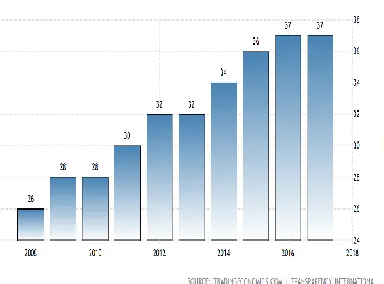
2014a)(4). .The role of the Public Sector is crucial to achieve the objectives of SDGs, so implementation of good governance becomes very important. Slow implementation of good governance, weaknesses in rule and law enforcement and judicial systems, as well, is the main cause of corruption in Indonesia (Martini, 2012)(5),(World Bank,2010)(6). Based on the reports of Transparency International (2018)(7), Indonesian corruption ranks on 2017 is 96 from 176 countries with a score of 37 on a scale of 100, presented in chart 01, below :
Source: (Transparency International, 2018)(7)
Corruption in public procurement issues, not only belongs to Indonesian Government, but also belongs to other government both developed or developing countries, because the impact can be harmful to a country‘s economy. Below are the impact of corruption in public procurement presented in table 01:
Table 01. The Impact of Public Procurement Corruptions On Country’s Economy
Financial
Increase cost of product,service or and investment which is not benefit the country‘s economic development , and will end with the decrease of potensial income.
Poor quality of goods or works.
Increase the national budget expenditure because of the increase of cost which is not needed such as repairs due to poor construction of roads or buildings.
Environment
Environmental impact of projects overlooked or inadequately considered.
Failure to meet proper environmental standards, or to achieve environmental goals, set in the project during implementation of contracts.
Illegal or irresponsible use of natural resources.
Health
Low quality products increase health and safety risks.
Lost of public funds that could be used to provide or improve essential amenities and services, such as healthcare, access to clean water and education.
Human‘s
Safety Low quality construction of buildings, roads and bridges increase probability of accidents.
Innovation
Decrease the capability of providing competitive innovative solutions .
Reduces market access and discourages investment in innovation by potential bidders.
Erosion of Corrupt behaviour by government officials or
value and trust in government
toleration of corrupt behaviour encourages bad practice by companies and citizens
Lack of integrity in procurement decreases the validity of government decisions in other areas and diminishes trust in other government processes
Source: Adapted from Transparency International (2018)
Table 02. The Incident of Public Procurement Corruptions In The World
Countries Name of Case
Bangladesh(9) The Padma Bridge Case
USA10 The Scandal in Army Corps of Engineers Indonesia(11) The E-KTP Scandals
Azerbaijani(8) Illegal harvesting of caviar
Columbia(12) Over-payments for seven drugs in 32 hospitals
Honduras(12)
The Health Minister was misuse of state of emergency rules to purchase 57 per cent of the 405 Honduran essential medicines from a single supplier, without competition.
Nigeria(12)
The misuse of public procurement funds in the construction of 40 Primary Healthcare Centres (PHCs).
Philipines(13) The Bataan Nuclear Power Project Uganda(13) The Bujangali Dam Project
Source: Own Development (based on many sources)
Weak governance has been a problem all over the world (Fukuyama, 2005)(13). While all of countries accepted the concept of good governance as a key to solve this problem, actually it is very hard to implement, particularly for countries with weak government. Even if there is a specialist who mastering to create a sound monetary policy, he/she might not be able to fix a corrupt system within a weak legal institutions (Fukuyama,2005)(13). Research around the world provided solutions in addressing this issues. In the digital era, technology is the heart of all activities. The maximum utilization of technology can provide an opportunity for society welfare. Technology can be considered in accelerating the process of eradicating corruption, as an alternative tool to support the implemention of good governance concept. Yermack (2016)(14) considered that blockchain technology can replace it as a tool to fight corruption. The important point from the benefit of the blockchain is to minimize the chance of fraud. In blockchain it is very difficult to create fictitious assets, transactions can not be backdated, can not capitalize operating costs illegally, and so on
(Yermack,2016)(14). Furthermore, Yermack
(2016)(14),explains that blockchain technology makes accounting transactions "real time", the data generated through blockchain technology is well-maintained, so auditing or financial reporting standards is not important any more.
Definition and mechanism of blockchain According to Nakamoto‘s works on 2008 (15)
2379 , can not changed because the network is robust in its
unstructured. The Nodes work all together at onceto the same directions. Nodes can joint and rejoin the network , or accepting the proof-of-work chain as simptoms of what happened . The Nodes also choose to express the acceptance of valid blocks by extending or rejecting invalid blocks. In simple way, figure (1) below described how the blockchain technology‘s mechanism work
Figure (1) Blockchain Mechanism (Adapted from Wild, Arnold & Sttafford, 2015)(18)
Research Methods
This research use descriptive qualitative research method. The concept of Blockchain, as a new technology in the world has not been applied thoroughly and has not been empirically tested The emphasis of research is literature study because it relies more on information contained from a number of sources. The sources of literature include reports from various world-renowned bodies that conduct research on Indonesia. In addition, data from various researches on blockchain technology have been collected, from various angles of science, i.e : information systems, law, economics and accounting. Lack of research in this area, made this study did not limit the use source of data, as long as it is considered relevant, reliable and accountable. This study consist of two part : part (1) Literature Review for the benefit of using Blockchain Technology , part (2) Review the adoption of Blockchain Technology from theoretical base. We use four accounting theories to explain and proved the usefulness of Blockchain Technology that can accelerate the implementation of good governance. The accounting theories we used are : Agency Theory, Social Contract Theory, Institutional Theory, Legitimacy Theory and Stakeholder Theory
Part 1. Benefits of Using Blockchain Techonology in Various Fields
After the success of Nakamoto (2008)(17) when introducing bitcoin as a digital currency, blockchain technology was finally known as one of the alternative of transactional recording media that usually traditionally used ledger (ledger). Blockchain can be used to record share ownership and can provide solutions to company problems related to the inability to record timely and accurate data of its shareholders (Kahan & Rock, 2008) (18). Blockchain can also be used to prevent corruption (Yermack, 2017) (19). Lee (2016)(20) mentions the benefits of blockchain for peer-to-peer stock trading in dealing with issues currently occurring
2380 Part 2. Theoritical Basis
This study proposes the use of blockchain technology in public procurement process as a tools to support the process of Corporate Governance. The theoretical basis used to support of the argument is The Accounting Theories such as Agency Theory, the Social Contract Theory by Jean-Jacques Rousseau (1762) (28), The Institutional Theory and The Legitimacy Theory. The difference of this study with research from Reijers, O'Brolcháin, Haynes (2016)(29) that this study looks at the use of Blockchain Technology from a common sense perspective. The relationship between the community and the government is a balanced reciprocal relationship in which the people are obliged to submit to the government, while the government is obliged to provide the security and welfare (Social Contract Theory from the point of view of Rousseau, 1762)(28). Thus, perception that the government was accountable and transparent, will make the society felt comfortable, on the contrary, the society will provide the loyalty to the government to obey the rule. Compared to research conducted by Reijers, O'Brolcháin, Haynes (2016)(29) which see it from point of view that social contract arise because this technology has a ―special fiture‖. Reijers, O'Brolcháin, Haynes (2016)(29) used Etherium (one of underlying technology of Blockchain), to explain the implication of social contract theory on their study.
2.1 Social Theory of Contract
Social Theory of Contract (Rousseau, 1762)(28) , explain the role of government and society in a state. In the beginning of human history, the society do not have the standard rules, but want to live with peace. When the peace is very difficult to find, then the society made an agreement (contract) and pointed one of them to be the authority/ government. The content of the contract is the society obliged to respect one another and live safely and peacefully. The society must obey the rules made and surrender all or part of his independence or his rights to the government. The government have big power to guarantee the provision of protection for life and property and give sense of security by providing justice by making rules and laws. At the end, the government with their big power to rule the society, must provide welfare to all their society.
2.2 Agency Theory
In Agency Theory, the relationship between government and society, reffered to principle and agent relationship. Agency theory explained the relationship between agent and principles as an ―agency relationship‖ (Jensen &Meckling, 1978)(30). They define this relationship as a contract under which one or more persons (the principal) engage (the agent) to perform some service on their behalf which involves delegating some decision making authority. The assumption in this theory, that both parties are want to maximize their wealth. With this reason, agent will not always act in the best interests of the principal, which is called "agency problem" (Jensen & Meckling, 1978) (30). To reduce the agency problem, the principal can gives the appropriate incentives for the agent and spent ―monitoring costs ―, to make sure that the agent will not take certain actions which would harm the principal‘s interest. This monitoring cost, reffered to ―agency cost‖.
2.3 Institutional Theory
Following the work of Fiss (2008)(31) , this study try to explain the adoption of Blockchain Technology from point of view of Institutional Theory, beside the previous theory above. Fiss (2008)‘s(31)
work, was try to explain corporate governance from sociological institutionalism using socially informed perspective, to investigate the element of organization from both culture and socio politically approach. Different from Fiss (2008)(31) , this study argue that Blockchain Technology was seen as an institution. This argument was based on Scott‘s (2001:33)(32)
definitions of institutions , that Institutions consist of cognitive, normative, and regulative structures and activities that provide stability and meaning to social behavior. The adoption of Blockchain Technology will change organizations into the form of changes made by (Isomorphism). DiMaggio & Powel (1983) (33)
states that mimetic behavior in the organization are considerable, when an organization faces a problem with ambiguous causes or unclear solution, so organizations will modelled with the new organizations form.
2.4 Legitimacy Theory
Legitimacy Theory was come from the concept of organizational legitimacy which has been defined by Dowling and Pfeffer (1975, 122) (34) which states that the organization must ensure to operate within the boundaries and norms of their societies, by always adjust their value's system with value of the entire social system of which the entity is a part. Threat to legitimacy arise when there is a disparity amongs them
2.5 Stakeholder Theory
Stakeholder Theory was coined by Edward Freeman, (1984)(35) . He explains that in a company consist a group namely stakeholder which involved or affected shareholders which are one of many stakeholders in a company. The stakeholder consist of employees, environmentalists near the company‘s plants, vendors, governmental agencies, and more. Freeman‘s theory suggests that a company‘s real success depend on satisfaction of all its stakeholders. Fontaine, Harmaan & Schmid (2006)(36) , try to explain Freeman and Evan‘s work (1990)(37)
2381 agreed by unanimous consent (3) The principle of
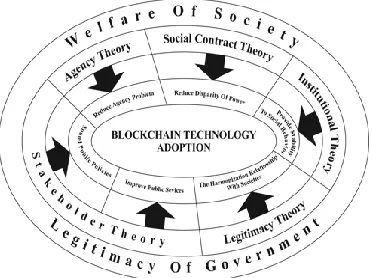
externalities: If contract between A and B involve C, C has to be invited as a party of the contract (4) The principle of contracting costs: Each parties must share in the cost of contracting (5) The agency principle: Any party must serve the interests of all stakeholders and (6) The principle of limited immortality: The corporation should be managed as if it can continue to serve the interests of stakeholders through time. With all of those explanation above, it is clear what is the ideal conditions to guide manager in managing the organization toward its stakeholder satisfactions. Base on the description above, we resume in Figure 03 :
Figure 03. Theoritical Model For Blockchain Adoption Basis
Result & Discussion
Corporate governance issues arise when two conditions are present (Hart,1995)(38). First, when there is an agency problem. Second, when transaction costs occured to minimize agency problem in an agency relationship. There were three important transaction cost such as : a) cost of thinking , b) cost of negotiating with other party during this relationships and c) cost of writing down , e.g. cost for judge , if there was a dispute or a status quo decision between principle and agent. The occurring of these transaction costs, will motivate the principle - agent not to do a fair contract between them (Hart, 1995) (38) , which mean that one party will take advance from other party. This can be mean that one party not always make decision that meet the interest of others (Nurul Hidayah, 2016)(40).The conditions may arise the needed of governance structure as mechanism to fix the agency problem. Blockchain Technology feature‘s does not allow third parties to intervene on transactions, so the data will maintained with integrity. Blockchain Technology creates trust from the people because of the transparent mechanism of blockchain work, so that the public can easily monitor all actions taken by the government. The social contract between the government and the people through the use of Blockchain Technology raises a sense of security that the government has fulfilled its obligations in protecting and prospering its people. Todate, the concept of good governance has been widely applied. The good governance concept was tailored in to the objectives of Sustainable Development, based on (1) inclusive social development (2) inclusive economic development; (3) environmental sustainability and (4) peace and security (UNCTAD,2014)(39). Good Governance Mechanism consists of transparency, democracy , efficiency and effectiveness of
public services. The Governance Process refers to the quality of participation to ensure socio-economic and political priorities based on the consensus of the community and hear all the aspirations of all types of layers of society. The end result of governance is the peace, stability and prosperity of society. Accountability is a theme that colors the concept of governance as a whole, both horizontally (between the judiciary and the legislature), as well as vertically, between the government and the people. To achieve sustainable development requires an accountable official, in relation to all actions taken on behalf of the people and using the resources of the people. Based on the accounting theories above and the Concept of Good Governance towards Sustainable Development (UNDP, 2014)(4), it can concluded that the use of blockchain technology creates :
(1) accountability in every government action / policy, since the blockchain feature does not allow third parties to intervene on transactions, so the data is maintained with integrity.
(2) Blockchain Technology creates trust from the people because of the transparent mechanism of blockchain work, so that the public can easily monitor all actions taken by the government. (3) The social contract between the government and
the people through the use of Blockchain Technology raises a sense of security that the government has fulfilled its obligations in protecting and prospering its people
(4) History of transaction data that can not be deleted or replaced (new blocks will connect to the next block, if already validated referring to historical history of transactions).
(5) The date of the transaction can not be back-dated, nor manipulated by any party.
(6) The transaction validation process by using proof of work, is a very complicated process and can not be intervened by a third party, so the integrity of the data is not in doubt. Public ledger that can be accessed by anyone and anywhere
With the above features, any problems arising from weak supervision systems, weak enforcement, third-party interference can be reduced and even eliminated. The use of Blockchain Technology can be used for several reason, such as:
(1) to support good governance implementation especially for public sector procurement in Indonesia, because it can eliminate the agency problem and information asymmetry that always arise in the agency relationship between principal and agent
(2) for the decision-making process because it eliminates the "cognitive bias" that always occurs in any decision-making, which can lead to bias, (3) to eliminate the disparity of power between
institutions and individuals because blockchain technology does not required third party interference in conducting financial transactions.
2382 that technology can be used to combat corruption, further
empirically research is expected. We predict that ‗culture‘ may be one of variables that can affected the implementation of good governance in Indonesia. This prediction was came from argument that Indonesia as an archipelago, has many different culture amongst its citizens. We suspected that different culture caused difference perceptions of corruptions, which hamper to combat corruption. It is highly recommended to use other research methods such as mixed methods, to get a thorough understanding. This study provided other perspective of Accounting Theory that can be applied in order to prove that Blockchain Technology can be used as supporting tools of corporate governance especially to combat corruption in public procurement. Further research is needed to get clarity on the root of the problem, and the important things is to provide framework as a precautions on detecting public procurement corruption
REFERENCES
(1) OECD.(2016).―Preventing Corruption in Public
Procurement‖. retrieve from :
http://www.oecd.org/gov/ethics/Corruption-in-Public-Procurement-Brochure.pdf
(2) Ministry Of Indonesian Finance. (2017). ―Informasi APBN 2018, Pemantapan Pengelolaan Fiskal Untuk Mengakselerasi Pertumbuhan Ekonomi
Yang Berkeadilan‖.
https://www.kemenkeu.go.id/media/6552/informasi-apbn-2018.pdf
(3) Transparency International.(2017).‖Open Data & The Fight Against Corruption In Indonesia‖. http://webfoundation.org/docs/2017/04/2017_Open DataIndonesia_EN-2.pdf
(4) United Nations Conference on Trade and Development. (2014).‖World Investment Report, Investing The SDGs, Action Plan‖. Retrieve from: http://unctad.org/en/PublicationsLibrary/wir2014_e n.pdf.
(5) Martini. Mairi. (2012). ―Causes of Corruption in
Indonesia‖. Retrieve from: http://
―www.u4.no/publications/causes-of-corruption-in indonesia/downloadasset/2890
(6) World Bank. (2010). ―Worldwide Governance Indicators‖.
http://info.worldbank.org/governance/wgi/pdf/wgida tatables.pdf
(7) Transparency International.(2018). ―Corruption Perception Index 2018‖. Retrieve from : https://www.transparency.org/cpi2018
(8) Transparency International.(2014). ―Curbing Corruption in Public Procurement Practical Guide‖. https://www.transparency.org/whatwedo/publicatio n/curbing_corruption_in_public_procurement_a_pr actical_guide
(9) World Bank Statement On The Padma
Cases.2012. retrieve from
http://www.worldbank.org/en/news/press- release/2012/06/29/world-bank-statement-padma-bridge
(10)19-Year Corruption Sentence for Ex-Manager With Army Corps of Engineers‖, New York Times, 12
July 2013: http://www.nytimes.
com/2013/07/12/us/19-year-corruption-sentence-for-ex-manager-with- army-corps-of-engineers.html (11)Indonesia's House speaker allegedly involved in e-KTP mega corruption scandal. March 9, 2017.
Retrieve from:
http://www.thejakartapost.com/news/2017/03/09/in donesias-house-speaker-allegedly-involved-in-e-ktp-mega-corruption-scandal.html
(12)Transparency International Pharmaceuticals And Healthcare Programme. 2017. ―Making the Case for Open Contracting in Healthcare Procurement‖. Retrieve from : http://ti-health.org/wp-content/uploads/2017/01/Making_The_Case_for_O pen_Contracting_TI_PHP_Web.pdf
(13)Global Corruption Report. (2005) .‖Corruption in Construction & Post Conflict Reconstruction, Foreword by Francis Fukuyama.‖ Transparency International.
(14)Yermack.(2016).‖Corporate Governance and Blockchain‖. Review of Finance, Volume 21, Issue 1, 1 March 2017, Pages 7–31
(15)Nakamoto, Satoshi.(2008). ―Bitcoin: A Peer-to-Peer
Electronic Cash System‖.
https://bitcoin.org/bitcoin.pdf
(16)Wild,Jane. Arnold, Martin. Stafford,Phillps.(2015). ‖Technology:Bank Seek The Key To Blockchain‖. https://www.ft.com/content/eb1f8256-7b4b-11e5-a1fe-567b37f80b64
(17)Kahan & Rock.(2008).‖The Hanging Chads of Corporate Voting‖.Georgetown Law Journal 96, pp. 1227-1281.
(18)Yermack.(2017).―Blockchain and The Future of
Finance‖.
https://www.sns.se/wp- content/uploads/2017/09/david-yermacks-presentation.pdf
(19)Lee, L.(2016).‖New Kids on The Blockchain: How Bitcoin's Technology Could Reinvent The Stock Market‖. Hastings Business Law Journal 12, 81-132.
(20)Schroeder, Jeanne L.(2015).‖Bitcoin and the
Uniform Commercial Code‖.
https://cardozo.yu.edu/sites/default/files/schroeder. bitcoin.pdf.
(21)Boucher, Philips.(2016). ―What if Blockchain
Technology Revolutionized Voting?‖
http://www.europarl.europa.eu/RegData/etudes/AT AG/2016/581918/EPRS_ATA(2016)581918_EN.pd f
(22)Wright,Aaron&DeFilippi,Primavera.(2015)―Decentr alized Blockchain Technology and The Rise of Lex Crypographia.‖ Yeshiva University and Universite
Paris II.
https://www.intgovforum.org/cms/wks2015/uploads /proposal_background_paper/SSRN-id2580664.pdf (23)Lazanis, R. (2015). ―How Technology Behind
Bitcoin Could Transform Accounting as We Know It‖. TechVibes, January
2383 (25)Yli-Huumo J, Ko D, Choi S, Park S, Smolander
K.(2016). ―Where Is Current Research on Blockchain ?‖
(26)Atzori, Marcella.(2018). ―Blockchain Governance and The Role of Trust Service Providers: The TrustedChain® Network.‖ The Journal of The British Blockchain Association. Vol 1, issue 1, pp.1-17.
(27)Rousseau, Jean Jacques. (1762). ―The Social Contract (Betts, Christhoper, Trans)‖. Ofxord
University Press, Oxford World‘s
ClassicsTechnology?-A Systematic Review. Plos One 11 (10).
(28)Reijers,Wessel, O'Brolcháin, Fiachra, Haynes,Paul.(2016). ―Governance in Blockchain Technologies & Social Contract Theories‖. Ledger Vol 1 (2016) 134-15.
(29)Jensen, Michael C., and William H. Meckling. (1976). ―Theory of The Firm: Managerial Behavior, Agency Costs and Ownership Structure‖. Journal of Financial Economics, 3: 305–60.
(30)Peer C. Fiss. (2008). ―Institutions and Corporate Governance.‖ Pp. 389-410 in The SAGE Handbook of Organizational Institutionalism, edited by Royston Greenwood, Christine Oliver, Kerstin Sahlin & Roy Suddaby. London: Sage Publications. (31)Scott, W. R. (2001). ―Institutions and
organizations‖. Thousand Oaks, Calif., Sage Publications.
(32)DiMaggio, P. 1., Powell, W. W. 1983. ―The Iron Cage Revisited: Institutional Isomorphism and Collective Rationality In Organizational Fields‖. American Sociology. Review. Vol. 48, No. 2 (Apr., 1983), pp. 147-160
(33)Dowling, J . , Pfeffer, J. 1975. ―Organizational legitimacy‖. Pacific Social. Review. Vol. 18, No. 1 (Jan., 1975), pp. 122-136
(34)Freeman, R.E (1984). ―Strategic Management: A stakeholder Approach‖. Boston, MA: Pitman. (35)Fontaine, C., Haarman, A., & Schmid, S. (2006).
―The Stakeholder Theory‖. Research Paper. Bordeaux, France: Edalys D velopment Durable et Responsabilit d‘Enterprise.
(36)Freeman, R.E and Evan, W.M. (1990). ―Corporate Governance: A stakeholder Interpretation‖, Journal of Behaviour Economics, 19: 337-59.
(37)Hart, Oliver. (1995). ―Corporate Governance: Some Theory and Implications‖. The Economic Journal, 105(430): 678–689.
(38)United Nations Conference on Trade and Development.(2014). ―Discussion Paper : Governance for Sustainable Development Integrating Governance. Integrating Governance in the Post-2015 Development Framework‖. http://www.undp.org/content/dam/undp/library/Dem ocratic%20Governance/Discussion-Paper--Governance-for-Sustainable-Development.pdf (39)Yayan Nuryana & Dwi Asih. 2019. ― The Effect Of
Good Corporate Mechanism & Earnings
Management On Company Financial
Performance‖. Global Journal Of Management & Business. Vol 19, No.1 D (2019).
(40)Nurul Hidayah. 2016. ―The Influence of Board
Diversity and Corporate Governance