© 2015 IJSRST | Volume 1 | Issue 5 | Print ISSN: 2395-6011 | Online ISSN: 2395-602X Themed Section: Engineering and Technology
Bidirectional Speed Control of DC Motor Based on Pulse
Width Modulation using Microcontroller
Ayman Y. Yousef
*1, M. H. Mostafa
21Electrical Engineering Department, Faculty of Engineering at Shoubra, Benha University, Cairo, Egypt 2Distribution Sectors, South Cairo Electrical Distribution Co., Cairo, Egypt
ABSTRACT
This paper presents a design, simulation and implementation of Pulse Width Modulation (PWM) speed control system of DC motor using microcontroller (MCU). The PIC16F877A microcontroller is programmed to generate two periodic PWM signals from its Capture/Compare/PWM (CCP) modules. These output PWM signals from MCU with various duty cycle are used to controlling the speed and direction of DC motor through L293D driver chip which is used as an interface between MCU and DC motor. The PIC MCU has been programmed using flowcode software package and the complete PWM control system model has been simulated using proteus design suite software package. A hardware setup has been practically implemented for the proposed control system in order to check the simulation results and which were acceptable and satisfactory.
Keywords: PIC Microcontroller, PWM Technique, CCP Module, Duty Cycle, DC Motor Driver.
I.
INTRODUCTION
DC motor drives are used for many speed and position control systems where their excellent performance, ease of control and high efficiency are desirable characteristics [1, 2]. The rotational speed of a DC motor is directly proportional to the mean (average) value of its supply voltage which applied to the motor terminals and by increasing this value up to its maximum value, the motor can rotate faster. Pulse-width modulation (PWM) is a digital technique used in many industrial applications mostly for controlling the motor speed by varying the amount of power delivered to the DC motor. In other words by increasing the voltage applied to the motor its speed will increases.
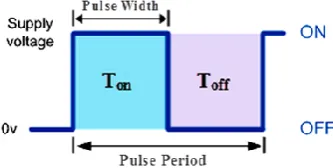
Figure 1: PWM time duration
The PWM means varying the ratio between the "ON" (tON) time and the "OFF" (tOFF) time durations, which called the "Duty Cycle". Then by varying the width of pulse, the motor voltage and hence the power applied to the motor can be controlled as shown in Fig. 1 which shows the ON and OFF time of simple PWM signal. The pulse period is given by:
(1)
Where: T is the Pulse period, TON is the ON time = Pulse width, and TOFF is the OFF time.
The duty cycle is defined by the ratio of the pulse width to pulse period as:
(2)
(3)
If the rated supply voltage of the DC motor is Vs, then the average DC output voltage fed to the motor is given by:
OFF
ON T
T
T
(4)
Therefore, the motor speed can be controlled with regularly adjusting the time of turn-on and turn-off in order to changing the average value of the motor voltage Vav and then the rotational speed of the motor can be varied. Figure 2 illustrate the timing diagram of the PWM signals for various duty cycles with supply voltage of 12V. The motor speed is slow, medium and fast with duty cycle 25%, 50%, and 75% respectively.
Figure 2: PWM Signals with Different Duty Cycles
There are three methods could achieve the adjustment of duty cycle [ 3 ]: (a) Adjust frequency with fixed pulse-width. (b) Adjust both frequency and pulse-pulse-width. (c) Adjust pulse-width with fixed frequency which is the method chosen in this work depending on the PWM module embedded in a PIC 16F877A microcontroller.
II.
Generation of PWM using PIC16F877AThe PIC16F877A has two Capture/Compare/PWM (CCP) Modules [4]. Each module (CCP1 and CCP2) contains a 16 bit register (two 8-bit registers) and can operate in one of the three different modes as:
• 16-bit Capture register • 16-bit Compare register
• PWM Master/Slave Duty Cycle register
These modules can support PWM signals by initializing the control register and duty-cycle register. The CCP1 and CCP2 modules are identical in operation, with the exception being the operation of special event trigger. Table. 1 show the resources and interactions of the CCP modules.
TABLEI
CCP MODE -TIMER RESOURCES REQUIRED
CCP Mode
Timer Resource
Capture Compare
PWM
Timer1 Timer1 Timer2
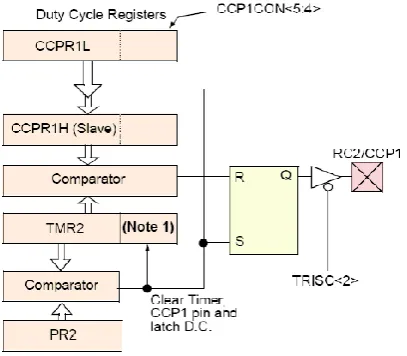
The operation of a CCP module is described with respect to CCP1, whereas CCP2 operates the same as CCP1 except where noted [4]. The CCP1 Module is comprised of two 8-bit registers: CCPR1L (low byte) and CCPR1H (high byte). The CCP1CON register controls the operation of CCP1 module as shown in Fig. 3.
Figure 3: Block diagram of PWM mode of CCP1 module.
Also, the CCP2 Module is comprised of two 8-bit registers: CCPR2L (low byte) and CCPR2H (high byte). The CCP2CON register controls the operation of CCP2 module. The special event trigger is generated by a compare match and will reset Timer1 and start an A/D conversion (if the A/D module is enabled) [4].
In Pulse Width Modulation mode, the CCP1 or CCP2 pins produces up to a 10-bit resolution PWM output. s
average Dutycycle V
Since the CCP1 pin is multiplexed with the PORTC data latch, the TRISC<2> bit must be cleared to make the CCP1 pin an output. Clearing the CCP1CON register will force the CCP1 PWM output latch to the default low level. This is not the PORTC I/O data latch [5].
The PWM period is specified by writing to the PR2 register and has a time base (period) and a time that the output stays high (duty cycle) [6] as shown in Fig. (4). The frequency of the PWM is the inverse of the period (1/period).
Figure 4: Microcontroller PWM output
III.
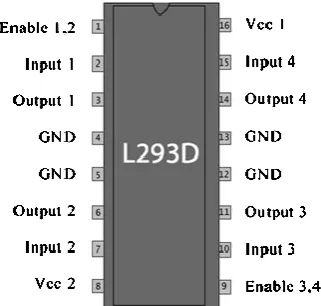
DC Motor DriverIn order to control the DC motor, the motor armature winding must be driven by signals which are generated by the PIC16F877A microcontroller. Since the PIC microcontroller input and output ports terminals do not source a sufficient current to the motor therefore, an integrated power driver is used. A simple and low cost L293D device was chosen to drive a small DC motor. The pin assignment and the internal schematic diagram of L293D IC device are shown in Fig. 5 and Fig. 6 respectively.
Figure 5: L293D pin assignment diagram
Figure 6: Internal L293D schematic diagram
The L293D driver consist of four channel driver or dual H-Bridge channel and can be used to drive four motors in one direction only, or two motors bidirectional. The chip has a built-in freewheeling diodes to protect the circuit from the back EMF [7] . it can drive a motor with a maximum output voltage of 36v. It has output current of 600mA and peak output current of 1.2A per channel and 5 kHz switching frequency.
It has two control inputs, one enable input and one output per each channel. The pins EN1, IN1, IN2, OUT1 and OUT2 control one of the motors while the pins EN2, IN3, IN4, OUT3 and OUT4 control the other if the driver used to control two motors. The Control inputs are used to control the direction while the enable input is used for turn the bridge ON or OFF. In addition, it has four ground center pins connected together and used as a heat sink. The device must be powered by two supply voltage; the first is the external voltage supply which also drives DC motor up to 36V and the other is +5V which is the logic supply voltage to control the IC.
IV.
Control System StrategyThe proposed control strategy based on PWM technique using PIC microcontroller and the L293D driver chip is shown in Fig. 7 .
The operation of the H-Bridge is fairly simple by Identify the logic state of Enable 1, Input 1, and Input 2 pins. Enable 1 pin is responsible for the motor turn on and off, while the Input pins are used to change the speed direction of the motor by changing the voltage across its terminals. For example, if Enable 1, Input 1pins are in HIGH state, and Input 2 pin in the LOW state, the motor will rotate clockwise. On the other hand, if Enable 1, Input 2 pins are in HIGH state, and Input 1 pin in the LOW state, the motor will turn to the other direction. If Input pins are both at the same level and the Enable pin is high then the motor will stall (or break) and with the Enable pin is low the motor will freewheel.
Therefore, the idea of the control depends upon the two control inputs connected to the driver channel, when the microcontroller sends a logic value 1 to the motor it will start running in a certain direction, and when the logic value is 0 it will inverse the direction. The behavior of the DC motor for various input conditions are as in the following truth table 2.
TABLEII
MOTOR BEHAVIOUR WITH VARIOUS INPUT CONDITIONS
Motor status Input 1 Input 2
Motor Stops or brake Low Low
Motor Runs (Anticlockwise)
Low High
Motor Runs (clockwise) High Low
Stops or brake High High
V.
PWM Control System DescriptionThe proposed schematic diagram of the PWM control of DC motor is designed and simulated by Proteus 7.10 professional software package. The circuit is consists of the PIC16F877A microcontroller which is the main control element of the implemented control system and other electric and electronic devices as shown in Fig. 8.
Figure 8: Schematic diagram of the PWM control of DC motor designed by Proteus software
A digital LCD (4x16) connected to port B and one 7-segment unit connected to port D are used to display the details of DC motor control modes of operation. The PIC will generate the PWM signals from CCP1 and CCP2 modules at port C (RC2 and RC1) to drive the DC motor and control its speed.
The motor driver chip L293D is interfaced with PIC microcontroller pin RC2 and RC1 at its input terminals IN1and IN2 while its EN1 pin is connected to pin RC7 at HIGH state signal constantly.
Two push button switches (button1and button2) are used to select the direction of rotation (clockwise or anticlockwise) of the DC motor. Another push button switch (button 3) is used to make the motor in brake mode. Two toggle switches (switch 4 and switch 5) are used to increase/decrease the DC motor speed. The DC motor is connected to the output pins (OUT1 and OUT2) of the L293D driver chip. A 5V/12V DC power supply is used to drive the PIC microcontroller and L293D chip by 5V, and the DC motor by 12V.
VI.
Software Algorithm Implementationmicrocontroller RAM in order to execute the control system.
The software implementation of the control algorithm consists of main routine and a group of subroutines as shown in Fig. 9.
Figure 9: Structure of software implementation
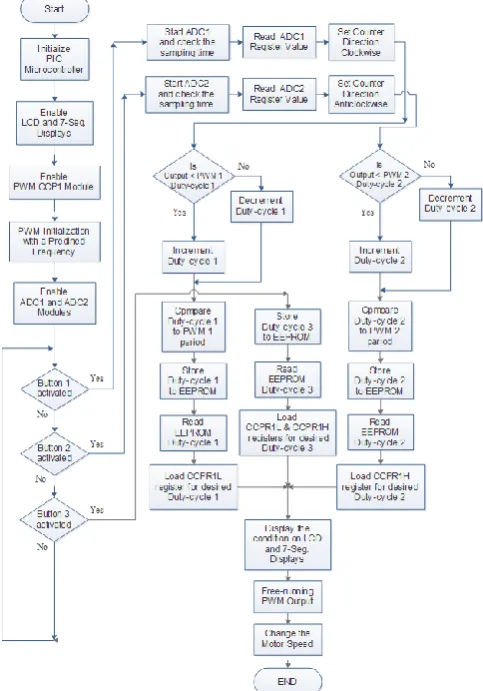
The program of main routine shown in Fig.(10) started by configuring the PIC microcontroller and loading it by the necessary system codes, its initialization and also call the start routine to display the motor status. The right and left direction routines are programed to generate the two PWM signals having duty cycle changing from 0 to 100% with period equals 4ms and frequency equals to 244 Hz by using of CCP1 and CCP2 PWM modules of the PIC microcontroller.
These two PWM modules are configured as output pins and the PWM period is specified by writing to the PR2 register. The duty cycle 1 of the clockwise direction (right mode) and duty cycle 2 of the anticlockwise direction (lift mode) are stored in the microcontroller EEPROM. Two analogue to digital converter channels (ADC1 and ADC2) of the microcontroller are used to set the output at the target level by incrementing or decrementing the duty cycle values.
The duty cycle 1 is specified by writing to the CCPR1L register for CCP1 module and also the duty cycle 2 is loading to the CCPR2L register of CCP2 module. The brake mode is programed to load the CCPR1L register and CCPR2L register by duty cycle 3 which is equal to 100% of the PWM period.
Figure 10: flowchart of the developed control algorithm.
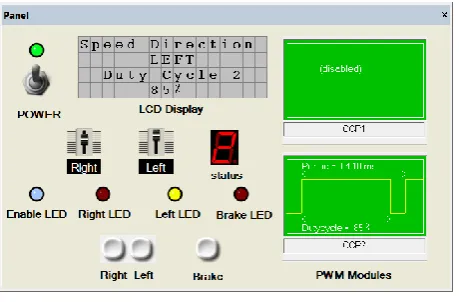
The simulation of the PWM control system with the different modes of operation using flowcode software is shown in Fig. 11. The right direction mode is simulated at duty cycle 1 equals 65% of PWM period using CCP1 module. The lift direction mode is simulated at duty cycle 2 equals 85% of PWM period using CCP2 module. The brake mode is simulated at duty cycle 3 equals 100% of PWM period using CCP1and CCP2 modules.
Figure 11a: Start mode
Figure 11b: Right direction mode (CCP1 module with Duty cycle 1 = 65%)
Figure 11c: Lift direction mode (CCP2 module with Duty cycle 2 = 85%)
Figure 11d: Brake mode
(CCP1 and CCP2 modules with Duty cycle 3 = 100%)
Figure 10: Simulation of PWM control system on flowcode software panel
VII.
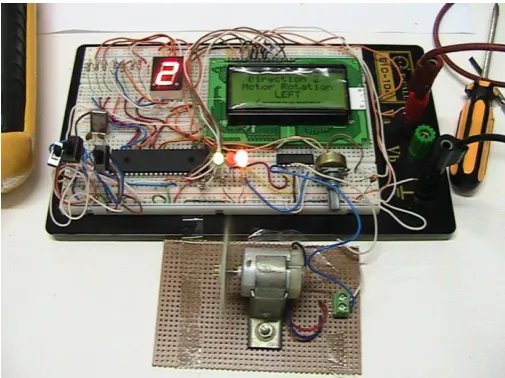
Hardware System ImplementationThe minimum hardware development setup of the bidirectional PWM control system of DC motor having rated voltage V =12V and current I=0.5A. is shown in Fig. 12.
Figure 12: Photograph of hardware setup connection of PIC16F877A based PWM control system of DC motor
The practical implementation of the three modes of operation (right, lift, and break) of the PWM control system of DC motor with LCD, 7-segment display, L293D driver is shown in Fig. 13.
Figure 13b: Lift direction mode
Figure 13c: Brake direction mode
Figure 13: Photograph of hardware setup connection of PWM control system with different modes of operation.
VIII.
Simulation and Excremental ResultsThe simulation results of the digital PWM signals with period of 4ms and frequency of 244 Hz generated from PIC16F877A microcontroller of the proposed control system of DC motor using proteus software package are shown in Fig. 14.
The output PWM signals and the corresponding DC motor terminal voltage for various values of duty cycle are shown also in Fig. 13. The chosen values of 25%, 50%, 75%, and 100% duty cycles gives motor terminal voltage as average values equals 3V, 6V, 9V, and 12V respectively.
Figure 14a: Output signals at duty cycle 25% Horizontal: 1 msec/div.
Vertical; 5 volt/div. Upper Trace: PWM signal. Lower Trace: Terminal voltage (Vav = 3V).
Figure 14b: Output signals at duty cycle 50% Horizontal: 1 msec/div.
Vertical; 5 volt/div. Upper Trace: PWM signal. Lower Trace: terminal voltage (Vav = 6V).
Figure 14c: Output signals at duty cycle 75% Horizontal: 1 msec/div.
Lower Trace: terminal voltage (Vav = 9V).
Figure 14d: Output signals at duty cycle 100% Horizontal: 1 msec/div.
Vertical; 5 volt/div. Upper Trace: PWM signal. Lower Trace: terminal voltage (Vav = 12V).
Figure 13: PWM signals and DC motor terminal voltage at various values of Duty cycle.
The hardware oscilloscope results of PWM signals with the same period and frequency at different values of PWM duty cycle are shown in Fig. 15.
Figure 15a: PWM signal at duty cycle = 25% Horizontal: 2 msec/div.
Vertical; 10 volt/div.
Figure 15b: PWM signal at duty cycle = 50% Horizontal: 2 msec/div.
Vertical; 10 volt/div.
Figure 15c: PWM signal at duty cycle = 75% Horizontal: 2 msec/div.
Vertical; 10 volt/div.
Figure 15d: PWM signal at duty cycle = 100% Horizontal: 2 msec/div.
Figure 15: Photograph of PWM signals at various values of PWM duty cycle.
IX.
CONCLUSIONThis paper has covered the design, simulation and practical implementation of a low-cost bidirectional speed control of DC motor based on PWM technique using PIC16F877A MCU. The PWM channels of the PIC microcontroller with its embedded CCP modules has been programed to generate two digital PWM signals with period 4ms and frequency of 244 Hz. The proposed control system model can control the DC motor speed and direction by varying the duty cycle of the output PWM signals. A dual H-Bridge channel built in L293D device was chosen to drive a DC motor and also used as interface between it and MCU. The PIC16F877A MCU can integrate all required functions in its single chip and therefore, it reduces the hardware setup of the overall control system. A very good agreement was achieved between the experimental and simulation results.
X.
REFERENCES[1] Sabedin A. Meha, Besnik Haziri, Loreta N. Gashi, and Behar Fejzullahu “Controlling DC Motor Speed using PWM from c# windows Application ” 15th International Research/Expert Conference” Trends in the Development of Machinery and Associated Technology, TMT 2011, Prague, Czech Republic, 12-18 September 2011.
[2] Bharat Joshi, Rakesh Shrestha, and Ramesh
Chaudhar “Modeling, Simulation and
Implementation of Brushed DC Motor Speed Control Using Optical Incremental Encoder
Feedback” Proceedings of IOE Graduate
Conference, 2014.
[3] Yue-Li Hu, and Wei Wang “Design of PWM Controller in a MCS-51 Compatible MCU ” IEEE Proceedings of (HDP’07) 2007.
[4] PIC Microcontroller Instruction Sets, PIC16F877A Datasheet.
[5] A.S.M. Bakibillah, Nazibur Rahman, Md. Anis Uz Zaman, “Microcontroller based Closed Loop Speed Control of DC Motor using PWM Technique” International Journal of Computer Applications Volume 108 – No 14, December 2014.
[6] Pallavi Papalkar and S. P. Phulambrikar, “Speed Control of DC Motor using Capture/Compare/Pulse Width Modulation Module of PIC Microcontroller” International Journal of Engineering Research & Technology,Vol. 3, Issue 9, September- 2014 [7] Push-Pull Four Channel Driver with Diodes,
L293D Datasheet.
[8] Shinde Krishnat Arvind, Tarate Akshay Arun, Taur Sandip Madhukar, and Prof. Jayashree Deka “Speed Control of DC Motor using PIC 16F877A Microcontroller” Multidisciplinary Journal of Research in Engineering and Technology, Volume
1, Issue 2, July- 2014