96
Integrated Career Pattern Hope Of Bureaucration
In The Future
Burdan Ali Junjunan; Dadang SuwandaAbstract: In carrying out public service duties, government duties, and the task of development, the State Civil Apparatus (ASN) employees must have professional capabilities as individuals as set out in ASN management based on the merit system. The absence of a clear career pattern arrangement will result in the low performance of government employees (PNS) and consequently have a low quality of public services, even resulting in service users having to pay a high cost economy. Career development through a good career pattern can encourage employees to grow and develop according to professionally owned competencies. Employees will be motivated to perform well which contributes to the improvement of agency performance. In addition to the above, there is a clear career pattern that also provides career security for structural and functional officials in the central and regional government. Career patterns are used as a guideline or reference in the appointment of someone to a certain position by referring to the position competency standards held, so that the process of transferring, promoting, transferring and demoting government employees (PNS) is better organized. Career patterns may no longer depend on the policies of the leadership of the institution. Clear career patterns in the area will also have a positive impact on the political climate in the region, where officials will be neutral when regional elections are held. Therefore policies need to be formulated regarding the career pattern of civil servants as a guide in the management of career patterns of civil servants that are selective, fair and competitive. Keywords: Career Patterns, State Civil Apparatus (ASN) and government employees (PNS).
————————————————————
1. INTRODUCTION
Government employees (PNS) have a stake in realizing the administration of government tasks and implementation of National development. The implementation of National development is very dependent on the ability of the State Apparatus. Therefore government employees should have good quality in order to be able to carry out their duties professionally, fairly, responsibly, precisely and correctly. In Law No. 5 of 2014 concerning the State Civil Apparatus (ASN Law) PNS career development is carried out based on the merit system by looking at qualifications, competencies, performance appraisal, and needs of government agencies and carried out by considering integrity and morality. These competencies include: 1) Technical competencies measured by the level and specialization of education, functional technical training, and experience working technically; 2) Managerial competencies measured from the level of education, structural or management training, and leadership experience, and; 3) Cultural social competencies measured by work experience are related to plural societies in terms of religion, ethnicity and culture so that they have national insight. Integrity is measured by indicators of honesty, compliance with the provisions of laws and regulations, the ability to cooperate, and service to the community, nation and state. Morality is measured by the application and practice of religious, cultural and social ethics values. Every civil servant has the same rights and opportunities in developing competencies, including education and training, seminars, courses.
Upgrading and implementation are evaluated by authorized officials and used as one of the bases in the appointment of positions and career development. Government Regulation Number 13 of 2002 concerning Appointment of government employees in Structural Position in Article 12 states that to ensure career development direction, career baselines with Presidential Decree and each Institution leader determine the career pattern of civil servants based on the PNS career pattern as intended. Government agencies are required to develop career patterns for PNS specifically according to their needs based on national career patterns. To ensure the harmony of the potential of government employees with the need to carry out government and development tasks, a career pattern for government employees is integrated nationally. This provision can be interpreted as a career pattern even though it is prepared by each agency both the central government (ministries, non-ministries and other state institutions) of the provincial and district / city governments, but must be integrated nationally. If career development refers to employees, namely efforts to improve employee careers, then career patterns are blueprints or guidelines for the possibility of career paths to be passed by a government employees. If we look at nationally the number of State Civil Apparatus (ASN) in Indonesia currently reaches 4,351,490 people. The ASN composition consists of executive or general administrative positions, teacher functional positions, technical and health, and structural positions. "The composition of the ASN is still not good. Public administration and teachers are still the most. Small health workers, "said Deputy of Human Resources (HR) Apparatus Ministry of Administrative Reform and Bureaucratic Reform (Kempan), Setiawan Wangsa Atmaja This was stated by Setiawan during a discussion on the Leader's Talk entitled "ASN Professional Not Just A Dream" at the State Secretariat Building, Jakarta, Tuesday (9/10). "This composition is what we are changing. In 2018, we select, except the general administration. We want to fill out the technical ones, "he said. For information, from the data of the Ministry of Administrative Reform, there were 1.643.535 people (37,70%) general administration ASN, 1.636.322 (37,60%) teachers, Structural position of 434.488 (9,99%), technical functional positions 372.740 (8,57%), and health 264.305 ___________________________
Burdan Ali Junjunan; Associate Expert Lecturer P4KASN Jatinangor-Sumedang, West Java, Indonesia
97 (6,07%). While the number of government employees who
will enter the pension age limit for 2016 until 2020 is 752.271 people with details of Structural 85.829 people, Specific Functions 409.800, and General Functional 256.642 people. Based on these data, it is seen that the portion of government employees who occupy general functional positions is still quite large, where there is no career path in this general functional position. The trend that occurs in government agencies at this time is the career development of civil servants precisely more on the leadership or organization side. The principle of employee career development is the need for willingness and commitment from employees and leaders of the organization, because the career of civil servants is the lowest to the highest level of development in achieving positions. Therefore to determine the career pattern of government employees, it is necessary to refer to Law No.5 / 2014 concerning the State Civil Apparatus (ASN), taking into account the types and levels of existing employee positions according to the provisions stipulated in this ASN Law, as well as what conditions must be fulfilled and what stages must be passed in order to reach the existing position positions. If we observe the career pattern of government employees in several regencies / cities in Indonesia, we can see several problems that arise, among others, as follows:
1. Still low professionalism of government employees, 2. Inadequate level of welfare,
3. The distribution and composition are not yet ideal, 4. Placements in positions that are not yet in
accordance with competence, 5. Not objective assessment of work,
6. Promotion that has not been based on work performance,
7. Work culture and work morale are still low,
8. Application of disciplinary regulations that are not carried out consistently and consequently and internal problems of civil servants.
In order to realize the government employees figure as mentioned above, which enables the growth of employees' commitment to be optimal, there is an organizational management system for employees, namely the career pattern of government employees. Career pattern is a pattern of government employees development that describes the career development path that shows the relationship and harmony between position, rank, education and training position, competence, and the tenure of a civil servant from the first appointment in a certain position to retirement. The aim of this career basic pattern is to provide guidance for the Central and Regional government employees Development Officers to develop career patterns for civil servants in their respective agencies. The problem is how is the career pattern created, established and implemented whether it is in line with the expectations to create accountable and qualified professional civil servants, the employee problems faced by most of the Regional Governments on average are similar to career patterns that are not transparent and unmeasured, partially felt employees are unfair, there are employees whose careers are very fast, there are also employees whose careers can be said to be on the road. When viewed from the number of employees and compared to available
positions, it is not comparable, so that a civil servant must have expertise and skills in accordance with his field of work to be able to compete objectively in occupying positions as future career development for civil servants. Regulations regarding career patterns in several regencies / cities throughout Indonesia still vary depending on the commitment of stakeholders in each of their governments, some provinces / districts / cities have put them in the form of regulations (governors / regents / mayors) that provide an overview of career travel maps from CPNS to retirement according to rank, position, education, age and years of work, but there are still many who have not made the intended career pattern. Therefore, in the implementation of the career pattern there are problems, including: 1) Not yet able to give a clear picture of how the career system will be built in the Regional Government; 2) The substance of the existing career pattern guidelines governs the terms of office; 3) Mechanism of transfer of position / career vertically, horizontally, condition zig zag) has not been regulated in detail; 4) Scoring of the civil servants who will be appointed as structural officials has not been based on elements: rank, education (diploma), DUK, and other relevant elements; and 5) Unique / unique characters and tasks of each Echelon I Unit (eg Education, Health, Agriculture and Public Works) have not been accommodated in the PNS Career pattern. A good career pattern will provide certainty to employees about the implementation of their duties that will determine their future in the organization. Certainty such as promotion in office, sanctions for violations as a result of his work will spur employees to always work optimally. Therefore a clear career pattern is needed to improve employee performance which will lead to the overall performance of the Ministry.
2. RESEARCH METHODS
In research using literature and library studies issued by local governments in several provinces, districts / cities as samples, based on established criteria. The accuracy and objectivity of the information obtained is then expected to be able to describe the value or success rate of a program (career pattern) that has been running. This study is descriptive analysis that aims to describe the actual situation that occurs in the pattern of Civil Servants Career in the Regional Government. The approach used in this study is a qualitative approach to maximize all information related to the subject matter in order to get a deep and comprehensive evaluation results. The location of the study was carried out at the Staffing and Training Agency of Garut Regency as a research sample for implementing career patterns.
3. LITERATURE REVIEW
3.1 Career Pattern of government employees
98 2002: 276). Career pattern practice is more of an
implementation of career planning, this is as expressed by Handoko and Reksohadiprojo (2001), that: "career patterns are personal enhancements made by someone to achieve a career plan". While the career system according to Handoko (2000), "carried out alone by the organization itself, so it must start from the basic concept of the career itself". Thus, the career system is a pattern of employee guidance where the appointment of employees is based on skills, years of service, loyalty and other conditions such as work performance, responsibility, loyalty, initiative, cooperation and leadership so that high employee productivity can be achieved. This is in accordance with what was revealed again by Handoko (2000) that: "there are four components in the implementation of the career system, including career planning, career paths, career goals, and career development". Government Employees (PNS) must have a clear career pattern built into a good career system. So that the career pattern in each institution is the duty of every leader in the relevant institution to develop and determine the career pattern of civil servants in their environment. In the career development of civil servants we must refer to Law No. 5 of 2014 which adheres to the "merit system" which is based on qualifications, competencies, and performance fairly and fairly regardless of political background, race, color, religion, origin, type sex, marital status, age, or disability condition. This is similar with the opinion of Khotimah et al., 2013 which states that: "successful recruitment is recruitment carried out through the merit system in ASN policy and management". This merit system has the following characteristics:
1) Selection and promotion in a fair and competitive manner,
2) Applying the principle of fairness,
3) Payroll, reward and punishment based on performance,
4) Standards of integrity and behavior in the public interest,
5) HR management effectively and efficiently,
6) Protect employees from political intervention & arbitrary actions.
As it is understood that in ASN there are types and levels of ASN positions, the State Civil Apparatus Position (ASN) in accordance with Law Number 5 of 2014 concerning ASN consists of three types of positions, namely:
a) Administrative Position
Administrative Position is a group of positions that contain functions and duties relating to public services and government administration and development. Administrative positions have three types of levels, namely:
1) For the highest level of office is called the position of administrator,
2) For the intermediate level is called the supervisory position and
3) For the lowest level position is called the executive position.
Officials in administrator positions are responsible for leading the implementation of all public service activities as well as government administration and development. Officials in the supervisory office are responsible for
controlling the implementation of activities carried out by implementing officials. While officials in the executive position are responsible for carrying out public service activities as well as government administration and development. Each of these positions is determined in accordance with the competencies needed to be able to handle workloads that are the responsibility of government agencies or work units.
b) Functional Position
Functional Position is a group of positions that contain functions and tasks related to functional services based on certain skills and skills. The Functional Position in ASN consists of functional positions of expertise and functional positions of skills. The functional positions of expertise are four levels, namely:
1) The highest functional position of the expert is called the main expert functional position,
2) Intermediate expert functional positions, 3) Functional positions of young experts and
4) The lowest functional position of the expert is called the first expert functional position.
While the functional position of skills, also consists of four levels, namely:
1) The highest skill functional position is called the supervisor's functional position,
2) Advanced functional positions, 3) Functional and skilled positions
4) The lowest functional position is called a beginner functional position.
c) High Leadership Position
High Leadership Position is a group of high-ranking positions in government agencies. The High Leadership Position, consists of three levels, namely:
1) The highest position of the highest level is called the main high leadership position,
2) Middle level high positions are called senior high-level positions, and
3) The highest position at the lowest level is called the position of senior leadership.
99 and the Law on the National Police of the Republic of
Indonesia, and procedures for filling them will be regulated by Government Regulation. Government employees can move between and between high leadership positions, administrative positions, and functional positions at central agencies and regional institutions based on qualifications, competencies, and performance assessments. Civil servants can be appointed to certain positions within the Indonesian National Army (TNI) and the Indonesian National Police (Polri) agencies. Civil servants who are appointed in certain positions within the TNI and Polri, then the rank or position is adjusted to the rank and position within the Indonesian National Armed Forces and the Indonesian National Police. Further provisions regarding rank, procedures for appointment of civil servants in positions, job competencies, job classification, and procedures for the transfer of administrative positions and functional positions are regulated by Government Regulations. Promotion of government employees is determined based on objective comparisons between competencies, qualifications, and requirements needed by positions, assessment of work performance, leadership, cooperation, creativity, and consideration of the performance appraisal team of civil servants in Government Agencies, regardless of gender, ethnicity, religion, race, and class. Every civil servant who fulfills the requirements has the same rights to be promoted to a higher level of office. Promotion of Administrative Officers and PNS Functional Officers is carried out by the Personnel Development Officer after being considered by the PNS performance appraisal team at Government Agencies. The civil servant performance appraisal team was determined to be formed by an Authorized Officer. Filling in the main and middle high leadership positions in the ministries, secretariat of state institutions, non-structural institutions, and Regional Institutions is carried out openly and competitively among civil servants by taking into account competency requirements, qualifications, ranks, education and training, position record, and integrity and other requirements needed in accordance with the provisions of legislation. Filling in the main and middle high leadership positions is carried out at the national level. Filling in high-ranking leadership positions is conducted openly and competitively among civil servants by taking into account competency requirements, qualifications, ranks, education and training, position track record, and integrity as well as other job requirements in accordance with statutory provisions, implementation can be national or inter-district level / city in 1 (one) province. Certain positions of the main and middle high leaders can come from non-civil servants with the approval of the President whose filling is done openly and competitively and stipulated in the Presidential Decree. High-ranking positions can be filled by Indonesian National Armed Forces and members of the Republic of Indonesia National Police after resigning from active service if needed and in accordance with the competencies determined through an open and competitive process. High-ranking positions in certain government agencies can be filled by Indonesian soldiers and members of the Republic of Indonesia National Police in accordance with competencies based on the provisions of statutory regulations. The filling in of the High Leadership Position is carried out by the Personnel Development Officer by first
forming a Government Agency selection committee. In forming a selection committee for the Staffing Officer, coordinating with the State Civil Apparatus Committee (Komite Apararatur Sipil Negara/KASN). The Government Institution selection committee as referred to consists of internal and external elements of the relevant Government Agency. The selection committee is selected and appointed by the Staff Development Officer based on knowledge, experience, competence, track record, moral integrity, and neutrality through an open process. The selection committee, conducts selection by taking into account competency requirements, qualifications, rank, education and training, track record of position, integrity, and assessment of competency tests through an assessment center or other assessment methods. The selection committee carries out its duties for all job filling selection processes open for the period of service stipulated by the Personnel Development Officer. Provisions regarding filling in the High Leadership Position with the above stages can be excluded from Government Agencies that have implemented the Merit System in fostering ASN Employees with KASN approval. Government Agencies that have implemented the Merit System in fostering ASN Employees who are included in the exception must report regularly to KASN to obtain new approval.
3.2 Perspective of the ASN Law No. 5 of 2014 in the Career Pattern of Civil Servants
Employee development includes two things, namely the development of employee quality and employee career development. The development of competency-based quality of human resources (PNS) is needed to create a professional government. Competency concerns the authority of each individual to carry out a task or make a decision according to his role in an organization that is relevant to his expertise, knowledge and abilities. This is where competence becomes an underlying characteristic of an individual or someone achieves high performance in his work. These characteristics arise in the form of knowledge, skills, and attitude to create apparatuses who have a high spirit of service in serving people who always act economically, efficiently, rationally, transparently, and accountably. The competencies possessed by civil servants individually must be able to support the implementation of organizational strategies and be able to support any changes made by management. Personnel management has not run systematically, consistently and directed. This is still evident in:
1) Procurement and placement of CPNS / PNS has not referred to the basic needs of the organization 2) promotion has not been based on rank / class
structure, competence and work performance, 3) Appointment in structural positions has not been
based on competency and work performance, 4) PNS development is still very limited, as well as 5) Work discipline, work appraisal, welfare
improvement and pension programs have not been the focus of the study and consideration of the leadership.
100 objectives of civil servants and institutions. the trend of
career development for civil servants at this time is more on the leadership or organization side. Common problems with the current PNS career pattern are:
1) Have a job, but don't have a career (have a job, not have a career)
2) Experience rotation and mutation, but have no career path clarity (rotation and mutation without career path)
3) Having a promotion and position, but not in a certain career level (promotion, with no career ladder)
4) Not having a career plan (no career plan)
5) The organization has no succession planning (no succession plan)
6) Organizations manage rotation, transfer, promotion reactively, not proactively (no talent management system)
7) Organizations do not prepare future leaders (no grooming system for future leaders)
Along with the enactment of Law Number 5 Year 2014, the development of PNS careers includes developing competencies that include technical, managerial, socio-cultural, integrity and morality competencies. Where as the output of career development will arise harmony between the potential of civil servants with the need to carry out government and development tasks that are arranged in a clear Career Pattern. In relation to this, the career development of civil servants is expected to be managed professionally. Every Government Agency sets up a career pattern for civil servants specifically in accordance with the needs based on national career patterns. PNS career patterns include: 1) Planning; 2) Recruitment; 3) Selection; 4) Placement; 5) Promotion and mutation; 6) Discipline; 7) Performance appraisal; 8) Diklat; 9) Pension. The previous career pattern of civil servants refers to Government Regulation Number 13 of 2002 Amendment to Government Regulation Number 100 of 2000 concerning Appointment of government employees in Structural Position, in which regulating the relationship between position, rank, education and training position, and subsequent competence and tenure are refined to Career development of civil servants by Law Number 5 Year 2014 with a "merit system" that is based on qualifications, competencies, and performance fairly and fairly regardless of political background, race, color, religion, origin, gender, marital status, age, or disability condition, this merit system has the characteristics:
1) Selection and promotion in a fair and competitive manner,
2) Applying the principle of fairness,
3) Payroll, reward and punishment based on performance,
4) Standards of integrity and behavior in the public interest,
5) Protect employees from political intervention & arbitrary actions.
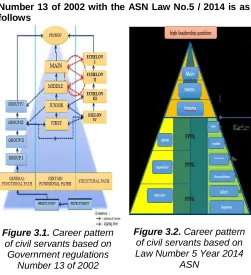
Comparison of career patterns of civil servants based on Government Regulations
Number 13 of 2002 with the ASN Law No.5 / 2014 is as follows
Figure 3.1. Career pattern of civil servants based on
Government regulations Number 13 of 2002
Figure 3.2. Career pattern of civil servants based on Law Number 5 Year 2014
ASN
The principles of the PNS career pattern are:
1) Certainty, namely the career pattern must describe the certainty about the direction of the career path that can be taken by each civil servant who has fulfilled the requirements specified in the legislation.
2) Professionalism, namely career patterns must be able to encourage increased competence and work performance of civil servants
3) Transparent, that is, a career pattern must be known by every civil servant and gives equal opportunities to civil servants who have fulfilled it 4) Justice, namely that the provisions in the career
pattern apply equally to every civil servant and are not discriminatory.
PNS Career Pattern Forms are:
1) Horizontal, namely the movement of civil servant positions from one position to another in the same class and position group both within the administrative position group, or within the functional position group.
2) Vertical, namely the movement of civil servant positions from one position to another higher position within the group of administrative positions or within a group of functional positions.
3) Diagonal, namely the movement of civil servant positions from positions in administrative positions to positions in functional positions or vice versa
101 grow and develop according to professionally owned
competencies. In this case, employees will be motivated to perform well which will have an effect on improving agency performance. In addition to the above, a clear career pattern also provides career security for structural officials in the central and regional environment. Career patterns are used as guidelines or references in the appointment to a position based on their competency standards, so that the process of transferring, promoting, transferring and demoting civil servants is better organized. Career patterns no longer depend on changes in agency leadership. A clear career pattern in the region will also have a positive impact on politics in the region, where officials will be neutral when regional heads change, following the revision of the Law on Regional Election through Law Number 10 of 2016. One of the changes included in the Law This is about the prohibition for prospective incumbents to transfer state civil apparatus, if the prospective incumbent who carries out the mutation six months before and after the appointment as a regional head candidate will be rewarded for cancellation as a candidate for regional head. This is also reinforced by the General Election Commission Regulation (PKPU) Number 3 of 2017 Article 89 Paragraph 1, stated in the article that prospective candidates as incumbents are prohibited from making official changes six months before the date of appointment of candidate pairs until the end of the term "Sanctions according to Paragraph 3 is for incumbents who violate the nomination, they will be declared as not fulfilling the requirements, "Except:" if there is an urgent need and obtain permission from the Minister of Home Affairs (Minister of Home Affairs), Chairperson of the Central Bawaslu. He acknowledged these rules and prohibitions as a form of anticipating the possibility of bureaucracy being led as a success team or ASN involved in practical politics.
4. RESULTS AND DISCUSSION
4.1 Implementation of Career Systems in the Environment
Rules regarding the Guidelines for Career Patterns of Civil Servants in some Regional Governments are regulated in the Governor / Regent / Mayor Regulations on Career Patterns within the Government which includes:
1) Procurement Elements and Employee Appointment;
2) Elements of the Promotion of Employees; 3) Elements of Education and Training; 4) Employee Assignment Elements; 5) Dismissal Elements.
The five elements have an important role and are interrelated with each other which is a number of career coaching, so that it can provide enthusiasm or motivation for every employee to always improve professionalism and can be a reference for authorized officials in the appointment, transfer and dismissal of civil servants in the Garut Regency Government environment.
4.2. Field Data Analysis
Data in this study were obtained from data Staffing and Training Agency of Garut Regency.
a. Formal education
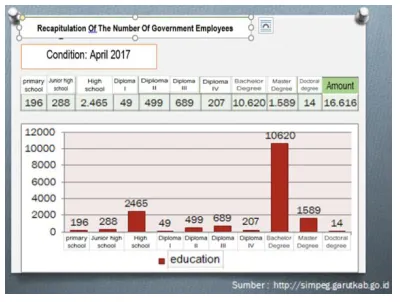
Each level of office must have a formal education level and qualification, so that it can support the implementation of tasks in their positions in a professional manner, especially in the effort to implement the theoretical, analytical and methodological framework for carrying out tasks in their positions. From the data recorded in regional staffing/personnel agency (BKD), it can be seen that the determination of employee career in the Government of Garut Regency has taken into account the level of formal education that is owned (73,21%), provide positions that are adjusted to the level of education (58.85%) even though we understand that employees have high education does not guarantee that it can work well.
Table 4.1. Recapitulation of the Number of Civil Servants
b. Position Education and Training
Education and training is an effort to develop apparatus resources, especially for professional improvement related to administrative skills and management skills (leadership). To improve the quality of capabilities involving work skills, thinking and skills, education and training are very necessary. Education is an activity for people who are general knowledge including the theory of problems concerning the achievement of goals. While training is an activity to improve work ability through practical knowledge and its application in an effort to achieve goals. Job training must be followed by a civil servant who is appointed to a position to improve his skills and expertise in the field of his duties. In order to develop employees as an effort to improve quality, such as: skills, knowledge, expertise and character of employees carried out through education and training. Education and training provided to employees must be in accordance with the requirements needed, so that the improvement in the quality of employees will be truly fulfilled.
The Garut Regency Government based on the issuance of several regulations on job competency standards, namely:
1. Regent Regulation Number 45 of 2017 concerning Primary High Competency Leadership Standards, within the Garut Regency Government.
102 3. Regent Regulation Number 47 concerning
Supervisory Position Competency Standards in the Garut Regency Government area.
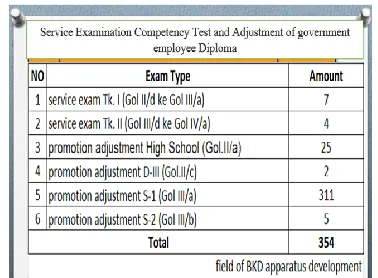
Thus, employees can pursue positions that are expected to have clear standardization, then if we look at the data, it shows that most of the training attended by employees, especially in-service training, has become a consideration of leaders in determining employee career (52,15%). The expertise or ability of officials in the Garut Regency Government in carrying out tasks is largely in line with the needs of the organization (51,67%) and the remaining amount of (46,89) is not in line with the needs of the organization in the Garut Regency Government. This means that, in Garut Regency Government as a whole has been relatively good in the placement of employees, but still must be made improvements in terms of expertise and ability in carrying out the task to create employees who have reliable professionalism in carrying out their duties. Capability is one element in maturity related to knowledge or skills that can be obtained from education, training and experience. The ability to carry out tasks, especially Government officials of Garut Regency in the opinion of Garut leaders increased according to the needs of tasks mandated by the organization. Then the participation of employees in the training carried out by the Regency Government is largely in accordance with the needs of the organization and assignments or in the term of the right man on the right place but there is still a tendency for sending training participants not from the fields in need. But overall the training and training conducted by the BKD Garut has increased employees more skilled in carrying out their duties, and in accordance with the demands of bureaucratic reform.
Table 4.2. Service Examination Competency Test and Adjustment of government employee Diploma
Table 4.3. Structural Officer Education and Training Leadership
c. Age
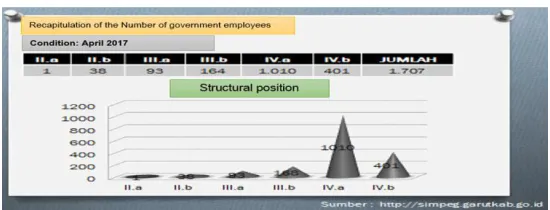
A career is also influenced by age, that each individual at a certain age level has a role that must be run in accordance with the stages of development. The relationship between the age of the individual and the stage of career development has a role in career maturity that must be carried out in accordance with the stages of development. Based on the data obtained it can be seen that 54.07% consider the age factor in career determination, indeed if we look at from several theories that old age does not necessarily indicate maturity in acting and behaving. Mature age is not synonymous with old age, and otherwise old age does not always mean mature. Likewise, with a civil servant who has old age, it does not mean that he automatically has the ability in his field of work, not necessarily if compared with the younger civil servants. Even though the progress of an institution that is needed is an employee who has maturity in acting and has high competence.
Table 4.4. Recapitulation of the Number of government employees
d. Years of service
103 regenerate positions not running optimally. Based on the
acquisition of data in the field shows that in the Garut Regency Government environment most (56.46%) working period has become a consideration of leaders in the determination of positions, According to Stephen P. Robins (2006.46) Ability (ability) is the capacity of individuals to carry out various assignments in certain jobs. All abilities of an individual are essentially composed of two sets of factors, namely intellectual ability and physical ability. According to Mc Shane and Glinow in Buyung (2007: 37) natural aptitude and learned capabilities are required to successfully complete a task (ability is natural intelligence and learned capabilities needed to complete a task). Intelligence is a natural talent that helps employees learn certain tasks faster and do them better. So the overall value means that an employee cannot be judged simply because of the length of the work period, but it will be more objective if the assessment is based on the ability and expertise based on the education that is owned, without excluding certain people who are given certain talents. So it will be more objective in evaluating if the leader in giving a position is more considering the ability of the employee concerned.
e. Rank
Civil servants' ranks / people are related to positions held and / or formal education they have. If a person's career system in the organization runs well can be seen from the harmony between the rank and position that is owned. If rank and position are not in line, there is a problem with the career of a civil servant or can the career system in the organization not work well. Based on the data, it shows that (71,15%) rank has become a consideration for the leadership to determine the direction of a career in the environment of the Garut Regency Government. This means that the leadership in this Regional Government has considered the rank component in accordance with BKN Regulation Number 35 of 2011 concerning Guidelines for Preparing Civil Servant Career Patterns in the field of staffing known to the rank of PNS. The definition of rank in PP 7/1977 concerning the Regulation of government employee Salaries suggests that what is meant by rank is a position that indicates the level of a civil servant in a series of staffing. Employee is used as the basis for payroll in the meantime Drs.D.S Widodo in his book the main points of Understanding Staff Administration Science suggests that rank is the position of a person in a series of all levels of staffing. While the notion of promotion according to experts promotion is something that is generally coveted by each employee (Manullang, 1997). So it can be concluded that the notion of promotion is a motivation or driver for civil servants to further increase their service in carrying out their duties. There is also a promotion which is an award given to PNS services related to the country. Promotional promotions are usually based on ability, seniority, exams, interviews, a combination of these factors. n the Republic of Indonesia Law Number 8 of 1974 concerning the Principles of Staffing Appointment of civil servants in a position is carried out by taking into account the rank levels assigned to the position. The obligation that has been carried out by an employee is the main consideration for the employee to obtain an award from the leadership, which includes promotion in the form without ignoring the existing formation. The obligations of an employee generally include
elements of loyalty, work performance, responsibility, obedience, honesty, cooperation, initiative and leadership:
The purpose of promotion of employees is:
a. to provide encouragement or morale for employees in carrying out activities or office work.
b. To reward employee services for the agency c. To provide opportunities for employees to develop
better curry.
Table 4.5. Recapitulation of the Number of government employees
f. Position Experience
104 so that officials will later it masters the new task (for
example for prospective head of field).
g. Job Performance Assessment
Government employee work performance appraisal is a systematic process of assessment carried out by appraisal officials on employee work goals and work behavior of civil servants. Work performance is the work achieved by each civil servant in an organizational unit in accordance with the employee's work goals and work behavior. Employee Work Objectives, hereinafter abbreviated as SKP, are work plans and targets to be achieved by a civil servant. The work performance appraisal of civil servants aims to ensure the objectivity of PNS development based on the work performance system and Career system which is focused on the work performance system. Job performance assessments are performed on a civil servant who will or is currently in office. The assessment of civil servants' work performance is based on the principle of Objective, Measured; Accountable; Participatory; and Transparency while the benefits that can be obtained from work performance assessment are: a. To establish career development or promotion b. To determine training c. To determine payroll standards d. To determine the transfer or transfer of employees e. Increase employee productivity and responsibility f. Increase employee motivation g. Avoid favoritism h. Measuring the success of one's leadership Work performance assessment is carried out systematically, with emphasis on the level of achievement of employee work goals or the level of achievement of work outcomes that have been prepared and agreed upon between Civil Servants and Appraisal Officials. Furthermore, employees who are experienced should be given the opportunity to promote to other places because promotion must consider the work performance of employees. From the overall value of the work performance appraisal of employees in the Government of Garut Regency that almost 90% of structural officials in the Government of Garut Regency have been able to describe leadership policies effectively, quickly and precisely.
h. Position Competence
According to the Regulation of the Head of State Employment Agency Number 7 of 2013 concerning Guidelines for Preparing Civil Servants Managerial Competence Standards, competency is a characteristic and ability to cover aspects of knowledge, then what is meant by Managerial Competence is Soft Competence which covers aspects of knowledge, skills, and attitudes that are gas and or office function. PNS Managerial Competency Standards, hereinafter referred to as Managerial Competency Standards, are minimum managerial competency requirements that must be possessed by a civil servant in carrying out office tasks. Position is a position that shows the duties, responsibilities, authority and rights of a civil servant in a state organizational work unit. Every position in an organizational unit must have a position competency standard. Based on the results of interviews with the head of the staffing agency, it shows that career opportunities in the Garut Regency Government in large part have paid attention to the capabilities possessed by employees, most of which have been based on organizational needs, seen from rare positions in the area.
The position composition according to most has been in accordance with the development of the organization. All employees in this regional government have the same career opportunity and most employees have the opportunity to compete in a healthy manner, because employees assume that the position is an award for the performance of the work, while the career development of employees has received attention from superiors and not from superiors. In an effort to ensure objectivity in the formation of civil servants based on the career system and work performance systems, according to the head of the BKD the List Rank (Daftar Urut Kepangkatan/DUK) is a requirement in determining a career in the Government of Garut Regency. Then the position competency in the Government of Garut Regency has largely become a consideration in determining the career career in Garut Regency Government. Most of the work performance appraisals are taken into consideration in determining careers in Garut Regency Government, competency of candidates must be tested including medical tests. To occupy such structural positions, a civil servant needs to go through an assessment and the results are published. fit and proper test and results announced. To be more transparent, the Garut Regency Government applies an auction of positions (open bidding) and the results are announced, then the employee who gets a punishment (punishment) is not only shifted but is completely removed from his position.
Table 4. 6. Appointment of JFU Teacher Candidates to JFT Teachers
105 scope of PU-work tasks; b) Education and training. There
are still trainees sending training participants who are not in accordance with the fields in need, then the opportunity to attend training for certain areas of southern Garut has not been fully accommodated, this has an impact on the lack of opportunities for promotion and lack of technical expertise in the area; c) Working period is one component in evaluating career patterns and this of course can be used as a basis for determining one's career in an organization, the District Government has not fully considered the years of work in determining the position of an employee; d) The rank of a government employee is certain, which of course is related to the length of work, but it does not mean that someone who has a high rank will get a better career, because there are other components that must also be considered such as work performance. The Government of Garut Regency is fully considering the rank in determining the career of employees. In the education office, many employees have class III (three), which of course makes the problem in coaching, because there is a higher rank of staff than their superiors so that staff are difficult to advance. It seems that this has not been regulated proportionally; e) The job experience of a civil servant is certain, but whether the experience can have implications for performance that can be seen from the speed and accuracy in completing work. This Garut Regency Government has no cadre formation of candidates who have been prepared; f) Job performance assessment is more interpreted as a record of work accomplished by someone as a success in carrying out tasks assigned to him based on skills, experience, and sincerity and time during a certain period of time. Promotion of positions in the Garut Regency Government has not considered work performance assessment, g) Position Competence. Definition of competence refers to the ability of people to fulfill the requirements of their current or future roles. Thus, competency is not only related to current performance. Competence can also be used to predict future performance because competency is a continuous characteristic that generally cannot be lost. Competence must be used to refer to the field of work where a person is competent. Competence must be used to refer to the dimensions of behavior that underlie competent performance. Job competency can be interpreted as the ability of an employee in a particular field of work, in terms of job competency has become a concern in the Government of Garut Regency, but other components of career determination must be considered including the assignment, capacity of the number of positions must be in accordance with organizational development, opportunity same career and get the opportunity to compete in a healthy manner.
5. CONCLUSION
Garut Regency Government as one example of local governments that have career patterns with employee career systems have considered the elements as mandated by Garut Regent Regulation Number 69 of 2017 concerning Career Patterns of Civil Servants of the Garut Regency Government, but there are still those in the implementation. must be repaired. Constraints in structuring the career system of civil servants in the Garut Regency Government include the determination of careers not yet fully
considering the expertise and capabilities, there are still training participants who are not in line with the field of work needed, the opportunity to participate in training for certain SKPD has not been fully accommodated, promotion in the District Government arrowroot has not fully considered work performance assessment. Career development is expected to contribute to the performance of the organization. Career development is a sustainable program so that in the implementation it requires a continuous learning process in order to support the success of improving organizational performance. Even though the reference has been made but in reality the application to the institution has not been fully implemented, where the organization guarantees certainty the direction of career development for the career starting from the lowest career to the highest career in accordance with the competence and work performance it has. As a recommendation, the author makes several policy recommendations including: Each organization / institution develops a clear and measurable career pattern by taking into account the following aspects: 1) Position Analysis & Mapping; 2) Minus Growth Policy (Revenue <Amount); 3) Pension PNS every year; 4) Limitation Policy and / or Reduction of Employee Expenditures; 5) Monitoring and Evaluation and Redistribution / Reallocation of Civil Servants; 6) Preparation of Policy Promotion for Civil Servants with assessment centers, and / or functional training courses; 7) Preparation of Policies for Filling Open Jobs between agencies; 8) Determination of Competency Standards; 9) Capacity Building for Competency-Based Civil Servants; 10) Preparation of Individual Performance Measurement Policies; 11) Strengthening Functional Position (Addition in number, career pattern, capacity building, addition of allowances).
SUGGESTION
The Career Pattern Guidelines include the following: 1) Contains a career path pattern or career path,
namely the direction of one's progress in the field of work. Career paths are made complete by containing the names of positions that can be and may be occupied by an employee and the requirements to be able to occupy these positions. The pattern created will be a picture and guide for employees and organizations to find out where they can progress in their careers if they are "willing and able".
2) Contains corresponding clusters of positions, has similarities, and correlates in their functions and duties. This is important so that the direction of repositioning (promotion and mutation) of government employees is clearer and government employees themselves can conduct self-assessments on the development of their careers in the future. Besides that, the organization will be more optimal and effective.
3) Contains and regulates recruitment, education and training, transfer patterns and promotions, pensions and dismissals.
106 5) Specifically for positions in the Education, Health,
Agriculture and Public Works Environment that have uniqueness in their fields of work, there is a need for fast-track (career path acceleration), which is more equitable, which is related to the same career period as other positions outside the field.
6) In order to be clear and measurable in the assessment, it is better that the tests carried out to employees are more quantitative and to better ensure the objectivity in the assessment should be fit and proferent tests, test assessments, and computer assisted tests (CAT) so that the results are announced and follow up from the results of the test.
7) Improve the quality and quantity of training and technical skills, especially those relating to expertise that leads to structural positions and functional positions, this is to provide stimuli for employees to choose their career paths.
8) The implementation of technical and structural training is carried out based on the needs of the organization
9) Personnel and Education and Training Agency to build a database on the development of training for Government employees in the Garut Kabuapaten area so that training and training will be targeted, and develop professional, accountable, synergic, transparent and innovative human resources.
REFERENCES
[1]. Arikunto, S & Jabar. 2004. Evaluasi Program Pendidikan. Jakarta: Bumi Aksara
[2]. Dalil, Soendoro 2002, Paradigma Baru Manajemen Sumber Daya Manusia, Yogyakarta:
[3]. Handoko. 2000. Manajemen Personalia dan Sumber Daya Manusia. Yogyakarta: BPFE-Yogyakarta.
[4]. Hani T., Handoko dan Reksohadiprodjo. 2001. Manajemen Sumber Daya Manusia dan Perusahaan. Yogyakarta: BPFE.
[5]. Irianto, Jusuf. 2001. Manajemen Sumber Daya Manusia. Jakarta: Insan Cendekia.
[6]. Khotimah, Khusnul, Purwoko, dan Setiyono, Budi. 2013.
[7]. Nainggolan, H, 1987, Pembinaan Pegawai Negeri Sipil, Jakarta: PT. Pertja.
[8]. Prahoto. 1987. Pengembangan Sumber Daya Manusia. Jakarta: Gunung Agung. Sedarmayanti. 2001. Sumber Daya Manusia dan Produktivitas Kerja. Bandung: CV. Mandar Maju.
[9]. Peraturan Pemerintah Nomor 11 Tahun 2017 tentang Manajemen Pegawai Negeri Sipil.
[10].Peraturan Pemerintah Nomor 100 Tahun 2000 tentang Pengangkatan Pegawai Negeri Sipil Dalam Jabatan Struktural.
[11].Peraturan Pemerintah Nomor 13 Tahun 2002. Republik Indonesia, tentang Pengangkatan Pegawai Negeri Sipil dalam Jabatan Struktural.
[12].Peraturan Pemerintah Nomor 46 Tahun 2011 tentang Penilaian Prestasi Kerja Pegawai Negeri Sipil.
[13].Peraturan Pemerintah Nomor 11 Tahun 2002 Tentang Perubahan Atas Peraturan Pemerintah Nomor 98 Tahun 2000 Tentang Pengadaan Pegawai Negeri Sipil.
[14].Peraturan Kepala Badan Kepegawaian Negara Tentang Pedoman Penyusunan Pola Karir Pegawai Negeri Sipil.
[15].Peraturan Pemerintah Nomor 35 Tahun 2011 tentang Pemberhentian Pegawai Negeri Sipil Yang Mencapai Batas Usia Pensiun Bagi Pejabat Fungsional.
[16].Peraturan kepala badan kepegawaian negara Nomor 35 tahun 201 1 Tentang Pedoman penyusunan pola karier Pegawai negeri sipil,
[17].Peraturan walikota yogyakarta Nomor 28 tahun 2016 Tentang Pola karier pegawai negeri sipil Di pemerintah kota yogyakarta
[18].Peraturan Bupati Garut Nomor 45, 46 dan 47 Tahun 2017 tentang Standar Kompetensi Jabatan Dilingkungan Pemerintah Kabupaten Garut.
[19].Peraturan Bupati Garut Nomor 69 Tahun 2017 tentang Pola Karir Pegawai Negrei Sipil dilingkungan Pemerintah Kabupaten Garut.
[20].Peraturan bupati sumedang nomor 21 tahun 2018 tentang pola karier pegawai negeri sipil Dilingkungan Pemerintah Kabupaten Sumedang.
[21].Siagian P Sondang. 1998. Manjemen Abad 21. Jakarta : Bumi Aksara
[22].Soetjipto, Budi W., dkk., 2002. Paradigma Baru Manajemen Sumber Daya Manusia Yogyakarta: Amara Books.
[23].Surat Kepala Badan Kepegawaian Negara Nomor: K.26- 30/V.7-3/99, tanggal 17 Januari 2014, tentang Batas Usia Pensiun PNS.