IN SECONDARY EDUCATION WITH REFERENCE TO A SURVEY
OF CURRICULAR DRAMA IN 259 SECONDARY SCHOOLS
KENNETH ROBINSON PhD THESIS
ABSTRACT
During the past twenty years drama teaching has been developed as a specialist element in
secondary school curricula. This thesis recon-siders the central claims which have been made for this and presents a new model of the roles and functions of dramatic activity relating them to the growing demands for educational .accounta-bility. Chapter One provides a general
perspective on drama in schools identifying three main phases of development. Chapter Two identifies the major issues in drama teaching now, looking specifically at the notion of individualism and at the apparent antipathies -for example, drama versus theatre, emotion versus intellect - with which it is associated. Chapter Three examines the essential features of dramatic activity: acting-out and social interaction.
Chapter Four looks at the relationships in drama and in everyday life between real and symbolic social roles so as to characterise 'acting-out' in more detail. Chapter Five argues a view of knowledge which provides a fundamentally differ-ent perspective on many of the key ideas now used by drama teachers, specifically those of individ-ualism, subjectivity and creativity. Chapter Six presents a model of the roles and functions of drama and of theatre in schools looking particu-larlyat 'self-expression' and its relations to symbolic representation in the arts. Chapter Seven argues for new approaches to assessment and evaluation in the light of this and presents a framework for evaluative action. Chapter Eight examines the varying roles of the teacher in drama, relating them to the notion of cultural education. Chapter Nine looks at the roles of drama and
theatre in the secondary curriculum as a whole arguing for a broader cultural and political
CON TEN T S
INTRODUCTION
1 Drama in schools
2 The problems of drama
2.1 Definition
12.2 Theory and practice
2.3 Methods and methodology
2.4 Back to basics: curriculum accountability
3 Aims of the thesis: three perspectives on drama in
schools
3.1 An historical perspective
3.2 A theoretical perspective
3.3 The material context
4 The background research: the national survey
5 Why the emphasis on secondary schools?
6 A revaluation of drama in schools: structure of the thesis
CHAPTER ONE
DRAMA IN EDUCATION: A GENERAL PERSPECTIVE
1 Reasons for the chapter
2 The evolution of drama in schools
2.1 Conflicting assessments of progress
2.2 Three main phases of development
3 Drama to the 1950's
3.1 The school drama and the early theatre
3.2 From 1900 to the 1930's
3.2.1 Drama as text
3.2.2 The Playway
3.2.3 Broadening the base of primary
activity and experience
3.2.4 Formal and informal drama
3.2.5 Drama in the secondary school 3.2.6 Amateur dramatics
3.3 From the 1930's to the 1950's: speech
3.3.1 The need for discipline
education:
and drama
3.3.2 A benefit of its own 3.3.3 Drama and English
4 Drama in the 1950's and 1960's: child drama and self-expression
4.1 Straws in the wind 4.2 Child drama
4.3 The division of drama and theatre: official resistance
4.4 A climate of change 4.5 Curriculum development 4.6 Related developments
4.6.1 Personal growth
4.6.2 Drama in higher education
4.6.3 Children's theatre and theatre-in-education 4.6.4 Community arts: cultural elitism and
cultural populism 5 Drama in the 1970's: taking stock
5. 1 Approval 5.2 Doubts
5.3 Retrenchment and accountability
5.3.1 Disenchantment with progressivism 5.3.2 The movement to the right
5.3.3 Economic recession 5.3.4 Falling rolls
6 The need for clarification 7 Summary
CHAPTER TWO
KEY ISSUES IN DRAMA IN SCHOOLS 1 Reasons for the chapter
2 Individualism: instrinsic and extrinsic aims 3 The rational individual
3.1 The education of mind
3.2 Objectivity and bodies of knowledge 3.3 Transmission and initiation
4.1 Education of the whole person 4.2 Subjectivity and self-expression
4.3
'Eduction'5 Young pupils and the pupal child 6 Corollaries
6.1 'Traditional' and 'progressive' education 6.2 Theory and ideology
6.3
Emotions and intellect6.3.1 The academic curriculum 6.3.2 Rationalising feeling
6.4
Marking the ground6.4.1 Emotion versus intellect 6.4.2 Arts versus science
6.4.3
Centre or periphery? 6.5 A conflict of interests6.5.1 External pressures 6.5.2 Internal pressures 7 Key issues in drama in schools
8
9
7.1 How can drama be defined in educational settings? 7.1 .1
7.1 .2 7.1 .3
Is it a subject? Is it a method? What is it?
7.2 What distinctive contributions can drama make to children's education?
7.3
What relation is there between drama and theatre?7.4
What is the relation between drama and the teach-ing of English?7.5 What is the role of drama in children's emotional development?
7.5.1 Purgation 7.5.2 Empathy
7.6
What are the roles of the teacher in drama lessons?7.7
How can drama work be assessed and evaluated?7.8
What are the roles of drama in the curriculum? Beyond IndividualismCHAPTER THREE
THE ESSENTIAL FEATURES OF DRAMATIC ACTIVITY
1 Reasons for the chapter
2 The dangers of abstraction
3
Aims and functions in drama teaching 3.1 The trouble with aims3.2 The need for specifics
3.3
Theory and practice3.4
The concept of function4
The range of drama lessons5
Classifications of drama6 The central features of dramatic activity
6.1 Drama and theatre as encounters
6.2 Social interaction
7 Recasting the question
CHAPTER FOUR
ACTING-OUT: REAL AND SYMBOLIC ROLES
1 Reasons for the chapter
2 Taking roles
2.1 Roles and ideas
2.2 The concept of role
3 Real social roles: role-enactment
4
Symbolic roles: role-play5 A general capacity
6 The sense of intention 7 The sense of convention
8 Taking care
9
Three corollaries9.1 Re-enactment and pre-enactment
9.1.1 Imaginal experience
9.1.2 Living in the future perfect
9.2 Ceremonial: symbolic enactment
9.3
Affectation: the intention to deceive 10 Role-play: acting and acting-out10.2 Acting-out and acting 11 Summary
CHAPTER FIVE
THE NEGOTIATION OF MEANING 1 Reasons for the chapter 2 Individualism re-visited
3 Dialectical epistemologies
4
The subject and object worlds 5 Representing experience5.1 A general capacity 5.2 The concept of symbol
5.2.1 A function not a quality
5.2.2 Logical and psychological meaning
6 Intentionality
6.1 Personal knowing 6.2 Intentional objects 7 Constructing reality
7.1 Three themes
7.2 The psycho-physical ambient
7.3
The socio-cultural ambient 8 The organisation of meanings8.1 Construing and enduring 8.2 The personal dialectic 9 Provinces of meaning
9.1 The natural attitude
9.2 Tensions of consciousness 10 Ways of knowing
10.1 Types of theory
10.2 Discursive and presentational forms 11 Reason and emotion
12 Objectivity and self-expression 12.1 The personal co-efficient
12~1.4 Subjective and objective meanings: inter-personal standards
12.2 The creative mind
12.2.1 A special faculty 12.2.2
12.2.3 12.2.4 12.2.5
Successive approximations
Heuristic tension: ,-jumping the gap Bi-sociation: crossing the tracks
The creative mind: integrated and collec-tion codes
13 The negotiation of meaning: the social dialectic 13.1 The 'null' point
13.2 The world of 'others' 13.3 Social negotiation
13.4 The social distribution of knowledge 14 In extremes
14.1 Objectivism 14.2 Subjectivism 15 The dramatic mode 16 Swnmary
CHAPTER SIX
f.
1-. \ ~THE FUNCTIONS OF DRAMA AND THEATRE 1 Reasons for the chapter
2 Drama, theatre and social reality
3
The conventions and theatre3.1 The actor and the role: dramatic conventions 3.2 Real time and virtual time
3.3
The meaning of the stage3.4 The life of the play: existential conventions
4
Real and symbolic roles: a dialectic of ambiguity 5 Controlling the form6 The process of dramatising 6.1 A process in time
6.2 The concept of process
8. 1 Acting-out
8.2 Disposable drama
9
Heuristic functions (1): exploration 9.1 Transmission?9.2 Exploring the known: 'I never knew I knew that'
9.3
The known and the unknown9.4
An
enquiry not a rehearsal 10 Heuristic functions (2): expression10.1 Eduction?
10.2 The concept of expression
10.2.1 Self-expression?
10.2.2 Which self?
10.2.3 Expressive behaviour and expressive action
10.2.4 Logical and psychological expressions: a
function not a quality
10.2.5 The contents of expression: intentional
objects
10.2.6 Reaction and response
10.3 Self-expression and self-indulgence: qualities of
response
10.4 Objectivation: the expressive act
11 The role of animator
12 Communicative functions (1): expression
12.1 Imitation and deceit
12.2 Expression in drama and theatre
13 Communicative functions (2): interpretation
13.1 Objections to acting
13.2
13.3
Responding to text
The sense of audience
14 The role of audience
15 Responsive functions (1): interpretation
15.1 Is art a system?
15.2 Formal and aformal symbols
15.3 Systemic symbols
15.4 Schematic symbols
15.5 Expressions in and by drama
17 A basis for inference 18 Swnmary
CHAPTER SEVEN
EVALUATION AND ASSESSMENT: THE COMPONENTS OF DRAMA 1 Reasons for the chapter
2 Accountability
3 Evaluation, assessment and examination
4
Objectives and objectivity 5 Adaptation and responsiveness6 Expressive and instructional objectives 7 Objective evaluation?
8 New approaches to evaluation
9
Reflexive evaluation10 The action and the act of evaluation 10.1 Description and comparison
11 12 13 14 10.2 10.3 The 11 .1 11.2 11 .3
The The 13.1 13.2 The 14.1 14.2
The action and the act of evaluation A framework for evaluative actions
components of drama (1): social interaction Two related tasks
The real social network: the 'learning milieu' The interaction of real and symbolic roles 11.3.1 The re-inforcement of roles
11.3.2 Using roles
components of drama (2) : content
components of drama (3) : forms of expression Dramatic form
The sense of form
components of drama (4) : media A plateau of competence
Controlling the media
15 The negotiation of meaning (2): the process of drama 15.1 Focal and subsidiary awareness
15.2 The arts process and the work of art 15.2.1 Process and product
15.2.2 Successive approximations
15.2.3 The work of art 15.2.4 Aesthetic response 16 The act of evaluation
16.1 Why evaluate?
16.2 Teachers' ideologies
16.2.1 Psychometric models 16.2.2 Epistemological models 16.3 Children's ideologies
17 The need for objective evaluation: false consciousness 18 Summary
CHAPTER EIGHT
THE ROLE OF THE TEACHER: DRAMA AND CULTURAL EDUCATION 1 Reasons for the chapter
2 The negotiation of meaning (3): negotiation and interaction
3 The roles of the teacher: preliminary remarks 3.1 The teacher as enabler
4
3.2 Using roles
3.3 Focal and subsidiary awareness
3.4 Objective and subjective understanding 3.5 Drama and the real world
3.6 The creative process
3.7 The strengths of the teacher: adaptation and response
The roles of the teacher 4.1 To step back
4.2 To create security 4.3 To encourage response 4.4 To build belief
4.5 To focus and control 4.5.1 Control
4.5.2 The need for specifics 4.6 To clarify
4.7 To challenge 4.8 To inform
4.9
To instruct5 The teacher in role
5.1 Real and symbolic roles
5.2 The teacher in brackets
6 The teacher as playwright and director: the skills of drama
6.1 The need for control
I
6.2 Social skills
6.3 Analytic skills
6.4 Expressive skills 6.5 Aesthetic skills
7 Educating the emotions
7.1 Reason and emotion
7.2 Feeling and emotion
7.3
The intentional context of drama: virtual emotion7.4
A note on therapy7.5
Feeling and cognition7.6
Drama and moral education 7.7 Educating feeling8 Drama and cultural education
8.1 The concept of culture
8.1.1 The arts and culture
8.1.2 Interaction
8.1.3 Evolution
8.2 The arts and cultural change 8.2.1 The sense of audience
8.2.2 The cultural unconscious
8.2.3 Cultural consciousness
8.3 Cultural education
8.3.1 Transmission and 'eduction'
8.3.2 Whose culture?
8.3.3 Which heritage?
8.3.4 Diversity, relativity and change·
8.4 Participation
8.5 Appreciation
10 Summary
CHAPTER NINE
DRAMA AND THE CURRI CUL UM 1 Reasons for the chapter 2 Praxis
3 Curriculum and culture
4
Drama in the curriculum: practical constraints 4.1 Time4.2 Facilities 4.3 Specialists
4.4
Status5 Drama in the curriculum: ideological constraints 5.1 Education as conservation
5.2 Professional identities 5.3 The world of the specialist 5.4 Territorialism and isolation 6 Theory and practice
7
Accountability7.1 The demands of accountability 7.2 Power and responsibility
7.3 Three misconceptions
7.3.1 The academic illusion 7.3.2
7.3.3
Education for employment Objectives and objectivity 8 The pressures of examinations
8.1 Main constraints 8.2 Passing
8.3 Failing
8.4 Reasons to examine?
9
A new situation9.1 Youth unemployment 9.2 Selective options
9.3
A broader problem11 .1 The curriculum as process
11 .2 The need for a policy
11 .3 The need for specifics
11 .4 The need for specialists
11 .5 The need for information
12 Evaluation, assessment Gnd curriculum development
12.1 Illuminative evaluation
12.2 Responsive evaluation
12.3 Pervasive assessment
12.4 Informative assessment
13 Implications for accountability
13.1 Profile reporting
13.2 Criterion referencing
14 Changing the curriculum
14.1 Institutional skills
14.2
14.3
A broad approach
The school and the community
15 Summary
16 In conclusion
APPENDIX ONE
1 The survey
1.1 The questionnaire
1.2 The sample
1.3 The response
1.3.1 Part one
1.3.2 Part two
1.4 Classifying the sample schools
2 Where is drama taught?
3
How many drama teachers are there? 3.1 -Specialists3.2 Non-specialists
3.3
Where do drama teachers come from? 3.4 Where do drama teachers go to?4
How much drama is there?4. 1 The staff
4.1.1 Time spent teaching drama
4.1.2 Time spent on other teaching
5
4.2 The children
4.2.1 status of drama 4.2.2 Time for drama Facilities for drama
5.1 Areas for drama work
5.1 .1 Custom built areas 5.1.2 Adapted areas
5.1 .3 Unadapted areas 5.2 Equipment for drama work
5.2.1 Sound equipment 5.2.2 Lighting equipment 5.2.3 Video equipment
6 Types of development through drama
7
Assessment and examination 7 . 1 Streaming7.2 Forms of assessment 7.3 'Methods of assessment
8 Examinations: a review of C.S.E. syllabuses 9 Extra-curricular drama
10 Questionnaire and note8 for teachers APPENDIX TWO
1 Introduction
2 Lesson one: the essence machine 2.1 The school
2.2 The teacher 2.3 The group
2.4 Lesson outline 2.5 The lesson
2.6 Teacher's intentions 2.7 Teacher's comments 3 Lesson two: crossroads
3.1 The school 3.2 The teacher 3.3 The group
3.6
Teacher's intentions3.7
Teacher's comments4
Lesson three: factory4.1
The school4.2
The teacher4.3
The group4.4
Lesson outline4.5
The lesson4.6
Teacher's intentions4.7
Teacher's comments5
Lesson four: preparations5.1
The group5.2
Lesson outline5.3
Teacher's intentions5.4
Teacher's commentsNOTES
Po..~t.:
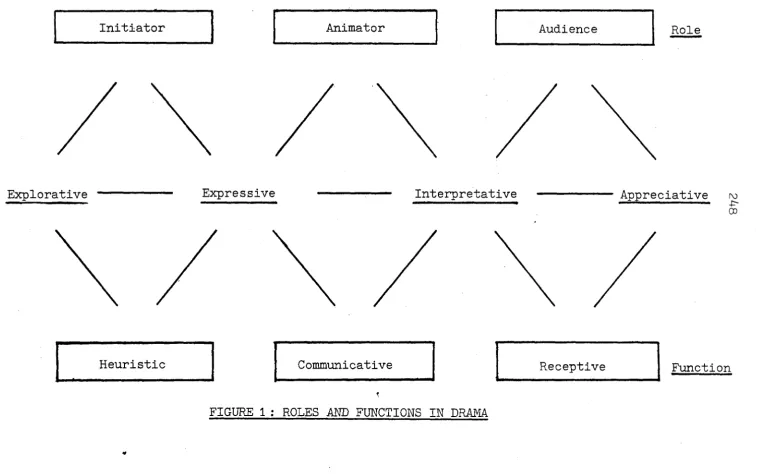
(1 ) Roles and Functions in Drama and Theatre 2.'+~
(2) Snapshot,
1945
"277'Snapshot,
1945'
2..11(4) A Cycle of Constraint ~Cf.O
(5) Departments responsible for drama work
3':;
(6) Time spent teaching drama by 1 - 4 specialists:'
q b
(8)
Time spent on non-drama teaching by 1 -
4
specialists
(1 ) (2) (3)
(4)
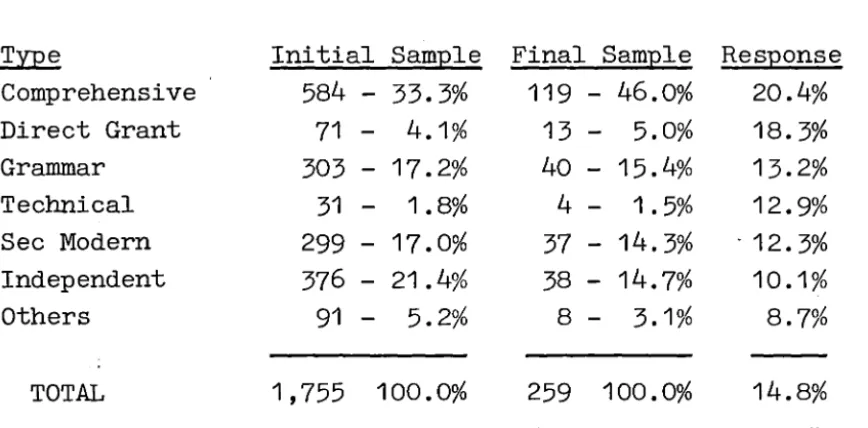
(5) (6) (7) (8) (9) ( 10) (11 ) ( 12) ( 13) ( 14) (15 ) ( 16) ( 17) ( 18) ( 19) TABLESClassification of schools in initial and final samples according to general type.
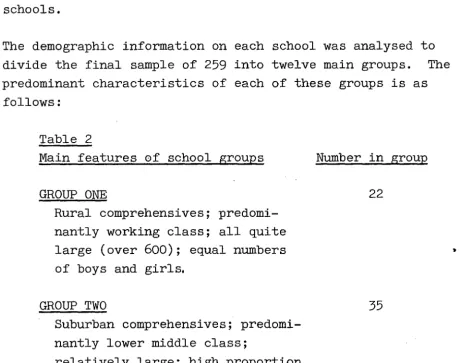
Main features of school groups.
Numbers of drama specialists per school. . Numbers of music, art and English specialists per school.
Total numbers of English, art, music and drama specialists.
Distcibution of specialists according to school group.
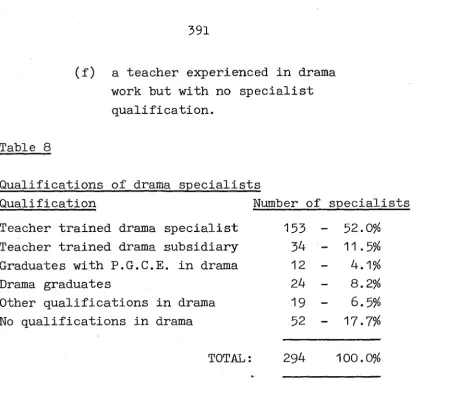
Numbers of non-specialists per school. Qualifications of drama specialists.
Numbers of drama specialists in English and drama departments.
Number of minutes spent by children of each year on timetabled drama activities.
Number and size of drama groups in each year throughout the sample.
Number and type of' areas available for drama work in the sample schools.
Technical equipment available for use in drama work.
Types of development through drama. Methods of streaming.
Methods of determining ability. Forms of assessment in drama work.
Main aims of C.S.E. syllabuses returned with questionnaire.
Content of syllabuses.
3-a\
4-0\
INTRODUCTION
1 Drama in schools
During the past twenty years, there have been considerable
changes in both the practice of, and the provision for, the
teaching of drama in secondary schools. Where i t was once
seen chiefly as part of English teaching, drama is now
established in some degree as a curriculum activity in its
own right. Throughout the country there are teachers
employed in schools as drama specialists working, in some
cases, within independent drama departments. Of the lL2
local education authorities in the United Kingdom, 60 employ
either a drama adviser or an adviser with responsibility for
drama. In some authorities - Devon and Northumberland, for
example - there are teams of advisory teachers in drama and
invsome there are maintained drama centres.1
The National Association for the Teaching of Drama (NATD)
lists 44 local associations of drama teachers from
Cleveland to Somerset and Inner London to Clwyd.2 There are
now C.S.E. syllabuses in Drama and/or Theatre Arts and G.C.E.
Papers at Ordinary, Ordinary/Alternative and Advanced Level
with the Associated Examining Board. Major reports on the
curriculum during the 1960's and 1970's, from Newsom
(Ministry of Education : 1963) to Bullock (Department of
Education and Science: 1975b) have commented on the positive
benefits of including drama of one form or another in the
s c h 0 01 curriculum. For thousands of children in hundreds
of schools, drama has become part of the institutional
pat-tern of compulsory education.
Yet, despite the apparent pace of it, the development of
drama in schools has not traced a simple upward curve. First,
the main increases in provlslon were during the ten years or
so from the mid 1960's to the mid 1970's.3 Since then, the
18
educational spending have greatly reduced the numbers of students in drama training and the numbers of jobs available to them .. Second, the general climate of educational
accountability has challenged some of the basic principles which have been associated with this work. Third, there are, in any case, deep divisions among teachers over funda-mental questions concerning both the theory and practice of drama in schools. My general concern in this study is with identifying and pursuing some of these theoretical questions. There are a number of reasons for this.
2 The problems of drama
2.1 Definition
Drama has come to connote a wide range of activities in schools and this raises difficult problems of defini-tion. At extremes, drama, for some teachers, means acting, the school play and the practice and apprecia-tion of theatre. For others, it has nothing to do with theatre or arts appreciation. They see i t rather as a form of self-expression or even therapy. Where some claim that drama is a subject in its own right, others see it principally as a method of teaching. Certainly, while drama has been developed as a specialism, there has also been an increasing use of techniques of role-play, simulation and improvisation in other areas of the curriculum: in social studies, the humanities and in the teaching of English, for example.
4
Moreover, many of the activities of specialist drama lessons have long taken place elsewhere: discussion, writing, physi-cal games, group work and so on.In addition to this there has been the development out-side schools of Theatre-in-Education, Children's
prompted to ask in 1968 whether there existed,in the middle of this range of artistic expression, a disci-pline that can be identified as drama? If not, how do we describe drama? Who is to teach it?6
As I hope to show, this question of definition is still pressing. It is not peripheral to an understanding of drama in schools but central to it and to this study. The emphasis here on theory is not due therefore to disinterest in practice. On the contrary, the clarifi-cation of practical matters is the underlying concern. There are several reasons for tackling the issues this way round however. Some of these are to do with the general relationship between theory and practice and some to do with questions of provision and of
accountability.
2.2 Theory and practice
The current literature of drama teaching principally consists of two sorts of book. There are those which describe the authors' own conceptions and practical work within the framework of particular methods. 7 Others comprise general lists of games, exercises, literary extracts and so on to be used as source
material. 8 The usual emphasis in both cases, however, is on answering the question, 'How?' Few provide, except in the most general terms, an underlying
theoretical rationale -for what is done3 Yet, for many teachers, the most perplexing questions in drama are really to do with its educational functions. If they are sure that drama has a value, they are still , uncertain quite what this value is and have difficulty therefore in articulating it to parents,
employers, colleagues and so on.
2.3 Methods and methodology
Different authors have also come to be associated with different 'types' of drama. Certainly they differ as teachers. But then all teachers do. The complex rela-tionships between teachers and groups mean that generalis-ing about the value of this or that method can be unwise. What works for one teacher may be disastrous for another: activities which engage one group may disaffect the next. In the end, the value of teaching methods cannot be pro-perly considered independently of the personal techniques with which they are practised.
The need this suggests is not for methods of teaching drama to be prescribed for te~chers to follow but for a critical approach to the whole area of methodology, starting with an analysis of their own practice. Such an analysis, I contend, will draw in complex questions of theory which in the past have been greatly neglected. I do not mean there-fore to abandon the real world at schools for a higher realm of abstraction. I hope rather to show that there is an important dialectic here: that, in thinking about
theory, I necessarily have practice in mind.
2.4 Back to basic: curriculum accountability
A central problem for teachers is to find a coherent approach to assessing and evaluating drama in schools. This is partly a professional need to improve and
develop daily practice - but it is also political - so as to respond positively to the pressures of educational accountability.
The policy of retrenchment in public spending pursued by the last Labour administration has been toughened in the present government's percentage cuts across the whole range of public services. This has added to the pressures on schools to show 'results'. For if
line with general economic policies, parents have also become more anxious about the employment prospects of their children and about the need for vocational
qualifications. As youth unemployment continues to rise,10 it seems likely that the pressures on the curriculum will increase.
Such developments have made clear the political signi-ficance of both the content and style of education. They have also led to a series of reports from many sectors of education with forecasts and models for the future of the curriculum. 11 As I will show, much of the conventional wisdom about the aims of drama has been challenged, albeit indirectly, in these changes in the educational climate.
If this analysis bears on the basic functions of drama in the classroom, therefore, it must also ask how basic these are to education and to the curriculum as a whole.
3 Aims of the thesis: three perspectiveson drama in schools
This thesis therefore has a number of aims. I am concerned overall with developing a coherent way of thinking about drama in schools which can inform practice. Within this I want to tackle central questions of definition and of
function relating these'to issues of evaluation, assessment and of curriculum provision. In doing so I aim to offer three related perspectives on this work.
3.1
An historical perspectiveevidence of these changes and has also been instrumental in bringing them about. There have been few attempts, however, to chart the general course of these changes or to draw out the underlying reasons for them. 12
There is then a gap in our recorded understanding of this work which it may be useful in itself to try to fill. There are three reasons for doing so here, how-ever, which are of specific importance for this study. These are to indicate:
1
what the changes have been in the general understanding of drama: what has changed and why;2 some of the influences on contemporary aims and methods;
3 the extent to which these changes in the theory aL~ practice of drama have been caught up in much t::--oader social and educational developments.
As I will show the current vocabulary of drama, and the conceptual understanding i t embodies, is ranged around a series of oppositions. Many of these began as fine distinctions but, through over-use, have become rough-edged dichotomies. By uncovering their origins in what were quite different social and educational
circum-stances, I want t·o revaluate their usefulness in our own.
There are evident dangers in undertaking such a
per-spective. Interpreting the past is always precarious. • The process of selection and commentary always carries with i t a risk of distortion and of bias. There is also the need to reckon with what Raymond Williams
(1971)
providing an historical analysis of drama in schools which is only part of the present purpose could well occupy an entire study of its own if full justice were to be done it . I want here to provide only
a general background of key themes and developments so as to contextualise the wider argument. It should be acknowledged from the first therefore as being neces-sarily selective. It must be left to others or to another time to give a more complete account of the rich history of this work in schools to the present day.
3.2 A theoretical perspective
In tackling questions of theory I want also to broaden the debate. The attempts to establish drama as a
specialism in secondary schools may suggest the need for a special theory of some sort. I want to argue against this and show the important ways in which drama overlaps with other areas on innovation.
Speci-ficall~ I want to demonstrate the richness of ideas developed in apparently quite different fields of
enquiry - in epistemology, linguistics, aesthetics and in the sociology of knowledge - for organising our understanding of the drama process.
A cautionary note is also needed here
Under-taking such an analysis necessarily draws us towards intimidating theoretical issues in each of the areas which I have mentioned. These cannot all be dealt with in either the detail nor with the confidence which a
specialist study in any of them alone would demand. We' need to tread carefully among these issues therefore
and maintain the focus on drama which this study claims. Accordingly there will be points at which lines of
point up the dangers of territorialism and isolation to which I will return in concluding the study.
3.3 The material context
Whatever educational functions drama may prove to have in theory, it still has to be organised and conducted in real schools with real children. The ways in which any activities are provided for in terms of space, staffing ratios, time and facilities,considerably influence the relationships between what is possible and what is actually achieved in education. It is important, therefore, to set these activities and this analysis of them in a material context.
The 1968 D.E.S. Survey was prompted by the expansion of drama in schools and set out to take stock of it. One of the conclusions of that survey was that the great diversity of aims, methods and opinion in drama was a sign not so much of ~ealthy variety as of a danger that quantity was fast outstripping quality. (D.E.S. 1968, p3). There are two aspects of this which I want to look into.
1 I want to clarify how much drama teaching is actually going on: what the 'quantity' is. Do many schools have specialist teachers or is the work mostly done within other departments? Is drama more common -in certain types of school? Do all children in the same school have drama or is there some sort of selection? What size groups do teachers work with and for how long? What kind of • facilities are made available and with what
results?
provision for drama. Part of my purpose here has been to add to our knowledge of the patterns of curriculum provision for drama by means of a , national survey.
2 One of the results of the moves to establish drama as a specialism has been a tendency for its supporters to make considerable claims for it. I will argue that often these have not taken due account of the material context in which the work is done. As a result teachers have sometimes lost focus in day-to-day work by basing activities on over-generalised aims. This has compounded the problems of effective evaluation and consequently of curriculum accountability.
I want to look here then·at:
(a) how drama is actually organised and pro-vided for in a range of secondary schools and to establish if there are any detectable
patterns;
(b) to consider this provision in the con-text of the theoretical analysis and vice-versa.
4
The background research: the national survey In part this study has set out to establish what is actually going on in schools. 13 The concern there-fore has been with a macro rather than with a micro' study of drama. Accordingly a wider sample hasstandardised questions of provlslon and policy. This involved three related forms of enquiry.
(a) The guestionnaire
At the beginning of this study I designed and administered a postal survey to a broad sample of schools throughout the British Isles. This has yielded statistical informa-tion which is used to contextualise and
inform particular points of argument. The procedures of the survey together with the final questionnaires are discussed in
Appendix 1.
The main questions posed by the survey were:
1 Where is drama taught?
2 Who teaches drama?
3 How much drama is there in schools?
4
What are the facilities for drama? 5 What are drama teachers doing?6 What are the attitudes of teachers to assessment and examinations in drama?
(b) School visits and observations
An
analysis of the final sample of schools "d" t d t 1 " " 1 4 I " "t d In lca e we ve maln grouplngs. VlSl e schools representing these groups to conduct free interviews with the staff,15 about their work, to look at facilities and to observe lessons.(c) Selected interviews
In addition to the school-based interviews, I conducted a series of selected interviews with:
individual writers and practitioners whose work has been influential in the development of drama in schools
with groups and other individuals whose work relates in some way to drama e.g. Theatre-in-Education, Community Arts groups, local arts centres.
I also gained access to archive material of professional associations for the teaching of drama. The general background to the study has also been greatly enriched by my involve-ment with the Schools Council Project both through the regional working groups we
estab-.
lished and the programme of local, regional and national in-service courses and conferences with teachers and administrators which followed.
5
Why
the emphasis on secondary schools?I have confined this study to work in secondary schools.16 There are three main reasons for this.
(1)
I am interested in the notion of drama as part of compulsory e~ucation. Of the two main divisions in the age range I have most direct experience of secondary education and a greater personal interest in it.(2) In the comparatively informal atmosphere of pri-mary schools, changes in the pattern of the day,
involving innovatory activities, can often be introduced at the discretion of individual teachers. 17 In the
institutionalise. The need is particularly important here to understand and respond to the material context.
(3) For the political and professional reasons out-lined above, questions of function and of priority
became more insistent in the secondary school as pupils draw nearer to public examinations and the world of work. So too does the need for a supporting rationale.
6 A revaluation of drama in schools: structure of the thesis
I have called this thesis a 'revaluation'. This is because it sets out to reconsider some of the central claims which have been made for drama and to revise the terms in which the functions of such activities have been understood. These revisions have implications for how drama is organised in schools, for how it is taught and how its effects are per-ceived and understood: implications,in Bernstein's (1971) terms,for curriculum, pedagogy and evaluation.
The thesis is divided into nine chapters. Some of these deal specifically with drama and others with more general themes which bear upon it. Chapter One traces the main lines of historical development of drama in schools. It
identifies three main phases in this development and draws in the principal changes which characterise them. It begins with some early influences on theory and practice and moves through to contemporary work setting it in the current cli-mate of accountability.
to the process of arts work being described in terms of various dichotomies. Examples of these are: emotion versus intellect; participation versus appreciation; drama versus theatre and, perhaps most significant, arts versus science. I will argue that these dichotomies obscure some equally important relationships. I distinguish between two major conceptions of individualism - the 'rational' and the
'natural' - and argue that drama has developed as a special-ism mainly within the natural paradigm. Because the
dominant forms of accountability tend to derive from ration-alist assumptions, however, there is a tendency among drama teachers to try to legitimate what they do in those terms. I argue that this is not feasible and that there are serious difficulties in continuing, in any case, to accept either set of individualistic assumptions to account for drama. This is specifically because they under-emphasise or ignore:
(1) the social context of personal knowledge; (2) the social nature of dramatic activity; (3) the educational implications of these.
On this basis I identify the key issues to which any theoreti-cal analysis of drama must be addressed, although I do not, of course, set out to pursue all of them here.
Chapter Three explores the problem of defining drama. The two key features are identified as 'acting-out' and 'social interaction'. This poses two main areas for investigation: the notions of 'role' and of 'group negotiation'.
Chapter Five examines the implications of drama as a social activity looking particularly at the notions of 'symbolism' and of 'everyday social reality'. It presents a dialectical view of knowledge in which the process of personal conscious-ness is of central importance. This draws on a
phenomenQLogical analysis which emphasises the significance of different 'ways of knowing' and the creative, intentional activity of the knower. The concepts of 'subjectivity' and of 'objectivity' are examined in relation to this and a
number of implications are drawn out for the idea of 'creat-ivity', and for the dialectic of reason and emotion. The view of knowledge as 'object' is discounted in favour of knowledge as a process of 'negotiating meaning'. Dramatic activity is argued to provide'a key example of this general process.
Chapter Six looks at the relations between drama, theatre and social reality in the light of this. I identify the main functions of dramatic activity so as to illuminate the relationships between 'participation' and 'appreciation'. The concept of expression is given particular attention. The chapter concludes by criticising the partial ways in which drama is often used in schools.
Chapter Seven tackles the problems of evaluation and assess-ment. I look at the concept of evaluation and offer a
distinction between the 'act' and the 'action' of evalua-tion. The prevailing 'objectives model' of evaluation is criticised as being innappropriate for the arts. What is urgently needed however is a coherent framework for evaluat-ive action. The chapter proposes such a framework derived from the main components of drama. It further develops the concept of negotiation looking at the relationship between
Chapter Eight applies the main themes of this analysis to identifying the roles of the teacher in the drama lesson and considers each of these roles in turn. The argument is then elaborated to embrace the notion of 'cultural education' through drama. The key features of this are discussed and related to a view of the social functions of theatre.
In the final chapter I consider the implications of this study for drama in the curriculum. An account of current provision is given and of the common problems which teachers find in this. These are argued to be, in the main, those of many forms of innovation and to be rooted in conflicting views about the functions of education as an institution and about the relations of knowledge and the curriculum. These issues are directly linked to questions of educational power and responsibility. The use of examinations as a way round this is criticised and altsrnative approaches, based on more thorough patterns of formal assessment are recommended. I conclude by arguing that this involves a broader view of the cultural functions of education in the school and the
community and that drama and the other arts have an increas-ingly important role in this.
CHAPTER ONE
DRAMA IN EDUCATION: A GENERAL PERSPECTIVE 1 Reasons for the chapter
(1) To sketch the main phases in the development of drama in schools
(2) To look at the background to current
principles and practice in drama teaching
(3) To indicate some of the broader social and educational developments with which drama in schools has been associated.
2 The evolution of drama in schools
2.1 Conflicting assessments of progress
Most schools in Britain have a tradition of school plays: from the nativity of the primary school to the production of classics in the secondary school. Along with other extra curricular activities this has an
established place in the cultural life of educational institutions. The development of the school play has interacted down the years with the development of pro-fessional theatre.1 Although the school play is an
important element of dramatic activity in schools, and we will begin by looking at its origins, I am principally
concerned in this chapter with a related line of develop-ment: that of drama as a specialist part of the daily curriculum.
written indicates that different people have had dif-ferent things in mind in using the term drama in education.
The literature, for example, contains a number of
estimates about the amount of drama going on in schools at various times. The telling fact is that at the same moment it has seemed to some observers that drama was going on allover the place in schools and to others that there were just isolated flares of activity here and there. Is there any coherence in these views or were some of them just wrong?
The 1960's are generally thought of as the boom years for drama teaching. Certainly drama courses benefited considerably from the unprecedented investment in
teacher training. In 1962 there were six main courses in drama. By 1971 there were over 100.2 This would have encouraged the Newsom committee who, in 1963,
expressed concern that,
, ••••. the educative experience of drama, in all its forms, is too often, despite notabl~ exceptions, restricted or denied to pupils'.
(.M.inistry Df Education: 1963, para 480, p157)
Three years later, John Hodgson and Earnest Richards saw little change. As they saw it,
.•.•. so far, in most schools, drama has not been seen as signi-ficant enough to be given a
place' •
(Hodgson, J and Richards, E: 1966, p8)
were making their way through specialist drama courses and were beginning to move out from the colleges. But the implication seems to be, in both of these statements, that drama had not yet struggled to its feet in schools.
It is perplexing to compare these views with those of an unpublished report written in 1949, fourteen years before Newsom. The report was the outcome of a Working Party convened for the Ministry of Education by the Permanent Secretary, John Maude (Ministry of Education: 1949a). Its terms were,
...•• to consider the place, function, content and technique of drama in. the education of children and young people and in the training of teachers'. (Ibid., p1)
It began by reporting that, 'in the past two decades, there has been a remarkable development of drama in every kind of school', and went on:
, .•..• It is true that many schools still include little or no drama in any part of their curriculum, but so many others do find room for it, in one form or another, that drama can now be regarded as an established and worthwhile part of school life' •
(Ibid., p6)
Exactly twenty years earlier a book was published looking at the history of The School Drama in England. Its author commented that in schools and colleges, not only in England,
....• but throughout the English speaking world, the educational value of drama is receiving increasingly widespread recognition'.
(Vail Motter: 1929, pvii)
Ten years before that, in 1919, the Board of Education had reported on the benefits of dramatic activity in schools and had recommended increased provision for it in schools, colleges and universities. (Board of
Education: 1919). So it was no surprise when, in 1938, a new book on School Drama (Boas, G.and Hayden, H.,
(Eds): 1938) appeared in which it was confidently stated that,
... the Benediction of the Board of Education upon dramatic work in schools has fallen as a
final vindication upon what is by now an established practice'. (Ibid., p32)
concerned the Inspectorate most. Here, for the first time, was an urgent demand for definition .
... the question we have con-tinually asked ourselves is this: does there exist in the middle of this range of artistic expression, a discipline that can be defined or identified as drama? If not, how do we describe drama? Who is to teach it? If our answers are uncertain it is because we have hesitated to impose a definition on a young and growing subject. But the need for clarification is strong and, since the quantity of work is far outstripping quality, urgent' .
(D.E.S.: 1968, p3)
2.2 Three main phases of development
The key to this puzzle lies in a changing conceptionsof drama in education and of the institutional forms it has been assumed it should take. Where it had once been seen as part of the teaching of English, and had, in that sense, been firmly established, a new under-standing of drama began to emerge in the 1950's and 1960's which led to calls for it to be seen as a
separate specialism. In that sense it was not estab-lished at all.
The most contentious issue in these changes has been the meaning of the terms drama and theatre and the rela-tionship or otherwise between them. At a key point in the history of drama in schools, opinion divided on this t
issue and has remained divided ever since.
curriculum. Second, because, as we shall see, it raises broader issues for education as a whole, and especially arts education, bearing as it does on some basic questions of function.
In these respects the development of drama in schools can be divided into three main phases.
Phase j From the beginnings of compulsory education
to the 1950's:
when drama and theatre were virtually synonyms in education.
Phase 2 From the 1950's to the 1970's:
when drama began being developed as a separate specialism. Many teachers then sharply dis-tinguished what they were doing from theatre. Phase 3 From the early 1970's to the present:
when, partly because of the pressures of public accountability, many teachers have been led to re-examine the assumptions of earlier work and the place of both drama and theatre in schools.
Each of these phases, although clearly overlapping, is distinguishable according to the activities used in drama lessons, the outcomes sought and the underlying assumptions about the roles of the teacher.
3 Drama to the 1950's
3.1 The school drama and the early theatre
In its earliest forms, drama in education in England ~
... The school boys were simply one of the many independent 'groups of drama producers. The plays they acted were as much a part of the English drama of their day as any other plays in the kingdom'. (Vail Motter, T H: 1929, p238)
The earliest recorded stage performance in England was of a boy-production of the Play of St Catherine given by the choir boys of Dunstable in the early 12th century. Among the earliest surviving written plays in the
language are those composed originally for performance by s.chool boy companies including Ralph Roister Doister, by Nicholas Udall, a s?hool master at Eton and
Westminster. Music and Drama had an important place in Tudor education in general~ Roger Ascham, tutor to
Elizabeth I, himself emphasising the educational values of dramatic activity and of play. 3
The pattern of dramatic activity up to and including the early Elizabethan period was irrevocably changed with the coming of the professionals. Theatre, from the late 16th century, began to be more business-like. Although the school boys and other amateurs - Children of the Chapels, scholars, gentlemen of the Inns of Court - were to continue acting, their influence on the development of the theatre gradually declined as they were edged away from the centres of innovation.
Within the schools themselves the practice of acting plays was maintained, not just as a means of entertain-ment, but of education. Drama activities were
enthusiasm for Latin and the classic texts. The use of drama persisted in schools even within the starker vision of the Puritans. If they could see no virtue in the public performances of theatre, they saw some at least in using dramatic activity to teach the
classics. It was in the 18th century that interest in drama as a means of education,
... both in familiarising the student with good authors and in training him in speaking, poise and "stage presence'"
(Vail Motter, T H: 1929, p242)
really began to expand.
Traditionally dramatic activity had been valued for the social skills it promoted and for its part in transmit-ting the dominant culture. At the centre of 18th century
Romanticism,howeve~ stood the concept of the 'Natural' world. In education, Rousseau's study of Emile argued for forms of teaching which promoted games and pleasur-able activity and did not impose adult attitudes and values on young minds; an education which cherished
childhood. Here a basis was being set down for drama to be seen first and foremost as a natural form of expres-sive activity.
Like Rousseau, Froebel, in his work with very young child-ren during the 19th century, saw play and 'natural'
activity as the foundation of a liberal and humane education. If play commended itself for these reasons to liberal educationalists of the 19th century, and with John Dewey and others, 0 f the 20th century, it
The new disciplines of social and psychological enquiry which were emerging in the post-Darwin world of evolu-tion and natural selecevolu-tion sought to analyse the
patterns of personal and social development and to con-sider the functions of play and other early activity
within this. Together, the liberalisation of educational philosophy and studies in the psychology of play nurtured a conception of drama in schools which broke almost com-pletely with its theatrical traditions.
3.2 From 1900 to the 1930's 3.2.1 Drama as text
For the first four hundred years or so of its Use in schools, drama meant acting in plays and learning about dramatic literature. The accepted distinction was that 'drama' referred to the stock of texts and
'theatre' to the business of performing them. It is in these senses that early reports on the curriculum in this century endorsed the use of dramatic activity in schools. In its report on The Teaching of English the Board of Education defined drama as three things: as something to be written; as something to be read; and as something to be acted. (Board of Education:. 1919, p315). Drama was text.
The practical activities of drama comprised the per-formance of scenes and pieces in the class; the public performance of plays by pupils; visits"by pupils to professional performances of suitable plays. For the Board, the outcomes of these activities were clear:
•...• The pupils who take part in the performance of plays learn •.•••• ,to _eXJ>res~
emotion becomingly. to be expresslve yet restraine~, ~o subordinate the indiVidual
personal disabilities'.
(Ibid., p316)
'It will hardly be suggested', the report adds, 'that these are negligible accomplishments'.
The association of drama activities with the pro-motion of particular social attitudes is cornmon to all three phases of its development.
3.2.2 The Playway
As the Board was reporting, an influential figure in the development of drama was preparing the second edition of a book which contained a more expansive view of drama in schools. Henry Caldwell Cook, a teacher at the Perse School in Cambridge, saw dramatic activity as a method of teaching across the whole curriculum. He deplored what he saw as the suppression of children's natural
vitality ~nd curiosity by formal methods of instruc-tion. In their place he offered The Playway, which he described as,
... some ideas and practical suggestions on educational method which it is hoped may prove help-ful to teachers who have not shut their minds against reform' .
(Caldwell Cook: 1919, pix)
a seemingly inexhaustible impulse to play, he
argued, teachers would be better employed in learn-ing to tap this energy, and to use it constructivel~
than in trying to staunch it.
He was not simply adding to the general repertory of classroom methods. He made this clear
in associating the Playway with seven general maxims.
If teachers were to adopt his methods, they must accept that:
(1) The method of study is quite as important as the matter studied. (p23)
(2) Direct instruction is only a small part of ,what can take place in a classroom. (p28) (3) Self-improvement is not a matter of discipline
only but a condition which makes it possible for the boys to learn by themselves in actual lessons. (p31)
(4)
If boys are to be taught by means of play, master must have a genuine interest in the play. (p36)(5) 'One of the first qualities of a playmaster tact. (p41)
(6) The basis of educational method must be a regard for the pupils' interests. (p45)
the
is
(7) Under a natural system of education, there can be no absolute standard of discipline. Right behaviour is a relative condition to be deter-. mined by its appropriateness to the occasion.
(p47)
and the learner. In these ways the Playway
exemplified the principles, and dramatic activity the practice, of 'progressive' education in general.
3.2.3 Broadening the base of primary education: activity and experience
The Playway was not an isolated innovation. The value of play and of expressive activity of one sort or another in education had been pointed to by philosophers back to Aristotle and Plato. But with the perspectives on human behaviour which 19th
century evolutionary theory proposed, systematic attempts to examine and establish the social
functions of play were now being made. The assump-tion that human activity is principally directed towards survival and procreation suggested that, being pervasive 'and seemingly instinctive, play must participate biologically or socially in the
satisfaction of these needs.
Some early speculations in this direction were made by Herbert Spenser (1873) who suggested that play was the burning away o~ surplus energy, once the needs of survival had been met- a kind of steam valve. Later writers progressed to detailed
observations of children and animals at play, set-ting out to describe and classify the main features of these activities. ~ S.Hall (1916), the American psychologist, discarded 'surplus energy' in favour of a 'recapitulation theory' which proposed direct parallels between ontogenetic and phylogenetic development; the one being a repetition of the other. Karl Groos (1901) followed Darwinian
need for a special theory was called into question. In 20th century psychology the tendency has been to integrate the attempts to understand the functions of play into the search for a general theory of human psychology.
In the process the conviction that play is functional and participates in the growth and development of the child has become part of the intellectual landscape. This was beginning to be so as Caldwell Cook wrote The Playway. Nevertheless, the transition from speculative theory to daily
practice, when it happens at al17 can be impercept-ibly slow. The Playway was remarkable partly because it readily translated emerging principles into a
practical methodology. But it was also remarkable for its breadth. Caldwell Cook argued the use of the Playway not only across the whole curriculum but across the whole age range. The implications of theories of play may have been obvious to some of those working with very young children. Caldwell Cook had his eyes on the secondary school as well.
A number of other teachers were experimenting along related lines. John Dewey's work in his Laboratory School in America was commanding interest on both
sides of the Atlantic. At the Dalton School in New York and at the Porter School, near Kirksville in Missouri, other teachers were encouraging 'learning by doing', as was John Merrill at the Francis W
Parker School in the United States,5 and A S l 6
Makarenko in the U.S.S.R.
In Britain in the 1920's innovations of this sort were isolated. Where they did exist they were
mostly confined to primary or to independent schools, which, being less tied to public policy, are some
of self-expression and creativity slowly percolated into the state system of educationj first at the primary level and then eventually up into the secondary schools. How did this come about?
By the late 1920's and early 1930's the Board of Education's view of primary schools was sympathetic to liberal notions and was clearly being influenced by psychologists' adventures into child development. H.M.I. through its reviews and reports on the school
curriculum, played a seminal part in spreading these perspectives throughout the state primary system. A key figure in the Inspectorate of this time was Christian Schiller, seen by one commentator as the principal agent in the liberalisation of pri-mary schools in Britain.
7
The Board of Education had long encouraged teachers to be flexible in their work in schools. 8 The
Hadow Report (Board of Education: 1931) on Primary Schools, of which Schiller was a principal author, argued within this tradition for the need to look to the 'whole child'. The report firmly endorsed play, activity and self-expression,as important elements within state education; activities which,
••.•. if the psychologists are right, are so closely correlated with the develop-ment and perception of
feeling' • (Ibid., p76)
In saying so, the Committee recognised, as Caldwell Cook had done twelve years before, that teaching methods and attitudes would have to change. The tendency to see the curriculum as a jigsaw of tra-ditional subjects, related only as a pattern of separate units, needed to be questioned. So too did the practice of presenting work to children simply as 'lessons to be mastered'. Methods of work were needed which took as their starting point, 'the experience, curiosity and awakening powers of the children themselves' (Ibid.,pp xvii-xxix) .
3.2.4 Formal and informal drama
The Hadow Committee recognised in 1931 that the term 'drama covered a wide variety of activities. The report made working distinction between 'formal' .. drama on one hand, comprising work on, and
perform-ance of plays, and 'informal' drama on the other, in which children were encouraged to create and act out their own scenes and stories. The Committee did not distinguish between the values of these activities, arguing rather that both offered 'good opportunities for developing ... self-expression' (Board of Education: 1931, p76).
3.2.5 Drama in the secondary school
If drama found a place in primary education in the 1930's and 1940's it was partly because the general atmosphere was congenial to it. The curricula of secondary schools has always been more subject to ~
external pressures and less open to change. The Consultative Committee on the Education of the Adolescent published in 1926, and also chaired by Hadow, insisted however that,
larger interests of mankind' .
(Board of Education: 1926, para 93)
In outlining its proposals for the development of secondary education through the grammar and modern schools, the Committee therefore offered three main
objectives:-....• One is the forming and strengthening of character -individual and national
character - through the placing of youth, in its hour of growth,
'as it were in the fair meadow' of a congenial and inspiring environment.
Another is the training of boys and girls to deli&~t in pursuits and rejoice in accomplishments -work in music and art; -work in wood and metals; work in litera-ture and the record of human history - which may become the recreations and the ornaments of hours-.of:leisUre in maturer years.
And still another is the awaken-ing and guidawaken-ing of the practical intelligence for the better and more skilled service of the communi ty' •
(Board of Education: 1926,pxxiii)
The 1931 Hadow Report emphasised the role of expresT sive activity in the development of feeling. Here in 1926 the arts are associated with recreation and with leisure - as distinct from developing 'the practical intelligence'.




![Table 6 Distribution of s]2ecialists according to school grou]2 GROUP SUBJECT](https://thumb-us.123doks.com/thumbv2/123dok_us/8166710.1362938/390.606.43.507.141.689/table-distribution-ecialists-according-school-grou-group-subject.webp)