2 8 0 7 7 1 3 4 5 8
A study of the
community reprovision programmes
of the
psychiatric institutions
in
England 1993 -1995
by
Colin John Rickard
M.A. F.R.I.C.S.
Thesis submitted to the Faculty of Medicine of the University of London
for the degree of Doctor of Philosophy
Royal Free Hospital School of Medicine
Department of Primary Care and Population Sciences
MEDICAL LIBRARY
ROYAL FREE HOSPITAL
ProQuest Number: 10105753
All rights reserved
INFORMATION TO ALL USERS
The quality of this reproduction is dependent upon the quality of the copy submitted.
In the unlikely event that the author did not send a complete manuscript
and there are missing pages, these will be noted. Also, if material had to be removed,
a note will indicate the deletion.
uest.
ProQuest 10105753
Published by ProQuest LLC(2016). Copyright of the Dissertation is held by the Author.
All rights reserved.
This work is protected against unauthorized copying under Title 17, United States Code.
Microform Edition © ProQuest LLC.
ProQuest LLC
789 East Eisenhower Parkway
P.O. Box 1346
PREFACE
The investigations which form the basis of this thesis were undertaken by the author between November 1992 and December 1995. Analysis of the results was undertaken as the work progressed and completed between January 1996 and March 1997.
Professor Shah Ebrahim acted as supervisor for this study.
The subject of the thesis was decided upon by the author who organised the running o f the study. The author assisted the hospital managers at each of the three case studies in setting up a standard project management database to monitor key events, timetable and costs in their reprovision programme. All data was collected by the author with the exception of the majority of the patient interviews which were undertaken by a qualified psychiatric nurse acting as a research assistant. Both the researcher and the author were instructed in the use o f the instruments for patient interviews by a consultant psycho-geriatrician. Approval for the studies was obtained from the Medical Ethics Committees and the Occupational Health Departments of the case study hospitals, general medical practitioners were contacted and informed o f the nature of the intended research in the case of those patients remaining under their care. Analysis of data was performed by the author with advice from a statistician. The thesis presented here is entirely the work of the author.
MEDICAL UBRARY
ROYAL FREE HOSPITAL
ABSTRACT
The reprovision of services in the community previously provided by psychiatric hospitals in the UK has taken from less than five to more than ten years to achieve for each hospital so far closed. Many psychiatric hospitals remain at least partially open. Protracted closures incur substantial double running costs to maintain both community and hospital reprovision. Purchasers should bring all possible pressure on providers to reduce the duration o f closure programmes in an effort to reduce these costs to a minimum. There is concern that rapid implementation of closure plans will result in the use of expedient, and possibly, sub-standard facilities, too little time to explain plans to all interested parties (patients, families, staff, local communities), and thus rapid closure plans may be seen as low quality.
The research tested the hypothesis: - "Planned short closure programmes can be achieved without detriment to the quality of reprovision".
A database of all the English psychiatric hospitals, identifying those reproviding services in the community with a view to closure, was set up to map their progress over three years. Key steps associated with successful programmes from a macro-level, planning perspective were identified. Three psychiatric hospitals’ reprovision programmes were monitored in detail to provide a micro-level study of the quality of reprovision from patient, family and staff perspectives.
The National study found that 24 (41%) of psychiatric institutions open in 1995 had no agreed plans fo r reprovision in the community and at least 25 would still be open after the year 2000. M ajor capital schemes were a major determinant of programme length and only 40% of programmes completed on time. All hospitals studied were acquiring more com plex case mixes and higher staff patient ratios whether they were closing or not. There were wide variations in both the level of reprovision and the rate of closure of psychiatric institutions between the English health regions.
The case studies of closures shorter than the national average programme length, found no harm caused to patients, acceptable physical reprovision standards and that patients, staff and relatives found the outcome satisfactory.
ACKNOWLEDGMENTS
The author gratefully acknowledges the assistance of the following people:
Professor Shah Ebrahim for encouragement, inspired thoughts and supervision.
Pat McIntyre, an incredibly easy to work with and effective field research assistant.
Professor Barry Gurland and Dr. John Toner of the Centre for Geriatrics and Gerontology Columbia University, New York for their help and inspiration especially with Quality of Life issues and piloting of the questionnaires.
W endy McLoughlin, who, as a Columbia University Masters student, investigated Common Mental Health Policy issues between the US and UK and assisted with the research.
The members of the Royal Free Hospital Projects Directorate for their help and forbearance whilst this work was researched.
Dr David St. George and Dr John Clark for their invaluable advice on the statistical analyses and structure of the thesis.
Dr Martin Blanchard for training on the instruments used for patient interviews.
Dr Noam Trieman for imparting a little of his specialist knowledge and expertise in this field.
The staff, patients and their relatives of the Case Study Sites for their co-operation and assistance.
Deborah Sinclair-Day for her help with Estates issues and assembling the final draft (again).
The Department of Health and the Mental Health Task Force for funding the research project.
Christina Emmett for her interest and support as research assistant for this study.
I have been grateful for the opportunity to present parts of this research as a speaker at the following conferences:
-New York Office of Mental Health Annual Conferences, Albany, -New York, USA. 1993 & 1994 Columbia University, New York, Statewide Psychiatric Fellowship Programme, New York, USA:
-- Binghampton, 1994 - Poughkeepsie, 1995 The International Institute on Ageing, United Nations, Malta: - Study Course, 1996
Team for the Assessm ent of Psychiatric Services (TAPS) Conference, London, England, 1996
Table of Contents
Preface 2
Abstract 3
Acknowledgments 4
Chapter 1 Mental Illness and Community Care 11
1.0 Introduction 12
1.1 The Burden of Mental Illness 12
1.2 The History of Social and Health Care of the Mentally III 15 1.2.1. Changes In the Law and Social Attitudes to the Mentally III 16
1.3 UK Government Policy - Care In the Community 17
1.4 Definition of Community Care for the Mentally III 18
1.5 Financing the “Care In the Com m unity” Policy 20
1.6 The International Context 21
1.7 The Impact of Closure Programmes 22
1.7.1 Financial 22
1.7.2 Mental Health Services 22
1.8 Problems with Putting Community Care Policy Into Practice 23
1.8.1 Finance Difficulties 23
1.8.2 Public Perception of Community Care 24
1.8.3 The Discharge of “Dangerously III" Patients 24
1.8.4 Costs o f Long Term Care 25
1.8.5 Location of Community Care Facilities 26
1.9 M anagement of Capital and M ajor Change In the NHS 27
1.10 The Research Issues 34
Chapter 2 Literature Review 36
2.0 Introduction 37
2.1 Availability of Data 37
2.2. Literature Review 38
2.2.1 British Studies 39
2.2.2 American Studies 40
2.2.3 Comparability of US and UK data 42
2.2.4.1 Studies o f Deinstitutionalisation in Mental Health Reprovision 43 2.2.4.2 Learning Disabilities Reprovision - Possible Parallels 64
Chapter 3 Study Design and Methods 76
3.0 Hypothesis 77
3.1 Overall Study Design 77
3.2 Selection o f the Research Methods 78
3.3 The National (England) Survey Design 81
3.3.1 Content of Questionnaires 81
3.3.2 Defining the Sample 82
3.3.3 Identifying the Appropriate Respondent 83
3.3.4 Pilot Study 83
3.3.5 Verification and Management of the Data in the National Study 84
3.3.6 Baseline and Annual Follow-up Surveys 85
3.3.7 Project Management Techniques in the Analysis of Programmes 86
3.4 In-depth Case Studies of Three Reprovision Programmes 88
3.4.1 Objectives 88
3.4.4.1 Case - Study Design 88
3.4.2 Content of Questionnaires 89
3.4.3 Patients' Perception Survey 90
3.5 Patient Assessm ent 92
3.5.1 The Brief Assessm ent Schedule 92
3.5.2 Dependency Measures for Patients Exhibiting Severe Dementia 93
3.5.3 Patients’ Quality of Life Questionnaire 95
3.6 Staff and Carers’ Surveys 97
3.6.1 Staff Perceptions Questionnaire 98
3.6.2 The General Health Questionnaire 99
3.7 Friends’ and Relatives’ Perceptions 99
3.8 Physical Survey o f Facilities 101
3.9 Verification o f Data in the In-depth Case Studies 102
3.10 Data Management 102
Chapter 4 Results - The National (England) Study 104
4.0 Introduction 105
4.1 Description of Population 105
4.1.1 Response Rate 105
4.2 Who completed the Questionnaire? 105
4.3 Hospital Reprovision Programmes 106
4.4 Geographical Variations in Progress 109
4.5 Purchaser/Provider Arrangements 112
4.6 Management Structures and Progress 112
4.7 Hospital Populations and Bedspaces in Use 114
4.8 Case Mixes of Hospital Populations 115
4.9 Associated Hospitals 120
4.10 Duration of Reprovision Programmes 121
4.11 Problems with Reprovision 124
4.12 Non-exchequer Funding 126
4.13 Estates Data 128
4.14 Retrenchment Efficiency 129
4.15 Quality of Institutional Facilities 130
4.16 Changes in the Scale of Reprovision Programmes 130
4.17 Numerical Differences in Reprovided Services 132
4.18 Staff Transferring to Community-based Facilities 132
4.19 Projected Completion of the Community Mental Health Reprovision Programmes in
England 134
Chapter 5 Results - Case Studies 136
5.1 Introduction 137
5.2 Questionnaires and Methodologies 137
5.3 CASE1 137
5.3.1 Brief History 137
5.3.2 The Closure Plan 137
5.3.3 Built Environment - Physical Surveys 137
5.3.4 Effects on Patients 140
5.3.4.1 Changes in Patients’ Cognitive Impairment and Depression
Levels 141
5.3.4 2 Quality of Life - The Patient's Perspective of Reprovision 143
5.3.6 Staff Views 145
5.4 CASE 2 149
5.4.1 Brief History 149
5.4.2 The Closure Plan 150
5.4.3 Built Environment - Physical Surveys 150
5.4.4 Effects on patients 152
5.4.4.1 Changes in Patients’ Dependency Level 153
5 4.4.2 Quality of Life - The Patient's Perspective of Reprovision 155
5.4.5 Relatives' and Friends’ Views 156
5.4.6 Staff Views 156
5.4.7 General Health Questionnaire 159
5.5 CASE 3 160
5.5.1 Brief History 160
5.5.2 Closure Plan 160
5.5.3 Built Environment 160
5.5.4 Patient Data 161
5.6 Quality Control - Formal Audit of Fieldwork 161
C h a p te r 6 D is c u s s io n - The N atio n a l (E ngland ) S tu d y 163
6.0 Introduction 164
6.1 Limitations of the study 164
6.2 Strengths 164
6.3 W eaknesses in Study Design 165
6.4 Alternative Research Approaches 165
6.5 The Principal Findings 165
6.5.1 Success of Community Care Policy 165
6.5.2 Determinants of Progress 166
6.5.3 Problems of failure to close 167
6.5.4 Reductions in Provision 168
6.5.5 Inequalities 169
6.5.6 Funding 169
Chapter 7 Discussion - The in-depth Case Studies 172
7.0 Introduction - The Case Studies 173
7.1 Limitations of the Case Studies 173
7.2 Strengths of the Study 174
7.3 Alternative Approaches 174
7.4 The Principal Findings 175
7.5 Case 3 - W hat went wrong? 179
7.6 Case 3 - Could they have succeeded? 180
7.7 Summary - The Case Studies 181
Chapter 8 Conclusion 183
8.0 Introduction 184
8.1 Conclusions 184
8.2 Has the Hypothesis been supported? 193
8.3 Changes in Policy during the Study 193
8.3.1 Political Policy 193
8.3.2 Financial Policy 194
8.3.2.1 Cost Pressures Developing in the System 195
8.4 A Methodology for Analysing Reprovision Programmes 196
8.4.1 Analysis of Programmes 196
8.4.2 Project Management - Analysis Methodology 196
8.4.3 A National Standardised Reporting System for Hospital Closures 198
8.5 Further Research 204
Appendices 204
Bibliography 296
Lists of Tables, Figures and Appendices 313
CHAPTER 1
MENTAL ILLNESS AND COMMUNITY CARE
1.0 Introduction 12
1.1 The Burden of Mental Illness 12
1.2 The History of Social and Health Care of the Mentally III 15 1.2.1. Changes in the Law and Social Attitudes to the Mentally III 16
1.3 UK Government Policy - Care in the Community 17
1.4 Definition of Community Care for the Mentally III 18
1.5 Financing the "Care in the Community” Policy 20
1.6 The International Context 21
1.7 The Impact of Closure Programmes 22
1.7.1 Financial 22
1.7.2 Mental Health Services 22
1.8 Problems with Putting Community Care Policy into Practice 23
1.8.1 Finance Difficulties 23
1.8.2 Public Perception of Community Care 24
1.8.3 The Discharge o f "Dangerously III” Patients 24
1.8.4 Costs o f Long Term Care 25
1.8.5 Location of Community Care Facilities 26
1.9 Management of Capital and Major Change in the NHS 27
1.0 INTRODUCTION
In 1993 there appeared to be little understanding of the processes being adopted by psychiatric hospitals to implement community care and even less understanding of the progress they were
making.
An article in the British Medical Journal in 1993 stated:
" With so m any problem s impinging on the plans to close Britain’s mental hospitals and, whether ju stifie d o r not, a public perception that closures cause tragic failures o f care, it seems
extraordinary that the Department o f Health cannot sa y how m any mental hospitals are due to
close. Such ignorance hardly inspires confidence. N o r is it in keeping with the call in the Health
o f the Nation (DoH, 1992) for better information and understanding about the burden o f mental
illness”. (Groves, 1993)
This study attempts to follow the successes and failures of the 82 psychiatric institutions that were open in 1993 in their plans to introduce community-based services for their patients over the three years to the end of 1995.
Three hospitals were also studied in depth seeking the views o f both staff, relatives and patients. The patient group selected for these micro studies were the elderly mentally ill.
This chapter examines the changes in Mental Health Law and Government policy leading to the current environment in which the introduction of community care is being managed and
examines some o f the problems emerging.
1.1. THE BURDEN OF MENTAL ILLNESS
The burden of mental illness can be presented as:
FIGURE 1.1
%
BURDENS OF DISEASE - SHARE OF MORBIDITY, COSTS & MORTALITY - BY DISEASE, ENGLAND AND WALES, 1985.
40
35 30
25 20 15
10
M ental
A
i nKey to ICD Chapters I Infectious
II Cancer III Endocrine IV Blood V Mental VI Nervous
\
□ CO ST ■ M O RBIDITY □ M ORTALITY
VII Circulatory VIII Respiratory IX Digestive X Genito-urinary
XI Pregnancy & Childbirth XII Skin
a O o O
X X
XIII Musculo-skeletal XIV Congenital XV Prenatal XVI III defined
XVII Accidents, poisoning, violence
Source: Department of Health, 1988
M o rb id ity
Costs of Mental Illness
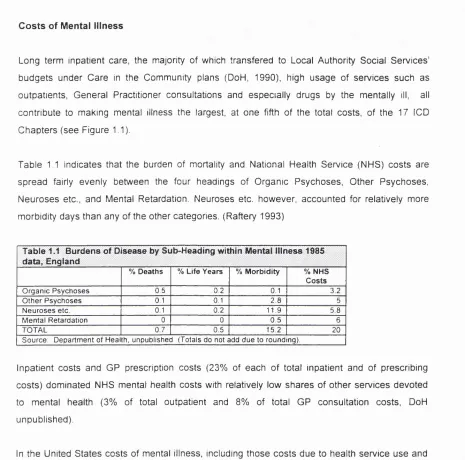
Long term inpatient care, the majority of which transferee! to Local Authority Social Services’ budgets under Care in the Community plans (DoH, 1990), high usage of services such as outpatients. General Practitioner consultations and especially drugs by the mentally ill, all contribute to making mental illness the largest, at one fifth of the total costs, of the 17 ICD Chapters (see Figure 1.1).
Table 1.1 indicates that the burden of mortality and National Health Service (NHS) costs are spread fairly evenly between the four headings of Organic Psychoses, Other Psychoses, Neuroses etc., and Mental Retardation. Neuroses etc. however, accounted for relatively more morbidity days than any of the other categories. (Raftery 1993)
Table 1.1 Burdens of Disease by Sub-Heading within Mental Illness 1985 data, England
% Deaths % Life Years % M o rb id ity % NHS
C osts
Organic Psychoses 0.5 0.2 0.1 3.2
O ther Psychoses 0.1 0.1 2.8 5
Neuroses etc. 0.1 0.2 1 1 9 5.8
M ental Retardation 0 0 0.5 6
TO TA L 0.7 0.5 15.2 20
Source: Department o f Health, unpublished (Totals do not add due to rounding).
Inpatient costs and GP prescription costs (23% of each of total inpatient and of prescribing costs) dominated NHS mental health costs with relatively low shares of other services devoted to mental health (3% of total outpatient and 8% of total GP consultation costs, DoH unpublished).
In the United States costs of mental illness, including those costs due to health service use and to private costs imposed by time-off work indicates that US spends roughly the same amount as the UK on mental health services, as measured by the proportion of Gross Domestic Product (GDP) accounted for by total (public plus private) spending (Raftery, 1993).
M o rta lity and Mental Illness
A different picture emerges when considering the implications of relocating elderly mentally ill patients from the institution into the community. The effects of relocation have been extensively studied, however there has been little consensus amongst researchers. Cranz (1980) in a US based study of an entire geriatric hospital transferring to a new building reported a high mortality rate in organically brain damaged elderly patients. Marlowe (1974) in a similar relocation reported an increase in mortality. Borup (1983) reviewed 32 such studies and found that whilst five supported an increase in mortality, 23 did not.
1.2 THE HISTORY OF SOCIAL AND HEALTH CARE OF THE MENTALLY ILL
Early legislation concerning the insane was primarily drawn up to protect the populace. A full table o f Mental Health Legislation is shown at Appendix 1.1 and the legal process for the admission of patients at Appendix 1.2. The Vagrancy Act of 1744 required each parish to look after its own poor and the "furiously and dangerously mad" who were to be "locked up in a secure place as long as the madness shall contrive".
Public awareness o f abuse and mistreatment of patients caused Parliament to set up a committee which produced The Asylum Act of 1808. The Act empowered every county, at its discretion, to provide an asylum. The Asylum Act of 1845 made the provision of such hospitals mandatory.
As the 19th century progressed, the County Mental Hospitals became increasingly overcrowded. The hospitals' inability to provide curative treatment, and an expanding population with a greater life expectancy, made the rising numbers inevitable. The mentally ill in addition to their psychiatric condition, suffered the same poor quality of health as the rest of the population.
Funding and clear identification of responsibilities for the care of the mentally ill was assisted by The Metropolitan Poor Act 1867, and its amendment in 1868, which obliged local authorities, (not elected at that time) to provide institutional care for the insane. Interestingly, the 1857 Lunacy Act in Scotland permitted voluntary admission, a possibility that was not formally copied until 1930 in England and W ales when the Mental Treatment Act was introduced.
A national census of paupers In 1896 revealed that between 1861 and 1891 there was a rapid expansion of hospital facilities. Both hospitals and beds provided by charitable institutions more than doubled and accommodation for the sick provided by public authorities increased by over 50 per cent. The ability to better categorise and treat general illness as opposed to psychiatric illness brought about a greater contrast between those for whom hospital provided care and treatm ent and those to whom it was a place of detention and isolation.
Mental health inpatient provision in England and W ales grew steadily from the beginning of the 19th century and peaked at 151,000 patients in 1954. During that period, and until comparatively recently, over 95% of hospital care was in large, often isolated mental hospitals which were mainly built between 1811 and 1903.
Services for people with mental health problems in England began to change in the 1950s from a pattern which was almost totally dependent on large, isolated mental illness hospitals to one which offered a range of services in each local community. The reduction in patient numbers that began in 1954 is attributed to changes in treatment methods (especially the introduction of new drugs), changes in legal definition and classification of mental illness (e.g. 1959 Mental Health Act) and changes in public attitude to mental illness.
It w as in 1961 that Enoch Powell, as Minister of Health, first announced the closure o f mental illness hospitals and their replacement by alternative provision coining the expression “water
tow er hospitals”. He eloquently described these hospitals as “ ... isolated, majestic, imperious,
brooded over b y the giant water tower and chimney combined, rising unmistakable and daunting
out o f the countryside”. (Powell, 1961).
In 1991 the number of patients in NHS psychiatric hospitals in England had dropped sharply and stood at 47,000 but a year later had reduced to 40,000. By this time only just over 50% of these patients were accommodated in large (“water tower” type) mental illness hospitals.
1.2.1 Changes In The Law And Social Attitudes To The Mentally III
In 1930 The Mental Treatment Act was introduced. The Act, for the first time, created a category of voluntary patient. Outpatient clinics for the mentally ill were at this time also given official sanction and local authorities were given powers for after care.
The 1959 A ct derived directly from the findings of a Royal Commission, the Percy Commission, on the Law Relating to Mental Illness and Mental Deficiency 1957, whose aim was to review all prior legislation and effectively to make access to treatment and care a matter for professional (primarily medical) discretion. The Report was part of a social revolution; for the first time since 1774 there were to be no judicial controls prior to compulsory admission. This Commission defined governing principles that would ensure mentally disordered and physically ill patients would be treated in the same way. The clear trend of The Mental Health Act 1959 was towards informality and medical discretion, and away from judicially ordered civil commitment. Despite this Act however, the use of unlawful restraint and treatment without consent continued which led to the Mental Health (Amendment) Bill in 1982. This act was mainly concerned with the rights of the 10% of patients being compulsorily detained but also embodied further protection of the rights of voluntary patients.
The Mental Health Act 1983, currently in force, may be seen as a moderate swing back towards a more legal approach to mental health. Its three primary areas of change may be characterised as providing a right to services, setting limits on the exercise of compulsory powers and maintaining the civil and social status of patients.
1.3 UK GOVERNMENT POLICY - CARE IN THE COMMUNITY
Current policy is set out in the National Heath Service and Community Care Act (DoH, 1990). The A ct enabled the formation of NHS Trust hospitals. It set up purchaser/provider arrangem ents through District Health Authorities (DHA) who would purchase services from Trust Hospitals for whom they no longer had direct management responsibility and permitted the formation of General Practitioner (GP) fundholder practices and enabled the further provision of accommodation and other welfare services by local authorities.
The Family Health Services Authorities (FHSA) were formed from the Family Practitioner Committees (FRO) and were responsible for, amongst others, general medical practitioner services. The FHSAs subsequently merged with the District Health Authorities (DHAs) in April 1995 and GP (General Practitioner) Fundholding Practices were recognised. They were given funds taken from DHAs’ budgets to enable them to purchase services directly from Trust Hospitals. In 1996 GP fundholding extended to some 50% of practices in England but was under-represented in urban areas. There are restrictions on the scope of services GPs can purchase.
The responsibility for the care of the mentally ill in the community with regard to their accommodation and all support other than health fell to local authority social services departments. They were responsible for assessing the needs of any person who might be in need o f such services. They would then decide whether these needs call for the provision of any such services.
There is considerable local discretion left to local authorities as to the manner and form such an assessm ent might take. The Act does
not
include provision for appeal against failing to receive an assessm ent or an unreasonable delay in securing one. The services a mentally ill person m ight receive from a social services department could include home care services to provide relief for the carer in the home, day care centre placement for those with greater dependency and residential or nursing home care.1.4 DEFINITION OF COMMUNITY CARE FOR THE MENTALLY ILL
‘Community care’ may be a current vogue but it is not a new idea. In 1657 the lunacy authorities in Scotland began community based care by funding the "boarding-out” of lunatics in residential accommodation. This practice was developed following a visit to Belgium by the Scottish Authorities. Lunatics in the village of Gheel had long been sent for domiciliary-type care provided by a religious order and Scotland followed this practice. Up to 1900 around 20% of all lunatics were boarded out.
referrals, more care may be provided by an individual's personal network if treated in the community rather than in the institution.
Public concerns about the introduction of community-based care for the mentally ill are nothing new. As far back as 1808 there was a Parliamentary Committee set up to investigate abuse and m istreatment of patients which resulted in the Asylum Act of 1808. Public concern continued which resulted in the Asylum Act of 1845 making the provision of properly run psychiatric hospitals mandatory and subject to review by a Board o f Commissioners in Lunacy. ,
Yet again public concern was behind the 1930 Mental Treatment Act which allowed patients to request voluntarily treatment and also to be treated in the community at outpatient clinics. Public enquiries into the poor treatment of patients at St Augustine’s, the use of unlawful restraint and treatment without consent resulted in the 1959 Act. Even today the Am endm ent Act of 1982 dealing with the rights of compulsorily detained patients is being reviewed.
Community care as a concept, allowing more patients to be treated at home or in their local com munities safe from some of the abuses suffered by them in the institutions, unseen by the public, has many attractions. However, the scope for care being provided by members of the community also depends on many factors, including:
• the availability of carers (traditionally women not in paid employment),
• the provisions for income maintenance for both the cared and the carers, and • the types of treatment favoured.
The inherent problems of translating the concept into a policy of "Community Care” capable of implementation which were identified by Bulmer (1987) remain largely true today. He defined four policy gaps in relation to community care in Britain:
• the lack of any consistent family policy,
• the failure to develop any policy to support women acting as informal carers, • the failure to think through the implications for informal care of the de
institutionalisation of the mentally ill and mentally handicapped,
• the lack of serious attention to the interweaving of formal and informal care.
Care provided by the community such as by family, friends, neighbours or voluntary organisations, imposes heavy burdens with such carers receiving little support, advice or information from official agencies (Fadden et al. 1987). A changing population and age structures will exacerbate this problem over time. The Organisation for Economic Co-operation and Development (OECD) has shown that the trends to smaller families, life-long involvement of women in the labour force and the consequently reduced scope for informal caring, all apply internationally (OECD, 1986). Although the modern welfare state has evolved income- maintenance schemes which guarantee at least a minimum income to the sick, including the mentally ill,, state support for carers remains limited.
1.5 FINANCING THE “CARE IN THE COMMUNITY” POLICY
Unlike health services, social services care is not free at the point of use. Depending on income and assets, the user may have to make a contribution. In the Community Care Bill, the Secretary o f State was given powers to make Mental Health Services Specific Grants (MHSSG), (Hogman, 1992), towards any “expenses” of local authorities in connection with their social services functions for persons suffering from mental illness. This Government funding assumes that local authorities recoup about 10% of the cost from user contribution (Labour Research, 1996).
The present costs of long-term care
In 1996, The Department of Health, in giving evidence to the House of Commons Health Committee studying Long Term Care, estimated that publicly funded long-term costs in 1995/96 were as
follows:-social services expenditure on long-term care - £6 billion after taking account of user charges;
NHS expenditure on long-term care - £8 billion including all community health services for adults, as well as inpatient, out-patient and day care for adults in the geriatric, mental illness and learning disabilities specialties.
in 2030 is over five times greater than now at £65.4 billion (4.8% of GDP). The Department of Health told the House of Commons Health Committee that these two outcomes are in practice the least likely and that, absolute demand for long-term care is likely to rise steadily. In its report, the Committee dismisses talk of a “demographic timebomb” waiting to explode over the next twenty to thirty years. It does, however, acknowledge possible significant increases in costs in the middle decades of the next century. (HMSO, 1996). These costs of long-term care and the exchequer or the individual, when they can afford it, takes the financial burden, are a matter of current debate and are further discussed in Chapter 8.
1.6 THE INTERNATIONAL CONTEXT
It has been estimated by the World Health Organisation (Cohen, 1988) that the total number of psychiatrically ill worldwide is no less than 250 million (around 4% of the global population) with a prevalence of schizophrenia, as suggested by psychiatric epidemiologists, at 1% of the population i.e. 60 million schizophrenics worldwide.
However, much higher figures are estimated by population-based studies. In such a study Robins & Regier (1991) reported that 2% of the population required psychiatric help annually whilst UK studies (Goldberg 1991), suggest 25% - 30% of the population experience psychological distress each year.
In the UK specialised psychiatric health services attend to around 580,000 persons annually mainly as outpatients (Raftery 1991). Between 4% to 5% of the UK population is being treated for mental illness at any time based on estimates that one third of all psychiatric illness is dealt with by General Practitioners in primary care. Such estimates are paralleled by US figures (Regier, 1978, quoted in Mollica & Astrachan, 1991) whereby 3% of the population in 1975 was identified as receiving specialised psychiatric services each year.
Table 1.2 Direction of Changein Industrialised Countries
UK beds down by two thirds since 1955
Ireland beds falling since 1955
US beds down sharply since 1960
Germ any beds down since 1970s
Belgium beds down since 1974
France hospital expenditure falling
Finland Inpatient rates down since 1974
Sweden beds down from 1970
Italy beds rose to 1963, decline since
Japan 1984 peak in beds
Source ; Bennett (1991), Mangen (1987)
although Japan Is an exception. However, the supply of inpatient beds is increasing in some third world countries e.g. India, Pakistan but from low levels (United Nations, 1995).
1.7 THE IMPACT OF CLOSURE PROGRAMMES
1.7.1 Financial
As hospitals close the patterns of financing become complex, from a simple system where the hospital received funds to provide care for a large population usually on a single site to one where patients are transferred to a mixed economy service with funding coming from many sources. The funding is, in the case of health, in theory, free at the point of service use and for the Local Authority restricted to what is in their budget. The private and charitable sectors also provide services. For hospitals in closure, due to their high fixed infrastructure costs, their unit price per patient increases. The “reprovided services” have "upfront" revenue costs to carry out recruitment, training and commissioning of services before patients are moved. All o f these cause high peaks of costs which, from anecdotal evidence, can double the costs of mental health services for a year or two whilst the final transition to closure takes place. High quality management combined with relatively sophisticated financial systems, both of which are in short supply in the NHS, are necessary to minimise these effects.
1.7.2. Mental Health Services
1.8 PROBLEMS WITH PUTTING COMMUNITY CARE INTO PRACTICE
1.8.1 Finance Difficulties
Government traditionally splits finance into capital (the cost of building and equipment) and revenue (annual running costs in the NHS, principally staff costs). During the period of this study up to 1995, capital in the NHS was available through Regional Health Authorities (RHAs) with a defined and understood bid process for its acquisition. However, there were problems in the system. During this study Regional Offices replaced RHAs and lost their sources and ability to grant capital funding, temporarily recovered it (see Case 3 micro study) and then lost it again. Towards the end o f the programme, the Private Finance Initiative (PFI), so far a monumental failure for the NHS, (Brown, 1995) replaced conventional capital funding. Other private sector funding for smaller schemes where funded by housing associations, e.g. hostels, was reduced due to government budget cuts. The charitable sector lost income in a depressed economy. Neither the private nor charitable sectors have been large players in NHS community reprovision. (See Chapter 4).
Revenue has been affected by both its dispersal and restricted availability. Purchaser/provider arrangements and the need to meet annual government efficiency cuts and targets, cause mental health services to struggle for funding against other emotive health issues such as poor A & E services, waiting list initiatives and the vast Information Technology programme in the NHS to administer purchaser/provider arrangements.
1.8.2 Public Perception of Community Care
Community Care has acquired an unfortunate reputation. Mr Dorrell, Secretary of State for Health, as late as July 1996, in a speech discussing a proposed Charter which would set out what a mentally ill patient would be entitled to expect under the existing rules, said:
"People often say that Care in the Community means this Government is not interested in
hospital care, which isn't true". (Hawkes, 1996).
Marjorie Wallace, of the Mental Health Charity, SANE, said in response ...
"... the Government is still closing down psychiatric hospitals without replacing them and so no
new patient can be admitted without discharging som ebody equally ill. "
Kate Harrison, as reported in the same article, of the Mental Health Charity MIND, said:
"The truth is that there is a dearth o f services fo r the m entally ill, plus a lack o f social support.
The Government should provide more fo r community care and set national minimum standards”.
These statements worried the Government sufficiently that Gerard Malone, the health minister, told NHS Chairmen the next month to “improve care in the community standards". (Hawkes, 1996). He, however, did not make further funds available.
There are three public debates about community care which run contemporaneously: (i) The discharge of "dangerously ill” patients into the community;
(ii) The burden of long term care falling to the individual and not as previously borne by the state;
(iii) The location of care facilities for the mentally ill in the community.
1.8.3 The Discharge of “Dangerously III" Patients
registers, Labour Health spokesman, David Blunkett, MP, accused him of “breathtaking com placency”. He said:
"We were prom ised legislation to introduce a new system o f keyworkers, it didn’t come last year
and we don't know whether it will be introduced next year".
All this leaves the public concerned and forces the G overnm ent to make promises such as Stephen Dorrell in February, 1996, insisting that:
"... nothing (the institutions) would close unless the proper facilities were up and running in the
community". (Evening Standard, 1996)
These words echo those of Virginia Bottomley, the Secretary of State for Health at the time of the tragic Ben Silcock event, when she ordered a review of mental health law, to include possibly an element of compulsion into Community Care and also used the incident to review the issue of mental hospital closures. ( Groves, 1993).
1.8.4 Costs of long term care
The NHS Community Care Act, 1990, set the framework of means testing of community care. This Act, although passed in 1990, was not implemented until 1993. According to the Institute of Health Service Management, in a meeting with the Assistant Director of Social Services, at the end of 1992, this was mainly due to the real organisational and financial issues not being addressed by Social Services.
In October 1995, there was a dramatic clash between President Clinton and Congress when the Republican-dominated House of Representatives sought to make large reductions in the Medicare (The Health Insurance Programme for Elderly Americans), budget, (Fletcher, 1995). The American President was confident enough in the strength o f the elderly vote to vigorously oppose such a move. The UK Government, also perhaps worried about voter reaction, continues to dither over the issue.
In September 1996, Mr Dorrell, the Secretary of State for Health, stated that the Government was deferring consideration of how the costs of long-term care might be met as an issue requiring more detailed consideration that could not be fitted in before the next election. (Murphy, 1996). However, this position did not remain sustainable and ju st before confirming the date of the election the government announced plans for a private insurance-based system to be paid for by the individual which would allow a higher level of personal assets to be retained after receiving state help for the costs of long-term care. (Eaglesham, 1997).
1.8.5 Location of community care facilities
Not surprisingly, after reading in the newspapers about unfortunate incidents involving discharged patients and a popularly perceived view that community care is in chaos, people discovering their local NHS Trust Hospital plans to place a community care facility for form er psychiatric patients in a location near them respond negatively.
W hether or not the provider of community services for the mentally ill chooses voluntarily to consult with the potential neighbours on these sites, they cannot avoid the requirement to obtain change of use\town planning consent (Town and Country Planning Act, 1990). local authorities are required to follow a formal process of public consultation under Town Planning Law. Any attempt to take minor schemes through planning officers delegated powers falls foul of the “bad neighbour”^ rules that require public consultation, an unfortunate stigma these schemes acquire even before consultation.
local authorities’ views and possible support for these schemes vary widely, (see Chapters 4 and 5). Sometimes much time is spent in town planning appeals and litigation against a background of vociferous protests through the local press against these developments, “not in my back yard”, (NIMBY’s), but elsewhere the scheme would be acceptable. The government tried to help and so introduced an amendment to the Town and Country Planning Act, 1990
permitting small (< 5 persons) group homes for those persons who were form er residents of psychiatric institutions to be classed as “family homes" thereby allowing these houses to be occupied without the need to acquire town planning consent.
Two problems arose. Firstly the number of residents had to include care staff, so for practical purposes the number was uneconomically small (although those involved in relocating patients with learning disabilities who require special needs housing have used this arrangement extensively and successfully). Secondly, there has been extensive litigation entered into by local residents to challenge planning applications made under this arrangement and some have met with success. (C & G Homes Ltd vs Secretary of State for Health, 1994). Local people still have rights under common law to challenge these schemes where there are restrictions (restrictive covenants on the use of the property) usually made on the first sale of the property when new, but binding in law on successor owners.
1.9 Management of Capital and Major Change In the NHS
Assuming data on the progress of plans for the reprovision of mental health services could be collected to formulate a national study, how might the data be analysed? In the private sector Project Management techniques are well established and widely adopted for the management of capital and m ajor change programmes.
"Project Management can be defined as the provision o f a m anagem ent control system in which
all participants can effectively perform and so ensure that the project is completed within the
project constraints o f time, cost, quality and function” . (ECH Report, 1990).
Problems in the management of the NHS’s capital programme , projected at £2.2 billion in 1992, (Social Services Statistics 1993) have resulted in several detailed reviews of process.
Capricode (HMSO 1978), (in use between 1978 and 1993), set out principles designed to improve both accountability and the management of capital schemes. In particular it introduced both the principle of project management and provided a clear set of definitions to specify the m ajor stages of a capital project's development. Essential to the management of the process it stated what level of information in terms of scheme content, detail of development, cost and time-tabling data was necessary to define each of these stages.
was issued following a highly critical report by the Working Group on Capital Expenditure Contracts, H.M Treasury, 1986 on cost and time overruns on government contracts. The National Audit Office Report on the Hospital building programme issued in 1989 identified little progress, although at least it noted that project m anagement had become a “buzz" word even if it were not taking place.
In 1990 the Department of Health commissioned B.C. Harris, (ECH), Project Management Consultants who produced “Report on Project Management in the NHS in England". Their brief was to establish to what extent the recommendations o f Central Government (mentioned above) for the improvement of management of capital projects (particularly the appointment o f project managers) in the public sector had been adopted in the NHS.
The report had disappointing findings. Project managers were being appointed by the NHS, however only in few instances did they have the skills to undertake the task, their access to com puter software packages essential to monitoring progress was minimal and they were generally of junior rank, lacked authority and were unsupported. NHS Finance departments however, no doubt alarmed by criticisms of overspending, had appointed more senior finance officers (but less qualified in project management), to “ manage” the capital programme making the project manager’s role more difficult. The report recommended that project managers be given more support and training, a career structure and more direct financial control of their projects.
Three years later in 1993, Nigel Parry Associates were commissioned by the Department of Health and produced their report “Implementation of Health Care Building Projects". The report identified that project managers in the NHS had “neither a full understanding o f their role nor the
s ta ff resources and needed more support and training”, it also noted that the guidance in
Capricode HMSO 1978, was now out of date, did not give project managers sufficient authority and needed urgent revision.
The working party that produced the important supporting documentation to the CIM appeared not to have noticed the change in policy and in 1995 issued the “Agreement for the appointment of project managers for the commissioning of construction projects in the NHS”, (DON 1995). This 60 page document sets out in precise detail the role of project managers, their powers and responsibilities and most particularly the minimum data bases they will acquire and maintain to manage projects.
At the time o f writing the PFI programme in the NHS has been stopped, (Pike A & Timmins, The Financial Times, July 17th, 1997), with only a small number of schemes (14) progressing. All other PFI schemes have been stood down pending a review. It may be hoped the NHS will be permitted to project manage capital projects again; although one of the reasons for PFI’s introduction was the government's hope of better cost control in capital projects. The failure of the PFI to generate new capital from the private sector means that the issue of better cost control in the NHS cannot be addressed.
Project Management Techniques
"In business enterprise forethought is necessary before useful decisions on and consequent
action can be taken. The basis o f short effective action is long term planning - without planning a
course o f action becomes a succession o f random changes without direction". (Brech, 1975).
The theory of Project Management is formally based on operational research techniques which have been tested retrospectively on schemes where the outcome was known.
Activities within programmes are identified where they can be closely and specifically defined permitting accurate comparisons to be made between programmes for similar activities. The time required to complete specific activities, their costs and the relative criticality o f the completion of these tasks to each other are recorded.
This knowledge is then applied to projects in progress with a view to predicting future outcomes in time to permit intervention where unacceptable divergence from the agreed programme is anticipated. Industries where these techniques are widely applied (e.g. oil, production engineering and construction) maintain standard data bases of time and cost for ranges and chronologies of activities which are of great assistance to project managers in formulating predictions.
({HSG(94)31}, HMSO, 1994), in order that such a database could be formulated. Consequently project management in the NHS lacks the basic tools to carry out acceptable work.
Project Management Tools
A brief description of the scientific tools of the project m anager is useful in understanding the NHS’s obvious problem with its introduction.
The project manager is required to manage two variables, cost and time, and in this process maintain both quality and function. The latter two are controlled by a specification o f quality requirements and an approved design solution both of which are agreed with the client and both of which must fit within the specified budget and time envelopes for the project. There are detailed techniques for ensuring that these envelopes do not become compromised which are based on disag regated cost and time budgets. These increase in sophistication (and certainty) as the project is defined and are finalised at the end of the planning phase. W hilst it would have been desirable in any consideration of project management in the NHS to investigate the efficacy of the application of these techniques, it would itself have comprised a major study.
Managing Time
NHS major projects are complex, multi-functional and multi-professional involving the co ordination of many different activities. H.L. Gantt developed the simplest form of scheme analysis in the form of a bar chart described in detail by Moskowitz, (1979). Gantt charts have the great advantage of being readily understood, however, their inability to display multi sequence activities in other than an extremely cumbersome way limits their applications.
The first true Project Management tool with the ability to perform Critical Path Analysis (CPA) on networked data came into use in the mid 1960s. The formulation o f a critical path enables a number of time and resource requirements taking place either sequentially or contemporaneously in a common time interval to be examined to determine which is critical to the maintenance of the programme. All the critical activities for a given set of circumstances are plotted for the activities of a project. The simplicity of presentation of the Critical Path usually outweighs its lack of sophistication in some applications.
CPA itself has wide applications and more specialised industry specific versions have been developed. PERT, the Project Evaluation and Review Technique, developed by the US Military and explained by Phillips (1981), is applicable to combined capital and major change projects and is used, largely unchanged, in the UK as in the Prince system (described in Chapter 8, as a simple system the NHS could adopt).
CPA is useful to the Project Manager (PM) but difficult to understand without some training. Attem pts have been made to produce the data displayed in a more simple format in the form of Precedence Diagrams, (in essence a histogram style of presentation which is restricted to displaying the critical path without extraneous information) but complex CPA data are still required by the PM.
A wide range of other techniques are available to tease out specific problems. Two useful exam ples are firstly, line of balance techniques using the same network data as CPA but allowing the detail of repetitive functions to be analysed in more detail and secondly, linear programming which is a useful resort for the PM who is working with scarce resources and w here some details o f planning will not be determined in time before decisions must be made to regain a late programme.
However, using these techniques will never be the complete answer to setting up the optimum starting plan.
“It m ust be appreciated that in practical problems the use o f mathematical decision m aking
techniques does not give complete solutions and often only p a rt o f the overall problem which
can be formulated in mathematical terms can be solved. Frequently a combined mathematical
and intuitive approach will be required’’. (Cormican, 1985).
Managing Cost
sample causing Instability in the data. Present attempts to smooth the data by introducing costs from the equally small public sector building programme, Median Index of Public Sector, (MIPS), issued by the Department of the Environment, do not appear to increase reliability.
Notwithstanding this current, hopefully short-term problem, it is possible to monitor both cost and time in the construction phase through well tried techniques. Some 20 years ago a formula was developed within the health service for predicting cash flow on construction projects. Over the years this DHSS expenditure forecasting method became something of a UK industry standard even though it was based entirely on health service data.
The formula was: V = S [x+Cx^ - Cx - (6x^ - 9x^ + 3x) / K], where V = cumulative value o f work executed, S = contract sum, x = proportion of contract period elapsed, c & k "factors". The purpose of the this formula was to define a time and cost envelope within which progress would be considered satisfactory. In recent years, however, there has been some criticism o f the method and so a study was commissioned to verify the validity o f the system in the construction industry (DoH, 1994/5).
The original formula relied on a series of C and K factors, which varied depending on the contract value, giving a family of S-curves. The basis of the S-curve was that construction projects tended to have slow start-up and end phases with consistently faster development in between. Having studied recent development on almost 400 completed projects, it was concluded that there was a quite apparent S-shape definition but no significant improvement in the quality of prediction was to be gained by varying the C and K factors. It should be emphasised that the S-curve is an average estimation of expenditure, and specific projects will differ to a greater or lesser degree from this standard curve.
The results of this recent research recommend C and K factors of O and 4 respectively for all contract values. The values of C and K have deliberately been rounded to prevent spurious accuracy. No significant improvement was achieved by varying the C and K factors for different contract values. The zero value for C implies symmetry in the S-curve with, on average, half the expenditure achieved at the mid-point of the contract period. The value of K reflects the gentle curvature of the S-shape.
would normally indicate satisfactory progress, whilst expenditure outside these suggested limits could give cause for concern.
The following graph gives a representation of the standard S-curve together with the confidence limits expressed in terms of percentages rather than actual values.
Figure -1.2
Example of a standard time and expenditure 8 curve for new capital construction
100
3
1
20 30 40 100
10 50 60 70 80 90
0
%tlme
— — Upper confidence limit (%)
Cumulative S-curve (%)
Lower confidence limit (%)
The ability to both forecast and track expenditure is extremely valuable to a project manager providing a relatively simple methodology for measuring progress and noting divergences. The methodology can also be applied to a delayed project to recalculate a new time and expenditure envelope. However, some caution must be used when applying the technique if the delay is not general in its nature.
Problems of Project Management in the NHS
So, if the science of Project Management is available, what are the problems of introducing project management in the NHS?
2. Duties of Project Managers and the data sources they will use were not published until 1992.
3. A critical path is pointless if the initial time periods for activities are not based on a reliable data base. The NHS only thought its establishment necessary in 1994, as presented as requirements for those completing capital developments to undertake a Post Project Evaluation, [HSG(94(31] , as published in the Capital Investment Manual. (DoH, 1994).
4. The attempt to introduce Project Management has been diluted by the introduction of PFI and the NHS being given a “hands off" approach to project delivery.
“A ll this puts something o f a burden on the project m anager who supplies the
“intuition", (Cormican, 1985)
1.10 THE RESEARCH ISSUES
Since its formation in 1948, the NHS has been evolving to cope with new therapies and technological change. Most of these changes have been gradual and whether they immediately succeeded or even failed did not prejudice the service as a whole.
The National Health Service and Community Care Act left no part of the Health service untouched. The purchasing of services and the inherent culture of competition was beyond anything thought of in 1948. Against that background managing the closure of the psychiatric institutions and their reprovision with mental health services based in the community poses a challenge to patients, management, clinicians and carers alike. As discussed earlier, protracted reprovision programmes devour resources. The cost of keeping institutions partly open, and partly providing community care is not only uneconomic, it provides a poor service for the user, many of whom depend almost entirely for their continuing well being on the efficiency o f these services.
The study also examines the administrative mechanisms necessary to manage the process of closure and reprovision that allow rapid and economic implementation and the management of resource within allocations. Decision processes that involve a client whether patient, staff or carer, morale issues and training of staff are investigated. Systems that create plans in a multi disciplinary environment involving third parties which attempt to predict outcomes, permit intervention and adaptation for unforeseen events and the required changes necessary are also investigated.
CHAPTER 2
LITERATURE REVIEW
2.0 Introduction 37
2.1 Availability of Data 37
2.2. Literature Review 38
2.2.1 British Studies 39
2.2.2 American Studies 40
2.2.3 Comparability of US and UK data 42
2.2.4 National Macro Studies 43
2.0 INTRODUCTION
This chapter examines available national studies’ data on community reprovision programmes.
2.1 AVAILABILITY OF DATA
Comprehensive information on the mental health services is not readily available and this was made clear by the inability of the then Secretary for Health, Tim Yeo, in 1993 to respond to a written parliamentary question on how many mental illness hospitals were to close in England by 1997, (Groves, 1993). This was also confirmed by the responses of Dr. J. Yates in evidence to the Health Committee of the House of Commons in relation to their first report "Better off in the Community" Yates, J (1993). ^
"We no longer have d ata about individual sites...co llected in B rita in to d a y ...in that sense we
are unable to m onitor by gathering (existing) d a ta ...th a t avenue is closed to it (Departm ent o f
H e alth ) without special d ata collection ".
“Assuming the problem o f collecting data fro m ind ividu al sites could be overcome, it w ould be
necessary to identify the proposed services f o r those suffering fro m m ental illness. To do this it
is necessary to accurately num ber and categorise those illnesses in the population to be
served”.
The Mental Health Foundation also stated, (Lady Runciman 1994).
"One o f the greatest difficulties fa c in g organisations concerned with mental health is the
absence o f reliable statistical d ata on the range o f disorders commonly subsumed under the
heading o f mental illness. In addition, it is often difficult to reconcile the different taxonomies
used by mental health professionals to classify disorders. "
Considering that the concept of community care and the attendant closure of the institutions had its roots in the 1950s, the above statements are surprising. Countries such as the UK and the USA have experienced considerable change in services and have been significant contributors to an extensive world-wide literature.
2.2. LITERATURE REVIEW
A review was therefore undertaken to discover if other research data and methodologies existed which were not discovered by Yates, or the Department of Health. The focus o f this review was studies which collected data directly relating to the closure of large mental institutions, their reprovision and their scope.
The dramatic decline in the number of inpatients which occurred after the mid 1950s, is generally seen as marking a major change in the history of psychiatric services with the subsequent run-down of the number of residents in mental hospitals and the associated turn to community-orientated policies whereby the mentally ill are maintained outside the hospital. Against the dramatic background of service changes the number of psychiatric inpatients in England and W ales declined from around 150,000 in 1955 to under 60,000 in 1986.
The ability of patients to be discharged from hospital is primarily linked to the “pharmacological revolution”. This was built around chlorpromazine (largactil) and its derivatives to which Jones (1972) attributed a strong role:
by 1955 they w ere being w idely prescribed. W ithin the hospitals, they created a totally
d ijferen t atm osphere.. .facilita tin g the concurrent open-door p o licy and the movement to bring
psychiatric nurses into closer contact with general nursing. I t meant some patients could go
home sooner, there m ight be no need f o r fu rth e r hospitalisation, some patients d id not have to
come into hospital a t a ll, th eir symptoms could be controlled and the illness treated a t home.
Im perceptibly, the emphasis began to shift fro m talk o f ‘a fte r-ca re ’ to talk o f ‘alternative care ”.
The literature review considers work published after 1955 which may be the most important turning point in the recent history of care in the community.
Despite such a dramatic change in policy, there has been very little policy evaluation. O'Driscoll (1993) carried out a very comprehensive literature review on the feasibility of actually closing mental hospitals, covering several hundred papers. She shortlisted those considered to be of an acceptable scientific standard and to be representative of similar work. She agreed with Braun et al (1981), who undertook a similar literature review, that “the failure to evaluate adequately the effect o f discharging hundreds o f thousands o f chronically ill patients from large public mental
hospitals has been a m ajor failure in the conduct o f public policy” . O’Driscoll, (1993)