Licensed under Creative Common Page 67
http://ijecm.co.uk/
ISSN 2348 0386
TESTING THE MEDIATION ROLE OF QUALITY CULTURE
IN THE RELATIONSHIP OF QUALITY MANAGEMENT
PRACTICE AND INNOVATION PERFORMANCE
Ghanem Barjes G Alotaibi
Ministry of Interior, Saudi Arabia
School of Business Management, Universiti Utara Malaysia, Malaysia [email protected]
Rushami Zien B Yusoff
School of Business Management, Universiti Utara Malaysia, Malaysia
Sany Sanuri bin Mohd Mokhtar
School of Business Management, Universiti Utara Malaysia, Malaysia
Che Azlan bin Taib
School of Business Management, Universiti Utara Malaysia, Malaysia
Abstract
This paper focuses on examining the mediation role of quality culture on the relationship
between Quality Management practices and innovation performance in hospitals of Kingdom of
Saudi Arabia. Questionnaire was sent to a selected sample of hospitals. The respondents were
directors of the hospitals. The collected data were analyzed using Partial Least
Squire-Structural Equation Modeling. Results of the analysis revealed that quality culture hasa partial
mediation role. Results of this study are applicable and helpful in enhancing the management of
culture and quality for achieving high innovation performance. In addition, the study has added
to the body of knowledge the view of the important role quality culture when linking quality
management and innovation.
Keywords: Quality management, quality culture, innovation performance, hospitals, Saudi
Licensed under Creative Common Page 68 INTRODUCTION
Quality Management practices (QMP) are emerged from principles of QM that proclaimed by gurus of quality such as Juran and Deming. The main QM principles in the earlier frameworks of quality management are continuous improvement, customer focus and people management (Kanji, 1990) . Through the historical development there are many practices were developed based on different theoretical and empirical studies. For example, quality department practices (Saraph, Benson, & Schroeder (1989).
The impact of quality gurus, Feigenbaum (1986), (Taguchi, 1986), Crosby (1979), Deming (1986), Juan (1988), Ishikawa (1985), havedeveloped QM principles and practices framework. Based on these principles, many frameworks were formed and tested. Hence, organizations adapt QM according to their business activities and goals. For example, zero defect framework that introduced by Crosby (1979) stressed on prevention and opposing inspection systems. This framework asserted a deeper understanding of quality criteria. Gurus also asserted that quality standards must be among managers in order to increase the commitment. The framework focuses on management leadership role in leading successful quality management initiatives through employees’ involvement. Therefore, Quality based on Crosby’s framework is a continuing improvement process.
Deming (1986) was among the most contributors to the development of quality management frameworks. Deming focused on the use of statistical techniques to sustain quality processes and production standards. He also emphasized on the role of management in supporting quality implementation and the creation of dynamic surroundings for quality standards. More, Deming supports employees’ contributions as main factor for quality
achievement. Juran (1980) focused on that managers need to show high level of communication in order to enhance quality training to be implemented successfully.
Ishikawa (1985) model focused on the significance of quality training by developing knowledge of quality. Ishikawa explains the use of “cause-and-effect technique” to improve quality performance. Involving employees’ and training them on the processes may lead to
successful implementation. Feigenbaum (1986) focused on customer satisfaction to be the main goal of quality implementation. He asserted that all business activities should target improving customer satisfaction. He listed four phases of quality control: standard setting, followed by standard conformation, the next phase is action correction, and finally improvement planning. Hence, Feigenbaum’s concept of quality is based on the good level of quality training,
competences and knowledge of employees and managers.
Despite the differences in gurus’ quality frameworks, there is an agreement shows on
Licensed under Creative Common Page 69 employee’s involvement are the main factors for implementing quality initiatives successfully.
Hence, organizations have to use quality management approach based on its culture, its structure, and its environment (Yasin, Alavi, Kunt, & Zimmerer, 2004). However, there are many frameworks consisted of critical factors of QMP were developed and introduced by scholars (Kaynak, 2003).
Innovation has been defined as “production or adoption, assimilation, and exploitation of
a value-added novelty in economic and social spheres; renewal and enlargement of products, services, and markets; development of new methods of production; and establishment of new management systems” (Crossan and Apaydin, 2010).
Henderson and Clark (1990) developed innovation model to show that there is a controversy between incremental innovation and radical innovation. Incremental innovation is improving and enhancing existing product or process while radical innovation is to come up with new product or process. The model was not adequate to clarify how deeper organizations innovate. In addition, the model was built based on knowledge perspective and called “architectural knowledge” because it classifies innovation into four types: radical innovation,
architectural innovation, incremental innovation and modular innovation (Henderson & Clark, 1990).
QM has been defined as a culture (Mosadeghrad, 2013). Culture is one of the most important components that affect organizational process in healthcare organizations. QM systems should be reliable with the culture in the organization, especially healthcare organizations (Al-swidi & Mahmod, 2011). Some scholars have stated that organizational culture is basically a QM practice (Talib, Rahman, & Qureshi, 2011). One of the common problems of QM implementation in healthcare organizations is to form and support organizational culture (Mosadeghrad, 2013). In that, creating and supporting proper culture is important indicators of effective QM systems healthcare sector.
QM practices have an effect on the culture (Cameron & Quinn, 2006; Santos-Vijande & Álvarez-González, 2007). For instances, (ii) Service culture practices are fixed in TQM practice(Arshad & Su, 2015), management leadership practices of TQM have to develop and provision QM culture through leadership practices (2012; Plekhanova, Smith, & Hamdan, 2012), (iii) employees involvement and empowerment practices of QM support the culture by motivating the employees and developing sense of obligation towards organizations (Sadikoglu & Zehir, 2010).
Licensed under Creative Common Page 70 QMP and innovation
QMP have impact on developing innovation by their impact on the orientation to innovation. Orientation to innovation is grounded by many factors such as recognition and decentralization (Moreno et al., 2011). In an organization uses TQM system those factors create environment that redirect the organization towards innovation. This argument call for that QM is not only innovation supporter but also innovation creator through their impact on the orientation to innovation. Thus, QM influence innovation in different levels: creation level (Moreno et al., 2011), performance level (Arshad & Su, 2015; Kim et al., 2012; Ooi et al., 2012), QM-innovation integration level (Lee, 2015), and innovation outputs level (Fernandes et al., 2014).
The theoretical approach indicated a positive relationship between Quality management systems (QMS) and innovation. QMS help innovation by the outcomes of practicing the main QM principles such as human resource management focus, continuous improvement and customer focus (Krivokapic, Vujovic, Jovanovic, Petrovic, & Pekovic, 2013). Empirical studies have supported this trend by showing the positive influence of QMP on innovation. When examining the impact of QM practices such as practices of TQM, empirical studies have indicated continuous improvement practices to be the most important factor lead to innovation (Krivokapic et al., 2013). In addition to the positive impact of QM on innovation, QMS creates an innovation measurement systems consists of the context of the influence and outcomes of QMS on innovation in the organization.
The same view of the human factors quality model was emphasized by the study of Hernández, González, and Aquiahuatl (2013). From empirical studies view, QMS and quality culture with human factors approach is the ideal strategic system that forms the organizational management system and organizational competitiveness. They support the organizational management system through the practices of the QM that creates strong quality culture. The quality culture, in turn, directs the managerial decision towards effectiveness. QMS and quality culture creates and support strong competitiveness through innovation and creativity, specially human innovation and creativity (Hernández et al., 2013).
Licensed under Creative Common Page 71 relation with suppliers, measuring results, product design. The extensive innovation types they examined and adding the perspective of innovation output have made their study more comprehensive with regard to the relationship between TQM and innovation. They used in the part of innovation each of the variables: research, development of technological innovation, product innovation, product innovation, organizational innovation, management innovation and marketing innovation. Based on the literature review findings and the empirical studies indications, the following hypothesis was developed:
H1: QMP have positive impact on innovation performance at hospitals in KSA
Culture and innovation performance
There are many studies have proved the positive relationship among organizational culture and innovation (Hogan and Coote, 2014).Although, very few of these have used culture levels, the direct relationship between organizational culture and innovation has been extensively studied. Most of the studies used diversity of cultural types, like clan culture, adhocracy, market and hierarchy culture, (Cameron and Quinn, 2006). Their results showed that there is no clear conclusion on deciding about what culture should be used to support innovation performance. But the studies agreed on that culture is one of the main factors considered to have impact on innovation performance (Naranjo-Valencia et al., 2010). Culture impacts employee behavior and help them to understand innovation as a basic need for organizational survival in the high competition environment (Büschgens et al., 2013; Hartmann, 2006). Previous studies argue that the impact of organizational cultures depends on the innovation strategic orientation of the organization. However, the previous empirical studies in this field remain limited. Based on the preceding discussion on the role of organizational culture, the following hypothesis was developed:
H2: Quality culture mediates the relationship between QMP and innovation performance
METHODOLOGY
This study has collected the data using questionnaire method. Scale of measuring QMP and Quality culture was adapted from the study Alharbi and Yusoff (2012) while the scale of measuring innovation performance was adapted from the study of Sadikoglu and Zehir (2010) and Yusr et al., (2012). All scales are five-point Likert.
Licensed under Creative Common Page 72 usable questionnaires were received representing response rate of 72.3%, which considered good for a study with organizational level of analysis (Sekaran, 2003).
The collected copies were keyed into SPSS software then the data were screened and cleaned(Sekaran, 2003). The reliability test revealed Crobach’s Alfa of 0.90 for the construct
Innovation performance, 0.85 for the construct Quality Culture, and 0.98 for the construct Quality Management Practice. The next step was running factor analysis and testing the hypotheses using Partial Least Squire- Structural Equation Modeling with the software SmartPLS.
ANALYSIS AND FINDINGS
Measurement model
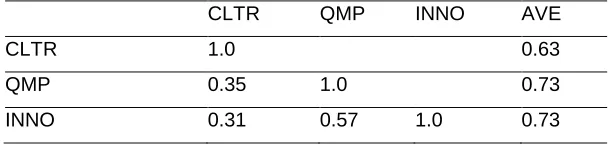
Measurement model was run to validate the constructs. All factor loadings of Quality Management Practices, Quality Culture, and Innovation performance achieved loading more than .5. Convergent validity of the constructs was assessed by calculating the Average Variance, Extracted (AVE), all AVEs achieved the respective values, see table 1. Discriminant validity was assessed by calculating the squired root of AVE (Fornell&Larcker, 1981). As shown in table 2, Discriminant validity of all constructs was confirmed by placing the squired root of the AVE at the diagonal elements of the correlation matrix. All squired root of the AVEs are higher than their respective correlations. In addition, the correlation between any two constructs should not exceed 0.9 otherwise one of the two constructs should be deleted.
Table 1: Convergent validity
Construct Composite Reliability Average Variance Extracted (AVE)
CLTR 0.872 0.633
QMP 0.96 0.73
INNO 0.965 0.73
Table 2: Discriminant validity of the constructs
CLTR QMP INNO AVE
CLTR 1.0 0.63
QMP 0.35 1.0 0.73
Licensed under Creative Common Page 73 Testing the hypotheses
QMP and innovation performance
H1: QMP have positive impact on innovation performance at hospitals in KSA
As shown in figure 1 and table 3 QMP have significant impact on innovation performance with t-value of 18.75 and p value less than .001. Therefore Hypothesis H1 was supported.
Figure 1: The impact of QMP on innovation performance
Table 3: Testing hypothesis H1
Hypotheses estimate t-Value P Supported?
QMP → INNOV 0.756 18.75 *** Supported
Testing Hypothesis H2: the mediating role of Quality Culture
H2: Quality culture mediates the relationship between QMP and innovation performance in
hospitals in KSA.
As shown in figure 2 and table 4, with the mediation of quality culture variable the effect of QPM remains significant even after it reduced from .76 to .49 with t-value of 5.12 and p value less than .001. Therefore, quality culture does have a partial mediation role in the relationship between QMP and innovation performance (Awang, 2015), and hypothesis H2 was supported.
Licensed under Creative Common Page 74 Table 4: Testing hypothesis H2
Hypotheses Estimate t-Value P Significance
Quality management practices → Quality culture 0.79 28.08 *** Significant Quality culture → Innovation performance 0.34 3.84 *** Significant Quality management practices → Innovation performance 0.49 5.12 *** Significant *** P<0.001 ** P<0.01
DISCUSSION
Quality culture has a mediator role in the relationship between QMP and innovation performance in Saudi Hospitals. This findings supported the argument that QMP foster creating quality culture that support improving services and products, continuing improvement, satisfying customers and enhancing competitive advantage (Peris-Ortiz et al., 2015). That is, QMP enhance leadership efficiency, increase employees empowerment, increase employees involvement, support teamwork performance and increase employees skills by continual training (Rönnbäck & Witell, 2008). All the elements together present main aspects of quality culture, and they were found to have positive impact in innovation performance in this study.
Thus, quality culture in Saudi hospitals has effective role between QMP and innovation. The current finding is also in line with argument that QM that creates strong quality culture and quality culture, in turn, directs the managerial decision towards effectiveness. QMS and quality culture creates and support strong competitiveness through innovation and creativity, specially human innovation and creativity (Hernández et al., 2013).
In addition, the mediating role of quality culture in Saudi hospitals is one of the main causes of QM success impact on innovation because it is already associated with QM application. The effort of implementing QM in Saudi hospitals is useful when it being fixed with the quality culture as main plan to using the resources and directing the behaviors that society accepts as the way dealing with improvement. Organizations with quality culture are determined as units that have vibrant ethics and views support quality behavior and support innovation. Therefore the entire instruments of the organization should be incorporated its quality culture. According to Kanji et al. (1997) the important principles of QM are positively influence quality culture.
CONCLUSION
Licensed under Creative Common Page 75 were analyzed using PLS-SEM. The analysis has revealed that quality culture is partialy mediates the relationship between QPM and innovation performance. This finding is helpful in enhancing the management practices and the culture and quality in the hospitals for achieving high levels of innovation performance. By adding this finding to the related body of knowledge, the study has contributed to the literature with the view of quality culture in linkage between quality management and innovation performance from perspective of Saudi hospitals. This study tried to clarify the contradiction of the role of culture in the relationship between QMP and innovation performance. There are some limitations in this study. This study has analyzed data collected from directors of hospitals only and not involved other types of organizations. In addition, this study has used only cross sectional questionnaire to collect the data. Future studies may collect data from both managerial and workers. The future studies can also use qualitative research design to get deeper results.
REFERENCES
Al-swidi, A. K., & Mahmod, R. (2011). Fostering the Performance of Banks Through Total Quality Management ( TQM ) Practices : A Bank Branches Perspective. European Journal of Social Sciences, 19(2), 268–285.
Arshad, A. M., & Su, Q. (2015). In Service Innovations : An Empirical Study. The Journal of Applied Business Research, 31(3), 891–910.
Cameron, K., & Quinn, R. (2006). Diagnosing and Changing Organizational Culture. Cameron, Kim Quinn, Robert. San Francisco: John Wiley & Sons. Retrieved from http://libaccess.mcmaster.ca/login?url=http://search.ebscohost.com/login.aspx?direct=true&db=bth&AN= 21794228&site=ehost-live&scope=site
Crossan, M. M., & Apaydin, M. (2010). A Multi-Dimensional Framework of Organizational Innovation: A Systematic Review of the Literature. Journal of Management Studies, 47(6), 1154–1191. Journal Article. http://doi.org/10.1111/j.1467-6486.2009.00880.x
Fernandese, A., Lorenco, L., & Silva., M. (2014). The influence of quality management on innovation performance. Review of Business Management, 16(53), 575–593.
Henderson, R. M., & Clark, K. B. (1990). Architectural Innovation: The Reconfiguration of Existing Product Technologies and the Failure of Established Firms. Administrative Science Quarterly, 35(1), 9–30. Journal Article.
Hernández, V., González, B. P., & Aquiahuatl, E. (2013). Human approach in the quality management system of manufacturing SMEs in Mexico Theoretical review and proposal of a conceptual model. Contaduría Y Administración, 58(2), 113–133. http://doi.org/10.1016/S0186-1042(13)71212-9
Juneja, D., Ahmad, S., & Kumar, S. (2011). ADAPTABILITY OF TOTAL QUALITY MANAGEMENT TO SERVICE SECTOR. International Journal of Computer Science & Management Studies, 11(2), 93–98.
Kafetzopoulos, D., Gotzamani, K., & Gkana, V. (2015). Relationship between quality management, innovation and competitiveness. Evidence from Greek companies. Journal of Manufacturing Technology Management, 26(8), 1177–1200. article. http://doi.org/10.1108/JMTM-02-2015-0007
Kanji, G. K. (1990). Total quality management: the second industrial revolution. Total Quality Management, 1(1), 3–12. Journal Article. http://doi.org/10.1080/09544129000000001
Licensed under Creative Common Page 76 Moreno, A. R., Domínguez, M. C. H., & Egea, T. O. (2011). The influence of quality management on orientation to innovation in service firms, 5(17), 8997–9006. http://doi.org/10.5897/AJBM11.729
Mosadeghrad, A. M. (2013). Obstacles to TQM success in health care systems Obstacles to TQM success in health care systems. International Journal of Health Care Quality Assurance, 26(2), 147–173. http://doi.org/10.1108/09526861311297352
Peris-Ortiz, M., Álvarez-García, J., & Rueda-Armengot, C. (2015). Achieving Competitive Advantage through Quality Management. BOOK, Springer.
Plekhanova, V., Smith, P., & Hamdan, K. (2012). A role of quality of information for innovation: Leadership style and information management. 2012 International Conference on Innovations in Information Technology (IIT), 344–349. http://doi.org/10.1109/INNOVATIONS.2012.6207765
Rönnbäck, Å., & Witell, L. (2008). A review of empirical investigations comparing quality initiatives in manufacturing and service organizations. Managing Service Quality, 18(6), 577 – 593. Journal Article.
Sadikoglu, E., & Zehir, C. (2010). Investigating the effects of innovation and employee performance on the relationship between total quality management practices and firm performance: An empirical study of Turkish firms. International Journal of Production Economics, 127(1), 13–26. http://doi.org/10.1016/j.ijpe.2010.02.013
Santos-Vijande, M. L., & Álvarez-González, L. I. (2007). Innovativeness and organizational innovation in total quality oriented firms: The moderating role of market turbulence. Technovation, 27(9), 514–532. http://doi.org/10.1016/j.technovation.2007.05.014
Saraph, J. V, Benson, P. G., & Schroeder, R. G. (1989). An Instrument for Measuring the Critical Factors of Quality Management. Decision Sciences, 20(4), 810–829. Journal Article. http://doi.org/10.1111/j.1540-5915.1989.tb01421.x
Sekaran, U. (2003). RESEARCH METHODS FOR BUSINESS: A Skill-Building Approa. New York: John Wiley & Sons, Inc. http://doi.org/10.1017/CBO9781107415324.004
Taguchi, G. (1986). Introduction to Quality Engineering: Designing Quality into Products and Processes. Book, Tokyo: Asian Productivity Organization.
Talib, F., Rahman, Z., & Qureshi, M. N. (2011). Assessing the awareness of total quality management in Indian service industries: An empirical investigation. Asian Journal on Quality, 21(3), 228–243. Journal Article.