Using WebQuests
In The Social Sciences Classroom
Olga A. Kachina, California State University East Bay, USAABSTRACT
This article investigates if WebQuests have been an effective instructional tool for teaching Social Sciences subjects. In order to obtain an answer to this question, a review of scholarly literature from 1995 to the present has been undertaken and action research in 8th grade U.S. history course was conducted. The literature investigation has shown that WebQuests gained a prominent place as a valuable internet-based and inquiry-oriented teaching/learning tool that develops students’ higher-order thinking skills and shifts the classroom toward being more student-centered. However, there has not been sufficient research to establish the effectiveness of this tool. The results of action research conducted in one of the middle schools in Northern California are a small contribution to this discussion.
Keywords: Internet-Based Learning; Inquiry-Oriented Teaching; WebQuests for the Social Sciences
INTRODUCTION
he shift from industrial to an informational society created changes in public education. Both National Curriculum Standards for Social Sciences (NCSS) and National Educational Technology Standards (NETS) have demanded teaching students to use technology. Dodge (1995) introduced WebQuest, an internet-based strategy, for the first time. WebQuest immediately became popular among history teachers, who created hundreds of WebQuests for many Social Sciences topics and grades. However, when the first wave of admiration for WebQuest strategy passed, serious concerns about the effectiveness of WebQuest arose among educators. The main reason for this was that little research was conducted on the effectiveness of WebQuests. Moreover, some studies indicated that there were no significant differences in the learning outcomes between traditional- versus WebQuest-based instruction.
The contradiction between the opinion that WebQuest is a valuable student-centered, internet-based and inquiry-oriented learning tool and results of experimental research created a backlash against the use of WebQuests in the Social Sciences Classroom. On the one hand, strong WebQuest supporters continue to offer teachers new WebQuests on educational websites. On the other hand, using WebQuests continue to be an occasional instructional strategy.
This article investigates if WebQuests have been an effective instructional tool for teaching Social Sciences subjects. In order to obtain an answer to this question, a review of scholarly literature from 1995 to the present has been undertaken and action research in 8th grade U.S. history course was conducted.
PART I. LITERATURE REVIEW
This investigation is based on a three-part literature review. First, we review the history of creation of WebQuest and its main theoretical underpinnings. Next, we consider using WebQuests in Social Sciences classrooms. Finally, we review the findings to draw conclusions about the effectiveness of using WebQuests.
History of WebQuest Creation
It is natural to start a literature review about WebQuest instructional strategy with an analysis of the basic writings of Dodge and March (1995, 1997), the creators of the WebQuest.
In 1995, Dodge wrote his first article about this new instructional activity, “Some Thoughts about WebQuests.” In this article, he gave for the first time the definition of a WebQuest. According to him, a WebQuest is “an inquiry-oriented activity, where some or all of the information that learners interact with comes from resources on the Internet" (Dodge, 1995, 1). He also presented the concept of two types of WebQuests, short term and long term. The major differences between them are instructional goals and duration of WebQuests. An instructional goal of a short term WebQuest is knowledge acquisition and integration, whereas an instructional goal of a long term WebQuest is extending and refining knowledge. A short-term WebQuest is designed to be completed in 1-3 class periods, while a long term WebQuest typically takes between 1-4 weeks in a classroom setting. For the first time, Dodge presented the structure and examples of short term WebQuests. According to Dodge (1995, 1997), WebQuests should contain at least the six following parts: (1) Introduction, (2) Task, (3) Information Sources, (4) Process, (5) Guidance, and (6) Conclusion.
The Introduction serves as a hook for a WebQuest activity and provides background information. The Task is the most important part of the WebQuest activity because it provides students with an objective for the activity and directs their efforts toward that goal. The Information Sources section provides students with reliable resources, collected and checked by the teacher. The Process provides students with a step-by-step instruction about how to complete the Task. The Guidance section in a modern WebQuest structure is replaced by two sections: the Evaluation and Teacher Page. The Evaluation usually contains rubrics which evaluate students work during the project. The sixth part is the Conclusion, which brings the WebQuest to a closure. It sums up the knowledge obtained by the students in this WebQuest and encourages them to extend their thinking into the future. If the six parts outlined above are for the use of the students, the Teacher Page is for the teachers who might want to use this WebQuest with their students. The Teacher Page contains information about students’ grade level, recommendations for special needs students or gifted students, as well as how this activity fits into curriculum. Dodge (1995) underlines that students have to have the cognitive skills that might be required while completing a WebQuest activity.
March, a former student of Dodge and cofounder of WebQuest, stresses the importance of WebQuests to increase student motivation by providing students with essential tasks and opportunities to work in cooperative groups. According to March (1998), working in groups helps students complete the tasks because some WebQuests can be quite complex or involve controversial topics.
Dodge (1995, 1997) and March (1998) underscore that WebQuests promote students’ higher level thinking, their cognitive and social skills. The theory and practice of WebQuest are based on the ideas of constructivism that were created and developed by Dewey (1938), Piaget (1973), and Vigotsky(1978). Constructivism is a student-based learning strategy when learners construct knowledge for themselves. Creators of the WebQuest strategy based their approach on two constructivist ideas: (1) Piaget’s cognitive constructivism, demanding inquiry method of teaching (Piaget, 1973) and (2) Vigotsky’s social constructivism with its emphasis on the theory of social interaction and the Zone of Proximal Development (Vigotsky, 1978). According to Dodge (2001), during WebQuest activities students construct their new knowledge and skills through a critical thinking, knowledge application, cooperative learning, and scaffolding learning.
WebQuest was a new type of educational technology because it demanded active use of the Internet. Dodge (2006) recognized that, in the middle of the 1990s, when WebQuest was created, many teachers were still very ignorant of the new technology. He wrote that “The web was still new or unknown to most people. Universities were beginning to put course materials up online, but most K-12 schools were still years away from making substantive use of the web for teaching and learning ” (2006,p.1).
It is no coincidence that the proliferation of computer technology and the constructivist principles of learning and teaching merged in WebQuest as a new learning/teaching tool. According to Showalter (1998), “Constructivism and computing technology, separately and often together, have remade substantially the conception of the challenges of learning, and brought about new learning possibilities for almost all teaching and learning situations”(p. 72). New possibilities for learning/teaching created by WebQuest have led to its wide popularity among teachers around the country. In fifteen years, since 1995, hundreds of WebQuests have been created for all grades and subjects. Social Sciences educators have become active proponents of WebQuest methodology in teaching social sciences.
Using WebQuest activities in Social Sciences Classroom
The first National Curriculum Standards for Social Sciences (NCSS) were published in 1994, one year before the birth of the WebQuest strategy. The first set of National Educational Technology Standards (NETS) was published in 1998. Thus, WebQuest became a bridge between NCSS and NETS. On the one hand, WebQuest satisfied the demand of NCSS “to apply inquiry processes; and employ skills of data collection and analysis, collaboration, decision-making, and problem-solving” (NCSS, 1994, p. 4). On the other hand, WebQuest, as an Internet- based strategy, perfectly matches the demands of digital- age learning described in NETS.
Whitworth and Berson (2003) were among the first to summarize literature about using the internet in social studies classrooms. They analyzed 325 articles published from the spring of 1996 through the fall of 2001 in educational magazines. The majority of these articles were published in three NCSS magazines: Social Education, Social Studies and the Young Learner, and Theory and Research in the Social Studies. Whitworth and Berson concluded that the articles reflected the fast pace of the technological shift in society and the desire of the field of education to keep up with these technological changes. They underlined that during five years of existence WebQuest became one of the most popular Internet- connected strategies. A total of 102 out of 325 (31. 3%) articles were classified by Whitworth and Berson as Internet Resources and WebQuest.
Another attempt to analyze and summarize literature about using technology in social studies classrooms was made in Technology in Retrospect: Social Studies in the Information Age (Diem & Berson, eds., 2010). The authors assessed the trends and patterns of using technology in the Information Age, from 1984 through 2009. Friedman & VanFossen (2010), contributors to this edition, agreed with Whitworth & Berson (2003) that WebQuest became a most popular Internet-related strategy in social studies classroom. They underscored, however, that little research into the effectiveness of WebQuest was done during this period. The authors credited history teachers Milton and Lipscomb as being the first who analyzed the implementation of WebQuest strategy in their classrooms at the elementary and middle schools.
Through their publications, Milson (2002) and Lipscomb (2003) changed the direction of WebQuest-related literature, from being introductory and descriptive to being analytical. Prior to these publications, the majority of articles about WebQuest were centered on an explanation of the nature of WebQuest, its design, and its purpose. Articles analyzed the role of the WebQuest strategy among other instructional strategies that used the Internet. Their emphasis on the descriptive phase of WebQuest development was understandable because the Internet was new and just beginning to enter the life of society and education. For example, when Milson implemented “A Study of Ancient Egypt” as a 6th grade Social Studies WebQuest there were only six computers and
a classroom full of students (Milson & Downey, 2001).
was to assist the other groups in finding information on the web that the other three groups could not find in the learning stations. Milson & Downey (2001) noted that the WebQuest approach to inquiry was valuable for a variety of reasons. They pointed out that WebQuest as a structured process of getting information saved students time. Since the list of on-line resources was prepared and controlled by the teacher, it precluded students from getting into inappropriate sites. Additionally, the WebQuest strategy could be used in a classroom with limited computer resources, and was conducive to cooperative learning and student motivation.
Lipscomb (2003) was another history teacher who wrote about his WebQuest activities and made them available to other social sciences teachers. Whereas Milson (2001) had only six computers for his students, Lipscomb (2003) had a computer for every student. Lipscomb created a WebQuest for eighth-grade students to study the Civil War. The task section of the WebQuest was to assume the role of a person living during the Civil War and to create six journal entries; two that were written before the Civil War, two that were written during the Civil War, and two that were written after the Civil War. The procedure section of the WebQuest consisted of students broken into five groups according to the roles assumed by the students, Confederate Soldier, Union Soldier, Southern Woman, Northern Woman, or Female Abolitionist. The results of his research indicated that the students enjoyed the WebQuest activities, and their journal entries demonstrated their tremendous creativity in content and appearance (Lipscomb, 2003). Among his recommendations to the teachers were: (1) chose WebQuest carefully; (2) assess students’ technological capabilities; and (3) determine their prior knowledge and content understanding.
To help teachers create high quality WebQuests, Dodge and March (2001) created criteria for WebQuests’ evaluation. They also created Websites where teachers could share their WebQuests and get feedback so they could improve WebQuests. The first website promoting WebQuest strategy was created by Dodge in 1995 in response to the huge interest of the teachers around the world to this internet-based and inquiry-oriented activity. This first website was named WebQuest. org (http://webquest. org/). Ten years later, Dodge (2005) created its second generation website QuestGarden, housing a huge collection of WebQuests in social sciences for the elementary- to high- school levels (http://questgarden. com/). March created his own website, BestWebQuests (http://bestwebquests. com/), which has his own WebQuests as well as WebQuests created by other teachers. March’s WebQuest “Searching for China” (1995) was one of the first high-quality samples that strongly influenced social sciences teachers. One of the best websites to date that provides social sciences teachers with WebQuest samples was created by the Learning Center of the Library of Congress. Especially valuable is that this website includes primary sources and tips for how to work with them (http://memory. loc.gov/learn/lessons/97/dream/index.html). High-quality websites that provide social sciences teachers with WebQuest activities have been recommended by Vanguri, Sunal, Wilson, & Wright (2004), including The WebQuest Page Matrix, WebQuest Collections, Blue Web’n, and Filamentality websites.
Among the printed materials, the publication of the book authored by Thombs, Gillis, and Canestrari (2009) with its emphasis on a culturally responsible approach of using WebQuest in the Social Studies Classroom is particularly valuable for history teachers. The book is relevant to the diverse and multi-national student population of the U. S., and is very useful for teachers who are sensitive to culturally responsive social studies program. WebQuests found in this book have important controversial topics that stimulate students’ historical thinking, as for example, “World Religions and Conflicts,” “Immigration: Past, Present, and Future,” and “Voting Rights and Responsibilities.”
Since 1995, hundreds of WebQuests have been created for all grades and Social Studies subjects. However, little research was done in order to evaluate the quality of the WebQuests and effectiveness of their using in Social Sciences classroom.
Debates about effectiveness of using WebQuests
was still apprehensive about a wide-spread uncritical use of this tool, “Despite their [WebQuests] popularity, questions remain about the effectiveness with which WebQuests are being used with students” (p. 182).
Results obtained from action research conducted by elementary and secondary school teachers with support of University professors fueled this discussion further. In some study- cases, results indicated that there were no significant differences in the learning outcomes between conventional- versus WebQuest-based instruction. In others, the results using WebQuests were even worse and tipped in favor of traditional classroom learning.
To compare the use of WebQuests vs. traditional instruction, Strickland and Nazzal (2005) conducted an action research in 7th grade classes. There were 86 students involved in the study and the topic was the Texas Revolution. Researchers randomly divided the students into two groups. The control group, consisting of 38 students, had to complete traditional instructional activity. The students in this group were required to individually create a poster entitled “Roadmap to Freedom.” This kind of activity was common for middle-school students. The poster had to reflect the major events in the Texas Revolution that led to independence. The students used materials from textbooks and placed events in chronological order.
The other group was the experimental group where students had to complete WebQuest on the Texas Revolution created by a teacher (http://www. citejournal.org/articles/TexRevlutionBetter/Texas_Revolution_Index. html). The experimental group consisted of 48 students and was divided into several subgroups of four. The task for the entire group was to create a living history of events leading to independence in the form of a news broadcast. Each of the four students in a subgroup had a role to play, news anchor, feature correspondent, war correspondent, and graphic designer. Students had to use internet resources to find all the necessary background information, be it historic documents, witness reports, expert reports, etc. At the end of the unit, they had to produce a slide show presentation of their findings.
Both groups were tested on their prior knowledge of the topic before the beginning of the experiment. Strickland & Nazzal (2005) admitted that there was no statistically significant difference in the scores of the two groups. The average pre-test scores indicated that students in both groups did not know much about the Texas Revolution before the experiment. However, results after the experiment were different. The control group had a higher score on the exam given at the end of the unit than the experimental group. Therefore, results of the experiment did not speak in favor of the WebQuest tool.
Similar results were reported by Gaskill, McNulty, and Brooks (2006) who conducted action research in social sciences classrooms in a rural high school. The purpose of the research was to compare the effectiveness of WebQuests with the effectiveness of conventional instruction. The participants, 72 high school students in a freshman history class, were divided into two groups. First group, which included 41 students, used the traditional method of instruction. Their teacher who was an excellent story-teller and had more than 20 years of teaching experience in social studies, gave a lecture on the topic of ‘‘Assassinations of Four American Presidents and Their Impact on the History of the United States. ” The students took notes, watched a movie, and participated in discussions. The other group that consisted of 31 students completed the WebQuest that was prepared by University Professors. The students worked individually and had to create a PowerPoint presentation about assassinations of four American Presidents.
The experiment lasted for four days. On the first day students in both groups took a pre-test. The results of the pre-test showed that the experimental group was slightly better informed about the subject. At the end of 4 days, both groups had a post-test that was identical to the pretest. Results were unexpected for those who believed in the effectiveness of the WebQuest activity. The results showed that the conventional instruction led to significantly greater student learning (Gaskill, McNulty, & Brooks, 2006).
Strickland and Nazzal (2005) recognized that their experiment (the Texas Revolution, 7th grade) was limited in that it looked only at the content learned by both groups and not the skills. They agreed that the poster activity in the control group turned out to be more creative and analytical because the students had to draw road signs and critically analyze their connection with the events of the Texas Revolution. The students in the experimental group who worked on the broadcast had only to recall the information they found while engaged in the WebQuest activity. As one of the possible reasons of ineffectiveness of the WebQuest method in comparison to the poster activity, the researchers pointed out that today the Internet is no longer a novelty since almost every student has access to the internet at home. According to the researchers, “Using the Internet to learn may not be as motivating to these students as it would be for students with limited access to the Internet” (p. 135).
Findings in the studies done by Strickland and Nazzal (2005) and Gaskill, McNulty and Brooks (2006) showed that the effectiveness of using WebQuests depended largely on human factors, namely: teachers’ understanding of and ability to implement WebQuest, and students’ skills and motivation to complete WebQuest. Maddux and Cummings (2007) shared this opinion and pointed out that effectiveness of using WebQuest depended on the content of the WebQuest, the motivation and abilities of the students, as well as abilities and skills of the teachers to create and use WebQuest in their teaching practice.
Zheng, Perez, Williamson, and Flygare (2007) came to the same conclusion in research about the connection between teachers’ understanding and skills of using WebQuest strategy and effectiveness of teaching. They interviewed 226 teachers who used WebQuests activities and found that most of the teachers who used WebQuests did not have deep understanding of this inquiry-oriented activity. In many cases, teachers neglected design and purposes of the WebQuest and, as result, WebQuest turned into an ineffective tool.
In this connection, the positive experience of Teacher Education Department (TED) of Alabama University had a particular significance. Preparedness of teachers and their ability to correctly design, evaluate, and use WebQuests was key for effective use WebQuests in the social sciences classroom. Understanding this, the TED incorporated WebQuests strategies in three graduate courses. In 2004, the Department conducted a study in order to “assess the ability of graduate students in social studies education at the elementary or secondary level to develop WebQuests using a grading rubric” (Vanguri, Sunal, Wilson, & Wright, 2004, p.2). During an academic year, three professors received over 50 submissions of WebQuest projects from pre-service and in-service teachers in social studies graduate programs. They evaluated teachers’ WebQuests through rubrics, paying particular attention to content, framing of the essential question, inquiry process, and relevant sources at appropriate grade level for students and quality of resources, and creativity of a WebQuest assignment. Studies concluded that elementary and secondary level teachers were able to understand the basic concepts of implementing WebQuests in their social studies classrooms.
Graham (2004) demonstrated other ways to prepare social sciences teachers to use WebQuest in educational curricular. At a high school, a group of five teachers participated in a study group focusing on the use of WebQuests. Over the course of 10 weeks, from February to April of 2003, participants learned theoretical underpinnings about WebQuests. They created and implemented their own WebQuests in classroom, and upon completion received feedback from colleagues. All participants recognized that this long-term workshop was successful on multiple levels, creating opportunity to turn WebQuest strategy into effective tool of teaching and learning. Both experiments, by Vanguri, Sunal, Wilson, and Wright (2004) and by Graham (2004), concluded that effective training of teachers to create and implement WebQuest as a tool led to improving students’ knowledge and skills.
Maddux (2002, 2007, 2009), one of the main critics of WebQuests, warned that teachers had to carefully consider students’ age and abilities during implementation of WebQuest in their classrooms. WebQuest cannot be effective if teachers do not use differentiation of instruction.
created and implemented their WebQuests in their classrooms. Results of this study supported the general perception of WebQuest by teachers and students. On the surface, they had an overwhelmingly positive reaction to the WebQuests. The majority of the students recognized that they enjoyed working with WebQuests and were more active than in traditional, textbook-based class model. They felt that they were in a greater control of their own learning. The majority of the teachers considered that WebQuest model was a very useful teaching tool in social sciences classroom.
VanFossen (2009) underlined, nonetheless, that not all teachers and not all students were satisfied with WebQuest strategies. Some teachers considered them time consuming. Some students recognized that WebQuests were too difficult for them and/or that they did not learn as much as in traditional classroom. The author concluded that this study showed conflicting results about effectiveness of using WebQuest strategy in social sciences classroom as well as strong demand to conduct more research about WebQuest effectiveness. Therefore, this study supported Maddux’s idea that the majority of WebQuests did not follow the principle of students’ differentiations.
Despite the criticism, not a single researcher called for abandoning the use of WebQuests in social sciences classrooms. All of them, however, urged teachers to use this internet-based strategy carefully, creating high quality WebQuests. Ikpeze and Boyd (2007) conducted a long-term interdisciplinary study, covering social studies, language arts, and science. At the end of the study, they emphasized that the effectiveness of the WebQuest tool and its success were closely linked to “carefully selected, organized, and delivered” (p. 654) tasks associated with using WebQuests.
It is clear that a strong demand for further study of WebQuest effectiveness continues to exist. Future researchers have to focus their attention on the following aspects of WebQuest effectiveness: student differentiation, inquiry-oriented activity and development of student motivation and social skills.
PART II. AN ACTION RESEARCH ON: THE EFFECTIVENESS OF USING A WEBQUEST IN THE WESTWARD EXPANSION UNIT, 8th GRADE, U.S. HISTORY COURSE
This action research project was conducted in one of the urban middle school in Northern California with population of about 1,150 students in 2010-2011 academic year. The research project was conducted in two 8th grade classrooms during the unit “The Westward Expansion.” The project was based on the WebQuest “How My Life Was Changed on the Oregon Trail: Exploring the Past” created by history teacher Kellogg (2010). It can be found in Website “Zunal WebQuest Market” http://zunal.com/webquest.php?w=57626. This WebQuest has a classical structure and clearly presents all six steps of the WebQuest.
Statement of Purpose
The purpose of this mixed methods study was to investigate whether WebQuest is an effective tool in teaching the topic on “Westward Expansion” in the U.S. History course taught in the 8th grade. The study was designed to answer three questions. First, does using WebQuest create the transition from the teacher-centered to student-centered environment? Second, what skills do students develop completing WebQuest? Third, is it possible to use a WebQuest created by another teacher? The main research question for this mixed method is “Does the WebQuest create an effective transition from the teacher-centered to student-centered environment which results in better developed students analytical, writing, technological, and social skills?”
Participants
Method
A mixed methodology approach, collecting qualitative and quantitative data, was used to measure the effectiveness of using Webquest. Qualitative data was derived from classroom observations, an interview with the teacher and students’ written responses to a question about the efficiency of the WebQuest (Attachment A). During the observation, special attention was paid to the students’ reaction to the Webquest, specifically, did they use their time effectively, did they enjoy what they were doing, what was their reaction when they came across a difficulty, and how did the teacher monitor the process. The main purpose of the interview with the teacher was to understand if the teacher was familiar with the WebQuest strategy, whether in the teacher’s opinion there were advantages and disadvantages to using the WebQuest and how easy or difficult it was using a WebQuest prepared by another teacher. The students’ opinions about the WebQuest were obtained on the basis of student written responses to a question about the efficiency of the WebQuest and on the basis of the two surveys. Quantitative data was derived from two student surveys given before and after the implementation of the WebQuest. (Appendix B).
Procedure
The implementation of the project took three days or six class periods. During the first day, in the first period, the students worked in their regular classroom. They took a short survey about the WebQuest. After a short discussion regarding their previous knowledge and usage of WebQuests, they were introduced to the WebQuest strategy. Following the PowerPoint Presentation, they looked at the structure of WebQuest “How My Life Was Changed on the Oregon Trail- Exploring the Past.” During the second period of the first day, students went to the computer lab. The students followed step-by-step instructions in the “Process Section.” They investigated several on-line sources about the Oregon Trail (http://www.isu.edu/~trinmich/introduction.html) and wrote down five facts that they found most interesting and explained why. The Researcher observed learning and social activities of the students.
During the second day, in the first period the students explored the Map of the Oregon Trail (http://historyglobe.com/ot/otmap1.htm. They had to describe five cities on the Oregon Trail and explain why they found them most interesting in their adventure. During the second period, the students read the diary of James Longmire (http://www.isu.edu/~trinmich/00.ar.longmire.html). Putting themselves in his place, they critically analyzed how traveling along the Oregon Trail changed his life. The Researcher observed learning and social activities of the students.
During the third day, the students were in a regular classroom, using all the materials that they found during their WebQuest activity. They had to write an article about their trip along the Oregon Trail for a national newspaper from the point of view of an imagined hero. Finally, the students evaluated their WebQuest activity through a second survey and an oral interview.
Data Analysis
Data analysis began from the first day of the implementation of the action research project that examined whether WebQuest is an effective tool in teaching the topic on “Westward Expansion” in the U.S. History course taught in the 8th grade.
Qualitative data were gathered during classroom observations by way of daily field notes. At the end of the project, the students were asked to provide a written response to the question “Was the WebQuest a good way for you to learn and write about the Oregon Trail? If yes, explain why. If not, explain why not.” Qualitative data were supplemented by a consultation with the teacher, daily discussions with the teacher about preliminary results and the final post-project interview with the teacher. (Appendix A).
The data analysis was conducted to answer the research question: Does the WebQuest create an effective transition from the teacher-centered to student-centered environment which results in better developed students analytical, writing, technological, and social skills?
Findings
Qualitative data gathered during classroom observations showed that the students were extremely well-task oriented, and stayed focused. Only one student out of 62 did not stay on the task and got diverted to using other internet sites. Initially, the students were naturally curious about this new method of learning, but later in the process, they were driven more by receiving a good grade for the material they were learning. Most of the students stayed on task and were able to complete the task by the deadline. Four students out of 62 were not able to complete the task on time because they read and wrote slower than other students. They completed the missed part of assignment at home. The observation also showed that after awhile, usually by the end of the 2nd period, the students got tired from reading from the computer screen. On the last day, when they worked on the essay for a newspaper, the observation showed that the students were using their research notes and were motivated and enthusiastic about completing their tasks. The teacher continuously monitored the activity of the students and was on standby to answer their questions.
At the end of the project, the students were asked to provide a written response to the question “Was the WebQuest a good way for you to learn and write about the Oregon Trail? If yes, explain why. If not, explain why not.” The majority of the students mentioned that WebQuest was a good way for them to learn and write about the Oregon Trail. Specifically the students pointed out that it was much easier for them to concentrate their attention on the topic using the on-line strategy than a textbook. Some of them clearly preferred the on-line text to a printed one. They also pointed out that without a doubt the Internet gave them more information on the topic than a textbook. One student admitted, “I kind of visualized that I was on the Oregon Trail because of a lot of the details.” Some of them stressed that they thought the cumulative information created a more accurate picture because the information came from many sources. Others mentioned that they were introduced to a good new learning strategy that they wanted to use in the future. One student expressed his thoughts in the following manner, “I think WebQuest was good because I learned how to do research on my own. I think it will be a good resource for me in the future.” Many students also recognized that they learned more about how to write a newspaper article. Many said that it was an easy way for them to learn because the WebQuest had clear instructions and guided them step by step. Also many students were satisfied that they were able to study the subject on their own, “It was a good way to learn because it teaches me to be independent about my work and gives me a good feelings, that I get to learn on my own.”
However, the students also mentioned some negative elements of this WebQuest. For example, one student recognized that “there sometimes was too much information, so I would get frustrated and just wanted to get it over with.” Another student complained that he “did not get much of the vocabulary” as he would from a textbook. Some students complained that it was too much reading and writing during this project. Even though the majority of students enjoyed the work with the computer and preferred it over the work with a textbook, they complained that their eyes were tired from spending too much time in front of the screen.
from the computer screen. Special pauses were arranged during which the students worked in groups and discussed material that they just read. To conclude, the teacher underlined that on the whole the WebQuest was a very effective tool and that she would use it in the future.
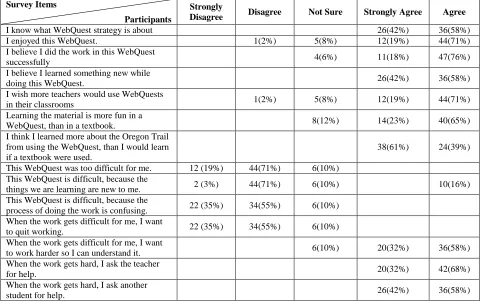
Quantitative data were gathered by conducting two student surveys, one pre-intervention and one post-intervention. All students stated that they had not used WebQuests before. Following the introduction to the WebQuest project, all students were optimistic about the project as is evident from their answers to the survey questions. They wanted to do the project, they believed that they could do it, and they wanted to learn something new (Table 1, Appendix C). Their positive attitude was due to the project’s new learning strategy that they have never used before. They were also excited by the prospect of using the Internet.
The post-intervention survey showed that that 100 % of students were now familiar with WebQuests and learned something new, that 90% enjoyed the offered Internet-based activity, 94% believed that they succeeded in doing this WebQuest, 90% wished more teachers used WebQuests in classroom, and 88% preferred learning the topic by using this tool rather than textbook. Specific to the topic of the Oregon Trail, 100% of the students felt that they learned more from using the WebQuest, than they would learn if a textbook were used.
Only 2% of the students did not enjoy this WebQuest activity, while 8% of the students were not sure, and only 2% did not want to see it used by other teachers. If the pre-intervention survey showed that all students felt they would be successful in using the WebQuest, the post-intervention survey showed that 6% were not sure and 10% felt that using the WebQuest was difficult for them. No one wanted to quit, when it was too difficult. Instead, they opted for help from the teacher and their classmates (Table 2, Appendix C).
Upon completion of this project, the teacher and students admitted that this WebQuest was an effective way to develop students’ analytical, writing, technological, and social skills. Students developed their analytical skills when they processed primary sources and answered questions based on them. They developed their writing skills when they worked on their essay for the newspaper. Their technological skills were developed when they used internet resources for completing the WebQuest. When they worked in groups and discussed the information gathered on-line, it helped them develop their social skills.
Limitations
This educational research was limited to native speakers, and excluded EL learners and Special Population students. The WebQuest Project was short-term and emphasized reading and writing materials. Students spent most of their time were working individually analyzing materials about the Oregon Trail and writing an essay. This research was conducted involving only two 8th grade classes in a suburban middle school. The teacher was in full control of the class environment was experienced and had a good rapport with the students. The situation would be much different in a different area school or with a less experienced teacher. The research did not examine the knowledge of students but rather the development of their skills and any shift to center-oriented activity.
CONCLUSION
When the WebQuest strategy appeared in 1995, it has became popular among Social Sciences teachers. They have embraced the fashionable and novel tool without testing its effectiveness. Moreover, initial investigations of the tool’s effectiveness have shown no significant differences in the learning outcomes between traditional- versus WebQuest-based instruction. The tension has developed between supporters of WebQuests as a new valuable student-centered, internet-based and inquiry-oriented learning tool and their critics. This tension has created a backlash against the use of WebQuests in Social Sciences. The need for more research into the new tool has been evident. The present research is a small contribution to the debate on the effectiveness of WebQuests.
substantial impact on education. However, the teacher’s and students’ experience with the WebQuest was so positive that they felt the need to learn more about it so they could use it more in the future. It is important, therefore, to conduct WebQuest workshops, educating California teachers in this matter, and create the similar programs the Teacher Education Department of Alabama University created in 2004.
This research shows that the effectiveness of the WebQuest is particularly striking in the area of developing students’ skills in gathering and analyzing the needed information independently. Without a teacher’s lecture on the topic, the students have learned the topic from a to z, by doing all the work independently. Qualitative and Quantitative data gathered during research clearly shows that the WebQuest is an effective instructional tool for transitioning from the teacher-centered to the student-centered environment. The students have been able to learn the topic about the Oregon Trail by themselves. Using on-line materials, they have learned about the reasons for the Westward Movement, the geographical route of the Oregon Trail, discoverers and explorers, Native Americans, and hardships of the journey. Students have analyzed primary sources and developed their writing skills. Following the WebQuest’s step-by-step instructions, the students have been able to complete the project by writing an essay for a newspaper.
Results of this research indicate that the students have enjoyed the WebQuest. The same results were found in many research papers. My educational research about effectiveness of using WebQuests in Social Sciences classroom supports the conclusions of those researchers who spoke in favor of using WebQuests in History, Geography, Economics, and Civic education classrooms. Specifically, this research supports the outcomes of the study by Strickland and Nazzal (2005) and another study by Gaskill, McNulty and Brooks (2006), advocating the importance of human factors in the effectiveness of using WebQuests.
This research also shares the Murry (2006) conclusion that Social Sciences teachers can use WebQuests created by other teachers. However, modifications must be made to accommodate all students, including ELD students and students with special needs, just like Maddux, one of the main critics of WebQuests, anticipated. This WebQuest supports Maddux’ warnings that teachers had to carefully consider students’ age and abilities during implementation of WebQuests in their classrooms and that WebQuests cannot be effective if teachers do not use differentiation of instruction. One of the recommendations of my research is that a teacher can use a WebQuest created by another teacher, but s/he must check to see if the WebQuest contain all necessary modifications to accommodate his/her students population.
In summary, this research shows that WebQuests are effective for teaching/learning process. They can be even more effective if educators take into account the following recommendations. Universities and school districts must offer WebQuests workshops for teachers. Teachers need to be more educated about the use of WebQuest in the classroom. Creators of WebQuests must provide modifications for potential student populations. Teachers must adopt WebQuests to suit their actual student population. Researchers have to continue their efforts into how to make the use of WebQuests more successful in the classroom.
AUTHOR INFORMATION
Olga A. Kachina, California State University East Bay, USA. She is a 2011-2012 Sally Casanova California Pre-Doctoral Scholar, a history teacher with an extensive teaching experience in Russia and the U.S. E-mail: [email protected]
REFERENCES
1. Abbitt, J., & Ophus, J. (2008). What we know about the impacts of WebQuests: A review of research. AACE Journal, 16 (4), 441-456.
2. Diem, R., & Berson, M. (Eds.). (2010). Technology in retrospect: Social studies in the information age, 1984-2009. Charlotte, NC: IAP- Information Age Publishing.
4. Dodge, B. (2001). FOCUS: Five rules for writing a great WebQuest. Retrieved 19, 2010 from http://babylon. k12. ny. us/usconstitution/focus-5%20rules. pdf
5. Dodge, B. (2006). WebQuests: Past, Present and Future. Retrieved November 19, 2010 from http://www.portalwebquest. net/pdfs/cf001. pdf
6. Friedman, A. & VanFossen, P. (2010). The internet in social sciences classrooms: Lost opportunity or unexplored frontier. In R. Diem & M. Berson (Eds.), Technology in retrospect: Social studies in the information age, 1984-2009 (pp. 51-74). Charlotte, NC: IAP- Information Age Publishing.
7. Gaskill, M., McNulty, A. & Brooks, D. W. (2006). Learning from WebQuests. Journal of Science Education and Technology, 15 (2), 133-136.
8. Graham, P. (2004). Study groups and WebQuest. Tech & Learning. Retrieved November19, 2010 from http://www. techlearning. com/article/2510
9. Ikpeze, C. H., & Boyd, F. B. (2007). Web-based inquiry learning: Facilitating thoughtful literacy with WebQuests. Reading Teacher,60 (7), 644-654.
10. Lipscomb, G. (2003). “I guess it was pretty fun”: Using WebQuests in the middle school classroom. The Clearing House, 76, 152-155.
11. March, T. (1998). Why WebQuests? An introduction. Retrieved November 19, 2010 from http://tommarch. com/writings/intro_wq. php.
12. Maddux, C. D., & Cummings, R. (2007). WebQuests: Are they developmentally appropriate? Educational Forum, 71 (2), 117.
13. Maddux, C. D. (2009). Information technology in education: The need for skepticism. International Journal of Technology in Teaching and Learning, 5 (2), 182-190.
14. Milson, A. J., & Downey, P. (2001). WebQuest: Using Internet resources for cooperative inquiry. Social Education, 65, 144-146.
15. Milson, A. J. (2002). The Internet and inquiry learning: Integrating medium and method in a sixth grade Social Studies classroom. Theory and Research in Social Education,30, 330
16. Molebash, P., Dodge, B., Bell, R., & Mason, C. (2002). Promoting student inquiry: WebQuests to web inquiry projects (WIPs). Paper presented at the Society for Information Technology and Teacher Education International Conference 2002, Nashville, TN. Retrieved from http://webinquiry. org/WIP_Intro. htm 17. Murry, R. (2006). WebQuests celebrate 10 years: Have they delivered? Action Research Exchange, 5 (1).
Retrieved November 22, 2010 from http://teach. valdosta. edu/are/vol5no1/Thesis%20PDF/MurryR_ARE. pdf
18. National Council for the Social Studies. (1994). Expectations of excellence: Curriculum standards for social studies. Washington D. C.: National Council for the Social Studies.
19. Piaget, J. (1973). The child and reality. NY: Grossman Publishers.
20. Rice, M. L., & Wilson, E. K. (1999). How technology aids constructivism in the social studies classroom. Social Studies, 90 (1), 28-33.
21. Showalter, A. (2009). Constructivist instructional design (C-ID): Foundations, models, and examples J. W. Willis, (Ed.). Charlotte, NC: IAP- Information Age Publishing.
22. Strickland, J., & Nazzal, A. (2005). Using WebQuests to teach content: Comparing instructional strategies. Contemporary Issues in Technology and Teacher Education, 5 (2), 138-148.
23. Thombs, M. M., Gillis, M. M., & Canestrari, A. S. (2009). Using WebQuests in the social Studies classroom: A culturally responsive approach. Thousand Oaks, CA: Corwin Press.
24. Vanguri, P. R., Sunal, C. S., Wilson, E. K., & Wright, V. H. (2004). WebQuests in social studies
education. Journal of Interactive Online Learning, 3 (2). Retrieved November 21, 2010 from http://www. ncolr.org/jiol/issues/PDF/3. 2. 5. pdf
25. Vidoni, K. L., & Maddux, C. D. (2002). WebQuests: Can they be used to improve critical-thinking skills in students? Computers in the Schools, 19 (1/2), 101–117.
26. Vigotsky, L.S. (1978). Mind and society: The development of higher mental processes. Cambridge, MA: Harvard University Press.
27. Whitworth, S., & Berson, M. J. (2003). Computer technology in the social studies: An examination of the effectiveness literature (1996- 2001). Contemporary Issues in Technology and Teacher Education, 2 (4), 472-509.
28. Zheng, R., Perez, J., Williamson, J. & Flygare, J. (2008). WebQuests as perceived by teachers:
APPENDIX A
Qualitative data was derived from classroom observations, an interview with the teacher and students’ written response to a question about the efficiency of the WebQuest.
1. Observation
During the observation, special attention will be paid to answers to the following questions:
What was the learning environment when the students were doing a WebQuest?
Did the students follow the teacher’s instructions?
Did the students use a computer for purposes unrelated to the classroom activity?
Did the students use time effectively?
What was the students’ attitude toward WebQuest as an internet-oriented activity?
How did the teacher monitor the process of the research on the Internet? 2. Interview with the teacher
During the interview with the teacher, the following questions will be asked:
Did the teacher use WebQuest strategy before?
Did the teacher take a WebQuest workshop?
Was the teacher satisfied with the results of using WebQuest activity? If yes, explain why or if not, explain why not?
How did the teacher evaluate the development of the students’ analytical-skills?
How did the teacher evaluate the development of students’ social skills? What were the differences between the WebQuest and the traditional teaching of this unit?
What were advantages and disadvantages of using WebQuest in teaching this unit?
What were advantages and disadvantages of using traditional strategies for teaching this unit?
How did the teacher modify the WebQuest for ELL, Special Population, gifted students?
Did using WebQuest strategy change the learning process from teacher-centered to student-centered? If so, explain why, if not, explain why not.
3. Students’ written responses to the WebQuest efficiency question.
APPENDIX B
Table 1 Pre-Intervention Student Survey (62 Participants) Survey Items
Participants
Strongly
Disagree Disagree Not Sure Strongly Agree Agree
I know what WebQuest strategy is about I am looking forward to doing this WebQuest.
I believe I can do work in this WebQuest. I believe I will learn something new while doing this WebQuest.
Table 2 Post-Intervention Student Survey (62 Participants) Survey Items
Participants
Strongly
Disagree Disagree Not Sure Strongly Agree Agree
I know what WebQuest strategy is about I enjoyed this WebQuest.
I believe I did the work in this WebQuest successfully
I believe I learned something new while doing this WebQuest.
I wish more teachers would use WebQuests in their classrooms
Learning the material is more fun in a WebQuest, than in a textbook.
I think I learned more about the Oregon Trail from using the WebQuest, than I would learn if a textbook were used.
This WebQuest was too difficult for me. This WebQuest is difficult, because the things we are learning are new to me. This WebQuest is difficult, because the process of doing the work is confusing. When the work gets difficult for me, I want to quit working.
When the work gets difficult for me, I want to work harder so I can understand it. When the work gets hard, I ask the teacher for help.
APPENDIX C
Table 1 Pre-Intervention Student Survey (62 Participants) Survey Items
Participants
Strongly
Disagree Disagree Not Sure Strongly Agree Agree
I know what WebQuest strategy is about 39 (63%) 22 (35%) 1 (2%) I am looking forward to doing this
WebQuest. 12 (19%) 50 (81%)
I believe I can do work in this WebQuest. 8 (13%) 54(87%)
I believe I will learn something new while
doing this WebQuest. 12(19%) 50(81%)
Table 2 Post-Intervention Student Survey (62 Participants) Survey Items
Participants
Strongly
Disagree Disagree Not Sure Strongly Agree Agree
I know what WebQuest strategy is about 26(42%) 36(58%)
I enjoyed this WebQuest. 1(2%) 5(8%) 12(19%) 44(71%)
I believe I did the work in this WebQuest
successfully 4(6%) 11(18%) 47(76%)
I believe I learned something new while
doing this WebQuest. 26(42%) 36(58%)
I wish more teachers would use WebQuests
in their classrooms 1(2%) 5(8%) 12(19%) 44(71%)
Learning the material is more fun in a
WebQuest, than in a textbook. 8(12%) 14(23%) 40(65%)
I think I learned more about the Oregon Trail from using the WebQuest, than I would learn if a textbook were used.
38(61%) 24(39%)
This WebQuest was too difficult for me. 12 (19%) 44(71%) 6(10%) This WebQuest is difficult, because the
things we are learning are new to me. 2 (3%) 44(71%) 6(10%) 10(16%) This WebQuest is difficult, because the
process of doing the work is confusing. 22 (35%) 34(55%) 6(10%) When the work gets difficult for me, I want
to quit working. 22 (35%) 34(55%) 6(10%)
When the work gets difficult for me, I want
to work harder so I can understand it. 6(10%) 20(32%) 36(58%) When the work gets hard, I ask the teacher
for help. 20(32%) 42(68%)
When the work gets hard, I ask another