IJSRSET1732227 | 28 April 2017 | Accepted: 08 May 2017 | May-June-2017 [(2)3: 16-33 ]
© 2017 IJSRSET | Volume 3 | Issue 3 | Print ISSN: 2395-1990 | Online ISSN : 2394-4099 Themed Section: Engineering and Technology
16
Experimental Study on Microbacterial Concrte Using Fly Ash
Nivya C, B K Baby Shamini
Structural Engineering, IAJJCE Marthandam , Anna University, Tamil Nadu, India
ABSTRACT
Microbial concrete is a recently developed technology in the field of Civil Engineering. This experimental study explains about the effects of using favourable microorganisms in concrete. When bacterial culture is mixed with concrete calcium carbonate is precipitated and it in turn improves the strength, durability and crack filling ability of concrete. Fly ash, starch medium, bacterial culture and synthetic polymers are provided inorder to test the compressive strength, tensile strength, absorption and permeability. Implementing of bacteria improves strength, durability, and strength of fly ash concrete through self-healing effect.
Keywords : Calcium carbonate precipitation, Bacterial Culture, Crack filling, Fly Ash, Self-Healing.
I.
INTRODUCTION
1.1 Microbial Concrete
Concrete, which forms major components in the construction Industry as it, is cheap, easily available and convenient to cast. However, drawback of these materials is it is weak in tension so, it cracks under sustained loading and due to aggressive environmental agents, which ultimately reduce the life of the structure. Bacterial induced Calcium Carbonate (calcite) precipitation has been proposed as an environment friendly crack remediation and hence improvement of strength of building materials .Microbiologically Induced Calcite Or Carbonate (CaCO3) Precipitation (MICP) is a technique that comes under a broader category of science called biomineralization . MICP is highly desirable because the Calcite precipitation induced as a result of microbial activities is pollution free and natural .The technique can be used to improve
the compressive strength and stiffness of cracked concrete specimens. Research leading to microbial Calcium Carbonate precipitation and its ability to heal cracks of construction materials has led to many applications like crack remediation of concrete ,sand consolidation ,restoration of historical monuments and other applications. So it can be defined as “The process can occur inside or outside the microbial cell or even some distance away within the concrete .Often bacterial activities simply trigger a change in solution chemistry that leads to over saturation and mineral precipitation. Use of these Bio mineralogy concepts in concrete leads to potential invention of new material called –Bacterial Concrete.
II.
METHODS AND MATERIAL
2.1.Fly ash Concrete
When Portland cement is mixed with water, most of the cement forms insoluble cementitious compounds; Ca(OH)2 is formed as part of this reaction. When fly ash is introduced into concrete, it reacts with the Ca(OH)2 to form additional cementitious compounds. In a properly proportioned mix, fly ash can improve many of the properties of concrete, including workability and consolidation, flexural and compressive strengths, pumpability, and decreased permeability. Fly ash is an extremely fine powder consisting of spherical particles less than 50 microns in size. Fly ash is one of the construction industry's most commonly used pozzolans. Pozzolans are siliceous or siliceous/alumino materials possessing the ability to form cementitious compounds when mixed with lime (calcium hydroxide, or Ca(OH)2,) and water.
2.2. Need of starch water
Starch water is also added to concrete for certain mixture which in turn helps the bacteria to grow by providing an nutrient medium. Bacterial growth has been activated by starch water and so precipitate calcite and filling all the pores of concrete thereby increasing density and strength.
2.3 Cracks
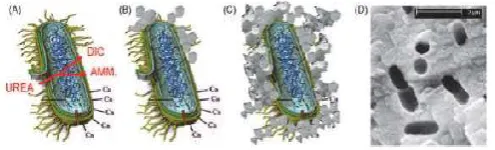
Ureolytic bacteria such as Bacillus cereus are able to precipitate CaCO3 in their micro-environment by conversion of urea into ammonium and carbonate. The bacterial degradation of urea locally increases the pH and promotes the microbial deposition of carbonate as calcium carbonate in a calcium rich environment. These precipitated crystals can thus fill the cracks. The crack
healing potential of bacteria and traditional repair techniques are compared in this research by means of water permeability tests, ultrasound transmission measurements and visual examination.
2.4. Fixing cracks by bacteria
Crack –penetrating water would not only dissolve calcite (CaCO3) particles present in mortar matrix ,but would also react together with atmospheric carbon dioxide with not fully hydrated lime constituents such as calcium oxide and calcium hydroxide according to the following reactions:
The freshly produced minerals from the above stated reactions and from dissolved and re-crystallized calcite mineral, precipitated on the surface of cracks what resulted in crack-sealing and concomitant reduction in permeability of the mortar. The healing potential of this system was directly related to the amount of nonreacted lime particles within the set mortar. Calcium carbonate precipitation is a straight forward chemical process governed mainly by four key factors.
1. Calcium concentration
2. Concentration of dissolved inorganic carbon(DIC) 3. The pH
4. Availability of nucleation sites
process and that a wide variety of microorganisms produce urease enzyme and makes it ideally suited for crack remediation for building material applications. This precipitation forms a highly impermeable layer which can be used as crack remediation for concrete or any other building material. The precipitated calcite has a coarse crystalline structure that readily adheres to the concrete surface in the form of scale. In addition it has the ability to continuously grow upon itself and it is highly insoluble in water.
Figure 2. Bacteria fixing cracks
Figure 3. Calcite precipitation by bacteria
2.4. Why Microbial concrete
This new technology can provide ways for low cost and durable roads, high strength buildings with more bearing capacity, long lasting river banks, erosion prevention of loose sands and low cost housing. The next section will illustrate detailed analysis of role of microbial concrete inaffecting the durability of building
2.5. Scope of microbial concrete
As the many researchers found out this superior and smart material although due to its various limitation, further study is require to get a more benefit from this material. Rodriguez-Navarro et al reported that fast precipitation of bacterial carbonates could result in a lower efficiency of the calcite deposition. Along with this, the presence of well-developed rhombohedra calcite crystalsresult in a more pronounced consolidating effect compared to the presence of tiny acicular vateritecrystals.So, detailed studies need to focus on different types of nutrients and metabolic products used for growing calcifying microorganisms, as they influence survival, growth, and bio-film and crystal formation. More work should be done on the retention of nutrients and metabolic products in the building material. Detailed microbial ecology studies are also needed in order to ascertain the effects of the introduction of new bacteria into the natural microbial communities, the development of the communities at short, mid and long-term, And the eventual secondary colonization of heterotrophic microorganisms using bacterial organic matter and dead cells, such as actinomycetes, fungi, etc.
3.
Experimental Program
3.1 Material
3.1.1 Bacteria-Bacillus cereus
Bacillus cereus is an endemic, soil-dwelling, Gram-positive, rod-shaped, beta hemolytic bacterium and this strains can be beneficial as probiotics for animals and it is non pathogenic. Some strains are harmful to humans and cause food borne illness, while other strains can be beneficial as probiotics for animals.[1] It is the cause of
"Fried Rice Syndrome," as the bacteria is classically contracted from fried rice dishes that have been sitting at room temperature for hours (such as at abuffet) B. cereus bacteria are facultative anaerobes, and like other members of the genus Bacillus can produce protective end spores. Its virulence factors include cereolysin and phospholipase C.
Microbial culture finds it difficult to survive in extreme conditions like high temperature, high pH etc. Bacterial culture used for the Experimental study is collected from cement godown, fly ash substance so that they can survive in concrete under all given condition.. Nutrient broth was prepared in conical flask an sterilized liquid media was prepared by autoclaving for 20 minutes at 120OC.The sample was mixed in flow chamber.A small quantity was taken and allowed to grow for 7-10 hours in incubator. The individual colonies were identified and bacterial culture is added to concrete as a replacement of water by 20%.
Table1: Growth medium used with the composition of nutrient agar: Beef extract Yeast extract Peptone NaCl Agar Distilled water 1.0g 2.0g 5.0g 5.0g 15.0g 1.0l 3.1.2 Cement:
Ordinary Portland cement of 53 grade available in local market is used in the investigation. The cement used has been tested for various properties as per IS:4031-1988 and found to be confirming to various specifications of IS:12269-1987 having specific gravity of 3.15
Table 2:Chemical constituents of Cement(OPC)
Chemical Constituents
% by weight
SiO2 21.04
Al2O3 5.02
Fe2O3 3.12
CaO 62.11
MgO 2.44
K2O + Na2O 1.04
SO3 3.12
Table 3: Properties of Cement
Consistency Initial setting time Final setting time
31% 110minutes 252minutes
3.1.3 Fly ash:
Physical and chemical properties of fly ash wasanalyzed as per ASTMC 618. Fly ash has a very high content of amorphous silicon dioxide which consists of fine spherical particles along with small amounts of iron, magnesium, and alkali oxides were found. Test results are shown below
Table 4: Chemical constituents of fly ash Chemical constituents % by weight
SiO2 58.11
Al2O3 27.21
Fe2O3 5.23
CaO 2.14
MgO 0.72
K2O + Na2O 1.0 Loss on ignition 1.52
Table 5: Physical properties of fly ash
Color
Specific gravity
Bulk density (kg/m3) Surface area (kg/m2)
Dark gray 2.4
700 19,000
3.1.4 Coarse Aggregate:
Coarse aggregate shall consist of naturally occurring materials such as gravel, or resulting from the crushing of parent rock, to include natural rock, slags, expanded clays and shales (lightweight aggregates) and other approved inert materials with similar characteristics, having hard, strong, durable particles, conforming to the specific requirements of this Section. Washing of this material will not be required if the requirements of 901-1.2 for maximum percent of material passing the No. 200 sieve can be met without washing. Crushed granite angular aggregate of size 12mm and 20 mm nominal size from local sourcehaving specific gravity of 2.74 is used as coarse aggregate.
3.1.5 Fine Aggregate:
available economically, finely crushed stone may be used as a fine aggregate.
3.1.6 Water:
Locally available portable water confirming to standards specified in IS 456-2000 is used.
3.2 Concrete mix:
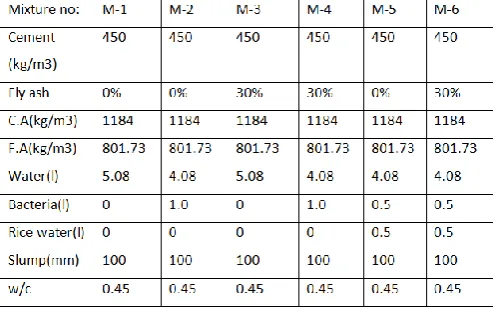
Concrete mixture was designed as per IS 10262-1982 to have 1-day, 7-day and 28-day compressive strength . Then cement was partially replaced with 0% and 30% fly ash by weight of cement and of bacterial culture(Bacillus cereus).Water is replaced with 20% by weight of water with bacterial culture. Rice water is added to two mixes by replacing 50% by weight of water.
Table 6:Mix proportions of concrete
3.2.1.Preparation of test specimens:
Concrete cubes were prepared with and without flyash using bacterial culture. Control concrete.Rice water was added to concrete to enhance bacterial growth by providing nutrient medium. All the experiments were performed in triplicates. Further following properties were studied:
At the age of 1,7 and 28 days: Compressive strength (IS:516-1959) – 100 mmx100mm cubes , and at the age of 28 days :Rapid chloride permeability test (ASTM C1202) and split tensile strength -200x 100 mm
cylindrical specimens Water porosity –(IS:516-1959) – 100 mmx100mm cubes.
3.2.2.Preparation of bacterial culture:
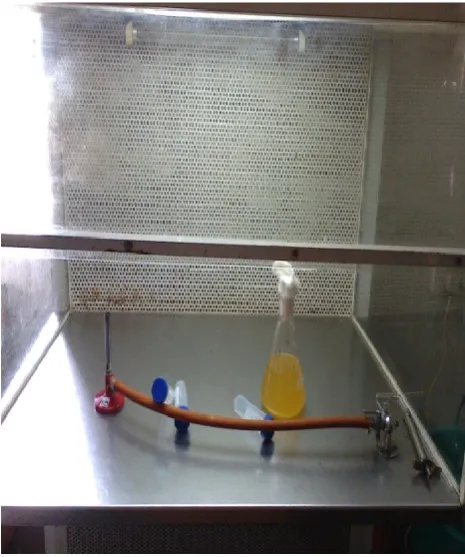
„Sample is collected from the cement go down and fly ash substance..Nutrient broth is prepared in conical flask. Prepared sterilized liquid media by autoclaving for 20 minutes at 120O C .Mixed the sample in laminar flow chamber. Small quantity of sample was taken. The sample was allowed to grow for 7 -10 hours. in incubator The individual colonies were collected Bacterial culture was added to concrete by replacing the water by 20%.
Figure 5. Culturing bacteria
3.3 Inducing Cracks
Standardized cracks were made in concrete samples with dimensions 100mm×100mm×100 mm cubes .A thin copper plate of 0.3mm thickness was introduced in the fresh concrete paste up to a depth of 30mm or 40mm. The moulds with the copper plates are shown in Fig. 1. The plateswere removed during demoulding, after 24h, resulting in prisms with a narrow groove on the upper surface, with a depth of 30mm or 40mm and a width of 0.3mm.
Figure 6. Steel plate induced in concrete cube
Figure 7. Crack formed on the surface
3.3.1. Filling cracks
Silica gel solution:
1.2 g NaClwas added to 10 ml demineralized water and vortexed during 30 seconds. Then, 40 ml Levasil sol was added and the solution was vortexed again. By means of a syringe, the
obtained suspension was brought into the crack and this was repeated until the entire crack was filled.
Silica gel solution with bacterial culture:
First, 1.2 g NaClwas added to 10 ml demineralized water and the mixture was vortexed during 30 seconds. Then, 50 ml of an overnight grown culture was centrifuged during 5 minutes at 4 °C
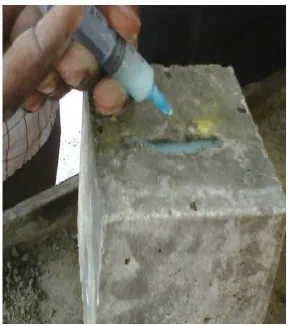
and 7000 rpm. The resulting pellet was suspended in the NaCl solution and vortexed during 30 seconds. Afterwards, 40 ml Levasil sol was added and the whole was vortexed again. The obtained suspension was brought into the crack by means of a syringe. When gel-formation
began, this treatment was repeated until the entire crack was filled. After hardening of the sol into a gel, the samples were immersed during 3 days in an equimolar solution of urea (20 g/L) and CaCl2.2H2O (49 g/L) or Ca(NO3)2.4H2O (79 g/L) or Ca(CH3COO)2.H2O (59 g/L).
Figure 9. Crack filled with solution with bacteria
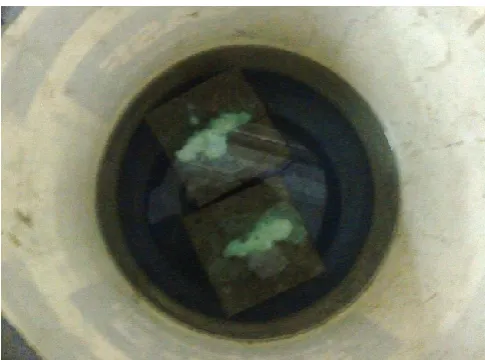
Cubes were kept in equi molar solution of urea and calcium chloride for 3 days .After that specimen was taken outside and kept in air for drying for 3 days.
Figure 12. Cubes immersed in solution
III.
RESULTS AND DISCUSSION
4.1.Compressive strength
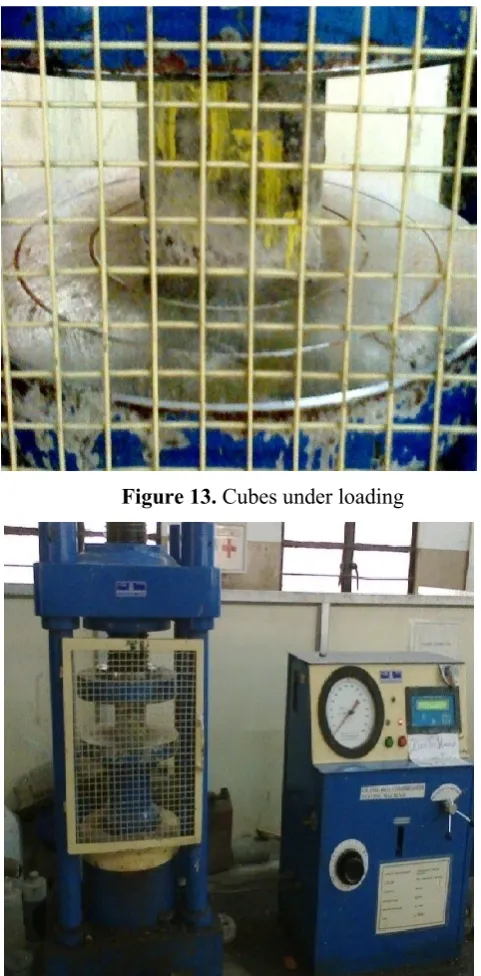
These specimens are tested by compression testing machine after 1, 7 days curing and 28 days curing. Load should be applied gradually at the rate of 140 kg/cm2
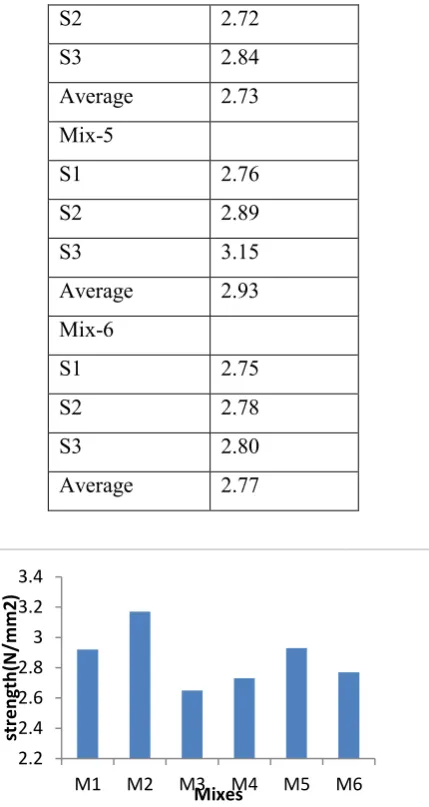
concrete with microbes. Split tensile strength also show corresponding increase in value.
Figure 13. Cubes under loading
Figure 14. Compressive strength testing Machine
Table 7: Compressive strength values (N/mm2 ) Mix-1
Item 1-day 7-day 28-day
S1 15.4 24.2 37.4
S2 13.2 23.1 38.5
S3 13.4 25.4 37.9
Average 14.0 24.2 37.9
Mix-2
S1 18.7 28.2 46.6
S2 18.5 28.6 40.0
S3 18.4 27.7 43.2
Average 18.5 28.16 43.2
Mix-3
S1 10.4 22.1 29.4
S2 10.5 21.9 31.0
S3 11.0 22.0 30.0
Average 10.6 22.0 30.13
Mix-4
S1 11.1 23.0 32.9
S2 12.0 24.2 29.3
S3 12.2 24.5 31.4
Average 11.7 23.9 31.2
Mix-5
S1 15.7 34.9 43.0
S2 17.5 34.5 42.7
S3 17.2 35.6 42.4
Average 16.8 35.0 42.7
Mix-6
S1 13.2 30.0 33.9
S2 12.3 29.4 37.0
S3 12.5 29.1 35.0
Average 12.6 29.5 35.3
4.2 Split tensile strength
tensile stress Osp (acting in a direction perpendicular to the line of action of applied loading) is given by the formula:
Figure 15. Cylinder under loading
Table 8: Split tensile strength values ( N/mm2 )
S3 3.34
Average 3.17
Mix-3
S1 2.45
S2 2.83
S3 2.67
Average 2.65
Mix-4
S1 2.64
S2 2.72
S3 2.84
Average 2.73
Mix-5
S1 2.76
S2 2.89
S3 3.15
Average 2.93
Mix-6
S1 2.75
S2 2.78
S3 2.80
Average 2.77
Figure 16. Graphical representation of split tensile values
4.3.Water absorption
The water absorption test was conducted as per ASTM C 642 in order to determine the increase in resistance towards water penetration in concrete. The cube molds of 70 mm were prepared both with and without bacteria and fly ash. The concrete specimens were cured for 28 days. After curing, the specimens were oven dried at 110 _C in oven, establishing a mass equilibrium of less than 0.5% between two measurements at 24 h intervals. Then the specimens were immersed in water at approximately 21 _C for 48 h and saturated mass after immersion was calculated. Then the specimens were placed in suitable receptacle, covered with tap water and were boiled for 5 h, further the saturated mass after
2.2 2.4 2.6 2.8 3 3.2 3.4
M1 M2 M3 M4 M5 M6
sp lit te n si le str e n gth (N /m m 2) Mixes Mix-1
S1 2.86
S2 2.9
S3 3.0
Average 2.92
Mix-2
S1 2.99
boiling was calculated.The specimens were suspended by a wire and the apparent mass in water was calculated as per the formula:
Volume of permeable voids% =
where A is the mass of the oven dried sample in air, grams, C is the mass of sample after immersion and boiling, grams, and D is the apparent mass of sample in water after immersion and boiling, grams.The influence of bacteria on the water absorption of fly ash concrete is given in Table 9 and shown in Fig. 3. Water absorption test at 28-days was conducted as per ASTM C 642. It can be seen from this figure that with the inclusion of bacteria, water absorption capacity of fly ash concretes decreased with the increase in bacteria concentration. Table 9: Water absorption values
% water absorbed
M1 6.4
M2 2.8
M3 4.1
M4 2.4
M5 3.7
M6 3.5
Figure 17. Graphical representation of water absorption values
4.4 Chloride permeability
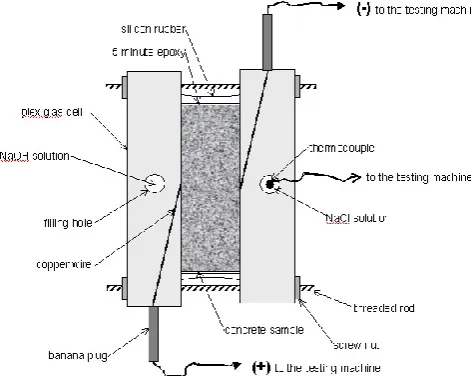
Corrosion is mainly caused by the ingress of chloride ions into concrete annulling the original passivity present. Rapid chloride permeability test (RCPT) has been developed as a quick test able to measure the rate of transport of chloride ions in concrete. This test was conducted as per ASTM method . Details of experimental set up are shown in Fig. 1. Concrete disc of size 100 mm diameter and 50 mm thickness with and without bacterial culture were cast and allowed to cure. After curing the concrete specimens were subjected to RCPT by applying 60 V. Two halves of the specimens are sealed with PVC container of diameter 90 mm. One side of the container is filled with 3% sodium chloride solution (that side of the cell will be connectedto the cathode terminal of the power supply) and other side sodium hydroxide solution (0.3 N) was poured and connected to anode terminal. The interpretation is that the larger the Coulomb number or the charge transferred during the test, the greater the permeability of the sample. The concrete which is more permeable will show higher charge transfer vice versa. The method has shown good correlation with chloride tests. The following formula, based on the trapezoidal rulecan be used to calculate the average current flowing through one cell.
=900(I0+2I30+2I60+2I90+2I120+………..2I300+2I330+2I360)
where Q is the current flowing through one cell (coulombs), I0 is the current readingin amperes immediately after voltage is applied, and It is the current reading in amperesat t minutes after voltage is applied 0 1 2 3 4 5 6 7
M1 M2 M3 M4 M5 M6
Figure 18. Parts of cell used in RCPT test
Figure 19. Cells arranged for RCPT test
Figure 20. Process involved in RCPT test
Table 10: RCPT rating(as per ASTM C 1202-97) Charge passed Chloride ion penetrabilty >4000 High
2000–4000 Moderate
1000–2000 Low 100–1000 Very low
<100 Negligible Table 11:RCPT values
Item Charge passed
(Coloumb)
M40 2038
M40+BACTERIA 1102
M40+FLY ASH 1456
M40+FLY ASH +BACTERIA 765
M40+BACTERIA+STARCH WATER
1102
M40+FLY ASH +BACTERIA +STARCH WATER
862
4.5 UPV Test:
guidelines given below, which have been evolved for characterizing the quality of concrete in structures in terms of the ultrasonic pulse velocity.
Figure 21. UPV apparatus
Figure 22. Reading on UPV apparatus
Figure 23. Process involved in UPV test
Pulse velocity= (Path length/Travel time)
Table 12: Ranges of UPV results
PULSE VELOCITY CONCRETE QUALITY
>4000 m/s Very good to excellent
500 – 4000 m/s Good to very good, slight porosity may exist
3000 – 3500 m/s Satisfactory but loss of integrity is suspected
<3000 m/s Poor and loss of integrity exist.
4.6 Microscopic Evaluation
Electron microscopy are valuable research tools for the study of concrete microstructure. ASTM-C-856 already
has a standard practice in place giving details of how to use optical techniques for examination of hardened concrete. The supplemental methods described in the accompanying report were also used to examine hardened concrete specimens, $89-1 to $89-19. Although most of the report emphasizes data obtained using epoxy impregnated thin sections, alternate methods have also been explored and polished impregnated samples were examined in reflected fluorescent light
Figure 24. Cracks formed in concrete cube
Figure 26. Cracks under Microscopic evaluation
Figure 27. Zoomed view of filled crack under microscopic evaluation
4.7. Strength of repaired material
Strength of the repaired specimen is evaluated using universal compressive testing machine. Specimen is tested in the same manner as strength test.specimen
filled with silica gel solution with and with out bacteria is kept under universal testing machine and loads are appilied till the cracks are formed .The test help us to find out how much strength has been regained.
Table 14: Compressive strength (N/mm2) repaired material
MIX Specimen
filled with Silica gel
Specimen filled with Silica with bacteria
M40 33.2 37.8
M40+BACTERIA 41.0 44.2
M40+FLY ASH 26.8 28.2
M40+FLY ASH + BACTERIA
31.2 33.4
M40+BACTERIA +STARCH WATER
35.6 39.8
M40+FLY
ASH+BACTERIA +STARCH WATER
34.2 36.8
IV.
CONCLUSION
improves workability and quality of concrete. When bacteria is added to fly ash concrete its strength has correspondingly increased. Highest value is obtained for control concrete with bacteria. An increase of 17% has been observed for microbial concrete from normal concrete. Split tensile strength also shows higher value for microbial concrete. Water absorption test conducted shows lesser value for fly ash with bacteria. Fly ash and bacteria being fine fills the pores of the concrete thereby increasing density and reducing water absorption. RCPT test conducted also shows good results for fly ash with bacteria .Cracks created has been filled effectively in UPV results irrespective of the mix. Bacterial gel fills the cracks much more efficiently than silica gel solution .It adhere to concrete specimen by precipitating calcite. Strength of the repaired material also shows the relevance of bacteria and role of bacteria to microbial concrete.
Compressive strength of microbial concrete has been increased by 15% when compared with normal concrete and addition of starch water has increased value by 12% . When bacteria is added to fly ash concrete its strength has increased by 6%.
Split tensile strength of microbial concrete also shows an increase in the value from control concrete by 10% and addition of starch water increased value by 6%
Considering durability aspect fly ash concrete with bacteria proves more efficient than microbial concrete. It has least value recorded as 2.4%. Chloride permeability test of various mixes give
lesser value for fly ash concrete with bacteria proving the pores of concrete has been effectively filled by calcite precipitation of bacteria.
Crack formed on concrete cubes of various mixes has been filled effectively which is seen in microscopic evaluation.
UPV test results done on all six mixes conclude that silica gel with bacterial solution fills the crack effectively than silica gel solution .
Strength of repaired material also gives highest value for cube filled with bacterial solution.
V.
REFERENCES
[1]. Greeshma C S, Dr A.S. Santhi, Dr.G.Mohan
Ganesh, Dr.G.Kalaichelvan (2014) “ Experimental Study on microbial concrete usinf fly ash “-International Conference on Science and Innovative Engineering 5th & 6th April 2014, Chennai, India. ISBN 978-81-904760-5-8
[2]. Maslehuddin M. Effect of sand replacement on the
early-age strength gain and long-term corrosion-resisting characteristics of fly ash concrete. ACI Mater 1989;86(1):58–62.
[3]. Berg E, Neal JA. Concrete masonry unit mix
designs using municipal solid waste bottom ash. ACI Mater J 1998;95(4):470–9
[4]. Navneet Chahal, Rafat Siddique , Anita Rajor.
Influence of bacteria on the compressive strength, water absorption and rapid chloride permeability of fly ash concreteConstruction and Building Materials 28 (2012) 351–356
[5]. N. DeBelie,W.DeMuynck, Crack repair in concrete
using biodeposition, International conference on concrete repair, rehabilitation and retrofitting, 24– 26November 2008,Cape Town, South Africa
[6]. V.Ramakrishnan, K.P.Ramesh and S.S.Bang,
“Bacterial Concrete”Proceedings of SPIE
Vol.4234mpp.168-176, Smart Materials
[7]. ASTM C618 – 08a standard specification for coal
fly ash and raw or calcined natural Pozzalono for use concrete
[8]. IS: 383-1970. Specifications for coarse and fine
[9]. IS: 10262-1982. Recommended guidelines for concrete mix design. New Delhi India: Bureau of Indian standards.
[10]. Bowders, J.J., Loehr, J.E., Neupane, D., Bouazza,
A., 2003. Construction quality control for asphalt concrete hydraulic barriers. J. Geotech. Geoenviron. Eng. 129,219e223.
[11]. Bowders, J.J., Neupane, D., Loehr, J.E., 2002.
Sidewall leakage in hydraulic conductivity testing of asphalt concrete specimens. Geotech. Test. J. 25, 210e214.
[12]. Jagadeesha Kumar B.G., Prabhakara, Pushpa H.
“Effect of Bacterial Calcite Precipitation on
Compressive Strength ofMortar Cubes ”