www.jeseh.net
Examination of the Teacher Candidates’
Environmental Attitudes
via NEP Scale in terms of Different
Variables
Emine Hande Aydos,Esed Yağcı
Hacettepe University
To cite this article:
Aydos, E.H. & Yağcı, E. (2015). Examination of the teacher candidates’ environmental
attitudes via NEP scale in terms of different variables.
Journal of Education in Science,
Environment and Health (JESEH), 1
(1), 20-27.
This article may be used for research, teaching, and private study purposes.
Any substantial or systematic reproduction, redistribution, reselling, loan, sub-licensing,
systematic supply, or distribution in any form to anyone is expressly forbidden.
Authors alone are responsible for the contents of their articles. The journal owns the
copyright of the articles.
Examination of the Teacher Candidates’ Environmental Attitudes
via New Environmental Paradigm (NEP) Scale in terms of Different
Variables
Emine Hande Aydos*, Esed Yağcı
Hacettepe University
Abstract
In today’s world, the importance of environment education that is one of the most important issues is increasing rapidly. In the basis of the education, families and teachers take role together. It is aimed to grow up individuals who have positive attitudes and are sensitive the environment at every level of education. In order to achieve this goal, there is need for teachers giving importance to environment education and having adequate equipment. It will be beneficial to learn the environmental attitudes of teacher candidates who grow up elementary students after a few years. Because of this reason, in this study, it is aimed to examine the environmental attitudes of teacher candidates in terms of different variables. In the research, quantitative research methods were used. Sample is consisted of 1th and 3rd grade students from different department of science in Faculty of Education at Hacettepe University. In order to collect the data, New Environmental Paradigm (NEP) Scale was used. In the finding of the research, it was investigated that there is a difference in environmental attitudes of teacher candidates in terms of department of science, grade level, region lived during their childhood and get the status of environment education course variables and there is no difference in term of also, some suggestions were given.
Key words: Teacher candidate; Environment education; NEP; Attitude
Introduction
It is not possible to think the environment separate the effect of people because environment is not only the world outside of our skin, it is also a place that we affect, affected, shaped and as the same time a place where we realize ourselves (Uşak, 2006). It is very crucial that individuals benefit from the living area and they avoid the behaviors which can be reverse the natural balance of it (Uzun & Sağlam, 2005). At this point, it is crucial that all individuals should gain the conscious and ability in order to protect the environment and to have better living conditions. The main goal of environment education is to protect the nature and natural resources. Besides of giving information, environment education should affect the behavior of the individual. In order to be gained positive and persistent behavior change and provide the individuals to participate actively are the main aim of environment education (Şimşekli, 2004).
In today’s world, one of the most salient problems is environmental problems. Changing living conditions, developing technology, rapid population increase, industrialization and also urbanization increase the environmental problems. In this regard, it is very crucial to provide the environmental conscious in national and international areas. Environmental problems and its results make environment education a current issue. It is necessary that environment education programs should be varied for every age and education level in order to increase the environmental conscious. In this regard, examination of educational applications and programs provide the environmental education activities to become realistic and goal directed (Gülay & Ekici, 2010). When the substantial effects of environmental problems are seen clearly, as a reaction, it is widely increase environmental protection conscious and environmental sensibility. Before it is thought that environmental conscious is related to the people that live in developed countries, in recent years, it is clearly asserted that people in developing and underdeveloped countries have an important environmental conscious (Dunlap, Gallup & Gallup, 1993; Furman, 1998). It is impossible to think young people without the education in all countries all over the world. Education must be concerned with more than simply the transmission of knowledge and more than formal education. It must think about all the influences on young people’s attitudes and behaviors.
*
Corresponding Author:
21
Journal of Education in Science, Environment and Health (JESEH)
Throughout this education, young people are also gained attitudes and behaviors of environment education (Yencken, Fien & Sykes, 2005).
Because of the reasons that are emphasized strongly it is crucial that environmental education need to take place in every level of education systematically from early childhood to high school in years. It is important to give place environment education activities in national education programs (Gülay & Ekici, 2010). In order to provide the development of individuals’ attitude and behavior, both formal and informal environment education can be used by the educators. All these affect the environmental education progress and for a qualified environment education, there are various and contemporary ways (Palmer, 1998).
Education faculties are one of the important parts of the system and every year, lots of young people are graduated from there. Therefore, if the educators provide to increase the sensitivity of young people in education faculties and start to move actively, it could be a big step to prevent the environment problems developed multifaceted. As a result of this, it is provided that young people behave consciously for a balanced, safe, healthy and livable world (Maskan, Efe, Gönen & Baran, 2006).
Importance of the Research
As known one of the most important issue of educational program is environment education and its importance is increasing every day. The main aim of environment education is to protect the nature and natural sources. Families and teachers compose the fundamentals of this education together. It is necessary to aim of growing up individuals who are sensitive to the environment and have positive attitudes at every level of elementary education. It can be reached to this aim with the teacher giving importance to environment education and having enough information about this issue. It is necessary to give effective and qualified education to every level of elementary education students by teacher candidates graduated with qualified environment education. It can be beneficial to examine the environmental attitudes of teacher candidates who will graduate in a few years and educate elementary education students. Because of all these reasons, it is aimed to examine the environmental attitudes of teacher candidates in terms of different variables. Throughout this aim, research questions are given above:
1. Do teacher candidates internalize eco centric or anthropocentric approach for the environmental attitudes? 2. Is there any difference between the environmental attitudes of teacher candidates according to the department of science?
3. Is there any difference between the environmental attitudes of teacher candidates according to the grade level?
4. Is there any difference between the environmental attitudes of teacher candidates according to the region lived during their childhood?
5. Is there any difference between the environmental attitudes of teacher candidates according to the environment education course taken?
Method
In the research, descriptive method was used. According to Kaptan (1998), descriptive method describes and clarifies the events, objects, creatures, institutions, groups and different areas. The most important limitation of the research is to select probable based randomized sample group. At the same time, with the use of simple randomized sample, area study was conducted in a short time at different department in Hacettepe University. At this framework, it is aimed to examine the environmental attitudes of teacher candidates in terms of different variables such as department of science, gender, classroom level, the region lived during their childhood and environment education course taken.
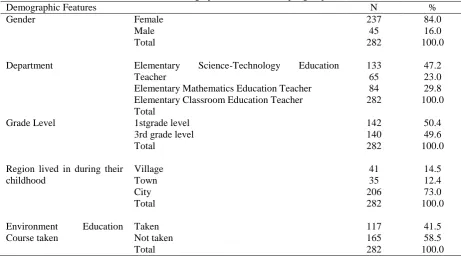
Sample of the Research
in town and 73% of them lived in city during their childhood. 41.5% of them have stated that they attended ‘Environment Education’ course and 58.5% of them did not.
Table 1. Demographic features of sample group
Demographic Features N %
Gender Female
Male Total 237 45 282 84.0 16.0 100.0
Department Elementary Science-Technology Education
Teacher
Elementary Mathematics Education Teacher Elementary Classroom Education Teacher Total 133 65 84 282 47.2 23.0 29.8 100.0
Grade Level 1stgrade level
3rd grade level Total 142 140 282 50.4 49.6 100.0 Region lived in during their
childhood Village Town City Total 41 35 206 282 14.5 12.4 73.0 100.0 Environment Education
Course taken Taken Not taken Total 117 165 282 41.5 58.5 100.0
Data Collection Tool
In the original version of NEP scale, all 15 items have strong item-total correlations and yield an Alpha of 83 when combined into a single measure, and it is appropriate to treat them as continuing a single (revised) NEP Scale (Dunlap, Van Liere, Mertig & Jones, 2000). Demirel et al. Found the Cronbach Alpha as 0.72, Taşkın found the Cronbach Alpha as 0.46, Sam et al. Found the Cronbach Alpha as 0.53, Furman found the Cronbach Alpha is 0,60, Günden and Miran found the Cronbach Alpha as 0.62, Erdoğan found the Cronbach Alpha as 0.62. Inthisstudy, the version of Alnıaçık and Koç was used and they found the Cronbach Alpha as 0.68. Alnıaçık and Koç (2009) have conducted the study with 222 university students. Reliability analysis was conducted with Cronbach’s Alpha, and validity test was applied by explanatory factor analysis. The Ecological Paradigm Scale was handled in various validity and reliability studies other than Recreation area. This scale evaluates the attitude of people in order to understand their internalizing anthropocentric attitude with 15 Likert type judgments and a lot of researchers have used it (Dunlap et. al., 2000). At first, there is only one factor in the scale (Dunlap & Van Liere, 1978). However, after a few studies, it is revealed that the scale has more factors (Albrecht, et al., 1982; Arcury, 1990; Geller & Lasley, 1985; Noe & Snow, 1990; Scott & Willits, 1994, Furman, 1998).
Dunlap and other have revised the scale in a research in 2000. P-NEP Scale has 15 items and it is five point Likert type scale. 8 items of the scale (1,3,5,7,9,11,13,15) support ecocentric attitude and other 7 items (2,4,6,8,10,12,14) support anthropocentric attitude. Alnıaçık and Koç (2009), in the research, have stated that there are four factors but there is only one dominant factor and they have not divided the scale into factors. The scale is formed two parts. In the first part, there are questions related to demographic features (Department of science, grade level, region lived in during their childhood and Environment Education course taken or not) and in the second part, there are items in order to determine environmental attitudes level of teacher candidates in the scale. Questions related to the environmental attitude provide opportunity ecocentric and anthropocentric approaches.
Data Collection Process
23
Journal of Education in Science, Environment and Health (JESEH)
Data Analysis
In the study, data was acquired throughout the R-NEP scale and analyzed using SPSS 21.0 (Statistical Program for Social Sciences). For the data analyze, t test was used grade level and Environmental Education course taken variables and also One-way ANOVA was used for the department of science and region lived during their childhood variables. Meaning level was determined as p<0.05.
Results and Discussion
This research is conducted to examine the environmental attitudes of teacher candidates in different departments, grade level, region lived in during their childhood and Environment Education course taken. When the answers of teacher candidates are examined in general, it can be clearly seen that ecocentric attitude is wide. Eight items of the scale (1,3,5,7,9,11,13,15) support ecocentric attitude and answers of them mostly change from mildly agree to strongly agree. Other seven items (2,4,6,8,10,12,14) support anthropocentric attitude and answers of them mostly change from mildly disagree to strongly disagree. Findings of t test and One-way ANOVA results are given in Table 2.
Table 2. Mean and standard deviation results of environmental attitudes of teacher candidates according to department of science
Department of Science n
X
sdEcocentric Attitude
Department of Elementary Science-Technology Education Department of Elementary Mathematics Education Department of Elementary Classroom Education
133 65 84
33,69 31,63 33,93
2,92 5,04 3,56 Department of Elementary Science-Technology
Education
133 21,48 3,20
Anthropocentric Attitude
Department of Elementary Mathematics Education Department of Elementary Classroom Education
65 84
21,94 21,95
3,64 4,19 When mean and standard deviation values of environmental attitude were examined for ecocentric attitude according to department of science variable of teacher candidates, mean of Department of Elementary Science-Technology Education is 33.69; mean of Department of Elementary Mathematics Education is 31.63 and mean of Department of Elementary Classroom Education is 33.93 (see Table 3).When mean and standard deviation values of environmental attitude were examined for anthropocentric attitude according to department of science variable of teacher candidates, mean of Department of Elementary Science-Technology Education is 21.48; mean of Department of Elementary Mathematics Education is 21.94 and mean of Department of Elementary Classroom Education is 21.95.
Table 3. One-way ANOVA results of environmental attitudes of teacher candidates according to department of science
ANOVA Sum of
Squares df
Mean
Square F p
Ecocentric Attitude
Between Groups 234.66 2 117.33
8.60 .001
Within Groups 3805.07 279 13.64
Total 4039.73 281
Anthropocentric Attitude
Between Groups Within Groups Total
15.21 3656.77 3671.98
2 279 281
7.60
13.11 .58 .560
p<0.05
Elementary Classroom Education. Also, there is no significant difference between department of science of teacher candidates and anthropocentric attitude (p=0.560). Kahyaoğlu, Daban and Yangın (2008) have also found in their research that teacher candidates from Department of Elementary Social Sciences Education and Department of Elementary Classroom Education have higher environmental attitudes than Department of Science-Technology Education and Department of Mathematics Education teacher candidates (see Table 4).
Table 4. t test results according to grade level of teacher candidates
Grade level N X SS df t p
Ecocentric
Attitude 1
st level 142 32.81 3.57
280 -2.14 .033
3rd level 140 33.77 3.96
Anthropocentric
Attitude 1
st level 142 22.35 3.75
280 2.97 .003
3rd level 140 21.09 3.37
p<.05
When table 4 is examined, there is a significant difference in ecocentric and anthropocentric attitudes according to the grade level of teacher candidates. For the ecocentric attitude, mean of 1st grade level teacher candidates is 32.81 and mean of 3rd grade level is 33.77. According to this result between the grade level, there is a difference on behalf of 3rd grade level (p=0.033). For the anthropocentric attitude, mean of 1st grade level teacher candidates is 22.35 and mean of 3rd grade level is 21.09.
Also, according to this result between the grade level, there is a difference on behalf of 3rd grade level (p=0.003). Işıldar (2009) has found that for ecocentric attitude there is a difference on behalf of 4th grade students. However, there is no significant difference for anthropocentric attitude. Ek, Kılıç, Öğdüm, Düzgün and Şeker (2009) have examined the relationship between environmental attitude and grade level of students in high school and found the mean of 4th grade students is higher.
Despite of this research, Aydın (2010); Sam, Sam and Öngen (2010) stated that there is no significant difference between the grade levels of students on environmental attitudes of them. Sever and Yalçınkaya (2012) have found in their research that grade level has a significant effect on both ecocentric and anthropocentric attitude. For the ecocentric attitude, there is a difference on behalf of 1st grade students and for the anthropocentric attitude; there is a difference on behalf of 2nd grade students. Although students take Environment Education course at 2nd grade, they have anthropocentric attitude than 1st grade. Therefore, it can be said that 2nd grade students have lower environmental consciousness than 1st grades (see Table 5).
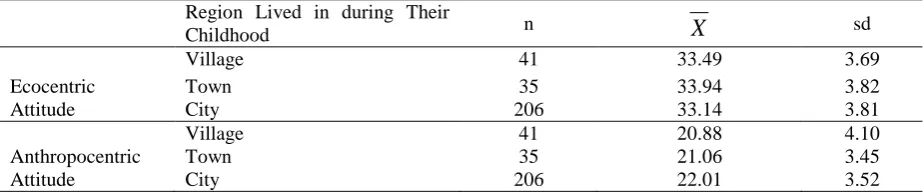
Table 5. Mean and standard deviation results of environmental attitudes of teacher candidates according to region lived in during their childhood
Region Lived in during Their
Childhood n
X
sdVillage 41 33.49 3.69
Ecocentric Attitude
Town City
35 206
33.94 33.14
3.82 3.81
Village 41 20.88 4.10
Anthropocentric Attitude
Town City
35 206
21.06 22.01
25
Journal of Education in Science, Environment and Health (JESEH)
Table 6. One-way ANOVA results of environmental attitudes of teacher candidates according to region lived in during their childhood
ANOVA Sum of
Squares df
Mean
Square F p
Ecocentric Attitude
Between Groups 21.41 2 10.71
.743 .476
Within Groups 4018.32 279 14.40
Total 4039.73 281
Anthropocentric Attitude
Between Groups Within Groups Total
61.72 3610.26 3671.98
2 279 281
30.86
12.94 2.385 .094
p<0,05
When Table 6 is examined, there is no significant difference between region lived in during their childhood of candidate teachers and ecocentric attitude (p=0.476). Also, there is no significant difference between region lived in during their childhood of candidate teachers and anthropocentric attitude (p=0.094). According to this result, it can be said that environmental attitudes of candidate teachers does not change according to region lived in during their childhood of teacher candidates. Despite of this research, Ek and others (2009) have found that there is a significant difference between regions lived in during their childhood of candidate teachers and scores gained from Environmental Attitude Scale on behalf of students lived in city (p=0.005). Şama (2003) has also found that there is a significant difference between regions lived in during their childhood of teacher candidates and there is a positive effect of going from the village to the city with the life period (see Table 7).
Table 7. T test results according to taking the environment education course Environment
Education Course N X SS df t p
Ecocentric
Attitude Taken 117 34.35 3.27 280 4.07 .000
Not taken 165 32.53 3.96
Anthropocentric
Attitude Taken 117 20.97 3.51 280 -3.02 .003
Not taken 165 22.27 3.60
p<.05
When table 7 is examined, there is significant difference in ecocentric and anthropocentric attitudes according to taking the Environment Education Course and not variable. For the ecocentric attitude, mean of teacher candidates who takes Environment Education course is 34.35 and mean of teacher candidates who does not take Environment Education course is 32.53. According to this result between taking Environment Education course, there is a difference on behalf of teacher candidates who takes the course (p<0.05). For the anthropocentric attitude, mean of teacher candidates who takes Environment Education course is 20.97 and mean of teacher candidates who does not take Environment Education course is 22.27. For the anthropocentric attitude, it is expected that teacher candidates who take Environment Education course have low mean. Also, according to this result, between taking Environment Education course, there is a difference on behalf of teacher candidates who takes Environment Education course (p=0.003).
Conclusion
Average of the scale item shows us that ecocentric attitude is higher between the sample groups in the research. When the analysis is done, it has been seen that there is significant difference between department of science of teacher candidates and ecocentric attitude. Between Department of Science-Technology Education, Department of Mathematics Education and ecocentric attitude, there is a difference on behalf of Department of Science-Technology Education. Between Department of Elementary Classroom Education, Department of Mathematics Education and ecocentric attitude, there is a difference on behalf of Department of Elementary Classroom Education. Also, there is no significant difference between department of science of teacher candidates and anthropocentric attitude.
There is a significant difference in ecocentric and anthropocentric attitudes according to the grade level of teacher candidates. For the ecocentric attitude, mean of 1st grade level teacher candidates is 32.81 and mean of 3rd grade level is 33.77. According to this result between the grade level, there is a difference on behalf of 3rd grade level. For the anthropocentric attitude, mean of 1st grade level teacher candidates is 22.35 and mean of 3rd grade level is 21,09. Also, according to this result between the grade level, there is a difference on behalf of 3rd grade level.
There is no significant difference between region lived in during their childhood of candidate teachers and ecocentric attitude. Also, there is no significant difference between region lived in during their childhood of candidate teachers and anthropocentric attitude. It can be said that environmental attitudes of candidate teachers does not change according to region lived in during their childhood of teacher candidates.
There is significant difference in ecocentric and anthropocentric attitudes according to taking the Environment Education Course and not variable. For the ecocentric attitude, mean of teacher candidates who takes Environment Education course is 34.35 and mean of teacher candidates who does not take Environment Education course is 32.53. Between taking Environment Education course, there is a difference on behalf of teacher candidates who takes the course (p=0.000). For the anthropocentric attitude, mean of teacher candidates who takes Environment Education course is 20.97 and mean of teacher candidates who does not take Environment Education course is 22.27. For the anthropocentric attitude, it is expected that teacher candidates who take Environment Education course have low mean. Also, according to this result, between taking Environment Education course, there is a difference on behalf of teacher candidates who takes Environment Education course. Environment Education course provides students to understand how the environmental knowledge and attitudes are being formed. This education can be added to the curriculum from early childhood to high school in a formal way. Also, Environment Education course should be taken part in every level of education parallel with the development of students (Meydan & Doğu, 2008).
Recommendations
In the light of findings, these can be suggested above:
In education faculties, effective environment education should be given, education environments should be prepared in order to provide the students’ learning by doing and activities should be prepared for students’ gaining environment conscious.
For teacher candidates, Environment Education should be active and programs should be prepared in the light of this point.
In order to develop ecocentric attitude of teacher candidates, education activities should be revised. Environment Education should start from early childhood to high school at every level of education
and it should be continue with interdisciplinary approach.
In education programs, Environment Education should be given step by step and development level of the students should be considered.
27
Journal of Education in Science, Environment and Health (JESEH)
References
Alnıaçık, Ü. & Koç, F. (2009). Yeni çevresel paradigma ölçeği ile üniversite öğrencilerinin çevreye yönelik tutumlarının değerlendirilmesi, Bölgesel Kalkınma Kongresi, Balıkesir Üniversitesi Burhaniye MYO, 14-16 Kasım 2009, Balıkesir.
Aydın, F. (2010). Coğrafya öğretmen adaylarının çevre sorunları ve çevre eğitimi hakkındaki görüşleri (Gazi Üniversitesi Örneği). International Online Journal of Educational Sciences, 2(3), 818-839.
Dunlap, R. E., Van Liere, K. D., Mertig, A. G. & Jones, R. E. (2000). Measuring endorsement of the new ecological paradigm: A revised NEP scale. Journal of Social Issues, 56, 425-442.
Dunlap, R. E., Gallup, G. H. & Gallup, A. M. (1993). Of global concern: Results of the health of the planet survey. Environment, 35(9); 33-39.
Dunlap, R. E. & Van Liere, K. D. (1978). The ‘‘new environmental paradigm’’: A proposed measuring instrument and preliminary results. Journal of Environmental Education, 9(1), 10-19.
Ek, H. N., Kılıç, N., Öğdüm, P., Düzgün, G., & Şeker, S. (2009). Adnan Menderes Üniversitesinin farklı akademik alanlarında öğrenim gören ilk ve son sınıf öğrencilerinin çevre sorunlarına yönelik tutumları ve duyarlılıkları. Kastamonu Eğitim Dergisi, 17(1), 125-136.
Erol, G. H. & Gezer, K. (2006). Sınıf öğretmenliği öğretmen adaylarının çevreye ve çevre sorunlarına yönelik tutumları. International Journal of Environmental and Science Education, 1(1), 65-77.
Furman, A. (1998). A note on environmental concern in a developing country. Results from an İstanbul survey.
Environment & Behavior, 30, 520-534.
Gülay, H. & Ekici, G. (2010). “MEB Okul Öncesi Eğitim Programı’nın çevre eğitimi açısından analizi”. Türk
Fen Eğitimi Dergisi, 7(1), 74-84.
Işıldar, G. (2008). Meslek yüksek okulları boyutunda çevre eğitiminin çevreci yaklaşımlar ve davranışlar üzerindeki etkilerinin değerlendirilmesi, Türk Eğitim Bilimleri Dergisi, 6(4),759-778.
Kahyaoğlu, M., Daban, Ş. & Yangın, S. (2008). İlköğretim öğretmen adaylarının çevreye yönelik tutumları. D.Ü. Ziya Gökalp Eğitim Fakültesi Dergisi, 11, 42-52.
Kaptan, S. (1998). Bilimsel Araştırma ve İstatistik Teknikleri, Ankara: Tekışık Ofset.
Maskan, A. K., Efe, R. Gönen, S. & Baran, M. (2006).Farklı branşlardaki öğretmen adaylarının çevre sorunlarının nedenleri, eğitimi ve çözümlerine ilişkin görüşlerinin değerlendirilmesi üzerine bir araştırma. Çukurova Üniversitesi Eğitim Fakültesi Dergisi, 32(2), 1-11.
Meydan, A. & Doğu, S. (2008). İlköğretim ikinci kademe öğrencilerinin çevre sorunları hakkındaki görüşlerinin bazı değişkenlere göre değerlendirilmesi, Selçuk Üniversitesi Ahmet Keleşoğlu Eğitim Fakültesi
Dergisi, 26, 267-277.
Palmer, J. (1998). Environmental Education in the 21st Century: Theory, Practice, Progress and Promise
(Studies). USA: Taylor & Francis.
Sam, N., Sam, R. & Öngen, B. K. (2010). Üniversite öğrencilerinin çevresel tutumlarının yeni Çevresel Paradigm ve Benlik Saygısı Ölçeği ile incelenmesi, Akademik Bakış. Uluslararası Hakemli Sosyal
Bilimler E-Dergisi, Sayı 21.
Sever, R. & Samancı, O. (2002). İlköğretimde çevre eğitimi, Doğu Coğrafya Dergisi, 7, 153-165.
Şama, E. (2003) Öğretmen Adaylarının Çevre Sorunlarına Yönelik Tutumları. Gazi Eğitim Fakültesi Dergisi, 23(2), 99-110.
Şimşekli, Y. (2004). Çevre bilincinin geliştirilmesine yönelik çevre eğitimi etkinliklerine ilköğretim okullarının duyarlılığı. Eğitim Fakültesi Dergisi, 17(1), 83-92.
Tuna, M. (2006). Türkiye’de Çevrecilik: Türkiye’de Çevreye İlişkin Toplumsal Eğilimler. Ankara: Nobel Yayın Dağıtım.
Uşak, M. (2006). Çevre Nedir? Çevre Bilimi. Aydoğdu, M., Gezer, K. (Ed.). Ankara: Anı Yayıncılık.
Uzun, N. & Sağlam, N. (2005). Sosyo ekonomik durumun çevre bilinci ve çevrenin akademik başarı üzerindeki etkisi. Hacettepe Üniversitesi Eğitim Fakültesi Dergisi, 29, 194-200.