Implementation of EasyTime Formal Semantics
using a LISA Compiler Generator
Iztok Fister Jr.1, Marjan Mernik1, Iztok Fister1, Dejan Hrnˇciˇc1
University of Maribor
Faculty of electrical engineering and computer science Smetanova 17
2000 Maribor Slovenia
[email protected], [email protected],
[email protected], [email protected]
Abstract. A manual measuring time tool in mass sporting competitions would not be imaginable nowadays, because many modern disciplines, such as IRONMAN, last a long-time and, therefore, demand additional re-liability. Moreover, automatic timing-devices based on RFID technology, have become cheaper. However, these devices cannot operate as stand-alone because they need a computer measuring system that is capa-ble of processing incoming events, encoding the results, assigning them to the correct competitor, sorting the results according to the achieved times, and then providing a printout of the results. This article presents the domain-specific language EasyTime, which enables the controlling of an agent by writing the events within a database. It focuses, in particu-lar, on the implementation of EasyTime with a LISA tool that enables the automatic construction of compilers from language specifications, using Attribute Grammars.
Keywords:domain-specific language, compiler, code generator, measur-ing time.
1.
Introduction
23]), and accessible to a wider-range of users (e.g., sports clubs, organizers of sporting competitions). Moreover, they were also able to compete with time-measuring monopolies at smaller competitions.
In addition to measuring technology, a flexible computer system is also needed to monitor the results. The proposed computer system enables the monitoring of different sporting competitions using a various number of mea-suring devices and meamea-suring points, the online recording of events, the writing of results, as well as efficiency and security. This measuring device is dedi-cated to the registration of events and is triggered either automatically, when the competitor crosses the measuring point that acts as an electromagnetic antenna fields with an appropriate RFID tag, or manually, when an operator presses the suitable button on a personal computer that acts as a timer. The control point is the place where the organizers want to monitor the results. Until now, each control point has required its own measuring device. However, mod-ern electronic-measuring devices now allow for the handling of multiple control points, simultaneously. Moreover, each registered event can have a different meaning, depending on the situation within which it is generated. Therefore, an event is handled by the measuring system according to those rules that are valid for the control point. As a result, the number of control points (and measuring devices) can be reduced by using more complex measurements. Fortunately, the rules controlling events can be described easily with the use of a domain-specific language (DSL) [11, 17]. When using this DSL, measurements at dif-ferent sporting competitions can be accomplished by an easy pre-configuration of the rules.
A DSL is suited to an application domain and has certain advantages over general-purpose languages (GPL) within a specific domain [17]. The GPL is dedicated to writing software over a wider-range of application domains. Gen-eral problems are usually solved using these languages. However, a program-mer is necessary for changing the behavior of a program written in a GPL. On the other hand, the advantages of DSL are reflected in its greater expressive power in a particular domain and, hence, increased productivity [14] , ease of use (even for those domain experts who are not programmers), and easier veri-fication and optimization [17]. This article presents a DSL called EasyTime, and its implementation. EasyTime is intended for controlling those agents respon-sible for recording events from the measuring devices, into a database. There-fore, the agents are crucial elements of the proposed measuring system. To the best of the author’s knowledge there is no comparable DSL of time measuring for sport events, whilst some DSLs for performance measurement of computer systems [2, 21] as well as on general measurement systems do indeed already exist [13]. Finally, EasyTime has been successfully employed in practice, as well. For instance, it measured times at the World Championship for the double ultra triathlon in 2009 [9], and at a National Championship in the time-trials for bicycle in 2010 [9].
com-petitions. Focus is directed primarily on triathlon competitions, because they contain three disciplines that need to be measured, and also because of their lengthy durations. The design of DSL EasyTime is briefly shown in section three. The implementation of the EasyTime compiler is described in the fourth section, whilst the fifth section explains the execution of the program written in EasyTime. Finally, the article is concluded with a short analysis of the work performed, and a look at future work. This paper extends a previous workshop paper [10] by providing general guidelines on how to transform formal language specifications using denotational semantics into attribute grammars. The con-creteness of these guidelines is shown on EasyTime DSL.
2.
Measuring Time in Sporting Competitions
In practice, the measuring time in sporting competitions can be performed man-ually (classically or with a computer timer) or automatically (with a measuring device). The computer timer is a program that usually runs on a workstation (personal computer) and measures in real-time. Thereby, the processor tact is exploited. The processor tact is the velocity with which the processor’s instruc-tions are interpreted. A computer timer enables the recording of events that are generated by the competitor crossing those measure points (MP) in line with the measuring device. In that case, however, the event is triggered by an oper-ator pressing the appropriate button on the computer. The operoper-ator generates events in the form of⟨#, M P, T IM E⟩, where #denotes the starting number
of a competitor,M P is the measuring point, andT IM E is the number of sec-onds since 1.1.1970 at 0:0:0 (timestamp). One computer timer represents one measuring-point.
Today, the measuring device is usually based on RFID technology [6], where identification is performed using electromagnetic waves within a range of radio frequencies, and consists of the following elements:
– readers of RFID tags, – primary memory, – LCD monitor,
– numerical keyboard, and – antenna fields.
More antenna fields can be connected on to the measuring device. One an-tenna field represents one measuring point. Each competitor generates an event by crossing the antenna field using passive RFID tags that include an identification number. This number is unique and differs from the starting num-ber of the competitor. The event from the measuring device is represented in the form of⟨#, RF ID, M P, T IM E⟩, where the identification number of the RFID
tag is added to the previously mentioned triplet.
agent communicates with the measuring device via the TCP/IP sockets, and appropriate protocol. Usually, the measuring devices support aT elnetprotocol that is character-stream oriented and, therefore, easy to implement. The agent employs the file transfer protocol (f tp) to communicate with the computer timer.
2.1. Example: Measuring Time in Triathlons
Special conditions apply for triathlon competitions, where one competition con-sists of three disciplines. This article, therefore, devotes most of its attention to this problem.
The triathlon competition is performed as follows: first, the athletes swim, then they ride a bicycle and finally run. In practice, all these activities are per-formed consecutively. However, the transition times, i.e. the time that elapses when a competitor shifts from swimming to bicycling, and from bicycling to run-ning, are added to the summary result. There are various types of triathlon competitions that differ according to the lengths of various courses. In order to make things easier, organizers often employ round courses (laps) of shorter lengths instead of one long course. Therefore, the difficulty of measuring time is increased because the time for each lap needs to be measured.
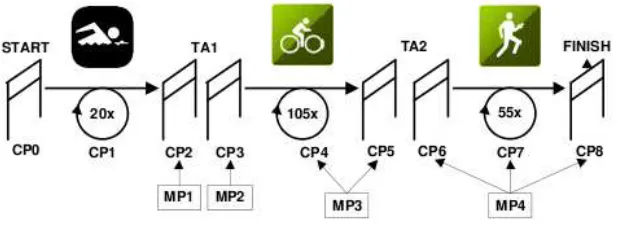
Measuring time in triathlon competitions can be divided into nine control points (Fig. 1). The control point (CP) is a location on the triathlon course, where the organizers need to check the measured time. This can be intermediate or final. When dealing with a double triathlon there are 7.6 km of swimming, 360 km of bicycling, and 84 km of running. Hence the swimming course of 380 meters consists of 20 laps, the bicycling course of 3.4 kilometers contains 105 laps, and the running course of 1.5 kilometers has 55 laps (Fig. 1).
Fig. 1.Definition of control points in the triathlon
(CP1), the intermediate time for bicycling (CP4) and the intermediate time for running (CP7). However, the current time INTER x and the number of remain-ing laps LAPS x are measured by the intermediate results, wherex= {1,2,3}
denotes the appropriate discipline (1=SWIM, 2=BIKE and 3=RUN).
The DSL EasyTime was developed in order to achieve this goal, and has been employed in practice by conducting measurements at the World Cham-pionship in the Double Triathlon in 2009. Note that the measurements were realized according to Fig. 1. The next sections presents the design, implemen-tation, and operation of EasyTime.
3.
The Design of the EasyTime Domain-Specific Language
Typically, the development of a DSL consists of the following phases [17]:
– a domain analysis,
– a definition of an abstract syntax, – a definition of a concrete syntax, – a definition of formal semantics, and – an implementation of the DSL.
Domain analysis provides an analysis of the application domain, i.e. measuring time in sporting competitions. The results of this analysis define those con-cepts of EasyTime that are typically represented within a feature diagram [5, 25]. The feature diagram also describes dependencies between the concepts of DSL. Thus, each concept can be broken-down into features and sub-features. In the case of EasyTime, the concept race consists of sub-features: events
(e.g., swimming, bicycling, and running), control points, measuring time,
transition area, and agents. Each control point is described by its starting
and f inishline and at least one lap. In addition, the feature transition area
can be introduced as the difference between the finish and start times. Both
updating time and decrementing laps are sub-features of measuring time. However, an agent is needed for the processing of events received from the measuring device. It can act eitherautomaticallyor manually. Note that dur-ing domain analysis not all the identified concepts are useful for solvdur-ing actual problem. Hence, the identified concepts can be further classified into [16]:
– irrelevant concepts, those which are irrelevant to the actual problem; – variable concepts, those which actually need to be described in the DSL
program; and
– fixed concepts, those which can be built into the DSL execution environ-ment.
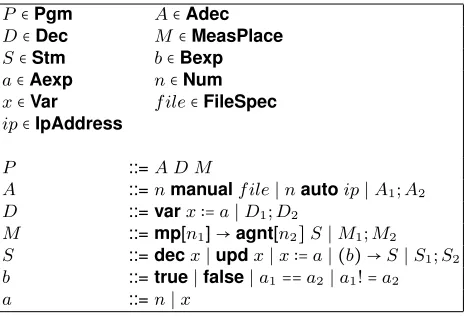
terminal symbols are defined. The translations of the EasyTime domain con-cepts to non-terminals are presented and explained in Table 1, whilst an ab-stract syntax is presented in Table 2. Note that, the conceptsEventsand Tran-sition are irrelevant for solving actual problem and are not mapped into non-terminals’ symbols (denoted asnone in Table 1). Interestingly, a description of agents and measuring places cannot be found in other DSLs or GPLs. Whilst attribute declaration is similar to variable declaration in many other program-ming languages. However, note that there is the distinction that variables are actually database attributes allocated for every competitor. Some statements, such as assignment, conditional statement, and compound statement can be found in many other programming languages, whilst decrement attributes and update attributes are domain-specific constructs.
Table 1.Translation of the application domain concepts into a context-free grammar
Application domain concepts Non-terminal Formal sem. Description
Race P CP Description of agents; control points; measuring
places.
Events (swimming, cycling, none none Measuring time is independent from the type of an
running) event. However, good attribute’s identifier in control
points description will resemble the type of an event. Transition area times none none Can be computed as difference between events final
and starting times.
Control points (start, number D D Description of attributes where start and finish time
of laps, finish) will be stored as well as remaining laps.
Measuring places (update time, M CM Measuring place id; agent id, which will control this
decrement lap) measuring place; specific actions (presented
with new non-terminal S) which will be performed at this measuring place (e.g., decrement lap). Agents (automatic, manual) A A Agent id; agent type (automatic, manual); agent
sour-ce (file, ip).
Table 2.The abstract syntax of EasyTime
P∈Pgm A∈Adec
D∈Dec M∈MeasPlace
S∈Stm b∈Bexp
a∈Aexp n∈Num
x∈Var f ile∈FileSpec ip∈IpAddress
P ::=A D M
A ::=nmanualf ile|nautoip|A1;A2
D ::=varx∶=a|D1;D2
M ::=mp[n1]→agnt[n2]S|M1;M2
S ::=decx|updx|x∶=a|(b) →S|S1;S2
b ::=true|false|a1==a2|a1!=a2
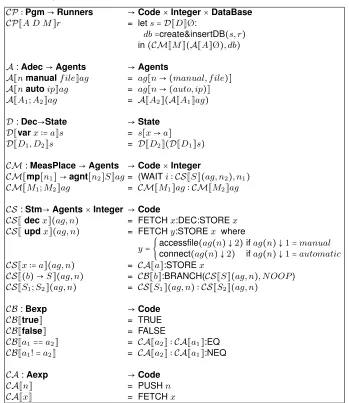
Although a language designer can proceed after domain analysis with infor-mal or forinfor-mal design patterns [17] the forinfor-mal design step is preferred since it can identify problems before the DSL is actually implemented [27]. Moreover, formal specifications can be implemented automatically by language develop-ment systems, thus significantly reducing the impledevelop-mentation effort [17]. The meaning of the EasyTime language constructs is prescribed during the formal semantics phase. Each language construct, belonging to the syntax domain, is mapped into an appropriate semantic domain (Table 3) by semantic functions
C P,A,D,C M,C S,C B, andC A(Table 4).
Table 3.Semantic domains
Integer={. . .−3,−2,−1,0,1,2,3. . .} n∈Integer Truth-Value={true, f alse}
State=Var→Integer s∈State
AType={manual, auto}
Agents=Integer→AType× (F ileSpec ∪ IpAddress)ag∈Agents Runners=(Id×RF ID×LastN ame×F irstN ame)∗
r∈Runners DataBase=(Id×V ar1×V ar2×. . .×V arn)∗ db∈DataBase
Code=String c∈Code
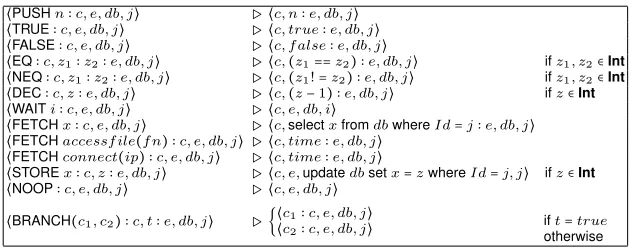
These semantic functions translate EasyTime constructs into the instruc-tions of the simple virtual machine. The meaning of virtual machine instrucinstruc-tions has been formally defined using operational semantics (Table 5) as the transi-tion of configuratransi-tions<c, e, db, j>, wherecis a sequence of instructions,eis
the evaluation stack to evaluate arithmetic and boolean expressions,dbis the database, andj is the starting number of a competitor. More details of Easy-Time syntax and semantics are presented in [9]. This article focuses on the implementation phase, as presented in the next section.
Table 4.EasyTime formal semantics
CP ∶Pgm→Runners →Code×Integer×DataBase CP⟦A D M⟧r = lets= D⟦D⟧Ø:
db=create&insertDB(s, r) in(CM⟦M⟧(A⟦A⟧Ø), db) A:Adec→Agents →Agents
A⟦nmanualf ile⟧ag = ag[n→ (manual, f ile)] A⟦nautoip⟧ag = ag[n→ (auto, ip)] A⟦A1;A2⟧ag = A⟦A2⟧(A⟦A1⟧ag)
D:Dec→State →State D⟦varx∶=a⟧s = s[x→a] D⟦D1, D2⟧s = D⟦D2⟧(D⟦D1⟧s)
CM:MeasPlace→Agents →Code×Integer
CM⟦mp[n1] →agnt[n2]S⟧ag= (WAITi∶ CS⟦S⟧(ag, n2), n1)
CM⟦M1;M2⟧ag = CM⟦M1⟧ag∶ CM⟦M2⟧ag
CS:Stm→Agents×Integer →Code
CS⟦decx⟧(ag, n) = FETCHx:DEC:STOREx CS⟦updx⟧(ag, n) = FETCHy:STOREx where
y= {accessfile(ag(n) ↓2)ifag(n) ↓1=manual connect(ag(n) ↓2) ifag(n) ↓1=automatic CS⟦x∶=a⟧(ag, n) = CA⟦a⟧:STOREx
CS⟦(b) →S⟧(ag, n) = CB⟦b⟧:BRANCH(CS⟦S⟧(ag, n), N OOP) CS⟦S1;S2⟧(ag, n) = CS⟦S1⟧(ag, n) ∶ CS⟦S2⟧(ag, n)
CB:Bexp →Code
CB⟦true⟧ = TRUE
CB⟦false⟧ = FALSE
CB⟦a1==a2⟧ = CA⟦a2⟧ ∶ CA⟦a1⟧:EQ
CB⟦a1!=a2⟧ = CA⟦a2⟧ ∶ CA⟦a1⟧:NEQ
CA:Aexp →Code
CA⟦n⟧ = PUSHn
CA⟦x⟧ = FETCHx
all the requested 105 laps (ROU N D2 == 0) then time spent on the bicycle
must be stored in the database (upd BIKE). Lines 28-33 define the fourth measuring place which is also controlled by automatic agent no. 2. At this measuring place we must first check if a competitor has just started running (ROU N D3==55). If this is the case, we must record the transition time between
Algorithm 1 EasyTime program for measuring time in a triathlon competition as illustrated in Fig. 1
1: 1 manual ”abc.res”;
2: 2 auto 192.168.225.100;
3:
4: var ROUND1 := 20;
5: var INTER1 := 0;
6: var SWIM := 0;
7: var TRANS1 :=0;
8: var ROUND2 := 105;
9: var INTER2 :=0;
10:var BIKE := 0;
11:var TRANS2 :=0;
12:var ROUND3 := 55;
13:var INTER3 := 0;
14:var RUN := 0;
15:
16:mp[1]→agnt[1]{ 17: (true)→upd SWIM; 18: (true)→dec ROUND1; 19:}
20:mp[2]→agnt[1]{ 21: (true)→upd TRANS1;
22:}
23:mp[3]→agnt[2]{ 24: (true)→upd INTER2;
25: (true)→dec ROUND2;
26: (ROUND2 == 0)→upd BIKE;
27:}
28:mp[4]→agnt[2]{
29: (ROUND3 == 55)→upd TRANS2; 30: (true)→upd INTER3;
31: (true)→dec ROUND3;
32: (ROUND3 == 0)→upd RUN;
33:}
4.
Implementation of the Domain-Specific Language
EasyTime
4.1. A LISA Compiler-Generator
One of the benefits of formal language specifications is the unique possibil-ity for automatic language implementation. Although some compiler generators accept denotational semantics [22], the generated compilers are mostly inef-ficient. Although many compiler-generators based on attribute grammars [12, 20] exist today, we selected a LISA compiler-compiler that was developed at the University of Maribor in the late 1990s [18]. The LISA tool produces a highly efficient source code for: the scanner, parser, interpreter or compiler, in Java. The lexical and syntactical parts of the language specification in LISA supports various well-known formal methods, such as regular expressions and BNF [1]. LISA provides two kinds of user interfaces:
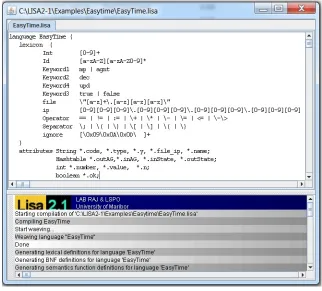
– a graphic user interface (GUI) (Fig. 2), and – a Web-Service user interface.
Table 5.The virtual machine specification ⟨PUSHn∶c, e, db, j⟩ ▷ ⟨c, n∶e, db, j⟩ ⟨TRUE∶c, e, db, j⟩ ▷ ⟨c, true∶e, db, j⟩ ⟨FALSE∶c, e, db, j⟩ ▷ ⟨c, f alse∶e, db, j⟩
⟨EQ∶c, z1∶z2∶e, db, j⟩ ▷ ⟨c,(z1==z2) ∶e, db, j⟩ ifz1, z2∈Int ⟨NEQ∶c, z1∶z2∶e, db, j⟩ ▷ ⟨c,(z1!=z2) ∶e, db, j⟩ ifz1, z2∈Int
⟨DEC∶c, z∶e, db, j⟩ ▷ ⟨c,(z−1) ∶e, db, j⟩ ifz∈Int
⟨WAITi∶c, e, db, j⟩ ▷ ⟨c, e, db, i⟩
⟨FETCHx∶c, e, db, j⟩ ▷ ⟨c,selectxfromdbwhereId=j∶e, db, j⟩ ⟨FETCHaccessf ile(f n) ∶c, e, db, j⟩ ▷ ⟨c, time∶e, db, j⟩
⟨FETCHconnect(ip) ∶c, e, db, j⟩ ▷ ⟨c, time∶e, db, j⟩
⟨STOREx∶c, z∶e, db, j⟩ ▷ ⟨c, e,updatedbsetx=zwhereId=j, j⟩ ifz∈Int ⟨NOOP∶c, e, db, j⟩ ▷ ⟨c, e, db, j⟩
⟨BRANCH(c1, c2) ∶c, t∶e, db, j⟩ ▷ {⟨c1∶c, e, db, j⟩
⟨c2∶c, e, db, j⟩ ift=true
otherwise
– since it is written in Java, LISA works on all Java platforms, – a textual or a visual environment,
– an Integrated Development Environment (IDE), where users can specify, generate, compile and execute programs on the fly,
– visual presentations of different structures, such as finite-state-automata, BNF, a dependency graph, a syntax tree, etc.,
– modular and incremental language development [19].
LISA specifications are based on Attribute Grammar (AG) [20] as introduced by D.E. Knuth [12]. The attribute grammar is a triple AG= ⟨G, A, R⟩, whereG
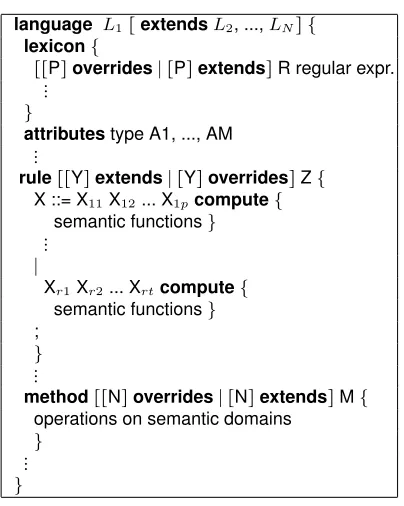
denotes a context-free grammar,Aa finite set of attributes, andRa finite set of semantic rules. In line with this, the LISA specifications (Table 6) include:
– lexical regular definitions (lexicon part in Table 6), – attribute definitions (attributes part in Table 6), – syntax rules (rule part before compute in Table 6), – semantic rules, (rule part after compute in Table 6) and – operations on semantic domains (method part in Table 6).
Fig. 2.LISA GUI
4.2. Translation scheme from denotational semantics to attribute
grammars
The most difficult part of transforming formal EasyTime specifications into LISA specifications, consists of mapping denotational semantics into attribute gram-mars. This mapping can be described in a systematic manner, and can also be used for the implementation of other DSLs (e.g., [15]). It consist of the follow-ing steps similar to the translation scheme from natural semantics into attribute grammars [3]:
1. Identification of syntactic and semantic domains in each semantic func-tion of denotafunc-tional semantics. Identified syntactic domains must have their counterparts in non-terminals of concrete syntax. Identified semantic do-mains must be represented appropriately, with suitable data structures (ty-pes) in chosen programming language.
Table 6.LISA specifications
language L1[extendsL2, ...,LN]{
lexicon{
[[P]overrides∣ [P]extends]R regular expr. ⋮
}
attributestype A1, ..., AM ⋮
rule[[Y]extends∣ [Y]overrides]Z{
X ::= X11X12... X1pcompute{ semantic functions}
⋮ ∣
Xr1Xr2... Xrtcompute{ semantic functions}
;
}
⋮
method[[N]overrides∣ [N]extends]M{
operations on semantic domains
}
⋮
}
non-terminal should not have inherited attributes. Whilst LISA automatically infers whether an attribute is inherited or synthesized [12], the type of at-tribute must be specified (Fig. 2).
3. For all identified attributes attached to a particular non-terminal’s, semantic equations need to be developed that are in conformance to semantic equa-tions from denotational semantics. In particular, semantic equaequa-tions need to be written for each synthesized attribute of the left-hand side non-terminal and for each inherited attribute attached to non-terminals of the right-hand side. This rule is applied to every production of a concrete syntax. In this step the whole semantic equation is not yet written, only the existence of such an equation is identified.
4. In the productions of concrete syntax certain new non-terminals appear, which are consequences of transformation of abstract syntax into concrete syntax. These non-terminals also carry information that are needed for com-putations. In this step such non-terminals are identified and attached at-tributes are classified into inherited and synthesized.
5. Finalizing semantics for all identified semantic equations. These semantic equations need to be in conformance to denotational semantics, and require careful examination of semantic functions of denotational semantics (e.g.,
C P,A,D,C M,C S,C B, andC Afrom Table 4). This step is most demanding.
ex-Table 7.The concrete syntax of EasyTime
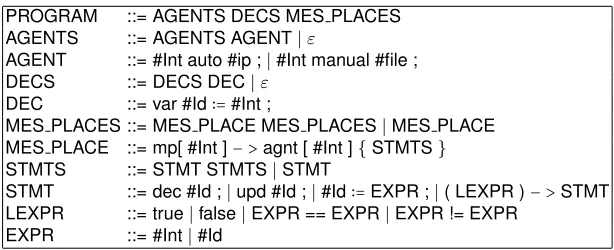
PROGRAM ::= AGENTS DECS MES PLACES AGENTS ::= AGENTS AGENT|ε
AGENT ::= #Int auto #ip ;|#Int manual #file ; DECS ::= DECS DEC|ε
DEC ::= var #Id∶=#Int ;
MES PLACES ::= MES PLACE MES PLACES|MES PLACE MES PLACE ::= mp[ #Int ]− >agnt [ #Int ]{STMTS}
STMTS ::= STMT STMTS|STMT
STMT ::= dec #Id ;|upd #Id ;|#Id∶=EXPR ;|( LEXPR )− >STMT LEXPR ::= true|false|EXPR == EXPR|EXPR != EXPR
EXPR ::= #Int|#Id
pressions and commands of a language under development. Such addi-tional tests require that new attributes are defined to carry the results of tests, as well as existing attributes being propagated to appropriate con-structs (e.g., expressions, commands). An attribute grammar is finalized during this step.
Note that the presented guidelines are general and not restricted to a par-ticular class of attribute grammars [12, 20] (e.g., S-attributed, L-attributed, or-dered attribute grammar, absolutely non-circular attribute grammar). Actually, the class of obtained attribute grammar can be identified only after the transla-tion has been completely performed.
4.3. Translation scheme from EasyTime formal semantics to LISA
When applying the aforementioned rules to EasyTime, the following results are obtained after each step.
Step 1:
The following non-terminals from Table 7 represent syntactic domains
(Ta-ble 2): PROGRAM∈Pgm, MES PLACES∈MeasPlace, DECS∈Dec, AGENTS
∈Adec, STMTS∈Stm, etc. Semantic domains (Table 3) such asInteger,
Truth-Value,Codehave direct counterparts with Java types: int, boolean, and String. While semantic domains which are functions (e.g.,State,Agents) can be mod-eled with Java Hashtable type. For example, from Figure 2 we can notice that attributeinState, which represents functionState, is of type Hashtable. Using methods such asput(), get(), andcontainsKey() we can respectively insert
Step 2:
From C P ∶ Pgm → Runners → Code × Integer × DataBase (Table 4) it
can be concluded that to non-terminal PROGRAM one inherited (representing a parameter of type Runners) and three synthesized attributes (representing parameters ofCode,Integer, and DataBase) need to be attached. However, the starting non-terminal should not have inherited attributes [12, 20]. From the definition of semantic functionC P (Table 4) it can be noticed that the input
pa-rameter of typeRunners are only needed to create a database. Hence, both parameters (of typeRunnersandDataBase) can be omitted from LISA speci-fications, and its functionality can be externally implemented. Moreover, it was decided to represent both the generated code and the identification number of the virtual machine, where the code is going to be executed, as a string”(Code, Integer)”. Hence, only one synthesized attribute, PROGRAM.code, is attached to starting non-terminal PROGRAM.
From A ∶ Adec → Agents → Agents(Table 4) it can be concluded that one
inherited and one synthesized attribute need to be attached to non-terminal AGENTS. For this purpose AGENTS.inAG is an inherited attribute, and AGEN-TS.outAG a synthesized attribute. Both attributes are of type Hashtable since semantic domainAgentsis a function, which can be modeled as a Hashtable.
From D ∶Dec → State→State(Table 4) it can be concluded that one
inher-ited and one synthesized attributes need to be attached to non-terminal DECS. For this purpose DECS.inState is inherited attribute, and DECS.outState a syn-thesized attribute. Both attributes are of type Hashtable since semantic domain
Stateis a function, which can be modeled as a Hashtable.
FromC M ∶MeasPlace →Agents→ Code×Integer(Table 4) it can be
con-cluded that one inherited and two synthesized attributes need to be attached to non-terminal MES PLACES. Again, it was decided to represent both, a gener-ated code and the identification number of virtual machine, as a string. For this purpose MES PLACES.inAG is an inherited attribute and MES PLACES.code is a synthesized attribute.
From C S ∶ Stm → Agents × Integer → Code (Table 4) it can be concluded
that two inherited and one synthesized attribute need to be attached to non-terminal STMTS. For this purpose STMTS.inAG and STMTS.n are inherited attributes of type Hashtable and int, respectively. The attribute STMTS.code is a synthesized attribute of type String. The attributes, inherited and synthesized, attached to the appropriate non-terminals are collated in Table 8.
Table 8.Attributes of non-terminals representing syntactic domains from EasyTime for-mal semantics
X Inherited(X) Synthesized(X)
PROGRAM code
AGENTS inAG outAG
DECS inState outState MES PLACES inAG code
Step 3:
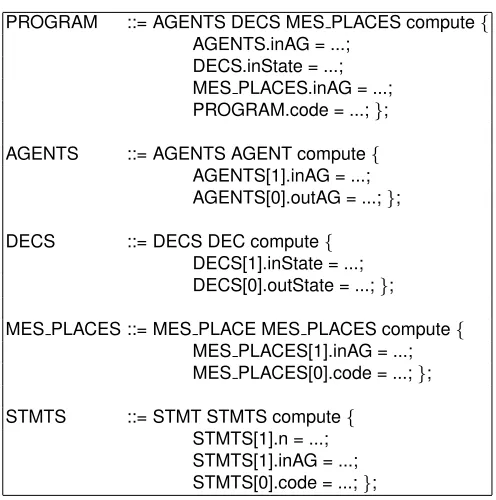
In this step semantic equations are given for each synthesized attribute of the left-hand side non-terminal, and for each inherited attribute for the right-hand side non-terminal. This procedure is applied to each production in the context-free grammar (Table 7). The LISA specification fragment as illustrated in Table 9 indicates, which semantic equations need to be developed. Let us explain the process for the first production. Since the non-terminal PROGRAM, left-hand side non-terminal, has only one synthesized attribute code (Table 8) only one semantic equation must be defined (PROGRAM.code = ...;). Other non-terminals (AGENTS, DECS, MES PLACES) in the first production are on the right hand side and hence only inherited attributes attached to those nonterminals must be defined (AGENTS.inAG = ...; DECS.inState = ...; MES -PLACES.inAG = ..;). Note that the order of these semantic equations is irrel-evant [12, 20].
Table 9.Semantic equations under development that are obtained after Step 3 PROGRAM ::= AGENTS DECS MES PLACES compute{
AGENTS.inAG = ...; DECS.inState = ...; MES PLACES.inAG = ...; PROGRAM.code = ...;}; AGENTS ::= AGENTS AGENT compute{
AGENTS[1].inAG = ...; AGENTS[0].outAG = ...;}; DECS ::= DECS DEC compute{
DECS[1].inState = ...; DECS[0].outState = ...;};
MES PLACES ::= MES PLACE MES PLACES compute{
MES PLACES[1].inAG = ...; MES PLACES[0].code = ...;}; STMTS ::= STMT STMTS compute{
Step 4:
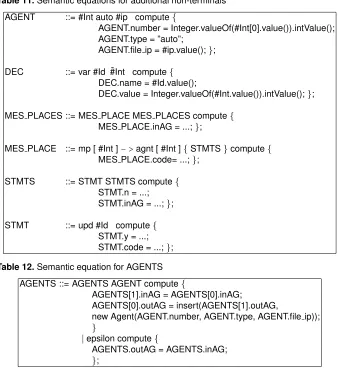
From step 3, it can be identified the following non-terminals, which appears in concrete syntax (Table 7) and were unidentified in steps 1 - 3: AGENT, DEC, MES PLACE, and STMT (Table 10). If the structure of these non-terminals is simple (e.g., AGENT, DEC) then attributes attached to these non-terminals car-ried only synthesized attributes representing mostly lexical values (Table 11). Semantic equations can be derived immediately for those attributes. On the other hand, some non-terminals might be complex (e.g., MES PLACE, STMT) and inherited attributes attached to these non-terminals are also needed. The attributes might be similar to those attributes attached to other non-terminals in productions, where new non-terminals appear (Table 8). Moreover, semantic equations may no longer be simple (Table 11). For example, attributes attached to non-terminals MES PLACE and STMT (Table 10) are the same as those attached to non-terminals STMTS and MES PLACES, respectively (Table 8). However, due to the semantics of the update statement (Table 4) another at-tributeyis attached to the non-terminal STMT (Table 10).
Table 10.Attributes for additional non-terminals
X Inherited(X) Synthesized(X) AGENT number, type, file ip
DEC name, value
MES PLACE inAG code STMT inAG, n code, y
Step 5:
The reasoning of this step is only explained for semantic functions Aand C M(Table 4), which are translated into attributes for non-terminals AGENTS,
AGENT, MES PLACES, and MES PLACE (Tables 8 and 10). For other se-mantic functions the reasoning is similar. The sese-mantic equationA⟦A1;A2⟧ag
=A⟦A2⟧ (A⟦A1⟧ag)(Table 4) constructsag∈Agents, which is a function from
an integer, denoting an agent, into an agent’s type (manual or auto), and an agent’s ip or agent’s file. This function is described in LISA as presented in Table 12. From Table 12 it can be noticed how the attributeoutAG, which rep-resents theag∈Agents, is constructed simply by the calling method insert().
The methodinsert()will insert a new agent with a particular number, type, and
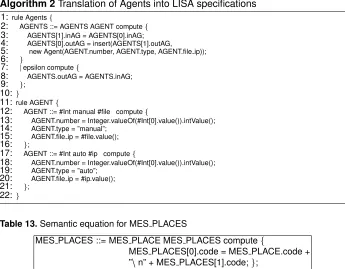
file ip into the Hashtable. Note also, how the missing equations from Step 3 have been developed. The net effect is that we are constructing a list, more precisely a hash table, of agents where we are recording the agent’s number (AGEN T.number), the agents’s type (AGEN T.type), and the agent’s ip or file (AGEN T.f ile ip) (see Step 4). The complete LISA specifications for semantic functionA, is shown in Algorithm 2.
The reasoning for the semantic function C M is done in a similar
man-ner. The semantic equation C M⟦M1;M2⟧ag =C M⟦M1⟧ag ∶ C M⟦M2⟧ag
repre-Table 11.Semantic equations for additional non-terminals AGENT ::= #Int auto #ip compute{
AGENT.number = Integer.valueOf(#Int[0].value()).intValue(); AGENT.type = ”auto”;
AGENT.file ip = #ip.value();}; DEC ::= var #Id ¯#Int compute{
DEC.name = #Id.value();
DEC.value = Integer.valueOf(#Int.value()).intValue();}; MES PLACES ::= MES PLACE MES PLACES compute{
MES PLACE.inAG = ...;};
MES PLACE ::= mp [ #Int ]− >agnt [ #Int ]{STMTS}compute{
MES PLACE.code= ...;}; STMTS ::= STMT STMTS compute{
STMT.n = ...; STMT.inAG = ...;}; STMT ::= upd #Id compute{
STMT.y = ...; STMT.code = ...;}; Table 12.Semantic equation for AGENTS
AGENTS ::= AGENTS AGENT compute{
AGENTS[1].inAG = AGENTS[0].inAG;
AGENTS[0].outAG = insert(AGENTS[1].outAG,
new Agent(AGENT.number, AGENT.type, AGENT.file ip));
}
∣epsilon compute{
AGENTS.outAG = AGENTS.inAG;
};
sented in Table 13, with the following meaning: The code for the first construct
MES PLACE is simply concatenated with the code from the second construct
M ES P LACES[1].
The semantic equationC M⟦mp[n1] →agnt[n2]S⟧ag =(W AIT i∶ C S ⟦S⟧ (ag, n2), n1)(Table 4) is described in LISA, as presented in Table 14.
However, in this step the undefined semantic equations from steps 3 and 4 also need to be developed (Table 15). For example, a list of agents (inAG) needs to be propagated.
Step 6:
Algorithm 2Translation of Agents into LISA specifications
1: rule Agents{
2: AGENTS ::= AGENTS AGENT compute{
3: AGENTS[1].inAG = AGENTS[0].inAG;
4: AGENTS[0].outAG = insert(AGENTS[1].outAG,
5: new Agent(AGENT.number, AGENT.type, AGENT.file ip));
6: }
7: ∣epsilon compute{
8: AGENTS.outAG = AGENTS.inAG;
9: };
10:}
11:rule AGENT{
12: AGENT ::= #Int manual #file compute{
13: AGENT.number = Integer.valueOf(#Int[0].value()).intValue();
14: AGENT.type = ”manual”;
15: AGENT.file ip = #file.value();
16: };
17: AGENT ::= #Int auto #ip compute{
18: AGENT.number = Integer.valueOf(#Int[0].value()).intValue();
19: AGENT.type = ”auto”;
20: AGENT.file ip = #ip.value();
21: };
22:}
Table 13.Semantic equation for MES PLACES
MES PLACES ::= MES PLACE MES PLACES compute{
MES PLACES[0].code = MES PLACE.code + ”/n” + MES PLACES[1].code;};
MES PLACES ::= MES PLACE compute{
MES PLACES.code = MES PLACE.code};
is necessary to propagate attributeinState into the measuring places, state-ments, and expressions. The complete LISA specifications for MES PLACE are shown in Algorithm 3 also using attributesokandinState.
Semantic equations for other production are obtained in a similar manner. Let us conclude this example by finalizing semantic equations for the starting production (see also Table 9). The initial hash table for agents (AGEN T S.inAG) and declarations (DECS.inState) are empty (Table 16). Agents and declara-tions are constructed after visiting the subtrees represented by the non-terminals
AGEN T SandDECS, and stored into attributesAGEN T S.outAGandDECS. outState, that are passed to the subtree represented by the non-terminalM ES P LACES. If all the syntactic constraints are satisfied (M ES P LACES.ok == true), then the generated code is equal to a code produced by the subtree represented by the non-terminalM ES P LACES.
Table 14.Semantic equation for MES PLACE
MES PLACE ::= mp [ #Int ]− >agnt [ #Int ]{STMTS}compute{
Table 15.Developing undefined semantic equations for MES PLACES MES PLACES ::= MES PLACE MES PLACES compute{
MES PLACE.inAG = MES PLACES[0].inAG; MES PLACES[1].inAG = MES PLACES[0].inAG; ...};
MES PLACES ::= MES PLACE compute{
MES PLACE.inAG = MES PLACES.inAG; ...};
Table 16.Semantic equations for the starting production
PROGRAM ::= AGENTS DECS MES PLACES compute{
AGENTS.inAG = new Hashtable(); DECS.inState = new Hashtable(); MES PLACES.inAG = AGENTS.outAG; MES PLACES.inState = DECS.outState; PROGRAM.code = MES PLACES.ok ? ”/n” + MES PLACES.code + ”/n” : ”ERROR”;};
5.
Operation
Local organizers of sporting competitions were faced with two possibilities be-fore developing EasyTime:
– to rent a specialized company to measure time, – to measure time manually.
The former possibility is expensive, whilst the latter can be very unreliable. How-ever, both objectives (i.e. inexpensiveness and reliability), can be fulfilled by EasyTime. On the other hand, producers of measuring devices usually deliver their units with software for the collecting of events into a database. Then these events need to be post-processed (batch processed) to get the final results of the competitors. Although this batch-processing can be executed whenever the organizer desires, each real-time application requests online processing. For-tunately, EasyTime enables both kinds of event processing.
In order to use the source program written in EasyTime by the measuring system, it needs to be compiled. Note that the code generation [1] of a program in EasyTime is performed only if the parsing is finished successfully. Otherwise the compiler prints out an error message and stops. For each of measuring places individually, the code is automatically generated by strictly following the rules, as defined in Section 3. An example of the generated code from the Algorithm 1 for the controlling of measurements, as illustrated by Fig. 1, is pre-sented in Table 17. Note that the generated code is saved into a database. The meaning of the particular instructions of virtual machine (e.g., WAIT, FETCH, STORE), is explained in Table 5.
Algorithm 3Translation of MES PLACE into LISA specifications
1: rule Mes places{
2: MES PLACES ::= MES PLACE MES PLACES compute{
3: MES PLACE.inAG = MES PLACES[0].inAG;
4: MES PLACES[1].inAG = MES PLACES[0].inAG;
5: MES PLACE.inState = MES PLACES[0].inState;
6: MES PLACES[1].inState = MES PLACES[0].inState;
7: MES PLACES[0].ok = MES PLACE.ok && MES PLACES[1].ok;
8: MES PLACES[0].code = MES PLACE.code + ”/n” + MES PLACES[1].code;
9: };
10:MES PLACES ::= MES PLACE compute{
11: MES PLACE.inAG = MES PLACES.inAG;
12: MES PLACE.inState = MES PLACES.inState;
13: MES PLACES.ok = MES PLACE.ok;
14: MES PLACES.code = MES PLACE.code;
15: };
16:}
17:rule MES PLACE{
18: MES PLACE ::= mp/[#Int/] / − / >agnt/[#Int/] /{STMTS/}compute{ 19: STMTS.inAG = MES PLACE.inAG;
20: STMTS.inState = MES PLACE.inState;
21: STMTS.n = Integer.valueOf(#Int[1].value()).intValue();
22: MES PLACE.ok = STMTS.ok;
23: MES PLACE.code = ”(WAIT i ” + STMTS.code + ”, ” + #Int[0].value() + ”)”;
24: };
25:}
is, only an interpretation of the code could have any impact on the performance of a measuring system. Because this interpretation is not time consuming, it cannot degrade the performance of the system. On the other hand, the preci-sion of measuring time is handled by the measuring device and is not changed by the processing of events. In fact, the events can be processed as follows:
– batch: manual mode of processing, and – online: automatic mode of processing.
The agent reads and writes the events that are collected in a text file, when the first mode of processing is assumed. Typically, events captured by a computer timer are processed in this mode. Here, the agent looks for an existence of the event text file that is configured in the agent statement. If it exists, the batch pro-cessing is started. When the propro-cessing is finished, the text file is archived and then deleted. The online processing is event oriented, i.e. each event generated by the measuring device is processed in time. In both modes of processing, the agent works with the program PGM, the runner table RUNNERS, and the re-sults table DATABASE, as can be seen in Fig. 3. An initialization of the virtual machine is performed when the agent starts. The initialization consists of load-ing the program code from PGM. That is, the code is loaded only once. At the same time, the variables are initialized on starting values.
Table 17.Translated code for the EasyTime program in Algorithm 1 (WAIT i FETCH accessfile(”abc.res”) STORE SWIM FETCH ROUND1 DEC STORE ROUND1, 1)
(WAIT i FETCH accessfile(”abc.res”) STORE TRANS1, 2) (WAIT i FETCH connect(192.168.225.100) STORE INTER2 FETCH ROUND2 DEC STORE ROUND2
PUSH 0 FETCH ROUND2 EQ BRANCH( FETCH connect(192.168.225.100) STORE BIKE, NOOP), 3) (WAIT i FETCH connect(192.168.225.100) STORE INTER3 PUSH 55 FETCH ROUND3 EQ BRANCH( FETCH
connect(192.168.225.100) STORE TRANS2, NOOP) FETCH ROUND3 DEC STORE ROUND3
PUSH 0 FETCH ROUND3 EQ BRANCH( FETCH connect(192.168.225.100) STORE RUN, NOOP), 4)
him/her immediately. Actually, EasyTime is only of assistance to referees. All misuses of the triathlons rules do not have any impact on its operation.
Fig. 3.Executable environment of a program in EasyTime
me-ters for more than 20 seconds. Interestingly, this phenomenon is only pursued during long-distance triathlons, whilst drafting is allowed over short-distances. Any competitor who violates this drafting rule is punished by the referees with 5 minutes of elimination from the cycling race. The referees observe the race from motorcycles and determine the drafting violations according to their feelings. In this sense only, this assessment is very subjective. On the other hand, the ref-erees can control one competitor a time. Consequently, an automatic system is needed for detecting drafting violations during triathlons. A drafting detec-tion system is proposed in order to track this violadetec-tion. This system is based on smart-phones because these incorporate the following features: informa-tion access via wireless networks and GPS navigainforma-tion. Smart-phones need to be borne by competitors on their bicycles (Fig. 4). These determine informa-tion about competitor current GPS posiinforma-tions and transmit these over wireless modems to a web-service. From the positions of all competitors the web-service calculates whether a particular competitor is violating the drafting rule. In ad-dition, these violations can be tackled by the referees on motorcycles using smart-phones.
Fig. 4.Proposed system for drafting detection in triathlons
ob-tained by projecting the current position of the#-th competitor on the line that connects the points gained by tracking the cycling course with a precise GPS device, at each second. This has an impact on the competitor’s current posi-tion, from which the distance is calculated to the competitor in front of him. At the moment, both systems run on the same server separately. However, further development of a wireless technology and pervasive computing [29] indicates that EasyTime should have the ability to run on an application server as well.
Interestingly, the measuring time in biathlons represents another great chal-lenge for EasyTime. Here, competitors ski on cross-country skiis and stop at certain places to shoot at targets with rifles carried by them. In order to measure time during biathlons, EasyTime needs to be modified slightly. In line with this, two measuring devices are need, and a special measuring device for counting hits. The first measuring device is dedicated to measuring the four laps of ski-ing, whilst the second is applied for counting the penalty laps. Each missed shot attracts one additional penalty lap. The measuring device for counting hits is de-scribed in EasyTime as a new agent. This agent is responsible for setting the number of additional penalty laps to be measured using the second measuring device. In contrast to the static initialization of the laps counter in EasyTime, a new request is demanded, i.e, a dynamic initialization of this laps counter needs to be implemented.
6.
Conclusion
The flexibility of the measuring system is a crucial objective in the development of universal software for measuring time in sporting competitions. Therefore, the domain-specific language EasyTime was formally designed, which enables the quick adaptation of a measuring system to the new requests of different sporting competitions. Preparing the measuring system for a new sporting competition with EasyTime requires the following: changing a program’s source code that controls the processing of an agent, compiling a source code and restarting the agent. Using EasyTime in the real-world has shown that when measuring times in small sporting competitions, the organizers do not need to employ specialized and expensive companies any more. On the other hand, EasyTime can reduce the heavy configuration tasks of a measuring system for larger competitions, as well. In this paper, we explained how the formal semantics of EasyTime are mapped into LISA specifications from which a compiler is automatically generated. Despite the fact that mapping is not difficult, it is not trivial either, as some additional rules must be defined for attribute propagation. Moreover, we need to take care of error reporting (e.g., multiple declarations of variables). In future work, EasyTime could be replaced by the domain-specific modeling language (DSML) [24, 26, 28] that could additionally simplify the programming of a measuring system.
References
1. A.V. Aho and J.D. Ullman.The theory of parsing, translation, and compiling. Prentice Hall PTR, Upper Saddle River, NJ, USA, 1972.
2. P. Arpaia, L. Fiscarelli, G. La Commara, and C. Petrone. A model-driven domain-specific scripting language for measurement-system frameworks. IEEE Transac-tions on Instrumentation and Measurement, 60(12):3756–3766, 2011.
3. I. Attali and D. Parigot. Integrating natural semantics and attribute grammars: the minotaur system. Technical Report 2339, INRIA, 1994.
4. Championchip website, 2010.
5. A. van Deursen and P. Klint. Domain-specific language design requires feature descriptions. Journal of Computing and Information Technology, 10:1–17, 2002. 6. K. Finkenzeller.RFID Handbook. John Wiley & Sons, Chichester, UK, 2010. 7. I. Fister, M. Mernik, and B. Filipiˇc. Optimization of markers in clothing industry.
Engineering Application of Artificial Intelligence, 21(4):669–678, 2008.
8. I. Fister, M. Mernik, and B. Filipiˇc. A hybrid self-adaptive evolutionary algorithm for marker optimization in the clothing industry. Applied Soft Computing, 10(2):409– 422, 2010.
9. I. Jr. Fister, I. Fister, M. Mernik, and J. Brest. Design and implementation of domain-specific language Easytime. Computer Languages, Systems & Structures, 37(4):276–304, 2011.
11. P. Hudak. Building domain-specific embedded languages.ACM computing surveys, 28, 1996.
12. D. Knuth. Semantics of context-free languages. Mathematical Systems Theory, 2(2):127–145, 1968.
13. T. Kos, T. Kosar, and M. Mernik. Development of data acquisition systems by using a domain-specific modeling language.Computers in industry, 63(3):181–192, 2012. 14. T. Kosar, M. Mernik, and J.C. Carver. Program comprehension of domain-specific and general-purpose languages: comparison using a family of experiments. Empir-ical software engineering, 17(3):276–304, 2012.
15. I. Lukoviˇc, M.J. Varanda Pereira, N. Oliveira, D. da Cruz, and P.R. Henriques. A DSL for PIM specifications: Design and attribute grammar based implementation.
Computer Science and Information Systems, 8(2):379–403, 2011.
16. S. Mauw, W. Wiersma, and T. Willemse. Language-driven system design. Interna-tional Journal of Software Engineering and Knowledge Engineering, 14:1–39, 2004. 17. M. Mernik, J. Heering, and A. Sloane. When and how to develop domain-specific
languages.ACM computing surveys, 37(4):316–344, 2005.
18. M. Mernik, M. Leniˇc, E. Avdiˇcauˇseviˇc, and V. ˇZumer. Lisa: an interactive environment for programming language development. In11th International Conference Compiler Construction, volume 2304 ofLecture Notes in Computer Science, pages 1–4, 2002. 19. M. Mernik and V. ˇZumer. Incremental programming language development.
Com-puter Languages, Systems and Structures, 31(1):1–16, 2005.
20. J. Paakki. Attribute grammar paradigms - a high-level methodology in language implementation.ACM Computing Surveys, 27(2):196–255, 1995.
21. S. Pakin. The design and implementation of a domain-specific language for net-work performance testing. IEEE Transactions on Parallel and Distributed Systems, 18(10):1436–1449, 2007.
22. L. Paulson. A semantics-directed compiler generator. In Proceedings of the 9th ACM SIGPLAN-SIGACT Symposium on Principles of Programming Languages, POPL ’82, pages 224–233, 1982.
23. Rfid timing system website, 2010.
24. J. Sprinkle, M. Mernik, J-P. Tolvanen, and D. Spinellis. What kinds of nails need a domain-specific hammer?IEEE Software, 26(4):15–18, 2009.
25. V. ˇStuikys and R. Damaˇsevicius. Measuring complexity of domain models repre-sented by feature diagrams. Information Technology And Control, Kaunas, Tech-nologija, 38(3):179–187, 2009.
26. V. ˇStuikys, R. Damaˇsevicius, and A. Targamadze. A model-driven view to meta-program development process.Information Technology And Control, Kaunas, Tech-nologija, 39(3):89–99, 2010.
27. M. Viroli, J. Beal, and M. Casadei. Core operational semantics of proto. In Pro-ceedings of the 2011 ACM Symposium on Applied Computing, SAC ’11, pages 1325–1332, New York, NY, USA, 2011. ACM.
28. R. Vitiutinas, D. Silingas, and L. Telksnys. Model-driven plug-in development for uml based modeling systems. Information Technology And Control, Kaunas, Tech-nologija, 40(3):191–201, 2011.
Iztok Fister Jr.is a first-year post-graduate student in Computer Science and Information Technologies at the Faculty of Electrical Engineering and Computer Science, University of Maribor. Besides his study and research activities, espe-cially in the field of web-oriented programming, he is an enthusiastic competitor in triathlons. He is a student member of IEEE.
Mernik Marjan received his M.Sc., and Ph.D. degrees in computer science
from the University of Maribor in 1994 and 1998 respectively. He is currently a professor at the University of Maribor, Faculty of Electrical Engineering and Computer Science. He is also a visiting professor at the University of Alabama in Birmingham, Department of Computer and Information Sciences, and at the University of Novi Sad, Faculty of Technical Sciences. His research inter-ests include programming languages, compilers, domain-specific (modeling) languages, grammar-based systems, grammatical inference, and evolutionary computations. He is a member of the IEEE, ACM and EAPLS.
Iztok Fistergraduated in computer science from the University of Ljubljana in 1983. In 2007, he received his Ph.D. degree from the Faculty of Electrical En-gineering and Computer Science, University of Maribor. Since 2010, he has worked as a Teaching Assistant in the Computer Architecture and Languages Laboratory at the same faculty. His research interests include computer archi-tectures, program languages, operational research, artificial intelligence, and evolutionary algorithms. He is a member of IEEE.
Dejan Hrn ˇci ˇc received his B.Sc. degree from the Faculty of Electrical Engi-neering and Computer Science, University of Maribor, in 2007. Currently he is working on his Ph.D. thesis in computer science. His research interests include evolutionary computation, grammatical inference, and optimization techniques.