ISSN: 2250-1177 [415] CODEN (USA): JDDTAO Available online on 15.03.2019 at http://jddtonline.info
Journal of Drug Delivery and Therapeutics
Open Access to Pharmaceutical and Medical Research© 2011-18, publisher and licensee JDDT, This is an Open Access article which permits unrestricted non-commercial use, provided the original work is properly cited
Open Access
Review Article
Preparation of solid lipid nanoparticles through various methods using
different precursors
Ms.Richa Singh
Department of pharmacology, DIPSAR, Delhi pharmaceutical sciences and research university, New Delhi, India
ABSTRACT
Now a day there has been exponential increase in interest in developing nanoparticles for novel drug delivery system. Nanoparticles provide many advantages over conventional drug delivery system like improved pharmacokinetic property; enhance bioavailability, smaller drug dose required for the treatment. Recently solid lipid nanoparticles (SLN) materialized as novel approach to oral and parenteral drug delivery system. SLN possess a solid lipid core that can solubilise lipophilic drug. Lipid core was stabilised by using surfactant (emulsifier). SLN can be prepared by using various precursors like emulsion, micro emulsion, and SLM can be prepared by using lipid coated microcrystal. These precursors further proceed to obtain particles of desired size and shape by making use of various techniques and equipment’s. Each precursor show benefits along with some limitations.
Keywords: solid lipid nanoparticles, SLN precursors, membrane contractor, spray dry and congealing, GAMA.
Article Info: Received 13 Jan 2019; Review Completed 24 Feb 2019; Accepted 25 Feb 2019; Available online 15 March 2019
Cite this article as:
Singh R, Preparation of solid lipid nanoparticles through various methods using different precursors, Journal of Drug Delivery and Therapeutics. 2019; 9(2):415-419 http://dx.doi.org/10.22270/jddt.v9i2.2461 *Address for Correspondence:
Ms.Singh Richa, Department of pharmacology, DIPSAR, Delhi pharmaceutical sciences and research university, New Delhi, India
INTRODUCTION
A solid lipid nanoparticle is typically spherical in shape or some time bicontionous structure with an avg. Diameter b/w 10-1000 nm. In SLN drug is encapsulated in lipid matrix which is stabilised by using surfactant or co-surfactant or by using mixture of surfactant. Combination of surfactants prevents particles agglomeration more efficiently. Lipid used in SLN preparation are triglyceride i.e. Tristearin, Monoglyceride i.e. Glycerol Monostearate, steroids and
wax’s. Thereare various methods which uses different types
of precursors for the preparation of solid nanoparticles. These precursors provide intermediates to the obtain nano-particles of desired size. Precursor chosen for the preparation of SLN depends on size of particle which we want to obtain. Some precursors like emulsion, micro emulsion produce SLN whereas some precursors and methods produce SLM (solid lipid micro particles). Various solvents used during preparation of precursor which removed completely at final step of SLN formation which is important from toxicological point of view. Precursors used for SLN preparation are namely:-
1) Emulsion
It is mixture of two or more immiscible liquid which consist a fine dispersion of minute droplets of one liquid into
another with or without emulsifier. It is widely used as precursor for the synthesis of SLN.
Emulsion can be o/w or w/o type or either w/o/w or o/w/o. SLN can be prepared through emulsion by following techniques:-
1.1) By Hot Homogenisation
ISSN: 2250-1177 [416] CODEN (USA): JDDTAO 1.12) high shear and ultrasound homogenisation: - these two
methods are widely used and can easily handle. Both these method used to improve dispersion quality of micro
particles. SLN particles prepared by these methods consist suitable emulsifying agent which allows formation hot intermediates due to use of high shear for mixing.
Figure 1: drug partitioning when hot homogenization technique used for SLN preparation. 1
1.2) Melt Dispersion Technique:-by employing this technique
micro particles obtained from emulsion. For lipophilic and hydrophilic drug o/w and w/o type emulsion used respectively. Lipophilic drug nanoparticles prepared by dissolving drug in melted lipid and then emulsified in hot surfactant solution using high shear for mixing, then obtain emulsion cooled at room temperature to get solid lipid micro
particles2. Whereas for preparing nanoparticles of
hydrophilic drug, aqueous solution of drug emulsified with melted lipid and then put in external aqueous phase to obtain w/o/w emulsion then it cooled to room temperature
to obtain solid micro particles of 1-250µm in diameter3.
1.3) Supercritical Fluid Extraction Of Emulsion (SFEE):-this
method based on extraction of solvent from emulsion by
passing through extraction column with supercritical co2 in
concurrent direction. Extraction efficiency depend on operating temperature and pressure. In this method drug in dissolved in melted lipid and emulsified with aqueous solution of surfactant and then homogenised to obtain fine emulsion. Then obtained o/w emulsion introduced in
extraction column and simultaneously supercritical co2
introduced from bottom counter-currently at constant temperature (35°c) and pressure (80bar).
Solvent extraction occur when emulsion come in contact
with supercritical co2 and expansion of organic phase occur
due to inverse flux of supercritical co2 into emulsion droplet
and leads to precipitation of lipid-drug material dissolved in
organic phase4 .
Advantage:-this method is high solvent extraction efficiency
as compare to other conventional methods. This method ensures complete removal of solvent which is important from toxicological point of view. Particle obtained by this
method have mean diameter b/w 20-90nm in diameter4.
1.4) Phase Inversion Temperature (Pit):-this method uses the
concept of ability of Polyethoxylated surfactants to change their affinity toward oil and water with temperature. In this method, surfactant used which leads to conversion of emulsion from o/w type to w/o when heated above pit and again converted back when temperature decreases below pit5 .
Pit method used for preparation of nanoparticles and nano-capsules. Now days it is used for the preparation of SLN. In which it consist oil phase and aqueous phase. Oil phase consist solid lipid and non-ionic surfactant and aqueous phase consist NaCl. Both phases heated separately at equal temperature above pit i.e. approximately 90c. Then aqueous phase added drop wise in oily phase under agitation and obtain w/o emulsion. Then it cool at room temp below pit and then o/w emulsion formed and SLN obtained of
30-100nm in diameter6.
2) Micro Emulsion as Precursor
Micro emulsion is also commonly used as precursor for SLN preparation. Particle size of droplet in micro emulsion varies from 10-80 nm. Particles shape of micro emulsion is not static its various from droplet like swollen micelle’s to bicontionous structure. Microemulsion has two unique properties one is it has low interface tension b/w oil and water interface and second one is highly flexible interface
which is obtained by using suitable co-surfactant7 .
Techniques used to prepare SLN from micro emulsion are:-
2.1) Micro emulsion dilution technique (MDT) - this method
first used by Gasco (researcher) for the preparation of SLN. This method can used for both lipophilic as well as for hydrophilic drug because of great solubilisation property off
ISSN: 2250-1177 [417] CODEN (USA): JDDTAO formation of o/w type micro emulsion which is prepared by
using melted lipid and by aqueous solution of surfactant and co-surfactant under stirring. Then formed micro emulsion cooled by diluting with water volume 10-200 times of micro emulsion and get SLN with reduced particle size and small size distribution.
B)Micro emulsion cooling technique (MCT):-in this method
SLN prepared from o/w emulsion by cooling at 4°c without diluting the emulsion. Emulsion obtained by melting emulsifying wax. This method operates at mild temp, less
time consuming and high drug entrapment is obtainable 10.
Particle size of obtained nanoparticles varies from 50-300nm.
3) Soap Micellar Solution as Precursors
This method based on coacervation technique which produces particles of 200-1000nm size. In this method interaction b/w micellar solution of fatty acid alkaline solution and acid solution takes place. As proton exchange proceed b/w coacervation solution and soap solution, fatty
acid get precipitates11,12 .
This method not uses drug incorporation in solvent and complex equipment’s for SLN preparation. Drug incorporates in micellar solution which is obtained at Kraft point. Good solubilising property of micellar solution help in loading
poorly soluble drug13,14 and give high drug loading in SLN.
Particle size of SLN depends on micellar solution concentration and grade of polymer used for stabilisation. 4) Using Water Miscible Solvent System
This method is developed to encapsulate drug to get enhanced stability and bioavailability. This method operates at mild temperature which makes it useful for Thermoliable drug substance. Different method used for SLN using water miscible solvent system
4.1) solvent injection method: - in this method drug and lipid
dissolved in water miscible solvent which is injected in water phase through syringe needle with continuous stirring. Then water is added which result into precipitation of lipid, encapsulating drug. Particle size of obtained SLN depends on type of lipid, surfactant, and solvent used in preparation and also depends on viscosity of external phase. This method produces nanoparticles of 100-500nm in diameter.
4.2) solvent evaporation method: - in this method o/w
emulsion prepared for lipophilic drug which is dissolved in
inner organic phase15 and w/o emulsion for hydrophilic
drug that is dissolved in inner aqueous phase system 16,17.
In this method lipid matrix dissolved in water immiscible organic solvent which is emulsified aqueous phase then solvent is removed under reduced pressure which results into precipitation of lipid matrix and nanoparticles formed of
30-500nm in diameter16,18 . But this method become out
dated because nanoparticles are formed by removal of solvent by evaporation and chances of solvent residue remain left which is not good from toxicological point of view.
Organic solvent and prepare emulsion of o/w type. When this emulsion poured in water, drug start to solidify which is
dissolved in organic solvent due to diffusion of solvent from droplet to continuous phase.
Solvent used like benzyl alcohol, methyl ethyl acetone, ethyl Formate in this method give good quality drug loaded PGLA
microsphere19.
5) Coarse and Fine Suspension as Precursors SLN prepared by this precursor requires one step process which convert particle of suspension directly into solid nanoparticles. This precursor used as feed solution which first atomised by various technique like pneumatic and ultrasonic atomisation to get spray foam, then it come in contact with hot gas, which results into formation solid dried
particles due to evaporation solvent20 . Obtained dried
particles separated by cyclone.
Advantage:-in this technique various parameter can be
controlled like droplet size, solute concentration, relative humidity and temperature and which is helpful in
characterisation of obtained nanoparticles21.
6) Solid Lipid Micro Particles as Precursor
SLM produced from ethanolic solution of lipid and drug. It can prepared by various method spry drying and spray congealing method. SLM prepared by spry drying method is smaller and more homogenous in nature. Shape of the particles influenced by:
(i) Drying rate
(ii) Viscosity of liquid which constitute feed (iii) Surface tension
Whereas in electrospray method, SLM and SLN prepared by forming alcoholic solution of lipid which is used for preparing particles of nearly 1µm in diameter. The solution contained in syringe which is connected with metallic capillary. Then solution passed through syringe under the influence of electric field and solvent get evaporated during travelling.
Particle size and shape depend on solvent and applied voltage22,23.
Figure 2: spray congealing equipment based on Buchi b-290
ISSN: 2250-1177 [418] CODEN (USA): JDDTAO
Figure 3: (a) standard electrospray. (b) Coaxial electrospray. (c) Multiplexed electrospray
7) Micronized Lipid Matrix (Mlm)
MLM prepared by cryogenic micro ionisation method. In this firstly lipid matrix prepared by melts dispersing or solvent stripping. In melt dispersion, drug dissolved in molten lipid whereas in solvent stripping, drug and lipid dissolved in mixture of solvent.
Obtained lipid matrix cooled in liquid nitrogen at -80°c. Then grind to obtain micronized lipid matrix. Obtained particles then sieved and get particles size varies from 1-500µm in diameter.
8) Coated Microcrystals as a Precursor
Coated microcrystal prepared by rapid expansion of supercritical solution (REES) also called supercritical fluid
nucleation. In this method matrix dissolve in supercritical fluid (SCF) and expanded passing through nozzle to get particles25.
In modified REES method lipid coated BSA (bovine albumin
serum)26 used for SLN preparation. Coating is done by REES
method. In which coating material and BSA microcrystal placed in autoclave hang rotating impeller, heated and
pressurised with co2 (temperature range 35-40°c and
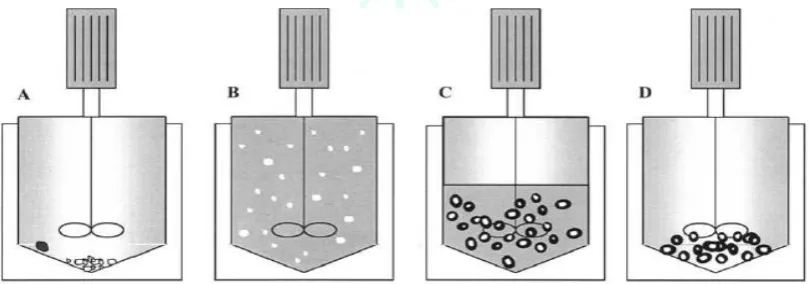
pressure about 200 bar). The system is left to achieve equilibrium at these conditions which results into solubilisation of coating material in SCF. Then autoclaved cooled which lead to decrease in pressure and phase change from SCF to liquid phase and coating material become insolubilize and get precipitate over BSA microcrystal and coated BSA particle’s collected from bottom.
Figure 4: scemtic represention of coating process.(a)filling step: bsa particle represented in white and coating material
represend in black.(b)solubilisation of coating material in scf co2.(c)decompression phase: insolubilisation of coating material).
(d) harvesting of coated particles27.
9) Particles from Gas Saturated Solution/Suspension
Gas saturated solution/suspension expanded by using nozzle to prepare nanoparticles. Gas saturated solution can be prepared by gas assisted melting atomisation (GAMA) in
which melted material mixed with SCF i.e. co2 under
pressure and then expanded by passing through nozzle. During travelling of saturated solution, SCF get vaporize and dry fine particle are collected. Then these particles are used to prepare suspension by dispersing these particles in water. Prepared suspension further expanded by passing through nozzle to get nano sized particles.
10) Using Lipid and Water Phase as Separate Entities
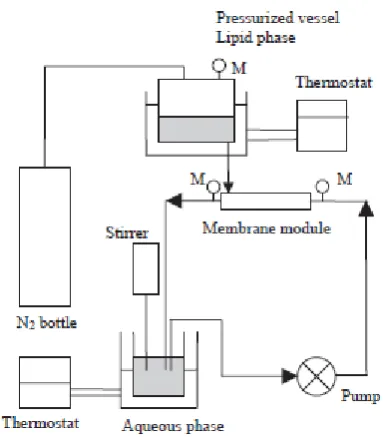
SLN can be prepared by passing lipid and water phase as separately through membrane contractor made up of
Kerasep ceramic membrane28 [28]. In this lipid material
heated in pressurised vessel and passed through membrane pores which results into formation of small articles which detached from membrane due to tangential flow of water. Then obtained water dispersion cooled to get SLN of 100-200nm in diameter. Particle size depends on type and
ISSN: 2250-1177 [419] CODEN (USA): JDDTAO
Figure 5: schematic diagram of membrane contractor for
SLN preparation27
Figure 6: experimental setup for SLN preparation by
membrane contractor27
CONCLUSION
Various precursors are used to prepare SLN by employing different-2 type of techniques to obtain particles of different size and shape. Material used in SLN preparation should be safe and biocompatible. Solvent used in precursor formation should remove from final preparation because traces of solvent are not safe from toxicological point of view. Precursor chosen for SLN preparation depends on particle size and shape and to enhance drug entrapment and physiochemical parameter.
Each precursor leads to formation of particle with different size. Every precursors show advantage and some limitation. Selection of precursor for preparation of SLN depend on benefit to limitation ratio, size of particle which we want to obtain, safety from toxicological point of view, reproducibility, feasibility, and characteristics of drug encapsulated within particles.
REFERENCES
[1] Müller R.H., Mäder K, Gohla S, Solid lipid nanoparticles (SLN) for controlled drug delivery-a review of the state of the art. European journal of pharmaceutics and biopharmaceutics, 2000. 50(1):161-177.
[2] Bodmeier R., Wang J., Bhagwatwatar H. Process and formulation variables in the preparation of wax microparticles by a melt dispersion technique. I. Oil-in-water technique for water-insoluble drugs. J Microencapsul 1992; 9:89-98
[3] Bodmeier R., Wang J., Bhagwatwatar H. Process and formulation variables in the preparation of wax microparticles by a melt dispersion technique. 11. W/O/W multiple emulsion technique for water-soluble drugs. J Microencapsul 1992; 9:99-107
[4] Chattopadhyay P., Shekunov B., Yim D., Cipolla D., Boyd B. Farr S. Production of solid lipid nanoparticle suspensions using supercritical fluid extraction of emulsions (SFEE) for pulmonary delivery using the AERx system. Adv Drug Deliv Rev 2007; 6:444– 453
[5] Shinoda K., Saito H. The stability of O/W type emulsions as a function of temperature and the HLB of emulsifiers: the emulsification by PIT-method. J Colloid Interface Sci 1969; 30:258–263
[6] Montenegro L., Campisi A., Sarpietro M.G., Carbone C., Acquaviva R., Raciti G., Puglisi G. In vitro evaluation of idebenone-loaded solid lipid nanoparticles for drug delivery to the brain. Drug Dev Ind Pharm 2011; 37:737–746
[7] Hoar T.P., Schulman J.H. Transparent water in oil dispersions: the oleopathic hydromicelle. Nature 1943; 152:102–103
[8] Kreilgaard M. Influence of microemulsions on cutaneous drug delivery. Adv Drug Deliv Rew 2002; 54:S77-S98
[9] Gasco M.R. Method for producing solid lipid microspheres having a narrow size distribution. US5250236 (1993)
[10] Koziara J.M., Lockman P.R., Allen D.D., Mumper R.J. Paclitaxel nanoparticles for the potential treatment of brain tumors. J Control Release 2004; 99:259–269
[11] Battaglia L., Trotta M., Cavalli R. Method for the preparation of solid micro and nanoparticles. WO2008149215 (2008)
[12] Battaglia L., Gallarate M., Cavalli R., Trotta M. Solid lipid nanoparticles produced through a coacervation method. J Microencapsul 2010; 27:78–85
[13] Bianco M.A., Gallarate M., Trotta M., Battaglia L. Amphotericin B loaded SLN prepared with the coacervation technique. J Drug Deliv Sci Tech, 2010; 20:187-191
[14] Chirio D., Gallarate M., Peira E., Battaglia L., Serpe L., Trotta M. Formulation of curcumin- loaded solid lipid nanoparticles produced by fatty acids coacervation technique. J Microencapsul 2011; 28:537–548
[15] Trotta M., Debernardi F., Caputo O. Preparation of solid lipid nanoparticles by a solvent emulsification-diffusion technique. Int J Pharm 2003; 257:153-160
[16] Garcia-Fuentes M., Torres D., Alonso M.J. Design of lipid nanoparticles for the oral delivery of hydrophilic macromolecules. Coll Surf B: Biointerf 2003; 27:159-168
[17] Gallarate M., Trotta M., Battaglia L., Chirio D. Preparation of solid lipid nanoparticles from W/O/W emulsions: Preliminary studies on insulin encapsulation. J Microencaps 2009; 26:394–402
[18] Siekmann B, Westesen K. Investigation on solid lipid nanoparticles prepared by precipitation in o/w emulsion. Eur J Pharm Biopharm 1996; 42:104–109
[19] Sah, H., 2000. Ethyl fomate—alternative dispersed solvent useful in preparing PLGA microspheres. Int. J. Pharm. 195:103–113.
[20] Killeen M.J. Spray drying and spray congealing of pharmaceuticals. In Encyclopedia of Pharmaceutical Technology. Edited by Swarbrick J. Boylan JC 2000
[21] Pilcer G., Amighi K. Formulation strategy and use of excipients in pulmonary drug delivery. Int J Pharm 2010; 392:1-19
[22] Trotta M., Cavalli R., Trotta C., Bussano R., Costa L. Electrospray technique for solid lipid-based particle production. Drug Dev Ind Pharm 2010; 36:431-438
[23] Bussano R., Chirio D., Costa L., Turci F., Trotta M. Preparation and characterization of insulin loaded lipid-based microspheres generated by electrospray. J Disper Sci Technol 2011; 32:1524-1530 [24] A. Maschke, C. Becker, D. Eyrich, J. Kiermaier, T. Blunk, and A.
Gopferich, Development of a spray congealing process for the preparation of insulin-loaded lipid microparticles and
characterization thereof, Eur. J. Pharm. Biopharm, 2007, 65:175–187 [25] Byrappa K., Ohara S., Adschiri T. Nanoparticles synthesis using supercritical fluid technology – towards biomedical applications. Adv Drug Deliv Rev 2008; 60 299-327
[26] Ribeiro Dos Santos I., Richard J., Pech B., Thies C., Benoit J.P. Microencapsulation of protein particles within lipids using a novel supercritical fluid process Int J Pharm 2002; 242:69–78
[27] Luigi Battaglia L, Gallarate M, Panciani P.P, Ugazio E, Sapino S, Peira E and Chirio D., Techniques for the preparation of solid lipid nano and microparticles,Research gate, 2015; 51-70
[28] Charcosset C., Fessi H. Novel method for preparing solid lipid nanoparticles using a membrane reactor. WO2007000531 (2007) [29] El-Harati A.A., Charcosset C., Fessi H. Influence of the formulation
for solid lipid nanoparticles prepared with a membrane contactor. Pharm Dev Technol 2006; 11:153–157