RESEARCHARTICLE
Sailing: Cognition, action,
communication
Thora Tenbrink
School of Linguistics and English Language, Bangor University, UK
Frank Dylla
Bremen Spatial Cognition Center, Cognitive Systems, Bremen University, Germany
Received: April 3, 2017; returned: May 5, 2017; revised: July 12, 2017; accepted: August 22, 2017.
Abstract:How do humans perceive and think about space, and how can this be represented adequately? For everyday activities such as locating objects or places, route planning, and the like, many insights have been gained over the past few decades, feeding into theories of spatial cognition and frameworks for spatial information science. In this paper, we explore sailing as a more specialized domain that has not yet been considered in this way, but has a lot to offer precisely because of its peculiarities. Sailing involves ways of thinking about space that are not normally required (or even acquired) in everyday life. Movement in this domain is based on a combination of external forces and internal (human) intentions that impose various kinds of directionality, affecting local action as well as global planning. Sailing terminology is spatial to a high extent, and involves a range of concepts that have received little attention in the spatial cognition community. We explore the area by focus-ing on the core features of cognition, action, and communication, and suggest a range of promising future areas of research in this domain as a showcase of the fascinating flexibility of human spatial cognition.
Keywords: navigation, planning, embodied cognition, reference frames, communication, concepts, complexity
1
Introduction
and communicating about spatial tasks and goals are relatively well understood, at least for general everyday contexts. Rich resources of evidence highlight human concepts of space and their representation in language, including perspectives and reference frames for representing spatial relationships, spatial knowledge acquisition and memory, and strate-gies for dealing with spatial tasks. Here we turn to a domain of human experience that is somewhat more specialized, and therefore opens up new ways of accessing human spatial cognition and communication. Sailing, as we will demonstrate, involves ways of thinking and talking about space that are not normally required (or acquired) in everyday life. Nev-ertheless, the skill is fully accessible to any (physically able) human who cares to engage with it, without presupposing extraordinary spatial abilities. Sailing is therefore a well suited setting for studying spatial cognition in an applied context that is sufficiently dis-tinct from human everyday life to pose substantial challenges and raise new issues, without necessitating excessive domain expertise. This paper aims to make a start by exploring a range of cognitive challenges specific to the sailing domain. It sets the stage for future developments addressing specific modeling and reasoning mechanisms that, as such, are beyond the scope of this paper, although we do suggest a range of promising directions in this regard.
Like many other activities in human experience, sailing is a skill that cannot be learned purely through theoretical instruction. Sailing needs to be experienced. Disregarding the many other manual actions involved, including the non-trivial task of setting the sails suit-ably, just steering a sailboat towards a goal can be surprisingly hard for the beginner. While many larger yachts have steering wheels, which are familiar enough, most smaller yachts and all sailing dinghies have tillers—and these require unintuitive motions: in order to turn to the right (i.e.,starboard), the tiller needs to be pushed to the left (i.e.,port). Moreover, un-like steering a car or bike, the sailor at the helm (i.e., in charge of the tiller or steering wheel) directly feels the effects of even small changes in the sails’ arrangement, the wind with its force and direction, the impact of waves on the boat, and much else. Distances and angles to the goal need to be judged constantly from ever-changing visual information gained while moving through the water (and up and down through the waves), sometimes with sparse landmarks available for orientation.
Beyond demonstrating theoretical knowledge and practical skills, some sailing certifi-cates therefore require a certain number of hours at sea; likewise, a common figure of speech in sailing communities is “It’s all about time on the water.” It seems that the sen-sorial experience of the many factors influencing a sailboat’s movement under different weather conditions cannot be substituted by any other learning method. The result of this experience is a rich resource of implicit knowledge that may be difficult to verbalize and communicate, but nevertheless provides the kinds of intuitions that are an essential part of the skill. Other parts are more explicitly taught and described in sailing handbooks, but nonetheless complex and challenging. In this paper, we will look more closely at those elements of sailing skills that directly pertain to spatial cognition, with a focus on direc-tionality and navigation. We do this by relating sailing concepts to central insights gained from spatial cognition research in other domains, related to the dimensions of cognition, action, and communication.
traditionally represented using compass terminology (north-westerly wind, etc.). Since this type of reference frame for directional information is not necessarily prominent for spatial thinking in Western cultures, conceptualizing wind direction may already require adapting spatial concepts in a rather fundamental way. However, while compass terminology will at least be known to the aspiring sailor, other concepts lead even further away from everyday experience. For example, of the ten “beginner sailing terms everyone should know,”1eight involve some kind of spatial directionality related to the boat and its interaction with the wind: aftorstern(the back side of the boat),bow(the front side of the boat),port/starboard (left/right in the direction of the boat’s movement),leeward/windward(away from/towards the wind), tacking/jibing(changing the boat’s movement direction and sail arrangement relative to the wind in two possible ways).
Confronted with such specialist jargon, one may ask why sailors do not simply use nor-mal language, and refer tofront,back,forward,backward,left,rightlike everyone else. In this paper, we argue that the jargon is not just a matter of sophisticated technical style. Instead, it is a symptom of the cognitive challenges involved when aiming for a spatial goal on the water, using the wind as a power resource. For a start, domain specific language is often less ambiguous than the more flexibly used everyday language. The nautical expressions starboardandportare exclusively based on the boat’s intrinsic directionality, whereas pro-jective terms such asrightandleftcan be used for many directions, and they might (when navigating a boat) be confused with the sailor’s current perspective. Additionally, every-day motion is mainly based on landmarks and self-controlled movement (through phys-ical action or engine power), whereas sailing motion is mainly based on wind direction and force, which require skill to make use of. Expert language therefore serves to clarify some of the potential confusions normally involved in using spatial language. Beyond this, the distinctive sailing terminology at least in some cases directly reflects distinctive spatial concepts; and this is what makes sailing a domain well worth studying in spatial cognition research.
In the following, we start by taking a closer look at thecognitioninvolved in steering a sailboat towards a goal. To illustrate a range of cognitive elements that are specific to the situated spatial cognition of sailing, we spell out a few possible sailing situations. Next, we address cognitive challenges aroundactiongoals such as navigating a route, meeting other boats, and improving speed. Finally, we return to the issue of sailing terminology and concepts from acommunicationperspective. Each of the three sections concludes with an overview of relations and pointers to relevant research in the field, highlighting research questions to be explored in more depth. Section 5 furthermore opens up a range of overar-ching avenues for future research. As we hope to show, the domain of sailing can serve as an excellent showcase for the fascinating flexibility of human spatial cognition.
2
Cognition
Humans are amazingly flexible in a world of dynamic change. Whenever we move or re-orient our heads or eyes, the perceived environment changes, and the brain needs to align and integrate previous with current perceptual information [18]. This happens rapidly and without awareness, leading to well-known curious effects caused by selective attention [51] and change blindness [60], but also enabling us to travel at considerable speed through
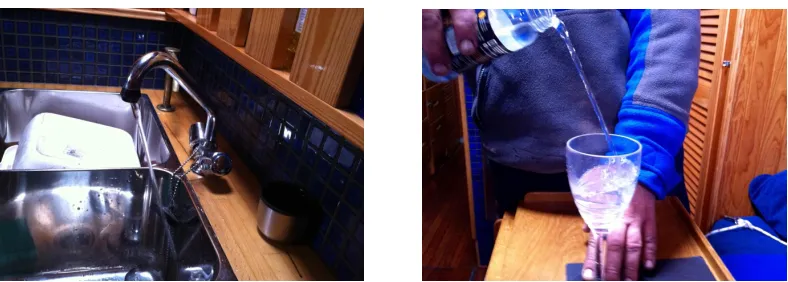
Figure 1: Stream of water from a tap (left) and out of a bottle (right), in a yacht heeling at a
20◦angle. Note that holding a glass vertically under the tap as usual would not work, just
like the bottle is not really above the glass, leading to erroneous expectations about gravity. Heeling angles of up to35◦are perfectly normal while sailing upwind.
real and (often more challenging) virtual worlds [40] without losing our sense of orienta-tion and spatial locaorienta-tion. Although vision may be a primary informaorienta-tion source in many situations, conceptual updating processes are further supported heavily by proprioception and subconscious knowledge about the motions just performed—leading to nausea and confusion in the case of a mismatch between these information sources [64].
Adding to these physical challenges, another spatial direction needs to be constantly accounted for that is not normally relevant in everyday life, namely depth below the boat. This information, essential for avoiding accidents by running aground, cannot be directly perceived (the ground cannot be sensed, i.e., felt, heard, and only rarely be seen in the water, except through effects on the water surface that some experts can detect) and must therefore be derived from instruments, interpretation of warning buoys, or knowledge of the environment.
In the following we will focus on the cognitive challenges that are more directly in-volved in steering a sailboat towards a goal. We start by considering directional concepts involved in sailing, and then introduce Tenbrink’s model of reference frames [68] (chosen because it captures a wide range of configurations through a limited set of mechanisms), which we then use to spell out the conceptual elements involved in various sailing situa-tions.
2.1
Directional concepts
An observer watching a sailboat move on a river may think of the perceived motion as a simple forward direction, comparable to walking or driving a car: you look where you’re going, and keep your goal in sight. For a sailor, however, goal-directed movement is con-siderably more complex. To start with, there are some physical constraints. Sailboats are less maneuverable than most other vehicles, and also need to be handled differently. Since boats don’t have brakes, any stop must be planned well in advance. It is impossible to sail directly into the wind (upwind), with the precise width of the so-calledno-go zone de-pending on the type of boat. Also dede-pending on type, sailboats can be inert (or slow to react) to a high extent, enhanced by the physical properties of the water. Using an engine (available typically on a yacht but not on a dinghy) supports movability, but can create additional challenges. If the propeller sits at the boat’s side rather than the back, it creates a substantial sideways force that needs to be counteracted by the helm. Such boats cannot normally move backwards at all. However, even when positioned at the middle of the back, the propeller will have a tendency to push a vessel to one side (calledpropwalk), with asymmetric effects concerning movement adjustments to either side.
Conceptually, the domain contains various directional effects and forces that affect the boat’s movement in different ways. These need to be considered while steering the boat towards a goal. From a formal perspective these directions can be regarded as vectors, either as a unit vector or (where applicable) with a specific length reflecting force. Although we disregard force in the following for the sake of simplicity and clarity, we do note that this aspect (e.g., wind force or strength of tide) can decisively add to the cognitive challenges of sailing.
First of all, just like most other people on the move, the sailor will typically be head-ing for a particular destination (GoalD). This could simply be based on line of sight, i.e., the sailor’s view directionViewD; however, this is a rather unstable notion, as sailors will seldom be able to fixate theirViewDfor any extended period of time. Alternatively,GoalD
as a coastline (or river bank)CoastL. Rather than representing a direction,CoastLprovides a further potential frame to align with, and can contribute to conceptual complexity by introducing curves and misalignments withMoveDand other relevant directions.
Static objects introduce further directions by the line of sight towards them (object direc-tionObjDbased onViewD). Fixed objects on water and objects on land can serve as land-marks and may provideGoalD, or at least orientation towards determiningGoalD. Static floating objects such as buoys can do the same, but are less stable and thus provide a more vague type ofObjD. Dynamic objects such as other boats, large animals, or icebergs cannot serve as navigation aids, as they do not provide static orientation. However, they need to be accounted for to avoid collision.
OnceGoalDis clear, it might seem that the sailor simply needs to head there, aligning
BoatD, the direction where the boat itself is pointing, withGoalD. Unfortunately, while this works for most other vehicles including cars, bikes, airplanes, and even powerboats (as they override other forces more easily by engine power), sailing doesn’t work that way. The main obstacle to this simple alignment is that sailing is impossible against the wind; however, there are further factors that affect the boat’s trajectory.
For instance, the boat’s movement direction (MoveD) does not necessarily coincide with
BoatD, because the wind (coming from directionWindD) pushes the boat sideways, in ad-dition to powering the sails as intended. Although the keel or fin transfers most of this force into forward motion, a drift will remain—a kind of sideways force (called weather helm) similar (or adding) to propwalk. Furthermore, the movement of the boat itself influ-ences the effects of the wind. As a simplified example, withWindDcoming from behind at the same speed as the boat’sMoveD, the sailor will not feel any wind at all—and in fact this configuration is not optimal for sailing. Therefore, somewhat surprisingly, heading di-rectly downwind is typically avoided, mirroring to some extent the impossibility of going directly upwind. How this effect plays out is further influenced by the orientation of the sails. Because of the interaction betweenMoveDandWindD, following nautical terminol-ogy we can distinguish true (absolute or cardinal,WindDabs) and apparent wind (relative,
WindDrel) directions, whereWindDrelis as an aggregation ofWindDabsandMoveD(i.e.,
formally their vector sum) under consideration of their relative speeds and other influenc-ing factors.
Many waterways involve further forces that affect the boat’s trajectory, such as tide (tidal directionTideD) or the current of a river (RivD). This is especially true in the case of a strait, which can be sufficiently similar to a river to be referred to as such in colloquial speech. Tide and current are similar in that both are associated with the flow of water. However, both come with complications. Unlike the relatively even flow of a river, the tide changes direction, and often does not affect the full extent of a waterway evenly—there will be places (eddies) where the water actually flows in the opposite direction. Combined with the wind and other factors affecting the perceived movement on the water surface (surface directionSurfD), this is not easily discernible for the human eye—but it certainly affects the reactions of the boat. Furthermore, in nautical terminology there may be a specifically definedRivDwhich is not associated with the direction of water flow, e.g., in canals and straits; this is represented on the water by red and green buoys or specific traffic signs. In special cases (e.g., if associated with a harbor),RivDcan change at some point within a waterway; this is indicated by a specific kind of buoy.
summa-rize the directions introduced and their abbreviations in Table 1, along with the shorter abbreviations used in figures. For current purposes we can neglect the vertical movement of the vessel on the water, in line with nautical conventions [38]. Although this movement is ubiquitous, it does not appear to introduce directional concepts that pose conceptual issues. Also, we do not consider special cases such as river junctions or traffic control units, which may induce additional views or directions. Generally, we adhere to the factors rele-vant to navigating on the basis of human perception rather than instruments (cf. notion of “vessel navigation in sight” in [38, Part B Section II]).
BoatD BD boat direction
CarD CD compass based cardinal direction
CoastL CL coastline or river bank (potentially aiding directional information)
GoalD GD goal direction (e.g., line of sight to a goal or directional knowledge of its position)
MoveD MD movement direction (BoatDnot necessarily equal toMoveD)
ObjD OD object direction
RivD RD river direction
SurfD SD surface direction
TideD TD tidal direction
ViewD VD view direction
WindD WD wind direction
WindDabs WDabs true (absolute or cardinal) wind direction
WindDrel WDrel apparent (relative) wind direction (an aggregate ofWindDabsandMoveD)
Table 1: A summary of directions and its abbreviations used in text (left column) and fig-ures (middle column) throughout the paper.
2.2
Spatial reference frames
As we saw in the previous section, simply steering a boat to a goal can be quite challenging due to the various factors that affect directionality. As a result, the very concept offorward motionis not straightforwardly applicable. What does it mean, generally speaking, to move forward? The term itself suggests a notion offrontthat determines the direction of move-ment. Like otherprojective terms(such as left, right, front, back, below, above), notions of forward, backward, and sideways movements all depend on some kind of reference frame that allows to define the various sides referred to by these terms. To our knowledge, the model proposed by Tenbrink [68] is the only one available to date that systematically ac-counts for the various conceptual elements involved in the representation of movement by projective terms. The model covers, i.e., is able to express, all relations from all point or line based qualitative calculi representing relative direction as compiled in [20].
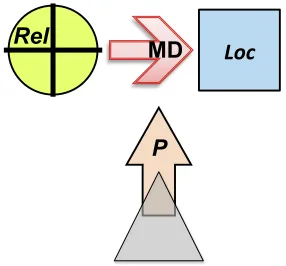
Consider the sentence “The box is on the right of the ball,” which describes a static object configuration. Here, the term “on the right” is projective; it relies on a view direction for its interpretation. Because the ball does not have a view direction, this must come from else-where, which (in Levinson’s [47] terminology) means that arelativereference frame must be employed. In this kind of situation, three distinct conceptualrolescan be distinguished, plus the notion of a directional system that defines how space is carved up into regions:
• thelocatum(“Loc”) as the object or place to be located (in this case the box);
• therelatum(“Rel”) as another object or place in relation to which the locatum is de-scribed (in this case the ball);
• a conceptualperspective(“P”), contributed by some kind of directionality: e.g., a view direction from anorigin(in this case the speaker’s line of sight); and
• an abstract directional system projected onto the relatum (providing, for instance, the direction for “on the right”). The system is conceptually flexible with respect to the width of its axes and regions, as well as the directional notions: it can represent compass directions (supporting anabsolutereference system) or reverse the order of left,back,right,frontunder certain circumstances (see [68] for details).
With this conceptual framework, any combination of two objects (Loc and Rel) and a per-spective (P) can be used to constitute a valid reference frame along with a conceptual direc-tional system (e.g., left, back, right, front). P serves to orient the reference axes associated with the relatum. This allows the speaker to refer to the right of the ball in the above example of a relative reference frame.
In anintrinsicreference frame [47], the source for P (or the origin providing P) coincides with Rel. This captures sentences such as “The box is in front of me.” Here, the speaker serves as origin as before, i.e., provides P through theirViewD. In contrast to the previous situation, however, Loc is described relative to the speaker, rather than to a different object. This reduces the number of entities involved to two, filling the roles of Loc and a kind of Rel that is also capable of serving as origin for P. The previously examined sentence “The box is on the right of the ball” could not be interpreted in this way, since the ball cannot serve as origin—a ball has no directionality, as needed for this role.
Now, consider what happens when we introduce movement. The sentence “I’m moving the box to the right” can be interpreted in a very similar way as the first situation, except that it is dynamic. Instead of describing thecurrent position of a staticobject (the box) relative to another (the ball), a projective-term based movement description represents the futureposition of an object relative to its own previous position prior to movement. Thus, paralleling the box in the static version, the position on the right can be identified as Loc, whereas Rel is the previous position of the same object. This interpretation directly cor-responds to the formalization mechanisms available in most Qualitative Trajectory Calculi (QTC) variants [20]. QTC formalisms capture spatial change [27] qualitatively by repre-senting the relative positions of two objects at a specific point in time and the positions of the same objects at some succeeding point in time.
Loc
P
Rel
MD
Figure 2: Relative reference frame, with movement from relatum to locatum. The direc-tional system in this case representsleft, back, right, front, in clockwise order.
Loc
P
Rel
MD
Figure 3: Intrinsic reference frame, with movement from relatum to locatum. Here the directional system representsback, left, front, right, in clockwise order.
P, i.e., the perspective of the speaker. If the origin was positioned somewhere else, the directional system would be oriented in a different way.
Now consider the case of movement with an intrinsic reference frame. Then Rel (coin-ciding with the origin) moves from the current position to a new one (Loc). This is exempli-fied in Figure 3 (adapted from [68, Figure 7b, examples 30–32]). Consider the sentence “I’m moving to a place in front of me.” The speaker conceptualizes a place (Loc) in front of the current position (Rel), as defined by the view direction (P), using Rel’s intrinsic directional system (i.e., the speaker’s front side). Following movement (as expressed by the arrow
MoveD, MD), the speaker is positioned at this new place, having moved from Rel to Loc. Incidentally, a simpler way of expressing this same dynamic spatial relationship in lan-guage is by saying “I’m moving forward.” Thus, lanlan-guage abstracts from the elements and configurations that define the direction offrontas needed for a forward direction, allowing reference to the movement in a very simple way. This may be due to frequency: humans move forward as soon as they can crawl or walk, and have no difficulties identifying the direction, based as it is on the most fundamental human traits. The concept of a movement to one’sleftorrightis more difficult, since the two sides of the lateral axis are less easy to distinguish (see [26] for the cognitive precedence of the frontal axis in surrounding space); this adds to the fact that a sideways movement is also physically less simple.
BD
VD
ê
Loc
P
Rel
MD
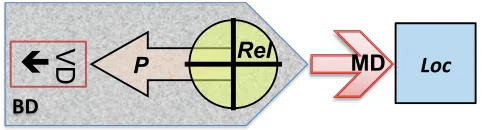
Figure 4: Movement configuration for rowing. The boat’s shape and orientation is indi-cated by the large grey encompassing arrow shape.
possibility to fill this role—as everyone knows who has ever wondered whether it’s “to the left from your or my point of view.” However, negotiating speaker perspectives in dialogue is not all there is to it; in theory, any kind of directionality available in a situation could be used as P for a reference frame. Consider the movement involved inrowing, illustrated schematically in Figure 4. The rower’s view directionViewD(VD in the figure) is oriented away from the direction of movementMoveD(MD), but the boat’s intrinsic directionBoatD
(BD) is aligned withMoveD. In the two situations considered so far, only one direction was available (the speaker’sViewD) that could provide P for a (relative or intrinsic) reference frame. In the rowing situation, there are two conflicting ones (ViewDandBoatD)—which of these would speakers use in order to describe the movement directionMoveDthrough dynamic projective terms? Indeed, there are two ways of describing the same scene: the boat movesforward—but the rower actually movesbackward. To spell this out: ifBoatD
defines the orientation of P in the reference system, the movement is forward (in language: theboatmoves forward). In contrast, if we assume thatViewDdefines P, the movement is backward (in language: therowermoves backward). Figure 4 shows the latter version to illustrate the natural conceptualization of a backward movement involved in rowing.
As highlighted by the rowing example, P is not necessarily defined by a person’sViewD, although this may be considered prototypical for everyday human movement as well as object localization. Even though it is natural to conceptualize the rowing movement as backwardbased on the rower’sViewD, it is entirely possible to conceive of the movement asforwardbased onBoatD. Tenbrink [68] describes further possible ways of defining P. For current purposes, we now return to the initial question: how does forward movement work in sailing, where there are multiple sources for directionality as we have already seen? Do speakers rely onViewD to describe forward motion, or what kinds of principles would apply in this case? To understand the complexity of this question, we need to consider a few hypothetical sailing situations.
2.3
Simple case
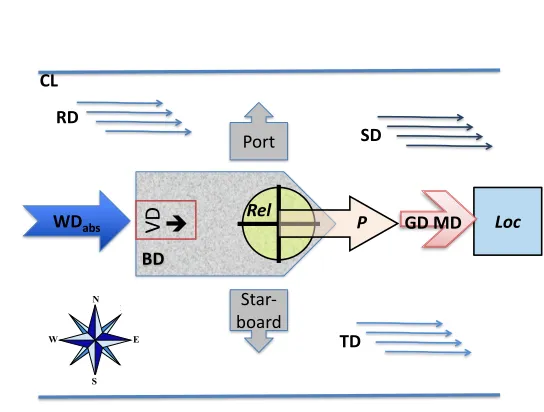
In the simplest case (which will hardly ever occur in actual sailing) the boat would move directly towards its destination, forward (as seen from the human viewer, the sailor) from relatum (previous location) to locatum (new location). This situation is illustrated in Figure 5, which shows a sailboat destined towards the compass directionCarDeast. ViewD(the sailor’s view direction) aligns with P (perspective) to provide the directionality for the ref-erence frame. Since Loc is a place east of Rel, the direction of movementMoveDaligns with the goal directionGoalD. The boat is also aligned with the sailor’s view direction (BoatD
BD
Loc
CL
WDabs
Port
Star-board
RD
TD
P
SD
GD MD
VD
ê
RelN
E W
S
Figure 5: Simple (fictive) case of sailing in the intended direction, with all relevant direc-tions aligned with the intrinsic reference frame.
conveniently to the general river directionRivD, the tideTideD, and the perceived surface directionSurfDof the water (a consequence of the aligned directions ofWindDabs,RivD,
andTideDin this case). Moreover, both coastlinesCoastLare parallel to the previously de-scribed directions. Port and starboard are defined byBoatDas usual, and are here aligned with the directional system (the black cross) imposed on Rel. This situation does not pose any extraordinary conceptual challenges, since all relevant directions are aligned and there are no conflicts of directions to reconcile and act upon.
2.4
On a reach
Figure 6 shows a situation in whichSurfD,RivD, andTideDare roughly aligned with the coastlineCoastLas before (which is a fairly usual case), and the boat is still moving to an eastward destination (CarD). However,CoastLis not aligned with the current movement directionMoveD, and the windWindDabsblows roughly at a90◦angle to the boat’s
intrin-sic directionBoatD: the boat isreaching, in nautical terminology. In a dinghy, the sailor is likely to be seated on the side of the boat, yielding aViewD(without tilting the head) that is neither aligned withMoveD, nor with P in the intrinsic reference frame capturing aforward movement. Since the sailor is not looking in the direction of movement, the sailor’s view cannot defineforward. Yacht sailors are generally more free to move; the person steering the boat may or may not be looking ahead, and their perspective may or may not align with any other person’s perspective on the boat, again making the sailor’sViewDdubious as a basis for P.
While the discrepancies caused by the misalignment betweenMoveDandSurfD,RivD,
Loc
CL RD
SD
TD
P Rel
GD MD
N
E W
S
Figure 6: Sailboat reaching eastward, with the wind at a90◦angle.
diverse forces contributed by them still need to be taken into account. MoveDcoincides here withGoalDwhich is eastward (CarD), but not withBoatDdue to the wind force; this needs to be compensated by adjusting the rudder. The sails need to be in a suitable position forWindDrel, which emerges as a product ofWindDabs andMoveD, depending on their
relative speed. Furthermore, unlike the previous simple scenario, the sailor will not be able to proceed in this same direction for any extended amount of time, due to the misalignment withCoastL. Also in contrast to the previous scenario, everyday spatial motion concepts pose some problems. In what sense, if any, is the sailor movingforward—i.e., “to a position Loc in front of its own previous position Rel” as defined above? Our schematic depiction suggests that the underlying intrinsic reference frame has not changed; there is a directional system imposed on Rel, i.e., the previous location, a movement directionMoveD, and a new location Loc. All of these are uncontroversial. However, the specific features of the directional system (where the front is, etc.) still need to be defined by P, the perspective determining directions and orientations in any reference system. In this scenario there is just one sense in which the boat is actually moving forward, arguably the most important one: it is moving (MoveD) in the intended directionGoalD, i.e., eastward, as the sailor can confirm by glancing at the compass. The boat is moving forward relative to its goal; a fortunate situation.
In this scenario, conceptual complexity is caused by the multiple directions available as possible candidates for P. Unlike other directions in this situation,GoalDis abstract in that it depends on the sailor’s concept of a goal position and does not need to have a reflection in the world itself (although it may, if the sailor is moving towards a specific location).GoalD
is thus the aim of the movement, but not itself suited as a source for P, because P relates to the actual movement rather than the conceptualized targeted one.
In most movement situations, P would be defined by either the mover’s view direction
corresponds to BoatD. However, P does not align with either of these in the sailing do-main. Relative to the sailor, the boat is moving roughly to the right; relative to the boat’s orientation, the movement is slightly to the left. Moreover, it is also not moving forward relative to the river or any other direction related to the water (SurfD, RivD,TideD), or relative to the windWindDabs. Note that all of these could arguably serve as P, given that
all of them provide directions. Additionally, the coastlineCoastLprovides a very promi-nent potential reference frame for conceptual alignment; humans are well known to orient towards landmarks and prominent features of the environment [30,49]. Since the water sur-face provides little information that is useful for orientation, it can be expected thatCoastL
remains conceptually primary. Nevertheless, its relevance will concern the movement only indirectly: not necessarily in terms of adjusting and conceptualizing the actual movement directionMoveD, but (typically) in terms of keeping track of the goal directionGoalD, plus any potential dangers contributed by traffic or by the coast itself (e.g., shallow water or rocks).
2.5
Close to the wind
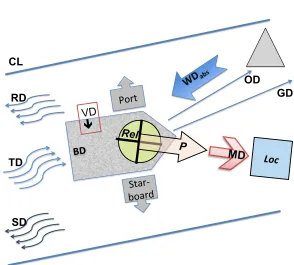
In the previous example, in spite of several conceptual challenges, we describedMoveDas aligned withGoalD. Figure 7 shows a different, equally common scenario. Here the sailor needs to changeMoveDiteratively in order to approach the goal, a place close to a rock (shown as a triangle in Figure 7). This provides a set of two related directions:ObjD, which is visually defined by the object, andGoalD, which as such only exists in the sailor’s mind.
GoalDpoints almost directly upwind; therefore,MoveDcannot align withGoalD.
When considering sailing strategies, the sailor may be (if only subconsciously) influ-enced by the movement on the water surface, which in this scenario is caused byWindDabs
but does not align with the tideTideD. Furthermore, in the case of meeting other vessels, the river directionRivDmight be important, which in this scenario also does not align with
TideD.
In nautical terms, this boat is sailingclose hauled(as close to going upwind as possible)— but is there also a sense in which it is movingforward? This scenario has a broad range of conceptually relevant directions, but none of them coincides withMoveD. Therefore P, the perspective of the intrinsic reference system representing a forward movement, cannot be defined; strictly speaking there is no sense in which the boat is actually moving forward. However, this conclusion implicitly builds on the assumption that a forward direction is restricted to a straight line rather than a wider region. Although this is certainly a standard case in prototypical directed movement [21], other scenarios have been shown to involve rather broader interpretations [33]. Considering the relatively small discrepancy between
MoveDandBoatD, it seems reasonable to expect that speakers might ignore it and describe the boat’s movement as forward based onBoatD, despite its wind-induced drift towards the starboard side. However, if the discourse situation affords it, speakers might point to this discrepancy and actually say, with good reason, that the boat is not really moving forward at all.
2.6
Further challenges
BD
Loc
CL
Port
Star-board
RD
TD
P
SD
OD
VD
ê
GD
Rel
Figure 7: Sailing close to the wind, aiming for a goal location close to a rock that is within the no-go zone (upwind).
action strategies, we briefly observe a few further challenges to the sailor’s cognition when steering the boat towards a goal. Consider going against a strong river current, where
BoatDcontrasts strongly withSurfD, giving the subjective impression that the boat is mov-ing fast. However, due to the strong impact ofRivD, actually the boat might be barely progressing relative toCoastLorGoalD. In the opposite case, when moving with the cur-rent (RivD=BoatD), the sailor will get a subjective impression of moving rather slowly, as
BoatDdoes not seem to differ fromSurfD—in spite of the boat’s fast progress relative to
CoastL. As long as a stable point of reference is available, this is not a problem. However, in locations on open water the skipper needs to disregard subjective perceptions and rely on other information sources. Prior to the invention of electronic positioning devices, geo coordinates had to be derived by means of stellar constellations (requiring a clear night sky)—or other cues that only skilled experts can interpret, as in the famous case of the Polynesian natives’ astonishing navigation skills on open water [31].
Another challenge concerns the spatial updating processes involved in changing
environment. As the sailor’s knowledge about the actual translation and rotation will be rather imprecise, this global model might not be entirely correct. This problem is enhanced by the fact that (unlike turning when driving a car) continuous perceptual updating may be impossible during the actual tacking process, since a dinghy sailor needs to duck under the main sail as it swings over to the other side of the boat.
To sum up the considerations of the cognition of sailing, a number of empirical ques-tions arise that are centrally related to wider research in spatial cognition. Studies are needed that address specific aspects affecting the directionality of a sailing vessel, so as to gain a better understanding of the various influencing factors. This would allow for identifying cognitively supportive representations of directionality, and to predict cogni-tive effort for specific kinds of configurations. Intuicogni-tively, for instance, sailors may find it easier to understand spatial relations whenWindDabscorresponds toRivDand/orTideD,
or perhaps at a90◦angle relative toCoastL, irrespective of the more obvious positive effects ofWindDat its most effective angle relative to the sails. Thus, the very idea ofspatial cogni-tionin this domain opens up a range of additional layers, adding to our knowledge about how humans understand space under various circumstances. This includes the following:
• Given the domain-specific challenges involved in heading towards the intended movement direction, what kinds of reference frames do sailors conceptually use for this purpose? How do they establish a notion offorward movementrelative to the de-sired goal direction? How much cognitive effort is involved in reconciling the various conflicting directional concepts—or ignoring them, as may be necessary? This relates to previous research on reference frame choice and conflict, e.g., [8, 9].
• Previous research showed that some cultures use absolute reference frames (like com-pass directions) more than others, leading to generally different spatial concepts [47]. Does the need for orientation towards wind directions, which are referred to by com-pass terminology, change the ways of thinking about space generally? Do experi-enced sailors have clearer awareness of compass directions than other people? Also, to what extent do sailors benefit from generally higher spatial abilities [15], given the cognitive challenges of orienting to different kinds of directionality?
• What are preferred—and/or most efficient—ways of orienting in the environment? What role do common types of landmarks and environmental features (coastline) play, and how do sailors integrate them in their conceptual reference frames? This ex-tends previous insights on the essential role of landmarks for spatial cognition across situational contexts, e.g., [17, 25].
• How do sailors manage spatial updating processes after a change of direction (tacking or jibing)? What are the conceptual or perceptual influencing factors that support or hamper this process? This adds a new dimension to debates around the cognitive processes underlying spatial updating and path integration, e.g., [43, 72].
3
Action
3.1
Navigation
While the previous section outlined the challenges around concepts of simple direction-ality (movingforwardor towards a single goal concept), sailing on a larger scale involves planning navigation strategies in advance. Similar to other types of route planning, this is either based on prior knowledge of the environment, or on maps, which in the nautical context are calledcharts. The special name is indicative of the specific character of these “maps,” as nautical charts show fundamentally different spatial features than road maps. The most salient aspect is the rough indication of depth as visualized by colors; this is enhanced by details on depth at a specific status of the tide, and on the nature of the sea ground (rocks, sand, mud etc.). Charts furthermore offer information about tidal streams and levels, buoyage, navigation lights, and potential hazards like shellfish beds, wrecks, submarine cables, and windmills.
Planning a sailtrip over an extended route2 involves complex calculations of tidal di-rections and times along with the weather forecast and further constraints, which can lead to very small time windows within which a location needs to be reached so as to ensure a safe journey. Overnight stays need to be planned ahead so as to reach a safe harbor in time. Some harbors can only be entered at high tide, and harbors as well as bays often do not provide effective shelter for all wind directions. Apart from the non-trivial fact that strong winds can impede the journey altogether, the general weather forecast may need to be enhanced by further spatial, temporal, or local aspects. Low pressure as well as spring tides enhance tidal movements, with strong effects particularly in narrow passages. If the wind comes from ashore, this will lead to calmer waters since waves build up over longer distances on the sea. WindDagainstTideDwill lead to higher waves. If the wind comes across mountains, this may locally lead to less reliable, shifty wind conditions with strong sudden gusts that can strongly affect sailing vessels. During the day, under certain con-ditions there may be an additional sea-breeze because of the cooler air from the water, a phenomenon too local to be captured by the general wind forecast.
Altogether, a wide range of spatial and situational factors need to be taken into account for safe navigation, and this involves spatial skill, domain expertise, and action heuristics [3]. These may be similar to those found in other spatial domains, but also depart from them in ways that open up interesting areas for spatial cognition research. For instance, due to the various factors influencing directionality, reading a chart effectively towards a suitable and safe navigation plan certainly involves more complex considerations than everyday map-based route planning, which research has addressed abundantly. The fact that sailing involves far more uncertainty about traveling conditions (due to the higher dependency on weather, waves, tidal strength, etc.) will affect planning in ways yet to be explored. Together the various effects can be expected to lead to fundamentally different heuristics and strategies than those known from other types of navigation [5, 15, 16, 32, 35, 36].
Once the general navigation plan is specified, the sailor needs to constantly reconcile this plan with the challenges of conceptualizing movement in an intended direction as specified above. Perhaps indicating the high challenge of this multi-layered cognitive ef-fort, it is common practice (in modern times) to use the engine on a yacht during local challenges. This reduces the cognitive load locally, and lessens the dependency on weather conditions in the global navigation plan. Compared to everyday navigation, there may be
a more pronounced need for continuous updating of the general navigation plan in rela-tion to the actual condirela-tions. As part of this process, the (typically North-oriented) chart must be conceptually aligned with the various factors affecting the actual directionality of the boat as specified in the previous section; i.e., the chart-based reference frame must be aligned with the reference frame used for sailing. While the cognitive challenges of rec-onciling map orientation with current movement direction are well known from everyday navigation [39, 48], the influence ofWindDas the main driving force for the vessel adds to the complexity. The fact thatWindDis typically represented in terms of compass directions may potentially lessen the cognitive load for the sailor, as this corresponds to the chart rep-resentation. However, while charts can be rotated to align to the currentMoveDorGoalD
depending on the sailor’s preference,WindDis not manipulable.
Although spatial cognition research has so far largely ignored the cognitive challenges of navigation in the sailing domain, some indications come—rather surprisingly—from the study of blind sailors, pursued for the purpose of developing an assistance system. Simon-net and Vieilledent [59] investigated exploration strategies of blind sailors and the presen-tation in terms of haptic maps that were either aligned with the ship’s heading (BoatD) or with North (CarD). While no actual sailing was involved, participants were immersed in a haptic and auditory maritime virtual environment. Results showed that performance was improved if a central point of reference was used. BoatDalignment appeared to be better for controlling the course during displacement, whereasCarDalignment seemed more ef-ficient for building a mental representation and remembering it after the navigation task. Interestingly, no other work on sailing is cited; instead, the authors discuss their findings against previous results on building up mental representations of environments.
3.2
Avoiding other boats
So far, we have only considered a single boat in an environment of objects and directions. Most sailing events involve other boats, each with their own directionality and relative speed (see [71] for a formalization of relative movement). This poses challenges, for in-stance, when considering right of way. Nautical regulations (COLREGS [38]) call for spe-cific actions depending on the class of object, and (for sailboats) the currentWindDrel(port
or starboard), using domain specific expert terminology to express highly complex spatial relationships, as exemplified by the following (COLREGS Rule 12):
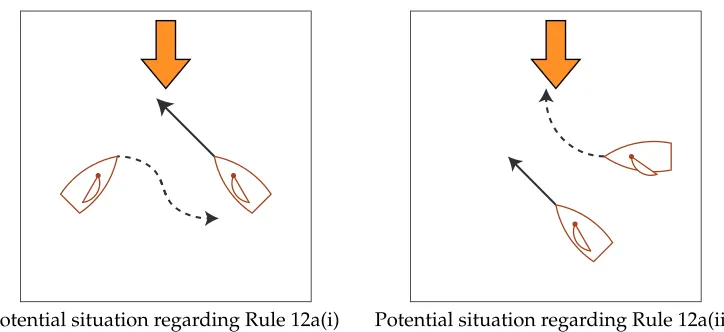
a. When two sailing vessels are approaching one another, so as to involve risk of collision, one of them shall keep out of the way of the other as follows:
(i) when each has the wind on a different side, the vessel which has the wind on the port side shall keep out of the way of the other;
(i) when both have the wind on the same side, the vessel which is to windward shall keep out of the way of the vessel which is to leeward;
(i) if a vessel with the wind on the port side sees a vessel to windward and cannot determine with certainty whether the other vessel has the wind on the port or on the starboard side, she shall keep out of the way of the other.
Potential situation regarding Rule 12a(i) Potential situation regarding Rule 12a(ii)
Figure 8: Pictograms as used for explaining COLREGs and corresponding reasonable be-havior in text books.
As exemplified here, the COLREGS abstract from all further details exceptWindDand the orientation of the vessels towards each other (depending on the type of vessel). Stan-dard text books illustrate the rules by pictograms (such as those shown in Figure 8) that depict an idealized vague wind direction while ignoring wind speed. The cognitive chal-lenge of takingWindDinto account is reflected by the necessity of defining (or conceptually operationalizing) wind-dependent spatial concepts such aswindward.
Furthermore, given the many factors affecting directionality, it may not be clear whether or when a rule like our example Rule 12 applies. In order to assess the risk of collision, sailors may apply the heuristics ofconstant bearing. Assuming straight linear motion, i.e., motion with constant direction and velocity, on a plain a collision will take place if the relative angle between the boats does not change over time. It has been shown that humans [1,22], as well as animals [53] may apply this strategy to intercept moving objects. Although the assumption ofstraight linear motion on a plainoften does not hold, humans are still able to derive reliable conclusions. During sailing, this can be aided by simple heuristics such as observing the background landscape relative to the approaching object; its apparent movement indicates the anticipated trajectory and thus supports collision prediction.
Some rules explicitly advocate adopting a conservative view in case of doubt, as in Rule 13c: “When a vessel is in any doubt as to whether she is overtaking another, she shall assume that this is the case and act accordingly.” Familiar as it is from other contexts, it might be expected that the process of overtaking should not pose any conceptual problems; clearly, experiences to the contrary have led to the incorporation of this rule.
commu-nication to the first author), who conceptually simplified the COLREGS to the heuristics: “If you meet another boat head-on, go port to port, and if you see someone’s port side you are responsible for avoiding them, which typically means going behind. Most importantly, in any case, do whatever you need to do to avoid a collision.”
Independent of the extent to which official navigation rules are conceptually accessible and actually followed in practice, the cognitive challenge of integrating other boats into the sailor’s own action goals remains. When encountering another boat, a coarse assessment of its speed needs to be made so as to calculate the extent to which the sailor’s own trajectory and angle must be adapted. To assess forward movement in such situations, various con-flicting reference frames need to be integrated on different levels of granularity: a boat that is currently evading or turning might still be (generally) moving forward towards a spec-ified goal. Due to the necessity of evading other vessels, MoveDmay locally differ from
GoalDeven more flexibly than in the case of a single boat navigating relative toWindDabs.
These maneuvers need to be interpreted correctly in order to make accurate predictions about their future trajectory. Visual judgements on the water are however hampered by the lack of a consistent reference frame, plus (as may be the case) low visibility conditions, the boat’s constant movement in the waves, and other perceptual and conceptual chal-lenges. Due to these challenges, expert visualization tools support interpretation of events and scenes have been developed.3 The specific influences of each of these are yet to be explored. Misinterpretation can easily lead to potential hazards, for instance if a skipper assumes that the other skipper has seen them, while in fact they haven’t. The cognitive challenges associated with interpreting ambiguous visual information can lead to collision even in seemingly avoidable cases [54].
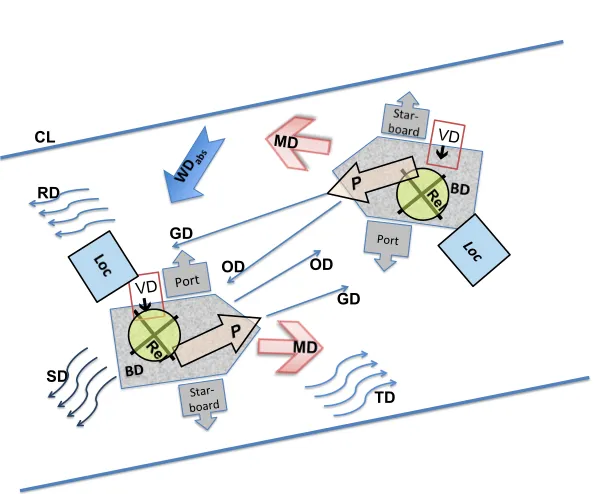
Figure 9 illustrates a possible meeting situation of two boats using our current repre-sentation format. Each sailor’s action goal is represented in terms of a relative reference frame, where the goal location Loc is a position behind each other following the current motion trajectory MoveD. In this situation, each moving vessel is a dynamic controlled object that serves as Rel for the other one. SinceMoveDis affected byWindDandTideD, the anticipation of the futureMoveDof both vessels can only be an approximation. This complicates the assessment of an appropriateGoalDin this situation that avoids collision, while not reducing speed as far as possible: an action goal to which we turn next.
3.3
Speed
Optimizing speed is a primary goal of many sailors’ activity. Collision avoidance can be relatively easy if time does not matter; in case of doubt, a useful strategy is to allow for a generous detour. Safety can be enhanced by exaggerated movements as the sailor demon-strates their intended collision avoidance strategy. In a regatta or race, however, sailors will aim to adopt a different strategy so as to achieve optimal spatiotemporal performance. As a result, the vessels will get much closer together than in leisurely traffic at sea. This involves fine-grained anticipation of each other’s movements, while still accounting for every other factor affecting the boat’s directionality [66]. The considerable cognitive chal-lenges involved in racing are demonstrated by expert support tools such as theSailracer4
3For example, http://blog.visual.ly/how-data-visualization-changed-the-way-we-experience-sailing/ and http://www.georacing.com.
BD
Loc
CL
Port
Star-board
RD
TD SD
OD
VD
ê GD
Port VD
ê
OD GD
MD
Figure 9: The current goal (Loc) is to the right of the other boat (Rel) for each of the two sailors, who are seated with a view direction VD as indicated. Since both boats are moving, they will go closely behind each other.
andTactical Sailing5apps, which demonstrate or calculate optimal start strategies and tac-tical maneuvers for regattas.
Other considerations concern optimization strategies with respect to local or global speed. In some situations speed can be gained locally by taking advantage of a gust, which may either take the boat closer to or away from the currentGoalD, depending on its nature and direction. Since gusts produce a specific kind of surface on the water, they can be an-ticipated, allowing for local speed optimization. Larger waves can be used to surf, leading to a change inMoveDbut increasing speed locally. Other angles relative to the waves may be safer and allow for more control. Since the tide may severely slow a vessel down if
TideDis adverse toGoalD, sailors in a race may wish to take advantage of the reduced tidal movements near the coast, where they may even find a local eddy that enhances speed; however, this may take the boat away from itsGoalD.
Going downwind, contrary to intuitions, having WindD directly behind the boat’s
MoveD(as in Figure 5 above) leads to less than optimal speed becauseMoveDsubtracts fromWindD. For this reason, it may be faster to deviate from a straight line towards the goal in order to make better use of the wind.6 The optimal angle betweenMoveD and
WindDin a particular sailing situation then depends on estimating the effects of the force ofWindDrelative to the costs of deviating fromGoalD. Going upwind, a straight line to the goal may be impossible due to the no-go zone; here, a relevant consideration is how much distance should be covered between changes ofMoveD, i.e., tacks. The tacking
pro-5http://www.tacticalsailing.com
cess takes time as speed decreases, but covering longer distances betweenMoveDchanges takes the boat further away from its goal.
In a race, sailors can be seen to use different kinds of strategies in all these respects, although various tactics (likelongest leg first) may be recommended and learned.7 This strategy is surprisingly similar to common wayfinding strategies in everyday route con-texts [4]. Due to the incomplete knowledge underlying spatial planning in this regard, optimal planning strategies are not readily available. How humans deal with this kind of situation and which kinds of cognitive heuristics are beneficial across different situations is an empirical issue yet to be addressed.
To sum up, the following research questions arise for spatial cognition research in the area of Action:
• How is chart-based navigation planning and position updating achieved, under con-siderations of compass directions and conflicting notions of directionality imposed by the wind and other influencing factors? What kinds of navigation strategies are adopted to simplify the associated complexity? This adds to research on the cognitive challenges of orienting oneself and following navigation strategies in the real world relative to a map, which may differ according to gender [15, 48].
• What are the cognitive challenges of local collision avoidance under the complex vi-sual and conceptual conditions of sailing? What kinds of cognitive strategies and heuristics are adopted by experts and novices, e.g., to predict the trajectory of an approaching controlled vessel? How do they relate to strategies adopted in other domains, e.g., robotic implementations for cluttered scenarios [50], radar assistance for flight vehicles [45], and predicting people’s motion patterns [6]?
• How are navigation strategies optimized for speed, which requires constant consider-ation and integrconsider-ation of the various influencing factors? What kinds of heuristics sup-port the availability of immediate action decisions under conditions of uncertainty, and how do they relate to other domains [34, 74]?
4
Communication
Sailing can be a lonely endeavor, but is typically social like many other outdoor activi-ties, supported by a rich vocabulary of technical terminology. A newcomer to this activity will gradually need to acquire a host of new concepts and terms, supported by beginners’ handbooks and coaches, aiming at first to understand just the basics of sailing in a partic-ular direction as described in Section 2 above. Navigation plans may need to be discussed and conveyed to others, and a skipper needs to communicate with the crew, to achieve the goals described in Section 3.
The sailing domain offers expert terminology using concepts that differ systematically from everyday usage. Used to define sides,starboardandportare more restricted than the generic spatial termsleftand rightsince they allow only a boat as relatum. Their combi-nation withWindDallows for domain-specific orientation concepts such asstarboard tack that require expertise to conceptualize, since everyday spatial language does not consider
WindD. A range of further terms such asclose hauled(sailing upwind) andheading up (turn-ing further upwind) rely onWindDequally heavily, reflecting the importance ofWindD
for spatial concepts of sailing. The list could be continued, but covering technical sailing jargon exhaustively is not the goal of this section; these examples should suffice to illustrate our point.
Not all concepts and technical terms need to be available for successful communication. Similar to other domains, only those aspects of a situation or plan need to be conveyed that are relevant from a cognitive point of view [62], for example to achieve a certain (local or global) action. Reference frames, as such, are rarely verbalized in everyday language (i.e., it is not common to explicitly refer tointrinsicorrelativereference frames in order to convey a spatial relationship), so this would not be expected for sailing either. Likewise, it is not necessary to understand all of the physical forces and directionalities involved in order to communicate global action plans, or indicate a rough direction of motion.
Nevertheless, various spatial relations may become relevant at some point. For instance, a gust may be anticipatedten meters ahead. For this purpose, the spatial relationaheadneeds interpretation in relation toWindDas well asMoveD, which implies conflicting informa-tion as the gust will not come from the direcinforma-tion the boat is moving. As a result, speakers may differ in how they interpret the meaning of terms likeaheadorforward. In everyday us-age, the mover’s intrinsic front is typically used for directionality, and a forward movement is conceived as a line rather than a broader region [21]. In the sailing domain, these terms may be avoided, or their meaning may be extended to represent a somewhat different con-cept (this is an empirical question). As a matter of fact, sailing terminology offers another concept related to forward motion, namely “Course made good (C.M.G.)—taking the most efficient route from one point to another depending on the direction of the wind” (cited from Wikipedia under “Five essentials of sailing,” well known in sailing communities).
As outlined above,WindDrelative toBoatDis relevant for handling the sails. Here, the most basic distinction is that betweenupwindanddownwind, which affects points of sail (as expressed by more fine grained terms likeclose hauledandon a reach) as well as action: going downwind, a change ofMoveDis typically accomplished by a jibe, whereas going upwind means tacking; these imply different operations. Accordingly, sailors can often be observed to limit communication to these simple terms, talking about goingdownwindor upwindwithout specifying further details.
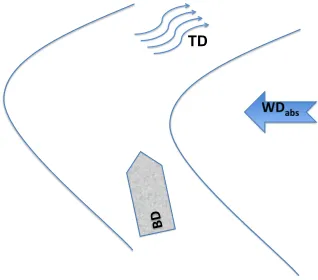
However, this coarse binary concept can be tricky, as exemplified in Figure 10. Depend-ing on scale, a sailor usDepend-ingCoastLfor orientation may not perceive any change of direction; however,WindDabsrelative toBoatDchanges fromdownwindtoupwindas the vessel
TD
BD
Figure 10: Relative toCoastL, the sailor is not changing direction in spite of a change from downwind to upwind.
Second, Saury and Durand [57] adopted a cognitive ergonomics approach to address the practical knowledge of expert sailing coaches. They observed five training sessions and conducted in-depth interviews with the coaches. Analysis focused on categorizing the knowledge aspects conveyed in concrete moments of the coaching situation, and verbal-ized subsequently in the interviews. Results highlight handling of constraints such as un-certainty, cognitive anticipation based on flexible plans, shared responsibilities, and further aspects that illustrate the problem solving components in this domain and their verbaliza-tion. Although this paper has been widely cited (in the general realm of sports education), the central idea of using targeted research in this specific domain for the purpose of devel-oping more efficient training materials, and basing future coaching processes on research rather than intuition, does not seem to have been taken up.
In sum, the Communication aspect of sailing opens up the following issues of relevance to spatial cognition research:
• Out of the complex repertory of conceptual aspects relevant for sailing and the associ-ated technical jargon, what kinds of concepts are used efficiently to convey strategies pertaining to local actions and global plans, and what does this reflect concerning the cognitive processes involved? This relates to the many ways in which spatial language (repertory and usage) reflects spatial cognition, e.g., [46, 47].
• What can we gain from the complex processes of sailing communication about no-tions of embodied and distributed cognition, as discussed widely in the literature [12, 63, 75]?
• What kinds of concepts need to be conveyed and communicated to beginning sailors, in order to facilitate learning processes? How can such insights feed into cognitively supportive training materials? How does this relate to research on efficient commu-nication and learning in other spatial domains [56, 58]?
5
Discussion
respect to three areas: basic elements ofcognition, goal basedactionrelevant to local and global strategies, andcommunicationof cognitive aspects relevant for different situational contexts. Since we have already provided pointers to wider research in concise summaries above, we now combine our three perspectives and consider emerging areas for future research.
Spatial reference frames are the cognitive building blocks that are required to relate oneself and other entities spatially to each other and to the environment, to assess relative orientation, direction, and movement, and to formulate linguistic expressions that capture these relationships adequately for communicative purposes. In sailing, many different ele-ments and directions are available that may potentially inform or affect such a conceptual spatial reference frame. A sailboat can move “forward” using a range of available direc-tions (GoalD,BoatD,WindD,ObjD,TideD,RivD, etc.) asperspective, with the sailor’sViewD
arguably the least reliable or relevant candidate. In terms of reference systems, the roles and relations relevant for intrinsic and relative reference frames [47, 68] are filled in domain-specific ways. This exemplifies how a conceptually complex domain (such as sailing) adds to the number of combinatory possibilities available, complicating matters considerably in comparison to everyday movement or object localization scenarios. Nevertheless, most of the combinatory options available may never be used in reality; there are conventionalized ways of dealing with the complexity in practice.
As has been frequently observed, linguistic expressions for spatial concepts are based on qualitative rather than quantitative information [67]. This has generally been recognized as reflecting the primary way humans deal with and think about spatial relationships [47], although quantitative aspects are relevant as well. Since it is beyond human cognitive abilities to perceive and conceptualize a large amount of details, they rely on cognitive “shortcuts,” which tend to be based more on qualitative and schematic than on quantita-tive information [11]. These observations have triggered extensive research in the area of Qualitative Reasoning(QR) [7, 10, 44]. According to Kuipers [44], for instance, humans func-tion remarkably well within an infinitely complex world without a chance to understand it completely.
In the domain of sailing, humans are normally not aware precisely which direction and amount of force a specific factor (e.g., WindDor TideD) has at any given moment, and how these factors will influence a specific vessel.8 Accordingly, the language used for communication reflects the basic qualitative aspects relevant for sailing. A sentence likethe boat is moving downwind along the riverinvokes a concept that incorporatesBoatD,WindD, andCoastL, but no fine physical details. Similarly, it would be inefficient to reason with detailed assumptions before acting in the environment. For instance, planning precisely how many tacks (or turns) are needed to approach a certain goal is typically impossible since essential factors can change dynamically.
Sailors can act upon (or react to) the forces present at a particular moment, based on the physical sensation of their effects on the boat, but any future (deliberate) action plan will necessarily remain on a coarse level. As a consequence, sailing is a particularly well suited area for studying the interplay of conceptual granularity with different kinds of spatial in-formation or knowledge. Humans are known to conceptualize and refer to spatial tasks and
subtasks on different levels of granularity, depending on the challenges involved [69, 70]. Similar issues are also relevant for geographic information systems [24]; the implications for extended domains such as sailing have yet to be explored.
Here, expertise will play an important role. Experts can draw on intuitions based on extensive prior experience [3,28,61], leading to flexible optimization and adaptation strate-gies in direct reaction to the dynamics involved. For instance, while inexperienced people might try to directly steer towards a goal (i.e.,BoatD=GoalD), experienced sailors would be more likely to choose an angle that accounts for the various relevant forces. Conceivably, such an action plan may be simulated to some extent in the sailor’s mind by conceptualiz-ing core elements of the anticipated action on a qualitative level.
Along these lines, reasoning and communicating about the complex factors affecting sailing is based on a set of core qualitative elements and relationships rather than precise calculation.9 The extent to which this is true at different levels of granularity, from local actions to global navigation planning, speed optimization, and effective communication and distribution of cognition, remains open for future research. Some actions will be based on high-level cognition and conscious considerations; however, the complex vector physics relevant for sailing will hardly ever be taught to novices in any detail. Instead, sailing skill is acquired by (physical) experience, and this will affect intuitions at all levels, albeit to different degrees.
Current debates around the notion ofembodied cognitionconcern the extent to which hu-man cognition can be understood based on the contribution of physical interaction with the world. While some of the issues raised in this debate, e.g., [75]:cognition is situated; cogni-tion is time-pressured; we off-load cognitive work onto the environment; cognicogni-tion is for accogni-tion, may not be true for all situations and all kinds of knowledge, they are quite straightforwardly true for the domain of sailing. Sailors act based on the physical experience of the interplay of diverse factors within a situation; reactions (by trained sailors) to given physical forces are immediate rather than delayed through a complex decision process; the environment is not fully encoded or cognitively represented; and knowledge about sailing means be-ing able toactappropriately rather than being able toreasonabout complex configurations and spatial directions. Feinberg and Genz [23] discuss these effects for the case of Poly-nesian seafaring [31], suggesting that orientation in this highly complex environment is achieved by embodied skills rather than consciously accessible mechanisms. Sailing on rivers and lakes may be less challenging but still involves a complex interplay of environ-mental factors—and these need to be understood on a level of cognition that is not, in all its detail, consciously accessible or communicable in language.
Future research will need to provide empirically validated details concerning a range of observations that we have only touched upon. While several pointers were given through-out this paper where appropriate, we suggest further future directions as follows.
Our theoretical examination of directions affecting the concept offorwardmotion and thereby spatial action planning as well as communication raises several issues. Which per-spective (or reference frame) do sailors (experts and novices) rely on, under which circum-stances and level of activity? How are directions and spatial relationships expressed in language by different types of speakers and in different situations? Are any of those
ceptual and linguistic choices more suitable or effective than others, leading to performance differences? How do novices reconcile the novel spatial concepts with their everyday ex-perience?
More generally, how do the various factors affecting a sailboat affect spatial planning on a larger scale? How is incomplete and uncertain knowledge accounted for both locally and globally? What kind of navigation behavior can, under diverse circumstances, be regarded as optimal? How do experts differ from novices in this regard—what makes expertsbetter under most circumstances? What do they conceptualize differently? How do they verbal-ize their advanced knowledge and concepts in this domain, addressing different kinds of people (novices, peers, non-sailors)?
With respect to computation, various aspects of the sailing domain have been addressed from a performance simulation or modeling perspective [55, 66] and in robotics,10 though rarely from a cognitive perspective (but see [76]); most research in this area focusses on the mechanic aspects of controlling rudder and sails [65] or yacht performance in various conditions [55]. What would an autonomous sailboat need to know in order to perform strategically while adhering to the rules? Another promising perspective concerns cogni-tive modeling. The benefits of modeling sports activities have been pointed out several times in the literature, for example with respect to decision making [41] and coaching [14]. Here, the cognitive building blocks and processes need to be specified so as to adequately capture action and communication of sailing agents.
The sailing domain also offers exciting questions from a neurocognitive point of view. If learning to sail involves acquiring fundamentally new spatial concepts, and is physically oriented rather than primarily focused on high-level planning, what does this mean in terms of neural plasticity, and for the development of place cells [52]? More generally, how does this affect the neural systems involved in spatial cognition and navigation? How does the brain adapt to the changed (and ever changing) perceptual conditions [18], and how do conceptual updating processes work in the face of conflicting and unstable directional information? Here, not only the various directional concepts are relevant but also the more low-level physical aspects of sailing, such as orientation and motion in a heeling boat.
To conclude, we are convinced that the sailing domain highlights the fascinating flex-ibility of human spatial cognition in many different ways. Exploring the details of this flexibility will not only inspire spatial cognition research but also support our understand-ing of embodied and distributed cognition, action with uncertain knowledge, and ways of conveying cognitive complexity efficiently to novices.
References
[1] ADAMS, J. A. Human tracking behavior. Psychological Bulletin 58, 1 (1961), 55–79. doi:10.1037/h0041559.
[2] ANDERSON, B. D. The physics of sailing. Physics Today 61, 2 (2008). doi:10.1063/1.2883908.
[3] ARAUJO, D., DAVIDS, K., ANDSERPA, S. An ecological approach to expertise effects in decision-making in a simulated sailing regatta. Psychology of Sport and Exercise 6, 6 (2005), 671–692. doi:10.1016/j.psychsport.2004.12.003.
[4] BAILENSON, J. N., SHUM, M. S., AND UTTAL, D. H. The initial segment strat-egy: A heuristic for route selection. Memory & Cognition 28, 2 (2000), 306–318. doi:10.3758/BF03213808.
[5] BALDWIN, C. Individual differences in navigational strategy: Implications for display design. Theoretical Issues in Ergonomics Science 10, 5 (2009), 443–458. doi:10.1080/14639220903106379.
[6] BENNEWITZ, M., BURGARD, W., AND THRUN, S. Adapting na