Nagi. World Journal of Engineering Research and Technology
EFFICIENCY OF E-LEARNING FROM STUDENTS PERCEPTIONS
A CASE STUDY OF ALBAHA UNIVERSITY KSA
*Dr. Nagi Zomrawi Mohammed
Associate Professor of Surveying and Digital Mapping Al Baha University (KSA), Sudan University of Science and Technology, Khartoum, Sudan.
Article Received on 25/03/2019 Article Revised on 15/04/2019 Article Accepted on 05/05/2019
ABSTRACT
Different definitions have been stated for E-learning. All these definitions consent on that; e-learning is a new method of learning utilizing electronic technologies to access educational curriculum online, via the internet outside of a traditional classroom, but not a course delivered via a DVD, CD-ROM, or over a television channel. It can be provided in different interactivity levels; passive, limited,
moderate or full.[4] E-learning was started in Kingdom of Saudi Arabia
(KSA) in 2002. Since that time it became an interesting learning
method among academic community.[3] This study work tried to analyze the students
orientation and impression, after completing an engineering course taught for the first time to civil engineering student via Blackboard learning management system in limited or supporting level. Then, the efficiency of e-learning evaluated from students’ perceptions. Results proved that e-learning can successfully supporting student and it had a positive impact. It helps them access to course modules and improve their academic capacities. It also increase students’ academic contributions. Through e-learning, students easily follow course attentions and the course become popular. Moreover, it is easy to do tests and tasks and obtain grades. Therefore, e-learning assists to achieve course learning objectives.
KEYWORDS: Distance Learning, E-Learning, Learning Management Systems and Likert scale.
World Journal of Engineering Research and Technology
WJERT
www.wjert.org
SJIF Impact Factor: 5.218*Corresponding Author Dr. Nagi Zomrawi Mohammed
Associate Professor of
Surveying and Digital
Mapping Al Baha
University (KSA), Sudan
University of Science and
Technology, Khartoum,
INTRODUCTION
A learning system based on formalized teaching but with the help of electronic resources is known as E-learning. While teaching can be based in or out of the classrooms, the use of
computers and the Internet forms the major component of E-learning.[6]
E-learning has taken the world of learning by storm, flaunting its features such as flexibility, cost-effectiveness, accessibility, and more. Organizations adapting to e-learning is just one
step of the process.[5]
E-learning can be Synchronous learning; refers to a learning event in which a group of students are engaging in learning at the same time or, Asynchronous learning; in which a student-centered teaching method that uses online learning resources to facilitate information sharing outside the constraints of time and place among a network of people.
Measuring the effectiveness of e-learning courses plays a major role in deciding whether certain training courses are working for a particular set of learners or not. There might be e-learning courses with excellent features, but they might not be suitable for a set of audience. Measuring the effectiveness of learning will help training managers realize whether their
e-learning courses are being effective enough.[7]
E-learning has proved to be the best means in the corporate sector, especially when training programs are conducted by Multinational corporations (MNCs) for professionals across the globe and employees are able to acquire important skills while sitting in a board room, or by having seminars, which are conducted for employees of the same or the different organizations under one roof.
The institutes which use e-learning technologies are a step ahead of those which still have the
traditional approach towards learning.[13]
sitting in front of screens to using handheld devices to send e mails, text messages and send instant messages. Some of them even talk to each other in bytes. In fact, this generation is
called the digital generation.[14]
Previous studies and investigations showed that majority (73%) of the students in Kingdom
of Saudi Arabia (KSA) still prefer classroom teaching to individual study [9].
E-LEARNING EDUCATION IN KSA
The higher education in Kingdom of Saudi Arabia (KSA) was established in 1975. It has received enormous governmental support; new universities, scientific and applied colleges were established and huge funds were allocated in budgets for higher education. By now (2019) the number of higher education institutions in KSA has registered 26 government
universities, 10 private universities, and 41 private colleges.[13] These universities and
colleges have scientific, and applied majors in different areas. The ministry of higher education has also adopted modern approaches for scientific research, and future planning. Many KSA Universities have started using technology such as Blackboard as Learning Management System (LMS) with many other great pulg-ins and tools in a smart classroom like e-Podium, Interactive board, lecture sharing, e- attendance, video conferencing, etc. Well the evolution from traditional blackboard and chalk to a huge innovative technological development in the education system has not been that easy among teachers and students. Competing with global trend of presenting higher education online most universities in KSA have significantly increased their focus on learning and will replace entire curricula by e-learning materials into existing curricula. The universities like King Saud University (KSU), King Abdul Aziz University, Al-Baha University, Taiba University, Qassim University, King Khalid University and Madinah Islamic University have formal agreements with the National Center of Electronic Deanship Learning (NCeDL) to introduce e-learning schemes into their curricula. The e-Learning Centre, in the Deanship of Academic Development at King Fahad University of Petroleum and Minerals, which was established in 2003, offers integrated access to online resources using WebCT. It provides approximately 80 courses including engineering, sciences and industrial management, both in English and Arabic, through the
Albaha University
Albaha University is a governmental university that was established in 2006 with three faculties; Engineering, Science and Applied Medical Sciences. At the present, the university consists of 11 faculties distributed in four campuses; the main campus located at Alaqiq
town, Almikhwah campus, Almandaq campus, and Baljurashi campus.[11]
The university looking forward to be the best place to learn. Its vision is; ‘Achieving leadership in offering academic programs and conducting specialized research related to local and national development needs through leadership, innovation and partnership’.
Albaha university comprises nine deanships. Deanship of E-learning and Information Technology (DEIT) started to apply e-learning since 2014 by implementing Blackboard learning management system. Many efforts were done to motivate in this direction. All these efforts done by DEIT did not yield the planed objectives.
By the end of 2018, DEIT declared RAFID program for developing and teaching academic curriculums utilizing e-learning tools. Rafid was an ambition e-learning program supported by Blackboard learning management system. The program comprises number of simulations sessions, training materials and other interactive activities by which trainers can gain capabilities and skills that helps them to develop and teach their own electronic courses satisfying the required accreditation standards.
I.Blackboard
Blackboard Inc. provides powerful and easy-to-use systems for educational instruction, communication, and assessment. In the last three years, Blackboard Inc. has marketed two major product lines: The Blackboard Commerce Suite and the Blackboard Academic Suite. The core of the Academic suite is the Blackboard Learning System, the course management system for classroom and online educational assistance.
Blackboard allows faculty to add resources for students to access online. Powerpoint, Captivate, video, audio, animation, and other applications are created outside of Blackboard and added into Blackboard courses for students to enhance teaching and learning efforts.
Student can log on to Blackboard and access his class materials anywhere he has an internet connection.
Blackboard helps to solve most critical challenges in education to drive student success. The education landscape is continuously evolving. It’s why it focused on providing the technology, tools and support to transform to meet the specific needs of students. In the classroom, in an office, or even a government agency - provide a connected learning experience and support network. Blackboard works to create the seamless, intuitive and insightful experience learners need for success in an educational environment.
Get insights that are accessible, relevant, and actionable. Leverage data from all touch points and deliver insights at every level. Providing the right information to the right person, at the
right time can be the difference between at-risk students and student success [3].
Data and Analysis
Surveying course is one of the fundamental subjects that involved in academic plan of most civil engineering programs. It generally covers topic that concerned with mapping, setting out, earthwork, and design. The course title differs from one program to another. It may have appeared under the name of surveying, mapping techniques or geomatics. Surveying is applicable in almost all branches of civil engineering whether structure, highways or
hydraulic engineering.[12]
Academic plan 2010 (1432 Hijri) of civil engineering program described Surveying 2 (32011304) course is to teach students the basic principles of engineering surveying,
principles of GPS and photogrammetry. The course description includes horizontal and
vertical curves, methods of setting out, area and volume computation, introduction to GPS
and photogrammetry.[1]
used to support traditional classroom teaching method. Students perceptions were evaluated after the completion of the course.
A questionnaire containing thirteen statements was designed and quested through e-learning tools and made available for students. Out of fifty students, 43 students were responded. To what extent is e-learning effective is the idea around which questions were formed. Parameters to be measured from student’s perceptions were stated as follows:
1. In e-learning I can easily access to course modules, and academic material.
2. E-learning increased my academic capacity and my results became better.
3. E-learning increased my academic contribution and discussions.
4. I prefer to do the tasks and home work through e-learning tools.
5. I prefer to obtain my grades through e-learning tools.
6. In e-learning I can easily Follow course attentions and announcements.
7. In e-learning I became in contact and closer to my instructor.
8. In e-learning the course became more attractive.
9. I prefer to revise my assessments through e-learning tools.
10.I prefer to do the tests through e-learning tools.
11.Virtual classes are interesting and supporting me.
12.E-learning assists to achieve course objectives.
13.I want to take other courses by e-learning.
In addition to free recommendations comments.
Five scale choices was used; strongly agree, agree, neutral, disagree, strongly disagree. Students responses were analyzed and arranged as illustrated in table (1) below.
Table 1: The study questions and their responses.
Qu estion S tr on gly Agr ee Agr ee Ne u tr al Disagr ee S tr on gly Disagr ee Percentage Frequency
Q1 40.0 48.5 11.5 0.0 0.0
Q2 11.6 51.6 17.8 14.7 4.3
Q3 39.5 49.3 11.2 0.0 0.0
Q4 55.2 42.3 2.5 0.0 0.0
Q5 58.5 38.0 1.8 0.0 1.7
Q7 44.6 50.1 5.3 0.0 0.0
Q8 17.6 46.5 22.9 10.4 2.6
Q9 49.3 40.4 8.6 1.7 0.0
Q10 17.6 23.8 22.1 10.6 25.9
Q11 14.9 55.8 13.0 12.8 3.5
Q12 15.9 67.7 14.7 0.0 1.7
Q13 19.6 25.2 14.1 14.1 27.0
Q: Question
By making a quick analysis of table (1), it can be seen that, in general, e-learning has positive outcomes from student’s point of view.
In order to simplify analysis, the five point Likert scale; strongly agree (5), agree (4), neutral (3), disagree (2), strongly disagree (1) was used.
The final results recalculated by reducing data in table (1) using Likert scale, then reducing it to 100% to represent positive responses.
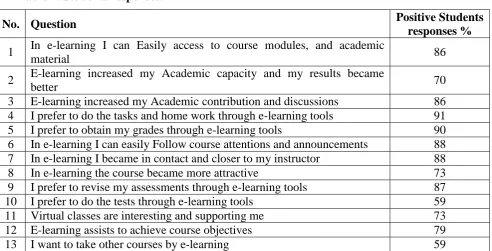
Table (2) below represents the final results. Table 2: Students responses.
No. Question Positive Students
responses %
1 In e-learning I can Easily access to course modules, and academic
material 86
2 E-learning increased my Academic capacity and my results became
better 70
3 E-learning increased my Academic contribution and discussions 86
4 I prefer to do the tasks and home work through e-learning tools 91
5 I prefer to obtain my grades through e-learning tools 90
6 In e-learning I can easily Follow course attentions and announcements 88
7 In e-learning I became in contact and closer to my instructor 88
8 In e-learning the course became more attractive 73
9 I prefer to revise my assessments through e-learning tools 87
10 I prefer to do the tests through e-learning tools 59
11 Virtual classes are interesting and supporting me 73
12 E-learning assists to achieve course objectives 79
13 I want to take other courses by e-learning 59
E-learning increased student’s academic contribution and discussions. Moreover, about 91% of students prefer to prefer to do their tasks and home works and obtaining their grades through e-learning tools.
Results also reflects that 88% of students can easily Follow course attentions and announcements and became in contact and closer to their instructor.
Also, utilizing e-learning technology, the course became more attractive and students like to obtain their scores through e-learning tools.
Although, 59% of students prefer to do tests through e-learning tools, this percentage is the lowest compared with all other results. On the other hand, the 41% of students those afraid of taking e-tests and e-exams they hesitate to take a new e-course in future.
About ¾ of students make the most of virtual classes and they think that it interesting and supporting them.
Finally, about 4/5 of the class agree on that e-learning assists to achieve learning objectives. Fortunately, all student’s free comments were positive.
Figure (1) hereunder, is a bar graph representing questions investigated via student’s positive responses. It can be said that most of students like to take courses through e-learning tools and they trust on its benefits.
CONCLUSION
This study work tried to measure and analyses the student orientation and impression after completing an engineering course taught for the first time to civil engineering student via Blackboard learning management system in supporting level. Results proved that e-learning can successfully support students and it had positive impressions.
From results obtained and analysis carried out, it can be concluded with that through e-learning:
Access to course modules and academic material became easy.
Students’ academic capacities improved.
Students’ academic contribution and discussions increased.
Students can easily follow course attentions and announcements and became more
contact to course instructor.
The course became attractive.
Students prefer to do e-tests and e-exams and like to study new e-course in future.
E-learning assists to achieve course learning objectives.
ACKNOWLEDGEMENT
I would like to express my very great appreciation to the Deanship of E-learning and Information Technology (DEIT) at Albaha University. My special thanks are expressed to the
dean, Dr. Naif A. Mokhayesh and Vice dean, Dr. Hassan Alghamdi for their excellent
planning and execution of Rafid eLearning project.
I wish to acknowledge the help provided by all the staff of Rafid project whom support me with very valuable knowledge and orientation during the work.
REFERENCES
1. Academic plan, faculty of engineering, Albaha university, 2010.
2. Algahtani, Abdullah, faleh, Evaluating the Effectiveness of the E-learning Experience in
Some Universities in Saudi Arabia from Male Students' Perceptions, Durham theses, Durham University, 2011.
3. http://uupinfo.org/research/working/bradford.pdf.
4. http://www.elearningnc.gov/about_elearning/what_is_elearning/.
5.
6. https://coreaxis.com/four-levels-elearning-interactivity/.
7. https://economictimes.indiatimes.com/definition/e-learning.
8. https://elearningindustry.com/levels-of-interactivity-in-elearning-advantages-4.
9. https://en.wikipedia.org/wiki/Al_Baha_University.
10.https://en.wikipedia.org/wiki/Ministry_of_Education_(Saudi_Arabia).
11.https://www.researchgate.net/publication/300374330_E- Learning_in_Saudi_Arabia's_
Higher_Education.
12.https://portal.bu.edu.sa/web/university-links/vision-and-mission.
13.Nagi Zomrawi, Engineering Surveying Course Taught to Civil Engineering Students in
KSA Universities: A Case Study of Albaha University, International journal of trend in scientific research and development, 2018.
14.Yousef Mehdipour, e-teacher and e-learning in dot.com age, World journal of engineering