Background: Diarrhea is a leading cause of childhood mortality globally as well as in Nepal. Data all around the
world has shown the highest prevalence of diarrheal disease amongst 6-12 months old children. This paper aims to
assess the existing diarrhea preventive practices carried out by caretakers of children from 6-12 months of age and
their predicting factors in Chitwan district of Nepal.
Methods: A cross -sectional survey was conducted among 384 caretakers of children aged 6-12 months from
four different MCH clinics of Chitwan district, Nepal. Data were collected by using face- to-face interviews with
structured questionnaires from April 15 to May 30, 2018. Univariate analysis, chi square, Pearson correlation and
stepwise multiple regression analysis were the statistics used for data analysis.
Results: The findings showed that only around one-fourth (22.7%) of the caretakers followed good diarrhea
preventive practices. Stepwise multiple regression showed that age, monthly family income, knowledge, attitude and
accessibility to WASH (water, sanitation and hygiene), could predict the diarrhea preventive practices of caretakers
by only 20.5%. Accessibility to WASH (beta= 0.246) had the highest predictive power and age (beta= 0.015) had the
least predictive power of diarrhea preventive practices amongst them.
Conclusions: The findings of this study suggest that there is a definite need to promote diarrhea preventive practices.
Local government and non-government organizations should establish activities to improve accessibility to WASH,
caretaker’s attitude and caretaker’s knowledge in order to ultimately improve their preventive practices.
Keywords: Caretakers; children; chitwan; diarrhea preventive practices; 6-12 months old; Nepal.
Predictive Factors of Diarrhea Preventive Practices
by Caretakers
Priya Pathak,1 Chokchai Munsawaengsub,2 Sutham Nanthamongkolchai2
1Faculty of Public health and Faculty of Graduate Studies, Mahidol University, Bangkok, Thailand,
2Department of Family Health, Faculty of Public health, Mahidol University, Bangkok, Thailand.
Correspondence:
Priya Pathak, Faculty of Public health and Faculty of Graduate
Studies, Mahidol University, Bangkok, Thailand. Email: medicopriya9@gmail. com, Phone: +66619611471.ABSTRACT
J Nepal Health Res Counc 2019 Apr-Jun;17(43): 247-52
INTRODUCTION
Diarrhea claims the lives of millions of children
under-five globally and still remains to be a leading cause of
death worldwide.1,2 Seventy-two percent of deaths from diarrhea happen in children younger-than two years as incidence peaks at age 6–11 months, then decreases with age.3 Many studies have claimed that practices like hand-washing, sanitation, feeding practices, safe drinking water, proper disposal of faeces and waste management can help improve the situation and limit annual incidence of the disease.4-6 Numerous studies have been conducted to show obvious decline in diarrheal incidences when interventions are provided to improve the knowledge,
attitude and practices of the caretakers. However not
enough research in this area have been carried out to identify what may predict these practices.7-13 This study aims to identify the situation of diarrhea preventive
practices and their predictors amongst the caretakers of children aged 6-12 months in Chitwan district.
METHODS
This research was a cross-sectional survey about the diarrhea preventive practices of caretakers of children 6-12 months of age. This district lies in Province number 3 of Nepal, which has the highest prevalence of diarrhea
amongst all provinces (9%).14 Chitwan district is also
one of the very few districts of Nepal with the highest coverage and low dropout of vaccines as well as access to healthcare facilities.14
Data were collected between April 15th and May 30th, 2018. The sample population were the caretakers both male and female, aged 18 years and above of children aged 6 to 12 months living in Chitwan district. The
DOI
https://doi.org/10.33314/jnhrc.v0i0.1876
Originalfirst site of data collection was MCH clinic of District Hospital, Chitwan. The other three MCH were randomly
selected out of three clusters from the east, north and
south of the District Hospital. Each clinics selected from
the cluster are representative of the areas. A total of
four centers providing MCH clinics (1 District Hospital
and rest of the three selected clusters) were the study site. The sample size was calculated on the basis of Cochran’s Sample size formula.15 Based on the population composition, Bharatpur being the most populated,in Chitwan district,16 50% of the calculated sample size
was collected from the MCH clinic there. From the rest
of the three of the selected health centers/ hospitals, sample size proportionate to population was collected by clustered random sampling. Then by simple random sampling, caretakers of children 6-12 months of age presenting to those clinics between April 15th and May 30th 2018, were interviewed after informed and written consent.
The instrument used in this study was structured questionnaire which consisted of 6 parts: general characteristics of the caretaker, knowledge of the caretakers, attitude towards diarrheal diseases and its prevention, accessibility to Water, Sanitation and
Hygiene (WASH), social support and finally diarrhea preventive practice amongst caretakers. The first part
was general characteristics which consisted of 8 items:
Sex, Age, Occupation, Marital Status, Educational Level
and caretaker’s family income per month in terms of Nepalese Rupees. For the rest, each part had its own set of questions to which scoring was done.
Knowledge of the caretakers regarding diarrheal
disease, including meaning of diarrhea in children aged 6 to 12 months, prevention and causes of diarrhea, feeding during diarrhea, measures of treatment, oral rehydration solution and its preparation. These were yes / no questions which were 32 in number. Under attitude, a total of 14 statements were given which could be positive or negative statements and the answers were agree, uncertain and disagree. Under accessibility to
WASH, a total of 10 questions were given to which the
answers are multiple choice, this is concerned with the water, sanitation and hygiene facilities accessibility to the caretakers of children. Source of drinking and domestic water, distance between drinking water source and latrine, type of latrine, handwashing were included in the questions. These questions are based on the JMP
WHO/UNICEF WASH service ladders,4 on the basis of
which we can classify into accessible and inaccessible. Social support consisted questions regarding the four types of social support that is: emotional, tangible,
informational and appraisal support. For this part questions were asked on whether the respondents received support from their friends, family or health professionals always, sometimes or never and scoring was done for 15 questions. Finally, diarrhea preventive practices had 21 questions regarding practices like handwashing, food hygiene, sanitary disposal of child’s stool, and safe drinking water, with the answers in frequency. The answers for practicing the activities were
categorized as “every time”, “sometimes” and “never”
and scoring were done based on the responses.
This structured questionnaire was assessed for content
validity by three experts from Mahidol University, two from the Department of Family Health including a pediatrician and one from Department of Public Health
Nursing. After corrections and editing, a pilot study amongst 30 caretakers of children of the same age group
was done in a different district whose characteristics
were similar to the study population. The results were
then analyzed for their Cronbach’s alpha coefficient for
each set for reliability.17 The overall Cronbach’s alpha
coefficient was 0.746 and that for knowledge, attitude,
social support and diarrhea preventive practices were found to be 0.720, 0.709, 0.824 and 0.734, respectively(all above 0.7 : reliable). The data were analyzed by descriptive statistics in terms of frequency, percentage, mean, standard deviation and applied to show the general characteristics of caretakers. Chi square
test and Pearson product moment correlation coefficient
were used to determine the factors that were related to the factors associated with diarrhea preventive practices of caretakers after which to determine the predictive
factors that influence the diarrhea preventive practices
of caretakers, stepwise multiple regression was used. A
p-value of less than 0.05 was set as the cut off value to show statistical significance.
This research has been approved by the Ethical Review
Committee for Human research (COA no.: MUPH 2018-71, approval date: 26 March 2018), Faculty of Public Health,
Mahidol University. It was also approved by the Ethical
Review Board of Nepal Health Research Council (NHRC)
(registration no. 117/2018, 5 April, 2018). Necessary informed and signed permissions were also taken from
the District Health Officer (DHO) of Chitwan district and all respective health center in-charges of the four MCH
Clinics of Bharatpur and all participants after they were informed about the aims and objectives of the study and invited to participate.
RESULTS
the caretakers (72.9%) lied between the age group of 21
to 30 years of age, with the median age of 25.94 (SD=
5.23 years). The number of females (92.7%) were more than that of males (7.3%). 90.4% of the caretakers that
participated in the study were the mothers and most of
the caretakers (77.9%) were found to be unemployed/
housewives. Regarding the level of education, the distribution was similar for secondary and higher
secondary levels (26.6% and 23.2% respectively), whereas approximately similar number of caretakers (19.8%) had attained Bachelor’s degree as well. Less than 1% each were either single or divorced while the rest (98.4%) were married. Majority (75.6%) of the caretakers’ family
income lied below or equal to 30,000 Nepalese rupees (around 280 USD).
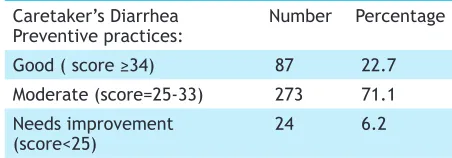
This study revealed that amongst 384 caretakers who
participated, 22.7% of the total participants of this study had good diarrhea preventive practices, 71.1% had moderate practices and only 6.2% needed improvement
(Table 1).
Table 1. Level of diarrhea preventive practices of caretakers (n=384).
Caretaker’s Diarrhea
Preventive practices: Number Percentage
Good ( score ≥34) 87 22.7
Moderate (score=25-33) 273 71.1 Needs improvement
(score<25) 24 6.2
Mean= 31.69; SD= 3.77, Min.=15, Max.= 40
To analyze the relationship between different factors
and diarrhea preventive practices of caretakers, Chi
square test and Pearson’s Correlation Coefficient were
used, the results of which revealed that age, caretakers monthly income, knowledge about diarrheal disease and its prevention, attitude towards diarrheal disease
and its prevention and accessibility to WASH were significantly correlated with the diarrhea preventive practices of caretakers at a statistically significant level (p-value) of <0.05. However, there was no statistically significant association between sex (p-value=0.872),
occupation (p-value=0.273), marital status (p-value= 0.529), educational status (p-value= 0.769) and diarrhea preventive practices of caretakers. Also, no association between practices and caretaker’s social support could be seen by Pearson’s correlation (p-value 0.079)
Age, monthly income of the family, knowledge and attitude towards diarrheal disease and its prevention
and accessibility to WASH were found to be the factors
that had the power to predict the diarrhea preventive
practices of caretakers upto some limit. Using stepwise multiple regression analysis, it was found that these
factors could predict upto 20.5% of the diarrhea
preventive practices carried out by the caretakers
of children 6-12 months of age. Accessibility to WASH
best predicted the diarrhea preventive practices of caretakers (beta= 0.246) (Table 2).
Table 2. Stepwise multiple regression between independent variables and diarrhea preventive practices of caretakers (n=384).
Predictive Factors B Beta t p-value Accessibility to
WASH 0.443 0.246 5.149 <0.001
Attitude 0.246 0.236 4.996 <0.001
Knowledge 0.284 0.164 3.533 <0.001
Age 0.830 0.115 2.508 0.013 R2= 20.5 ; p-value significant at <0.05
DISCUSSION
According to the results of this study, only around
one-fifth of the respondents had good diarrhea preventive
practices with the majority having only moderate level
of practices. The practices were based on five criteria
handwashing practices, child feeding practices, proper disposal of faeces, safe drinking water practices, and
food preparation and storage practices. Although 95.6%
of the caretakers had good practices regarding safe drinking water and more than half had good practices regarding food preparation and storage as well as handwashing and sanitation, majority of them needed improvement in feeding practices and proper disposal
of faeces.This study is different from other studies done
in Nepal or in other countries of Asia about behaviors or practices for diarrhea prevention done before which have showed at least / around half of the participants had good preventive practices / behaviors. A study done in Nepal’s Lalitpur district study found out that nearly
half (49.16%) of caregivers were doing good practice
during diarrhea in under-five children,18 another done in
Samut Sakhon province of Thailand showed 54.4% had
good level of practice related to childhood diarrhea and
another one from Indonesia showed 68.3% of mothers
had good behaviors in preventing diarrhea.11,19
However, similar study done in Cambodia in 2014 showed
that majority of the caretakers had poor diarrhea preventive behaviors.20
This study showed that the range of age of caretakers was
quite wide with a minimum of 18 years and maximum of
not only includes mothers as the caretakers, but also others like grandmothers, fathers, aunts, etc. who take care of the child. We also have to keep the inclusion criteria of age of 18 years of above, we may have
excluded many mothers younger than that age. This
could be the reason why the mean age is on the higher
side.As stated by the NDHS, “17% of Nepalese women age 15-19 have begun childbearing; 13% have had a live birth, and 4% are pregnant with their first child; this percentage increases with age, from 2% among women
age 15 to 36% among women age 19”.15Most of the
caretakers in this study were females which could be because most of the primary caretakers tend to be the mothers of the child, and the other females included
were the grandmothers and aunts and is befitting in the context of Nepal. This finding is similar to that of the
study done in Lalitpur in 2010.18
This study also showed that the factor with the
highest influence on diarrhea preventive practices was accessibility to WASH followed by attitude, knowledge
and age of caretakers, respectively. Accessibility to
WASH has been acknowledged as an important risk factor
for diarrhea in terms of lack of sanitation, inaccessibility to clean water supply, poor water-storage practices,
and insufficient personal hygiene, lack of vigilant hand
washing, poor sanitation and not treating water in the home.21-23 When questions regarding WASH were asked, it was found that although majority of the caretakers had access to tap-water as the source of drinking and domestic use water with the point source at home, but treatment of water before drinking was done properly by only a small proportion. Around one third answered that they did not treat the water at all before drinking. Similarly, there were disparities amongst the way of disposal of the waste from home amongst the
participants. However, accessibility to latrine and place
for handwashing inside the premises were present for most of them. Studies done all over the world have
shown that 90% of diarrheal disease occurrence are as a result of inaccessibility to WASH, especially in low
income settings.24-26
This study also showed that the influence of
characteristics of caretakers on diarrhea preventive practices of caretakers is very low, which brings up the fact that other factors may also be responsible which
may include affordability, policies and social norms.27 In a study from Western Ethiopia, community water source, water storage container, and knowledge of mothers remained a strong predictor of diarrhoeal morbidity. 28
In Nigeria, another study reflected that“promotion of
hygiene and nutrition education for mothers particularly
on proper infant feeding practices and complete immunization of infants is needed to address the diarrhea determinants”.29
In a study from the Philippines about “Determinants of
Mother’s Preventive Practices against Children’s Acute Gastroenteritis” which used the same statistics, showed that among the several variables that were considered, attitude and knowledge entered into the regression
model with unstandardized Beta coefficients of .193
and .030, respectively.30This implies that Knowledge and attitude are the common variables with similar
beta coefficients that can predict diarrhea preventive
practices of caretakers.
Most of the studies in the past regarding diarrhea prevention has compared the knowledge, attitude and practices to the incidence/prevalence of diarrhea in
the children. However, this study compares not only the
knowledge and attitude of caretakers regarding diarrheal diseases and their prevention, but also important factors like accessibility to water, sanitation and hygiene and
social support to the caretakers with their effect on
diarrhea preventive practices. Another gap that this
study fills is this study is amongst the very few studies which has been targeted specifically to the caretakers of
children 6-12 months of age. Usually studies of such kind cover a wider range of age group (under 5 years). But while doing this we tend to oversee the fact that there is a wide gap between the possible modes of transmission amongst the various subgroups of this group.
The samples were collected from the caretakers
who attended the MCH clinics which may not be
representative of the population. Language barriers due to multilingual ethnicities present in this area (Tharus, Maithili, etc.) were another issue.
CONCLUSIONS
This study reflects that majority of caretakers in Chitwan
district have moderate level of diarrhea preventive
practices. The findings of this study suggest that there is a definite need to promote diarrhea preventive practices,
responsible organizations should establish activities
to improve accessibility to WASH (water, sanitation
ACKNOWLEDGEMENTS
The researchers would like to give special thanks to
District Health Office, Chitwan and all four MCH clinic
In-charges for the permissions to collect data. We convey our thanks also to the local coordinators for data collection, and all those caretakers who participated in
the survey. This study was partially funded by The HEART
Foundation, Mahidol University, and we are very grateful
for the immense co-operation of Dr. SukhonthaKongsin
and Dr. Sukhum Jiamton. We are also grateful towards
the Mahidol MPH International committee for their
continued support.