PERCEPTIONS OF
PROBLEM-BASED LEARNING IN A COMPUTER
ENGINEERING PROGRAM IN BRAZIL
David Moises Barreto dos Santos, Carlos Alberto dos Santos da Silva State University of Feira de Santana, Feira de Santana, Brazil E-mail: [email protected], [email protected]
Abstract
This research aimed to evaluate students’ overall perceptions of Problem-based Learning use in a Computer Engineering program in Brazil. PBL is applied to nine interdisciplinary core courses of its curriculum. A 32-item questionnaire was administered to 115 students, with an average age of 20.9 (SD 2.7) between late 2014 and the beginning of 2015. It includes items on PBL general aspects, improved skills, PBL room and overall satisfaction. The results show that students’ degree of agreement with several items ranged from 4.1 to 5.9, in a seven-point scale. Some of these items revealed that 68.7% of the students got familiarized with PBL along the first year and there is a growing tendency among students to improve this familiarity with PBL over time. Moreover, the two items with lowest degree of disagreement were tutors’ feedback at the end of each tutorial session (35.7%) and the deadline to elaborate these solutions of problems (29.6%). Almost all students also agree with that PBL helps them to improve several skills, mainly problem-solving, self-directed learning and critical thinking. Repeating students in PBL courses scored higher than the non-repeating students. Many of them were statistically significant differences, inclusive for items on familiarization process. This can mean that their failures are not related to the familiarity with the method likely. Finally, most of the students are satisfied with PBL and like it, what indicates a successful use of it in the mentioned program.
Key words: problem-based learning, evaluation, students’ perception, computer engineering.
Introduction
Several authors have growly criticized the long-established teaching method in which one teacher speaks to many students. For Freire (1987) teachers “pour” knowledge in students as if they were empty containers, dividing classes between those who know and those who do not know, those who speak and those who listen, between those who prescribe and those who follow what was prescribed. Thus, it is necessary to create strategies for students to learn more actively.
75
In addition, PBL helps students to develop important and different skills: problem-solving, self-directed and lifelong learning, collaboration, effective communication, critical thinking, among others (Hmelo-Silver, 2004; Savery, 2006).
Although Computer and Engineering courses are grounded in relevant theories, they have a very striking practical nature, so PBL suits very well to them and can make Computer Engineering more attractive for students. Hence, several institutions have implemented PBL in their Engineering and Computing programs and it has been widely accepted by teachers and students (Aberšek, 2008; Mohd-Yusof, Hassan, Jamaludin, & Harun, 2011; Oliveira, Santos, & Garcia, 2013; Ribeiro & Mizukami, 2005). Moreover, PBL can help teachers to keep students’ attention without competing with technological distractions, one of the current challenges of education (Judd, 2014; Junco & Cotten, 2012; Sana, Weston, & Cepeda, 2013; Zhang, 2015). In an ethnographic study, the author observed PBL students spent little or no time using mobile devices during their meetings to discuss the problem while traditional students use them more often for non-academic purposes during their classes, especially to access Facebook (Santos, 2012). In general, PBL students used mobile devices to take notes about their discussions — ideas, facts, issues and goals.
In spite of the Computer Engineering program at UEFS has implemented PBL since it opened, in 2003, few evaluations of students’ perceptions of PBL were conducted and in addition they were informal, sporadic and very specific. Thus, the problem of this research is the lack of structured and overall evaluations of PBL in this program. Consequently, the research question of this work is: What is the PBL students’ overall impression of PBL method in their program?
The aim of this research is to evaluate students’ general perception of PBL use in the Computer Engineering program at State University of Feira de Santana (UEFS) in Brazil. To this end, a questionnaire was administered to 115 students of this program.
PBL at UEFS Computer Engineering
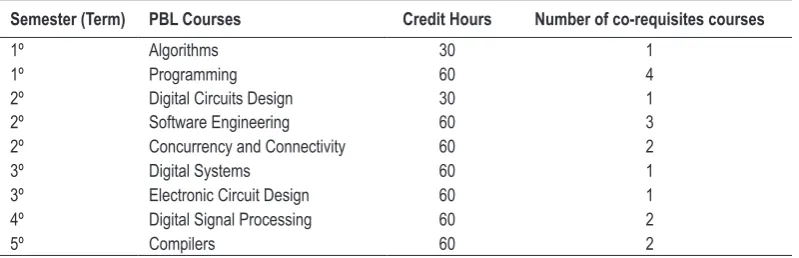
UEFS Computer Engineering is a five-year program with 3955 curricular hours. Its curriculum contains nine courses based on PBL, which covers the core of Computer Engineering topics and totalizes 480 hours. Each PBL course has a conventional course associated with it at least. For instance, Programming PBL course has four co-requisites courses, i.e. a student enrolled in Programming may also enroll in Algorithm and Programming II, Data Structure, Systems Design, Discrete Structure. These focus on theory while those focus on practice. This still means that PBL course integrates different disciplines, promoting an interdisciplinary approach, which can also be considered as a feature of PBL (Delisle, 1997). All PBL courses are listed in Table 1.
Table 1. PBL courses in Computer Engineering program at UEFS.
Semester (Term) PBL Courses Credit Hours Number of co-requisites courses
1º Algorithms 30 1
1º Programming 60 4
2º Digital Circuits Design 30 1
2º Software Engineering 60 3
2º Concurrency and Connectivity 60 2
3º Digital Systems 60 1
3º Electronic Circuit Design 60 1
4º Digital Signal Processing 60 2
76 In PBL courses, the students are gathered in small groups up to ten, maximum
recommended value by literature, and each group is tutored by a teacher. To illustrate, in a freshman class, which has 40 students, they are divided into 4 groups containing 10 students at most and 1 tutor each one. During some tutorial sessions (classes), each group discusses the problem and proposes a solution, which in general is a program or a system design. The number of tutorial session varies according to the complexity of the problem. Among other tasks, tutors assess students’ performance during each tutorial session, their solutions and their technical reports on it.
The remaining courses of this program are a priori based on traditional method in terms of having one teacher for one entire class. Why a priori? Because teachers can include active learning strategies for their own. There are numerous ways to do this. One simple example is to pause two or three times the class in order to students clarify their notes with partners. Thus, lecturers encourage students think about what they are learning. Straightforward strategies like this can obtain significant results (Ruhl, Hughes, & Schloss, 1987; Thaman, 2014). Inclusive, some teachers apply the own PBL in some of these courses sometimes.
Methodology of Research
General Background of Research
This is a descriptive research in which a questionnaire was used as the main research instrument. The data were collected from a convenience sample of students enrolled in Computer Engineering program at UEFS between 2014 and 2015.
Participants
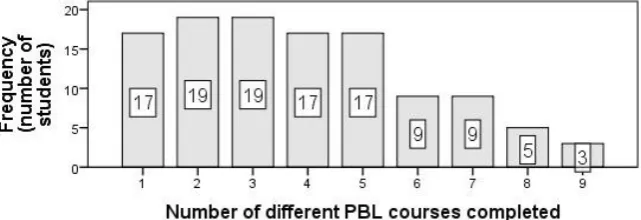
The convenience sample consisted of 115 students of almost 300 enrolled in Computer Engineering program at UEFS. One course by semester/term of the Computer Engineering program was visited in late 2014 to invite students to participate in this research, but many of these courses had already finished their activities or had few students. Due to this, some courses were revisited in the beginning of 2015. In addition, some students were invited in person out of classes. Even so, only approximately 40% of the students answered the questionnaire. They ranged from first-year to fifth-year students, with an average age of 20.9 (SD 2.7), 90.4% males and 9.6% females. While 75 of students never failed any course (65.2%), 20 repeated once (17.4%) and 20 repeated twice at least (17.4%). The Figure 1 shows the number of students had already completed different PBL courses. There is a high concentration of students up to 5 PBL courses because many of them have dropped out of the program after this approximately.
77
Instrument and Procedures
This research used only one measure, Q-PBL, whose content validity and reliability were confirmed through a content expert committee, with overall Content Validity Index above .93, and Cronbach’s alpha above .77, respectively (Santos & Silva, 2015). It is a 32-item questionnaire to evaluate the general use of PBL by their students, according to these sections: PBL general aspects, improved skills, tutorial room and PBL overall satisfaction. Using a seven-point Likert scale, the participants’ agreements were measured through 15 statements related to PBL general aspects: interest in building own knowledge, problem (clarity and workload), tutor (feedback, evaluation and supervision), tutorial group (relationship among group members), tutorial session (utility) and familiarity with PBL. A ten-point Likert scale was used to measure the intensity with which participants realize some of their skills improved by PBL (verbal expression, writing, self-directed learning, problem-solving, planning, teamwork/ collaboration, critical thinking, reading comprehension and interpersonal relationships), the quality of elements of tutorial rooms (tables, chairs, whiteboards, air conditioning, size of the physical space and cleanliness) and the overall satisfaction with PBL use in their course. This research was approved by Institutional Review Board of our university. All participants assigned the consent form.
Data Analysis
The data analysis was carried out by means of the SPSS 20. The categories of the ordinal qualitative variables were associated with numbers in order to perform these calculations. Descriptive statistics was used to analyse means, standard deviations and percentages, while inferential statistics was conducted to compare different pair-groups: male and female, repeating students and non-repeating students, freshmen (n=37) and seniors (n=8). Freshmen were considered those, who completed one or two PBL courses only and seniors were those, who had more experience of the course and completed eight or nine different PBL courses. All pair-group scores were not normally distributed for one of their categories at least, as assessed by Shapiro-Wilk’s test (p < .05). Thus, Mann-Whitney U test was run to verify if there were statistically significant differences between the mentioned pair-groups. The null hypothesis is that the distribution of the analysed dependent variable is the same — or different for the alternative hypothesis — across each category of the analysed independent variable. This research only presents the results of the comparative analyses that were meaningful or showed statistically significant differences.
Results of Research
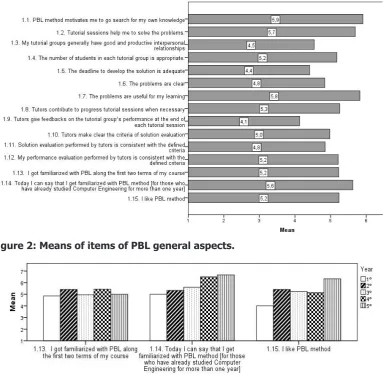
The Figure 2 shows the means of items of PBL general, which were all above 4.0. The three highest agreement means of the first section were “PBL method motivates me to search for my own knowledge”, “The problems are useful for my learning” and “Tutorial sessions help me to solve the problems”, respectively. The three lowest agreement means of PBL general aspect section were “Tutors give feedbacks on the tutorial group’s performance at the end of each tutorial session”, “The deadline to develop the solution is adequate” and “My tutorial groups generally have good and productive interpersonal relationships”, respectively. The percentages of disagreement with these three last items in some degree were 35.7%, 29.6% and 16.5%, respectively.
78 students agreed in some degree that they like PBL (71% of first-year students and 75% of the
remaining students). To analyse this issue deeper, students were grouped according to number of PBL courses completed. Those who completed one or two PBL course were grouped into first-year, those who completed three or four PBL courses were grouped into second-year, and so on. The groups approximately correspond to year of Computer Engineering course which students are enrolled. The result is shown in Figure 3. There are not any pattern in items 1.13 and 1.15. The familiarization process and like or dislike PBL is a subjective matter. However, the item 1.14 in Figure 3 shows that there is a growing tendency among students to improve their familiarity with PBL over time.
Figure 4 shows the results of skills (a) and tutorial room (b) sections, whose means were all above 7.1 and 6.9, respectively. Students scored higher problem-solving and self-directed learning and the remaining items differ little among them, varying approximately 0.6 at most. The lowest means were verbal expression, writing and collaboration (teamwork) skills. About tutorial rooms, where the tutorial sessions occur, the Figure 4(b) shows that their elements were well evaluated relatively, except chairs and whiteboard.
Figure 2: Means of items of PBL general aspects.
Figure 3: Students’ familiarity with PBL.
79
The results show that there is a tendency for the men to score the items of PBL general aspects higher than the women (Figure 5) and to score the items of improved skills lower than the women (Figure 6). In Figure 5, the latter rated only the items on familiarity with PBL (1.13 and 1.14) higher than the former. Maybe they can feel more familiarized — or can be familiarized indeed — to PBL than the men. Nevertheless, only scores of items on tutors’ evaluation for males were statistically significant higher than for females: 1.10 (U=369.5, z=-1.967, p=0.49), 1.11 (U=369, z=-1.986, p=0.047) and 1.12 (U=361.5, z=-2.084, p=0.037). All statements of the items can be seen from Figures 2 and 4.
(a) (b)
Figure 4: Means of items of skills and tutorial rooms sections.
Figure 5: Comparative means of items on PBL general aspects between male and female.
80 Seniors have a tendency to realize their skills improved more through PBL than
freshmen (Figure 7). However, it was not found statistically significant differences between both categories.
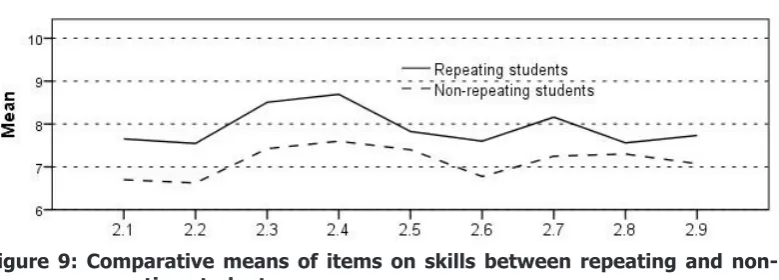
There is a curious tendency for the repeating students score the items of PBL general aspects higher than the non-repeating students, as can be seen from Figure 8. This tendency is stronger in the items on improved skills (Figure 9). These differences were statistically significant for the following items: 1.1 (U=993.0, z=-3.174, p=0.002), 1.3 (U=1,101.0, z=-2.398, p=0.17), 1.9 (U=1,169.5, z=-1.969, p=0.049), 1.13 (U=828.0, z=-4.05, p=0.0), 1.14 (U=523, z=-3.431, p=0.001), 1.15 (U=1,107.5, z=-2.391, p=0.017), 2.1 (U=1,143.0, z=-2.132, p=0.033), 2.3 (U=1,148.5, z=-2.114, p=0.035), 2.4 (U=977.5, z=3.151, p=0.002), 2.7 (U=1,145, z=-2.135, p=0.033). Among these differences, it is important to underline that repeating students felt much more familiarized to PBL than the others. In addition, a statistically significant difference (U=1020.5, z=-2.891, p=0.004) was also found between repeat (Mean 7.6, SD 1.8) and non-repeating students (Mean 6.7, SD 1.9) for the item on overall satisfaction.
Figure 7: Comparative means of items on skills between freshmen and seniors.
Figure 8: Comparative means of items on PBL general aspects between repeating and non-repeating students.
81
Discussion
The three items best evaluated in PBL general aspect section, in short, refer to self-directed learning and problem-solving skills, which were the two ones the students realized that they improved themselves by the method. They are also the two of main PBL skills stimulated by PBL according to several authors (Delisle, 1997; Duch et al., 2001; Savery, 2006). Thus, these results suggest that the main PBL goals have been reached by the program.
Regarding to the three items with the lowest means in this section, the first sentence refers specifically to the feedbacks at the end of each tutorial session, but they do not need to occur every session. It is important that feedbacks on students’ progress were given frequently or periodically, in the last session of each problem, for instance (Boud & Feletti, 1998; Duch et al., 2001). The second item is a complex issue on deadlines. On the one hand, tutors elaborate a problem schedule based on their experience and its complexity. On the other hand, some students can have a pace of learning slower or difficulties to manage their time or tendencies to academic procrastinations (Kandemir, 2014). This issue needs to be verified closer. The third item evaluates two features at the same time, but the tutorial groups can have a good relationship and be productive and vice versa. As the item “Tutorial sessions help me to solve the problems” was better evaluated than it, maybe the relationships are being productive, but not so good. The collaboration skill was the third lowest mean of skills section. This might also be a reflection of the difficulty to deal with relationships.
The other two items with the lowest means in the skills section were verbal expression and writing skills. However, their means were closer to other means, except solving-problem and self-directed learning skills which are the highest ones. Anyway, the most important fact is that students show improvements in all skills according to perceptions themselves. Some groups demonstrated a tendency to score higher than other groups, but this was more meaningful for repeating and non-repeating students, which had still statistically significant differences for four key skills in PBL — verbal expression, self-directed learning, problem-solving and critical thinking. A possible reason for this could be their effort to overcome failures or even to overcome themselves. Moreover, their failures in PBL courses are not related to the familiarity with the method likely.
The two lowest means of tutorial room section are chairs and whiteboards. In fact, they need to improve their quality: the chairs are not so comfortable and some whiteboards are damaged. Whiteboards are widely used by students to note the main elements of their discussions, i.e. ideas, facts, issues and goals. In spite of this seems a simple issue, this is often a complex and hard task for public university administration in Brazil for many reasons such as bureaucracy and limited funds.
The results on students’ familiarity with PBL suggest that, in general, they got familiarized, even in their first-year. A reason that helps this is the PBL workshop which has been promoted since 2006 for freshmen when they enter the university, before the classes started. The aim is to prepare them to use this method, so the own PBL is used in order to students learn about PBL. In previous research, students had said that it indeed helps them (Moura & Santos, 2015; Soares, Luz, Santos, & Pinto, 2011). One can not necessarily say that repeating students failed in PBL courses due to no familiarization with it because they had degrees of agreement higher than non-repeating students for both first-year and following years. These repeating students’ degrees of agreement might be considered high because their means were greater than or equal to 6.0 in a seven-point scale. There is still a natural tendency to degree of agreement on familiarization increase over time, i.e. the more students use PBL, the more familiarized they got; even some of them do not like it for some reason.
82 Conclusions
This research filled a gap of lack of systematized evaluation of general perception of PBL use by students of a Computer Engineering program at UEFS. The results show that students have a good overall impression of PBL regarding to all evaluated items, which involve general features of PBL, perception on improved skill by PBL and infrastructure. About familiarization process, there is a growing tendency among students to perceive improvements in their familiarity with PBL over the time. Most of the students not only are satisfied with PBL but also like it. That is more frequent among repeating students proportionally. This research was very significant because it indicates a successful use of PBL in the Computer Engineering program at UEFS according to students’ perceptions. Finally, these results are of interest for all involved actors in the program like students, teachers and university administrators. They can contribute for both to reconfirm the way how PBL is implemented at UEFS and improve some aspects of this implementation. In this sense, the frequency of tutors’ feedback and the deadlines to deliver the solutions of problems need to be more investigated with the purpose of defining whether – or how – they can be improved. Thus, future works should focus on qualitative research to deepen these issues, if the interpersonal relationships are as good as they are productive and whether the identified difference between groups will corroborate or not these findings. Moreover, this kind of research allows to add the students’ visions the reasons of their own answers in Q-PBL. Finally, to carry out a longitudinal research can analyse changes of students’ perceptions over time.
Acknowledgements
The authors would like to thank the students for their good will to answer Q-PBL. The authors also thank UEFS for their fund of undergraduate research fellowships.
References
Aberšek, B. (2008). Future for science and engineering education. Problems of Education in the 21st Century, 6, 9–17.
Boud, D., & Feletti, G. (1998). The challenge of problem-based learning. New York: Psychology Press. Delisle, R. (1997). How to use problem-based learning in the classroom. Alexandria: ASCD.
Duch, B. J., Groh, S. E., & Allen, D. E. (2001). The power of problem-based learning: a practical “how to” for teaching undergraduate courses in any discipline. Loudoun County: Stylus Pub.
Freire, P. (1987). Pedagogia do oprimido [Pedagogy of the Oppressed]. Rio de Janeiro: Paz e Terra. Hmelo-Silver, C. E. (2004). Problem-based learning: What and how do students learn? Educational
Psychology Review, 16 (3), 235–266. http://doi.org/10.1023/B:EDPR.0000034022.16470.f3 Judd, T. (2014). Making sense of multitasking: the role of Facebook. Computers & Education, 70, 194–
202.
Junco, R., & Cotten, S. R. (2012). No A 4 U: The relationship between multitasking and academic performance. Computers & Education, 59 (2), 505–514. http://doi.org/10.1016/j. compedu.2011.12.023
Kandemir, M. (2014). Reasons of academic procrastination: self-regulation, academic self-efficacy, life satisfaction and demographic variables. Procedia - Social and Behavioral Sciences, 152, 188–193. Mohd-Yusof, K., Hassan, S. A. H. S., Jamaludin, M.-Z., & Harun, N.-F. (2011). Cooperative problem-based learning (CPBL): a practical PBL model for engineering courses. In 2011 IEEE Global Engineering Education Conference (EDUCON) (pp. 366–373). IEEE.
Moura, A. L. B. de, & Santos, D. M. B. dos. (2015). Oficina PBL: uma análise da preparação de calouros de Engenharia de Computação para uso do método PBL [PBL Workshop: an analysis of training of Computer Engineering freshmen to use PBL]. In XLIII Congresso Brasileiro de Educação em Engenharia. São Caetano.
83
Ribeiro, L. R. de C., & Mizukami, M. da G. N. (2005). Student assessment of a problem-based learning experiment in civil engineering education. Journal of Professional Issues in Engineering Education and Practice, 131 (1), 13–18. http://doi.org/10.1061/(ASCE)1052-3928(2005)131:1(13)
Ruhl, K. L., Hughes, C. a., & Schloss, P. J. (1987). Using the pause procedure to enhance lecture recall. Teacher Education and Special Education, 10 (1), 14–18. http://doi.org/10.1177/088840648701000103 Sana, F., Weston, T., & Cepeda, N. J. (2013). Laptop multitasking hinders classroom learning for
both users and nearby peers. Computers & Education, 62, 24–31. http://doi.org/10.1016/j. compedu.2012.10.003
Santos, D. M. B. dos. (2012). A convergência tecnológica líquida no contexto da sala de aula: um recorte do ensino superior público baiano sob a ótica discente (doctoral thesis) [liquid technological convergence in the context of classrooms: a cutout of the Bahian public education from students’ perspective]. Federal University of Bahia, Brazil.
Santos, D. M. B. dos, & Silva, C. A. dos S. da. (2015). Validation and reliability of a questionnaire to evaluate Problem-Based Learning method (Q-PBL) by students. Manuscript submitted for publication.
Savery, J. R. (2006). Overview of problem-based learning: definitions and distinctions. Interdisciplinary Journal of Problem-Based Learning, 1 (1), 9–20. http://doi.org/10.7771/1541-5015.1002 Shamsan, B., & Syed, a T. (2009). Evaluation of problem based learning course at college of medicine,
Qassim University. International Journal of Health Sciences, 3 (2), 249–258.
Soares, L. R., Luz, I. A. dos S., Santos, D. M. B., & Pinto, G. R. P. R. (2011). O processo de formação dos estudantes de Engenharia de Computação da UEFS para o uso do método PBL: a sexta edição da Oficina PBL [The training of Computer Engineering students at UEFS to use PBL: the 6 edition of PBL Workshop]. In XXXIX Congresso Brasileiro de Educação em Engenharia. Blumenau. Thaman, R. G. (2014). Effective use of pause procedure to enhance student engagement and learning.
Journal of Clinical and Diagnostic Research, 8 (8), XM01–XM03.
Zhang, W. (2015). Learning variables, in-class laptop multitasking and academic performance: A path analysis. Computers & Education, 81, 82–88. http://doi.org/10.1016/j.compedu.2014.09.012.
Advised by Vincentas Lamanauskas, Šiauliai University, Lithuania
Received: November 04, 2015 Accepted: December 06, 2015
David Moises Barreto dos
Santos Adjunct Professor (Doctor), State University of Feira de Santana, Avenida Transnordestina, S/N, Novo Horizonte, 44.036-900 Feira de Santana, Bahia, Brazil.
E-mail: [email protected]
Carlos Alberto dos Santos da
Silva Undergraduate Student in Computer Engineering program at State Univer-sity of Feira de Santana, Avenida Transnordestina, S/N, Novo Horizonte, 44.036-900 Feira de Santana, Bahia, Brazil.
E-mail: [email protected]