172
REFLECTIONS ON EDUCATIONAL
EFFECTS IN THE AGE OF CRISES
Mirosław Kowalski
University of Zielona Gora, Poland E-mail: [email protected]
The beginning of the XXI century can be considered as the decade of “everything”. A crisis, by its own nature, causes destabilization in various areas of social and cultural functioning
as it affects the entire system without bypassing any function or structure. As a consequence, the weaknesses of a given socio-cultural system are revealed, all the while pointing towards a need for change. The process in question also applies to education which is responsible for creating the appropriate environment and conditions for human learning in a given cultural-economic context. Therefore, a person - along with his surroundings creates a specific system - in which he becomes sensitive to changes in a sociocultural context both on the macro-, exo- and micro-level. Bearing in mind the assumptions of psycho-pedagogical and educational concepts, the individual along with the systems he creates is subjected to environmental influences not just directly - through entering specific interpersonal interactions, but also indirectly - through the influence exerted by its products1.
Crises: A Time of Challenges or Destabilization?
The processes we are witnessing are not only applicable to transitions in modern and post-modern times. The changes refer to global systems, both in in the sphere of the economy and the organization of social life. For the past twenty years we have been observing different crises that have ‘travelled’ from one area of life to another. What is important here is that the situation which occurs after a given change or event, will never be the same as before. Old mechanisms become useless, because it is during a crisis that new methods and tools have to be developed. Cultural, economic or developmental change has two features: it is stable over time (a time transfer occurs) and expansive (it spreads from the context in which it was created to others). Observers of modern life point to cultural changes, whose aims are globalization and the transformation of everyday life through the creation of a global network. 2Anthony
Giddens emphasizes that modern institutions differ from earlier forms of social order due to their dynamics, the extent to which they undermine traditional customs and their global reach. He also considers the separation of time and space and the eradication of social institutions as the most important elements driving change in modern civilization. A key process of the acceleration of the distancing of time and space occurs through the use of “abstract systems”,
1 M. Kowalski, A. Pawlak, A. Famuła-Jurczak (red.), Przestrzeń edukacyjna – oczekiwania, doświad -czenia i dylematy społeczne, Oficyna Wydawnicza „Impuls”, Kraków 2010; M. Kowalski, A. Olczak (red.), Edukacja w przebiegu życia. Od dzieciństwa do starości, Oficyna Wydawnicza „Impuls”, Kraków 2010; M. Kowalski, D. Falcman, Świadomość aksjologiczna i podmiotowość etyczna. Analizy i impresje, Oficyna Wy -dawnicza „Impuls”, Kraków 2010; M. Kowalski, D. Falcman, Fenomenologie: socjologia versus pedagogika. Przesłanki instytucjonalizowania się pedagogiki fenomenologicznej, Oficyna Wydawnicza „Impuls”, Kraków 2011; M. Kowalski, D. Falcman, Ideologie nauk społecznych – warianty interpretacyjne, Oficyna Wydawnicza „Impuls”, Kraków 2012.
Vol. 77, No. 2, 2019 173
such as money as well as “expert systems”3, technological innovations, global networks
including the Internet etc. The strength of trust in these systems relates to a lack of a sense of mental safety of individuals and groups, which is intensified through the eradication of patterns of behaviour and cultural references. In the post-traditional world, modern mechanisms try to take control of interpersonal relations and social situations. Modern media channels (printed text, mediation, television, cinema, internet) not only reflect reality but are responsible for
creating it.
Changes in culture and consequently in education are a fact. Recognizing these differences not only highlight their distinctions, but also determine the further direction of transformations and possibilities of interaction.
The Creation of Education Systems as a Manifestation of a Given Culture
The influence of cultural conditions on education is an area of study for many researchers. The topic has been directly discussed by Ype H. Poorting, Klaus Hurrelman and Zbyszko
Melosik4. In 1995, Maria Staś-Romanowska5 characterized three cultural tendencies that are
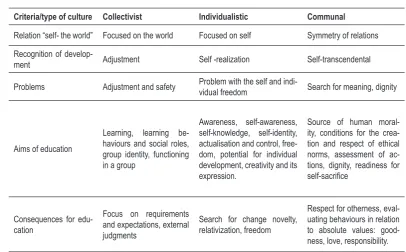
manifested in thinking about the individual, his development and his relation between the self and the world, which translate into problems posed before education. The first perspective can be considered collectivist. The individual is treated as a member of a given society. The problems in question relate to the adjustment and adaptation of the individual to changing
cultural conditions as well as their social identity and sense of security. The second tendency
in considering an individual and his/her development is from an individualistic perspective. The most important element here becomes the person, their freedom, dignity, expression and realization of dreams. Here pragmatism is in question, along with an awareness of choices and experiences. Answers are formulated in the categories of self-knowledge, self-esteem, identity, locus of control, orientation, expression, personal attributes or self-actualization. The flagship representatives of such a view of reality are humanistic concepts. The last perspective is the community level which is based on a neo-conservative and axiological approach.
The relationship between oneself and the world is treated symmetrically and read as a whole, it is governed by the principle of unity. It is characterised by a sense of meaning, dignity, universal values, and transgressing the limits of an individual embedded in a certain culture. Reconciliation of the above-mentioned meaning is reflected in the philosophy of dialogue and the phenomenological approach. It indicates the responsibility for one’s own life, for another person, or for the fate of the world (table 1).
3 An expert system is based on specific technical knowledge about practically everything: how to live, work, dress or treat clients. This knowledge belongs to educated experts in particular areas of life related to health, nutrition, management of time and money, raising children,. Their opinion becomes necessary and often superior in the decision-making process of an individual (see paragraphs therein).
4 Y.H. Poortinga, Towards a conceptualization of culture for psychology, as cited in: S. Iwawaki, Y. Kashima, K. Leung, Innovations in cross – cultural psychology, Amsterdam 1992, p. 3-17; K. Hurrelmann, Social structure and personality development, New York 1984; as cited in Melosik, Postmodernistyczne kon -trowersje wokół edukacji, Poznań-Toruń 1995.
Vol. 77, No. 2, 2019
174 Table 1. Educational models under different cultural pressures.
Criteria/type of culture Collectivist Individualistic Communal
Relation “self- the world” Focused on the world Focused on self Symmetry of relations Recognition of
develop-ment Adjustment Self -realization Self-transcendental Problems Adjustment and safety Problem with the self and indi-vidual freedom Search for meaning, dignity
Aims of education
Learning, learning be-haviours and social roles, group identity, functioning in a group
Awareness, self-awareness, self-knowledge, self-identity, actualisation and control, free-dom, potential for individual development, creativity and its expression.
Source of human moral-ity, conditions for the crea-tion and respect of ethical norms, assessment of ac-tions, dignity, readiness for
self-sacrifice
Consequences for edu-cation
Focus on requirements and expectations, external judgments
Search for change novelty, relativization, freedom
Respect for otherness, eval-uating behaviours in relation to absolute values: good-ness, love, responsibility.
Practical Solutions within Educational Systems
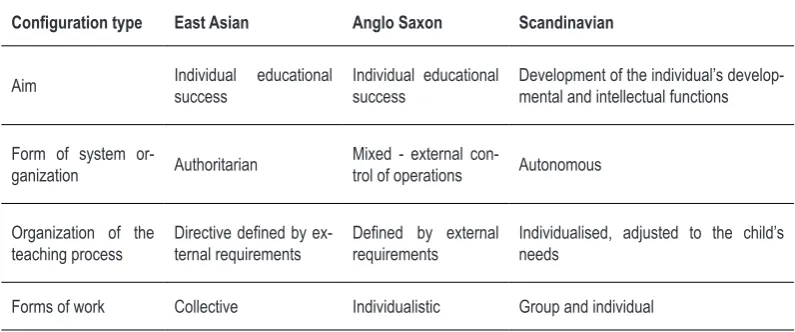
Three main configurations of educational (school) systems can be distinguished: East Asian, Scandinavian and Anglo-Saxon. In each of them one can notice characteristic patterns of behaviours and influences, differing in the manner of exercising control over the didactic process, its embedding in the social structure and environment, and methods of assessing a school’s performance6. In the East Asian configuration, organization of the education process
is focused on strict regulation of many issues, ranging from system regulations to instructions on how to teach and create a strict exam-oriented system. It is worth mentioning that in this configuration the value of education is emphasized through the pressure of achievements of students, parents and teachers. In the second configuration - Scandinavian - the basis of action is cooperation and creating optimal conditions for individual development in the peer group. This means that for many years, students acquire basic and advanced competencies in a given peer group. Schools have a wide range of autonomy. In this type of pedagogical culture, the teacher’s ethos is high. In the Anglo-Saxon approach, tests and educational procedures are instruments ensuring a high quality of education.
Vol. 77, No. 2, 2019 175
Table 2. Schools work on the basis of a good didactic base and long-term curricula.
Configuration type East Asian Anglo Saxon Scandinavian
Aim Individual educational success Individual educational success Development of the individual’s develop-mental and intellectual functions
Form of system
or-ganization Authoritarian Mixed - external con-trol of operations Autonomous
Organization of the
teaching process Directive defined by external requirements - Defined by external requirements Individualised, adjusted to the child’s needs
Forms of work Collective Individualistic Group and individual
At each of the presented levels of education: cultural, relational and operational, the unit acquires knowledge and experience necessary to fulfil social roles, build their identity and the concept of their own life. Thus, at each level, many interactions are initiated, leading to the formation of further changes of the system as well as the individual. Urie Bronfenbrenner7 calls
this process “an ecological transition” and considers it both as a factor and as a consequence of development. Therefore, the adopted way of dealing with a crisis is not only a consequence of a given situation, but also a means of creating the next. Depending on which approach is selected in the system, other pressures are identified, which in turn determine current tasks, provoke new problems and stimulate activity. However, in order for a given system to react properly to the pressure felt, a certain readiness is assumed, determined by the motivational factors inherent in the system (maturity, economic opportunity and acceptance of social expectations that create a specific climate of introduced changes). This moment can be considered a sensitive period. This means that the same pressures or similar groups of pressure, at a different moment in time can lead to different changes in the system’s functioning. Therefore, developmental readiness determines which path of changes will be selected and what tasks and challenges will
be undertaken.
Are Other Solutions Possible?
Returning to the analysis of the presented system solutions immersed in specific trends of culture, I point to the lack of reflection on questions regarding the purpose and direction of education at the level of the parent and teacher. This lack of enquiry is also revealed by researchers dealing with educational systems in the world, who point out, amongst others, an inadequate use of methods for adopted educational assumptions8.
In a dynamically changing world, it is rather difficult to achieve one effective solution that will be universal. This is the price we pay for diversity and changeability. It seems that, on the one hand, there is “educational mosaicism”, a multiplicity of parallel solutions, and on the other hand - answers to questions about the availability and legalization of various forms of education and upbringing. In addition to mosaicism, there are also other threats as described by
7 U. Bronfenbrenner, Ekologia rozwoju człowieka - historia i perspektywy, „Psychologia Wychowaw -cza” 1976, nr 5, p. 541.
Vol. 77, No. 2, 2019
176 Zygmunt Bauman9, which concern the dichotomization of societies, the lack of an equal start,
as well as the accessibility of cultural and scientific goods.
The search for a universal postmodern educational model is undertaken in the literature. An interesting model suggested by Shelly Brown-Jeffy and Jewell E. Cooper10, is CPR, Culturally
Relevant Pedagogy. They claim that education as a system is composed of five independent but essential elements. The first relates to the identification of educational entities and their expected cultural achievements. The priority here is to incorporate student’s cultural heritage and their local community in the educational programme and to create a positive culture not only related to education. The second aspect presented in their approach is creating rules of fair assessment and equal access to knowledge. This relates not only to the teacher’s dispositions and engagement but also to legally sanctioned equal access, opportunities and expectations of students at a given time. The third rule relates to the consideration of a student’s developmental potential and psychological needs. It applies to teachers’ development of appropriate teaching styles and techniques as well as their ability to motivate, engage, cooperate and communicate. The next element highlights a holistic approach to man. It manifests itself in the fact that the aims of learning are culturally recognized skills, for example communication, dealing with emotions or organization and planning. Teaching “the whole child” also includes supporting
and enabling the transfer of knowledge outside of school by showing its usefulness in building
bridges between the school, home and local environment. The last element concerns building relationships and cultivating a positive atmosphere in schools and classrooms. Relations
between teachers and students are to be bilateral and characterized by adults’ concerns for the
development and well-being of the child and for the development of a sense of community within the classroom. Such care requires knowledge and openness of both sides, but also the teacher’s knowledge of group processes and ways of modifying them.
The model proposed by S. Brown-Jeffy and J. E. Cooper is a suggestion that takes into account the communal culture model.
Consideration of System Solutions: Suggestions (Proposals)
The education system should allow for the existence of various practical solutions, which schools should autonomously decide so that practical solutions meet the challenges of reality, not only in terms of appearances and formalities, but in the sphere of skills and competence exercised in a spirit of cooperation, respect and dignity for both teachers and students.
Another suggestion concerns the need to support the development of teachers. The system should examine and analyse the atmosphere and monitor the development of social and leadership skills among teaching staff. In times rooted in different types of communication and exchange of information, communication skills, handling one’s emotions and steering students’ motivation and attention should become a part of teachers’ basic skills and competencies.
The final suggestion (postulate) relates to the creation of a system of support for school systems by creating conditions for the emergence of autonomous and community teaching teams. This high priority solution requires not only material stability of schools, but also mature school leaders and curators equipped with the skill of creating a reflective and interactive working and learning environment.
Nowadays, the choice of any solution or path is fraught with the risk of failure. For each pragmatic system contains an a priori phenomenological system, which is, for example, individualism, collectivism or a communal image of the world. Of course, each has its own
9 Z. Bauman, Etyka ponowoczesna, translated from the German language by J. Bauman, J. Tokarska-Bakir, Warsaw 1996.
Vol. 77, No. 2, 2019 177
limitations and creates certain possibilities. We observe them from a kaleidoscopic perspective of rapid changes and numerous challenges of everyday life. However, the use and observation of innovation indicators, GDP growth or rankings in determining the level of educational effects of individual countries indicates that each one is effective in a specific context and within certain conditions. This answers the question of why creative eclecticism, which is present in our educational system, does not produce the expected results. Borrowing the best solutions from each system will cause educational chaos and difficulties in defining the priorities and directions of education. It is impossible to reconcile the idea of developing and strengthening, for example, 6-year-olds by setting expectations of high achievements after each school year. Either we develop and wait patiently or expect quick “successes” in external rankings. The assessment criteria must also be adapted to the adopted work model.
A new direction of educational activities may contain elements of the communal approach as well as the configuration of Scandinavian approaches in the decision- making framework. Many countries today build their education system to be “elite and universal”. They cannot afford to waste the potential of both students and teachers. Teachers are not expected to carry out a grassroots revolution as a means of evolution, for then the risk of social stratification on not only an economic but also educational and elementary level may take place.
References
Aypay, A. (2011). The adaptation of the teaching-learning conceptions questionnaire and its relationships with epistemological beliefs. Educational Sciences: Theory and Practice, 11(1), 21-29.
Bauman, Z. (1996). Etyka ponowoczesna [Post-modern ethics], translated from the German language by J. Bauman, J. Tokarska-Bakir. Warsaw.
Bronfenbrenner, U. (1976). Ekologia rozwoju człowieka - historia i perspektywy [Ecology of human development - history and perspectives]. Psychologia Wychowawcza, 5, 537-549.
Brown-Jeffy, S., Cooper, J. E. (2011). Toward a conceptual framework of culturally relevant pedagogy. Teacher Education Quarterly, 38(1), 65-84.
Giddens A. (1991). Modernity and self-identity: Self and society in the late modern age. Stanford:
Stanford University Press.
Hurrelman, K. (1984). Social structure and personality development. New York.
Kowalski, M., Pawlak, A., Famuła-Jurczak, A. (2010). (Eds.). Przestrzeń edukacyjna – oczekiwania, doświadczenia i dylematy społeczne [Educational space - expectations, statements and social dilemmas]. Kraków: Oficyna Wydawnicza „Impuls”.
Kowalski, M., Olczak, A. (2010) (Eds.). Edukacja w przebiegu życia. Od dzieciństwa do starości [Education in the course of life. From childhood to old age]. Kraków: Oficyna Wydawnicza „Impuls”.
Kowalski, M., Falcman, D. (2010). Świadomość aksjologiczna i podmiotowość etyczna. Analizy i impresje [Axiological awareness and ethical subjectivity. Analyzes and impressions]. Kraków: Oficyna Wydawnicza „Impuls”.
Kowalski, M., Falcman, D. (2011). Fenomenologie: socjologia versus pedagogika. Przesłanki instytucjonalizowania się pedagogiki fenomenologicznej [Phenomenologies: Sociology versus pedagogy. Premises for the institutionalization of phenomenological pedagogy]. Kraków: Oficyna Wydawnicza „Impuls”.
Kowalski, M., Falcman, D. (2012). Ideologie nauk społecznych – warianty interpretacyjne [Ideologies of
social sciences - interpretation variants]. Kraków: Oficyna Wydawnicza „Impuls”.
Melosik, Z. (1995). Postmodernistyczne kontrowersje wokół edukacji [Postmodernist controversy about education]. Poznań-Toruń.
Vol. 77, No. 2, 2019
178 Straś-Romanowska, M. (1997). Kulturowe wyznaczniki rozwoju osobowości [Cultural determinants of personality development]. W: J. Rostowski, T. Rostowska, I. Janicka (red.), Psychospołeczne aspekty rozwoju człowieka [Psychosocial aspects of human development] (pp. 17-26). Łódź.
Poortinga, Y. H. (1992). Towards a conceptualization of culture for psychology. In S. Iwawaki, Y.
Kashima, K. Leung, (Eds), Innovations in cross – cultural psychology (pp. 3-17). Amsterdam.
Received: March 20, 2019 Accepted: April 15, 2019
Mirosław Kowalski PhD, Professor, Faculty of Education, Sociology and Health Sciences, University of Zielona Gora, Zielona Gora, Poland.
E-mail: [email protected]