EFFECT OF REACTIVE MATERIALS ON THE CONTENT
OF SELECTED ELEMENTS IN INDIAN MUSTARD
GROWN IN CR(VI)-CONTAMINATED SOILS
Maja Radziemska1, Zbigniew Mazur2, Joanna Fronczyk1, Jerzy Jeznach1
1 Faculty of Civil and Environmental Engineering, Warsaw University of Life Sciences-SGGW, Nowoursynowska
159, 02-776 Warsaw, Poland, e-mail: [email protected], [email protected], jerzy_jeznach@ sggw.pl
2 Faculty of Environmental Management and Agriculture, University of Warmia and Mazury in Olsztyn, Pl.
Łódzki 4, 10-727 Olsztyn, Poland, e-mail: [email protected]
INTRODUCTION
Chromium (Cr) is a trace and lithophilic el-ement; it ranks 20th in terms of frequency of occurrence, comprising 0.037% of the Earth’s crust. It also ranks fourth in regards to availabil-ity among 29 elements regarded as important due to their biological role and toxicity. The total amount of chromium in the natural environment is complemented by an additional, approximately 50% higher that from natural sources, amount of
chromium created as an effect of anthropogenic activity [Ščančarab and Milačič, 2014].
Trivalent chromium is adsorbed on cell mem-branes, and is quickly immobilized by proteins, while hexavalent chromium is able to enter the cell where it undergoes transformation into a tri-valent ion, which in reaction with inner-cell
sub-Volume 17, Issue 2, Apr. 2016, pages 141–147
DOI: 10.12911/22998993/62310 Research Article
ABSTRACT
Reactive materials represent a promising agent for environmental co-remediation. The
research was aimed to determine the influence of hexavalent chromium in doses of
0, 25, 50, and 150 mg Cr(VI).kg-1 of soil as well as zero valent-iron, and lignite
addi-tives on the content of macroelements in the Indian mustard (Brassica juncea L.). The
average accumulation of the analysed elements in Indian mustard grown in Cr(VI)
contaminated soil were found to follow the decreasing order Mg>Na>P>Ca>K. Soil
contamination at 150 mg Cr(VI).kg-1 of soil led to the highest increase in magnesium,
calcium, sodium, and potassium content in Indian mustard. The application of
zero-valent iron had a positive influence on the average Na and K content of the tested plant.
The application of lignite had a positive influence on the average magnesium, sodium
and calcium content in the above-ground parts of the studied plant. In the non-amended treatments (without reactive materials), the increasing rates of chromium (VI) had an
explicitly positive effect on the content of phosphorous and sodium in Indian mustard. Keywords: chromium, Indian mustard, macroelements, soil.
Received: 2016.01.08 Accepted: 2016.03.04
Published: 2016.04.01
stances can lead to genetic changes [Jabłońska-Czapla, 2015]. As a result of this phenomenon,
chromium is bound in the root cells and poorly transported from the root system to the above-ground parts of plants. Therefore, Cr(VI) ions are more biologically toxic, and absorbed faster by
plants than Cr(III) ions [Naseem et al., 2015].
Chromium compounds belong to a group
of chemicals whose toxicity to man is classified
depending on their oxidation state and solubil-ity, with hexavalent chromium compounds held responsible for strong carcinogenic and toxic
effects [Salnikow et al., 2008]. For humans, the
toxic dose of soluble chromates Cr3+ or Cr6+
hepa-tonecrosis and necrosis of uriniferous tubules, as well as some damage to the haematopoietic
system [Rowbotham et al., 2008]. As a result, they are classified by the International Agency
for Research on Cancer as B-2 group compounds
[IARC, 1990], that is substances which are car -cinogenic and mutagenic to humans. Hexavalent chromium is toxic mainly because of its strong oxidizing properties and due to the formation of free radicals when Cr(VI) in cells is reduced to
Cr(III). Studies on mutagenicity prove that chro -mium (VI) is genetically active [Wrobel et al.,
2015], and its toxicity is closely connected with its oxidizing properties. The final mutagenic form
of this metal is thought to be chromium (III), de-rived from reduction of chromium (VI) within the cellular nucleus and formation of complexes of
chromium (III) [Banks et al., 2006].
The objectives of this study were to determine
the effects of Cr(VI) on the content of trace ele -ments in the Indian mustard (Brassica juncea L.).
Moreover, an attempt was also made to determine
the ability of reactive materials i.e., zero-valent iron (ZVI), lignite and mixture of zero-valent iron and lignite (ZVI/Lignite), on the content of some elements in the analysed plant.
MATERIAL AND METHODS
The experiment was assessed under the con-ditions of a pot experiment in an acclimatized greenhouse, with two factors and fourfold
rep-lication. The first factor was the addition of in -creased doses of Cr(VI) to soil (0, 25, 50, and 150 mg.kg-1), introduced in a form of chemically pure aqueous solutions of K2Cr2O7 (Sigma-Aldrich).
The second factor consisted of the addition of two reactive materials, i.e. ZVI, lignite, and the
mixture of ZVI/lignite (3.0% w/w). Soils without
nickel and amendments (0.0%) were designated
as the control. Non-polluted soil for the pot ex -periment were collected at a depth of 0-20cm
from farmland in the vicinity of Olsztyn, Poland, (53°35’45’’N, 19°51’06’E). The chemical prop -erties of the soil are shown in Table 1. The soil was air-dried, passed through a 1-cm sieve and packed into 20-cm-diameter and 26-cm-height experimental pots (10 kg soil per pot); it was then used for physical and chemical analysis, as well
as N, P, K, Mg, Ca, Na concentration analysis.
The polyethylene pots were maintained un-der natural day/night conditions; during the day
(14h), the air temperature was 26±30C and
ap-proximately ten degrees lower (16±20C) at night
(10h), with a relative humidity of 75±5%. The plants were watered every other day with distilled water to 60% of the maximum water holding ca-pacity of the soil. The plants were harvested after 100 days, and soil and sorbents were collected.
The seeds of B. juncea (L.) cv. Małopolska, were obtained from an authorized Seed Produc
-tion Centre in Olsztyn, Poland (OLZNAS-CN Sp.
z o.o.), and were planted at the quantity of n=5 per pot. The soil was fertilized with a macro- and micronutrient fertilizer mixture (g kg-1) contain-ing N-26%, K2O-26%, B-0.013%, Cu-0.025%,
Fe-0.05%, and Mn-0.025%. The above-part of Indian mustard was harvested in the flowering
phase and plant material samples were collected for laboratory tests.
In the laboratory, plant samples were
thor-oughly rinsed, first with tap water and then with
deionized water to remove dust and soil particles.
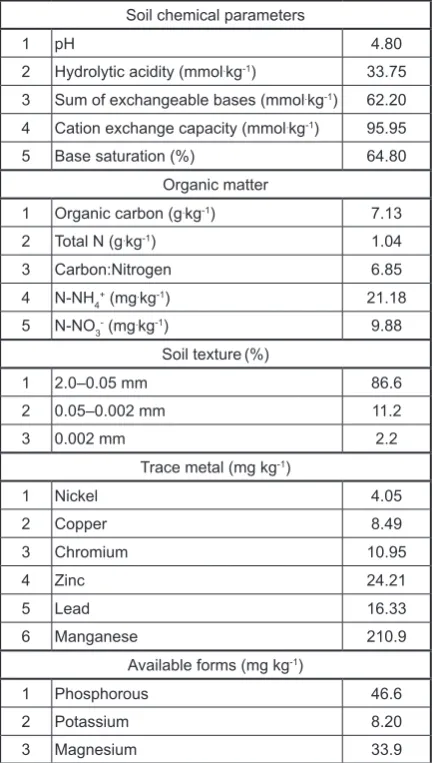
Table 1. Physical and chemical parameters of the
experimental soil
Soil chemical parameters
1 pH 4.80
2 Hydrolytic acidity (mmol.kg-1) 33.75 3 Sum of exchangeable bases (mmol.kg-1) 62.20 4 Cation exchange capacity (mmol.kg-1) 95.95
5 Base saturation (%) 64.80
Organic matter
1 Organic carbon (g.kg-1) 7.13
2 Total N (g.kg-1) 1.04
3 Carbon:Nitrogen 6.85
4 N-NH4+ (mg.kg-1) 21.18
5 N-NO3- (mg.kg-1) 9.88
Soil texture(%)
1 2.0–0.05 mm 86.6
2 0.05–0.002 mm 11.2
3 0.002 mm 2.2
Trace metal (mg kg-1)
1 Nickel 4.05
2 Copper 8.49
3 Chromium 10.95
4 Zinc 24.21
5 Lead 16.33
6 Manganese 210.9
Available forms (mg kg-1)
1 Phosphorous 46.6
2 Potassium 8.20
After oven drying (60 °C, 48 h) the plants were weighed (DW) and powdered using an analytical
mill (A11 IKA, Germany) preceding the chemical
analyses. The samples were kept at an ambient temperature until analysis. All reagents were of analytical reagent grade unless otherwise stated.
Ultra-pure (UP) water (Millipore System, USA) of 0.055 µS.cm-1 resistivity was used for
prepar-ing the solutions and dilutions.
Total nitrogen content was tested for by means
of Kjedahl’s method after mineralization in con -centrated sulfuric (VI) acid using hydrogen
perox-ide as a catalyst [Bremner, 1965]. Phosphorus (P)
was assessed by colorimetric analysis, using the vanadium-molybdenum method (Cavell, 1955);
sodium (Na), calcium (Ca), potassium (K) - atom
-ic emission spectrometry, AES method [Szyszko, 1982], magnesium (Mg) – atomic absorption spec
-trometry, AAS method [Szyszko, 1982].
Statistical analysis was performed using the software Statistica [StatSoft, 2010].
Differen-ces of means between treatments were tested by
ANOVA and comparisons of means using LSD
test, at p=0.05. The means and standard
devia-tions (±SD) of five replicadevia-tions are reported.
RESULTS AND DISCUSSION
The major cations in plant cells are
potas-sium (K), calcium (Ca), and magnepotas-sium (Mg) [Maathuis, 2009]. When soil pH becomes acid,
the phytoavailability of these elements usually
increases due to the replacement of cations on soil binding sites by H+ ions [Pinto and Ferreira, 2015]. According to the literature [Collin et al. 2014; Kabata-Pendias, 2011] trace elements have a strong and varied influence on the content of macroelements in plants, which was confirmed
by our studies. The analysis of results showed that the content of phosphorous, sodium, potas-sium, calcium, and magnesium in the Indian mus-tard (Brassica juncea L.) was influenced by the
level of chromium (VI), as well as the addition of
zero-valent iron or lignite (Figure 1).
Phosphorus (P) contained in the plant tis -sues occurs mainly in a form of inorganic com-pounds (ortho- and pyrophosphates), and in or-ganic forms, especially in phospholipids,
sugar-phosphates and nucleoproteins [Konieczynski and Wesolowski, 2007]. Indian mustard from this
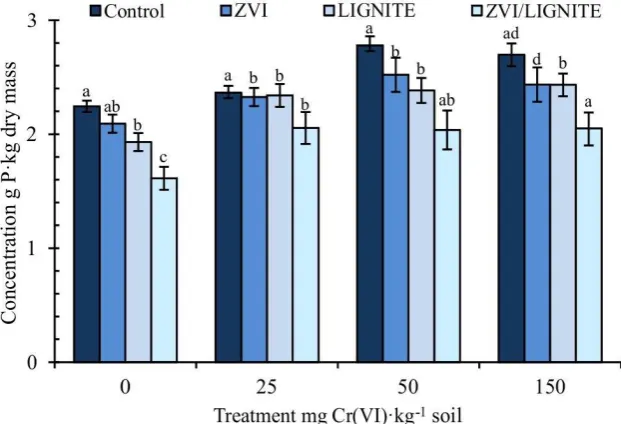
experiment had phosphorus concentrations range from 1.61 to 2.70 g.kg–1 (Figure 1). Applying
Cr(VI) to soil contributed to increased levels of phosphorus in plants as compared to the control series - without amendments. Crops in the study group without reactive materials and exposed to Cr(VI) doses of 50 mg.kg-1 soil were found to have
the highest phosphorus content in their above-ground parts. The addition of mixture zero-valent iron and lignite (ZVI/Lignite) caused a 23% de-crease in the average content of the above men-tioned element in Indian mustard as compared to
the control series. The results confirm researches of Kalembasa and Wysokiński [2002] where ad -dition of brown coals’ ash caused decrease of
Figure 1. Effect of Cr(VI) contamination on phosphorus (P) content in Indian mustard (g·kg-1dry mass); mean ± SD, n=3; Columns marked with different letter indicate significant differences between
contents of phosphorus in plants. In our recent
study [Wyszkowski and Radziemska 2013] the
average phosphorous content in oat (Avena sativa
L.) straw was the highest in objects with Cr(III) (+34%) and Cr(VI) (+27%) upon the application
of organic matter. Moreover, application of min -eral reactive materials, i.e. zeolite and halloysite to heavy metals contaminated soil led to positive
influence on the average phosphorus content of Zea mays L. [Radziemska et al., 2013].
The application of chromium (VI) to soil on
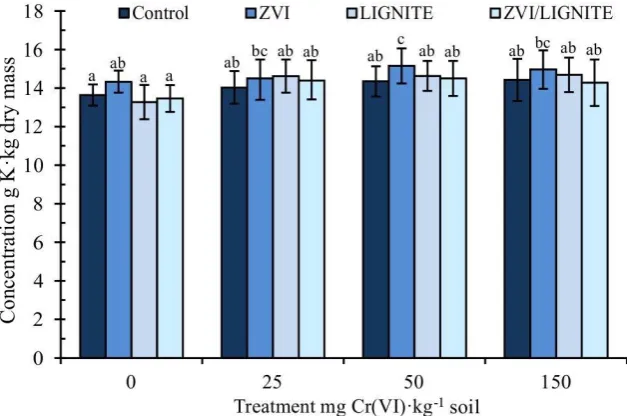
the whole led to increased potassium (K) contents
in plants, as compared to the control series -
with-out reactive materials (Figure 2). Leszczyńska and Kwiatkowska-Malina [2011] showed that the potassium contents in roots of rye, significantly decreased, influenced by addition of lignite in
comparison with control object. The accumula-tion of potassium in the grain of the oat was nega-tively correlated with the increasing contamina-tion of soil with hexavalent chromium reported by
Wyszkowski and Radziemska [2013]. Moreover, according to Kozera et al. [2006], heavy metals
in the soil may decrease potassium content in po-tato tubers. In the presented studies, among the substances added to the soil to alleviate Cr(VI) contamination, zero-valent iron (ZVI) turned out to be the best, leading to an 8% increase in the average content of the described element in the test plant as compared to the control series. An analogical situation was observed in the case of
natural lignite additive, although their influence
was smaller. In soils contaminated at the level of
50 Cr(VI).kg-1 with the addition of zero-valent
iron (ZVI), the content of the analyzed element in Indian mustard plants was approximately 5% higher than in plants grown in soil free of con-tamination and additives.
Calcium (Ca) is usually present at high
concen-trations in the cytosol of root cells [Pittman, 2011]. Atriola-Fortuny and Fuller [1982] reported that the influence of chromium (VI) on plants is indirectly
restricted by the presence of organic substances and calcium in the subsoil. Calcium content in the
tested plant was significantly influenced by the
dose of chromium (VI) as well as the reactive
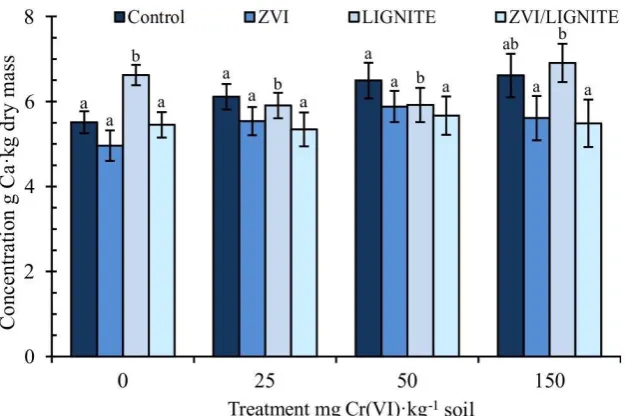
ma-terials added to the soil (Figure 3). The content of
calcium in the described plant in the control series - without reactive additives, was positively correlat-ed with increasing doses of hexavalent chromium. In this series, plants grown in soil contaminated by Cr(VI) at a level of 150 mg.kg-1 was characterized
by the highest calcium content. The addition of ze-ro-valent iron (ZVI) (+11%) and mixture zero-va-lent iron and lignite (ZVI/Lignite) (12%) led to the highest decrease in the average content of the ana-lysed element in relation to pots without neutral-izing additives. In soils contaminated at the level of 150 mg Cr(VI).kg-1 with the addition of lignite,
the content of the analysed element in Indian mus-tard plants was approximately 25% higher than in plants grown in soil free of contamination and
additives. Leszczyńska and Kwiatkowska-Malina [2011] demonstrated that the addition of lignite to
soil causes a higher content of calcium in all parts of rye (Secale cereale).
Figure 2. Effect of Cr(VI) contamination on potassium (K) content in Indian mustard (g·kg-1dry mass); mean ± SD, n=3; Columns marked with different letter indicate significant differences between
The chromium hexavalent dose as well as the addition of ZVI, Lignite and mixture of
ZVI/Lig-nite shaped sodium (Na) content in Indian mus
-tard (Figure 4). Plant from this experiment had
sodium concentrations range from 1.94 to 3.00 g.kg–1. Higher doses of chromium (VI) in the
con-trol series resulted in a significant increase of so -dium content in the aerial parts of the described plant, with the highest dose of such contamina-tion (150 mg.kg-1 of soil) increasing sodium con-tent by 20%. The influence of reactive materials used in the experiment was reflected in the so
-dium content of the Indian mustard. Mixture of
zero-valent iron and lignite (ZVI/Lignite)
nega-tively influenced the average content of this ele -ment. The calcium content in the analysed plant
was particularly and strongly affected by the ad -dition of zero-valent iron (+ 13%) and, to a lesser extent, by lignite (+ 4%). In soils contaminated at the level of 150 mg Cr(VI).kg-1 with the addition
of mixture of zero-valent iron and lignite (ZVI/ Lignite), the content of the analysed element in Indian mustard plants was approximately 11% lower than in plants grown in the soil free of ad-ditives. The data presented by Leszczyńska and Kwiatkowska-Malina [2011] showed that organic matter from different sources did not have an ef -fect on the content of sodium in some parts of rye
Figure 3. Effect of Cr(VI) contamination on calcium (Ca) content in Indian mustard (g·kg-1dry mass); mean ± SD, n=3; Columns marked with different letter indicate significant differences between
members of the same set (Tukey test, P < 0.05)
Figure 4. Effect of Cr(VI) contamination on sodium (Na) content in Indian mustard (g·kg-1dry mass); mean ± SD, n=3; Columns marked with different letter indicate significant differences between
in variants of soil contaminated with, or without the addition of heavy metals.
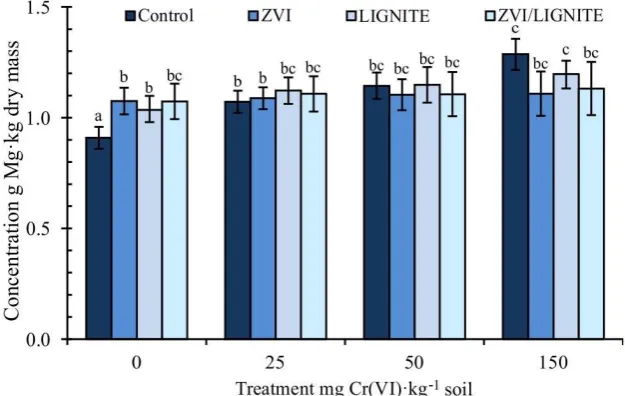
Magnesium (Mg) has a number of key func -tions in plants. The contamination of soil with hexavalent chromium, as well as the application
of reactive materials had a significant effect on
the content of magnesium in the Indian mustard
(Figure 5). The uptake of magnesium is strongly influenced by the availability of other cations, i.e. calcium, potassium, and NH4+ [Römheld and Kirkby, 2007]. Indian mustard from the pres -ent experim-ent was found to have magnesium concentrations ranging from 0.91 to 1.20 g.kg–1.
Crops in the study group without reactive materials and exposed to a Cr(VI) dose of 150 mg.kg-1 soil
were found to have the highest magnesium con-tent in their above-ground parts. The application of mixture zero-valent iron and lignite (ZVI/Lignite)
had a positive influence on the average magnesium
content in the above-ground parts of Indian mus-tard. When compared to the control series, lignite
was shown to have the most beneficial effect on
magnesium content in the analysed plant.
CONCLUSIONS
The reactive materials applied in the experi-ment, i.e. zero-valent iron (ZVI), lignite, and mixture zero-valent iron and lignite
(ZVI/Lig-nite) significantly shaped the content of phospho
-rus (P), calcium (Ca), sodium (Na), magnesium (Mg), and potassium (K) in the Indian mustard.
The average accumulation of macronutrients
Figure 5. Effect of Cr(VI) contamination on magnesium (Mg) content in Indian mustard (g·kg-1dry mass); mean ± SD, n=3; Columns marked with different letter indicate significant differences between
members of the same set (Tukey test, P < 0.05)
in tested plant grown in Cr(VI)-contaminated soil was found to follow the decreasing order of
Mg>Na>P>Ca>K.
In the control series (without the addition of
reactive materials), the differences in phospho -rous, calcium, sodium, magnesium and potas-sium content were positively correlated with the
increasing doses of Cr(VI)-contamination. Soil
contamination at 150 mg Cr(VI).kg-1 of soil led to
the highest increase in magnesium, calcium, so-dium, and potassium content in Indian mustard. The application of zero-valent iron (ZVI) had a
positive influence on the average sodium and po -tassium content of this plant species. Moreover, the application of lignite had a positive influence
on the average magnesium, sodium and calcium content in the above-ground parts of the studied plant. In the non-amended treatments (no reactive materials), the increasing rates of chromium (VI)
had an explicitly positive effect on the content of
phosphorous and sodium in Indian mustard.
REFERENCES
1. Atriola-Fortuny J., Fuller W.H. 1982. Adsorp -tion of some monohydroxybenzene derivatives by
soils. Soil Science, 133, 18–26.
2. Banks M.K., Schwab A.P., Henderson C. 2006.
Leaching and reduction of chromium in soil as af-fected by soil organic content and plants.
Chemo-sphere, 62, 255–265.
3. Bremner J.M. 1965. Total nitrogen. In: Methods
microbio-logical properties. Black CA et al. (eds). American
Society of Agronomy, Madison, WI. Agronomy, 9,
1149–1178.
4. Cavell A.J. 1955. The colorimetric determination
of phosphorous in plant materials.Journal of the
Science of Food and Agriculture, 6, 479–481.
5. Collin B., Doelsch E., Keller C., Cazevieille P., Tella M., Chaurand P., Panfili F., Hazemann J.L., Meunier
J.D. 2014. Evidence of sulfur-bound reduced copper in bamboo exposed to high silicon and copper
con-centrations. Environmental Pollution. 187, 22–30.
6. IARC. Monographs on the evaluation of the carci
-nogenic risk to human. WHO, 40, Geneva, 1990.
7. Jabłońska-Czapla M. 2015. Antimony, Arsenic and Chromium speciation studies in Biała Przemsza River (Upper Silesia, Poland) water by HPLC
--ICP-MS. International Journal of Environmental Research and Public Health, 12, 4739–4757. 8. Kabata-Pendias A. 2011. Trace elements in soils
and plants. Fourth ed. CRC, Boca Raton. pp. 534. 9. Kalembasa S., Wysokiński A. 2002. Wpływ na
-wożenia mieszaniną osadów ściekowych z popio
-łem z węgla brunatnego lub CaO na plon i skład chemiczny roślin. Część II. Zawartość wybranych makroelementów. Zeszyty Problemowe Postępów Nauk Rolniczych, 482, 257–263 (in Polish).
10. Konieczynski P., Wesolowski M. 2007. Total phos -phorus and its extractable form in plant drugs. Interrelation with selected micro- and
macroele-ments. Food Chemistry, 103, 210–216.
11. Kozera W., Nowak K., Majcherczak E., Barczak B.
2006. Effect of foliar fertilization with micronutri -ents on content of macronutri-ents in potato tubers.
Journal of Elementology, 11, 1, 29–34.
12. Leszczyńska D., Kwiatkowska-Malina J. 2011. Effect of organic matter from various sources on
yield and quality of plant on soils contaminated with heavy metals. Ecological Chemistry and
En-gineering S,18, 4, 501–507.
13. Maathuis F.J.M. 2009. Physiological functions of mineral macronutrients. Current Opinion in Plant Biology, 12, 250–258
14. Naseem S., Yasin M., Ahmed A., Faisal M. 2015.
Chromium accumulation and toxicity in Corn (Zea
mays L.) seedlings. Polish Journal of Environmen
-tal Studies, 24, 2, 899–904.
15. Pinto E., Ferreira I.M.P.L.V.O. 2015. Cation
transporters/channels in plants: Tools for nutrient
biofortification. Journal of Plant Physiology, 179, 64–82.
16. Pittman JK. 2011. Vacuolar Ca2+ uptake. Cell Cal-cium, 50, 139–146.
17. Rowbotham A.L., Levy L.S., Shuker L.K. 2000.
Chromium in the environment: an evaluation of
exposure of the UK general population and pos
-sible adverse health effects. Journal of Toxicology and Environmental Health, Part B, 3, 145–178.
18. Römheld V., Kirkby E.A. 2007. Magnesium func
-tions in crop nutrition and yield. Proceedings
of a Conference in Cambridge (7th Dec. 2007),
151–171.
19. Salnikow K., Zhitkovich A. 2008. Genetic and epi -genetic mechanisms in metal carcinogenesis and
cocarcinogenesis: Nickel, Arsenic, and Chromium. Chemical Research in Toxicology, 21, 28–44.
20. Ščančarab J., Milačič R. 2014. A critical overview
of Cr speciation analysis based on high perfor-mance liquid chromatography and spectrometric
techniques. Journal of Analytical Atomic Spec
-trometry, 29, 427–443.
21. StatSoft. 2010. Inc. STATISTICA (data analysis
software system), version 10.0. www.statsoft.com. 22. Szyszko E. 1982. Instrumental analytical method.
PZWL Warsaw, pp. 623.
23. Wrobel K., Rosa A., Escobosa C., Alexander A., Ibarra G., Mendez M., Eunice G., Barrien
-tos Y., Wrobel K. 2015. Mechanistic insight into
chromium(VI) reduction by oxalic acid in the
pres-ence of manganese(II). Journal of Hazardous Ma
-terials, 300, 144–152.
24. Wyszkowski M., Radziemska M. 2013. Influence
of chromium (III) and (VI) on the concentration of
mineral elements in oat (Avena sativa L.). Frese