Numerical Study of the Behavior of a Zirconia Dental Prosthesis with Prior
Defect
B. Meddour 1*, F. Khadraoui 2, A. Guerraoui 3
1 University of Abbas Laghrour, Khenchela 40000 Algeria
e-mail: [email protected]
2 University of Batna2, Batna 05000 Algeria
e-mail: [email protected] 3 University of Batna1, Batna 05000 Algeria
e-mail:[email protected]
*corresponding author
Abstract
The biomechanics field continues with its progress and will not cease to grow due to ongoing research in this area to find better solutions to problems. It is in this context that this work aims to simulate the mechanical behavior of a dental prosthesis made from zirconia. The proposal of zirconia as a material for dental prosthesis is the main aim of this paper. Indeed, Zirconia as a bioceramic material presents many advantages, and especially good biocompatibility and high resistance of wear. On the other hand the disadvantage of this material is its fragility i.e. it has weak strength against cracking. So, in this paper we considered a dental prosthesis assumed to be implanted to an adult person. In order to study the crack initiation we considered a defect in this prosthesis. Using the conditions of blocking and loading by Abaqus simulating tool, we obtained the results revealing the possibility of using zirconia as a material for dental prosthesis.
Keywords: dental, zirconia, simulation, masticator
1. Introduction
Dental prostheses according to their types can be made of one of the following materials:
- Acrylic resins which are thermoplastic polymers.
- Ceramics, including zirconia, alumina and porcelain, are used in the manufacture of adjoining dental prostheses, crowns and bridges.
- Metals often used for posterior teeth include precious metals (gold, silver, etc.) and non-precious metals (nickel, chromium, cobalt, etc.) (Aiche et al. 1984, LeJoyeux 1978)
The zirconia is known by a set of properties making it a candidate material to be used in the biological human environment. Some of the important properties are cited as the following:
- Compressive strength close to 6000 MPa
- Fine grain of the order of 1.5 μm
- Fine roughness ~ 0.02 μm
- Poor thermal and electrical conductivity
- Appearance of the dental prosthesis very close to that of the natural tooth
- A considerable hardness
- Good biocompatibility with the biological environment
- Good resistance to corrosion
- Some lightness (volume density ~ 6 g / cm3) according to Samir (2002)
Despite these advantages, like most ceramics, zirconia has the disadvantage of being fragile i.e. it has weak fracture toughness (KIC=7MPa.m1/2).
The advantages cited previously promote the use of this bioceramic material to manufacture dental bridges.
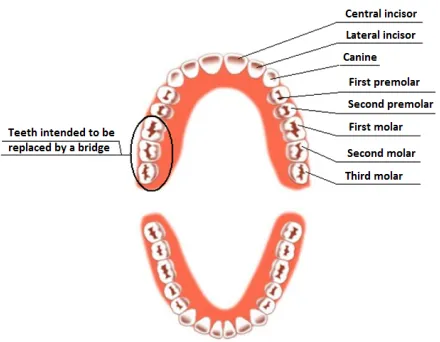
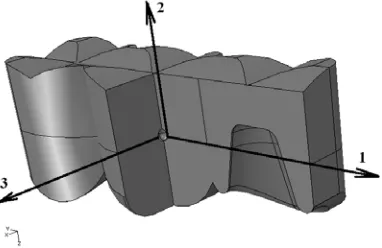
In this context, we considered a dental prosthesis (Fig. 1 and Fig. 2) in zirconia. We created a defect inside it and we performed the simulation passing through the following steps:
- Modelling the prosthesis with a spherical defect
- Inserting the model in Abaqus
- Considering loading and boundary conditions
- Meshing
- Obtaining results
Fig. 2. Bridge in zirconia.
2. Materiel & methods
2.1. Boundary conditions and loading
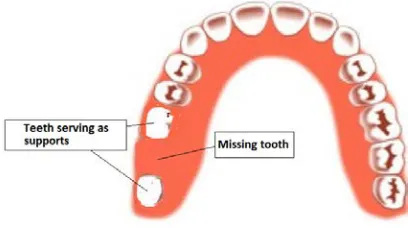
The blocking (Fig. 3) is provided by the support of the bridge on two natural teeth (Fig. 4).
The masticator teeth apply efforts represented by a tangential component Fy=150N and a
normal component Fz=150N
Fig. 3. Boundary conditions and loading according to Smukler (1993)
2.2. Mechanical characteristics of the bridge material
Table1. Mechanical characteristics of the bridge material
2.3. Mesh
The selected finite element is the 4 node tetrahedron
Number of nodes Number of elements
Bridge 9588 46926
Table2. Meshing data
Fig. 5. Bridge mesh
Fig. 6. Detail of the defect (Ø=0.5mm)
Material Young Modulus (MPa) Coeff of Poisson Fracture Toughness (MPa.m1/2)
3. Results
3.1. Analysis of stresses
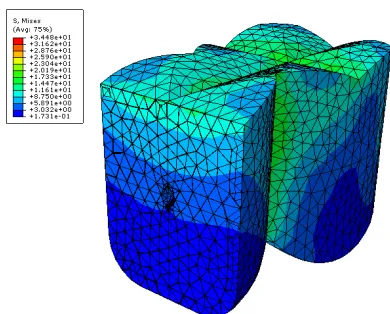
Fig. 7. Distribution of equivalent stresses Von Mises (Longitudinal section)
Fig. 9. Distribution of normal stresses σxx (Longitudinal section)
Fig. 10. Distribution of normal stresses σyy (Longitudinal section)
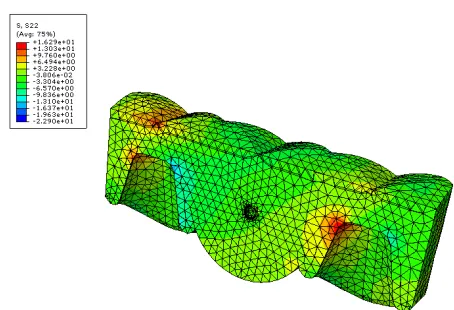
Fig. 11. Distribution of normal stresses σzz (Longitudinal section)
Fig. 13. Distribution of normal stresses σyy (Cross section)
Fig. 14. Distribution of normal stresses σzz (Cross section)
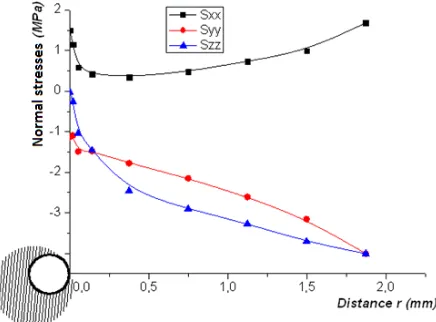
To see the variations of the stresses in the vicinity of the defect, we considered three directions 1, 2 and 3 that are parallel respectively to the axes y, z and x (Fig. 15). The results are represented on the following plots:
Fig. 16. Analysis of normal stresses on axis 1
Fig. 17. Analysis of normal stresses on axis 2
3.2. Fracture mechanics
The failure can be in one of three modes:
Fig. 19. The three failure modes according to Bernard (1990)
Mode 1 is considered to be the most dangerous; therefore to check the stability of the defect, we simply calculated the stress intensity factor KI.
The relationships between stresses and stress intensity factor are given by the following relationships according to Westergaard (1939):
) ( 2
lim ()
0 ) ( θ π σ I ij I r I ij f r K = → (1)
To determine KI, the extrapolation method was used on the median plane of the prosthesis
and considering the following relation:
r
K
I xxπ
σ
2
=
(2)Considering the 3 propagation lines of the crack (Fig. 15), the function KI (r) is interpolated
on the lines 1, 2 and 3:
k n
k k I
I
r
r
k
r
K
r
K
(
)
!
)
(
)
(
0 0 0−
=
∑
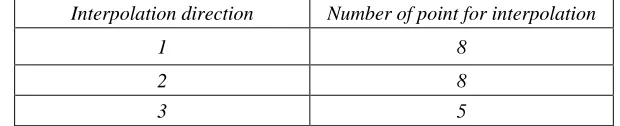
= (3)The exponent k is equal to the number of used points for interpolation for each direction (Table 3)
Interpolation direction Number of point for interpolation
1 8
2 8
3 5
Table3. Number of points for interpolation
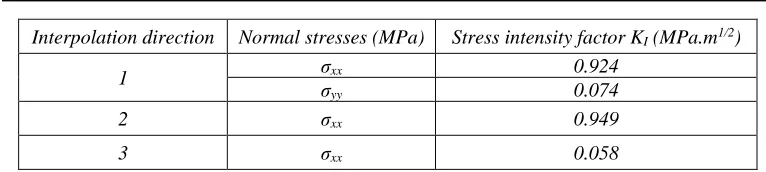
Finally, we extrapolate to the point r = 0.
Interpolation direction Normal stresses (MPa) Stress intensity factor KI (MPa.m1/2)
1 σσxx 0.924
yy 0.074
2 σxx 0.949
3 σxx 0.058
Table 4. Obtained values of KI
4. Discussion
The stress distribution patterns (Figs. 7-13) show that there is no stress concentration in the vicinity of the defect, but concentrations are noticed in the other zones where the geometry changes abruptly.
In addition, relatively high values of stresses Von Mises of ~ 34 MPa are noted. High values are remarkable for normal stresses σzz ~ 16.23 MPa.
The plots (Fig. 16, Fig. 17 and Fig. 18) show the non-existence of stress concentration in the vicinity of the defect and unaccented variations of normal stresses. For the vertical axis a little singularity is observed. For the other axis, there is no singularity. The non-existence of singularity in the vicinity of the defect is due to the geometry of the prosthesis and boundary conditions and loading.
The values obtained from KI (the other stresses are not taken into account because they are
compressive) are much lower than KIC= 7MPa m1 / 2 of the zirconia.
6. Conclusion
In this paper we studied a dental prosthesis relying on two worn teeth. Zirconia was proposed as a material of the dental prosthesis. To simulate the zirconia behavior in terms of strength against cracking, we created a defect inside the prosthesis. After configuring the conditions of blocking and loading and meshing we investigated in different section plans and direction, we obtained results which show that there is neither singularity nor remarkable stresses concentration in the vicinity of the defect and the calculation of the intensity stress factor revealed no intensity of stresses in the vicinity of the defect. Although the study is made of a single viewing angle this paper could confirm the possibility of use of zirconia as a material for dental prosthesis.
References
Aiche H, Antrassian J (1984). Le rôle des dents artificielles en prothèse complète.
QuestOdontostomatol ,33 ,39-46
Bernard B (1990). Notions pratiques de mécanique générale. Editions Eyrolles Paris. LeJoyeux J (1978). Prothèse complète. 3ème edition, Tome 3. Paris, Maloineédit.
Samir H (2002). Etude du comportement en fatigue en compression des biocéramiques (Al2O3, ZrO2) utilisées pour la conception des prothèses ostéo-articulaire. Thèse de doctorat. Smukler H (1993). Equilibration occlusale en denture naturelle. Paris Edition CdP, 16-19,
51,81-82