RESIDUAL FATIGUE LIFE ESTIMATION OF CRACKED AIRCRAFT
STRUCTURAL COMPONENTS UNDER LOAD SPECTRUM
Katarina Maksimovic1, Slobodanka Boljanovic2, Mina Djuric3, Ivana Vasovic
Maksimovic4*, Mirko Maksimovic5
1 Secretariat for Utilities and Housing Services Water Management, 1 Kraljice Marije Street,
Belgrade, Serbia
e-mail: [email protected]
2 Mathematical Institute of SASA, 35 Kneza Mihaila Street, Belgrade, Serbia
e-mail: [email protected]
3 Military Technical Institute, 1 Ratka Resanovica Street, Belgrade, Serbia
e-mail: [email protected]
4 Research and Development Institute Lola Ltd, 70a Kneza Viseslava Street, Belgrade, Serbia
e-mail: [email protected]
5 PUC Belgrade Waterworks and Sewerage, 27 Kneza Milosa Street, Belgrade, Serbia
e-mail: [email protected]
*corresponding author
Abstract
This work deals with fatigue behaviour of cracked aircraft structural components under cyclic loads of constant amplitudes and load spectrum. This investigation is focused on developing efficient and reliable computational methods for fatigue life estimation of cracked aircraft lugs under cyclic loads of constant amplitude and load spectrum. For crack growth analyses and residual lives of damaged lugs two approaches are used: the Strain Energy Density (SED) method and the conventional Forman`s method. A special attention has been focused on the determination of the fracture mechanics parameters of structural components such as stress intensity factors of aircraft cracked lugs. The effects of the shape of lug surface cracks on the residual fatigue life are investigated as well. The SED method uses the low-cycle fatigue (LCF) properties of the material, which are also used for the lifetime evaluation until the occurrence of final failure. Therefore, the experimentally obtained dynamic properties of the material such as Forman`s constants are not required when this approach is concerned. The complete computational procedure for the crack propagation analysis using low-cycle fatigue material properties is illustrated with the cracked structural elements. To determine analytic expressions for stress intensity factors (SIF), singular finite elements are used. The results of the numerical simulations for crack propagation based on the strain energy density method have been compared with the authors’ experimental results.
1. Introduction
Many structural components are subjected to cyclic loading. In these components, fatigue damage is the prime factor in affecting structural integrity and service life. Fatigue damage is typically divided into three stages: crack initiation, crack propagation and final failure. These three stages are important in determining the fatigue life of structural components.
Primary attention in this research has been to develop an efficient and reliable computational method for residual life estimation of damaged structural components under cyclic loading. To determine residual life of damaged structural components two crack growth methods are used: conventional Forman`s crack growth method and crack growth model based on the strain energy density method. The latter method uses the low cycle fatigue properties in the crack growth model. The governing equations for both crack initiation and crack growth phase using conventional crack growth and SED are given in Maksimović Set al. (2011); Maksimović S. et al. (2012) and Sehitoglu H. et al. (1996). The ability to successfully maintain aircraft airworthiness and structural integrity is critically dependent on the application of appropriate fatigue crack growth (FCG) prediction tools. The prediction tools are required to accurately predict FCG in aircraft structures and components under flight spectrum loading, and thus reliably provide total economic lives or inspection intervals as part of a stringent aircraft structural integrity management plan.
Fatigue crack growth in aircraft structures and components under flight spectrum loading is traditionally predicted based on FCG rates obtained from constant-amplitude (CA) crack growth testing using the cycle-by-cycle approaches (Blažić M. et al. 2011; Maksimović M. et al. 2012).
2. Fatigue crack growth method model based on strain energy method
In this work, fatigue crack growth method based on energy concept is considered and it is necessary to determine the energy absorbed till failure. This energy can be calculated by using cyclic stress-strain curve. As a result, the energy absorbed till failure becomes (Maksimović M. et al. 2018)
/ / /
4
1
e f f
W
n
(1)
where f/ is cyclic yield strength and f/ - fatigue ductility coefficient. Fatigue crack growth rate
can be obtained in the next form (Maksimović M. et al. 2018; Boljanović S. et al. 2014)
/ / 2 / / 14 f f I th
n n da K K dN EI
(2)
where KI is the range of stress intensity factor, - constant depending on the strain hardening
exponent n/, I
n/ - the non-dimensional parameter depending on Kth is the range of threshold
stress intensity factor and is function of stress ratio i.e.
0 1
th th
K K R
(3)
Kth0 is the range of threshold stress intensity factor for the stress ratio R = 0 and is coefficient
(usually, = 0.71). Equation (2) enables us to determine crack growth life of different structural component. Very important fact is that equation (2) is easy for application since low cyclic material properties (n/,
For comparisons computation results based on SED we used conventional Forman`s crack growth method too in the next form
1
n
C
C
K
da
dN
R K
K
(4)where: C, n are crack growth rate constant and exponent, R is stress ratio, KC is fracture toughness
and K is the range of stress intensity factor. For tension-compression cyclic load cases, the following Elber rate model is adopted:
1
max , , nq
cut cut
da
C R K R R R R
dN
(5)
where Rcut- is the cut-off value of the negative stress ratio. In the previous equation, the exponent
q is considered as the acceleration index (Chang, JB et al. 1981).
3. Crack growth analysis of cracked aircraft skin/plate under load spectrum
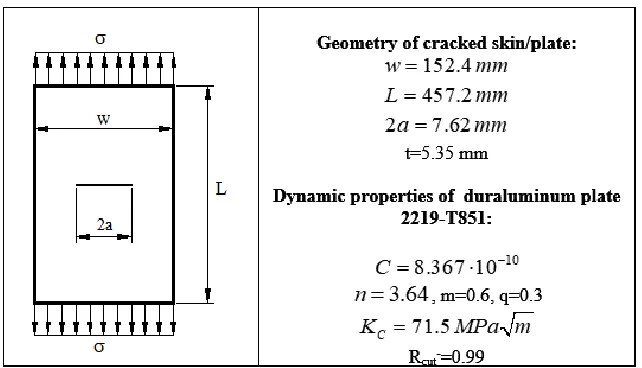
Here, we illustrated numerical simulation of crack growth method using strain energy density method (SED). Geometry of cracked aircraft skin is shown in Figure 1. Material of aircraft skin is aluminium alloy 2219-Т851. Low cyclic material properties of aluminium alloy 2219-Т851 are: f/ = 613 MPa; f/ = 0.35; n/ = 0.121; k/ = 710 MPa; Sy/ = 334 MPa; E = 71 103 MPa; Kth0
= 30; In/ = 3.067; = 0.95152, Kc = 71.5 MPa m. Detail computation residual life estimation of
cracked skin for various load spectra are given in Table 1. Computation results are compared with available experimental results according to Chang J. B. et al. (1981). Good agreement of present numerical results with experiments is evident.
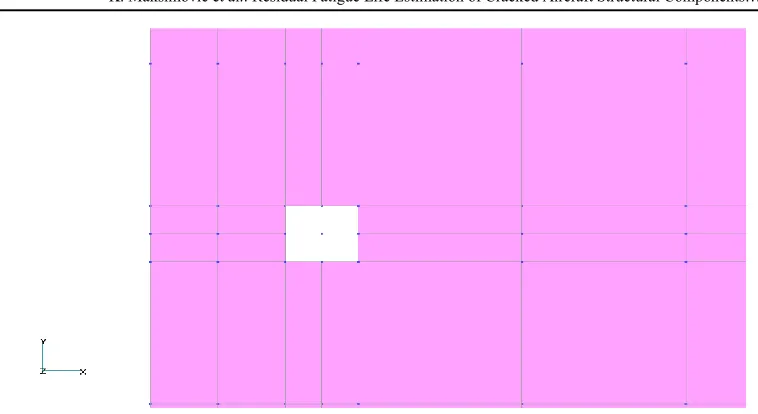
Fig. 2. Finite element model of skin/plate with initial crack and “super-element” around crack tip
In Figure 2, finite element model of cracked part panel is shown. To obtain precise stress intensity factors special “super-element” with 6-node singular finite elements around initial crack tip is used.
Specimen
No.
max
MPa
MPa
min
ExperimentNfexp
Computation results(eq.2)
NfSED
Computation results (eq.5)
NfElber
M-1 55.16 0 355810 370530 339000
M-3 55.16 -55.16 129240 126324 96000
М-4 55.16 -16.55 144000 138912
M-5 275.8 0 846 701 803
M-6 275.8 82.74 1695 1927 1537
M-7 275.8 193.06 14870 13346 7200
M-8 275.8 -27.58 409 447
M-9 55.16 -5.516 175000 179552
M-10 275.8 -82.74 251 143.5
Table 1. Comparisons numerical crack growth model based on Strain Energy Density Method (SED) with experiments for cyclic load of constant amplitude
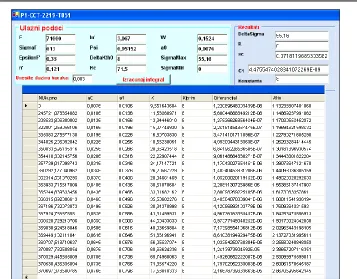
Table 2. Results of residual life estimation of cracked specimen М-1
In Table 2 are given the complete computation residual life results which include relation, a-N, (a- crack length, N- is the number of cycles). These results are obtained using in-house software “SED” based on Strain Energy Density Method (Maksimovic S. and Maksimovic K. 2012; Boljanović S. and Maksimović, S. 2014; Chang, J. B. et al. 1981; Maksimović, S. 2008; Maksimović K. et al. 2011; Boljanović S. et al. 2019).
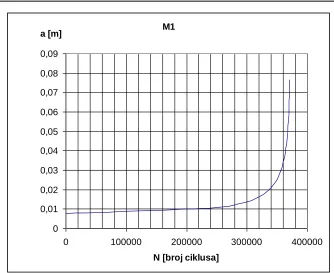
Fig. 3. Dependence a-N for specimen М-1 using SED under cyclic loads of constant amplitude
In Table 3 are shown residual life estimations of cracked plate/shell panel under multiple overload/underload spectrum. Good agreement of the present computation with experimental results is evident, according to Chang, J. B. et al. (1981).
Type of
speci-men
Loading
profile
max
I
MPa
min
I
MPa
max
II
MPa
min
II
MPa
NI
cycles NII cycles exp f
N
Numerical solution (SED)M-31 55.16 0 137.9 0 1000
0
to
failure 22430
(21140) 22262
M-32 137.9 0 275.8 0 5000 to
failure 5275
(5476) 5131
M-33 55.16 16.55 137.9 16.55 1000 0
to
failure 27000 27943
M-34 137.9 41.37 275.8 82.74 5000 to
failure 6884 6462
Table 3. Multiple overload/underload test descriptions and crack growth correlation: Comparisons Numerical results with experiments
4. Conclusion
This work presents a computational model/procedure for assessing the residual strength of damaged aircraft structural components subjected to cyclic loading. A special aspect of this investigation is based on application of Strain Energy Density (SED) method in residual life
M1 0 0,01 0,02 0,03 0,04 0,05 0,06 0,07 0,08 0,09
0 100000 200000 300000 400000
N [broj ciklusa] a [m]
I
estimation of structural components with initial cracks under load spectrum. In this approach, we used the same low cyclic material properties for crack growth and crack initiation. For determination low cyclic fatigue properties of materials and corresponding parameters of fracture mechanics including fatigue tests of representative aircraft structural components such as cracked aircraft skin are used. To validate computation methods in residual life estimation of cracked structural elements modified conventional crack growth method is used too. The computation procedures for residual life estimations of cracked structural elements these are compared with corresponding experimental tests. Good agreement between computation and experimental results are obtained (Tables 1 and 3). This approach can be used as efficient computation method in total fatigue life estimations of structural element under cyclic loads.
This work was partially supported by the Ministry of Education, Science and Technological Developments of Serbia under projects ON 174001 and TR-35024.
References
Boljanović S, Maksimović S (2014). Fatigue Crack Growth Modeling of Attachment Lugs. International Journal of Fatigue 58, 66–74.
Boljanović S, Maksimović S, Carpnteri A., Ćosić M. (2019). Fatigue endurance of plates with two semicircular edge notches and one quarter-elliptical corner crack or through-the-thickness crack, International Journal of Fatigue 127, 45–52.
Blažić M, Maksimović K, Assoul J (2011). Determination of Stress Intensity Factors of Structural Elements by Surface Cracks, in Proceedings IConSSS 2011 The Third International Congress of Serbian Society of Mechanics, Vlasina Lake (Serbia), 5-8 July 2011. pp. 374-382. ISBN 978-86-909973-4-3.
Chang JB, Engle RM, Stolpestad J (1981). Fatigue Crack Growth Behavior and Life Predictions for 2219-T851 Aluminum Subjected to Variable-Amplitude Loadings, ASTM STP 743, 1981.
Maksimović K, Stamenković D, Boljanović S, Maksimović M, Vasović I (2017). Modeling Fracture Mechanics Parameters of Cracked Structural Elements Under Thermomechanical Loads, 13th International Conference on Accomplishments in Mechanical and Industrial Engineering, 26-27 May 2017. Banja Luka, Republic of Srpska, ISBN 978-99938-39-73-6 Maksimović M., Nikolić-Stanojević V, Maksimović K, Stupar S (2012). Damage Tolerance
Analysis of Structural Components Under General Load Spectrum, TEHNICKI VJESNIK-TECHNICAL GAZETTE, vol. 19 br. 4, pp. 931-938.
Maksimović M, Vasović I, Maksimović K, Trišović N, Maksimović S (2018). Residual Life Estimation of Cracked Structural Components, FME Transactions, pp. 124-128; doi: 10.5937/fmet1801124M.
Maksimović S (2018). Life assessment methods of initial damaged structures under general loading spectrum, IFMASS 10 Fundamentals of fracture mechanics and structural integrity assessment methods 23-26 June.
Maksimovic S, Maksimovic K (2012). Improved Computation Method in Residual Life Estimation of Structural Components, Theoretical and Applied Mechanics, Special Issue- Address to Mechanics, Vol. 40, No. 2, pp. 247-261, Belgrade.
Maksimović S, Posavljak S, Maksimović K, Nikolic-Stanojević V, and Djurković V (2011). Total Fatigue Life Estimation of Notched Structural Components Using Low-Cycle Fatigue Properties, STRAIN An Int Journal for Experimental Mechanics, Volume 47, Issue Supplement S2, pp 341-349.