Pediatric laparoscopy
and adaptive oxygenation
and hemodynamic changes
Gloria Pelizzo,1Veronica Carlini,2 Giulio Iacob,2Noemi Pasqua,2 Giuseppe Maggio,3Marco Brunero,2 Simonetta Mencherini,3
Annalisa De Silvestri,4 Valeria Calcaterra,5,6
1Pediatric Surgery Unit, Children’s Hospital, Istituto Mediterraneo di Eccellenza Pediatrica, Palermo; 2Pediatric Surgery Unit, Fondazione IRCCS Policlinico San Matteo Pavia; 3Anesthesiology and Intensive Care Unit, Fondazione IRCCS Policlinico San Matteo, Pavia; 4Biometry and Clinical Epidemiology, Scientific Direction, Fondazione IRCCS Policlinico San Matteo, Pavia; 5Pediatric Unit, Department of Maternal and Child Health Fondazione IRCCS Policlinico San Matteo Pavia; 6Department of Internal Medicine and Therapeutics, University of Pavia, Italy
Abstract
Adaptive changes in oxygenation and hemodynamics are evaluated during pedi-atric laparoscopy. The children underwent laparoscopy (LAP Group, n=20) or open surgery (Open Group, n=10). Regional cerebral (rScO2) and peripheral oxygen sat-uration (SpO2), heart rate (HR), diastolic (DP) and systolic pressure (SP) were moni-tored at different intervals: basal (T0); anes-thesia induction (T1); CO2PP insufflation (T2); surgery (T3); CO2PP cessation (T4); before extubation (T5). At T1, in both the LAP and Open groups significant changes in rScO2, DP and SP were recorded com-pared with T0; a decrease in SatO2was also observed at T5. In the LAP group, at T2, changes in HR related to CO2PP pressure and in DP and SP related to IAP were noted; at T4, a SP change associated with CO2PP desufflation was recorded. Open group, at T3 and T5 showed lower rScO2values com-pared with T1. Pneuperitoneum and anes-thesia are influent to induce hemodynamics changes during laparoscopy.
Introduction
The laparoscopic surgical technique in children and infants is still undergoing
development and refinement. To date, its effects on systemic and cerebral oxygena-tion have not been completely investigated1-3 and the exact effects of surgical maneuvers in combination with conventional anesthe-siological procedures in hemodynamic reg-ulation are still debated. Hemodynamic alterations, associated with abdominal laparoscopy are mainly caused by the increased intra-abdominal pressure (IAP), brought on by pneumoperitoneum (PP) cre-ation. A decrease in venous return second-ary to inferior vena cava compression and the increase in central venous pressure and arterial blood pressure, in the absence of heart rate (HR) changes, seem to be the main adaptive responses.4-6 A 10% to 30% decrease in cardiac output with severe pathophysiologic modifications has also been reported in most studies,7-9 underscor-ing the need for dedicated anesthesiological support in pediatric laparoscopy, especially in infants. Pathophysiological hemodynam-ic alterations during laparoscophemodynam-ic proce-dures in children have not been fully inves-tigated.10-15Therefore, in small children and in surgical procedures of long duration, the standardization of mini invasive intraopera-tive assessment requires close anesthesio-logical monitoring to prevent adverse hemodynamic outcomes.16,17
The anesthesiologist should have a deep understanding of the consequences associ-ated with PP creation; and it is critical that the anesthesiologist be prepared to detect and address possible alterations that may occur during laparoscopic interventions.
In the present study, we evaluated whether adaptive changes in cerebral and systemic oxygenation and in hemodynam-ics are intraoperatively induced by IAP increases and PP-associated CO2 changes. The contribution of knowledge on the real impact of anesthesia on hemodynamic reg-ulation during pediatric laparoscopic proce-dures was also considered.
Materials and Methods
Patients
The initial inclusion criteria for recruit-ment in the study were as follows: thirty children (21M/9F), aged 1 to 18 years (mean age 8.1±5.1 yr), scheduled for elec-tive abdominal surgical procedures for con-genital unilateral inguinal hernia repair. The treatment group (LAP Group: 20 children, 12M/8F, mean age 9.6±5.1) underwent laparoscopic surgery, while the control group underwent traditional open surgery (Open Group: 10 children, 9M/1F, mean age 5.1±4.1).
Surgery was performed by an experi-enced surgeon, under general endotracheal anesthesia. To critically analyze and synthe-size current evidence, we performed an analysis of the completed results from both groups. Patients were consecutively recruit-ed between 1 February 2016 and 31 June 2016, at the Pediatric Surgery Unit of the Fondazione IRCCS Policlinico San Matteo, Pavia, Italy. Written consent was obtained from the parents of the children before the scheduled surgical procedure. The study was performed according to the Declaration of Helsinki and with the approval of the Institutional Review Board.
Surgery
All surgeries were performed in the same operating theater with a stable temper-ature of 22±1°C. Patients were placed in the supine position on a heated operating table (36±1°C). Laparoscopic treatment was accomplished, following a standard proto-Correspondence: Gloria Pelizzo, Pediatric Surgery Unit, Children Hospital, Via dei Benedettini n.1, 90134 Palermo, Italy. Tel.: +39.091.6666007 - Fax: +39.091.6666006. E-mail: [email protected]
Key words: laparoscopy; children; hemodinam-ics; changes.
Acknowledgments: the authors would thank Dr. L. Kelly for English revision of the manuscript.
Contributions: GP performed surgical treatment, drafted and critically revised the manuscript; VeC performed surgical treatment, collected the patient data, drafted the manuscript; GI collected the patient data; NP collected the patient data; GM performed anesthesiological support, col-lected the patient data and drafted the manu-script; MB performed surgical treatment; SM performed anesthesiological support, collected the patient data; ADS performed statistical analysis; VaC revised the literature, drafted and critically revised the manuscript.
Conflict of interest: the authors declare no poten-tial conflict of interest.
Received for publication: 7 May 2017. Revision received: 2 June 2017. Accepted for publication: 3 June 2017.
This work is licensed under a Creative Commons Attribution NonCommercial 4.0 License (CC BY-NC 4.0).
©Copyright G. Pelizzo et al., 2017 Licensee PAGEPress, Italy Pediatric Reports 2017; 9:7214 doi:10.4081/pr.2017.7214
Non commercial
col, via the trans-abdominal approach using one 3 mm telescope and two, 3 mm or 2 mm, surgical instruments, placed into the lower abdomen. The pneumoperitoneum (PP) was created with a 3 mm infra-umbili-cal camera-trocar placed via an open approach. The PP CO2 pressure, which ranged from 8 to 12 mmHg (8 mmHg in children weighing <15 kg; 10 mmHg: 15-40 kg; 12 mmHg: >40 kg), was achieved with a CO2insufflation flow rate of 1 L/min.
Patients included in the control group underwent a traditional open-surgery proce-dure. All interventions were performed on a day hospital basis and patients were fol-lowed for one week.
Data acquisition
Intraoperative transcranial near-infrared spectroscopy (NIRS) was used to assess regional cerebral oxygen saturation (rScO2), pulse oximetry was used to meas-ure peripheral oxygen saturation using (SpO2); and HR, diastolic (DP), systolic pressure (SP) and end-tidal CO2were mon-itored continuously during the entire proce-dure.
Changes in rScO2were measured using a near-infrared spectrometer. Prior to anes-thesia induction, a transducer was placed on the frontal side of the child’s head and attached with an elastic bandage to prevent displacement. The oximeter sensor was positioned on the middle finger of the left hand. HR was recorded during scanning also using pulse oximetry for heart timing and an index of pulse amplitude.
Indirect data on IAP during surgery were collected via dynamic urethral pres-sure meapres-surements with a high-resolu-tion manometry system and recorded with Medical Measurement Systems® (Enschede, the Netherlands).
The following parameters were ana-lyzed, every minute for five minutes (mean values were used for the statistical analy-sis), at five intervals: basal (T0) in LAP and Open groups; induction of anesthesia (T1) in LAP and Open groups; CO2PP insuffla-tion (T2) in the LAP group; surgery (T3) in LAP and Open groups; cessation of CO2 PP (T4) in the LAP group; before extubation (T5) in LAP and Open groups.
The operative times were recorded, including data acquisition and anesthesia duration (interval from beginning of induc-tion to cessainduc-tion of sevoflurane inhalainduc-tion). The anesthesiologists were not blinded to the data readings to prevent intraoperative alterations in the children.
Anesthesia protocol
All children were in good physical
con-dition (ASA, American Society of Anesthesiologists, class 1) and received standard anesthesia. Induction was per-formed endovenously (e.v.) with propofol (2-4 mg/Kg) and fentanyl (1 µg/Kg); and for muscle relaxation, cisatracurium 0.1 mg/Kg was given e.v.
After tracheal tube positioning, patients underwent volume controlled mechanical ventilation with a tidal volume of 8 mL/Kg, the respiratory rate adjusted to achieve an end-tidal CO2 of 32–37 mmHg, an I:E ratio of 1:2 (avoiding dynamic hyperinflaction) with a low-flow breathing system and an inspired mixture of air and oxygen (fresh gas flow of 4 l min− 1 with 40% FiO2during anesthesia). Anesthesia was maintained via administration of Sevoflurane gas (0.9 to 1.3 MAC range). The anesthesiology proto-col did not include hypotension manage-ment with fluid expansion or inotropes. Twenty minutes before the end of the inter-vention, all patients received Paracetamol 15 mg/kg, as an analgesic. The analgesia was consolidated with surgical wound infil-tration using levobupivacaine and lidocaine for both open and laparoscopic surgery.
Statistical analysis
Quantitative variables were described as the mean (SD) and compared among the different time intervals with population averaged mixed multilevel models to take into account the clustered nature of the data. Probability values of less than 0.05 were considered statistically significant. All statistical analyses were performed using the SPSS statistical package (SPSS, Chicago IL, USA) and Stata 8.0.
Results
During the surgical procedure, a signif-icant variation in rScO2was observed at the different time points in comparison with basal values (P<0.01). In the LAP group, a significant rScO2increase was noted at T1 (P<0.001). The intraoperative rScO2values at T2 (P=0.6), T3 (P=0.4), T4 (P=0.5) and T5 (0.7) were not different compared with T1. The minimal rScO2 variations during the laparoscopic procedure were not related to PP pressure (P=0.5) or CO2 flow rate (P=0.8).
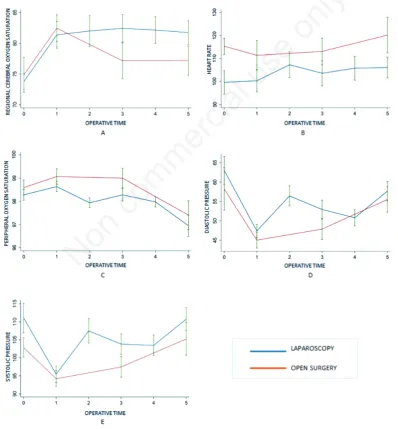
In the Open group a significant rScO2 increase was recorded at T1 (P<0.001). At T3 (P=0.007) and T5 (P=0.007) rScO2 was significantly lower than at T1. The rScO2 profile and parameter mean values are reported in Figure 1A and Table 1.
Heart rate
HR showed significant changes during the entire surgical procedure in comparison with T0 (P=0.02). In the LAP group, HR was significantly higher at T2 compared with T0 (P=0.04). HR changes were related to CO2 PP pressure (P=0.002). An HR increase was also observed at T5 (P=0.009) compared with basal values.
In the Open group, HR changes at T1 (P=0.4), T3 (P=0.6) and T5 (P=0.3) were not significantly different in comparison with T0. The HR profile and parameter mean values are given in Figure 1B and Table 1.
Peripheral oxygen saturation
The SatO2values were significantly dif-ferent during the surgical intervention (P<0.001).
In the LAP group, a significant rScO2 increase was noted at T1 (P=0.001). The SatO2 values at T2 were not significantly different in comparison with T0 (P=0.3), but were lower than T1 (P=0.06). The SatO2 differences between T0 and T3 and T4 were not significant (P=0.9 and P=0.4, respec-tively). A relevant decrease in SatO2 was observed at T5 in comparison with T0 (P<0.001). In the Open groups, SatO2at T1 (P=0.27) and T3 (P=0.34) was not different in comparison with T0. A significant decrease in SatO2was recorded at T5 com-pared to T0 (P<0.001). The SatO2 profile and parameter mean values are reported in Figure 1C and Table 1.
Diastolic pressure
The changes in DP values were signifi-cant during the surgical intervention (P<0.001). In the LAP group, a decrease in DP was significantly induced at T1 (P<0.001). At T2, even though the DP was lower than at T0 (P=0.01), an increase in pressure was recorded compared with T1 (p<0.001); these changes were related to CO2 PP (P<0.001). During the surgical pro-cedure, DP values remained significantly lower compared with T0 (P<0.001), without a significant difference between T4 and T1 (P=0.13). A DP recovery was observed at T5 (P=0.05).
In the Open group, a significant decrease in DP was revealed at T1 (P<0.001). A progressive DP increase was recorded at T3 (P=0.006) and T5 (P=0.05). The DP profile and parameter mean values are given in Figure 1D and Table 1.
Systolic pressure
The SP values were significantly differ-ent during the surgical intervdiffer-ention (P<0.001). In the LAP group, a decrease in
Non commercial
SP was significantly induced at T1 (P<0.001). At T2, an increase in pressure was recorded (P=0.15 vs T0; P<0.001 vs
T1); these changes were related to IAP (P<0.001). SP remained lower at T3 (P=0.006) and T4 (P=0.004) compared with T0. At T4, the SP change was related to CO2 PP desufflation (P<0.001). At T5, no signif-icant SP difference was noted in compari-son with T0 (P=0.6).
In the Open group, a significant decrease in SP was revealed at T1 (P=0.01). A progressive systolic PA increase was recorded at T3 (P=0.13) and T5 (P=0.5). The SP profile and parameter mean values are given in Figure 1E and Table 1.
End-tidal CO
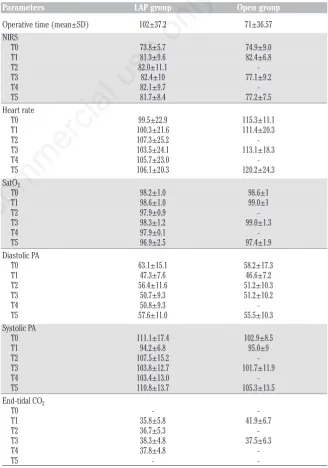
2During the surgical procedure, no sig-nificant variations in End-tidal CO2 were observed at the different time points in com-parison with T1 (P=0.37). The End tidal mean values are provided in Table 1. In Table 1, the hemodynamic mean values at the different surgical time points are report-ed.
Discussion
During laparoscopic procedures in chil-dren, adaptive changes in cerebral and sys-temic oxygenation and hemodynamic para-meters are observed. These changes are related to pathophysiological consequences induced by PP creation and the impact of general anesthesia. Adverse hemodynamic events may be prevented with stringent intraoperative technical monitoring and strict standardization of the pediatric anes-thesiological protocol. As in adults, pedi-atric laparoscopy is less invasive in nature, thereby providing a more rapid recovery, shorter hospital stay, decreased postopera-tive pain and improved cosmetic outcome when compared with traditional open sur-gery. Nevertheless, the procedure may be associated with hemodynamic alterations generated by the high intra-abdominal pres-sure brought on by PP creation and by the existence of insufflation gas that is absorbed by the blood. These systemic hemodynamic alterations may result in changes in end-organ blood flow and oxygen delivery. In addition, the impact of anesthesia on hemo-dynamic changes during laparoscopy should be considered.15,18-21To date, data regarding hemodynamic changes during laparoscopy are conflicting and further evaluations in very small children represent new research perspectives for the near future. The most commonly studied param-eters are HR, systemic vascular resistance,
mean arterial pressure and central venous pressure. Increases and decreases in virtual-ly all of the parameters noted above have been described after the institution of PP. The data vary in relation to the many factors affecting these values such as the child’s weight and age.22
Significant changes in cerebral oxy-genation occur in some patients during CO2 insufflation. To date, the data collected regarding alterations in cerebral oxygena-tion during laparoscopic procedures in chil-dren have been limited and non-homoge-nous.11-15
Previously, we reported on changes in cerebral oxygenation during laparoscopic procedures in pediatric patients, when
strin-gent monitoring was not adopted.15 In this study, we closely monitored cerebral oxy-genation with NIRS and the anesthesiolo-gists were not blinded to the readings to pre-vent intraoperative alterations. Under these conditions, we showed that CO2insufflation during PP may not influence cerebral oxy-genation during laparoscopic surgery. These results suggest that the impact of anesthesia on adaptive changes should not be underes-timated and confirm that this technology may be useful to anticipate any potential decrease in brain oxygenation. Rapid recog-nition of low cerebral perfusion and prompt correction is a challenge and the main goal is to avoid negative postoperative neurode-velopmental outcomes following pediatric
Table 1. Hemodynamic mean values at the different surgical time points.
Parameters LAP group Open group
Operative time (mean±SD) 102±37.2 71±36.57 NIRS T0 73.8±5.7 74.9±9.0 T1 81.3±9.6 82.4±6.8 T2 82.0±11.1 T3 82.4±10 77.1±9.2 T4 82.1±9.7 T5 81.7±8.4 77.2±7.5 Heart rate T0 99.5±22.9 115.3±11.1 T1 100.3±21.6 111.4±20.3 T2 107.3±25.2 T3 103.5±24.1 113.1±18.3 T4 105.7±23.0 T5 106.1±20.3 120.2±24.3 SatO2 T0 98.2±1.0 98.6±1 T1 98.6±1.0 99.0±1 T2 97.9±0.9 T3 98.3±1.2 99.0±1.3 T4 97.9±0.1 T5 96.9±2.5 97.4±1.9 Diastolic PA T0 63.1±15.1 58.2±17.3 T1 47.3±7.6 46.6±7.2 T2 56.4±11.6 51.2±10.3 T3 50.7±9.3 51.2±10.2 T4 50.8±9.3 T5 57.6±11.0 55.5±10.3 Systolic PA T0 111.1±17.4 102.9±8.5 T1 94.2±6.8 95.0±9 T2 107.5±15.2 T3 103.8±12.7 101.7±11.9 T4 103.4±13.0 T5 110.8±13.7 105.3±13.5 End-tidal CO2
T0 T1 35.8±5.8 41.9±6.7 T2 36.7±5.3 T3 38.3±4.8 37.5±6.3 T4 37.8±4.8 T5
-Non commercial
surgical procedures. The anesthesiologist should be specifically prepared to manage this vulnerable population.23,24
In this study we also collected data on the impact of CO2insufflation on peripheral oxygenation. Anesthesia induction and intraoperative management are critical determinants in peripheral oxygenation sta-bility during laparoscopic procedures; in fact, during the latter part of surgery (last ten minutes), especially in very young chil-dren (whose muscles are very weak and do not intrude with surgical activity), a gradual reduction in ventilator assistance was adopted in order to facilitate gradual recov-ery of spontaneous breathing.25,26
According to the literature, increases in arterial pressure during peritoneal insuffla-tion have been noted. Moreover, we showed that a significant decrease in diastolic and
systolic pressures, occurred at induction of anesthesia and during intraoperative surgi-cal time points.
The pressure profile was similar in both open surgery and the laparoscopic surgical approach; this observation supports the hypothesis that PP creation is only partially responsible for pressure variations and underlines the importance of dedicated anesthesiological management in pediatrics even for traditional surgery.
As previously reported,15during PP cre-ation, an HR increase was recorded. The correlation between HR changes and CO2 flow rate support the role of a neurohumoral CO2effect. CO2stimulates the sympathoa-drenal system causing a significant release of catecholamines and cortisol and thus increased HR. The absorption of CO2 dur-ing positive pressure pneumoperitoneum
may lead to an increased CO2load. While a different CO2 reabsorption in infants and children has already been reported based on the different characteristics in their peri-toneal surface, CO2elimination is related to age with younger children eliminating more CO2than older children.27
In most patients undergoing controlled ventilation, end-tidal CO2 closely reflects arterial CO2tension.27We did not measure arterial CO2and arterial pH levels in this study, but we assume that because there were only minor changes in end-tidal CO2, that the blood gases did not change signifi-cantly. Clinically, we did not observe any adverse cardiovascular or respiratory events in our patients.
The present preliminary report has sev-eral limitations. The sample size was limit-ed and a study on a larger number of
chil-Figure 1. Profile of regional cerebral oxygen saturation (A), heart rate (B), peripheral oxygen saturation (C), diastolic pressure (D) and systolic pressure (E) in LAP and OPEN groups at the different surgical time points.
Non commercial
dren is mandatory to confirm the results. Secondly, it concerns a population with a
broadrange of ages, from 1 to 18 years, and the impact of IAP, absorption and elimina-tion of CO2 and anesthesia protocols are different for infants, children and adoles-cents. The initial inclusion criteria for recruitment in the study selected an homogenous group of procedures, how-ever the influence of the different opera-tive times on the rScO2 cannot be excluded. The anesthesiologist’s anesthesia technique and ventilation strategy to obtain the best parameters were not standardized. Additionally, the exact impact of the anes-thesia on hemodynamics could be support-ed by hemodynamic evaluation during the standard anesthesia protocol and using dif-ferent anesthesiological agents. Finally, arterial blood gas analysis monitoring would be useful during laparoscopic proce-dures; in our study, the routine procedure, did not call for invasive PaCO2monitoring.
This study points to new study direc-tions to ameliorate our knowledge on the combined surgical and anesthesiological role on hemodynamic status in pediatric laparoscopy. With the advent of new mini invasive surgical approaches, there is a need for specific and dedicated anesthesiological procedures, particularly in children. Although anesthesia for laparoscopic sur-gery does not require a major extension of the traditional methods for pediatric abdom-inal surgery, special consideration must be given to alterations in cardiovascular and respiratory status that occur during the laparoscopic procedure.18-21 Children, infants and neonates represent an anesthesi-ological challenge because of age-specific anatomical and physiological issues. Apart from these pediatric-specific considera-tions, the pediatric anesthesiologist must understand the implications of laparoscopic surgery, and prevent or act accordingly to changes that will occur during these proce-dures.18-21There is room for improvement in quality of care during the laparoscopic surgical approach in pediatrics.
Conclusions
This study demonstrates that patho-physiological hemodynamic alterations are influenced by both the procedure and the anesthesia during pediatric abdominal laparoscopic surgery. However, the exact role of each factor needs further research. Due to age-related homeostatic vulnerabili-ty, hemodynamic status should not be underestimated in pediatrics. Knowledge of the pathophysiological changes, the
stan-dardization of intraoperative surgical assessment and anesthesia management are all mandatory to prevent adverse hemody-namic outcomes. Future challenges will include appropriate application of com-bined minimally invasive surgery and anes-thesiological protocols, while maintaining the child’s safety during and after laparo-scopic procedures.
References
1. Maesani M, Pares F, Michelet D, et al. Haemodynamic and cerebral oxygena-tion during paediatric laparoscopy in fluid optimized patients. Br J Anaesth 2016;116:564-6.
2. de Waal EE, de Vries JW, Kruitwagen CL, et al. The effects of low-pressure carbon dioxide pneumoperitoneum on cerebral oxygenation and cerebral blood volume in children. Anesth Analg 2002;94:500-5.
3. Schauer PR, Schwesinger WH. Hemodynamic effects of laparoscopy. Surg Endosc 1995;9:119-20.
4. Gupta R, Singh S. Challenges in paedi-atric laparoscopic surgeries. Indian J Anaesth 2009;53:560-6.
5. Tam PK. Laparoscopic surgery in chil-dren. Arch Dis Child 2000;82:240-3. 6. Hodgson C, McClelland R, Newton J.
Some effects of the peritoneal insuffla-tion of carbon dioxide at laparoscopy. Anaesthesia 1970;25:382-90.
7. Joris JL, Hinque VL, Laurent PE, et al. Pulmonary function and pain after gas-troplasty performed via laparotomy or laparoscopy in morbidly obese patients. Br J Anaesth 1998;80:283-8.
8. Joris JL, Chiche JD, Canivet JL, et al. Hemodynamic changes induced by laparoscopy and their endocrine corre-lates: effects of clonidine. J Am Coll Cardiol 1998;32:1389-96.
9. Wahba RW, Béïque F, Kleiman SJ. Cardiopulmonary function and laparo-scopic cholecystectomy. Can J Anaesth. 1995;42:51-63.
10. Tuna AT, Akkoyun I, Darcin S, et al. Effects of carbon dioxide insufflation on regional cerebral oxygenation during laparoscopic surgery in children: a prospective study. Braz J Anesthesiol 2016;66:249-53.
11. Tsypin LE, Mikhel'son VA, Chusov KP, et al. Central and cerebral hemodynam-ics during gynecological laparoscopic interventions in children. Anesteziol Reanimatol 2007;1:30-2.
12. Tytgat SH, Stolwijk LJ, Keunen K, et
al. Brain oxygenation during laparo-scopic correction of hypertrophic pyloric stenosis. J Laparoendosc Adv Surg Tech 2015;A25:352-7.
13. Tytgat SH, van Herwaarden MY, Stolwijk LJ, et al. Neonatal brain oxy-genation during thoracoscopic correc-tion of esophageal atresia. Surg Endosc Surg Endosc 2016;30:2811-7.
14. Bishay M, Giacomello L, Retrosi G, et al. Decreased cerebral oxygen satura-tion during thoracoscopic repair of con-genital diaphragmatic hernia and esophageal atresia in infants. J Pediatr Surg 2011;46:47-51.
15. Pelizzo G, Bernardi L, Carlini V, et al. Laparoscopy in children and its impact on brain oxygenation during routine inguinal hernia repair. J Minim Access Surg 2017;13:51-6.
16. Jackson HT, Kane TD. Advances in minimally invasive surgery in pediatric patients. Adv Pediatr 2014;61:149-95. 17. Truchon R. Anaesthetic considerations
for laparoscopic surgery in neonates and infants: a practical review. Best Pract Res Clin Anaesthesiol 2004;18:343-55.
18. Lasersohn L. Anaesthetic considera-tions for paediatric laparoscopy. S Afr J Surg 2011;49:22-6.
19. Srivastava A, Niranjan A. Secrets of safe laparoscopic surgery: Anaesthetic and surgical considerations. J Minim Access Surg 2010;6:91-4.
20. Ahmed A. Laparoscopic surgery in chil-dren: anaesthetic considerations. J Pak Med Assoc 2006;56:75-9.
21. Ahmed M, Nessa M, Islam MS, et al. Effects of pneumoperitoneum during laparoscopic surgery in young children. JAFCM Bangledesh 2009;5:18-20. 22. Hardacre JM, Talamini MA. Pulmonary
and hemodynamic changes during laparoscopy: are they important? Surgery 2000;127:241-4.
23. Rhondali O, Pouyau A, Mahr A, et al. Sevoflurane anesthesia and brain perfu-sion. Paediatr Anaesth 2015;25:180-5. 24. Rhondali O, Juhel S, Mathews S, et al.
Impact of sevoflurane anesthesia on brain oxygenation in children younger than 2 years. Paediatr Anaesth 2014;24:734-40.
25. Goligher EC, Ferguson ND, Brochard LJ. Clinical challenges in mechanical ventilation. Lancet. 2016;387:1856-66. 26. El-Khatib MF, Bou-Khalil P. Clinical
review: liberation from mechanical ven-tilation. Crit Care 2008;12:221. 27. McHoney M, Corizia L, Eaton S, et al.
Carbon dioxide elimination during laparoscopy in children is age depend-ent. J Pediatr Surg 2003;38:105-10.