_____________________________________________________________________________________________________
Comparative Efficacy of
Aloe vera
(Linn) and
Aloe
schweinfurthii
(Baker) Powdered Leaf Extracts in the
Control of Some Plant Fungal Pathogens
A. O. Alejo
1*, A. M. Ajayi
2and B. O. Akinyele
21Dapartment of Entomology, Nigerian Stored Products Research Institute, P.M.B 5044, Ibadan,
Oyo State, Nigeria.
2
Department of Crop, Soil and Pest Management, Federal University of Technology, P.M.B 704, Akure, Ondo State, Nigeria.
Authors’ contributions
This work was carried out in collaboration among all authors. Author AOA performed the statistical analysis and managed the literature searches. Authors AOA and AMA wrote the first draft of the manuscript and also managed the analysis of the study. Author BOA designed the study. The protocol of the study was written by authors BOA and AOA. All authors read and approved the final manuscript.
Article Information
DOI: 10.9734/IJBCRR/2019/v25i230072 Editor(s): (1) Prof. Halit Demir, Department of Chemistry, Faculty of Art and ScienceYuzuncu, Yil University, Turkey. Reviewers: (1) Paula Mendonça Leite, Universidade Federal de Minas Gerais, Brazil. (2)Mahendran Sekar,Universiti Kuala Lumpur, Royal College of Medicine Perak, Malaysia. Complete Peer review History:http://www.sdiarticle3.com/review-history/47190
Received 25 November 2018 Accepted 01 March 2019 Published 14 March 2019
ABSTRACT
Evaluation of the relative efficacy of powdered leaf extracts of Aloe vera (Linn) and Aloe
schweinfurthii (Baker) in the control of some plant pathogens was undertaken in this work. Antimicrobial activities of the extracts obtained using cold water, hot water and ethanol were tested against four fungal spp., namely, Alternaria solani, Colletotrichum lindemuthianum, Sclerotium rolfsii and Trichophyton rubrum. The phytochemical screening of the leaf extracts of the two aloe species revealed the presence of bioactive compounds such as alkaloids, tannins, saponins, flavonoids, cardiac glycosides, phytates and oxalates. The extracts were observed to exhibit varying inhibitory
effects on the selected fungi. Ethanolic extract of A. vera at 50 mg/ml and 100 mg/ml had the
greatest impact on A. solani and C. lindemuthianum respectively. Similarly, cold water extract of A. schweinfurthii at 100 mg/ml was the most effective against S. rolfsii and T. rubrum. However, hot
water extract of A. vera was least effective against C. lindemuthianum. Also, the efficacy of cold water extract of A. schweinfurthii at 50 mg/ml was very low against T. rubrum and A. solani. The hot
water extract of A. schweinfurthii at 20 mg/ml also showed the least effect against S. rolfsii.
Consequently, extracts from both Aloe species can be recommended in the management of the four fungal pathogens evaluated in this study. It is hoped that in no distant future, botanical fungicides would be developed from the two Aloe species.
Keywords: Alternaria solani; Colletotrichum lindemuthianum; phytochemical screening; inhibitory effects.
1. INTRODUCTION
Plants have been sources of preventive as well as therapeutic medicine among indigenous peoples of various communities for ages [1]. In the past, most of the dwellers of the third world countries rely solely on indigenous plant-based medicines as remedies for various health challenges [2]. In fact, it was reported that in South Africa, over 60% of the population consults the traditional healers [3]. World over, the business interest in these plant species for their proposed medicinal attributes, is on the increase despite the fact that little or no scientific information is available to back the claim of potency attributed to most of them.
The determination of the composition of these plants has been the focus of researchers in recent past [4]. Their efforts have been
channeled towards the extraction and
classification of biologically active components and subsequent development of drugs as well as herbal products as supplements [5]. Analysis of different species of medicinal plants for biologically active components known to have pharmacological properties had been conducted and most of the studied plants have shown antimicrobial property [6].
Aloe vera (Linn), for example, is known to have many bioactive and antipathogenic components and extracts from the Aloe specie can be used in the management of various ailments [7]. The
specie is succulent and it has no naturally
occurring populations in Nigeria, hence, can only be found in cultivation [8]. When examined, the DNA of A. vera shows that it is similar to that of A. perryi, a specie endemic to Yemen [9].
Preparations made from A. vera are
commercially advertised for skin conditions such as sunburns, cold sores and frostbite. Aloe vera gel is also used commercially as an ingredient in yoghurts, beverages, and some desserts [4].
Aloe schweinfurthii is one of the indigenous Aloe
species in West Africa [10]. It is a tropical plant
that is customarily used for the treatment of different ailments. These include chronic skin ulcers, coughs, dysmenorrhea, food poisoning, intestinal worms, difficult delivery, dysentery, general stomach aches, and lumbar pain. Other
traditional uses for A. schweinfurthii include
antiseptic usage, purgative, decoagulant,
larvicide, vermifuge, stomachic tonic and as a stimulant [11].
The use of plant extracts in the control of pests and diseases as well as in the preservation of food is as old as mankind [12]. Ancient Egypt had developed the use of extracts from plants in the preservation of food, as antimicrobial agents and in embalming the dead [13]. For example, the Egyptians were using garlic extract in food preservation. There is a continuous rise of interest in the search for antimicrobial agents from plants [14].
Numerous scientific studies have been
conducted on A. vera, the result of which has
shown the plant to have medicinal attributes, hence its relevance to cosmetic, pharmaceutical, nutraceutical and food industries [15]. Some of these companies are left with no choice but to import the components of this plant with attendant financial implications. Consequently, efforts are made by stakeholders to partially replace active components imported from other countries with those of indigenous Aloe species, so as to bring about increased utilization of indigenous plants. In the present work, effort was made to compare one of the Aloe indigenous to
Nigeria with A. vera in terms of its antifungal
properties.
2. MATERIALS AND METHODS
house of the Department of Crop, Soil and Pest Management, FUTA.
2.1 Collection and Preparation of Fungal Isolates
The four fungal pathogens evaluated in this work,
namely; Alternaria solani, Colletotrichum
lindemuthianum, Sclerotium rolfsii and Trichophyton rubrum were obtained from the culture collections of the pathology unit of the Department of Crop, Soil and Pest Management
Federal University of Technology, Akure.
Inoculation of each fungus was done separately on freshly prepared Potato Dextrose Agar (PDA) following standard procedure. The pure culture of each fungus was evaluated for susceptibility to the phytochemical components of the Aloe species.
2.2 Preparation of Extracts
Eight leaves each of the two species were collected, washed in running tap water and chopped. The chopped pieces were oven dried under a controlled temperature of 65°C for 72 hours. These oven dried leaves of the two Aloe species were crushed separately and ground into powder using a sterile mortar and pestle.
Extracts from the two samples were obtained using cold water (at 25°C), hot water (at 65°C) and ethanol. For cold water extraction, 100 ml of sterile distilled water at room temperature were dispensed into conical flasks containing 10 g of powdered samples. This was allowed to stand for 24 hrs with intermittent agitation. The mixtures were filtered separately using muslin filter cloth. They were thereafter kept in an incubator (under a controlled temperature of 65°C for 12 hours) so as to obtain solid extracts. With the aid of scalpel, these solid extracts were scrapped and divided into three portions of 0.2 g, 0.5 g, and 1.0 g. Each portion was dissolved in 10 ml sterile
distilled water to make three different
concentrations of 20 mg/ml, 50 mg/ml and 100 mg/ml. The same procedure was repeated for hot water extraction at 65°C. For ethanol extraction, 10 g of powdered samples of each species were separately soaked in 100 ml of ethanol inside 400ml conical flasks. The mixture was allowed to stand for about 72 hours after which it was filtered using muslin filter cloth.
These filtrates were dried inside an incubator under a controlled temperature of 65°C to obtain solid extracts. With the aid of scalpel, these solid
extracts were scrapped and weighed into 0.2 g, 0.5 g, and 1.0 g portions. Each portion was also dissolved in 10 ml distilled water to make different concentrations.
2.3 Phytochemical Screening
Screening was carried out for the presence of the following phytochemicals: oxalate, alkaloids, saponins, flavonoids, cyanide, phytates and tannins. The standard procedure as described by Sofowara and Harborne was adopted to identify and quantify the bioactive constituents [16,17].
2.4 Evaluation of Extracts against Fungal Pathogens
Two (2) ml of each extract was aseptically transferred into the Petri dishes. 20 ml aliquots of molten potato dextrose agar (PDA) at 50°C were poured into the Petri dishes containing each extract concentrate and swirled gently such that the extracts and the PDA mixed properly to form a homogeneous mixture. The PDA/extract
mixtures were allowed to set at room
temperature. A sterile 5 mm diameter cork borer was used to punch out agar discs from one-week old cultures of the four fungi separately and inoculation was done at the center of each Petri dish containing PDA/extract mixture. Each extract concentration represented a treatment and each treatment was replicated thrice for the dry leaf samples as well as the three extraction methods.
Two control experiments were set up. The first control involved the use of a standard fungicide i.e. Carbendazim (at 1.0 mg per 2 ml of sterile distilled water as recommended on Carbendazim 500 Fungicide WP label), while the second control was made up of fungal pathogens on PDA with no extract incorporated.
2.5 Data Collection
Data were collected on the mycelial growth of the four fungal pathogens. The zone of mycelial growth was measured after 48 hours of inoculation. All measurements taken were recorded. Percentage mycelial growth inhibition was determined using the formula:
% mycelia growth= (a-b)/a × 100
Where:
b = Zone of mycelia growth on treated sample
All data were subjected to analysis of variance (ANOVA) and means were separated using Duncan’s multiple range test (DMRT).
3. RESULTS
This study showed that Aloe leaves have alkalsoids, tannins, saponins, flavonoids, cardiac glycosides, phytates, and oxalates. The results also showed that there is a significant difference
in the proportion of phytochemicals in A.
schweinfurthii and A. vera. This can be seen in Fig. 1. In terms of proportion, oxalate, saponins, flavonoids, and cyanide were observed to be
more in A. schweinfurthii than in A.vera.
However, alkaloids, phytates, and tannins were
observed to be more in A. vera than in A.
schweinfurthii. These differences are significant.
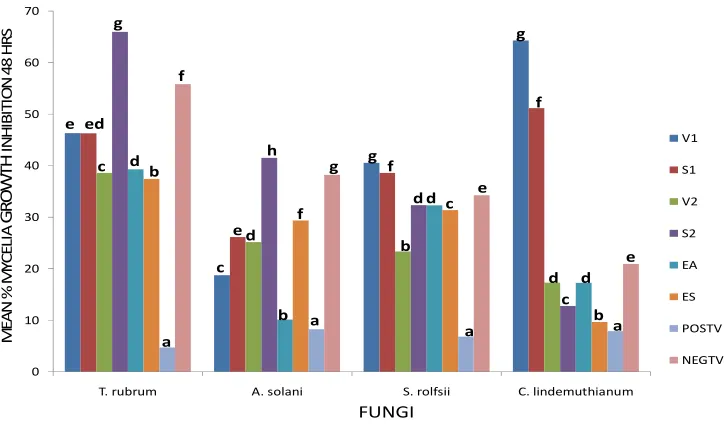
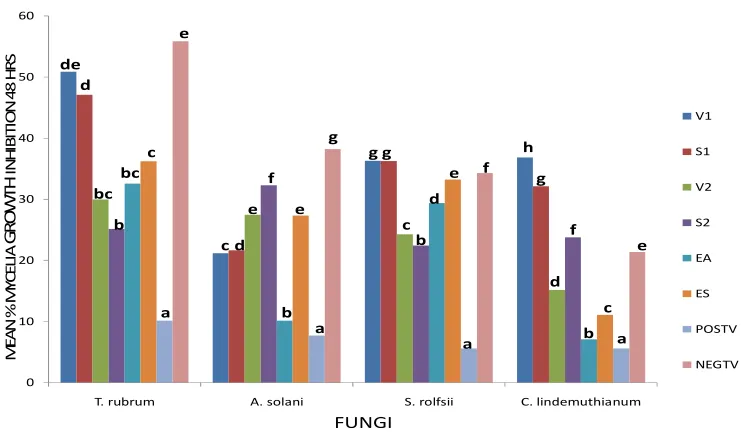
Also, the result on the percentage mycelial growth inhibition of the selected fungi by the leaf extracts of the two Aloe species are presented in Figs. 2 to 4. Significant differences exist among
the extracts with regards to inhibition of mycelial growth in the fungi species.
For example, the mycelial growth of Trichophyton rubrum was seen to be highly inhibited when tested against 20 mg/ml S2, whereas the same fungus was observed to be more resistant to the
effect of V1. Similarly, 100 mg/ml S2 had the
highest efficacy against Sclerotium rolfsii while
V1 showed no inhibitory effect against the fungus. In contrast, 50 mg/ml and 100 mg/ml of
EA had the greatest effects against Alternaria
solani and Colletotrichum lindemuthianum respectively. Highest inhibitory effects were observed in both cases. However, S1 and ES had mild to moderately high effects against the fungi.
4. DISCUSSION
This work showed that powdered leaf extracts of the two aloe species have a varying degree of inhibition of mycelial growth against the selected fungi pathogens. Alternaria solani has been reported to cause dark concentric rings on the fruits, stems and leaves of tomatoes. Early blight
0 1 2 3 4 5 6 7 8 9
A. schweinfurthii
A. vera
a b
a
b
a b
a
b
a
b
a
b a
b
Phytochemicals
0 10 20 30 40 50 60
T. rubrum A. solani S. rolfsii C. lindemuthianum
V1 S1 V2 S2 EA ES POSTV NEGTV d f e bc g a h e c e f b d a f e b d c a d g g f e d a b cd f M EA N % M YC E LI A G R O W TH IN H IB IT IO N 4 8 H R S FUNGI
Fig. 2. Effect of the extracts at 20mg/ml against the fungi after 48 hours
Notes: V1=Hot water extract from powdered Aloe vera, S1=Hot water extract from powdered Aloe schweinfurthii, V2 =Cold water extract from powdered Aloe vera, S2 =Cold water extract from powdered Aloe schweinfurthii, EA =Ethanolic extract from powdered Aloe vera, ES= Ethanolic extract from powdered Aloe schweinfurthii, POSTV=
Standard, NEGTV= Control
0 10 20 30 40 50 60 70
T. rubrum A. solani S. rolfsii C. lindemuthianum
V1 S1 V2 S2 EA ES POSTV NEGTV ed c g e b a f c e h b f a
g g f
b d d c
a e g f d c d b a e d d M EA N % M YC EL IA G R O W TH IN H IB IT IO N 4 8 H R S FUNGI
Fig. 3. Effect of the extracts at 50mg/ml against the fungi after 48 hours Notes: V1 = Hot water extract from powdered Aloe vera, S1=Hot water extract from powdered Aloe schweinfurthii, V2=Cold water extract from powdered Aloe vera, S2=Cold water extract from powdered Aloe
0 10 20 30 40 50 60
T. rubrum A. solani S. rolfsii C. lindemuthianum
V1
S1
V2
S2
EA
ES
POSTV
NEGTV
d
bc
b bc
c
a e
c d e
f
b e
a g
g g
c b
d e
a f
h
g
d f
b c
a e de
M
EA
N
%
M
YC
EL
IA
G
R
O
W
TH
IN
H
IB
IT
IO
N
4
8
H
R
S
FUNGI
Fig. 4. Effect of the extracts at 100mg/ml against the fungi after 48 hours
Notes: V1=Hot water extract from powdered Aloe vera, S1=Hot water extract from powdered Aloe schweinfurthii, V2=Cold water extract from powdered Aloe vera, S2=Cold water extract from powdered Aloe schweinfurthii,
EA=Ethanolic extract from powdered Aloe vera, ES=Ethanolic extract from powdered Aloe schweinfurthii, POSTV= Standard, NEGTV= Control
of tomatoes is also known to be caused by the same fungus [18,19]. All the extracts except S2 had significant inhibition on the mycelial growth of the fungus. The inhibitory effect of the
ethanolic extracts from A. vera was more when
compared to other extracts. One can, therefore, say that ethanol was more efficient in the extraction of phytochemicals which are effective against the fungus. This is in line with the claim that the amount of an active ingredient in an extract is a principal function of the solubility of the active ingredient, which in turn is influenced by the type of solvent used in the extraction [20]. This is the underlying factor responsible for the variation of efficacy in assayed extracts [21,20]. EA at 50mg/ml exhibited the greatest effect against the fungus. This is in consonance with
the discovery made when the extract of Aloe
vera was tested against pathogenic species of
genus Alternaria [22]. The inherent ability to
induce a toxic effect on mycelial growth and proliferation of these fungi was said to be
responsible for the efficacy of A. vera extract
[23]. The presence of alkaloid which was found
to be more in A. vera extract could also be
responsible for this. One of the major properties of alkaloids is their toxicity against the cells of
foreign organisms [24]. Extracts of A.
schweinfurthii also inhibited the growth of the
fungus except for S2 which was of no effect against the pathogen. The aqueous extracts that demonstrated the least activity against Alternaria spp. could be explained by the fact that when plant materials are ground in water, some phenolases and hydrolases are released and could have modulating effects on the activity of the compounds in the extracts. It could also be due to incomplete extraction of the active principles. This finding is in tune with a study carried out in Uruguay, where it was observed that a high proportion of the test plant extracts in water (80% of them) did not inhibit the fungus Alternaria sp [25].
Trichophyton rubrum is known to inhabit different environment including animals, humans and soils. It is a dermatophyte fungus that is economically important in hair, skin and nail infections in human [26]. The result of this study
agrees with the previous study which shows A.
effect (62.01% and 59.47% respectively) on T. rubrum at 20 mg/ml concentration. This study revealed that cold water extract from powdered Aloe schweinfurthii at 20 mg/ml have the greatest inhibitory effect. The low water temperature, unlike hot water, could also be said to maintain the nature of the bioactive ingredients. Saponin which was observed to be present in a higher
proportion in A. schweinfurthii could also be
responsible for this high activity of S2. This is in line with the report which states saponins to be important in plants as antifeedant and in protecting plants against microbes and fungi [28]. The presence of biologically active compounds in plants makes them be of medicinal importance especially for antimicrobial activity against pathogenic organisms.
Similarly, the cold water extract from powdered A. schweinfurthii at 100 mg/ml concentration
proved to be very active against Sclerotium
rolfsii. Flavonoids, which are present in a higher proportion, could be responsible for this. Flavonoids have antimicrobial properties [29] and have been shown to exhibits cytotoxic antitumor, antioxidant and anti-inflammatory activities [30]. The secondary metabolite shields the DNA, lipids, and carbohydrate of biological systems from oxidative processes [31].
V2 was also seen to have a significant effect on the fungus. The fungus has been known to infect a wide range of agricultural and horticultural crops. In Nigeria, cocoyam is seriously affected
by tuber rot caused by S. rolfsii [25]. It has also
been reported that the attacks from this fungus could cause a drop in production figures of cocoyam by 11% [32]. Although no worldwide compilation of host genera has been published, over 270 host genera have been reported in the United States alone. Susceptible agricultural hosts also include sweet potato (Ipomoea batatas), pumpkin (Cucurbita pepo L.), corn (Zea mays), wheat (Triticum vulgare) and peanut (Arachis hypogea). Horticultural crops infected by the fungus are included in the genera Narcissus, Iris, Lilium, Zinnia, and Chrysanthemum [33]. This work revealed S2 at 100 mg/ml and S1 at 20 mg/ml, to show the greatest and least efficacy against S. rolfsii.
Colletotrichum lindemuthianum is the causal
agent of anthracnose of Phaseolus vulgaris. It
produces red to brown, irregular-shaped blotches on pods. Small, thin lesions of the same colour can be seen on the stem. The fungus causes irregular seed development [34]. The attack by
the fungus may lead to total loss of crop if left
unchecked [35]. The highest percentage
inhibition of the fungus was by EA (66.79%) at 100 mg/ml, followed by the same extract at 20 mg/ml and ES (53.91%) at 50 mg/ml. The ability of ethanol to extract the active ingredients that are potent against this fungus could have been responsible for this. On the other hand, hot water extract from powdered A. schweinfurthii and hot
water extract from powdered A. vera proved to
be less effective against C. lindemuthianum. The reason for this is explained by the fact that the structure of the phytochemicals is unstable when exposed to high temperature [20]. Hence, plant
extracts, notwithstanding their increasing
relevance in therapeutic treatment, have the limitation in being rapidly degraded by high temperature and ultra-violet radiations [20,21,36]. The least effective extract against the growth of
the fungus out of the extracts of A. vera and A.
schweinfurthii is V1.
5. CONCLUSION
This research work clearly suggests that Aloe
schweinfurthii may be a good substitute for Aloe vera in the area of plant protection. The result showed that cold water extract from powdered A. schweinfurthii at 20 mg/ml and 100 mg/ml were
the most effective against T. Rubrum and S.
rolfsii respectively. On the other hand, the
efficacy of ethanolic extract from powdered A.
vera at 50 mg/ml and 100 mg/ml was observed
to be the greatest against Alternaria solani and
Colletotrichum lindemuthianum respectively. Further work should be done on the identification and quantification of the active constituents of each species of Aloe. The appropriate mix ratio of active constituents that will be most potent against fungal pathogens should also be investigated.
COMPETING INTERESTS
Authors have declared that no competing interests exist.
REFERENCES
1. Shinwari ZK. Medicinal plants research in
Pakistan. Journal of Medicinal Plants Research. 2010;4(3):161-76.
2. García‐Casal MN, Peña‐Rosas JP, Malavé
New York Academy of Sciences. 2016;1379(1):3-16.
3. Thring TS, Weitz FM. Medicinal plant use
in the Bredasdorp/Elim region of the Southern Overberg in the Western Cape Province of South Africa. Journal of Ethnopharmacology. 2006;103(2):261-75.
4. Sakkas H, Papadopoulou C. Antimicrobial
activity of basil, oregano, and thyme essential oils. J. Microbiol. Biotechnol. 2017;27(3):429-38.
5. Bernal P, Molina‐Santiago C, Daddaoua A,
Llamas MA. Antibiotic adjuvants:
Identification and clinical use. Microbial Biotechnology. 2013;6(5):445-9.
6. Ongsakul M, Jindarat A, Rojanaworarit C.
Antibacterial effect of crude alcoholic and aqueous extracts of six medicinal plants
against Staphylococcus aureus and
Escherichia coli. J. Health Res. 2009; 23(3):153-6.
7. Patel DK, Kumar R, Prasad SK,
Hemalatha S. Pharmacologically screened aphrodisiac plant-A review of current scientific literature. Asian Pacific Journal of Tropical Biomedicine. 2011;1(1):S131-8.
8. Akinyele BO, Odiyi AC. Comparative study
of vegetative morphology and the existing taxonomic status of Aloe vera L. Journal of Plant Sciences. 2007;2(5):558-63.
9. Darokar MP, Rai R, Gupta AK, Shasany
AK, Rajkumar S, Sundaresan V, Khanuja SP. Molecular assessment of germplasm diversity in Aloe species using RAPD and AFLP analysis. Journal of Medicinal and Aromatic Plant Sciences. 2003;25(2):354-61.
10. Burkill HM. The useful plants of west
tropical Africa. Families EI. Royal Botanic Gardens. 1994;2.
11. Tan PV, Enow-Orock GE, Dimo T, Nyasse
B, Kimbu SF. Evaluation of the anti-ulcer
and toxicity profile of Aloe buettneri in
laboratory animals. African Journal of
Traditional, Complementary and
Alternative Medicines. 2006;3(2):8-20.
12. Temikotan T, Akinyele BO, Odiyi AC,
Arotupin DJ. Phytochemicals of some members of the family Hyacinthaceae and their significance in plant protection. In Proceedings of the World Congress on Engineering. 2013;2:3-5.
13. Rojas JJ, Ochoa VJ, Ocampo SA, Muñoz
JF. Screening for antimicrobial activity of ten medicinal plants used in Colombian folkloric medicine: A possible alternative in
the treatment of non-nosocomial
infections. BMC Complementary and
Alternative Medicine. 2006;6(1):2.
14. Mahieux S, Nieto-Bobadilla MS, Houcke I,
Neut C. How to study antimicrobial activities of plant extracts: A critical point of view. In Natural Antimicrobial Agents. Springer, Cham. 2018;55-71.
15. Rajeswari R, Umadevi M, Rahale CS,
Pushpa R, Selvavenkadesh S, Kumar KS,
Bhowmik D. Aloe vera: The miracle plant
its medicinal and traditional uses in India. Journal of Pharmacognosy and Phyto-chemistry. 2012;1(4):118-24.
16. Harborne JB. Phytochemical methods: A
guide to modern techniques of plant analysis. Chapman & Hall Pub. London, UK; 1998.
17. Sofowora A. Screening plants for bioactive
agents. In: Medicinal Plants and
Traditional Medicine in Africa; 1993.
18. Chaerani R, Voorrips RE. Tomato early
blight (Alternaria solani): The pathogen, genetics, and breeding for resistance. Journal of General Plant Pathology. 2006;72(6):335-47.
19. Abada KA, Mostafa SH, Hillal MR. Effect of
some chemical salts on suppressing the infection by early blight disease of tomato. Egyptian Journal of Applied Science. 2008;23:47-58.
20. Enyiukwu DN, Awurum AN, Ononuju CC,
Nwaneri JA. Significance of
characterization of secondary metabolites from extracts of higher plants in plant disease management. Int J Adv Agric Res. 2014b;2:8-28.
21. Gurjar MS, Ali S, Akhtar M, Singh KS.
Efficacy of plant extracts in plant disease
management. Agricultural Sciences.
2012;3(3):425.
22. Bajwa R, Shafique S, Shafique S.
Appraisal of antifungal activity of Aloe
vera. Mycopath. 2007;5(1):5-9.
23. Palou L, Valencia-Chamorro S,
Pérez-Gago M. Antifungal edible coatings for fresh citrus fruit: A review. Coatings. 2015;5(4):962-86.
24. Cushnie TT, Cushnie B, Lamb AJ.
Alkaloids: An overview of their
antibacterial, antibiotic-enhancing and
antivirulence activities. International
Journal of Antimicrobial Agents.
2014;44(5):377-86.
25. Enyiukwu DN, Awurum AN, Nwaneri JA.
review. Net Journal of Agricultural Science. 2014a;2(1):30-46.
26. Hayette MP, Sacheli R. Dermatophytosis,
trends in epidemiology and diagnostic
approach. Current Fungal Infection
Reports. 2015;9(3):164-79.
27. Adejumo TO, Bamidele BS. Control of
dermatophyte-causing agents
(Trichophyton mentagrophytes and
Trichophyton rubrum) using six medicinal
plants. Journal of Medicinal Plants
Research. 2009;3(11):906-13.
28. Sahu R, Saxena J. Screening of total
phenolic and flavonoid content in
conventional and non-conventional
species of curcuma. Journal of
Pharmacognosy and Phytochemistry.
2013;2(1).
29. Choesrina R, Suwendar S, Mulqie L,
Mardliyani D. POTENSI AKTIVITAS
ANTIBAKTERI DARI FRAKSI ETIL
ASETAT DAUN JAMBU AIR [Eugenia aqueum (Burn F.) Alston] TERHADAP Sthaphylococcus aureus DAN Escherichia coli. Jurnal Ilmiah Farmasi Farmasyifa. 2019;2(1):33-9.
30. Tapas AR, Sakarkar DM, Kakde RB.
Flavonoids as nutraceuticals: A review.
Tropical Journal of Pharmaceutical
Research. 2008;7:1089-1099.
31. Atmani D, Nassima C, Dina A, Meriem B,
Nadjet D, Hania B, Flavonoids in human health: From structure to biological activity.
Current Nutrition & Food Science.
2009;5:225-237.
32. Nwachukwu EO, Osuji JO. Evaluation of
plant extracts for antifungal activity against Sclerotium rolfsii causing cocoyam cormel rot in storage. Research Journal of
Agriculture and Biological Sciences.
2008;4(6):784-7.
33. Farr DF, Bills GF, Chamuris GP, Rossman
AY. Fungi on plants and plant products
in the United States. APS Press;
1989.
34. Jain P, Singh SK, Sharma HP, Basri F.
Phytochemical screening and antifungal
activity of Semecarpus anacardium l. (An
anti-cancer plant). Int J Pharm Sci Res. 2014;5:1884-91.
35. Onifade AK. Antifungal effect of
Azadirachta indica A JUSS extracts on Colletotrichum lindemuthianum. Global Journal of Pure and Applied Sciences. 2000;6(3):425-8.
36. Eno IP. Field trial on the potential of
Anacardium occidentalis for the control of cowpea anthracnose disease in Nigeria. A MSc Thesis Presented to the Department PHM, MOUAU; 2011.
_________________________________________________________________________________ © 2019 Alejo et al.; This is an Open Access article distributed under the terms of the Creative Commons Attribution License (http://creativecommons.org/licenses/by/4.0), which permits unrestricted use, distribution, and reproduction in any medium, provided the original work is properly cited.
Peer-review history: