Volume 42, 2012 29
mendes, c., & ribeiro, c. (2006). A Educação Física e o Transtorno de Déficit de Atenção com hiperatividade(TDA/H): um estudo para o profissional no espaço escolar. retrieved 18/02/2012, from http://www.efdeportes.com/efd100/deficit.htm
napole, n. (2008). TCC: TDAH na Escola: Conhecimento e Atuação do Professor de Educação Física. retrieved 07-02-2012, from http://www.pedagogiaaopedaletra.com/posts/tcc-tdah-na-escola-conhecimento-e-atuacao-do-professor-de-educacao-fisica/
parker, h. c., adapt. soares, i. (2005). Desordem por défice de atenção e hiperactividade : um guia para pais, educadores e professores. porto: porto editora.
santos, d. (2007). A formação do professor de Educação Física para o trato com alunos portadores de transtorno de déficit de atenção e hiperatividade. retrieved 18/02/2012, from http://www. efdeportes.com/efd114/transtorno-de-deficit-de-atencao-e-hiperatividade.htm
sauvé, c., trans. almeida, J. (2006). Domesticar a hiperactividade e o défice de atenção. lisboa: climepsi.
sosin, d. (2006). Compreender a desordem por défice de atenção e hiperactividade. porto: porto editora.
Advised by Rui Corredeira, �niversity of Porto, Porto, Portugal�niversity of Porto, Porto, Portugal, Porto, Portugal
received: January ��, ���� ��, ���� accepted: March ��, ������, ����, ����
Fábio Castro MSc, Student, Faculty of Sport, University of Porto, �ua �r�� Pl�cido �osta, ��,�ua �r�� Pl�cido �osta, ��, Porto, Portugal��
E-mail: fabio��leandro��castro@gmail��com Website: http://www��fade��up��pt
Paula Batista Ph���, Associated Professor, Faculty of Sport, University of Porto, Porto, Portugal��Faculty of Sport, University of Porto, Porto, Portugal���� E-mail: pbatista@fade��up��pt
Website: http://www��fade��up��pt
Susana Soares Ph���, Associated Professor, Faculty of Sport, University of Porto, Porto, Portugal��Faculty of Sport, University of Porto, Porto, Portugal���� E-mail: susana@fade��up��pt
Website: http://www��fade��up��pt
SeNSory motor INteractIoN IN
VIrtual eNVIroNmeNt to promote
teachINg-learNINg proceSS
Stefano Di Tore, Paola Aiello, Carmen Palumbo, Rodolfo Vastola
university of Salerno, ItalyItaly e-mail: [email protected], [email protected], [email protected],
Gaetano Raiola
aristide gabelli primary School, Napoli, Italy e-mail: [email protected]
Francesca D’Elia
university of Salerno, ItalyItaly e-mail: [email protected]
Nadia Carlomagno
Suor orsola Benincasa university of Naples, Italy e-mail: [email protected]
Maurizio Sibilio
university of Salerno, Italy.Italy. e-mail: [email protected]
Abstract
“So far the school has been structured on the book, on the laborious acquisition of knowledge formulated in verbal language. Nowadays, thanks to the computer and its ability to simulate reality, it is possible to learn more naturally and without effort using our faculties of perception” (Antinucci, ����). The statement by Antinucci, as well as the studies on many scientific domains supporting the idea of the involvement of sensory-motor integration in the development of intelligence and learning (Piaget, �9��; Vereecken, �96�), suggest to investigate in the didactics methodologies and instruments able to foster this integration ability. These studies also justify the current full attention in the field of movement teaching for new technologies, therefore the present research aims at testing a “shapes game” module that uses Microsoft Kinect System as an input device for the acquisition of data related to the movement of the body segments of the user. The possibility to identify the movement of specific body segments allows to develop teaching methodologies designed to foster the achievement of visual-motor abilities useful to the process of learning in school, through immersive modes of interaction, typical of “exergames” based on a full body involvement (Coshott, ���9). The present study shows the results of the pre-test software, built on a sample of pupils (aged 8 to ��) attending the fifth year of Italian primary school.
the widespread of new technologies in all areas of personal and social life and the rapid evolutionthatcharacterize themleadto aconstant reflectionon their implicationsin the educational development of the individual. the school has a main function in fostering this development,providingspacesfor critical thoughtand placesto experiment teaching methods that canuse technologies referring to the “patterned interaction of a technological artefact and human action” (orlikowski, 1992), to support the process of teaching-learning. “so far the school has been structured on the book, on the laborious acquisition of knowledge formulated in verbal language. nowadays, thanks to the computer and its ability to simulate reality, it is possible to learn more naturally and without effort using our faculties of perception” (antinucci, 2011).
among the new technologies a prominent place is occupied by the instruments able to implement virtual learning environments; the scientific literature mainly refers to these instruments as “disembodied” media of communication (riva, 2004), able to ensure autonomy to the message and to enhance levels of performance and social interaction (Williams, 2008).
theimplicit reference, in this case,istothe mediaandtechnologiesthat realizevirtual environments in which is possible to negotiate meanings through the access to information andcommunication possibilities offered by them; these specific media and technologies are considered useful tools to support the teaching-learning process by developing critical reflection on their contents and by sharing the meanings attributed to them (ardizzone & rivoltella, 2008).
on the contrary, in this study it has been considered the potential of these tools, which create virtual environments to transform in experience the use of their contents through the recovery of the bodily dimension in the interaction. the basic idea, which leads us to consider these technologies useful tools for the promotion of learning and then to consider their educational and teaching purpose, is their ability to provide a setting for action in which to create “situated” and “embodied” learning activities through specific modes of interaction using the movement of the body in the promotion of learning.
of education in the 21st century Volume 42, 2012 31
to release digital learning content through traditional forms of interaction typical of the most popular technologies (eye-hand-mouse, keyboard-hand-eye, etc.) but allows teachers to provide both an alternative possibility to construct and reconstruct knowledge (yang, 2009).
the importance to reflect about a possible educational use of these kind of games in the schools comes from the surveys showing that video games are one of the most favoured activities in the daily life of children. considering for example the only italian context, playing video games is one of the main activities of children aged from 6 to 10. in a recent study the national institute for statistics showed gaming as the favourite activity for about 65.8% of boys and 47.5% of girls falling in this age group underlining also a growing trend. so, creating a learning environment in a videogame would indicate an opportunity to capitalize the use of this time constructively.
these scientific studies has prompted us to examine carefully the possibility of designing and developing a virtual learning environment with a high degree of immersion that would allow to enhance the bodily dimension in the processes of knowledge construction facilitating the learning process, through the dynamics and logic of interaction typical of videogames and specifically of “exergames”.
the aim of this study is therefore to provide an educational software and technology for students of primary school that is able to associate gaming with learning, improving motivation through the emotional and bodily involvement.
Methodology of Research
the present research is a pilot study whose methodologyhas required to analyse the literature on virtual learning environments to create a theoretical framework on the educational implications of the use of exergames to design a virtual learning environment for development of visual-motor integration skills.
the study involved 15 pupils (aged 8 to 10) attending the fifth class of an italian primary school which cooperates with the university of salerno for research activities.
the instruments used to carry out the research are:
1. the Visual motor integration test (beery, buktenica, 2000). the Vmi test is a “paper and pencil” test, scientifically validated, which requires the subject to copy a sequence of geometric forms. the test was designed to assess the ways in which individuals integrate their visual and motor skills. Vmi is also configured as a test virtually independent of the culture. for this reason it is based on geometric shapes and not on numbers or letters that have a close relationship with the culture. moreover, the Vmi test is one of the best and most accurate assessment tool for the integration of visual and motor skills.
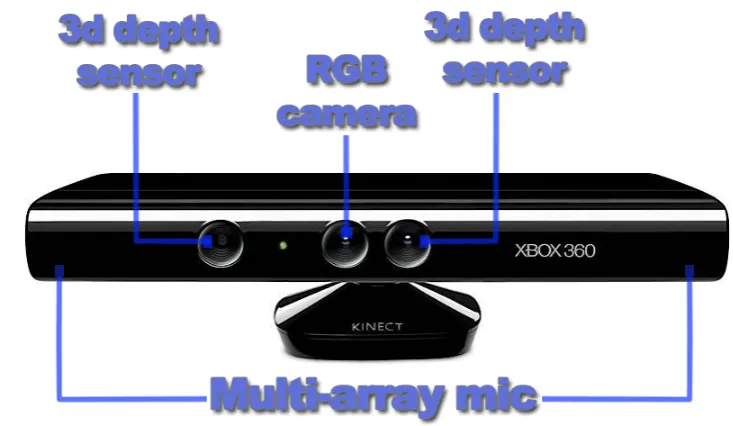
2. the Kinect device (figure 1), originally developed by microsoft co.
Figure 1: Hardware components.
the procedures of the study are:
1. identification of the learning objective, according to the italian ministry of education Guidelines of 2007 for primary school to be achieved through the use of the virtual learning environment. the virtual learning environment has been configured as a battery of modules each of which aimed at obtaining one or more specific learning objectives. at present it has been developed one module aimed at the achievement of the following learning objective: “to recognize and evaluate trajectories, distances, executive paces and timing succession of motor actions, knowing how to organize the movement in space in relation to oneself, objects and others” (ministry of education, 2007). Within this objective, it has been decided to pursue skills related to the functions of coordination and visual-motor integration, because it has been considered by the scientific literature as one of the preconditions of learning processes, particularly essential in the acquisition of instrumental skills of reading and writing, able to foster high level cognitive processes involved in the experiences of academic achievement (marsha & amundson, 1994). the visual-motor responses may be considered as the first sensory integration of the individual development, therefore, as one of the key objectives that any educational system should pursue. for this reason the development of our first module has been aimed to facilitate and support the visual-motor integration skills through virtual modes of interaction, i.e. to virtually grasp and handle digital shapes, coordinating hands movements and audio-visual feedback provided by the virtual learning environment. 2. planning and design of interaction forms on the basis of the selected learning objective: modes of interaction have been designed, requiring the involvement of body position in the digital space and a high degree of coordination in the use of the hands.
of education in the 21st century Volume 42, 2012 33
Kinect system makes it possible to experiment teaching methodologies designed to support processes of learning through experiences of interaction based on bodily involvement. the affordability and portability of the system also make it particularly suitable for its use in schools for educational purposes.
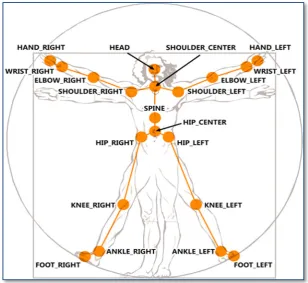
at this stage of development of our first module of the system, Kinect device is able to identify 20 body segments (figure 2).
Figure 2: Map of the bodily segments acquirable by Kinect device.
4. design and implementation of a virtual learning environment.
Figure 3: Layout of the module.
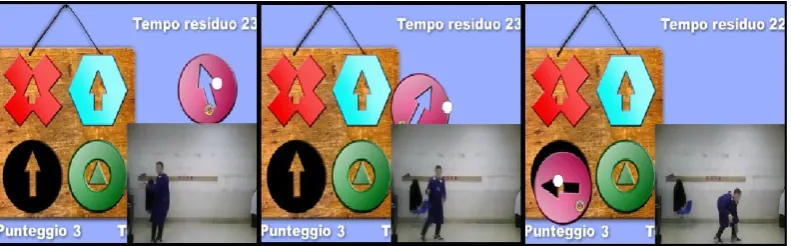
Figure 4: Screen and video captured frames.
5. the shapes within the module have been realized on the basis of the sequence of the same forms present in the Visual motor integration test (beery, buktenica, 2000). the module that has been produced was created in accordance with the theory underlying the Vmi test. the shapes-game not only shares with Vmi the same figures but also aims to encourage and stimulate the function of visual-motor integration measured by the test. this test has also been chosen to quantify the level of skill and coordination, visual motor integration of subjects, to determine a possible correlation between scores obtained in the form with the scores of the Vmi and to establish if the form created are not actually able to solicit and encourage the process of coordination and visual-motor integration.
of education in the 21st century Volume 42, 2012 35
our module and visual-motor integration skills quantified through the use of the Vmi test. the score obtained through the fruition of the module is related to the number of forms that the pupils were able to rotate and to put properly in a specific area. the time available for each form has been set at 25 seconds, after which the system switch to the next shape without awarding any point. every form correctly placed within 25 seconds corresponded to one point.
7. data analysis. data have been analyzed by a statistical correlation between:
- the score obtained at Vmi test and the score obtained using “shapes-game” module; - the time taken to complete the activities both the “shapes-game” module and the Vmi test.
Results of Research
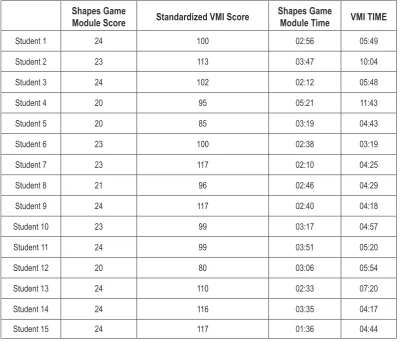
the results are shown in table 1 which lists: the score obtained using the module, the standardized score obtained at Vmi test, the time taken to complete the activities of the module, the time taken to complete the Vmi test.
Table 1. VMI and Shapes-Game Module scores and times.
Shapes Game Module Score Standardized VMI Score Shapes Game Module Time VMI TIME
Student � 24 �00 02:56 05:4�
Student 2 23 ��3 03:47 �0:04
Student 3 24 �02 02:�2 05:48
Student 4 20 �5 05:2� ��:43
Student 5 20 85 03:�� 04:43
Student 6 23 �00 02:38 03:��
Student 7 23 ��7 02:�0 04:25
Student 8 2� �6 02:46 04:2�
Student � 24 ��7 02:40 04:�8
Student �0 23 �� 03:�7 04:57
Student �� 24 �� 03:5� 05:20
Student �2 20 80 03:06 05:54
Student �3 24 ��0 02:33 07:20
Student �4 24 ��6 03:35 04:�7
Student �5 24 ��7 0�:36 04:44
REPORT
�orrelation Module Score/Standardized VMI Score 75��52%
�orrelation Module Time/ VMI Time 66��7�%
Discussion
in the full awareness that a sample of 15 pupils cannot be considered exhaustive, it is interesting to note how high are the coefficients of correlation, especially with reference to the relationship between the module attribution of the score and the score of Vmi test. the high coefficients of correlation, even if with a so limited sample, may therefore be considered as indication that seem to confirm the existence of a relationship between the visual-motor integration skills and activities that require to be completed.
Conclusion
the results obtained in the phase of pre-testing of the designed module encourage to study it in deep and to start the phase of experimental testing to evaluate the effectiveness of the used technologies to foster teaching and learning processes.
References
antinucci, f. (2002). la generazione dei videogiochi è già pronta; crescerà simulando. Telèma, �4, 41-43.
ardizzone, p., & rivoltella, p. c. (2008). Media e tecnologia per la didattica. milano: V & p.
beery, K. e., & buktenica, n. a. (2000). VMI Developmental Test of Visual-Motor Integration. milano:milano: Giunti.
bopp, m. (2006). didactic analysis of digital Games and Game based learning. in pivec, m. (ed),ctic analysis of digital Games and Game based learning. in pivec, m. (ed),
Affective and Emotional Aspects of Human-Computer Interaction. �ame-�ased and Innovative�ame-�ased and Innovative Learning Approaches (pp. 8-37). amsterdam: ios press.
cangià, c. (2006). Giocare o videogiocare? la comprensione del fenomeno videoludico per una sua utilizzazione formativa. Cittadini in crescita, �, 15-24.
ceccherelli, a. (2009). nuove forme di insegnamento i videogiochi e l’edutainment. Rivista Scuola IaD,
�, 96-115.
coshott, r. (2009). tests for exergames. retrieved 04/06/2009, from http://exergaming.pbwiki.com/ tests-for-exergames
Gee, J. p. (2003). What video games have to teach us about learning and literacy. new york: palgrave mcmillan.
of education in the 21st century Volume 42, 2012 37
prensky, m. (2001). Digital �ame �ased Learning. new york: mcGraw-hill. riva, G. (2004). Psicologia dei nuovi media. bologna: il mulino.bologna: il mulino.
riva, G., Vatalaro, f., Zaffiro, G. (2009). tecnologie della presenza. concetti e applicazioni. Mondo Digitale, 3, 32-45.
Williams, b. t. (2008). tomorrow will not be like today: literacy and identity in a world of multiliteracies.
Journal of Adolescent and Adult Literacy, ��, 682-686.
yang, s. h. (2009). using blogs to enhance critical reflection and community of practice. Educational Technology & Society, ��, 11-21.
young, b. (2009). exergaming definitions. retrieved 04/02/2009, from http://www.gamesforhealth.org/ index3.html.
Advised by �oris Aberšek, �niversity of Maribor, Slovenia
received: January �6, ���� �6, ���� accepted: March �6, �����6, ����, ����
Stefano Di Tore Ph��� Student at the �epartement of Human Philosophical and Educational Sci-ences, University of Salerno, Via Ponte �on Melillo, 84084 Fisciano, (SA), Italy�� E-mail: stefano��ditore@gmail��com
Paola Aiello Assistant Professor at the �epartment of Human, Philosophical and Educational Sciences, University of Salerno, Via Ponte �onMelillo, 84084 Fisciano (SA), Italy�� E-mail: paiello@unisa��it
Carmen Palumbo Ph� Student at the �epartment of Human, Philosophical and Educational Sci-ences, University of Salerno, Via Ponte �on Melillo, 84084 Fisciano (SA), Italy�� E-mail: capalumbo@unisa��it
Rodolfo Vastola Ph� Student at the �epartmentof Human, Philosophical and Educational Sciences, University of Salerno, Via Ponte �on Melillo, 84084 Fisciano (SA), Italy��
E-mail: rodolfo��vastola@libero��it
Gaetano Raiola Headmaster at Aristide Gabelli Primary School, Via �asanova, 30, Napoli (Na), Italy��
E-mail: raiolagaetano@libero��it
Francesca D’Elia Assistant Professor at the �epartment of Human, Philosophical and Educational Sciences, University of Salerno, Via Ponte �on Melillo, 84084 Fisciano (SA), Italy��Via Ponte �on Melillo, 84084 Fisciano (SA), Italy�� E-mail: fdelia@unisa��it
Nadia Carlomagno Assistant Professor, Suor �rsola �enincasa University of Naples, Italy��Suor �rsola �enincasa University of Naples, Italy��, Italy�� E-mail: nadiacarl@libero��it
Website: http://www��unisob��na��it/
Maurizio Sibilio Full Professor at the �epartment of Human Philosophical and Educational Sci-ences, University of Salerno, Via Ponte �on Melillo, 84084 Fisciano (SA), Italy��Via Ponte �on Melillo, 84084 Fisciano (SA), Italy�� Phone: 003� 08��644�6, Fax: 003� 08��644�7��