© 2018 IJSRST | Volume 4 | Issue 7 | Print ISSN: 2395-6011 | Online ISSN: 2395-602X Themed Section: Science and Technology
Study of Self Concept among 9
thGrade Students In Relation to their Gender
Roopa Vats
Assistant Professor, Guru Nanak College of Education, Punjabi Bagh, New Delhi, India
ABSTRACT
This study will focus on Self Concept among 9th grade students in relation to their Gender. Self as process is defined in terms of activities such as thinking and perceiving and coping with the environment. And Self concept is the term usually used to refer to this area of private experience and self assessment. The result of the study shows that maximum numbers of students have above average level of self- concept. And its positively cor-related with boys and girls. The result of this study will help to improve the environment of school to assist their students in showing better act in their self concept.
Keywords : Self Assessment, Self-Concept of Adolescents, Social Adjustment and Academic Achievement of Persian Students
I.
INTRODUCTION
Education is considered to be the core of human development and an essential pre- requisite for achieving fairness, self-esteem and social justice. The comprehensive development of human personality is the main objective of education. The major component of personality development is effective on self concept. Self concept is mainly help in building necessary character traits like respectfulness, responsibility, trustworthiness, fairness, caring, and citizenship. These traits help an individual to make good choices in thinking and behavior, resulting in social competence.
SELF-CONCEPT: Self concept is the term usually used to refer to this area of private experience and self assessment. Allport (1961) has described the self concept as “The self is something of which we are immediately aware. We think of it as the warm, central private region of our life. It has been referred by Lowe (1961) as one‟s attitude towards self. As such it play a crucial part in our consciousness (a concept broader than consciousness) and in our organism (a concept broader than personality). Thus it is some
kind of core in our being”. The success of an individual in his later life is not determined by his achievement only. It is only by developing self reliance and becoming well adjusted that one can hope to be a successful individual in his future life. It continues to expand with experience with emotional involvement, frustration, disc rim in alive adjustment and insight. The nature of self-concept is dynamic. This change can be either constructive or destructive. It depends upon ones perception of himself and the situation. It may be observed that the self concept and behavior mutually go on influencing each other.
II.
COMPONENTS OF SELF- CONCEPT
The concept of self has three major components: the perceptual, the conceptual and the attitudinal.
The conceptual component It is the person‟s conception of his distinctive characteristics, his abilities and disabilities, his background and origins, and his future.
The Attitudinal Component: These are the feelings a person has about himself, his attitudes towards his present status and future prospects, his feelings about his worthiness and his feelings regarding self-esteem, self-reproach, pride and shame.
Hall and Lindzey (1957) suggest that the term self has come to have two distinct meanings to psychologists; (i) Self as object and (ii) Self as process. Self as object is defined simply as total cumulative of attitudes, judgments and values which an individual holds with respect to his behaviour, his ability, his body, his worth as a person, in short, how he perceives and evaluates himself. Self as process is defined in terms of activities such as thinking and perceiving and coping with the environment. The point presented that the self concept defined in terms of self as object is an important aspect of personality and that individual differences along this dimensions are as meaningful as differences in attitudes, motives and abilities
III.
REVIEW OF RELATED LITERATURE
Pandith, Aqueel, Ahmad (2012) undertook to study the self-concept, level of aspiration and academic achievement of normal and physically challenged secondary school students of district Baramullah (J and k).The sample for the study was 300 including 150 normal and 150 physically challenged secondary school students by using random and purposive sampling technique. Sagar and Sharma‟s self-concept inventory, Mahesh Bhargava and M.A. Shah‟s level of aspiration scale were administered for the collection of data. The result of the study highlight that the normal secondary school students had high real self, level of aspiration and academic achievement as
compared to physically challenged students. On the other hand, physically challenged students were found to have high ideal self as compared to normal students.
Bharathi& Sreedevi (2013) conducted a study on
the Self-Concept of Adolescents. The findings of the study revealed that higher percentage of adolescents had above average levels of self-concept in dimension of temperamental (85), intellectual (77.5), physical (60) and social (52.5). About 47.5percent of adolescents equally had high and above average self- concept in education. And 57.5 percent of adolescents had high moral self concept. Adolescents overall Self-concept was found as 27.5 percent in high and 72.5 per cent have above average.
Abraham (2010) conducted a study on “The Self-Esteem And Social Relations Of Adolescents With
Learning Disability”. The study shows that,
statically there is a significant relationship between the respondents relationship with parents with respect to respondents self-esteem. There is less significant relationship between the respondents relationship with peers with respect to respondents self-esteem. Present study indicates that, statically there is a significant relationship between the respondents relationship with teachers with respect to respondents self-esteem.
Yengimolki (2015) conducted a study on “Self-Concept, Social Adjustment and Academic Achievement of Persian Students”. The present study aimed at exploring the relationship between self-concept and social adjustment with academic achievement of students. The results indicated that the better adjustment people have, the more ability they will make progress in their life.
IV.
RESEARCH METHODOLOGY:
methods and evaluation. This method is organized attempt to analyze, interpret and reports the present status of a social institution, group or area. So choose Descriptive survey method for research by the investigator.
V.
POPULATION AND SAMPLE
A Sample is a limited quantity of something which is proposed to be similar to and represent a larger amount of that thing. It is a basic aspect of the scientific procedure. So the concept of sampling has been introduced with a view of making research findings inexpensive and correct. Keeping this in view, a sample of total 100 Students of 9th grade of Sonepat district through random sampling technique have been taken for the investigation of the present study.
VI.
OBJECTIVE OF THE STUDY
To Assess the level of Self Concept among 9th grade students.
To find out relationship between Self Concept of 9TH grade students in relation to their gender.
VII.
HYPOTHESIS OF THE STUDY
There is no significant relationship between SelfConcept of 9TH grade students in relation to their gender.
TOOL USED
Self Concept developed by Saraswat (2010) DESCRIPTION OF TOOL
SELF CONCEPT: Self concept questionnaire (SCQ) developed by Dr. Raj Kumar Saraswat consists of 48 items. The self – concept inventory provides six separate dimensions of self- concept viz. physical, social, intellectual, moral , educational and temperamental Self- concept. It also gives a total concept score. The operational definitions of self-concept dimensions measured by this inventory are:
Physical – Individuals‟ view of their body, health, physical appearance and strength.
Social- Individual‟s sense of worth in social interactions
Temperamental- Individuals view their prevailing emotional state or predominance of a particular kind of emotional reaction.
Educational- Individual‟s view of themselves in relation to school, teachers and extracurricular activities.
Moral- Individual‟s estimation of their moral worth; right and wrong activities.
Intellectual- Individual‟s awareness of their intelligence and capacity of problem solving and judgments. The following table indicates item numbers included in different self- concept dimensions.
Self- Concept Dimensions
Code No. Item Numbers
Physical A 2, 3, 9, 20, 22, 27, 29, 31
Social B 1, 8, 21, 37, 40, 43, 46, 48
Temperamental
C 4, 10, 14, 16, 19, 23, 24, 28 Educational D 5, 13, 15, 17, 25,
26, 30, 32 Moral E 6, 34, 35,41, 42,
44, 45, 47 Intellectual F 7, 11, 12, 18, 33,
36, 38, 39
Reliability: Reliability of the inventory was found by test- retest method and it was found to be 91 for the total self- concept measure.
VIII.
INTERPRATATION AND ANALYSIS
Objective (1) To Assess the level of Self Concept among 9th grade students.
Table 1 Raw
Score
No. of Students
Interpretation
193 to 240
25 High self- concept
145 to 192
48 Above Average self-
concept
97 to 144 15 Average self-
concept
49 to 96 06 Below Average self-
concept
1 to 48 06 Low self- concept
Interpretation: The above table revealed that maximum no. of students are having above average level of self- concept. 25 students lie in the category of high level of self- concept. Rest of the students lies in the low Self- Concept category. Thus we can conclude that students have satisfactory level regarding their Self- Concept.
Objective (02) To Find out relationship between self concept of 9TH grade students in relation to their gender.
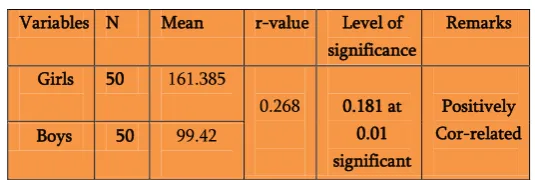
Table 2
Variables N Mean r-value Level of significance
Remarks
Girls 50 161.385
0.268 0.181 at 0.01 significant
Positively Cor-related
Boys 50 99.42
Interpretation: It is evident from the table that relationship between self concept of 9th grade students in relation to their gender is Positively co-related. The calculated „r‟ is 0.268 which is greater than the critical value of co- relation i.e. 0.181 at 0.01 level of significance. So the hypothesis “There is no significant relationship between self concept of 9th grade students
in relation to their gender” is retained. The result shows that there is a positively co- relation between of self concept among boys and girls student. It can be concluded that those 9th grade students boys as well as who have clear idea about self–concept.
IX.
FINDINGS OF THE STUDY:
Level of self concept among 9th grade students .
The result shows that maximum number of students have above average level of self- concept. Less number of students lies in below average and low level category of self- concept.
Relationship between self concept in relation to their gender.
The result shows that relationship between self concept of 9th grade students in relation to their gender is Positively co-related. It shows that there is a high co- relation between boys and girls in level of self concept.
It is sincerely believed that the result of this study will help to improve the environment of school to assist their students in showing better act in their self
0 10 20 30 40 50
High self-concept
Above Average
self-concept
Average self-concept
Below Average
Low self-concept
concept. Teachers in class rooms should be like gardeners who need to cultivate student‟s potential so that they will grow into socially well adjusted adults and will have a sound self- concept. Constant evaluation should be pursued to assess students‟ performance and the results should be used to improve their level of self concept. Individual counselling, making use of appropriate intervention techniques, should be used in order to strengthen their judgment power. There should be close coordination between parents, teachers and the principal. Parent-Teacher meetings should be held off and on in order to find out the strategy to improve the self concept of students. In absence of a Guidance and Counseling worker, the teacher should act as "go between” for the family and the school so as to bring about desired changes in the behaviour of students.
X.
REFERENCES[1]. Adsul, R. K. (2011). Self Concept of High and Low Achieving Adolescents. Indian Streams Research Journal, 1(2), 118-122.
[2]. Aruna, T. Bharathi &, Sreedevi, P. (2013). A Study on the Self-Concept of Adolescents. International Journal of Science and Research, 5(10), 512-516.
[3]. Asma-Tuz-Zahra, Manzoor H. Arif &
Muhammad Imran Yousuf (2010).
Relationship of Academic, Physical and Social Self-Concepts pf Students With Their Academic Achievement. Contemporary Issues in Education Research, 3(3).
[4]. Aurun, L., Ravikumar, M., Makhija, Shonali, & Vishwanathan, V. (2015). Study of Self Concept In Relation To Family Environment among Adolescents. The International Journal of Indian Psychology, 2(2).
[5]. Bajaria, Priyanka (2015). A Study on Self-Concept and Parenting Styles in Adolescents with Learning Disabilities. Indian Journal of Mental Health, 2(3).
[6]. Bong, M., & Skaalvik E.M. (2003). Academic Self-Concept and Self-Efficacy: How Different Are They Really? Educational Psychology Review, 15, 1-40.
[7]. Chandra, Gopal & Joshi, Mahakud Renu (2016). Self-Concept and Its Relation to Academic Achievement. International Journal of Education and Psychological Research, 5(1). [8]. Gates, Jersild, A.S (1970). Education
Psychology. New Delhi: McMillan Company. [9]. Haibin, Li & Laurel, Bornholt (2009).
Self-Concepts and Parental Reports on Children‟s Social Skills at Home. International Journal of Psychological Studies, 1(1), 1-9.
[10]. Lowe (1961). The self concept: Fact or artifact ? Psychological Bulletin, 58, 325-326.
[11]. Moghaddam, F.M., Taylor, D.M., & Wright, S.C. (1993). Social psychology in cross-cultural prospective. New York: Freeman.
[12]. Mohammed Al-Zyoudi (2007). Gender
Differences In Self-Concept Among
Adolescents With Low Vision. International Journal of Special Education, 22(1).
[13]. Sharma, R.A (2005). Methodology of educational research, Delhi Publication. [14]. Rath, Sangeeta & Nanda, Sumitra (2012).
Adolescent‟s self-concept: Understanding the role of gender and academic competence. International Journal of Research Studies in Psychology, 1(2), 63-71.