22 & 23.04.2017
In association with
I
nternational
Journal
of
Scientific
Research in
Science and
Technology
A Comparative Study of TIWT and Shearlet Transform with
Hard Thresholding for Normal Images
Syed Ali Fathima KMN
*1, Shajun Nisha S
2*1M.Phil(PG Scholar)PG & Research Dept of Computer Science, Sadakathullah Appa College,Tirunelveli,India E-mail-Id:[email protected]
2Prof.& Head,PG Dept of Computer Science,Sadakathullah Appa College, Tirunelveli,India E-mail Id:[email protected]
ABSTRACT
Digital Images are generally corrupted by noise, Noise is nothing but addition of unwanted information for the Original Image. Image clatter is arbitrary discrepancy of luster or blush information in images, Removal of the noise is necessary to reduce the minimal damage of the image, improve image details. This paper describes a comparison of the discerning power of the different multimotion based thresholding techniques i.e., TIWT, Shearlet for image denoising. Shearlets are a multischematic structure which allows to efficiently encode anistropic features in multi types of various classes. Shearlet is a novel denoising method which can preserve edges efficiently. Translation invariant method improved the wavelet thresholding methods by averaging the estimation of all rendition of the degraded image. Inference of images which are denoised and its contrary problems, thus the experiments and conjectural analysis happen together. Comparatively the better evaluation of the result to produce shearlet transform.
Keywords: Denoising, TIWT Transform, Shearlet Transform, Hard Thresholding
I.
INTRODUCTION
Image restoration is the removal or diminution of ruin that are incur ed while the image is being obtained. Degradation comes from smearing as well as noise due to electronic and photometric basis [1]. Image denoising is an important image processing task, both as a process itself, and as a constituent in other processes. Very many ways to denoised an image or a set of information exists. The main properties of a good image denoising model is that it will remove noise while defend edges. The goal of image denoising is to recuperate the true original image from such a indistinct piercing copy. The refurbish image should contain less noise than the interpretation while still observance spiky conversion (i.e. edges)[13]. Image denoising is a fundamental step in the image processing. Noise can distort by different inherent and exherent conditions. Depending on the devices noise may be additive and multiplicative noises. Additive noises are Gaussian and Salt and Pepper noise and Multiplicative introduced with the expressed intent to provide a highly proficient depiction of images with
dimensions and multi-resolution transforms as the novel WT with more directionality in disparity with TIWT[19].Shearlet representation predominantly well acclimatized at representing the edges and the other anisotropic objects which are the prevailing features in typical images[6]. Recently, Labate etc., described a new class of multi measuremental representation systems, called Shearlet, One advantage of this approach is that these systems can be erect using a generalized multi-pledge analysis and employed efficiently. Hard threshold denoising method of Shearlet transform can get good concert, for its degrees and multi-direction characteristic, image bare representation[9].Hence edges in an image get distorted. Shearlet transformation is a sparse, multi degree and multidimensional unconventional to wavelet transform. Shearlet Transform mingles multi extent and multi-trend demonstration and is very efficient to incarcerate inherent geometry of the multidimensional image and is optimally bare in representing image restraining edges[4]. Shearlets were introduced with the articulated purpose to provide a vastly competent representation of images with boundaries. In fact, the rudiments of the shearlet representation form a collection of well-contained waveforms, collection at different positions, scales and directions, and with highly anisotropic contours[5]. This makes the shearlet correspond to a particularly well acclimatized at representing the edges and the other anisotropic points which are the prevailing elements in archetypal images[2].The results appraise the recital of proposed filter and measure peak signal noise ratio. In this Paper intend, Shearlet is a narrative denoising method which can preserve edges competently better eradicates the noise from edges and without deforming the features[13].
Denoising Procedure:
The procedure to restored an image is given as follows: De-noised image = W−1 [T{W (Original Image + Noise)}
Step 1: Apply ahead TIWT and Shearlet transform to a din image to get rotted an image.
Step 2: Apply hard thresholding to rotted image to eliminate noise.
Step 3: Apply inverse TIWT and Shearlet transform to thresholded image to get a denoised rotted an image[6]. Shearlet denoising With hard thresholding absorbs three basic steps- first step involves computation the Shearlet
transform of noisy image, second step is used to apply thresholding on noisy Shearlet coefficient according to some rule and finally computing inverse Shearlet transform of amended Shearlet coefficients[15].
A.RELATED WORKS:
The deformations of images by noise are frequent during its acquisition, processing, compression, transmission, and re-production[6].The interfering throughout the conduction degrade the information. Noise may be generated by the transmission error and compression[13].In many applications, image denoising is used to produce good approximates of the original image from noisy observations[12].Translation Invariant denoising restrains noise by averaging over thresholded signals of all circular shifts. The hard thresholding will destroy all the coefficients whose enormity are less than the threshold to zero while keeping the continuing coefficients un amend. All the coefficients whose levels are greater than the threshold will be shrinked by the amount of the threshold[14].The denoising performance of wavelet transform methods is concerned by the following:
Wavelet sources
Number of disintegrations
Transform type (orthogonal, outmoded, translation invariant, etc)
rule which is not only automatically pleading but
also initiates relics in the improved images is the
basis of hard thresholding
[16].In particular, the inaccuracy rates of data inference from noise are highly reliant on the sparsity possessions of the depiction, so that many successful applications of shearlets center around restoration chores such as denoising and contrary problems. Simple threshold denoising method of Shearlet transform can get good performance, for its multi-scale and multi-direction characteristic, image meager representation. However, there is a lot to be recovered.[4].The shearlet representation is a multi scale pyramid of well-confined waveforms delineated at various positions and directions, which was initiated to overcome the constraints of habitual multi scale structures in dealing with multidimensional data[4].Shearlet transformation is a bare, multiscale and multidimensional unconventional to wavelet transform. Shearlet transform is optimal in representing image containing edges[5].The results evaluate the performance of proposed filter and measure peak signal noise ratio. In this Paper Proposed, Shearlet is a new denoising technique which can conserve boundaries well-organized better eradicates the noise from edges and without warping the features[13].B. MOTIVATION AND JUSITIFICATION
Image Denoising is the efficient one to denoise the images as well as to prevents the edges also. Removing or reducing noises from image is very important task in image processing. Image Denoising is utilized to develop and conserve the fine details that may be secreted in the data. In Image processing, noise is not easily eradicated as well as defend edges is also intricate. Shearlet is the greatest method for preserving the edges. Translation Invariant denoising smothers noise by middling more thresholded signals of all circular shifts. The hard thresholding will kill all the coefficients whose enormity are less than the threshold to zero while keeping the continuing coefficients unchanged.
Shearlet Transform coalesces multiscale and multi-directional significations and is very competent to incarcerate inherent geometry of the multidimensional image and is optimally bare in signifying image restraining edges, The intend method using shearlet transform can be concerned to different types of normal images such as Lena, Cameraman, the shearlet transform can be implemented. Shearlet is best because it has
retained the precise information. During these advantages I motivate and justified to do work in Comparative transform such as(TIWT and Shearlet).
C. ORGANISATION OF THE PAPER:
This paper is preparation as follows. Methodology which contains the summarizes of the work of the TIWT and Shearlet Thresholding techniques are current in Section II. Experimental results are shown in Section III. Performance Analysis is also discussed in Section IV. finally Conclusion is presented in Section V.
II.
METHODOLOGY
A.OUTLINE OF THE WORK :
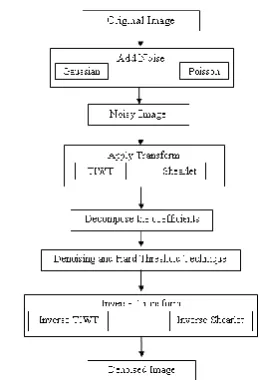
Denoising utilizes TIWT, Shearlet Transform. This system is eloquented in Fig 1.Gaussian and Salt & Poisson nosie is added with the two enter images such as Lena and Cameraman. TIWT, Shearlet Transform is used to crumbled the noisy image and then apply the Hard threshold function to the noisy image to get the denoised output image.
Figure 1. Block Diagram for TIWT and Shearlet with Hard Threshold
B.TIWT, SHEARLET TRANSFORM
succession position of original signal singularities. So Coifman and Donoho[21] locate TI de-noising to eradicate this defect.
Given a signal x(n)(n=0,1,…,N-1),defined Sh as
arithmetic operator of rendition[15], the value of reallocating is h: Sh ( x(n)) = x((n + h) mod N )
For all x, y a X and every scalar α
Shearlet have well restricted waveforms and soaring bearing sensitivity contrast to other state-of-art procedures. Shearlets are correlated with multi scale and multidirectional decomposition, which enable them to capture intrinsic geometric features of image.
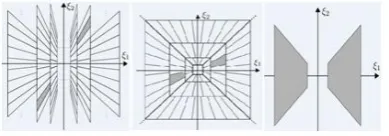
Shearlet has high directional sensitivity and are optimally meager in corresponding image containing edges. Shearlets are constructed by parabolic Scaling Fig.2, shearing and translation applied.
Figure 2. Shearlet Transform
As noise has a fine crumbed structure in the image therefore most of the noise Shearlet Transform is represented here, L2(R2).
Compared the two transform involves three basic steps are as follows:
i) first step rivets calculation the TIWT and Shearlet transform of noisy image,
ii) second step is make use to apply thresholding on noisy TIWT and Shearlet coefficients concurrence to some rule and
iii) finally calculate inverse TIWT and Shearlet transform of modified these coefficients.
C. HARD THRESHOLDING FUCNTION(TIWT AND SHEARLET)
Thresholding is a procedure used for signal and image denoising. The hard-thresholding function desires all Shearlet coefficients that are greater than the provide threshold λ and sets the others to zero. The threshold λ is chosen according to the signal energy[6].These methods are to make a noises free in an image.
( ) { ( ) ( )
Where T is Hard threshold. Let S(x, y) represent the original shearlet coefficient in the point (x, y) in each sub-band K ϵ { K1 K2 …. Kj} at scale j. The intend of this paper is to obtain denoised coefficient D(x,y) at the position S(x,y) by adjust the pixel values.
Step 1: wavelet decomposition of the image: establish the wavelet function and decomposition levels N , and decompose the image with N layer wavelet.
Step 2: Threshold selection: choose the threshold for each TI wavelet coefficients of each layer, and critic the threshold of detail coefficients.
Step 3: TIWT coefficient with threshold progression will be used to reform the image by inverse wavelet transform[10].
R. Coifman and D. Donoho[21] improved the wavelet thresholding methods by averaging the calculate approximately on of all transformations of the degraded image.
D. DECOMPOSE THE COEFFICIENTS:
Normally, those wavelet coefficients with diminutive degrees than the preset threshold are caused by the noise and reinstated by zero, and the others with better magnitudes than the preset threshold are caused by original signal, Then the denoised signal could be re-enacted from the resulting wavelet coefficients[21].A new translation-invariant (TI) wavelet denoising method with developed hard thresholding is presented to reduce the noise from the denoised image.
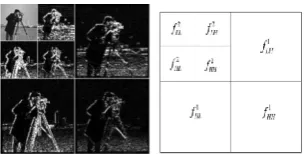
Figure 3. Lena image two level Decomposition ) , ( || || || ) ( || ) ,
(x ay a x a y a x y d xy
d
) , ( | | || || | || || ) ,
( x y x y x y dx y d
| | | | ||
||x 1 1 2
p p p p
x| | ( 1| 2)1 | | 2 1 2 2 2 1 2 ( | )
||
Figure 4. Cameraman image two level Decomposition
The shearlet decomposition procedure is instigated by detaching the image into its high pass and low pass constituents, Shearlet decomposition results in large number of shearlet coefficients and we need to detach noisy coefficients from original ones. Thresholding is very important because thresholding at outsized values result in beating of information whereas at stumpy values result in background encumber. A two level shearlet decomposition wherein each level consisting of 3, 3, 4 and 4 numbers of trimming directions respectively. Thus, the number of directional sub bands within each level was obtained as 8,8,16 and 16 respectively as the number of directional sub-bands within each level Ns= 2
s
where Ns is the number of
shearing directions[11].
The process, consists of following main stages: 1) comprehend the noisy image as input
2) Perform TIWT and shearlet of noisy image and obtain TIWT and Shearlet coefficients
3) calculate approximately noise variance from noisy image
4) determine threshold value using various threshold selection statutes.
5) Apply hard thresholding function to noisy coefficients 6) Perform the inverse TIWT and shearlet to re-enact the denoised image[16].
E.NOISE CATEGORIES
Digital images are often damaged by many types of noise comprising salt and pepper noise, Gaussian noise, Poisson noise, Depending on the type of interruption; the noise can involve the image to dissimilar area. normally our focal point is to confiscate certain kind of noise. Noise is the unwanted effects generated in the image, Image noise can be categorized as Impulse noise (Salt-and-pepper noise), Amplifier noise (Gaussian noise), Shot noise, Quantization noise (uniform noise), Film grain, on-isotropic noise, Multiplicative noise (Speckle noise) and Periodic noise[14].
A. Gaussian Noise (Amplifier Noise)
The term normal noise model is the synonym of Gaussian noise. This noise model is additive in nature [4] and follow Gaussian distribution. Meaning that each pixel in the noisy image is the sum of the true pixel value and a random, Gaussian distributed noise value. The noise is independent of intensity of pixel value at each point. P(z) is the Gaussian distribution noise in image; μ and σ is the mean and standard deviation respectively
.
( )
√( )
B. Poisson Noise (Photon Noise)
Poisson or shot photon noise is the noise that can reason, when number of photons intellect by the sensor is not ample to give evident numerical information[4]. This noise has root mean square value comparative to square root intensity of the image. Different pixels are beared by sovereign noise values. At convenient grounds the photon noise and other sensor pedestal noise distort the signal at different proportions.
( )
λλ
xfor λ>0 and x=0 1 ….
III.EXPERIMENTAL RESULTS
Figure 4.Original Image for Lena and Cameraman
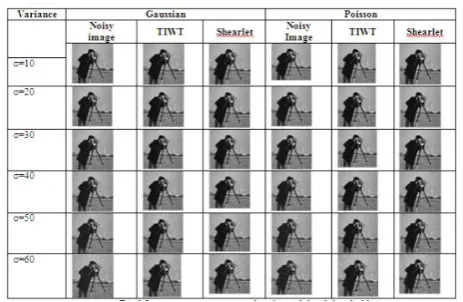
Figure 6. Cameraman image using TIWT and shearlet with hard threshold
IV. PERFORMANCE ANALYSIS
A. PERFORMANCE PARAMETERS:
i) PSNR:
PSNR is used to appraise the restoration results, which determines how secure the restored image is to the original image. It is the ratio between maximum achievable power of a signal and the power of fraudulent noise that distress the superiority and dependability of its representation. PSNR is calculated as,
√
ii) MSE:
The slighter the MSE the nearer the estimator is to the tangible data. A miniature mean squared error means that the arbitrariness reflects the data more precisely than a superior mean squared error. The goal is to estimation the signal xijfrom noisy observations yij such
that Mean Squared error (MSE) is minimum. I.e.
∑ ∑ [ ( ) ( )]
2
iii) RMS
:
The RMS overall time of a sporadic function is equal to the RMS of one period of the function. The RMS importance of a incessant function signal can be inexact by intriguing the RMS of a cycle of equally spaced samples. Additionally, the RMS value of various waveforms can also be established,
xrms=√ ( )
B .PERFORMANCE EVALUATION
The Recital of TIWT and Shearlet was calculated by using MSE,RMS,PSNR. The experimentation of TIWT and Shearlet with hard threshold Gaussian noise have been calculated and their denoised image results are shown in Table I, and Table II. Measured all the metrics, it is scrutinized that the TIWT and Shearlet presents well for Normal images such as Lena and Cameraman. In Table I, II analysis it identify the best threshold for a particular noises. From Table I, its observed that Hard Threshold is well Suitable for both Gaussian and Poisson noise. In Table II Poisson noise is better amputation for Hard threshold and Poisson noise is better elimination for Transforms.
TABLE I TIWT AND SHEARLET FOR DENOISED NORMAL IMAGES GAUSSIAN NOISE
TABLE II TIWT AND SHEARLET FOR DENOISED NORMAL IMAGES POISSON NOISE
IV. CONCLUSION
Gaussian noise and Poisson are well appropriate for Hard Thresholding Functions. Shearlet could propose superior results than hard thresholding to get better the finest excellence of the image.
III.
REFERENCES
[1] Miss Monika shukla1, Dr.Soni changlani2," A Comparative Study of Wavelet and Curvelet Transform for Image Denoising", changlani2IOSR Journal of Electronics and Communication Engineering (IOSR-JECE) e-ISSN: 2278-2834,p- e-ISSN: 2278-8735. Volume 7, Issue 4 (Sep. - Oct. 2013), PP 63-68
[2] Mr. Rohit Verma1 Dr. Jahid Ali2, "A Comparative Study of Various Types of Image Noise and Efficient Noise Removal Techniques",International Journal of Emerging Technology and Advanced Engineering Website: www.ijetae.com (ISSN 2250-2459, ISO 9001:2008 Certified Journal, Volume 4, Issue 3, March 2014)
[3] Glenn R. Easley1 and Demetrio Labate2," Image Processing using Shearlets"
[4] Zhiyong Fan1,2, Quansen Sun1, Feng Ruan2, Yiguang Gong2 and Zexuan Ji1 ," An Improved Image Denoising Algorithm based on Shearlet ",International Journal of Signal Processing, Image Processing and Pattern Recognition Vol. 6, No. 4, August, 2013
[5] Pooran Singh Negi1 and Demetrio Labate2," 3D Discrete Shearlet Transform and Video Processing"
[6] G. R. Easley, D. Labate, and W.Q. Lim,"Sparse directional image representations using the discrete shearlet transform,"Appl. Comput. Harmon. Analysis, vol.25, Jan. 2008, pp.25-46.
[7] Anju T S1, Mr. Nelwin Raj N R2 " Shearlet Transform Based Satellite Image Denoising Using Optimized Otsu Threshold", International Journal of Latest Trends in Engineering and Technology (IJLTET)
[8] "Denosing ECG using Translation Invariant Multiwavelet", World Academy of Science, Engineering and Technology , Jeong Yup Han, Su Kyung Lee, and Hong Bae ParkInternational Journal of Electrical, Computer, Energetic,
Electronic and Communication Engineering Vol:2, No:5, 2008.
[9] Rajesh Kumar Rai1, Trimbak R. Sontakke2,"Implementation of Image Denoising using Thresholding Techniques", ISSN 2249-6343 International Journal of Computer Technology and Electronics Engineering (IJCTEE) Volume 1 , Issue 2. Trends in Engineering and Technology (IJARTET) Vol.3, Issue4,April’16
[10] Mrs.P.Sivamani1,Mrs.V.VidhyaGowri2,Ms.S.V. Priyavarshini3, Ms.N.Revathi4, "Image Denoising Using Wavelet Thresholding", International Journal of Advanced Research journal of computer Technology and Electronics Engg(IJCTEE)
[11] Shubh Karman Kaur1, Rupinder Kaur2,"An Efficient Threshold Based Mixed Noise Removal Technique",International Journal on Recent and Innovation Trends in Computing and Communication ISSN: 2321-8169 Volume: 4 Issue 7 308 – 311.
[12] Arun Dixit, Poonam Sharma,"A Comparative Study of Wavelet Thresholding for Image Denoising",I.J. Image, Graphics and Signal Processing, 2014, 12, 39-46 Published Online November 2014 in MECS DOI: 10.5815/ijigsp.2014.12.06
[13] R. Bouchouareb and D. Benatia,"Comparative Study between Wavelet Thresholding Techniques (Hard, Soft and Invariant-translation) in Ultrasound Images", international Journal of Bio-Science and Bio-Technology Vol.6, No. 6 (2014), pp.29-38.
[14] "An Effective Signal De-noising Algorithm Combining Optimal Wavelet Packet Basis and Translation-Invariant", Di Wu Zhejiang University,Conference Paper,June 2008.
[15] Syed Ali Fathima KMN1, Shajun Nisha S2," Shearlet Transform Based Normal Image Denoising Using Hard Threshold", International Journal of Innovative Research in Computer and Communication Engineering,Vol. 4, Issue 11, November 2016.
Nisha2,"Attend in National Conference in "Recend Trends in Data Minining at Xavier’s College,Tirunelveli.
[17] Jannath Firthouse P1, Latha Rani G.L2, Shajun Nisha S3,"An Effective Shrinkage Threshold for Contourlet based on Image Denoising in Natural Images,International Journal of Advanced Research in Computer and Communication Engineering Vol. 5, Issue 6, June 2016.
[18] Anutam1 and Rajni2"Performance Analysis Of Image Denoising with Wavelet Thresholding Methods for Different levels of Decomposition", International Journal Of Multimedia & Its Applications (IJMA) vol.6, no.3, June 2014
[19] Abdullah Al Jumah,"Denoising of an Image Using Discrete Stationary Wavelet Transform and Various Thresholding Techniques", Journal of Signal and Information Processing, 2013, 4, 33-41.
[20] "The denoise based on translation invariance wavelet transform and its applications", Shuren Qin, Changqi Yang, Tang Baoping and Shanwen Tan, The Test Center, Institute of Mechanical Engineering, Chongqing University Chongqing 400044, P. R. China.
BIOGRAPHY
K.M.N.Syed Ali Fathima received the B.Sc
degree in Computer Science from MS University in 2012 and M.Sc degree in Computer Science from MS University in 2015. She is currently pursuing the M.Phil degree in Computer Science under the guidance of S. Shajun Nisha. Her Research interest are mainly include domain of Image Denoising.
Shajun Nisha S, Professor and Head of the