Processes
Adalberto Farias, Alexandre Mota and Augusto Sampaio
Centre of Informatics Federal University of Pernambuco P.O. Box 7851, Cidade Universitária, Zip 50732-970 - Recife - PE - BRAZIL
{acf | acm | acas }@cin.ufpe.br
Received 10 March 2008; accepted 24 April 2008
Abstract
Data abstraction is a powerful technique to overcome state explosion in model checking. For CSPZ(a formal
in-tegration of the well-known specification languages CSP and Z), current approaches can mechanically abstract in-finite domains (types) as long as they are not used in communications. This work presents a compositional and systematic approach to data abstract CSPZspecifications
even when communications are based on infinite domains. Therefore, we deal with a larger class of specifications than the previous techniques. Our approach requires that the domains (used in communications) being abstracted do not affect the behaviour of the system (data indepen-dence). This criteria is used to achieve an internal parti-tioning of the specification in such a way that complemen-tary techniques for abstracting data types can be applied to the components of the partition. Afterwards, the par-tial results can be compositionally combined to abstract the entire specification. We propose an algorithm that im-plements the partitioning and show the application of the entire approach to a real case study.
Keywords: Formal Methods, Model Checking, Data
Abstraction, CSP, Z, Compositionality.
1. I
NTRODUCTIONIntegrated notations are powerful to provide separa-tion of concerns when describing systems. The language
CSPZ [9], for example, integrates the process algebra CSP [18] and the model-based language Z [22] in such a way that behavioural and data aspects are modelled si-multaneously but orthogonally; while control flow is de-scribed in CSP (the behavioural part), data aspects are
modelled in Z (the data part). The syntax and seman-tics of the constituent languages are almost fully reused in
CSPZ, which also provides flexibility for applying tech-niques to perform compositional refinement and analy-sis. For example, process and data refinement techniques can be used relatively independently to achieve more con-crete specifications. Concerning analysis, theorem prov-ing [13] (Z proofs) or model checkprov-ing [5] (CSP proofs) can be used for verifying properties inCSPZ. The for-mer method requires user intervention in general, whereas the latter is fully automatic, but unable to analyse sys-tems with infinite state-spaces (thestate explosion prob-lem). To overcome such a limitation, several state-space compression techniques [5], likedata abstraction, for in-stance, have been applied.
Abstracting a system means finding anapproximation
that preserves desirable properties. This simpler represen-tation can besafeor optimalwith respect to the original system [6]. Safe abstraction does not preserve all prop-erties, whereas optimal abstraction represents the original system more faithfully. This work considers only opti-mal abstractions of CSPZ specifications. The language yields infinite state-space systems very naturally because infinite domains are allowed as types of state and commu-nication variables. In the first situation, the infiniteness is already handled by the data abstraction approach reported in [8, 16]. However, the infiniteness occurring in commu-nications is still an open problem.
problems handled by data abstraction through the appli-cation of a decomposition and reusing existing techniques to analyse the originated parts separately. After that, we integrate the results and obtain a more complex abstrac-tion. We have observed that this is simpler than analysing the entire specification.
We emphasize that our approach is applied to aCSPZ process in isolation; we split the data (Z) part into a data dependent and a data independent part. We can also ap-ply the approach to allCSPZprocesses (components) of a network of processes, provided the communication of the analysed component does not affect the behaviour of the other processes. In this sense, the state explosion of the entire network can be handled by applying our strategy to its components.
We also point out that our approach is related to refine-ment checking [18] rather than to classical model check-ing [5]. Thus, instead of provcheck-ing a specific property in a given model, we aim at finding an optimal abstrac-tion (SA) that preserves almost all properties of the orig-inal specification (S). The unique distinction betweenS
andSAoccurs when communicated values are abstracted; however, if these values do not affect the behaviour of other processes, we can considerSAinstead ofS(in iso-lation or in a network of processes) . Furthermore, as the equivalence between S andSA is given in terms of the failures-divergences model of CSP [18], our approach al-lows the verification of safety and liveness properties as well as application specific properties.
The main contributions of this work are:
• a systematic strategy for partitioning Z specifications into a data independent and a data dependent compo-nents;
• the algorithmic implementation for the partitioning strategy;
• the reuse of existing techniques to overcome the state explosion problem;
• a compositional approach for abstracting infinite domains of state and communication variables in
CSPZ;
• application of the strategy to a realistic case study.
Although our strategy is developed for CSPZ, it can be extended to other notations that associate events with state change, such asCSPOZ[9] or CSP-B [19].
This work is organised as follows. Section 2 provides an overview of CSPZ and presents part of the specifica-tion of a real system that is used as our case study; this system cannot be mechanically analysed by existing data abstraction approaches because it presents infinite com-munications. We propose an approach to deal with such
a problem in Section 3. The approach is based on a syn-tactic splitting, which is described algorithmically in Sec-tion 4. Afterwards, we discuss related work in SecSec-tion 5 and present our final remarks and future directions for this work in Section 6. The proofs of all lemmas and theorems presented in this work can be found in Appendix A.
2. B
ACKGROUND ONCSPZ
The notation CSPZ provides a convenient way for modelling concurrent systems with state information. Its semantics is defined in such a way that developers can rea-son about behavioural (CSP) and data (Z) aspects orthog-onally. This section introduces several aspects ofCSPZ: syntax, semantics, model checking and data abstraction. We introduce CSP and Z separately.
2.1. THECSP NOTATION
The process algebra CSP [18] can be viewed as a nota-tion for describing concurrent systems whose component processes interact with each other by communication, or as a collection of mathematical models that help one to reason about processes formally.
The most fundamental element in CSP is a communi-cation event, which can be viewed as an atomic transac-tion (or a possible synchronisatransac-tion point) between two or more processes; an event is also an abstract way of rep-resenting a real computation such as a method/function call, statement, input/output, internal action, an so on. An event occurs in a communicatingchannel, which can sup-port data types. For example, if a channeladoes not sup-port types, it defines the event a; otherwise, it defines a family of events. The communicationa?xinvolves an in-put on channela, whereasa!yrepresents an output on the same channel. Inputs and output are generically denoted bych.v, wherechis a channel andvis a value. Thus, if
v∈N, the communicationa.vcorresponds to the infinite set of events{a.1,a.2, ...}.
On the other hand, processes are used to describe some behaviour; each process has an associated alpha-bet, which is the set of all events occurring in process’s body. Thus, a processPhas the alphabetαP.
The most basic processes in CSP areSTOPandSKIP. The former represents a deadlock and do not communi-cate any observable event; the latter denotes successful termination after performing the special event, which is also used to synchronise processes upon successful ter-mination.
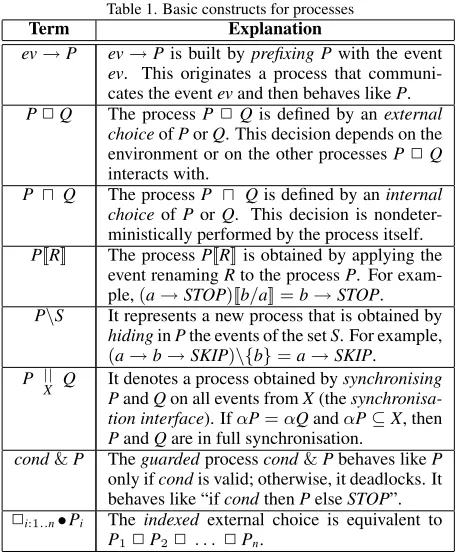
The construction of more complex processes is also possible by using operators. Table 1 provides a brief ex-planation of the main operators.
pa-Table 1. Basic constructs for processes
Term Explanation
ev→P ev→Pis built byprefixing Pwith the event ev. This originates a process that communi-cates the eventevand then behaves likeP. P2Q The processP2Qis defined by anexternal
choiceofPorQ. This decision depends on the environment or on the other processesP2Q interacts with.
P Q The processP Qis defined by aninternal choiceofP orQ. This decision is nondeter-ministically performed by the process itself. P[[R]] The processP[[R]]is obtained by applying the
event renamingRto the processP. For exam-ple,(a→STOP)[[b/a]] =b→STOP. P\S It represents a new process that is obtained by
hidinginPthe events of the setS. For example, (a→b→SKIP)\{b}=a→SKIP. P ||
X Q It denotes a process obtained bysynchronising PandQon all events fromX(the synchronisa-tion interface). IfαP=αQandαP⊆X, then PandQare in full synchronisation.
cond&P Theguardedprocesscond&Pbehaves likeP only ifcondis valid; otherwise, it deadlocks. It behaves like “ifcondthenPelseSTOP”. 2i:1..n•Pi The indexed external choice is equivalent to
P12P22. . . 2Pn.
rameterised) and the right-hand-side is the process body. For example, the specification
channel tick,tack
Clock=tick→Clock2tack→Clock
describes the behaviour of a clock that infinitely offers
tickortack(defined by non-typed channels) using recur-sion. Its graphic representation is given in terms of a
LabelledTransitionSystem(Figure 1).
tick tack
Figure 1. LTS representation of the processClock.
The set initials(P) denotes the set of acceptances (events) that can be performed by the processPin a spe-cific context. For example,initials(Clock) ={tick,tack}
andinitials(a→b→SKIP) ={a}.
The meaning of a CSP process is defined according to three models [18]: traces, failures or failures-divergences. The traces model (T) is based on the observable be-haviour, where a process is represented by a set of traces (sequences of events). For example, the processesSTOP
andSKIPare represented by{}and{,}, respec-tively. The process a →b →STOP is represented by
{ a,a,b}; means no event has been performed
yet,adenotes onlyawas performed, anda,bmeans the process performedafollowed byb.
It is worth noting that the traces model captures what a process “can” do. Actually, processes can reject events, originating the notion of refusals (the events a process can reject in a context). The failures model (F) captures this and represents a process as a set of failures; each one is defined as a pair(s,X)wheresis a trace and X is a set of refusals after performings. For example, the processes a → STOP 2b → STOP and
a→STOP b→STOPare represented by the same set of traces ({,a,b}). However, the second process can nondeterministically reject a before performing any event. The failures of these processes are respec-tively given by {(,∅),(a,{a,b}),(b,{a,b})} and
{(,∅),(,{a}),(,{b}),(a,{a,b}),(b,{a,b})}. Note that the first process is more predictable (determin-istic) than the second in F because it has less failures. Intuitively, a process that offers the external choice (2) of certain events is better than (a refinement of) a process that “decides” internally () on which events to engage.
Besides traces and refusals, processes can perform internal actions that are not captured by T or F. The failures-divergences model (FD) gives meaning to pro-cesses based on their failures and divergences. A diver-gence is a trace (and all its extensions) for which a process is not deadlocked and does not show any observable be-haviour (it infinitely performs internal actions). A diver-gent behaviour is similar to an infinite loop doing nothing. According to [18], process refinement () is defined in terms of set inclusion and the equivalence (≡) is de-fined in terms of refinement. That is,
• PT Q⇔traces(Q)⊆traces(P)
• PFQ⇔traces(Q)⊆traces(P)∧
failures(Q)⊆failures(P)
• PFDQ⇔failures(Q)⊆failures(P)∧
divergences(Q)⊆divergences(P)
• P≡MQ⇔PMQ∧QMP, for any CSP modelM.
2.2. THEZ NOTATION
The Z language [22] presents powerful structuring and abstraction mechanisms for describing data and sequen-tial aspects. It is based on set theory and first-order logic, and provides two internal languages: the mathematical
and theschemalanguages. The former is used to describe various aspects of a design: objects (abstract data types, functions, predicates, etc.), and the relationships between them; the latter is intended to structure and compose de-scriptions: collating pieces of information, encapsulating them, and naming them for reuse.
There are many ways of defining new types in Z. Ta-ble 2 shows the main type constructors.
Table 2. Type constructs of Z
Construct Explanation
[Id] It is agiven setthat introducesIdas a new type without specifying its values.
N==Id It is anabbreviationthat defines a type syn-onym. Thus,Nis another name for the previ-ously defined typeId.
nat::=zero| succnat
It is a free type that introduces the type nat (symbolic natural numbers) as either zero or the successor of a natural num-ber. Thus, nat is the smallest set contain-ing the followcontain-ing collection of distinct el-ements: zero, succ zero, succ(succ zero), succ(succ(succ zero)), and so on.
A Z schema is a construction where declarations and predicates are combined for defining new objects, with the general form,
Name declaration
predicate
Schemas have a name and are suitable for modelling state, initialisation and operations. When modelling the state, the declarative part defines all state elements and the predicate establishes an invariant that must be preserved. When representing operations, the declarative part con-tains all manipulated variables (state, inputs and outputs) and the predicate establishes “what” a schema does (post-condition) as long as “certain” conditions (preconditions) are satisfied. When a precondition is not valid, the post-condition of a schema might generate an arbitrary state.
In this sense, schemas are relations from a before state and an input to an after state and an output. This allows one to manipulate them using operators over relations. Table 3 shows some operators and their semantics. R1,
R2 andRare relations, whereassis a set. The relevant operators are relational composition (o9), domain restric-tion () and subtraction (−), and range restriction () and subtraction (−).
Table 3. Relational operators of Z
Op Semantics
o
9 R1o9R2={(x,y)|(x,z)∈R1∧(z,y)∈R2}
sR={(x,y)|(x,y)∈R∧x∈s} Rs={(x,y)|(x,y)∈R∧y∈s} −
s−R={(x,y)|(x,y)∈R∧x∈s} −
R−s={(x,y)|(x,y)∈R∧y∈s}
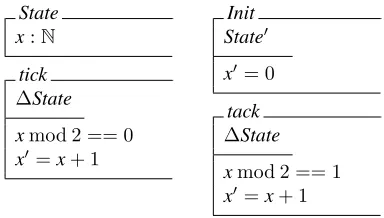
A Z specification is represented as a triple containing a state, an initialisation and a set of operations; that is, (State,Init,Ops). The following specification describes a simple clock, whose state contains a natural number as internal counter (x:N). The initialisation assigns0to the next value of the state variable (x= 0).
State x:N
tick
ΔState
xmod 2 == 0
x=x+ 1
Init State
x= 0
tack
ΔState
xmod 2 == 1
x=x+ 1
Regarding operations, the simple clock presents two schemas:tickandtack. Both of them can change the state (ΔState) by incrementing the state variable (x=x+ 1). However, they are enabled for different range of values: while tickis enabled for even numbers (xmod 2 = 0),
tackis enabled for odd ones (xmod 2 = 1).
Note that, while the above Z specification describes state change, the CSP description (represented by Fig-ure 1) establishes a random execution oftick’s andtacks’s without considering any state information. In the next section we show how to integrate these complementary features and associate behaviour with state manipulation.
2.3. INTEGRATINGCSPANDZ
The orthogonal and complementary characteristics of CSP and Z were the motivation for integrating them in a framework for describing behavioural and data aspects simultaneously. In this sense, CSPZ reuses as much as possible the existing syntaxes and semantics to provide a more expressive language. We first present the syntactic integration of CSP and Z before giving an informal view of its operational semantics.
spec/end spec, which are used to limit the scope of the process;ProcessNameis the name of the process.
Global data types
specProcessName CSP part - Interface
CSP part - Behavioural description Z part
end specProcessName
Figure 2. Structure of aCSPZspecification
In the CSP part, the Interfacecontains channel dec-larations; they define all events the process can perform. The behavioural description contains process definitions; they are used to define the control flow of the entire pro-cess starting in amainprocess equation.
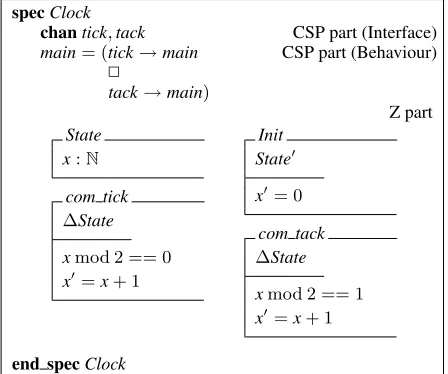
The data part is a Z specification that works conjointly with the CSP part. ACSPZspecification is basically the union of a behavioural description with a data one. For example, the specification of Figure 3 describes the sim-ple clock with control flow and state information together.
specClock
chantick,tack CSP part (Interface) main= (tick→main CSP part (Behaviour)
2
tack→main)
Z part State
x:N
com tick ΔState
xmod 2 == 0 x=x+ 1
Init State
x= 0
com tack ΔState
xmod 2 == 1 x=x+ 1
end specClock
Figure 3.CSPZspecification of an infinite clock
Note that the names of the Z operations were changed by adding the prefixcom . This associates a Z schema with a CSP channel in order to synchronise events with schema executions. Thus, the CSP part performs an event if, and only if, the Z part executes the associated oper-ation. This allows the Z part to affect the behaviour of the CSP one (and vice-versa): invalid preconditions cause event refusal (the blocking view ofCSPZ [9]). Note that this is different of the pure Z semantics and originates an LTS affected by control flow and state information to-gether (Figure 4). TheInitschema yields the initial state
while the CSP part performs an internal action (τ). Tran-sitions are labelled with an event and the execution of the corresponding schema is implicit. The state (possibly) changes after each transition according to the associated operation schema.
1
2
0
tick tack tick...
τ
com_tick com_tack com_tick Init
Figure 4. LTS of theCSPZprocessClock
2.4. CSPZMODELCHECKING
The simultaneous and synchronised execution of the behavioural and the data parts of a CSPZ specification has been the key point for the development of a model checking strategy [17]: the CSP and the Z parts are trans-lated into pure CSP processes (PCSPandPZ, respectively) that synchronise on all events from theInterface, as for-malised by Equation 1.
PCSPZ(State) =PCSP αP||
CSPZ PZ(State) (1) The component processes have the same alphabet as
PCSPZ; that is,αPCSPZ =αPCSP=αPZ. Therefore,PCSP andPZare in full synchronisation wherePZ(State)is re-sponsible only for state manipulation and has the normal form given by Definition 2.1.
Definition 2.1 Let PZ(State)be the process representing
the Z specification(State,Init,Ops). Thenormal formof PZ(State)is given by
PZ(State) =2com ev∈Ops•
precom ev&ev→PZ(com ev(State)) ♦
The processPZ(State)is defined by a recursion whose body is an external choice of all operations (2com ev∈Ops). As long as a guard precom evis valid,PZperformsev(in synchronisation withPCSP) and recurses using an updated state (com ev(State)).
Once aCSPZspecification is represented as a process, its analysis can be carried out using any CSP model. The standard modelFDis adopted in this work.
2.5. CSPZDATAABSTRACTION
Data abstraction [8, 16, 18, 21] is a powerful state-space compression technique, suitable for systems that manipulate data. It allows one to calculate simpler mod-els that preserve desirable properties and are analysable via model checking.
The underlying theory of data abstraction isabstract interpretation [6]. It is a general framework for estab-lishing correspondence between semantics. In this theory, elements of a concrete domain have an abstract meaning given byabstraction relations, such that values and op-erations over concrete domains are interpreted as values and operations over abstract ones. The theory allows one to find an approximation (safeoroptimal) for a given con-crete semantics (value, operation, etc.). They are simpler models that keep information about the actual (concrete) semantics. Safe abstractions preserve some properties, whereas optimal abstractions preserve all properties.
In CSPZ, abstract interpretation has been used to de-termine the minimum values of the state variables that preserve the behaviour of the entire process. For example, recall the processClockfrom Figure 3. There is an essen-tial information that affects the occurrence oftickortack:
xis even or odd. Intuitively, the values 0 and1 would be sufficient to preserve this observable behaviour. The approach proposed in [8, 16] assures this by using model checking and theorem proving; it expands the process and checks if a repeated trace is infinitely allowed by the CSP part via model checking, and by the Z part via theorem proving. For example, the tracetick,tackis allowed by the CSP part because it performs any sequence oftick’s andtack’s. In the Z part, the execution of the correspond-ing schema compositioncomp= com ticko
9com tack
en-ables the composition again (infinitely), as captured by thestabilitytheorem (Equation 2).
∀State; State|precomp∧comp•(precomp) (2)
If Equation 2 is valid, the future states can be repre-sented by the previous ones (an equivalence relation). For example, in the process Clock, the natural numbers are partitioned according to
Etick={n:N|nmod 2 = 0•n→n+ 2}∗
Etack ={n:N|nmod 2 = 1•n→n+ 2}∗
where∗means the reflexive closure operator of relations. The equivalence classesEtickandEtackare used to de-fine the abstraction functionh:N→ {0,1}as follows.
h(x) =
0, 0Etickx 1, 1Etackx
The function h is used to abstract the types of the variables, the constants and the post-conditions of
schemas; concrete preconditions are reused by the ab-stract schemas. The application ofhto the processClock
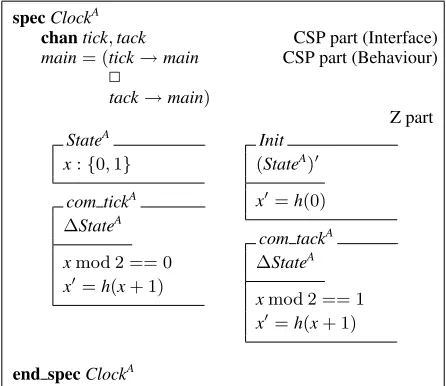
originates the abstract specification of Figure 5. Note that the abstract domain is given by the range ofh; the orig-inal preconditions are preserved; and the abstract post-conditions are obtained by simply applyinghto the ex-pressions assigned to the state variable. Thus,h(0)and
h(x+ 1)(wherex ∈ {0,1}) do not yield values outside
{0,1}. This means that the abstract domain is closed un-der initialisation and unun-der the operation+1.
specClockA
chantick,tack CSP part (Interface) main= (tick→main CSP part (Behaviour)
2
tack→main)
Z part StateA
x:{0,1}
com tickA ΔStateA
xmod 2 == 0 x=h(x+ 1)
Init (StateA)
x=h(0)
com tackA ΔStateA
xmod 2 == 1 x=h(x+ 1)
end specClockA
Figure 5. The abstract version ofClock
The LTS representation ofClockA is depicted in Fig-ure 6, where the state explosion caused by the state vari-ablexwas overcome. If this same variable were involved in communications, the approach of [8, 16] could not be applied. In the next section we show an example that be-longs to this class of problems.
1
0
τ
com tick Init
tick tack com_tack
Figure 6. LTS ofClockA.
2.6. A REALEXAMPLE
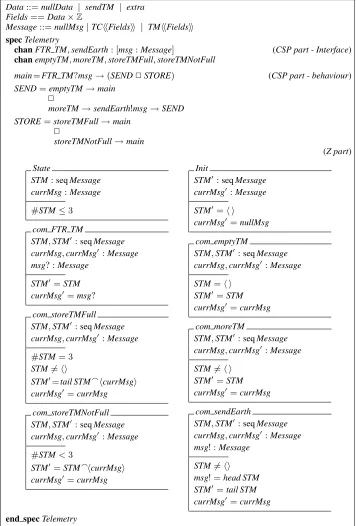
In this section we present a process that describes a module of the on-board computer of a Brazilian artificial microsatellite [16]. Figure 7 shows the specification.
The process uses some global data types. The free-typeMessageis defined in terms of the elementnullMsg
andTM(used for classifying messages as telecommands or telemetries, respectively). BothTCandTMmessages have a parameter Fields that is defined as the cartesian product ofDataand integers (Z). Datais another free-type with three values (nullDatadenoting an empty mes-sage,sendTMstanding for messages that should be sent to the Earth, andextrato represent other kinds of messages). The integer is used for recording the message ordering. Therefore,Messageis an infinite type.
The process Telemetry is responsible for maintain-ing the most recent telemetry data (temperature, voltage, some process status, etc.) and sending them to the Earth.
In the CSP part, the channelFTR TM is used for in-putting the most recent telemetry message captured by the other processes, whereas the channelsendEarthis used to communicate the stored telemetry data to the Earth. The remaining channels do not support data communication.
The behaviour ofTelemetryis established by itsmain
equation: it first accepts an input value on FTR TM
(FTR TM?msg) and sends data from the satellite to the Earth (SEND) or stores the new message (STORE). Send-ing data depends on whether an internal buffer is empty or not. If it is empty, the process performs emptyTM
and behaves likemain; otherwise, the process performs
moreTM, sends a stored data to the Earth (sendEarth!msg) and behaves likeSENDagain.
Storing a new message also depends on the buffer sta-tus: if it is full, the process performsstoreTMFull; other-wise it performsstoreTMNotFull.
Concerning the data part, the state ofTelemetry con-tains a variable (currMsg) that keeps a new message and a finite buffer of messages (represented by the sequence
STM : seqMessage), whose size is limited by an invari-ant (#STM ≤ 3). The initialisation assigns nullMsgto
currMsgand the empty sequence to the componentSTM. The operations com emptyTM andcom moreTM do not change the state; they use their preconditions to sim-ply check whetherSTMis empty or not, respectively.
To make our decomposition strategy clear later on, we declare the components explicitly instead of using the Z conventionsΔStateandΞStateas state change and preservation, respectively.
The remaining operations possibly yield state change. In com FTR TM, the state change is due to the input of a new message (currMsg = msg?). When the in-ternal buffer is full (#STM= 3), com storeTMFull dis-cards the oldest message and stores the newest one in the last position (STM=tail STMcurrMsg). Otherwise (#STM < 3),com storeTMNotFull simply appends the storage withcurrMsg(STM =STMcurrMsg).
As long as the storage is not empty (STM =), the operationcom sendEarthsends the oldest message to the Earth (msg! =head STM) and discards it from the storage
(STM=tail STM) .
The operations com FTR TM and com sendEarth
present an input and output, respectively. In the latter operation, the output assumes the value of a stored mes-sage. On the other hand, in com FTR TM, the input
msg? : Messageis not specified and can be any value of type Message. This naturally originates state explo-sion that cannot be handled by any existing approach for
CSPZ, including [8, 16]. Fortunately, as the behaviour of
Telemetryis not affected by the typeMessage, we can de-termine a minimum subset of it that is relevant to capture the behaviour of the system. Thus, data abstraction is still possible even when communications are based on infinite domains. In the next section we present an approach for handling such a class of problems.
3. D
ATAA
BSTRACTIONB
ASED OND
ATAI
NDEPENDENCEThe theory of data independence [14] is able to ab-stract infinite types based on syntactic properties (tions); it can be used in any context where these restric-tions are related to the type being abstracted. We have observed that, for some systems, variables with infinite types can be isolated, even when they participate in com-munications. This has been the key point of our approach: using syntactic restrictions to achieve a separation of con-cerns and applying complementary techniques to abstract infinite types. In this sense, our approach uses decompo-sition and compodecompo-sitional reasoning in the context of data abstraction.
The decomposition uses the data independence crite-ria (reproduced in Definition 3.1) to originate an internal
partitionof the Z part. This allows one to isolate the in-finiteness problem occurring in variables (state and com-munication), in such a way that data independence can be used to abstract their domains. The remaining variables are analysed according to our data abstraction approach.
Definition 3.1 A system P is data independent with re-spect to a data type X if, and only if:
(1) it must not contain constants, only input/output vari-ables of type X;
(2) it may contain only equality tests and polymorphic operations involving type X;
(3) it may contain more complex operations, as long as they are defined in terms of equality tests and poly-morphic operations;
(4) no replicated constructs (such as indexed paral-lelism) over the data type may appear, other than
Data::=nullData | sendTM | extra Fields==Data×Z
Message::=nullMsg|TCFields | TMFields specTelemetry
chanFTR TM,sendEarth: [msg:Message] (CSP part - Interface) chanemptyTM,moreTM,storeTMFull,storeTMNotFull
main=FTR TM?msg→(SEND2STORE) (CSP part - behaviour) SEND=emptyTM→main
2
moreTM→sendEarth!msg→SEND STORE=storeTMFull→main
2
storeTMNotFull→main
(Z part)
State
STM:seqMessage currMsg:Message
#STM≤3
com FTR TM
STM,STM:seqMessage currMsg,currMsg:Message msg? :Message
STM=STM currMsg=msg?
com storeTMFull STM,STM:seqMessage currMsg,currMsg:Message
#STM= 3 STM=
STM=tail STMcurrMsg currMsg=currMsg
com storeTMNotFull STM,STM:seqMessage currMsg,currMsg:Message
#STM<3
STM=STMcurrMsg currMsg=currMsg
Init
STM:seqMessage currMsg:Message
STM=
currMsg=nullMsg
com emptyTM
STM,STM:seqMessage currMsg,currMsg:Message
STM= STM=STM currMsg=currMsg
com moreTM
STM,STM:seqMessage currMsg,currMsg:Message
STM= STM=STM currMsg=currMsg
com sendEarth
STM,STM:seqMessage currMsg,currMsg:Message msg! :Message
STM= msg! =head STM STM=tail STM currMsg=currMsg
end specTelemetry
Figure 7. The processTelemetry
The items of Definition 3.1 define degrees of indepen-dence of a processPwith respect to a data typeX. Based on these items, it is possible to calculate the minimum cardinality ofX to preserveP’s behaviour: thethreshold
ofPwith respect toXortld(P,X), for short. For instance, ifPsatisfies(1)thentld(P,X) = 1. Thus, the typeXmust
re-lated to the communication (input/output) variables. Actually, data independence does not distinguish state from communication variables. Concerning the latter, there is preservation of behaviour, but communications (with concrete values) involving the process and its en-vironment are lost when restricting the cardinality of the domain. Therefore, our approach is only applicable to a
CSPZsystem, as long as its communicated values do not affect the other CSPZ components it interacts with (so-called closed systems). Furthermore, the reduction of the communicated values (of typeX) of a process is achieved by applying a renaming of events that reduces the data communicated byPto a set whose cardinality is greater than or equal totld(P,X). In this case, the renaming pre-serves P’s behaviour (Lemma 3.1). For example, letPbe a process that performsch.x(x∈ N) andtld(P,N) = 1. Suppose that, by data independence analysis, we restrict Nto the set{0}. Thus,ch.xis replaced withch.0andP’s behaviour is preserved because#{0} ≥tld(P,N).
Lemma 3.1 Let P be a CSP process. Let c be a channel of P with type Tcand R : A → B a renaming function,
such that A ={c.v ∈αP}and B={c.v ∈Σ}. If P is data independent with respect to Tcand#ran({c}R)≥
tld(P,Tc), then applying RpreservesP’s behaviour. ♦
Lemma 3.1 follows directly from data indepen-dence [14] and extends the idea of preservation of be-haviour considering all channels of a process; Σ repre-sents the set of all events a process can perform, andis an extended version of the domain restriction operator of Z [22], used for filtering relations. The type of a channel
chis denoted byTch. As events have the formchorch.v, we useto filter the events occurring in a channel. Thus, :PΣ×(Σ↔Σ) →(Σ↔Σ)such that
AS={(x,y)|x∈A∧((x,y)∈S∨∃v:Tx•(x.v,y)∈S)}
For example, letS ={(a.1,b),(a.2,c),(e,f),(c,f)}. Then,{a}S={(a.1,b),(a.2,c)}and{c}S={(c,f)}. Note that, if no values are communicated by channel
c, Rbecomes the identity map and, hence, P = P[[R]]. Moreover, when specific (or data dependent) operations of the type being abstracted are used, data independence is not applicable. However, we can still isolate the data independent aspects to apply a complementary technique to deal with the data dependent aspects separately. This is achieved by using Definition 3.1 to factor out the Z part, originating a partition of it.
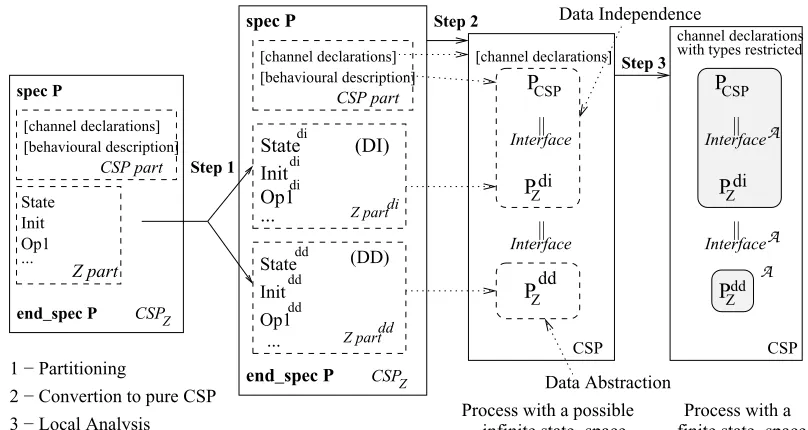
Figure 8 illustrates the steps of the complete strat-egy. Step 1 splits the Z part of aCSPZ process, origi-nating two internal subparts: one data independent (DI) and another data dependent (DD). Then, Step 2 trans-lates all structures (CSP part, DI and DD subparts) into CSP processes according to the strategy proposed in [17].
This originates a compound process that can still have an infinite state-space. To overcome this problem, Step 3 applies data independence to the parallelism of the CSP part and the DI component, and data abstraction to the DD component. The latter task gives an abstract process (Pdd
Z A
) that is combined with the data independent part (PCSP ||
InterfaceA P
di
Z) to produce the abstraction for the en-tire process, considering a new and finite synchronisation interface (InterfaceA).
To split the data part we introduce some definitions.
Definition 3.2 A Z specification isDIif it is data inde-pendent with respect to the types of its variables (state
and communication). ♦
Note that a DI specification is classified according to Definition 3.1 and, therefore, can be data abstracted by data independence. The other category of specifications (Definition 3.3) is also used when values of the type being abstracted occur in data dependent operations.
Definition 3.3 A Z specification isDDif it is not DI and has no infinite inputs (communicated to the environment)
in data dependent operations. ♦
Note that Definitions 3.2 and 3.3 are almost comple-mentary. Actually, Definition 3.3 is complementary to Definition 3.2 with an extra restriction: infinite inputs are not allowed. This is necessary because our data ab-straction strategy is able to deal only with finite data de-pendent communications. The essential advantage of us-ing Definitions 3.2 and 3.3 is to provide a partition of a Z specification, where infinite communications are data independent. Thus, if a Z specification can be decom-posed into two specifications such that Definitions 3.2 and 3.3 are satisfied by each resulting specification sepa-rately, asimple bi-partitionis originated (Definition 3.4). We assume that a schemaschbelongs to the specification (State,Init,Ops)if it is the state, the initialisation or one of the operations (sch ∈ ({State} ∪ {Init} ∪Ops)), and that two schemas aredisjointif they do not have variables in common.
Definition 3.4 Let Zspec = (State,Init,Ops), Zspecdi = (Statedi,Initdi,Opsdi)and Zdd
sp = (Statedd,Initdd,Opsdd)
be Z specifications. If Zspecdi is DI, Zspecdd is DD and for all schema sch∈Zspecthere are two corresponding and
dis-joint schemas schdi ∈ Zdi
spec and schdd ∈ Zspecdd such that,
sch=schdi ∧schdd, then Zdi
spec and Zspecdd form a simple
bi-partitionof Zspec. ♦
Statedd Initdd Op1dd
CSPZ
Z partdd
Statedi Initdi Op1di
Z partdi
...
(DI)
CSPZ Z part Op1
Init State
...
end_spec P spec P
[channel declarations]
CSP part
[behavioural description]
channel declarations with types restricted
Z
P
diCSP
P
|| Interface
|| Interface
CSP
P
|| Interface
Z
P
diZ
P
dd|| Interface (DD)
... spec P
end_spec P CSP part
[behavioural description] [channel declarations]
Step 1
1 − Partitioning
2 − Convertion to pure CSP
3 − Local Analysis finite state−spaceProcess with a
Step 3
Data Independence
Data Abstraction Process with a possible
infinite state−space
Step 2
CSP
Z
P
dd AA A
CSP
[channel declarations]
Figure 8. Overview of the strategy
Z specifications: executing an operation is similar to si-multaneously executing (parallelism) its DI and DD com-ponents. We also use this idea when applying data ab-straction: each component is analysed separately and the results are combined to yield a solution for the entire specification. Thus, before abstracting types, we convert each component into a process and capture the entire be-haviour by the parallelism of such processes, considering all events from theInterface. This follows the same idea as that presented in [18], where parallelism captures con-junction of specifications. The correspondence between the original and the compound CSP representation of a Z specification is formalised by Theorem 3.1.
Theorem 3.1 Let Zspec = (State,Init,Ops), Zspecdi = (Statedi,Initdi,Opsdi)and Zdd
spec = (Statedd,Initdd,Opsdd)
be Z specifications such that Zdi
specand Zddspecform a simple
bi-partition of Zspec. Let PZ,PdiZ and PddZ be CSP processes
capturing the behaviours of Zspec, Zspecdi and Zspecdd ,
respec-tively. Then,
PZ(State) =PdiZ(Statedi)α||P
Z Pdd
Z(Statedd) ♦
Using Theorem 3.1 in Equation 1, and the associativ-ity of the parallel operator [18], we obtain
PCSPZ(State) = (PCSPα||P ZP
di
Z(Statedi))α||PZPddZ (Statedd) (3)
Note that Equation 3 separates a CSPZ process into two component processes: one data indepen-dent (PCSP ||I PdiZ(Statedi)) and another data dependent
(Pdd
Z (State)). This allows the application of data indepen-dence to the first component and data abstraction to the second one [16]. The results of this separated analysis can be compositionally combined to yield the abstraction for the entire process. Of course, because communicated data are abstracted, we must consider a more restricted set of events performed by the abstract process (an ab-stract interface); it is calculated by applying a special renaming (interface abstraction) to the concrete events. As events are associated to channels, we use a renaming function (rev) for each typed channelevto map events in-volving values from an infinite domain (the type of the channel) to values from a finite one (the abstract type); if the channel is non-typed, the corresponding renam-ing is the identity over its name. For example, suppose that Nis the type of evandhev : N →→ {0}, where→→ stands for total surjections, is given byhev(x) = 0. Then,
rev={x:N•ev.x→ev.hev(x)}.
The union of all renaming functions of a process orig-inates a renaming for the entire interface, as captured by the following definition.
Definition 3.5 Let PZbe the process representation of a
Z specification. Let chs be the channels of PZ and rev a
renaming function for the channel ev (ev ∈ chs). The interface abstractionof PZis given by
R=ev∈chsrev ♦
abstract version of aCSPZ process, expressed as a par-allelism of a data independent and a data dependent pro-cesses considering ranRas the abstract interface. This is formalised in [16] and reproduced in Theorem 3.2.
Theorem 3.2 Let PCSPbe a CSPZ process with interface
I. Let Pdiand Pddbe CSP processes such that Pddis data
dependent, Pdiis data independent, and P =Pdi ||I Pdd.
Let PAdd be an optimal abstraction for Pdd with interface
abstraction R. If R preserves Pdi’s behaviour, then
PACSPZ =Pdi ran||R PAdd ♦
According to Theorem 3.2 the abstract version of Equation 3 (obtained by Step3of Figure 8) is given by
PACSPZ(State)=(PCSPran||RPdiZ(Statedi))ran||RPddZ A
(Statedd) (4)
It is worth pointing out that the partitioning strategy focuses on originating components whose schemas are disjoint (they do not have variables in common). Never-theless, this is not true in general. In the next section we show how to deal with this for a specific (but significant) class of problems.
3.1. EXTENDING THEPARTITIONINGSTRATEGY
In the ideal scenario, the components originated by the partitioning strategy are disjoint and valid (all expres-sions in the predicate part of each schema refer to vari-ables occurring in the declaration part). Nevertheless, this is not true in general. If there exist at least one schema whose components are non-disjoint, our data abstraction approach cannot be applied. On the other hand, if an ex-pression of a component refers to a variable of the other (disjoint) component, we can still abstract domains, as long as the expression is data independent with respect to the type of the variable. Furthermore, we have to check, at the end, if the abstract domain respects the minimum cardinality required by the expression.
To validate two disjoint component schemas, we need to adjust them by adding a new declaration and applying a syntactic substitution. For example, consider the fol-lowing state schemas Statedi andStatedd (inv
y is a data dependent invariant overy), and the operation schemaop, which contains a data dependent predicatepywith respect to the typeTy.
Statedi
x:Tx
Statedd y:Ty
invy
op x:Tx
y:Ty
x=y py
When partitioningop, the predicatepy is placed into the data dependent component (opdd) and the predicate
x=yis placed intoopdi.
opdi
x:Tx
x=y
opdd
y:Ty
py
Note thatopdiis not a valid schema becauseyhas not been declared. To fix this problem we introduce a new input variable (in? : Statedd) in the declaration partopdi and replace all occurrences ofyin the predicate part with
in?.y; this is achieved through the syntactic substitution [in?.y/y]. Dually, the schema opdd also receives Statedi as an input parameter that is not used in the predicate part. This is similar to the idea adopted in [3], where new events between decomposed operations are created to solve dependencies and to maintain the original seman-tics (action refinement). In this work we just exchange the states between the component operations. Thus,opdiand
opddbecome
opdi
x:Tx
in? :Statedd
x=in?.y
opdd
y:Ty
in? :Statedi
py
We also point out that this technique is possible be-causex=yis a data independent expression with respect toTy. Therefore, the values ofycan be abstracted and must respect the minimum cardinality required byx=y. On the other hand, if an expression of a component is data dependent with respect to the type of the variable placed in the other partition, this adjustment cannot be applied. This is pointed as a topic for future work in Section 6.
To make the CSP representation of the Z part uniform, we consider the extended normal form given in Defini-tion 3.6. It is obtained by substituting PZ withPZext in Definition 2.1 and by adding a new event before offering all enabled events.
Definition 3.6 Let PZ(State) be the process
repre-senting the Z specification (State,Init,Ops). Let
(Statedi,Initdi,Opsdi) and (Statedd,Initdd,Opsdd) be
Z specifications that form a simple bi-partition of
(State,Init,Ops). The extended normal form of PZ(State)is given by,
PZext(State) =communicate.State
di.Statedd →
PZ(State)[PZext/PZ] ♦
Theorem 3.3 Let Zspec = (State,Init,Ops), Zspecdi = (Statedi,Initdi,Opsdi)and Zdd
spec = (Statedd,Initdd,Opsdd)
be Z specifications such that Zdi
specand Zspecdd form a
sim-ple bi-partition of Zspec. Let PZext,P
di Zext and P
dd
Zext be CSP processes in the extended normal form capturing the be-haviour of Zspec, Zspecdi and Zddspec, respectively. Then,
PZext(State) =P
di Zext(State
di) || αPZext P
dd Zext(State
dd) ♦
In Theorem 3.3,Pdi Zext(State
di)andPdd Zext(State
dd)are re-spectively given by
communicate!Statedi?sdd→2ev∈chs• pre com evdi&ev→Pdi
Zext(com ev
di(Statedi,sdd))
and
communicate?sdi!Statedd→2 ev∈chs• pre com evdd&ev→Pdd
Zext(com op
dd(sdi,Statedd))
The way communicate.Statedi.Statedd is used inPdiZext
allows the process to output its state (!Statedi) and input the state of the data dependent component (?sdd). Dually, it also allowsPdd
Zextto input the state of the data indepen-dent component (?sdi) and output its state (!Statedd). Al-though an operationcom evhas two disjoint states as pa-rameters, it yields a new state for its corresponding com-ponent. Furthermore, as the events occurring on channel
communicateare limited to the scope of Pdi ZextαP||
Zext Pdd
Zext, they can be hidden. Therefore, Theorem 3.1 is still valid when considering the extended normal form (no internal actions, failures or divergences are originated). That is, there is a correspondence betweenPZext\{|communicate|} andPZ(Theorem 3.4).
Theorem 3.4 Let PZext and PZ be CSP process represen-tations for the Z specification(State,Init,Ops)such that PZis in the normal form and PZextis in the extended nor-mal form. Then,
PZext\{|communicate|}=PZ ♦
In the next section we show the application of the splitting strategy to the processTelemetry.
3.2. THESPLITTING OFTELEMETRY
Considering the schemaStateof the processTelemetry
(Figure 7), we analyse two declarations. As the invariant involves the variableSTMin a data dependent operation, we placecurrMsgintoStatediandSTMintoStatedd.
Statedi
currMsg:Message
Statedd
STM:seqMessage
#STM≤3
Regarding the initialisation, we expandStateand ob-serve that the predicate of the invariant involves STM. Therefore, the initialisation splitting yields
Initdi
currMsg:Message
currMsg=nullMsg
Initdd
STM:seqMessage
STM= #STM≤3
Concerning operations, com emptyTM is split into two schemas (com emptyTMdiandcom emptyTMdd) that do not change their respective states. The variablein?is not used by thecom emptyTMdibecause they are disjoint and do not access variables placed in com emptyTMdd (and vice-versa).
com emptyTMdi currMsg:Message currMsg:Message in? :Statedd
currMsg=currMsg
com emptyTMdd STM:seqMessage STM:seqMessage in? :Statedi
STM= STM=STM #STM≤3 #STM≤3
Incom FTR TMthe declarationscurrMsg:Message,
currMsg : Messageandmsg? : Messageand the pred-icatecurrMsg = msg?are placed intocom FTR TMdi, whereas the remaining declarations and predicates be-long tocom FTR TMdd. This means that onlyStatediis changed by the inputmsg?.
com FTR TMdi currMsg:Message currMsg:Message msg? :Message in? :Statedd
currMsg=msg?
com FTR TMdd STM:seqMessage STM:seqMessage in? :Statedi
STM=STM #STM≤3 #STM≤3
The splitting of the operationcom sendEarthyields
com sendEarthdi currMsg:Message currMsg:Message msg! :Message in? :Statedd
msg! =head STM currMsg=currMsg
com sendEarthdd STM:seqMessage STM:seqMessage in? :Statedi
Note that com sendEarthdi andcom sendEarthdd are disjoint but the former is not valid because it uses a vari-able (STM) declared in the latter. To fix this, we re-place all occurrences ofSTM in the predicate part with
in?.STM. This is possible becausehead STMis a poly-morphic (data independent) operation. Thus,
com sendEarthdi currMsg:Message currMsg:Message msg! :Message in? :Statedd
msg! =head in?.Statedd currMsg=currMsg
com sendEarthdd
STM:seqMessage STM:seqMessage in? :Statedi
STM=
#STM≤3 #STM≤3
STM=tail STM
The splitting of com storeTMFull and
com storeTMNotFullalso needs this adjustment.
com storeTMFulldi currMsg:Message currMsg:Message in? :Statedd
currMsg=currMsg
com storeTMFulldd STM:seqMessage STM:seqMessage in? :Statedi
#STM= 3 STM=
STM=tail STMin?.currMsg
com storeTMNotFulldi currMsg:Message currMsg:Message in? :Statedd
currMsg=currMsg
com storeTMNotFulldd STM:seqMessage STM:seqMessage in? :Statedi
#STM<3
STM=STMin?.currMsg
After partitioning the processTelemetry, we translated the components to CSP, using the extended normal form (Definition 3.6) for the Z part. Then we represented the entire process according to Equation 3.
The analysis of PCSP||I PdiZ(Statedi)by data
indepen-dence revealed thattld(PCSP||I PZdi(Statedi),Message)=1.
The application of data abstraction to Pdd
Z (Statedd) pro-ducedMessageA={nullMsg}as abstract domain, the ab-stract processPdd
Z A
and the interface abstraction given by
R={emptyTM →emptyTM,moreTM→moreTM}∪ {storeTMFull→storeTMFull}∪
{storeTMNotFull→storeTMNotFull}∪ {x:Message•sendEarth.x→sendEarth.h(x)}∪
{x:Message•FTR TM.x→FTR TM.h(x)} where the abstraction functionh:Message→MessageA
(also calculated by the approach) is given by
h(m) =nullMsg
Because Message is communicated on channel
FTR TMand#({FTR TM} −R})≥1,Rpreserves the behaviour ofPCSP ||
I P di
Z(Statedi). The abstract version of
Telemetryis then given by
PACSPZ(State) =PCSP ran||RPdiZ(Statedi)ran||R PddZ(Statedd)A
where the types of the channelsFTR TMandsendEarth
were changed fromMessagetoMessageA.
The abstract version of the components of
com FTR TMare given by
com FTR TMdiA currMsg:MessageA currMsg:MessageA msg? :MessageA in? :Statedd A
currMsg=h(msg?)
com FTR TMdd A STM:seqMessageA STM:seqMessageA in? :StatediA
STM=STM #STM≤3 #STM≤3
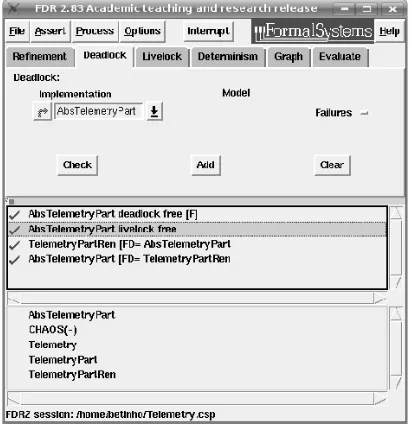
We have verified safety and liveness properties of
Telemetry using FDR [10] (see Figure 9). The Teleme-try partitioned and renamed is the process
TelemetryPartRen=
((main ||
InterfaceP di
Z(Statedi))Interface|| PddZ(Statedd))[[R]]
And the abstract Telemetry partitioned is given by
AbsTelemetryPart= (main ||
ranR P di
Z(StatediA)) ran||R PddZ A
(Statedd A)
Both processes were deadlock-free, livelock-free and equivalent inFD.
To provide a mechanisation of the partitioning strat-egy, we propose an algorithm that originates a simple bi-partition of the Z part of aCSPZspecification.
4. A P
ARTITIONINGA
LGORITHMThe partitioning strategy presented in the previous section is systematic and syntactic-based. In this section we describe it algorithmically.
We use some auxiliary functions. The most impor-tant function determines if a given expression is data in-dependent with respect to a given type. The function
Figure 9. Analysis of Telemetry in FDR
of syntactic analysis of expressions, as proposed in the lit-erature of compilers [1]. However, such a representation would require a detailed description of all kinds of ex-pressions that are allowed (a subset of the Z grammar). In this work we use a natural language style for conciseness. We assume that schemas are normalised [22]; that is, declarations have the formv:Tvwherevis a variable of typeTv, and all constraint information (including the in-variant) appears in the predicate part, which must be in the conjunctive normal form. This is necessary because the declaration and the predicate parts are split, originating schemas whose conjunction must be equal to the original one (Definition 3.4). This is established by the semantics of the schema conjunction [22], where declarations are merged and predicates are combined by conjunction.
For a given normalised schema sch = [ D | P], the functions decl(sch) and pred(sch) give the declaration (D) and the predicate (P) parts ofsch, respectively, as sets. The elements ofdecl(sch)have the formv:Tvand each element of pred(sch) is any kind of expression allowed in the predicate part. Thus,pred(sch)contains all con-juncts (propositional components of a conjunction) of the predicate part. For example,
Op x1:Tx
x1:Tx
x2:Tx
z:Tz
x1<x2∧x1>z x1=x1
decl(Op) ={x1:Tx,x1:Tx,
x2:Tx,z:Tz}
pred(Op) ={x1<x2, x1>z, x1=x1}
New declarations and predicates are inserted into
decl(Op)andpred(Op)by using set inclusion. For exam-ple,decl(Op)←decl(Op)∪ {d}means the declarationd
is included intodecl(Op).
The function include(Figure 11) includes a schema
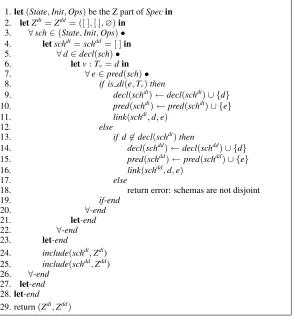
sch into a Z specification (State,Init,Ops). The state schema (sch=State) is placed into the first component, the initialisation (sch=Init) is placed into the second one, and operations are included intoOps. We use the func-tionsfst,sndandtrdto capture the first, the second and the third components of a Z specification, respectively. Thus,
fst(Zspec) =State,snd(Zspec) =Initandtrd(Zspec) =Ops. The algorithm is presented in Figure 12 and starts by considering only the Z part of the given specifica-tion (line 1). Initially, the partispecifica-tions Zdi and Zdd (line 2) are empty (without state, initialisation and operations) and each original schemasch(line 3) is analysed subse-quently. For each analysed schema, the corresponding data independent (schdi) and data dependent (schdd) com-ponents are initialised as empty schemas (line 4). Then the declarations of the current schema are analysed (line 5). The type of the declared variable (Tv) is taken (line 6) and used to classify all expressions of the predicate part (line 7). We point out that there may be many ex-pressions in the predicate part for a same declared vari-able. Because we analyse expressions separately, it may originate non-disjoint schemas (the same declaration is placed into different components). Thus, if the analysed expression is data independent with respect to Tv (line 8), both the declaration and the expression are placed into schdi (lines 9 and 10). If the analysed expression is data dependent with respect toTv, we check (line 13) if the schemas are disjoint (that is, if the declaration has not already been placed into schdi). If so, the declara-tion and the expression are placed into the data depen-dent schema schdd (lines 14 and 15). Otherwise, schdi andschddare non-disjoint and the algorithm returns an er-ror (line 18). Independently ofschdiandschdd being dis-joint or not, the algorithm solves the dependence between variables and expressions placed into different schemas (lines 11 and 16) by calling the functionlink(Figure 13), which is defined in a pattern matching style and uses the functionvars : Exp → PVarNameto obtain the set of all variables occurring in an expression. For example,
vars(x =x+y?∗100) ={x,x,y?}.
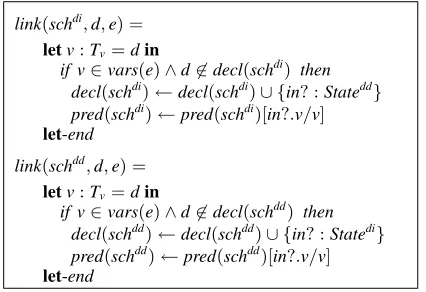
The functionlink receives a schema (schdi or schdd), a declaration (d) and an expression (e). If the declared variable is referred byeand has not been declared in the schema, a new declaration (in? :Statedd orin? :Statedi) is inserted and the substitution[in?.v/v]is applied to the predicate part.
is di(e,T) =
⎧ ⎪ ⎪ ⎪ ⎪ ⎪ ⎪ ⎪ ⎨ ⎪ ⎪ ⎪ ⎪ ⎪ ⎪ ⎪ ⎩
true, e does not present constants of type T and e can present only input/output variables of
type T or
e is an equality test or a polymorphic operation over type T or
e is defined in terms of equality tests and polymorphic operations over type T false, otherwise
Figure 10. The functionis di
include(sch,Zspec) =
if sch=State then
Zspec←(sch,snd(Zspec),trd(Zspec)) else if sch=Init then
Zspec←(fst(Zspec),sch,trd(Zspec)) else
Zspec←(fst(Zspec),snd(Zspec),trd(Zspec)∪ {sch})
Figure 11. The functioninclude
input: aCSPZspecificationSpec
output: a simple bi-partition (ZdiandZdd) of the Z part ofSpecor an error if the Z part does not satisfy Definition 3.4
1.let(State,Init,Ops)be the Z part ofSpecin 2. letZdi=Zdd= ([ ],[ ],∅)in
3. ∀sch∈(State,Init,Ops)• 4. letschdi=schdd= [ ]in 5. ∀d∈decl(sch)•
6. letv:Tv=din
7. ∀e∈pred(sch)• 8. if is di(e,Tv)then
9. decl(schdi)←decl(schdi)∪ {d} 10. pred(schdi)←pred(schdi)∪ {e} 11. link(schdi,d,e)
12. else
13. if d∈decl(schdi)then
14. decl(schdd)←decl(schdd)∪ {d} 15. pred(schdd)←pred(schdd)∪ {e} 16. link(schdd,d,e)
17. else
18. return error: schemas are not disjoint
19. if-end
20. ∀-end
21. let-end
22. ∀-end
23. let-end
24. include(schdi,Zdi) 25. include(schdd,Zdd) 26. ∀-end
27. let-end 28.let-end 29. return(Zdi,Zdd)