R E S E A R C H A R T I C L E
Open Access
Bone grafts utilized in dentistry: an analysis
of patients' preferences
Ramón Fuentes Fernández
1*, Cristina Bucchi
1, Pablo Navarro
2, Víctor Beltrán
1and Eduardo Borie
1,3Abstract
Background:Many procedures currently require the use of bone grafts to replace or recover bone volume that has
been resorbed. However, the patient’s opinion and preferences must be taken into account before implementing any treatment. Researchers have focused primarily on assessing the effectiveness of bone grafts rather than on patients' perceptions. Thus, the aim of this study was to explore patients' opinions regarding the different types of bone grafts used in dental treatments.
Methods:One hundred patients were randomly chosen participated in the study. A standardized survey of 10
questions was used to investigate their opinions regarding the different types of bone grafts used in dental treatments. Descriptive statistics were calculated for the different variables, and absolute frequencies and percentages were used as summary measures. A value of p <0.05 was selected as the threshold for statistical significance.
Results:The highest rate of refusal was observed for allografts and xenografts. The grafts with the lowest rates of refusal were autologous grafts (3 %) and alloplastics (2 %). No significant differences were found between the various types of bone grafts in the sociodemographic variables or the refusal/acceptance variable. Similarly, no significant relations were observed between a specific religious affiliation and the acceptance/refusal rates of the various types of graft.
Conclusions:Allografts and xenografts elicited the highest refusal rates among the surveyed patients, and autologous bone and alloplastics were the most accepted bone grafts. Moreover, no differences were found in the sociodemographic variables or religious affiliations in terms of the acceptance/refusal rates of the different bone grafts.
Keywords:Dentistry, Bone grafts, Dental health surveys, Patient preference
Background
Currently, many procedures require the use of bone grafts to replace or recover bone volume that has been resorbed due to systemic pathologies [1], periodontal de-fects [2], tooth loss [3] or other conditions. Advances in modern medicine have led to increases in the availability of new biomaterials that can be used to enhance bone volume recovery. These biomaterials may be obtained from the patient's own body, other humans, animals, or can even be synthetically produced [4]. Despite these advances, little research has been conducted regarding the patients' opinions about the different bone graft
materials available or their willingness to use these bio-materials in their surgeries. The source of the bone graft may be objectionable to the patient due to religious, eth-ical and/or cultural concerns. Some patient perception studies related to medical procedures involving soft-tissue grafts and organ transplants have been conducted [5, 6]; however, in dentistry, such research has primarily focused on assessing the effectiveness of bone grafts ra-ther than on patient perceptions.
The types of bone grafts most frequently used in den-tistry include autologous bone grafts, allografts, xeno-grafts and alloplastics. Autologous bone xeno-grafts come from donor sites in the patient's own body and have osteoconductive and osteoinductive properties. Such au-tologous bone grafts also contain osteogenic cells that * Correspondence:[email protected]
1
Research Centre in Dental Sciences, Dental School, Universidad de La Frontera, Manuel Montt #112, 4781176 Temuco, Chile
Full list of author information is available at the end of the article
help reduce the bone healing time [7, 8]. Allografts are another type of bone graft in which the bone is taken from another donor of the same species, and are typic-ally obtained from human cadavers and subsequently subjected to processing [9, 10]. Xenografts consist of bone tissue taken from a different species and have osteoconductive properties and preserve the original bone mineral structure, which is more complex than that of synthetic materials, i.e., alloplastics [11]. Alloplas-tic bone substitutes may be ceramic, hydroxyapatite, tri-calcium phosphate or tri-calcium sulfate [4].
Most clinicians base their decisions primarily on their experience and areas of expertise and often forget to ask the patient’s opinion or explain the advantages and dis-advantages of the different procedures and any alterna-tive products that may be used [12]. Such omissions result in a transgression of a main ethical principle, i.e., autonomy. Patients have the right to refuse a specific product or treatment if it is against their philosophical or religious principles. Accordingly, it is mandatory that patients participate in decision-making, that the clini-cian’s role should be minor and restricted to presenting the current scientific data about the possible and plaus-ible treatment alternatives [12], and that the clinician should listen to the patient’s questions and opinions be-fore a decision regarding the “best alternative” is made. Many procedures and treatments require patients to provide informed consent. This is a patient's ethical and legal right [13] and requires that clinicians describe to the patient the procedure and the origin and type of ma-terial to be used in the surgery [14]. The patient's refusal to undergo a treatment proposed by the clinician may prevent the treatment from proceeding and may also become an obstacle to a satisfactory clinician-patient relationship. Therefore, the patient's opinion and pref-erences must be taken into account before implement-ing any treatment.
The aim of the present study was to examine patients' opinions regarding the different types of bone grafts used in dental treatments.
Methods
A survey was administered to 100 dental patients who received treatment at the Dental Clinics of the Universidad of La Frontera in Temuco, Chile between January and July 2014. This sample corresponded to approximately 10 % of the patients treated in our clinics in the course of a year. The patients were chosen randomly. The patients were al-located a number from 1 to 10 in the waiting room, and two numbers were randomly selected each day. The pa-tients were also required to meet the established inclusion criteria of the survey. This research was approved by the Scientific Ethics Committee of Universidad of La Frontera
(protocol N. 145/13). The following inclusion criteria were applied:
– adult (18 years of age or older)
– able to read and write
– not under the influence of alcohol or drugs
– had not previously undergone any surgery involving bone graft or bone augmentation
The purpose of the study was briefly explained to the selected patients. Those who agreed to participate in the survey were asked to provide their written free and in-formed consent.
Before the survey was administered, only the origins of the different types of conventional bone grafts were explained to the patients, and their opinions regarding the acceptance or rejection of each type were acquired.
Survey
The survey recorded the following participant demo-graphic data:
– gender
– age
– education level: participants were asked to indicate their education level (yes/no). Yes responses were further investigated with the following response options: primary (incomplete/complete), secondary (incomplete/complete) and higher education (incomplete/complete).
– religion: participants were asked,“Do you profess a religious faith?”(yes/no). Yes responses were further investigated by asking the participant to write down the religion they followed.
The survey also included 10 questions as follows:
– Five closed-ended questions (with lists of possible answers) about the level of acceptance of each type of bone graft (acceptance, conditional acceptance or refusal). Respondents were allowed to choose only the single answer that best aligned with their opinion.
– Three open-ended questions (i.e., the patients' spon-taneous answers were recorded).
– Two mixed questions that aimed to identify the reasons for refusal (if applicable).
Statistical analysis
The open and mixed responses were categorized to fa-cilitate the statistical analyses. For example, some pa-tients answered:“I would not accept this graft because I do not like it” or “because it does not seem right to use this graft” and such responses were classified by the re-searchers as a “simple preference”. Responses such as, “God does not approve the use of human remains in other humans” and “the Bible says…” were classified as
“religious reasons”. These questions were for the pur-poses of the statistical analysis as this research was quantitative and not qualitative in nature. The statistical analyses of the survey results were performed with the SPSS / PC + v.20.0 software (SPSS, Chicago, IL, USA). Descriptive statistics were calculated for the different variables using the absolute frequencies and percentages as the summary measures. The relationships between the categorical variables were estimated with Pearson's chi-square test. A value of p <0.05 was selected as the threshold for statistical significance.
Results
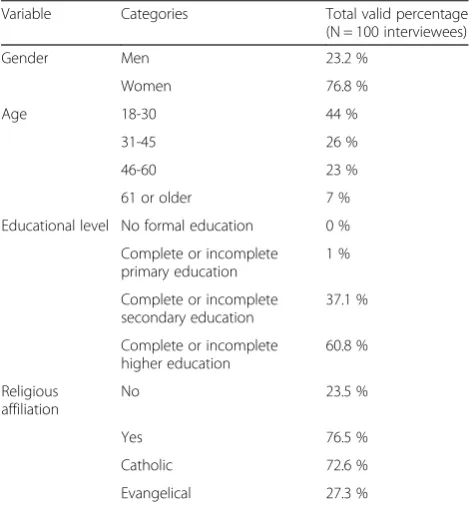
The total sample was 100 patients. The demographic data of the respondents are presented in Table 1. The majority of the patients surveyed were women (76.8 %) aged 18–30 (44 %) with higher education (60.8 %) who identified as Catholic (54.1 %).
The type of bone graft that elicited the highest rate of refusal was the allograft; 20 % of the patients stated that under no circumstances would they accept this type of
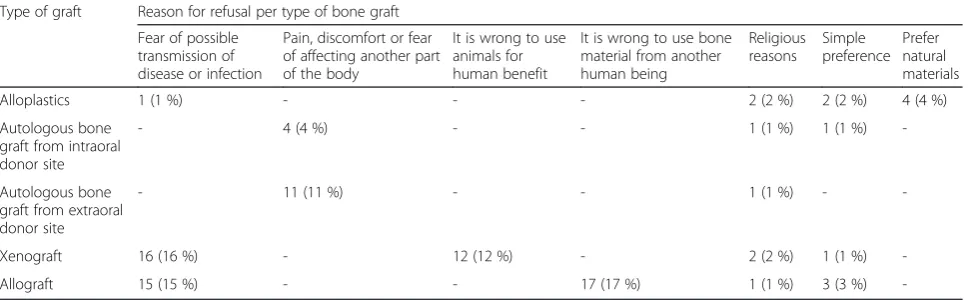
bone graft in their surgery. An additional 21 % said they would only accept an allograft if it was the only option. The reasons given for refusing an allograft were as fol-lows: fear of possible disease transmission (n = 15), the belief that it is wrong to use bone from another human being (n = 17), religious reasons (n = 1) and preferences (n = 3). Statistically significant relationships were ob-served between gender and the refusal of allografts: women were more likely than men to refuse an allograft and to accept an allograft only as a last resort (0.008).
The type of bone graft that elicited the second-highest refusal rate was the xenograft. 15 % of patients said they would accept this type of bone graft under no circum-stances, while 18 % said they would accept a xenograft only as a last resort. The reasons given for refusing a xenograft were as follows: fear of the possible transmis-sion of disease from the animal (n = 16), the belief that it is wrong to use animals for human benefit (n = 12), reli-gious reasons (n = 2) and simple preferences (n = 1).
The types of bone graft that elicited the lowest rates of refusal were alloplastics (2 %) and autologous grafts (3 %) from an intraoral donor site. Interestingly, the patients' reasons for refusing autologous bone grafts were primarily related to the fear of pain, discomfort or possible negative effects on other parts of the body (n = 15). Some patients also refused autologous bone grafts for religious reasons (n = 2) and simple preferences (n = 1).
Table 2 presents additional data about the patients' acceptance or refusal of the different types of bone graft, and the reasons for refusal are presented in Table 3.
No significant differences in the refusal/acceptance rates of the various types of bone graft were observed according to the sociodemographic variables (i.e., age, education level, and adherence to a religious faith). Similarly, no significant relationships between the spe-cific religious affiliation (i.e., Catholic or Evangelical) and the acceptance/refusal rates of the various types of graft were observed.
Discussion
Bone grafts have made it possible to resolve the prob-lems of the insufficient thickness or height of the jaw-bone in many patients who require dental implants for either functional or esthetic reasons. Autologous bone is currently considered the“gold standard”for bone regen-eration due to its osteoconduction, osteoinduction and osteogenesis-inducing properties [4]. However, autolo-gous bone grafts occasionally have significant drawbacks, such as increased postoperative morbidity, the need for a second surgery and the lack of sufficient bone mass at the donor site [11]. Consequently, science has developed other therapeutic options, such as alloplastic grafts (syn-thetic bone substitutes), processed bone from species other than that receiving the graft (xenografts), and Table 1Demographic data (gender, age group, educational
level and religious affiliation) of the surveyed patients (n = 100)
Variable Categories Total valid percentage
(N = 100 interviewees)
Gender Men 23.2 %
Women 76.8 %
Age 18-30 44 %
31-45 26 %
46-60 23 %
61 or older 7 %
Educational level No formal education 0 %
Complete or incomplete primary education
1 %
Complete or incomplete secondary education
37.1 %
Complete or incomplete higher education
60.8 %
Religious affiliation
No 23.5 %
Yes 76.5 %
Catholic 72.6 %
processed bone from different individuals of the same species (allografts) [4]. Unfortunately, the literature ports some controversial issues regarding allografts re-lated to possible graft rejection, virus transmission and other ethical concerns [15, 16]. Similarly, xenografts may produce zoonotic disease in some cases [16]. These data may influence the opinions of clinicians and patients, and these opinions should determine the final treatment. In general, the sociodemographic variables did not in-fluence the refusal/acceptance rates of the various bone grafts options, and these results are consistent with those of a study by Hof et al. [17]. Similarly, no signifi-cant differences were observed in the acceptance/refusal rates for the different bone grafts according to religious affiliation. These findings may be attributable to the fact that only two religious branches were included in the sample, i.e., Catholic and Evangelical. These are the pre-dominant religions of the Chilean population, and both allow the use of grafts derived from humans and animals [14]. Moreover, these findings demonstrate that the
opinions about specific therapies are unique to each pa-tient and not dependent on other factors.
Allografts were the bone grafts that elicited the highest refusal rate among respondents. 41 % declared that they would never accept this type of bone graft or would do so only as a last resort. A study involving 219 patients [6] who had received or were about to receive liver allo-transplants reported on these patients' opinions about possible donor-related risks. Most patients wanted to be informed about the risk of infectious disease transmis-sion (74.8 %). In the present study, 15 % of patients re-ported that they would refuse to accept a bone allograft due to fear of disease transmission from the donor.
Importantly, allografts are not available worldwide due to religious and ethical concerns [18]. However, in this study no significant differences were observed in the re-fusal rates for allographs due to specific religious affili-ation. Moreover, despite the finding of a significant relation between women and allograft refusal, we cannot dismiss the possibility that this finding was influenced Table 2Degrees of patient acceptance of the different types of bone graft (n = 100)
Type of graft Percentage of validated answers
Never Only as a last resort
Yes, if this type of graft leads to the best results
Yes, if my dentist recommends the use of this type of graft material
Yes. I am comfortable with the use of this graft material.
Only if the animal did not suffer or was killed in order to obtain the graft
Yes, but only from a living donor
Yes, but only from a deceased donor
Alloplastics 2 % 13 % 33 % 23 % 29 % - -
-Autologous bone graft from intraoral donor site (chin or posterior mandible)
3 % 7 % 31 % 20 % 39 % - -
-Autologous bone graft from extraoral donor site (tibia, hip, etc.)
8 % 17 % 26 % 19 % 30 % - -
-Xenograft 15 % 18 % 25 % 15 % 15 % 11 % -
-Allograft 20 % 21 % 19 % 0 % 4 % - 11 % 7 %
Table 3Summary of the reasons for the refusal of the different types of bone graft
Type of graft Reason for refusal per type of bone graft
Fear of possible transmission of disease or infection
Pain, discomfort or fear of affecting another part of the body
It is wrong to use animals for human benefit
It is wrong to use bone material from another human being
Religious reasons
Simple preference
Prefer natural materials
Alloplastics 1 (1 %) - - - 2 (2 %) 2 (2 %) 4 (4 %)
Autologous bone graft from intraoral donor site
- 4 (4 %) - - 1 (1 %) 1 (1 %)
-Autologous bone graft from extraoral donor site
- 11 (11 %) - - 1 (1 %) -
-Xenograft 16 (16 %) - 12 (12 %) - 2 (2 %) 1 (1 %)
-by the predominance of females in the sample. Despite the percentage of women not being representative of the total population at regional level, it is close to the per-centage of females that receive attention in our clinics (68 % of patients). In relation to the percentage of reli-gious/non-religious, data from the last Chilean census1 showed percentages of 67 % Catholic, 16 % Evangelical and 11 % non-religious. Therefore, this study exhibited percentages closer to the national population census with 55.5 % of individuals who declared themselves Catholic, 20.8 % Evangelical and 23.5 % non-religious.
Bone allografts from living donors are primarily ob-tained from the femoral head of patients undergoing hip-replacement surgery [19]. The donation criteria are quite strict, and over 50 % of willing donors are ex-cluded. Accepted donors are tested for contagious dis-eases. Allograft bone from cadavers is also used, but in these cases information about the donor's lifestyle must be obtained from relatives, and this information may not always be reliable [19]. Nonetheless, the risks and bene-fits of allografts should be discussed with the patient prior to the consent process [15]. Such discussions are a part of the process of patient choice and essential to the principle of autonomy. Similarly, the clinician should be aware of the moral and ethical issues related to the use of allografts, the origins of the allografts, and the pos-sible risks of disease transmission so as to respect the principles of beneficence and non-maleficence.
Regarding xenografts, 15 % of the patients reported that they would not accept this type of graft under any circumstance, and 18 % reported that they would ap-prove of a xenograft only as a last resort. The main rea-sons for xenograft rejection were the fear of possible disease transmission and the belief that it is wrong to use animals for human benefit. Both of these opinions are valuable and must be considered by the clinician prior to the surgical procedure.
The ethical aspects of xenografts have also been a topic of discussion in the scientific community. Nelson [20] asked for the careful consideration of the ethical is-sues involved in the use of animal organs and the sacri-fice of animal life for human benefit. McCarthy [21] reported that opponents of the use of animals may base their arguments on theological, philosophical and/or economic reasons. The rules and customs related to the use of products derived from animals may differ between different religions and individuals (Eriksson et al., 2013). For example, Hinduism does not allow the use of im-plants or products derived from cows or pigs, and Islam conflicts with the use of pig-derived products [14]. This study did not detect significant relationships between religion and xenograft primarily because Christian religions (i.e., Catholic and Evangelical) accept the use of animal-derived products [14]. In summary, some
animal-derived products may cause conflicts with per-sonal or religious beliefs that need to be considered prior to surgery.
In the case of autologous bone grafts, the majority of the patients who rejected their use provided reasons re-lated to potential discomfort or postoperative pain at the donor site, whereas only 2 % mentioned religion. A study conducted by Nkenke and Neukam [22] reported that mandibular bone grafts are generally well-accepted procedures that also involve low objective and subjective morbidity rates. Banwart et al. [23] studied morbidity in 261 patients who had bone harvested from the iliac crest and concluded that serious complications can be avoided and those complications affecting the functions of the donor site were rare. In a study by Hof et al. [17] in which 150 patients were interviewed in relation to dental implants and bone grafts, 43 % chose a synthetic bone substitute material (alloplastic) to avoid donor site mor-bidity, and 23 % were able to undergo surgery to obtain an autograft from the hip. In the present study, only 8 % expressed that they would never accept the harvesting of an autologous bone graft from an extraoral donor site, for example, the tibia or hip.
Clinicians occasionally make decisions about the type of surgery and products used without concern for pa-tient discussions, which violates the ethical principle of autonomy. Op den Dries et al. [6] found that 79.8 % of patients expressed the desire to be involved in decision-making regarding the advisability of accepting a liver transplant, 10.6 % wanted to make the final decision themselves, and only 9.6 % did not wish to be involved in the decision-making process. Therefore, the clinician must properly inform the patient without influencing his decision to obtain the patient’s opinion and informed consent for each product and procedure used in the treatment plan [14]. The final decision may depend on several factors, but it is necessary for the patient to be well informed [17]. In this sense, a professional must carefully consider the risks, costs and benefits of the type of bone graft to be used to achieve the final treat-ment outcome. Thus, the clinician must be sufficiently ethical and conscious of his duties to individuals and humanity.
One point that we wish to highlight is that despite the fact that all of the surveyed individuals were Christians, religion was one of the reasons for graft refusal. This finding was confusing for the authors but could be at-tributable to the differences that exist in individual reli-gious interpretations [14]. Unfortunately, this question was answered without explanation. Both individuals that answered wrote: “because the word of God says so” and “religious reasons”,but without further explanation.
each patient had a different opinion and strong argu-ments for choosing to accept or reject each type of bone graft, and this needs to be understood by the clinician prior to treatment planning. Unfortunately, it was not possible to directly compare previous studies with the present study because four types of bone grafts were examined here that have only recently become conven-tional. Similarly, this study employed a quantitative approach to the patients’ opinions about bone grafts. However, further studies employing qualitative analyses are needed to understand the different opinions in greater detail.
Conclusions
Allografts and xenografts elicited the highest refusal rates among patients, and autologous bone and alloplas-tics were the most accepted types. Moreover, no differ-ences in the acceptance/refusal rates for the different bone grafts due to the sociodemographic variables or religious affiliation were observed. Each patient expressed unique opinions and arguments for accepting or rejecting each type of bone graft. Therefore, although a clinician might have experience with a specific type of bone graft, he must ascertain the patient’s opinions before a treatment is planned.
Endnotes 1
Available at http://www.ine.cl/canales/chile_estadistico/ familias/censos.php.
Competing interests
The authors declare that they have no competing interests.
Authors’contributions
RF designed the study under the close supervision of CB and VB. CB, EB and VB collected the data, and PN performed the statistical analyses and reviewed the draft. CB, RF and EB wrote the draft and reviewed the manuscript. RF, EB and CB edited the manuscript before submission. All the authors read and approved the final manuscript.
Acknowledgements
We wish to acknowledge the help provided by Dr. Sergio Olate, Dr. Marcelo Martínez and Dr. Álvaro Marin regarding survey validation and correction. Also, the authors wish to thank the anonymous reviewers for their valuable contributions and suggestions, which helped to improve the manuscript. No funding resources were used to develop this research.
Author details
1Research Centre in Dental Sciences, Dental School, Universidad de La
Frontera, Manuel Montt #112, 4781176 Temuco, Chile.2Mathematics and Statistic Department, Universidad de La Frontera, Temuco, Chile. 3
Department of Dental Materials and Prosthodontics, Dental School of Ribeirão Preto, University of São Paulo, Ribeirão Preto, SP, Brazil.
Received: 5 September 2014 Accepted: 14 July 2015
References
1. Manrique N, Pereira CC, Garcia LM, Micaroni S, Carvalho AA, Perri SH, et al. Alveolar bone healing process in spontaneously hypertensive rats (SHR). A radiographic densitometry study. J Appl Oral Sci. 2012;20:222–7.
2. Rana R, Ramachandra SS, Lahori M, Singhal R, Jithendra KD. Combined soft and hard tissue augmentation for a localized alveolar ridge defect. Contemp Clin Dent. 2013;4:556–8.
3. Atwood DA. A cephalometric study of the clinical rest position of the mandible. Part II. The variability in the rate of bone loss following the removal of occlusal contacts. J Prosthet Dent. 1957;7:544–52.
4. Oporto VG, Fuentes FR, Álvarez CH, Borie E. Maxillomandibular morphology and physiology recovery: Biomaterials in bone regeneration. Int J Morphol. 2008;26:853–9.
5. Enoch S, Shaaban H, Dunn KW. Informed consent should be obtained from patients to use products (skin substitutes) and dressings containing biological material. J Med Ethics. 2005;31:2–6.
6. Op den Dries S, Annema C, van den Berg AP, Ranchor AV, Porte RJ: Shared Decision Making in Transplantation: How Patients See Their Role in The Decision Process of Accepting a Donor Liver.Liver Transpl2014. DOI: 10.1002/lt.23921.
7. Kasten P, Vogel J, Geiger F, Niemeyer P, Luginbühl R, Szalay K. The effect of platelet-rich plasma on healing in critical-size long-bone defects. Biomaterials. 2008;29:3983–92.
8. Huang MS, Wu HD, Teng NC, Peng BY, Wu JY, Chang WJ, et al.In vivo
evaluation of poorly crystalline hydroxyapatite-based biphasic calcium phosphate bone substitutes for treating dental bony defects. J Dent Sci. 2010;5:100–8.
9. Olate S, de Oliveira GR, Jaimes M, Barbosa JRA. Osseous recovery in implant insertion and pre implant reconstructions. Int J Morphol. 2007;25:649–57. 10. Grover V, Kapoor A, Malhotra R, Sachdeva S. Bone allografts: a review of
safety and efficacy. Indian J Dent Res. 2011;22:496.
11. Grageda E. Platelet-Rich Plasma and Bone Graft Materials: A Review and a Standardized Research Protocol. Implant Dent. 2004;13:301–9.
12. Dion-Labrie M, Fortin MC, Hébert MJ, Doucet H. The use of personalized medicine for patient selection for renal transplantation: physicians' views on the clinical and ethical implications. BMC Med Ethics. 2010;11:5.
13. Ochieng J, Ibingira C, Buwembo W, Munabi I, Kiryowa H, Kitara D, Bukuluki P, Nzarubara G, Mwaka E: Informed consent practices for surgical care at university teaching hospitals: a case in a low resource setting.BMC Med Ethics, 2014. DOI: 10.1186/1472-6939-15-40.
14. Eriksson A, Burcharth J, Rosenberg J. Animal derived products may conflict with religious patients' beliefs. BMC Med Ethics. 2013;14:48.
15. Robertson A, Nutton RW, Keating JF. Current trends in the use of tendon allografts in orthopaedic surgery. J Bone Joint Surg Br. 2006;88:988–92. 16. Oryan A, Alidadi S, Moshiri A. Current concerns regarding healing of bone
defects. Hard Tissue. 2013;2:13.
17. Hof M, Tepper G, Semo B, Arnhart C, Watzek G, Pommer B. Patients' perspectives on dental implant and bone graft surgery: questionnaire-based interview survey. Clin Oral Implants Res. 2014;25:42–5.
18. Oryan A, Alidadi S, Moshiri A, Maffulli N. Bone regenerative medicine: classic options, novel strategies, and future directions. J Orthop Surg Res. 2014;9:18. 19. Norman-Taylor FH, Santori N, Villar RN. The trouble with bone allograft. BMJ.
1997;315:498.
20. Nelson JL. Moral sensibilities and moral standing: Caplan on xenograft donors. Bioethics. 1993;7:315–22.
21. McCarthy C. Ethical Aspects of Animal-to-Human Xenografts. ILAR J. 1995;37:3–9.
22. Nkenke E, Neukam FW. Autogenous bone harvesting and grafting in advanced jaw resorption: Morbidity, resorption and implant survival. Eur J Oral Implantol. 2014;19:203–17.