Medium Access Control (MAC)
for Wireless Body Area Network (WBAN):
Superframe structure, multiple access
technique, taxonomy, and challenges
Fasee Ullah
1,2, Abdul Hanan Abdullah
1, Omprakash Kaiwartya
3*, Sushil Kumar
4and Marina Md. Arshad
1Introduction
Google search trend verifies the fact that ‘health monitoring’ is in the limelight now-adays [1]. Health monitoring has achieved a higher ranking as compared to ‘environ-ment monitoring’ using sensors. This is due to the significant reduction in healthcare cost by using the technological advancements in health monitoring. The department of economic and social affairs of the United Nations has a report on the vilest health condi-tions of elderly aged people [2]. The report states that elderly aged people will be 761 mil-lion at the age of 60 plus of the total population of world in 2025, which is approximately
Abstract
Health monitoring using biomedical sensors has witnessed significant attention in recent past due to the evolution of a new research area in sensor network known as Wireless Body Area Networks (WBANs). In WBANs, a number of implantable, wearable, and off-body biomedical sensors are utilized to monitor various vital signs of patient’s body for early detection, and medication of grave diseases. In literature, a number of Medium Access Control (MAC) protocols for WBANs have been suggested for address-ing the unique challenges related to reliability, delay, collision and energy in the new research area. The design of MAC protocols is based on multiple access techniques. Understanding the basis of MAC protocol designs for identifying their design objec-tives in broader perspective, is a quite challenging task. In this context, this paper quali-tatively reviews MAC protocols for WBANs. Firstly, 802.15.4 and 802.15.6 based MAC Superframe structures are investigated focusing on design objectives. Secondly, dif-ferent multiple access techniques such as TDMA, CSMA/CA, Slotted Aloha and Hybrid are explored in terms of design goals. Thirdly, a two-layered taxonomy is presented for MAC protocols. First layer classification is based on multiple access techniques, whereas second layer classification is based on design objectives and characteristics of MAC protocols. Critical and qualitative analysis is carried out for each considered MAC proto-col. Comparative study of different MAC protocols is also performed. Finally, some open research challenges in the area are identified with initial research directions.
Keywords: WBAN, MAC Superframe structure, Nature of patient’s data, Scheduling access schemes, Reliability, Energy
Open Access
© The Author(s) 2017. This article is distributed under the terms of the Creative Commons Attribution 4.0 International License (http://creativecommons.org/licenses/by/4.0/), which permits unrestricted use, distribution, and reproduction in any medium, provided you give appropriate credit to the original author(s) and the source, provide a link to the Creative Commons license, and indicate if changes were made.
REVIEW
*Correspondence: omprakash.kaiwartya@ northumbria.ac.uk 3 Department of Computer and Information Sciences, Northumbria University, Newcastle upon Tyne NE2 1XE, UK
15% of the whole world’s population. Since, the elderly aged people require more medi-cal checkup, as they are more in a life threatening situation of various health diseases [3]. These regular health checkup and monitoring of real time health conditions incur higher cost, which is a challenging problem specifically for lower income and developing countries. The report suggests the usage of technological advancements for health moni-toring which results in early detection of diseases, and thus, reduction of medical cost.
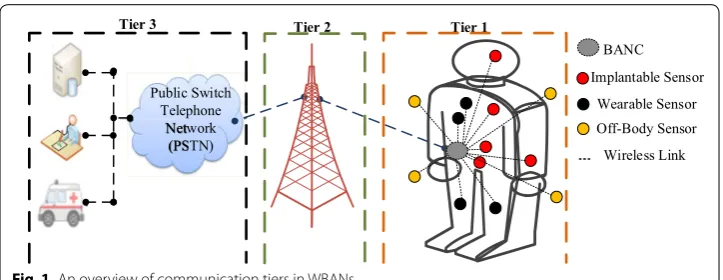
In health domain, Wireless Body Area Network (WBAN) has got a significant atten-tion in research and applicaatten-tions development, due to the considerable impact on patient-care or patient monitoring via biomedical sensors (BMSs) [4]. The real time health monitoring of patients significantly improves the rate of successful diagnosis in case of life threatening diseases. It also reduces the cost incurred in diagnosis, due to the early detection of diseases [5]. WBAN comprises of small BMSs that are wirelessly con-nected to a Body Area Network Coordinator (BANC) [6]. BMSs can be broadly divided into three categories, namely; in-body, on-body and off-body sensors [7]. In-body sen-sors are implanted inside the patient’s body, whereas on-body sensen-sors are sewed to the shirt or attached on the skin of a patient’s body, and off-body sensors are kept away few centimeters from a patient’s body [8]. An operation framework of WBANs with these sensors is presented in Fig. 1. BMSs are deployed to monitor different vital signs of a patient’s body in Tier 1. BMSs forward the monitored data of vital signs to BANC. The BANC transmits these data to Tier 2. Tier 2 comprises of a Base Station (BS), and it for-wards the outcomes of vital signs to Tier 3 over the dedicated internet communication links. Tier 3 includes a computer server, medical staff and transportation facilities [9]. Through this way, the patient’s vital signs are examined by medical staffs, and advice a treatment. The vital signs monitored via BMSs includes heartbeat rate, respiratory rate, EEG, ECG, blood pressure, temperature and glucose level [10]. Each category of vital sign is represented by a specific type of medical data, and is completely different from other categories of vital signs. Therefore, BMSs data is heterogeneous and have different processing requirements by the medical team, which is based on the category of data. The responsibility of a BANC is to allocate slots or channels to the monitored vital signs based on the category of data. Efficient slot allocation is a challenging task due to the resource constraint involved in sensor network such as limited energy, processing power, storage and transmission capability [11].
Public Switch Telephone
Network (PSTN)
Tier 1 Tier 2
Tier 3
BANC Implantable Sensor
Wearable Sensor Off-Body Sensor Wireless Link
Various MAC protocols have been suggested for WBANs to address the slot alloca-tion problems. There are two major design decisions have been made in MAC protocols namely, Superframe structure and multiple access (MA) scheme. The first design deci-sion, MAC Superframe structure is based on two IEEE standards namely, IEEE 802.15.4 and IEEE 802.15.6. The Superframe structures have different classification of data, frame format and MA schemes. The second design decision, MA schemes consist of stand-ard schemes and their combinations, which include Aloha, Slotted Aloha, Time Divi-sion Multiple Access (TDMA), Frequency DiviDivi-sion Multiple Access (FDMA) and carrier sense multiple access with collision avoidance (CSMA/CA). MAC protocols based on these MA schemes utilize different approaches for slot allocation such as predefined, predefined and prediction, contention, non-contention and urgency, probability, alert and permission. MA scheduling schemes are also known as scheduling access schemes in WBANs which is interchangeably used in the rest of the paper. The allocation of slots to emergency and non-emergency data increases collision in CAP channel accessing. The slot allocation is not an appropriate solution for emergency data. It reduces the per-formance of MAC protocol in term of insufficient slots for patient’s data, delay, retrans-mission of collided data packets, frequent invocation of beacon interval (BI), minimum duration of Superframe and slots, and higher energy consumption. The recent develop-ments in MAC protocols for WBANs are focusing on these issues.
In this context, this paper qualitatively reviews recent developments on MAC protocol designs for WBANs. The critical investigation focuses on Superframe structure, multi-ple access scheme, and taxonomy for MAC protocols. The broad picture of the paper is summarized below as major contributions of the work:
• Firstly, MAC Superframe structure is classified into two categories, namely, IEEE 802.15.4 and IEEE 802.15.6. Each category has been qualitatively investigated focus-ing on frame format, classification of a patient’s data, and MA schedulfocus-ing schemes.
• Secondly, MA schemes are classically explored considering slot allocation and the impact of slot allocation on the various performance parameters.
• Thirdly, a two-layered taxonomy for MAC protocols in WBANs is presented. First layer classification is based on MA techniques, whereas second layer classification is based on design objectives and characteristics of MAC protocols. Comparative study of different MAC protocols is also performed.
• Finally, some open research challenges in the area are identified, and the directions of their solutions are explored.
Related literature reviews
A survey on WBANs have focused on three layers including routing, MAC and PHY layers considering IEEE 802.15.6 standard [4, 18]. It has described the communica-tion range between BMSs for on and in-body with different consideracommunica-tions. However, the limitations of Superframe structure of IEEE 802.15.4 and PHY layer have not been identified. In [5, 12], authors have discuss applications of WBAN using different sensors for in and on body monitoring of a person. IEEE 802.15.4 MAC Superframe structure has discussed in with using TelOS. It has considered beacon interval (BI), durations of a slot, and Superframe structure. The selection of these metrics has been investigated for energy consumption of BMSs in terms of reliability and delay. A survey on channel interferences, energy, and scheduling access schemes has been conducted considering IEEE 802.15.4 and IEEE 802.15.6 [8]. These performance metrics have been considered based on the importance of the patient’s life. The issues on the design and development of low-powered BMSs have been in explored, for monitoring of in and out vital signs of a person in different applications [13]. The issues have been investigated due to the dif-ferent data rates to transmit the sensory information of a patient for each BMS. Further, the provision of quality of service has been discussed for MAC and PHY layers consider-ing IEEE 802.15.4 and IEEE 802.15.6. A similar survey has been presented focusconsider-ing on low-powered BMSs [14]. The Superframe structure has been classified into low power listening, contention and TDMA considering MAC protocols studies. Most of the MAC protocols have designed for wireless sensor networks (WSNs). However, the require-ments of WBAN are different due to the heterogeneous nature of a patient’s data, as compared to the homogeneous nature of data in WSNs.
The frame structure, frequency modulation techniques, and the security authentica-tion have been focused for MAC and PHY layers in IEEE 802.15.6 [15]. The Narrowband (NB), Ultra-wideband (UWB), and Human Body Communications (HBC) are the Super-frame structures, have been considered for human beings to animals using Slotted Aloha and CSMA/CA. The application, transport, network, MAC and PHY layers have been considered for Superframe structures of IEEE 802.15.4 and IEEE 802.15.6 in WBAN [16]. These layers have been investigated to establish an association between Superframe structure using Slotted Aloha, CSMA/CA and TDMA. The simulations have been con-ducted for Superframe structures of Bluetooth, IEEE 802.15.4, and IEEE 802.15.6 in [17]. The performance has been tested on data payload transmission, delay, throughput, and energy consumption using CSMA/CA and Slotted Aloha. Clearly, it has been investi-gated from simulations that IEEE 802.15.4 has performed better against IEEE 802.15.6 and Bluetooth. Most of the aforementioned surveys on WBAN have been considering multiple layers including physical, MAC, and routing. Contrary to theses generalized surveys, we focus on recent developments in MAC protocols considering Superframe structure, multiple access scheme, and two-layered taxonomy.
MAC Superframe structure
IEEE 802.15.4 based Superframe structure
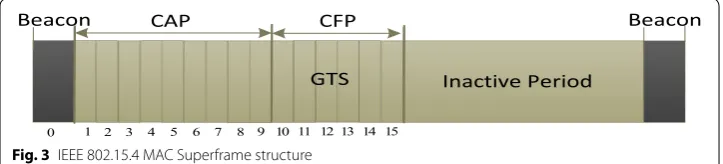
The BMSs are implanted or attached on the surface of a patient’s body for monitor-ing of various vital signs of a patient. These BMSs are connected to a BANC in the star topology [13]. The patient data are classified into normal, periodic and emergency data. The normal data comprises of a temperature. The periodic data contains the reading of glucose and blood pressure. The emergency data contains a life threatening vital signs information such as low or high threshold value of a heartbeat. Further, the Superframe structure of IEEE 802.15.4 MAC comprises of a beacon, contention access period (CAP), contention free period (CFP) and LPL as depicted in Fig. 3. In IEEE 802.15.4 MAC, all BMSs use CSMA/CA access scheme and the CSM/CA-based BMSs perform contention to access channel in CAP period. During contention, each BMS performs many backoffs and clear channel assessment (CCA) to access channel [14, 21]. The TDMA scheduling access scheme is grouped in CFP period and the CFP period allocates the guaranteed
MAC Super-frame structure
IEEE 802.15.4 IEEE 802.15.6
Beacon CAP CFP Inactive Period
Normal Periodic Emergency
Enabled Beacon
MAC Superframe MAC SuperframeNon-beacon Non-beacon Without Superframe
Beacon Type I/IIEAP 1
RAP 1 Type I/IIEAP 2
RAP 2 CAP
CSMA/CA Slotted Aloha
Normal Emergency
Type I/II CSMA/CA
Slotted Aloha NormalEmergency 16 slots Predefined
Contention Hybrid
Non-Emergency Flexible Slot
TDMA and FDMA Structure Multiple Access Schemes
CSMA/CA and Slotted Aloha
Patient Data Classification
Structure Multiple Access Schemes Patient Data Classification
Structure Multiple Access Schemes Patient Data Classification
Type I/II CSMA/CA Slotted Aloha
Emergency Structure Multiple Access Schemes
Patient Data Classification
Fig. 2 Classification of MAC Superframe structures
Beacon CAP CFP Beacon
Inactive Period
0 1 2 3 4 5 6 7 8 9 10 11 12 13 14 15 GTS
time slots to transmit the patient’s data [22]. However, the BANC allocates the CFP slots to those BMSs who obtain a channel access in CAP period.
At the beginning of communication, the BANC broadcasts a beacon to all BMSs in the network which contains information of synchronization, the logical address of BANC, and the next announcement of the beacon interval (BI). In synchronization, BMSs trans-mit the request for channel association and dissociation to a BANC. The address of the BANC is broadcasted to BMSs for remembering it as the head/coordinator for allocating of channels and data transmission. The BI is the time period whereas each BMS con-tends and transmits sensory data in the specified amount of time. The inactive period (IP) is used for saving energy when a BMS is not busy for transmitting sensory data. The followings are the limitations of the Superframe structure of IEEE 802.15.4 MAC [23] as follows:
• IEEE 802.15.4 provides limited 16 (0–15) channels.
• All BMSs perform contention to access channel in CAP period.
• Allocation of CFP channels only to those BMSs who obtains a channel access in CAP period.
• During contention for accessing channel, there is no priority-based slot allocated to emergency data and is no differentiation between normal, periodic, and emergency data to assign the first slot on the priority-basis during in the life critical situations.
• No priority based a dedicated slots are occupied for emergency data.
• Due to contention, BMSs consume a higher amount of energy.
• In TDMA, each BMS transmits sensory data in the fixed length of time and drops data if it has a large amount of data (frame).
• Emergency data face a higher delay due to collision, retransmission of the lost pack-ets, and limited time period of a BI.
These limitations severely reduce the performance of a MAC Superframe structure in terms of lower data reliability, collision and a higher amount of energy consumption. Moreover, the standard MAC Superframe structure does not support heterogeneous nature of patient’s data which is not appropriate for emergency data. Numerous research contributions have been made that are [24–26]. These papers have modified the Super-frame structure of IEEE 802.15.4 MAC according to the need of a patient’s data.
IEEE 802.15.6 MAC Superframe structure
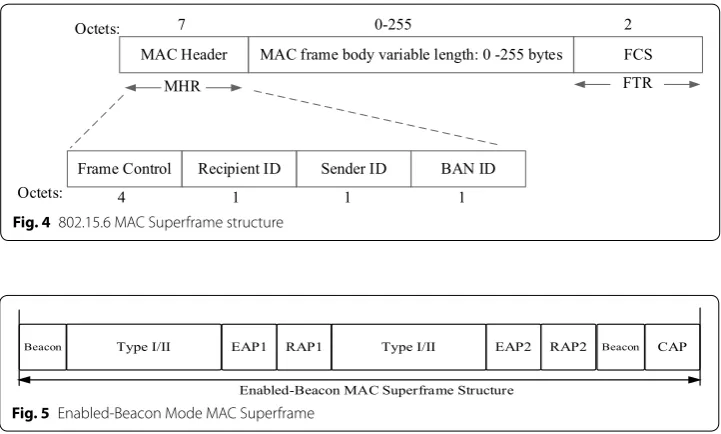
of a sportsman in different sports activities. The first draft version of IEEE 802.15.6 for MAC and PHY layers was publicized in 2012 [16]. This draft version describes IEEE 802.15.6 which divides the whole Superframe structure into different channels and bea-cons. Each channel is assigned an equal time frame to transmit the patient’s data. Fig-ure 4 (re-drawn from [15, 27]) shows an overview of IEEE 802.15.6 MAC Superframe structure.
The Superframe structure of IEEE 802.15.6 MAC comprises of three main modules that are MAC header, MAC variable length and frame check sequences (FCS). The MAC header reserves 7 bytes, the variable length reserves 0–255 bytes and FCS reserves 2 bytes as depicted in Fig. 4. The MAC frame body is further categorized into three sub-headers that are (a) Data Freshness which occupies 1 byte to protect data from the reply attack, (b) Message Integrity Code (MIC) occupies 4 bytes to authenticate the frame and maintains the integrity check of a frame, and (c) Data Payload contains data with MIC headers in the frame. Moreover, IEEE 802.15.6 MAC header is categorized into 4 sub-headers. First, the Frame Control occupies 4 bytes and uses to distinguish between con-trol frame and data frame along with an acknowledgment. The second and third headers are the addresses of the receiver and sender sensors, respectively. Each sensor uses 1 byte to store the address. The BANC header is the final header which occupies 1 byte to store the address. The slot allocation to the nature of a patient’s data in both IEEE 802.15.4 and IEEE 802.15.6 MACs is the responsibility of a BANC. Therefore, the draft version of IEEE 802.15.6 MAC defines three ways for transmitting the patient’s data [4,
15] which are discussed in the following subsections.
Enabled‑beacon MAC Superframe structure
The enabled-Beacon MAC Superframe structure comprises of a beacon, exclusive access phase (EAP-I-II), random access phase (RAP-I-II), Type (I–II) and CAP periods as shown in Fig. 5 (re-drawn from [4, 15]). The beacon is used to synchronize BMSs with a BANC. The channel allocation policy to BMSs is based on CSMA/CA or Slotted Aloha
Frame Control Recipient ID Sender ID BAN ID
MAC Header MAC frame body variable length: 0 -255 bytes FCS
Octets: 7 0-255 2
MHR FTR
Octets: 4 1 1 1
Fig. 4 802.15.6 MAC Superframe structure
Beacon Type I/II EAP1 RAP1 Type I/II EAP2 RAP2 Beacon CAP
Enabled-Beacon MAC Superframe Structure
schedule access scheme which are implemented on EAP, RAP and CAP periods. The EAP-I and EAP-II are reserved for life critical a patient’s data and these critical data are represented by Type-I in Enabled-beacon MAC. Further, the RAP-I, RAP-II, and CAP periods are reserved for normal and regular monitoring of the health conditions of a patient which is represented as Type-II. The enabled-beacon MAC provides only dedi-cated slots to emergency and non-emergency data as compared to IEEE 802.15.4 MAC. However, the limitations of IEEE 802.15.6 MAC Superframe structure are the same as aforementioned in IEEE 802.15.4 MAC as challenging problems.
Non‑beacon MAC Superframe structure
Figure 6 (re-drawn from [4]) shows the structure of non-beacon MAC Superframe structure. The non-beacon MAC allocates the entire channels (slots) of the Superframe to Type-I or Type-II category of a patient’s data. During data transmission, the non-bea-con based BMSs do not require synchronization with a BANC. With this advantage, the energy consumption of such BMSs is very minimum. The disadvantage is that the BANC cannot transmit data directly to BMSs but it must first transmit an activation alert signal to the recipient BMS. The second disadvantage is that the non-beacon MAC allocates slots to one type of a patient’s data at one time which is not an acceptable during life critical situations of a patient.
Non‑beacon without Superframe structure
This type of structure of Superframe does not use the predefined periods to transmit all types of a patient’s data but it is designed for scenario of Type-II. In this Superframe structure, the slot allocation to BMSs is based on contention or post-contention. The advantage of this structure is that the non-emergency based BMSs do not interrupt con-tention of emergency-based BMSs. However, the predefined allocation of slots to one type of sensory data is the wastage of slots.
Comparative analysis of MAC Superframe structures
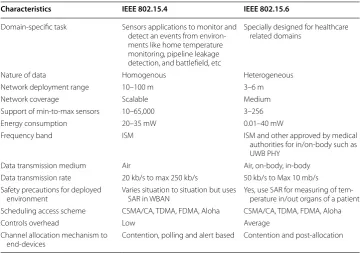
IEEE 802.11, IEEE 802.15, and IEEE 802.15.1 [17] are not capable to monitor and detect early abnormal conditions of a patient. However, IEEE 802.15.4 has the capabilities to monitor and detects abnormal conditions and transmit the sensory data to a BANC with the higher data reliability [28]. Lots of researchers have been modified the Superframe structure of IEEE 802.15.4 MAC and used for WBAN. Table 1 presents characteristics of IEEE 802.15.4 MAC and compares with IEEE 802.15.6 MAC [29].
Multiple access scheduling schemes for MAC in WBANs
The slots allocation activities to BMSs in MAC Superframe structure of IEEE 802.15.4 are carried out with the support of different multiple access (MA) scheduling schemes. The scheduling access schemes can reduce collision, delay, avoids retransmission of the lost packets and energy consumption. Thus, the existing MA schemes in MAC proto-cols classifies the scheduling access schemes into three main categories; namely, res-ervation-based, contention-based and hybrid [12, 14]. These three scheduling access schemes assist to allocate slots to heterogeneous nature of a patient’s data. The nature of patient’s data is divided into three classes as aforementioned. However, the classifica-tions of a patient’s data into three classes are not justifiable because these classificaclassifica-tions do not discuss low and high threshold values of vital signs and delay-sensitive data. In fact, the existing literature classifies the patient’s data into four to five classes [25, 30]. The patient’s data are transmitted to the BANC using various scheduling access schemes as discussed in the following sub-sections.
Reservation‑based slots allocation
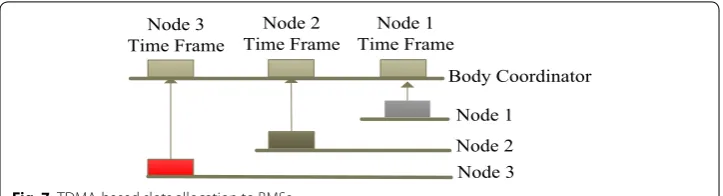
The TDMA scheduling access is the reservation-based slots allocation mechanism and this scheduling access is used for slots of the CFP period of MAC IEEE 802.15.4 Super-frame structure [18, 31] as aforementioned in Fig. 3. The body coordinator divides the time frames of CFP period into different predefined time frames. Each BMS waits and transmits sensory data in the allocated predefined time frame as shown in Fig. 7. For example, the nodes 1 and 2 are normal data whereas they transmit in the allocated pre-defined time frames. The node 3 detects an emergency data (i.e. low or high threshold value) at the same time during data transmission of nodes 1 and 2. In this life-critical situation, the node 3 must wait and transmit emergency data in the predefined allocated Table 1 Comparison of IEEE 802.15.4 and 802.15.6 based on Superframe
Characteristics IEEE 802.15.4 IEEE 802.15.6
Domain-specific task Sensors applications to monitor and detect an events from environ-ments like home temperature monitoring, pipeline leakage detection, and battlefield, etc
Specially designed for healthcare related domains
Nature of data Homogenous Heterogeneous Network deployment range 10–100 m 3–6 m
Network coverage Scalable Medium
Support of min-to-max sensors 10–65,000 3–256 Energy consumption 20–35 mW 0.01–40 mW
Frequency band ISM ISM and other approved by medical authorities for in/on-body such as UWB PHY
Data transmission medium Air Air, on-body, in-body Data transmission rate 20 kb/s to max 250 kb/s 50 kb/s to Max 10 mb/s Safety precautions for deployed
environment Varies situation to situation but uses SAR in WBAN Yes, use SAR for measuring of tem-perature in/out organs of a patient Scheduling access scheme CSMA/CA, TDMA, FDMA, Aloha CSMA/CA, TDMA, FDMA, Aloha
Controls overhead Low Average
Channel allocation mechanism to
time frame. Hence, the predefined-based time frame allocation is not suitable for emer-gency data due to the long waiting period which degrades the performance of MAC Superframe structure as well as ruins the patient’s life.
Contention‑based slots allocation
The most widely adopted scheduling access scheme is the CSMA/CA due to its sim-plicity, and infrastructure-free for data transmission [18]. The slot allocation policy of CSMA/CA access scheme to BMSs is based on first come first serve (FCFS) mechanism [32] and it is implemented on CAP period of IEEE 802.15.4 MAC Superframe struc-ture. During contention, each BMS performs contention to access slot (channel) in CAP period and all BMSs have the equal probability of accessing CAP slots [33]. Further, the body coordinator allocates the CFP slots to those BMSs who obtain a channel access in CAP period. Due to this challenging problem, the contention-based slot allocation to emergency data is not suitable because of collisions, retransmits the lost packets, a higher delay with lower data reliability and BMSs consume a higher energy [34].
FDMA‑based of TDMA slots allocation
The TDMA are the guaranteed timeslots for sending of a patient’s data to the medical doctor. Some research articles such as [35] has changed the contention of the BMSs for accessing channel in the CAP period and is using the frequency division multiple access (FDMA) for contention. The FDMA divides channels into different frequencies and timeslots whereas each BMS contends and transmits data within a specific amount of time without a higher of collisions of data packets and delay.
Hybrid‑based slots allocation
The hybrid-based slots allocations to BMSs are the combination of TDMA and CSMA/ CA scheduling access schemes. The TDMA-based slots are used for emergency-based BMSs whereas these types of BMSs transmit alert signals to the body coordinator dur-ing detection of low or high threshold values of vital signs. The non-emergency based BMSs perform contention with the support of a CSMA/CA access scheme for access-ing channel in CAP period. The existaccess-ing studies [25, 30] divide the CFP slots into emer-gency transfer slots (ETSs), data transfer slots (DTSs) and emeremer-gency beacon (EB). The patient’s data are divided into Critical data Packet (CP), Reliability data Packet (RP), Delay data Packet (DP) and, Ordinary data Packet (OP) [30, 36]. The CP and RP are the emergency data while DP and OP are non-emergency data. The body coordinator
Node 1 Time Frame Node 2
Time Frame Node 3
Time Frame
Body Coordinator
Node 1 Node 2 Node 3
reserves the DTS slots for non-emergency data and allocates to those non-emergency based BMSs who obtains a channel access in CAP period. In a similar way, the emer-gency-based BMSs transmit alert signals using EB slots during detection of emergency data. The decision of slots allocation on the priority basis depends on the criticality level of sensory data as described as Priority= Sensory_DataG∗S . Where the Priority is assigned to four types of a patient’s data, Sensory_data is the detected data of different vital signs, G is the data generation rate, and S is the size of a vital sign in bytes. However, the pro-posed protocol does not low and high threshold values of vital signs which is the limita-tion of this protocol.
Comparative analysis of MA scheduling schemes
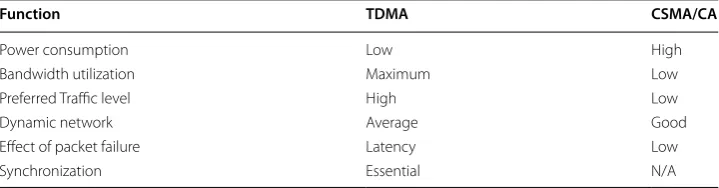
In wireless communication, the data transmission between BMSs and the body coor-dinator is scheduled with the support of scheduling access schemes [37]. It has been noticed that most of the MAC schemes use TDMA with CSMA/CA scheduling access schemes for allocating of slots in CFP and CAP periods, respectively. The high energy consumption, a higher delay, low throughput and data collision are the most challenging problems during contention for BMSs for accessing channel which degrades the perfor-mance of MAC protocol. In a similar way, TDMA-based BMSs wait and transmit data in their predefined time slots. Thus, both scheduling accessing schemes are not suitable for emergency-based BMSs due to contention and the long waiting period. Table 2 [38, 39] presents and compares different functionalities of both scheduling schemes in terms of power, bandwidth, traffic, network, packet delivery and synchronization. However, the energy consumption of CSMA/CA access scheme is higher as compared to TDMA. In fact, we can enhance the performance of both scheduling access schemes with the sup-port of network simulator 2 (NS2) [40].
Taxonomy of MAC protocols for WBANs
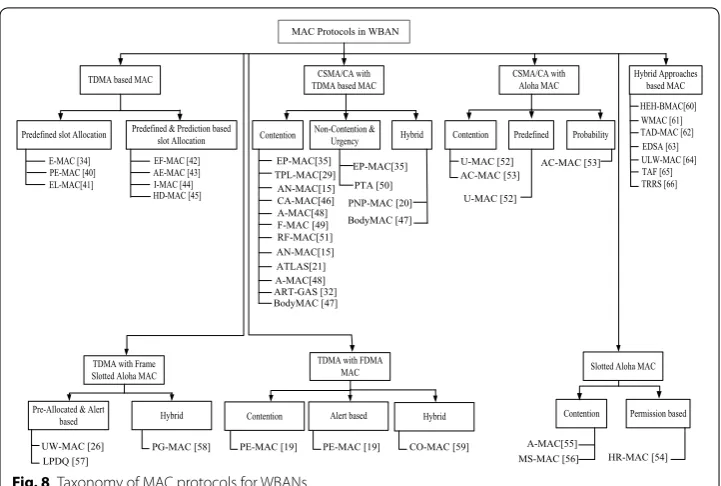
In this section, MAC protocols for WBANs have been investigated on the basis of the taxonomy presented in Fig. 8. In this taxonomy, MAC protocol designs are classified in two levels. The first level of classification contains seven categorizes of MAC proto-col designs which is based on MA schemes. The second level of classification is further divided into one, two and three sub-categories which are based on the specific slot allo-cation approach followed in the category. Each of the MAC protocols studied under tax-onomy are investigated considering Superframe structure, MA schemes, classification of the patient’s data, slot allocation process based on the classification of data and their
Table 2 Comparison of TDMA and CSMA/CA functionalities
Function TDMA CSMA/CA
Power consumption Low High
Bandwidth utilization Maximum Low
Preferred Traffic level High Low
Dynamic network Average Good
Effect of packet failure Latency Low
impact on performance parameters such as data reliability, delay, throughput, collision and energy consumption.
TDMA based MAC protocols
The TDMA based MAC protocols are divided into predefined and predefined with pre-diction based slot allocation to a patient’s data. Each BMS waits for transmitting data in the predefined time slot. During the wait period, a BMS drops data and consumes a higher energy which degrades the performance of MAC protocol. The predefined slot allocation process is not acceptable for emergency data in terms of the lower data reli-ability with a higher delay. Lots of research contributions have been made to resolve the addressed problems and are discussed different MAC protocols in the followings.
The TDMA based changeable Superframe structure comprises the Control data and Sensing data as depicted in Fig. 9 (re-drawn from [34]). The Control data contains a syn-chronization, broadcast, power detection, neighboring information upload and schedul-ing assignment slots. The Sensing data is used for synchronizing clocks of BMSs with the body coordinator before data transmission. Since, the body coordinator broadcasts the control schedule data to all BMSs for occupying different slots. These slots are ‘power
MAC Protocols in WBAN
TDMA based MAC
EP-MAC[35] TPL-MAC[29] AN-MAC[15] CA-MAC[46] A-MAC[48] F-MAC [49] RF-MAC[51] AN-MAC[15] PNP-MAC [20] ATLAS[21] A-MAC[48] CSMA/CA with TDMA based MAC
Contention Non-Contention &Urgency Hybrid Predefined slot Allocation Predefined & Prediction basedslot Allocation
E-MAC [34] PE-MAC [40] EL-MAC[41] EF-MAC [42] AE-MAC [43] I-MAC [44] HD-MAC [45] EP-MAC[35] CSMA/CA with Aloha MAC
Contention Predefined Probability
U-MAC [52] AC-MAC [53]
U-MAC [52]
AC-MAC [53]
Slotted Aloha MAC
Contention A-MAC[55] Permission based HR-MAC [54] MS-MAC [56] Hybrid Approaches based MAC
TDMA with FDMA MAC
Contention Alert based Hybrid
PE-MAC [19] PE-MAC [19] CO-MAC [59] TDMA with Frame
Slotted Aloha MAC
Pre-Allocated & Alert
based Hybrid UW-MAC [26] LPDQ [57] PG-MAC [58] HEH-BMAC[60] WMAC [61] TAD-MAC [62] EDSA [63] ULW-MAC [64] TAF [65] TRRS [66] ART-GAS [32] BodyMAC [47] PTA [50] BodyMAC [47]
Fig. 8 Taxonomy of MAC protocols for WBANs
Data Slots Sensing Data Control Data Schedule Assignment Upload Power Detection Synchronization Broadcast
1 2 N + 2 N + 3 2N + 2 2N + 5 3N + 4
detection’, ‘information uploading’ and ‘schedule assignment’. During data transmission, the body coordinator uses neighboring upload slot field for calculating the path and slot schedule which are transmitted to BMSs with the support of schedule assignment field. In this way, each node transmits data in the assigned timeslots with transmission power. However, the suggested scheme [34] uses many control fields which creates overheads for BMSs to execute all fields. The another limitation is that each sensor waits for its turn for transmitting data in the pre-allocated timeslot which is not suitable for emergency data due to a higher delay in the life-critical condition.
The suggested protocol in [41] reduces energy by using state transition with the sup-port of wake-up radio and main radio. The wakeup radio comprises of the sleep and wakeup states. The main radio contains idle (ready) state, Tx and Rx states. The default state of nodes is the sleep state. Both wake-up radio and main radio use wake-up state for periodic data (normal data) and random data (emergency data) transmission, respec-tively. The limitation of [41] is that each BMS either normal or emergency-based BMS waits and transmits data in the predefined time slot. With the waiting period degrades the performance of MAC protocol in terms of collisions, a higher delay with lower data reliability and higher energy consumption which is not appropriate for emergency data. The second limitation is that the suggested protocol does not differentiate between low and high threshold values of vital signs.
The suggested Superframe structure of MAC comprises of Control data and Sensing data as depicted in Fig. 10 (re-drawn from [42]). The control data contains a beacon, broadcast, information exchange, upload information, and schedule assignment. The sensing data field contains data slots whereas each node sends or receives data in the predefined time slot. In the beginning of communication, the beacon and broadcast are transmitted by the body coordinator to all nodes in the network for synchronization and information exchange, uploading data and schedule assignment, respectively. Since, each node calculates the transmission timeslots and sends back to the body coordinator. The calculation step is processed in the information exchange phase and upload information. In the upload information session, at a time one sensor can upload data and the body coordinator stops other sensors for sending data. However, this scheme [42] consumes a higher energy of sensors due to the outnumbers of control overheads which are used in the data transmission. The blockage of other sensors suffers the patient’s life which is not acceptable for real time health domain and also reduces the performance of MAC proto-col in terms of a higher delay with lower data reliability.
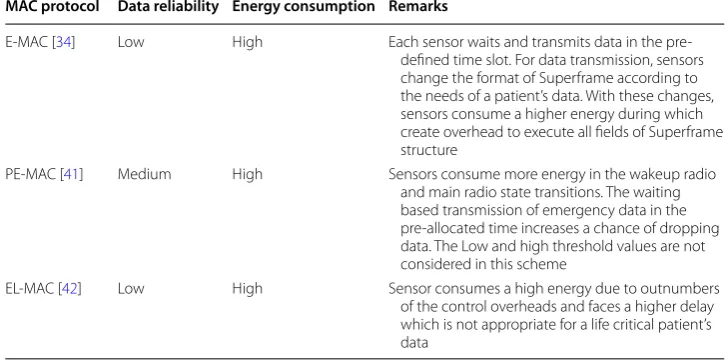
Table 3 presents the analysis of different MAC protocols in terms of data reliability and energy consumption of nodes during the long waiting period and data transmission. The predefined-based slot allocation to nodes is reducing data reliability in terms of a higher
Data Slots
Sensing Data Control Data
Schedule Assignment Upload
Broadcast Info Exchange
1 2 N + 1 N + 2 2N + 1 2N + 4 3N + 3
Beacon
delay which drops patient’s data and consumes a higher energy consumption of nodes. Therefore, the predefined scheduling schemes are suitable for non-emergency data and are not suitable for emergency data.
Predefined and prediction based slot allocation
The Medical MAC (MedMAC) protocol [43] is using TDMA scheduling access scheme and classifies the patient’s data into 0, 1 and 2 classes. The class-0 comprises of a low-grade data such as temperature and respiratory rate. The class-1 comprises of a medium-grade data such as ECG, EEG and blood pressure while class-2 contains a high-medium-grade data such as EMG, and capsule endoscope. The beacon period of the proposed MAC is used to allocate a dedicated channel to emergency data when a node detects an unpre-dictable data. During data transmission, each node transmits the request of synchroni-zation to the body coordinator. However, the synchronisynchroni-zation, the contention and does not considering the differences between low and high threshold values of two vital signs reduce the performance of MAC protocol in terms of a higher collision, and delay with low data reliability.
The allocation of a slot to nodes is based on first come first serve (FCFS) and each node requires a synchronization with the master node (MN) for data transmission [44]. Since, the monitoring node (MN) forwards the collected data of vital signs to the monitoring system (MS). The slot allocation to nodes on the FCFS approach, the emergency-based sensor drops and it is retransmitted in the extra slot (ES). This protocol [44] consumes a high amount of energy of sensor nodes during retransmission of the collided data and also does not differentiate between low and high threshold values of vital signs. Thus, these parameters reduce the performance of MAC protocol in terms of collision and higher delay with low data reliability.
The Superframe structure of MAC [45] comprises of Exclusive Access Periods (EAP-I/ II), and Random Access Periods (RAP-I/II) using Traffic types Type-I and Type-II. The EAP-I and EAP-II are used to transmit emergency data with the support of TYPE-I. The RAP-I and RAP-II are used to transmit normal/periodic data with the support Table 3 Analysis of the predefined based slots allocation
MAC protocol Data reliability Energy consumption Remarks
E-MAC [34] Low High Each sensor waits and transmits data in the pre-defined time slot. For data transmission, sensors change the format of Superframe according to the needs of a patient’s data. With these changes, sensors consume a higher energy during which create overhead to execute all fields of Superframe structure
PE-MAC [41] Medium High Sensors consume more energy in the wakeup radio and main radio state transitions. The waiting based transmission of emergency data in the pre-allocated time increases a chance of dropping data. The Low and high threshold values are not considered in this scheme
of TYPE-II. Both Types (I, II) inform the master node to allocate the slots when each node transmits data in the pre-allocated time slot. However, the master node blocks other slave nodes during data transmission of the one node in the pre-allocated time slot which consumes a higher amount of energy of other nodes in waiting. Another draw-back is that one node can upload information at a time which degrades the performance of the suggested MAC in terms of a higher delay with the higher packets drop.
The heartbeat rhythm MAC (H-MAC) protocol [46] is suggested whereas the body coordinator does not broadcast a beacon but it uses heartbeat rhythm for clock synchro-nization. The purpose of this process is to avoid periodic synchronization and achieves the minimum energy consumption without turn-on the radio signals. Moreover, the activation of radio signals is based on the heartbeat peak values (high threshold values) and valley (low threshold values) values of a patient which are associated with a blood circulation of the human body. If the blood circulation increases or decreases, the bio-sensor broadcasts a threshold value and activates the body coordinator to allocate a slot. However, this scheme [46] does not investigate the decision of slots allocation between two sensors if both sensors detect low and/or high threshold values of two vital signs at the same time and transmit to the body coordinator. This challenging problem reduces the performance of MAC protocol in terms of a higher delay and higher energy con-sumption which is not suitable in the life threatening conditions. Table 4 presents MAC protocols which are analyzing the predefined and prediction based slot allocation to BMSs. This type of slot allocation is suitable for non-emergency based BMSs because the BMSs consume minimum energy with higher data reliability. However, the main draw-back of these types of MAC protocols is that they cannot decide to allocate the slot on the priority basis between two vital signs if both sensors detect low and high threshold values and transmit to the body coordinator at the same time. Due to this challenging
Table 4 Analysis of predefined and prediction based slot allocation MAC protocol Data reli‑
ability Energy consump‑tion Remarks
EF-MAC [43] Low High Higher delay and lower data reliability have been noticed during contention of multiple nodes to access channel. This scheme is not suitable to transmit emergency data of more than one sensor at a time. In addition, it does not focus on low and high threshold values of vital signs
AE-MAC [44] Low High Retransmission of the lost packets degrades data reli-ability. Sensors consume more energy in the wait-ing state for a beacon to receive from MN which is not suitable for emergency data
I-MAC [45] Low High Nodes consume a higher energy during the waiting period to transmit data in their own turns because the master node locks the services of other slave nodes which are not suitable in case of emergency data
problem, the BMSs consume a higher amount of energy and drop sensory data due to long waiting period.
CSMA/CA with TDMA based MAC protocols
This section explains CSMA/CA with TDMA based MAC protocols in WBAN. As dis-cussed the challenging problems of IEEE 802.15.4 MAC, the [36] modifies the Super-frame structure of MAC and classifies the patient’s data into Emergency Data (ED), Periodic Data (PD), and Normal Data (ND). During contention of sensors if the channel is busy then ND-based sensor waits for a random amount of time and performs many backoffs. The PD-based sensor uses TDMA access scheme to transmit data. Further, this study uses an equation that is Priority= Data typet∗Psize which calculates the criticality levels of sensory data and differentiates between ND and PD for declaring it as ED as repre-sented by data type. The λt is the generation rate of the packet and Psize is the length of the generated data. However, the CSMA/CA and TDMA scheduling schemes reduce the performance of MAC protocol in terms of contention for emergency-based sensors due to the long waiting period during slots allocation process which is not an appropriate practice. Another limitation of this protocol does not differentiate between low and high threshold values of vital signs and also does not resolve the conflict of slots allocation if two sensors transmit the same types of data at the same time to the body coordinator.
The Priority-based Load Adaptive MAC (PLA-MAC) [29] protocol classifies the
patient’s data into Critical data Packet (CP), Reliability data Packet (RP), Delay data Packet (DP) and Ordinary Packet (OP). The CP is the first highest critical data and needs to allocate the first available channel. The RP is second the priority of data for allocat-ing channel without loss of the packet. The DP is the third priority of data which must be delivered on time. The OP is the fourth priority of patient’s data that can delay. The suggested Superframe comprises of a beacon, CAP, notification, CFP, and LPL. The CFP period is further divided into Emergency Data Transfer Slots (ETSs) and Data Transfer Slots (DTSs). At the beginning of channel allocation, all nodes perform contention to access channel in CAP period. The body coordinator allocates ETS slots to those emer-gency-based sensors who obtain a channel access in CAP period. The non-emergency based sensors can occupy ETS slots but they must perform a CCA to ensure collision-free data transmission. However, the suggested protocol [29] consumes a higher energy of sensors during contention period and does not different between low and high thresh-old values of vital signs. The contention reduces the performance of MAC in terms of a higher delay with low data reliability which is not suitable for emergency data.
DTS and updates their status. The allocation of ETS slots in the life critical conditions if all slots in DTS are not empty. The limitation of this scheme is the preemption of the non-critical data from DTS slots on the arrival of critical data which is the drawback of this scheme in terms of the preempted nodes drop data. The energy consumption of the nodes is higher due to contention and does not differentiate between critical and non-critical data to allocate a separate channel without performing of contention.
The Superframe structure of Low-delay Traffic-adaptive Medium Access Control (LTDA-MAC) [15] comprises of a beacon, fixed CAP, CFP, extended dynamic CFP and inactive sleep state. At the beginning of communication, the body coordinator broad-casts a beacon to all nodes in the network for clocks synchronization. During a channel allocation period, each node competes for a slot in the fixed CAP period along with the requesting of dynamic CFP slot from a body coordinator. The body coordinator allocates the fixed CFP and extended CFP slots to those nodes who gets a channel access in the fixed CAP slot. The limitation of this scheme is that the body coordinator transmits a notification alert to all nodes for stopping data transmission. With this stopping of data, the throughput of the MAC is reduced in the terms of a higher dropping of a patient’s data, a higher delay, and re-transmission of the dropped packet which consumes a higher energy of nodes. Thus, these issues badly reduce the performance of MAC proto-col which cannot allocate the slots to emergency data in an appropriate time.
The MAC Superframe structure of A-Traffic Load Aware Sensor (ATLAS) [26] com-prises of a beacon, CAP, CFP and IP. The sensory data is transmitted from sensors to cluster-head (S-to-CH) and cluster-head to the gateway (CH-to-G) using multi-hops. The CH synchronizes the clock with nodes during slots allocation process. The alloca-tion of slots to sensory data is based on the traffic load which is divided into low, mod-erate, high and overload traffic load. The CAP slots and IP of the Superframe structure are assigned to low load traffic. The gateway assigns CAP, IP and CFP slots to moderate traffic load. For high load data, the gateway assigns CFP and IP. While the CFP slots are assigned to overload data. In fact, the drawback of this protocol [26] is the higher delay in transmitting data to sensor-to-cluster and cluster-to-gateway which consumes a higher energy of the nodes and is not suitable in the life critical situations of a patient.
The Adaptive and Real-Time GTS Allocation Scheme (ART-GAS) [32] provides ‘ser-vice differentiation’ and ‘GTS’ slot allocation. Since, the ‘ser‘ser-vice differentiation’ offers two types of services that are based priority’ and ‘rate-based priority’. The ‘data-based priority’ devices contain emergency data and these types of emergency data allo-cate slots on the priority basis. The rate-based priority means data is generated recently with a high rate and needs a higher attention to transmit it. In this suggested protocol, each device is configured with different priorities such as CSMA/CA hit-miss and GTS hit-miss. These two priorities are used to avoid the wastage of the GTS slots. However, the contention consumes more energy of emergency-based sensors and reduces the per-formance of MAC protocol with lower data reliability in terms of collision, delay and retransmission of the collided packets.
channels when outnumbers of nodes are the alarming situations. For periodic and nor-mal data, the NTDMA slots are occupied. The following steps are used for allocating of a slot to emergency data as follows:
1. The emergency-based node tries during contention to transmit emergency data in CAP slots. However, the successful rate of emergency data transmission in CAP slot is comparatively very low because the normal-based nodes also perform contention. 2. In the case of failure, the particular node informs the hub in ES slot about an
alarm-ing situation. The collision may also occur in ES slot due to the multiple requests transmitted by other nodes.
3. In these situations, the nodes drop the packets if data transmission counter is reached to the maximum threshold values.
The drawback of this protocol [46] is high energy consumption during contention to access channel whereas the dropping ratio of packets of nodes exceed. Another limi-tation is that the proposed protocol changes the order of fields of the proposed MAC Superframe structure which creates overheads for emergency data.
The suggested BodyMAC protocol [47] comprises of a beacon, downlink and uplink. The downlink is used for a unicast, broadcast message, and control command. The uplink is used for CAP and CFP slots for sending data to the gateway. The suggested pro-tocol maintains ‘control-bandwidth’ and ‘data-bandwidth’ requests. The ‘control-band-width’ request is used by a node when a node contains more than one control packets and wants to transmit to the gateway. Similarly, the ‘data-bandwidth’ request generates by the sender node and transmits it to the gateway. The bandwidth of slots is divided into’ burst bandwidth’, ‘periodic bandwidth’, and ‘adjust-bandwidth’. The ‘adjust-band-width’ is assigned to nodes on-demands while other types of bandwidth are assigned to nodes on the temporary basis. However, this protocol [47] consumes a higher energy during contention to access channel which is not suitable for a patient’s data due to per-mission-based transmission and reception. The overall performance is not satisfactory in terms of a high energy consumption and low data reliability.
The suggested MAC Superframe structure of an Adaptive MAC (A-MAC) [48]
con-tains a beacon/synchronization, CFP, CAP, guard-band, and time slot [48]. The suggested protocol uses data and control packets. The data packets contain the patient’s data and the control packets contain the channel packet, Time Slot Request (TSR), TSR Reply (TSRR), Synchronization Acknowledgment (SYN-ACK), Data Request (DR) packet, and ACK (acknowledgment). During data transmission, the nodes transmit the TSR packet to the coordinator node (CN) for the allocation of slots. On the successful allocation of slots, the CN replies with a TSRR to nodes. Further, the node transmits a request of SYN-ACK for allocating of slots if a node needs a slot before the predefined timeslot. The DR assists in transmitting on-demand data. However, the suggested A-MAC does not allocate dedicated slots to emergency data and consumes a higher energy of BMSs dur-ing contention to access channel. The control packet creates overheads and degrades the performance of MAC in terms of collision and delay with lower data reliability.
The Fuzzy Control Medium Access (FCMA) [49] implements acquisition, fuzzy
real-time data, abnormal data, and emergency data of a patient body. The data acquisi-tion phase is used to collect data from the deployed sensors. When a body coordinator receives the patient’s data then it uses the fuzzy rules to decide whether to assign CAP or CFP slots. This activity is performed under the fuzzy logic control phase. In the CAP period, the fuzzy rules manage the Contention Window Size for priority data and data rate. The priority data represents the patient’s data such as normal, abnormal and emer-gency. While data rate represents the severity of a patient’s data such as low, medium and high. The suggested mechanism is suitable for emergency data, but sensors con-sume a higher amount of energy during contention to access channel. The sensory data is delayed during the decision making for allocating of slots to sensors.
The Priority-based adaptive Timeslots Allocation (PTA) protocol [48] divides the CAP slots into phase-1, phase-2, and phase-3 timeslots. The phase-1 slot is assigned to emer-gency data and is represented by C1 (critical). The phase-2 slot is assigned to contin-uous and discontincontin-uous data and is represented by C2. In the same way, the phase-3 slot is assigned to an audio/video data and is represented by C3. The allocation of CAP timeslots to the phase-2 and phase-3 based traffic depends on contention of nodes. The phase-1 slot is occupied for emergency traffic and cannot occupy by any other type of traffic. The drawback of this protocol is higher energy consumption during contention of nodes for accessing channel which is not suitable for emergency data in terms of a higher delay with lower data reliability.
The Radio Frequency Identification (RFID) based MAC (R-MAC) protocol classifies the patient’s data into emergency and routine data [51]. The emergency and routine-based sensors perform contention to access channel using CSMA/CA access scheme. Moreover, the suggested MAC Superframe structure comprises of a Configurable CAP (CCAP) slot, CFP guaranteed slots, and IP or LPL. During emergency data, the sensor will perform contention and will wait for a clear channel access. Since, the body coor-dinator allocates CFP slots to those nodes who gets a channel access in CCAP period. However, there is no slot allocate during alarming situations and each sensor contends to access channel. In these situations, the performance of the suggested protocol is reduced in terms of a higher delay with higher energy consumption.
Table 5 investigates the techniques used for slot allocation to sensors that are con-tention, non-concon-tention, and urgency. The patient’s data are categorized into different classes and each type of a patient’s data performs contention for accessing channel in CAP period. The body coordinator allocates slots of the CFP period to those nodes who obtains a channel access in CAP period. With this contention, the energy consumption of nodes is high which reduce data reliability. In TDMA-based approach, each node waits for transmitting data in the predefined time slot. Both types of scheduling access schemes are not optimal solutions for emergency data. Hence, the optimal solution is that the emergency-based node should transmit an alert signal in the guaranteed time slot for allocating of slot without contention. With this type of data transmission avoids the conflict of the priority-based slot allocation between two vital signs.
CSMA/CA with Aloha based MAC protocols
This section describes the hybrid scheduling access schemes which are the combination
Table 5 Analysis of CSMA/CA with TDMA based slot allocation MAC protocols MAC protocol Data reliability Energy consumption Remarks
EP-MAC [36] Low High Sensors consume a high energy during contention. The high delay is noticed due to the clock synchronization which is not suitable for emergency data. Another limitation of not differentiating between low and high threshold values of vital signs
TPL-MAC [30] Low High All sensors perform contention for accessing channel in CAP period which effects data reliability and consumes a higher energy of nodes which is not an appropriate solution in the life critical situation
PNP-MAC [25] Low High Sensors consume a high energy when they contend for slots in CAP. Preempts other data on the arrival of high priority data from the allocated slots which reduces the performance of data reli-ability due to preemption and sensors consume more energy
AN-MAC (LTDA-MAC) [23] Low High Nodes consume a high energy during contention to access channel. Notify other nodes to terminate data transmis-sion if there is no empty slot available in CFP which is not an appropriate solution for emergency data ATLAS [26] Low High Allocation of slots depends on the
traf-fic load. The higher delay is faced to transmit data from sensors-to-cluster and cluster-to-gateway. This process consumes a high amount of energy which is not suitable for emergency data in terms of outnumbers of emer-gency data
ART-GAS [32] Low High The different classification of a patient’s data is represented by low, middle, and high. The suggested MAC does not define the priority to allocate dedicated slots in the alarming situations. With this shortcoming, the performance of the suggested MAC is reduced CA-MAC [47] Low High High energy consumption is noticed due
to contention and data collision which affects the performance of slots alloca-tion to emergency data in the alarming situation
Body-MAC [49] N/A High Sensors consume a high energy during contention to access channel and is not suitable for the nature of a patient’s data due to permission-based slots allo-cation and data transmission. Gateway is always ACTIVE which also consumes a high energy
assign priority-based slots to the critical data as compared to non-critical data. The Slot-ted Aloha channel access method is used with the support of an enabled-beacon con-trol. At the beginning of data transfer, each node allocates a timeslot whereas a node can transmit critical and non-critical data. Therefore, ‘G’ is the total number of packets which are ready for transmission at the initial time slot as described as G= xx==X1n=rx
n=0 Cxn
[53]. Where ‘x’ is the traffic index, ‘n’ is the retransmission of the lost traffic and its range is from 1, 2, 3 to rx. The Cxn is the number of critical and non-critical patient’s data in the packet. The X (capital) is the supported traffic classes of the Cnx whereas G is the success-ful packet delivery transmission which must be equal to 1. However, each node transmits critical and non-critical data in the pre-allocated time slots which reduce data reliability with higher data collision. Another limitation is nodes consume a higher energy during contention and reduces the performance of MAC protocol.
A cross-layer based IEEE 802.15.6 Superframe structure is employed for transmit-ting the patient’s data on the reliable and an efficient path [54]. The proposed protocol is developed for extended star topology and divides the patient’s data into Emergency data (EM), Delay Sensitive packets (DS) and General Monitoring packets (GM). The body coordinator allocates the slots EAPI and EAPII to EM and DS-based sensors dur-ing data transmission, respectively. GM-based sensors employ RAP (I,II) and CAP slots for data transmission. The slot allocation priority to EM is highly preferred as compared to other two types of data which consume minimum energy. However, the data deliv-ery reliability for EM suddenly goes down when all BMSs continuously transmit data. Another limitation is that this protocol [54] does not discuss threshold values of vital signs. Table 6 presents the analysis of CSMA/CA with aloha based slot allocation to sen-sory data. The contention and predefined based slot allocation reduce data reliability and consume a higher amount of energy of nodes due to collision and a long wait, respec-tively. However, the probability based slot allocation reduces contention and avoids pre-defined time slots. With this optimal solution, the energy consumption is reduced, but it does not solve the conflict of slots between two emergency-based nodes. Hence, the Table 5 continued
MAC protocol Data reliability Energy consumption Remarks
F-MAC [51] Low High Sensors consume more energy during contention to access channel. The rules based assignment of the GTS slots produces a higher delay during the verification of different conditions PTA [48] Low High The reserved slots for emergency-based
BMSs cannot assign to non-emergency based BMSs if these are empty. This limitation wastes resources in terms of higher number of collisions of the packets, delay with lower data reliability and BMSs consume more energy RF-MAC [52] Low High Nodes perform contention to access
recommended solution is to allocate dedicated slots to low and high threshold values of vital signs without interrupting the contention of other nodes.
Slotted Aloha based MAC protocols
An urgency based Distributed Queuing Body Area Network (DQBAN) MAC protocol [55] is suggested with Collision Resolution Queue (CRQ) and Data Transmission Queue (DTQ). The CRQ provides a channel access to those sensors which has emergency data of vital signs. While DTQ is employed to allocate collision-free channels to emergency sensors. The suggested protocol uses fuzzy logic rules in helping to specify the criticality level of vital signs and residual energy of a node. The drawback of [55] is that it cannot decide to allocate slots between two sensors if both detect the same types of emergency data at the same time.
The suggested Superframe structure of MAC protocol comprises of a beacon, emer-gency access period (EAP), normal access period (NAP), guaranteed access period (GAP) and acknowledgement [56]. The EAP period is associated with uplink and down-link. The uplink is employed to transmit data from BMSs to the body coordinator. The downlink is employed to transmit data between the body coordinator and BMSs. During an emergency situation, the BMSs transmit a message to EAP period using contention and the coordinator replies back with the allocation of GAP slots. However, the energy consumption of this scheme [56] increases if more BMSs are added to the network which affects the data reliability in terms of higher data delay and collision.
The Discrete Time Markov Chain mode is employed together with Slotted Aloha slots in the non-saturated conditions which can access finite number of BMSs (users) [57]. The slot allocation to the higher priority BMSs is given a higher ranking as represented by CPmax [57]. The data reliability degrades with higher data collision if more BMSs con-tend to access a slot. However, this scheme does not concentrate on the patient’s data and energy consumption of BMSs is high during contention. Most of the MAC schemes allocate slots on the basis of contention as depicted in Table 7. The slot allocation conflict is the same challenging problem as noticed in this analysis. Thus, the permission-based slot allocation is an optimal solution to reduce the energy consumption and supports to increase data reliability.
Table 6 Analysis of CSMA/CA with Aloha based slot allocation MAC protocols MAC protocol Data reliability Energy consumption Remarks
U-MAC [53] Low High The slot allocation is based on the contention and predefined time slot. The energy consumption is high which degrades the data reliability in terms of a higher delay with collision and does not acceptable for critical data
TDMA with Frame Slotted Aloha based MAC protocols
The following contributions design the MAC protocol in WBAN which are based on TDMA with Frame Slotted Aloha (FSA) scheduling access schemes. The Traffic adaptive MAC (TaMAC) protocol [28] is suggested to handle normal data, emergency and on-demand data. The suggested Superframe structure comprises of CCAP and CFP periods. The CCAP provides Mini-slots to transmit data in the short duration. In the TaMAC protocol, the wake-up of traffic-pattern is employed for non-emergency data. While wake-up radio is employed for emergency and on-demand traffic. In an emergency situ-ation, the sensor transmits an alert signal to the body coordinator and the body coordi-nator replies with allocation of a channel. The energy consumption is low but sensors wait to transmit data in their predefined time slot which is the drawback of this protocol [28] due to outnumber of states in the state-transaction diagram. Another limitation is that the predefined based slot allocation to normal and emergency data is not acceptable due to the long wait where sensors drop data.
The Low-Power Distributed Queue (LPDQ) [58] scheme uses LPL, Distributed Queue (DQ) and Channel Hopping (CH) for ensuring the collision-free transmission, minimize the delay and reduce energy consumption. The suggested protocol comprises of net-work synchronization and data transmission phases [58]. In the network synchroniza-tion phase, all nodes are in LPL state whereas they periodically wake up and turn-on their radios to assure activities in the network. The DQ and CH are employed in the data transmission phase. The data transmission phase provides a fixed time structure where all nodes must transmit their packets by using an access request period (ARP). However, each sensor transmits an ARP message and waits to occupy channel which reduces the performance of MAC in terms of higher delay, ACK, retransmission of the lost packets, and high energy consumption. Another limitation of this scheme does not concentrate on a patient’s data.
The MAC Superframe structure of [59] comprises of active and inactive parts whereas body coordinator divides channels into application-specific control and traffic-specific data channels. The active part is further divided into a beacon, timeslot-has reserved for periodic traffic (TSRP), timeslot-has reserved for bursty traffic (TSRB), control channel access (AC) AC1 and AC2 as shown in Fig. 11 (re-drawn from [59]). The uplink chan-nels AC1 and AC2 are used to transmit medical and consumer electronics (CE) data, respectively using slotted-Aloha access scheme. In the life-critical situation, the body Table 7 Analysis of Slotted Aloha based slot allocation MAC protocols
MAC protocol Data reliability Energy consumption Remarks
HR-MAC [55] High Average The energy consumption is minimum and allocates error-free slots to BMSs. The drawback is that it cannot decide a slot allocation if the same types of two emergency data occurred at the same time A-MAC [56] Low High The contention-based slot allocation and does not
specify the patient’s data in this scheme. The data reliability is reduced if more BMSs are added to network
coordinator assigns AC1 channel to the high priority data. For contention-based slot allocation, the body coordinator calculates how many nodes are performing contention as described in N=min{NLf, N} [59]. Where N is the total available nodes, λ is the traffic average arrival rate, and Lf is the waiting duration for the next announcement of Superframe. However, the suggested MAC protocol [59] consumes a higher amount of energy of sensors during maintaining the sessions of control ad data channels which cre-ates overheads. The second limitation is that this scheme does not define low and high threshold values of vital signs.
The long waits of BMSs in the predefined timeslots drop the patient’s data and BMSs consume more energy in this period as described in Table 8. These types of BMSs are instructed to wake up periodically and verify events in the network. However, the desir-able solution is to transmit an alert command to the body coordinator during emergency situation where this process assists to resolve the conflict of slot allocation between two vital signs.
TDMA with FDMA based MAC protocols
This section presents different MAC protocols with combination TDMA and FDMA scheduling access schemes. The table-based wakeup for normal data and the radio-chip based wakeup for emergency data are introduced [24]. The patient’s traffic is classified into normal, on-demand and emergency data. With radio-chip wake up of on-demand and emergency sensors transmit request for slots allocation with few conditions. First, the body coordinator transmits a wake-up authentication code (WAC) packet to emer-gency and on-demand traffic sensors, respectively. Second, the particular sensor com-pares the received WAC packet with its own generated WAC packet. Third, if the data packets of both are matched, then data communication link is established and updates the counter. Fourth, if WAC code does not match or sensors do not have enough energy
TSRP AC1 AC2 TSRB Inactive
Beacon CFP1 CAP CFP2
Fig. 11 Priority based Superframe structure
Table 8 Analysis of TDMA with Frame Slotted Aloha based Slot allocation MAC protocol Data reliability Energy consumption Remarks
UW-MACs [28] Average Low Does not different between low and high threshold values and drops emergency data if other types of sensors occupy slots. Each node waits to transmit data in its predefined time slot
LPDQ [58] Low High Each sensor transmits an ARP and waits for the chan-nel which increases delay. The sensors re-transmit the packet, and wakes up periodically to verify any activity in the network which consumes a higher energy
to transmit their data, then both on-demand and emergency-based sensors drop data. However, this authentication process is the expensive practice in the life-critical alarm-ing situations whereas sensors consume a higher energy and drop the life-threatenalarm-ing data.
The suggested MAC [35] uses TDMA with FDMA and provides two channels during data transmission from BMSs to the body coordinator. The TDMA scheduling access scheme is implemented on the distributed algorithm and provides control and data sec-tions. The body coordinator uses a control section which supports a beacon to transmit in the network for synchronization. With this synchronization, the body coordinator allocates slots to BMSs. The BMSs transmit data in the data section when they receive a slot allocation message from the body coordinator. The FDMA divides slots into differ-ent frequencies and time-slots for data transmission. The suggested protocol [35] does not consider the patient’s data but energy consumption is minimized with collision-free data transmission. Table 9 shows that non-emergency based nodes use contention and emergency-based nodes transmit alert commands for informing the body coordina-tor in the life-threatening conditions. The energy consumption and data reliability are achieved with these processes because the patient’s data are categorized and each type of data is transmitted in the required slot. Further, an alert based data transmission avoids contention and consumes minimum energy but it does not resolve the slot conflict dur-ing allocation to emergency data if both types of a patient’s data are the same status. For example, if a node H detects low threshold values of a heartbeat and a node R detects the high threshold value of the respiratory rate. In this situation, both nodes inform the body coordinator at the same time and the body coordinator cannot decide which of them should give a higher and lower priority to allocate slots.
Hybrid approaches based MAC protocols
The hybrid based MAC protocols design new scheduling access schemes for allocating slots to different types of a patient’s data. This section explains each hybrid approach in the following subsections.
Polling and contention‑based slot allocation
The Human Energy Harvesting Medium Access Control (HEH-BMAC) protocol is sug-gested with objectives to re-charge the batteries of wireless nodes from the harvesting
Table 9 Analysis of TDMA with FDMA based slot allocation MAC protocols MAC protocol Data reli‑
ability Energy consump‑tion Remarks
PE-MAC [24] High Low The energy consumption of BMSs is low and provides a higher data reliability due to distribution and allocation of the separated channels to each type of a patient’s data