T E C H N I C A L N O T E
Open Access
Total knee arthroplasty using a hybrid navigation
technique
Alvin Ong
1, Kwang Am Jung
2*, Fabio Orozco
1, Lawrence Delasotta
1and Dong Won Lee
3Abstract
The use of computer navigation is becoming a well-recognized technical alternative to conventional total knee arthroplasty (TKA). However, computer navigation has a substantial learning curve and the use of commercially available navigation systems increases surgical time. In addition, the potential risks associated with the navigation TKA, such as, registration errors, notching of the anterior femoral cortex, oversizing of the femoral component, and overresection must be taken into consideration. On the other hand, conventional techniques are familiar and intuitive to most practicing surgeons, and thus, are easier to perform and are less prone to anterior notching and femoral component oversizing. However, conventional techniques have greater risks of inaccurate and inconsistent component alignment than computer navigation. This paper describes a novel technique that combines computer navigation and conventional TKA.
Introduction
The use of computer navigation for primary total knee arthroplasty (TKA) provides the benefits of accurate bone resection, low outlier frequencies, and the restora-tion of overall mechanical alignment. However, its use also involves the disadvantage of change in technique and workflow that have been associated with steep learning curve and increased surgical time. Furthermore, several investigators have described the potential risks associated with the use of navigation, which include registration errors, notching of the anterior femoral cor-tex, oversizing of the femoral component, and overre-section [1-4]. These risks mean that surgical plans provided by navigation software might require modifica-tion intra-operatively, based on the surgeon’s experience and knowledge. On the other hand, conventional TKA has the advantages of familiarity and simplicity. Further-more, decisions regarding bony resection level are based on measurements taken using a traditional jig and rod, and thus, anterior notching and femoral component oversizing can be avoided. Unfortunately, the conven-tional technique is more inaccurate and inconsistent in terms of its component alignment ability than computer navigation [5,6]. In this paper, we describe a hybrid
technique that combines the benefits of computer navi-gation and conventional TKA. This hybrid navinavi-gation technique was developed to allow TKA to be performed in-line with accepted conventional TKA practice, but with the accuracy of computer navigation.
Methods
Indications & Contraindications
The devised hybrid navigation technique was indicated for all 3500 knees that underwent TKA at our institute between Jan 2007 and April 2010. In no case was the hybrid navigation technique deemed to be contraindi-cated, and the procedure was not aborted intraopera-tively in any case. With regard to contraindication, in theory, hardware in the distal femoral metaphysis and diaphysis that might interfere with intramedullary rod placement would pose the only potential contraindica-tion to the use of the technique.
Preoperative Planning
No special preoperative planning was performed before hybrid navigation. In our practice, we routinely obtain standing anteroposterior (AP), posteroanterior (PA) and lateral radiographs for all patients scheduled for TKA. These images provide an overall picture of deformities present and of the corrections necessary. In addition, they provide information on the presence of hardware, extra-articular deformity, and bone loss. The goal of * Correspondence: [email protected]
2
Joint and Arthritis Research, Department of Orthopaedic Surgery, Himchan Hospital, 404-3, Mok-dong, Yangcheon-gu, 158-806, Seoul, South Korea Full list of author information is available at the end of the article
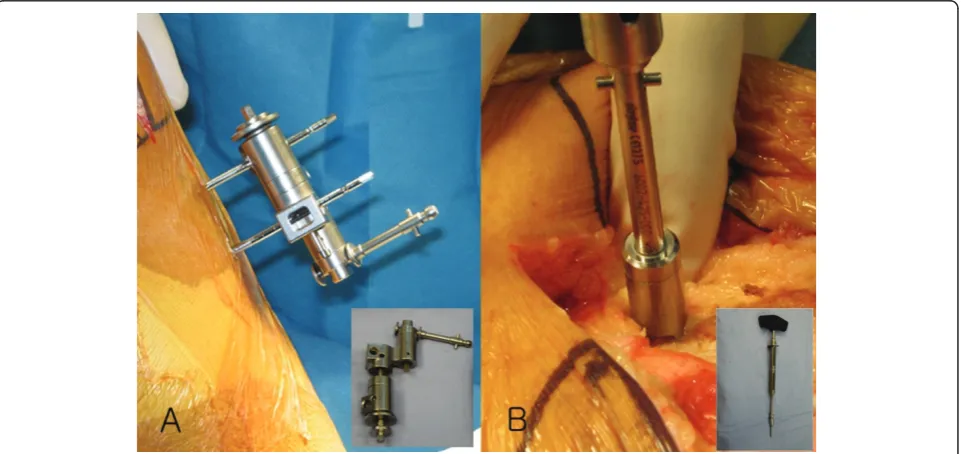
The implants used were the Triathlon implant (Stryker; Mahwah, NJ, USA) and the Genesis II total knee implant (Smith & Nephew; Memphis, USA). A medial parapatellar approach and an anterior-referencing tech-nique were used in all cases, and all implants were cemented. The navigation computer is best positioned opposite the surgeon approximately 4 feet away from the patient. The camera is located over the patient’s knee and directed downward at 45 degrees. Prior to exsanguination of the limb and incision, navigation trackers (light emitting diode) were fixed to both the distal femur and proximal tibia. Two 3 mm Apex pins were utilized on the distal femoral metaphysis and prox-imal tibial metaphysis in conjunction with the Stryker OrthoLock System (Stryker, Kalamazoo, Michigan, USA) (Figure 1). We recommend that these pin clusters be placed approximately 10 cm distal to the joint line in the proximal tibia, such that they do not interfere with the surgical incision or the operative field. Likewise, we recommend that pin clusters be placed approximately
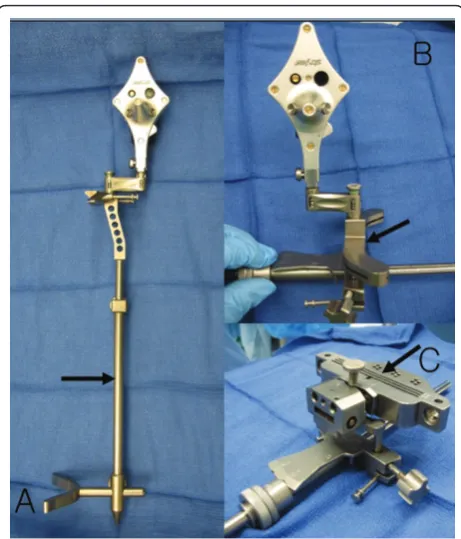
the intramedullary rod.) Care must be taken to ensure that the femoral and tibial trackers are positioned in direct view of the navigation camera. In all cases, a stan-dard extramedullary tibial cutting guide, an intramedul-lary distal femur alignment guide, a femoral rotation cutting guide, and a navigation-enhanced distal femoral cutting block (Stryker, Mahwah, NJ., USA)(Figure 2, 3) were utilized; each of these instruments was modified to allow them to accommodate a navigation tracker. A tracker was attached to navigation enhanced femoral rotation cutting guide and navigation enhanced conven-tional distal alignment guide with distal femoral resec-tion pivotal cutting block (Figure 2,3) The convenresec-tional femoral intramedullary rod (Figure 4) was shortened by 25 cm to avoid interference with the tracker pin on the femoral side. In terms of surgical steps, the centers of the femoral head, knee joint, and ankle joint were iden-tified, and then surface mapping of anatomic landmarks of the knee was performed. After the anatomical survey, navigation of the femoral and tibial bone resection was
performed using Stryker software (eNact Knee Naviga-tion Software 3.1). The navigaNaviga-tion system had axis and alignment incremental changes of 0.5 degree and the resection level and height in millimeter increments. The modified conventional tibial guide with a tracker was
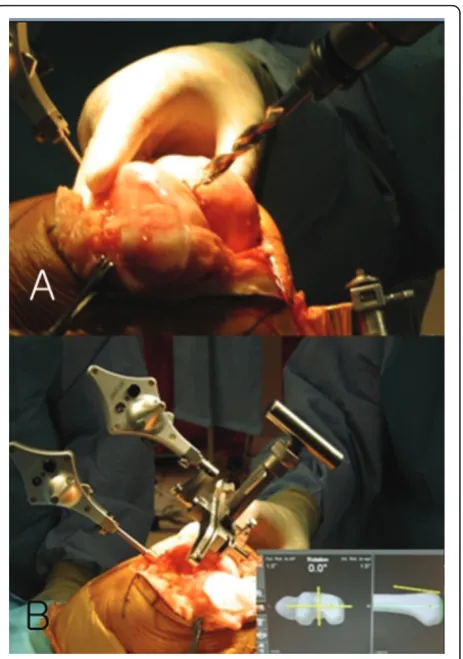
first fixed to the tibia; resection height and tibial slope were controlled manually under navigation guidance (Figure 5). After completing the tibial resection, a“ start-ing” hole was created in the distal femur for IM rod insertion (Figure 6). This“starting” hole was made just above the notch centered between the lateral and medial condyle. A modified short IM rod with a conventional distal alignment guide and tracker was then inserted into the opening. The femoral component rotational axis was controlled under navigation guidance using a tracker connected to the anterior femoral cutting jig (Figure 6). Rotation is based off the transepicondylar axis. After determining femoral component rotation, an anterior rough cut was performed using the conven-tional jig-based technique. Subsequently, the distal femoral resection pivotal cutting block was connected to the conventional distal femur alignment guide. The resection level and the exact position of distal femoral resection were controlled and “fine-tuned” using a Figure 2Standard extramedullary tibial cutting guide (A,
arrow), intramedullary distal femur alignment guide with a femoral rotation cutting guide (B, arrow), and a distal femoral cutting block (C, arrow) were modified to accommodate a navigation tracker.
Figure 3Navigation enhanced femoral rotation cutting guide (arrow) and a navigation enhanced conventional distal alignment guide with a distal femoral resection pivotal cutting block (arrowhead) were attached to the conventional distal alignment guide as shown (A,B).
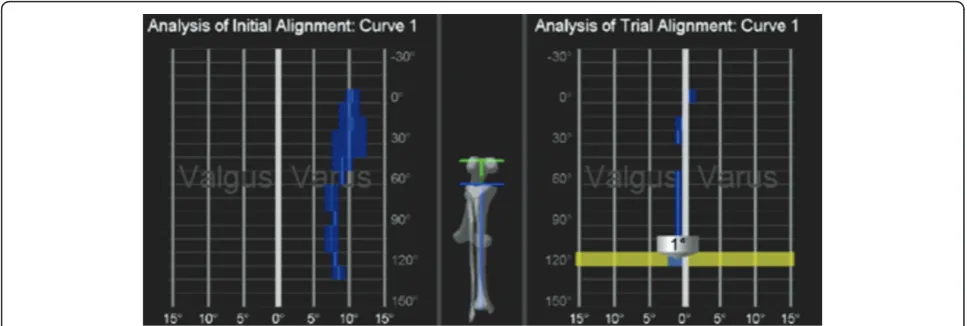
screwdriver (Figure 7). Flexion of the distal femur was set at approximately 3-5 degrees using the IM rod to accommodate femoral bow. After performing the distal femoral cut, the anterior/posterior and chamfer cuts were completed using a selected system-specific 6-in-1 or 4-in-1 femoral cutting block. Depending on the bal-ance of flexion and extension gaps, minimal bone adjustment was carried out under navigation guidance. After trial reduction, tibio-femoral mechanical alignment in knee extension and flexion were recorded and their kinematic curves were compared with preoperative tibio-femoral mechanical alignment. (Figure 8) After every surgical step, the accuracies of bone cuts were assessed with the aid of the navigation system and a resection plane probe. Cuts were corrected as necessary if they were deemed to be outside the acceptable range. After confirming their accuracies and soft tissue balance, real components were implanted with cement using the standard technique.
Brief Results
More than 3500 knees underwent primary total knee replacement from Jan 2007 to April 2010. The first 50 Figure 5The modified conventional tibial guide with a tracker was first fixed to the tibia. Resection height and tibial slope were controlled manually under navigation guidance.
Figure 6A“starting”hole was created in the distal femur for IM rod insertion (A). The femoral component rotational axis was controlled under navigation guidance using a tracker connected to the anterior femoral cutting jig (B).
knees treated (mean age 65.2 years) and the last 50 knees treated (mean age 64.3 years) were compared with respect to surgical time and component alignment to assess the effects of the learning process. Coronal and sagittal alignments of femoral components for the first 50 knees were mean valgus 0.5°and mean flexion 3.5° and these values were similar for the last 50 knees (mean valgus 0.2° and mean flexion 3.6°). For tibial com-ponents of the first 50 knees, mean coronal and sagittal alignments were valgus 0. 3° and flexion 2.5°, and these were also similar for the last 50 knees (mean valgus 0.3° and mean flexion 2.7°). Overall mechanical alignments for the first and last knee groups were mean varus 1.5° and 1°, respectively, and mean operation times (skin incision to skin closure) were 61 and 50 minutes, respectively. There were three cases of tibial fracture attributed to a tracker pin, but these fractures were con-sidered to be related to general concerns of navigation TKR, and not to a system-specific problem. Ten cases developed a superficial infection at a tracker pin site, but no case of fat embolism occurred.
Discussion
Computer navigation is becoming a well-recognized technical alternative to conventional total knee replace-ment, but its merits and demerits continue to be widely debated [7-11]. Computer navigation has the disadvantages of a protracted learning curve and increased surgical time [11] In addition, several investi-gators have suggested that navigation might increase the risks of notching of the anterior femoral cortex and oversizing of the femoral component. In particular, Minoda et al. [3] found that 40-85% male cases and 65-100% of elderly female cases treated with navigation showed anterior notching. Matsumoto et al. [2] sug-gested that surgeons should be aware of the potential
technique increases the accuracy of component align-ment versus the conventional technique and requires less time than navigation technique. Furthermore, our findings indicate that hybrid technique does not require a protracted learning process. In addition, no case of fat embolism was encountered. Accordingly, we believe that the described hybrid navigation technique enables TKA to be conducted safely and precisely without femoral notching or femoral component oversizing.
Conclusion
Considering several manufactures’ navigation systems with their own successful benefits, We do not present the devised hybrid navigation technique as a definitive method for navigation TKR. Nevertheless, we believe that this technique should be considered as an alterna-tive means of conducting navigation TKR.
Consent
All authors certify that the human research protocol used during this investigation was approved by our insti-tution and that all investigations conducted during this study conformed with ethical research principles.
Author details
1Department of Orthopaedic Surgery, Rothman Institute, New Jersey, USA. 2
Joint and Arthritis Research, Department of Orthopaedic Surgery, Himchan Hospital, 404-3, Mok-dong, Yangcheon-gu, 158-806, Seoul, South Korea.3The
Webb School of California, CA, USA.
Authors’contributions
AO and KAJ conceived the project, conducted the primary literature review and drafted the manuscript. FO, LD, and DWL contributed to the literature review, the manuscript preparation, and provided the photographs. All authors read and approved the final manuscript.
Competing interests
Alvin Ong is a consultant for Stryker Orthopaedics (Mahwah, NJ). All the other authors have no competing interests.
Received: 23 October 2010 Accepted: 26 May 2011 Published: 26 May 2011
References
1. Delp SL, Stulberg SD, Davies B, Picard F, Leitner F:Computer assisted knee replacement.Clin Orthop Relat Res1998,354:49-56.
7. Anderson KC, Buehler KC, Markel DC:Computer assisted navigation in total knee arthroplasty: comparison with conventional methods.J Arthroplasty2005,20(Suppl 3):132-138.
8. Bathis H, Perlick L, Tingart M, Lüring C, Zurakowski D, Grifka J:Alignment in total knee arthroplasty. A comparison of computer-assisted surgery with the conventional technique.J Bone Joint Surg Br2004,86:682-687. 9. Bolognesi M, Hofmann A:Computer navigation versus standard
instrumentation for TKA: a single-surgeon experience.Clin Orthop Relat Res2005,440:162-169.
10. Kim YH, Kim JS, Yoon SH:Alignment and orientation of the components in total knee replacement with and without navigation support: a prospective, randomised study.J Bone Joint Surg Br2007,89(4):471-476. 11. Yau WP, Chiu KY, Zuo JL, Tang WM, Ng TP:Computer navigation did not
improve alignment in a lower-volume total knee practice.Clin Orthop Relat Res2008,466(4):935-945.
12. Caillouette JT, Anzel SH:Fat embolism syndrome following the intramedullary alignment guide in total knee arthroplasty.Clin Orthop Relat Res1990,251:198-199.
13. Dorr LD, Merkel C, Mellman MF, Klein I:Fat emboli in bilateral total knee arthroplasty. Predictive factors for neurologic manifestations.Clin Orthop Relat Res1989,248:112-119.
14. Kim YH, Kim JS, Hong KS, Kim YJ, Kim JH:Prevalence of fat embolism after total knee arthroplasty performed with or without computer navigation.
J Bone Joint Surg Am2008,90(1):123-128.
doi:10.1186/1749-799X-6-26
Cite this article as:Onget al.:Total knee arthroplasty using a hybrid navigation technique.Journal of Orthopaedic Surgery and Research2011 6:26.
Submit your next manuscript to BioMed Central and take full advantage of:
• Convenient online submission
• Thorough peer review
• No space constraints or color figure charges
• Immediate publication on acceptance
• Inclusion in PubMed, CAS, Scopus and Google Scholar
• Research which is freely available for redistribution