DOI 10.1007/s12651-012-0119-5 A RT I C L E
The effect of housework on wages in Germany: no impact at all
Boris Hirsch·Thorsten Konietzko
Accepted: 16 September 2012 / Published online: 10 October 2012 © Institut für Arbeitsmarkt- und Berufsforschung 2012
Abstract This paper presents evidence on the impact of hours spent on housework activities on individuals’ wages for Germany using data from both the German Socio-Economic Panel and the German Time Use Survey. In con-trast to most of the international literature, we find no nega-tive effect of housework on wages. This holds for men and women, for married and single individuals, and for part-time and full-part-time workers both in West and East Germany. Our insights do not change when we distinguish different types of housework activities or address the endogeneity of housework in our wage regressions by using instrumental variables estimators.
Keywords Housework·Time use·Gender pay gap·
Germany
JEL Classification J16·J31·J22
Der Einfluss von Hausarbeit auf die Löhne in Deutschland
Zusammenfassung Auf Grundlage zweier deutscher Da-tensätze, des Sozio-oekonomischen Panels und der Zeitbud-geterhebung, untersucht dieser Beitrag den Einfluss der für Hausarbeit aufgewandten Zeit auf die Löhne. Im Gegensatz zum Gros der internationalen Forschungsliteratur findet sich kein negativer Effekt der Hausarbeit auf die Löhne. Dieses Ergebnis zeigt sich in West- wie Ostdeutschland sowohl für
B. Hirsch (
)·T. KonietzkoUniversity of Erlangen-Nürnberg, Chair of Labour and Regional Economics, Lange Gasse 20, 90403 Nürnberg, Germany e-mail:[email protected]
T. Konietzko
e-mail:[email protected]
Frauen und Männer, für verheiratete Individuen und Singles als auch für Teilzeit- und Vollzeitbeschäftigte. Unsere Er-gebnisse ändern sich zudem nicht, wenn wir verschiedene Formen von Hausarbeit unterscheiden oder die Endogenität der geleisteten Hausarbeit in den Lohnregressionen mithilfe von Instrumentvariablenschätzungen berücksichtigen.
1 Introduction
It is well known that women are more engaged in house-work activities than men (e.g., Burda et al.2008; Maani and Cruickshank2010) and that there is also a considerable gen-der pay gap with women earning significantly less than men (e.g., Altonji and Blank1999; Weichselbaumer and Winter-Ebmer2005). It is, however, less known how the amount of time spent on housework activities affects workers’ wages. If housework has a negative impact on wages, the gender difference in time spent on housework activities may con-tribute to explaining the gender pay gap. There is a growing empirical literature documenting that hours spent on house-work activities adversely affect house-workers’ wages which also finds the effect to be more pronounced for women than for men and to differ according to marital status. More recent contributions also report a different impact of housework on wages for part-time and full-time workers and that the ef-fect varies for different types of housework activities and is particularly strong for daily routine housework (for a recent survey of the literature, see Maani and Cruickshank2010).
to Anglo-Saxon economies. Moreover, in continental Euro-pean countries like Italy or Germany women show a much lower labour market attachment and thus the housework– wage relationship may differ here, too. What is more, the German case seems to be of particular interest given the per-sistent differences between the East and the West German labour markets: While labour market participation of East German women is found to be significantly higher than for West German women (e.g., Hanel and Riphahn2011), there is also ample evidence that the gender pay gap is lower in East Germany (e.g., Hunt2002; Maier2007). What is more, there is evidence that (1) East German women value em-ployment considerably higher and commit themselves more to paid work than West German women (Adler and Brayfield 1997), (2) part-time work is less widespread and accepted and time allocation to household activities is less gendered in East than in West Germany (Bauer et al.1996), and (3) prejudices against female employment are less pronounced among East Germans (Lee et al.2007). These observations seem to still reflect to some extent the entirely different poli-cies with respect to female employment in the former man Democratic Republic and the Federal Republic of Ger-many documented in Bauer et al. (1996). Given these pro-found differences, investigating the effect of housework on wages separately for East and West Germany may also shed some light on the different gender pay gaps in both parts of Germany.
The current paper is intended to add to the literature by systematically investigating the effect of time spent on housework on individuals’ wages for Germany making use of two different data sources: the German Socio-Economic Panel (GSOEP) and the German Time Use Survey (GTUS). By using two different data sets, by investigating the effect of housework on wages for part-time and full-time working as well as married and single individuals, and by provid-ing separate estimates for East and West Germany, we im-prove in several ways on earlier work by Anger and Kottwitz (2009) who use GSEOP data and constrain their analysis to full-time working, married individuals and who also pool West and East German observations. In contrast to Anger and Kottwitz (2009) and most of the international litera-ture, running FE (where possible) or OLS wage regressions we find no significant (neither in the economic nor in the statistical sense), adverse effect of housework on individu-als’ wages for any of the subgroups considered. This also does not change when instrumenting housework in the wage regressions to alleviate endogeneity concerns. Since endo-geneity of housework in the wage regression is likely to bias the coefficient of housework downwards, we conclude that we find robust evidence against a negative impact of house-work on wages for German house-workers.
The remainder of this paper is organised as follows: Sect.2reviews the existing theoretical and empirical
litera-ture on the housework–wage nexus and derives our hypothe-ses. Section3 presents our econometric specification. Our data are described in Sect. 4. Section 5 presents and dis-cusses the results of our econometric analysis, and Sect.6 concludes.
2 Literature review and hypotheses
There are at least two reasons why we should expect a negative relationship between wages and the time spent on housework activities. On the one hand, Becker (1985) ar-gues that housework activities are more demanding than leisure and other non-market activities, so that individuals engaged in housework may spend less effort on market ac-tivities and thus earn lower wages. Furthermore, housework may interfere with market work and thus lower productiv-ity because it may, for instance, limit individuals’ possibil-ities to engage in network activpossibil-ities after work, to stay at work late to complete projects, or to attend training courses (e.g., Bonke et al.2005). On the other hand, individuals with more housework responsibilities may select themselves into jobs offering more flexible working arrangements (such as flexible working hours) that result in negative compensating wage differentials or into jobs or occupations that are less demanding and for this reason pay lower wages.
The existing empirical literature has investigated the im-pact of housework on wages predominantly using U.S. data (e.g., Coverman 1983; Hersch 1991a, 1991b; Hersch and Stratton 1997, 2002; McLennan 2000; Keith and Malone 2005; Hersch2009) and generally finds a significantly neg-ative effect of the hours spent on housework on wages, the only exception being the study by McLennan (2000). This even holds after controlling for sectors and occupa-tions, thereby accounting for possible negative compensat-ing differentials. Additional studies by McAllister (1990), Phipps et al. (2001), Bonke et al. (2005), and Bryan and Sevilla-Sanz (2010) use data from Australia, Canada, Den-mark, and the UK, respectively, and arrive at similar con-clusions as the U.S. studies.1The same holds for Anger and
Kottwitz (2009) using survey data from the German Socio-Economic Panel. One notable exception is the study by En-gelhardt and Jann (2004) for Switzerland who are able to directly investigate the relationship between the time spent on housework activities, worker effort, and wages. Although the study finds that wages increase in workers’ motivation at the job, it also documents that motivation is not adversely affected by the time spent on housework activities, thereby casting some doubt on Becker’s (1985) effort story as one of
1For a recent survey on the existing theoretical and empirical literature
the main arguments to expect a negative wage–housework relationship.
The main empirical problem when investigating the im-pact of housework on wages is the potential endogeneity of hours spent on housework in the wage equation. Most evidently, reversed causality may be at work: Since indi-viduals with higher wages have higher opportunity costs of housework activities, high-wage individuals may decide to reduce their time spent on housework, e.g., by substituting market purchases for home production (Hersch and Strat-ton1997).2Additionally, endogeneity may stem from unob-served heterogeneity: For instance, individuals with higher innate abilities may be more likely to specialise in mar-ket work and thus less likely to engage in housework ac-tivities (Bryan and Sevilla-Sanz 2010). Failing to account for any of these sources of endogeneity would yield a downward-biased coefficient of hours spent on housework in wage regressions and could therefore even result in a spurious negative effect of housework on wages. To ad-dress endogeneity problems, the literature has applied both fixed-effects (FE) and instrumental-variables (IV) estima-tors, where instruments used include the characteristics of other household members or information on the type and ownership of residence (cf. Maani and Cruickshank2010). While typically the significantly negative impact of house-work on wages also shows up in FE wage regressions, studies using IV techniques usually find that time spent on housework is exogenous, so that instrumenting house-work is not necessary at all (e.g., Hersch and Stratton1997; Bryan and Sevilla-Sanz2010). One notable exception is the study by McLennan (2000) who finds no effect of work on wages once the endogeneity of time spent on house-work activities is accounted for.
Most empirical studies also document heterogeneous ef-fects of housework on wages depending on gender, mari-tal status, and working hours. Usually, women suffer higher wage losses from housework activities than men, and some studies also report higher wage losses for married as op-posed to single women (e.g., Hersch and Stratton 2002; Bryan and Sevilla-Sanz 2010). As Hersch and Stratton (2002) argue, the latter result may reflect more severe con-straints on the division and timing of housework activities for married individuals that are more likely to interfere with labour market activities. For instance, Alesina et al. (2011) show that intra-household bargaining may yield a situation in which married men put more effort on their careers and engage less in household production than single men and
2For empirical analyses finding a negative impact of wages on hours
allocated to housework activities we exemplarily refer to Hersch and Stratton (1994) for the U.S. as well as Gwozdz and Sousa-Poza (2010) for Germany. The latter paper also includes a comprehensive review of the empirical literature on this issue.
married women if there is a gender pay gap, implying com-parative advantages of men in market activities, or if men possess more bargaining power due to cultural or historical reasons. Since for historical reasons female employment has been and still is more widespread (Hanel and Riphahn2011) and accepted (Lee et al.2007) in East Germany, one should therefore expect housework activities to be less gendered in East than in West Germany and females to be more commit-ted to employment, which is indeed found (see Bauer et al. 1996, Adler and Brayfield1997, and our own findings below in Sect.4).
Moreover, Bryan and Sevilla-Sanz (2010) argue that part-time work may be more compatible with housework activi-ties, so that housework should have less an impact on wages of part-time workers. In line with this argument, they find that there is a negative impact of housework on married women’s wages only if they work full-time hours. As there is some evidence, that part-time work among females is less common and accepted among women in East Germany (e.g., Bauer et al. 1996) housework activities arguably interfere more with market work for East compared to West German women, so that one may expect a more adverse effect of housework on wages for East German women.
Finally, some papers investigate whether the impact of housework is the same for different housework tasks. For instance, Hersch and Stratton (2002) group housework tasks into three categories of housework: “typically female” tasks include cooking, cleaning, laundry, and shopping, “typically male” tasks consist of outdoor, maintenance, and repair ac-tivities, and “neutral” tasks include doing bills and driv-ing other household members. Includdriv-ing the hours spent on these different categories of housework activities in FE wage regressions they find that the negative effect of housework on women’s wages is mainly driven by the more pronounced negative impact of “typically female” housework on wages. As an explanation of their finding, Hersch and Stratton ar-gue that these housework tasks are more likely to interfere with market work as they are routine daily activities that usu-ally cannot be postponed. In a similar vein, Hersch (2009) reports that only “daily housework”, such as cleaning, laun-dry, and meal preparation, has a significantly negative effect on wages, whereas other categories of housework do not ad-versely affect wages.
Based on the existing theoretical and empirical literature on the impact of housework on wages our empirical analysis will test the following four hypotheses:
Hypothesis 2: Following the empirical findings in the liter-ature, we suspect the impact of housework on wages to dif-fer for men and women, with women sufdif-fering higher wage losses due to housework activities than men. Furthermore, we expect the effect to differ according to marital status as married individuals may be less flexible in the division and timing of housework activities.
Hypothesis 3: Given the profound differences between women’s labour market behaviour in East and West Ger-many, we expect time spent on housework to interfere more with market work for East than for West German women and thus a stronger effect of housework on wages for East German women.
Hypothesis 4: Since different housework tasks are likely to differ in their interference with on-the-job performance, we also suspect that routine tasks on a daily basis like cooking, shopping, and laundry have a stronger adverse effect on wages than other tasks.
3 Econometric specification
To investigate the impact of housework on wages, we run standard wage regressions. Our standard specification is
lnwit=xitβ+γ1hwit+γ2ptit+γ3hwitptit+vi+uit, (1)
where lnwit is the log hourly wage of individuali in
pe-riod t, xit a vector of control variables, hwit hours spent
on housework per week (on weekdays),ptit a dummy for
part-time work (i.e. less than 30 hours a week),hwitptit the
interaction term of these,via person fixed effect, anduitthe
idiosyncratic error component.
Our first hypothesis concerns the marginal effect of housework on average wages. The effect for full-time work-ers γ1 is expected to be negative, while the interaction ef-fect with part-time workγ3should be positive if part-time workers are more flexible when engaging in housework ac-tivities.3 To test our second hypothesis of different effects of housework (and other covariates) by gender and marital status, we run separate regressions for men and women as well as for singles and married individuals. We expect the marginal effect of housework to be more pronounced for women and especially for married women as these may be
3As pointed out by a referee, housework may affect wages with a lag
rather than immediately, in particular in heavily regulated labour mar-kets like Germany as opposed to less regulated ones like the U.S. To check this, we also fitted (in the GSOEP sample where we have in-formation on past housework activities) wage regressions including lagged rather than contemporaneous hours spent on housework. This yielded qualitatively similar results to the regressions including current housework as regressor.
less flexible.4To test our third hypothesis of different house-work effects for West German and East German women, we run all these regressions separately for West and East Ger-many. Eventually, we test our fourth hypothesis of differ-ent effects for differdiffer-ent categories of housework activities in a way following Hersch and Stratton (2002) and Hersch (2009) by including more disaggregated measures of house-work in the wage regressions. We distinguish categories of housework that are performed on a routine daily basis and other types of housework that are easier to be postponed.
The vector of control variables xitincludes standard
mea-sures of human capital endowments, i.e. years of school-ing, labour market experience (linearly and squared), and job tenure (linearly and squared), the number of children in the household, the spouse’s employment status (if present), a dummy for a temporary contract, and a set of dummies for the federal state the individual is living in.5 Moreover, we include a set of dummies for firm size and (one-digit) indus-try. As we discussed in Sect.2, individuals spending more time on housework may select themselves into less demand-ing jobs or jobs with more flexible workdemand-ing conditions and thus negative compensating wage differentials. To control for this sort of selection, we further include a dummy for flexible working hours and a set of dummies for the (one-digit) occupation.
To arrive at reliable effects of hours spent on housework on wages, it is crucial to control for time-invariant unob-served heterogeneity. Otherwise, the estimated marginal ef-fect of housework is likely to be biased downwards due to innate ability differences of individuals—with more able in-dividuals being more career-oriented and thus more likely to earn higher wages and less likely to spend many hours on housework. This is achieved by including the fixed effectvi.
As further discussed in Sect. 2, hours spent on house-work may still be endogenous because of reversed causality with high-wage individuals being less likely to engage in housework yielding a negative correlation betweenhwit as
well ashwitptit and the idiosyncratic error componentuit.
To check whether our results are suffering from the endo-geneity of housework, we also run IV regressions, where we follow the literature (e.g., Hersch and Stratton 1997; Bryan and Sevilla-Sanz2010) and instrument the time spent on housework (and the interaction term with part-time work)
4As suggested by a referee, rather than analysing along the married–
single distinction it may be more interesting to assess whether house-work has a different impact on the wages of individuals with and those without children. To check this, we re-did the following anal-yses distinguishing individuals with and without children, which did not change our insights.
5We follow Bryan and Sevilla-Sanz (2010) in using actual rather than
by three variables: two dummy variables indicating whether the individual lives in a house (vis-à-vis a flat) and whether he or she owns the place, and information on the size of the place.6
4 Data and descriptive evidence
For our empirical analysis we use data from two differ-ent sources: We utilise ten waves of the German Socio-Economic Panel (GSOEP) comprising the years 2000–2009 and data from the 2001/2002 German Time Use Survey. The GSOEP is a representative longitudinal survey admin-istered by the German Institute for Economic Research (DIW Berlin) covering about 11,000 households and more than 20,000 individuals. It contains detailed yearly infor-mation on individuals’ socio-demographic characteristics, labour market experience, gross wages, working hours, and household structure.7 Furthermore, in every wave, house-hold members were asked about the number of hours they spent on five different housework activities on a typical working day (i.e. Monday to Friday). The housework ac-tivities included are “errands (shopping, trips to government agencies, etc.)”, “housework (washing, cooking, cleaning)”, “childcare”, “care and support for persons in need of care”, and “repairs on and around the house, car repairs, garden work”. Together with the wage data included we can use this information to analyse the impact of time spent on house-work activities on hourly gross wages (deflated by the 2005 consumer price index).
Our second data set is the 2001/2002 German Time Use Survey (GTUS) provided by the German Federal Statisti-cal Office. In addition to information on individuals’ socio-demographic characteristics, net wages, and working hours, it contains detailed time diaries with precise information on individuals’ time allocation (distinguishing 272 possi-ble activities) over a typical working day in ten minutes in-tervals.8 Thus, the main advantage of the GTUS over the GSOEP is the more precise and detailed information on in-dividuals’ time spent on different housework activities. That
6Although our instruments are standard in the literature, we are aware
that some endogeneity may still exist even after instrumenting house-work. For example, we cannot rule out that idiosyncratic wage shocks unrelated to changes in observed covariates induce the individual to move to a bigger place, so that the rise in housework following the move may be endogenous with respect to wages and FE IV regressions may still suffer from endogeneity. Unfortunately, our data sets do not contain other credible sets of instruments to investigate this issue fur-ther. In particular, other standard instruments used in the literature like spouses’ characteristics are not available when including single indi-viduals in the analysis as we do.
7For details on the GSOEP we refer to Wagner et al. (2007).
8For details on the GTUS, see Federal Statistical Office (2005) or
Ehling et al. (2001).
said, its main disadvantages compared to the GSOEP are two: Firstly, it is only a cross-sectional data set and thus does not allow us to run FE wage regressions and, secondly, monthly net wages included are interval-censored with in-tervals’ width being€100, thereby adding noise to our de-pendent variable.
Our samples comprise individuals aged 16–60 years who are working full-time or part-time (i.e. 30 hours a week or less). We exclude apprentices, individuals on military or civilian national service, and self-employed workers. To eliminate potential outliers in the GSOEP data, we further exclude the top and bottom one per cent of observations with respect to hourly gross wages and the top five per cent of ob-servations with respect to hours spent on housework.9After dropping observations with missing covariates our samples comprise 61,396 observations (34,669 for men and 26,727 for women) for the GSOEP data and 2,876 observations (1,483 for men and 1,393 for women) for the GTUS data.
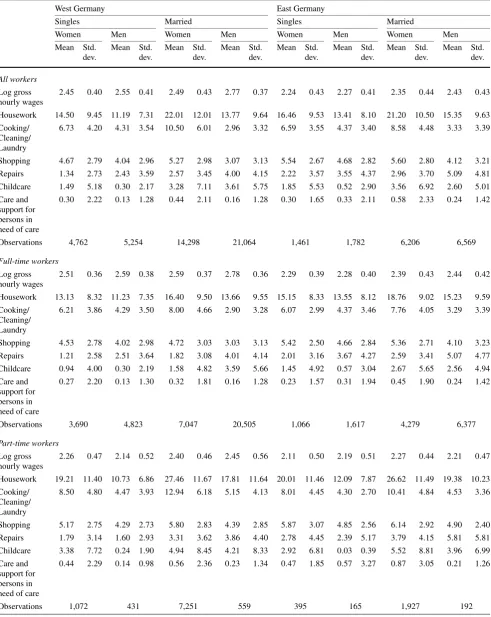
Table1 presents summary statistics for hours spent on housework activities and hourly log wages for men and women separately for East and West Germany and sepa-rately by marital status using our GSOEP sample. Singles are defined as individuals without a partner, while married individuals comprise all individuals who live with a spouse or partner in the same household.10 Regarding total hours spent on housework, we find that women dedicate much more time to housework activities than men. Married West German (East German) women spend about 22.0 (21.2) hours a week on housework, whereas married West German (East German) men allocate only 13.8 (15.4) hours per week to housework activities. On the other hand, single individu-als devote considerably less time on housework. While there is also a clear gender difference in time spent on house-work for singles, this difference is less pronounced com-pared to married individuals: West German (East German) single women spend 14.5 (16.5) hours a week on house-work, whereas West German (East German) single men have 11.2 (13.4) hours of housework per week. Disaggregating total hours on housework into five categories, we find that women (both married women and singles) predominantly spend time on housework activities such as cooking, clean-ing, and laundry, whereas married men spend more of their housework time on maintenance and repair activities. This is in line with Hersch and Stratton (2002) and Hersch (2009) who report considerable gendering of different housework tasks, with daily routine activities such as cooking, cleaning,
9In consequence, we drop individuals with hourly gross wages below
€1.92 or above€43.15 as well as individuals who report to spend more than 60 hours a week on housework activities.
10Note that considering married individuals in a strict sense only, i.e.
Table 1 Wages and hours spent on housework activities per week (working days) in West and East Germany by marital status, working hours, and gender (GSOEP sample)
West Germany East Germany
Singles Married Singles Married
Women Men Women Men Women Men Women Men
Mean Std. dev.
Mean Std. dev.
Mean Std. dev.
Mean Std. dev.
Mean Std. dev.
Mean Std. dev.
Mean Std. dev.
Mean Std. dev. All workers
Log gross hourly wages
2.45 0.40 2.55 0.41 2.49 0.43 2.77 0.37 2.24 0.43 2.27 0.41 2.35 0.44 2.43 0.43 Housework 14.50 9.45 11.19 7.31 22.01 12.01 13.77 9.64 16.46 9.53 13.41 8.10 21.20 10.50 15.35 9.63 Cooking/
Cleaning/ Laundry
6.73 4.20 4.31 3.54 10.50 6.01 2.96 3.32 6.59 3.55 4.37 3.40 8.58 4.48 3.33 3.39
Shopping 4.67 2.79 4.04 2.96 5.27 2.98 3.07 3.13 5.54 2.67 4.68 2.82 5.60 2.80 4.12 3.21 Repairs 1.34 2.73 2.43 3.59 2.57 3.45 4.00 4.15 2.22 3.57 3.55 4.37 2.96 3.70 5.09 4.81 Childcare 1.49 5.18 0.30 2.17 3.28 7.11 3.61 5.75 1.85 5.53 0.52 2.90 3.56 6.92 2.60 5.01 Care and
support for persons in need of care
0.30 2.22 0.13 1.28 0.44 2.11 0.16 1.28 0.30 1.65 0.33 2.11 0.58 2.33 0.24 1.42
Observations 4,762 5,254 14,298 21,064 1,461 1,782 6,206 6,569
Full-time workers
Log gross hourly wages
2.51 0.36 2.59 0.38 2.59 0.37 2.78 0.36 2.29 0.39 2.28 0.40 2.39 0.43 2.44 0.42 Housework 13.13 8.32 11.23 7.35 16.40 9.50 13.66 9.55 15.15 8.33 13.55 8.12 18.76 9.02 15.23 9.59 Cooking/
Cleaning/ Laundry
6.21 3.86 4.29 3.50 8.00 4.66 2.90 3.28 6.07 2.99 4.37 3.46 7.76 4.05 3.29 3.39
Shopping 4.53 2.78 4.02 2.98 4.72 3.03 3.03 3.13 5.42 2.50 4.66 2.84 5.36 2.71 4.10 3.23 Repairs 1.21 2.58 2.51 3.64 1.82 3.08 4.01 4.14 2.01 3.16 3.67 4.27 2.59 3.41 5.07 4.77 Childcare 0.94 4.00 0.30 2.19 1.58 4.82 3.59 5.66 1.45 4.92 0.57 3.04 2.67 5.65 2.56 4.94 Care and
support for persons in need of care
0.27 2.20 0.13 1.30 0.32 1.81 0.16 1.28 0.23 1.57 0.31 1.94 0.45 1.90 0.24 1.42
Observations 3,690 4,823 7,047 20,505 1,066 1,617 4,279 6,377
Part-time workers
Log gross hourly wages
2.26 0.47 2.14 0.52 2.40 0.46 2.45 0.56 2.11 0.50 2.19 0.51 2.27 0.44 2.21 0.47 Housework 19.21 11.40 10.73 6.86 27.46 11.67 17.81 11.64 20.01 11.46 12.09 7.87 26.62 11.49 19.38 10.23 Cooking/
Cleaning/ Laundry
8.50 4.80 4.47 3.93 12.94 6.18 5.15 4.13 8.01 4.45 4.30 2.70 10.41 4.84 4.53 3.36
Shopping 5.17 2.75 4.29 2.73 5.80 2.83 4.39 2.85 5.87 3.07 4.85 2.56 6.14 2.92 4.90 2.40 Repairs 1.79 3.14 1.60 2.93 3.31 3.62 3.86 4.40 2.78 4.45 2.39 5.17 3.79 4.15 5.81 5.81 Childcare 3.38 7.72 0.24 1.90 4.94 8.45 4.21 8.33 2.92 6.81 0.03 0.39 5.52 8.81 3.96 6.99 Care and
support for persons in need of care
0.44 2.29 0.14 0.98 0.56 2.36 0.23 1.34 0.47 1.85 0.57 3.27 0.87 3.05 0.21 1.26
Observations 1,072 431 7,251 559 395 165 1,927 192
and laundry being “typically female” activities as opposed to “typically male” activities such as maintenance and repair.
Furthermore, Table1documents gender pay gaps for all groups that are considerably more pronounced in West Ger-many and for married individuals. In West GerGer-many, mar-ried women’s hourly gross wages are 28 log points lower than men’s on average, while the difference in East Germany only amounts to 8 log points. For singles gender pay gaps both in East and West Germany are considerably lower: Sin-gle women’s average hourly gross wages in West Germany are 10 log points lower than single men’s, whereas the dif-ference is just 3 log points in East Germany. Consequently, those women with highest hours spent on housework suf-fer the largest earning difsuf-ferentials relative to men. Related to this, we find a negative correlation between hours spent on housework and wages of −0.166 that is also more pro-nounced for the subsample of women than for the subsam-ple of men. For additional descriptive information on our GSOEP sample, see Table7inAppendix.
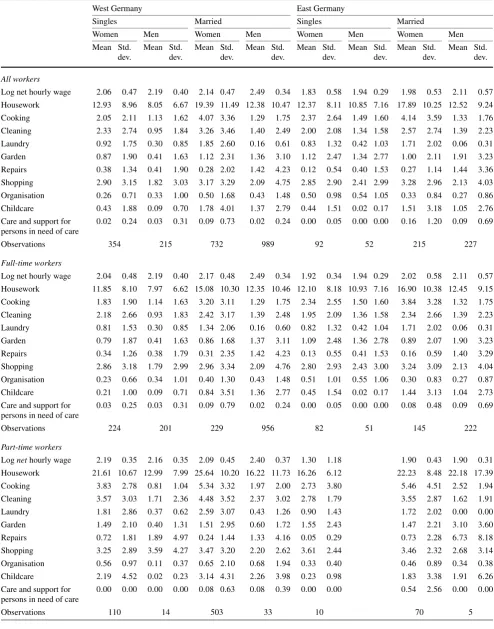
Table2presents the same descriptive statistics as in Ta-ble1for our GTUS sample. While the overall results of Ta-ble1are also found with the more precise time use data (i.e. women spent much more time on housework activities and in particular on routine activities than men, and there are considerable differences by marital status), gender differ-ences in hours spent on housework activities are even a little more pronounced in this data set. Gender pay gaps in the GTUS sample differ considerably more between West and East Germany. In West Germany married women’s hourly net wages are 35 log points lower than men’s on average, while the difference in only 13 log points in East Germany. For single women we observe 13 log points lower average net wages than for men in West Germany and 11 log points lower average net wages in East Germany. Other than in the GSOEP sample, those women with highest hours spent on housework do not generally suffer the largest earning differ-entials relative to men. Interestingly, the correlation between hours spent on housework and wages is zero (−0.012) and does not differ between the subsamples of women and men. For additional descriptive information on our GTUS sample, see Table8inAppendix.
5 Econometric analysis
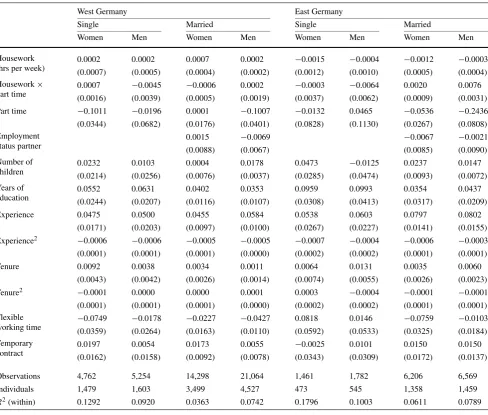
We now turn to our regression results. Table3 reports FE wage regressions on our GSOEP sample separately by gen-der and marital status for West and East German observa-tions including the total number of hours spent on house-work activities and the interaction term with part-time house-work as main regressors of interest.11 For West Germany the
ef-11Note that running separate regressions for full-time and part-time
workers (instead of including just an interaction term of hours spent on
fect of housework on full-time workers’ wages is small and insignificant for all groups with the exception of married fe-males for whom there is a small positive effect that is sig-nificant at the 10 per cent level. Moreover, the interaction effect of housework and part-time work is insignificant in all cases. We therefore find no support for our first hypoth-esis of a negative effect of housework activities on wages that is less pronounced for part-time workers. Furthermore, no clear differences according to gender and marital status show up, and thus there is no support for our second hypoth-esis.
For East Germany the results are a little more mixed. The effect of housework on full-time workers’ wages is negative but insignificant in all cases with the exception of married women for whom the wage decreases by 0.12 per cent for every additional hour spent on housework (significant at the 5 per cent level). Since in East Germany full-time working married women spend 21.2 hours to housework activities on average (see Table1), the total effect of housework would account to roughly 2.5 per cent lower wages in total and therefore is rather small from an economic point of view. Furthermore, the interaction effect of housework with part-time work is significantly positive at the 5 per cent level, so that part-time working married women experience no wage losses from housework. Nevertheless, overall differences in the effect of housework on wages between West and East Germany are only minor, and thus there is little evidence corroborating our third hypothesis.
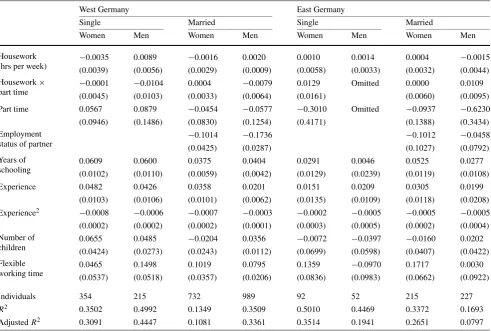
Turning to our GTUS sample, we unfortunately cannot fit FE wage regressions as the data come from a single cross section only but have to rely on simple OLS wage regres-sions, the results of which are reported in Table4. Although one should expect the coefficient of hours spent on house-work activities to be biased downwards due to either unob-served permanent heterogeneity or reversed causality (see our earlier discussion in Sects.2and3), our results find no significantly negative effect of housework on wages for both full-time and part-time men and women living in either East or West Germany, be they married or not. Thus, the GTUS data do not give any support to our first three hypotheses.
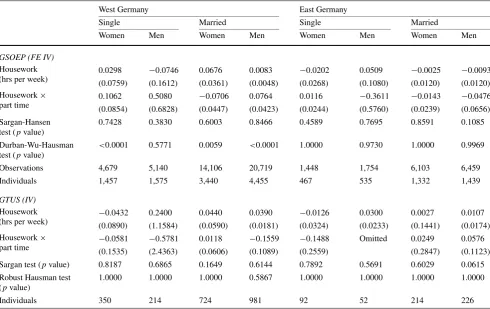
As made clear in Sects.2and3, endogeneity of house-work in the wage equation is likely to bias the estimated effect of housework on wages downwards, and the absence of negative effects in our previous regressions should there-fore not be subject to endogeneity concerns. To assess the robustness of our results and to make them more compa-rable to other studies, we nevertheless also fit wage re-gressions instrumenting hours on housework with dummies
Table 2 Wages and hours spent on housework activities per week (working days) in West and East Germany by marital status, working hours, and gender (GTUS sample)
West Germany East Germany
Singles Married Singles Married
Women Men Women Men Women Men Women Men
Mean Std. dev.
Mean Std. dev.
Mean Std. dev.
Mean Std. dev.
Mean Std. dev.
Mean Std. dev.
Mean Std. dev.
Mean Std. dev. All workers
Log net hourly wage 2.06 0.47 2.19 0.40 2.14 0.47 2.49 0.34 1.83 0.58 1.94 0.29 1.98 0.53 2.11 0.57 Housework 12.93 8.96 8.05 6.67 19.39 11.49 12.38 10.47 12.37 8.11 10.85 7.16 17.89 10.25 12.52 9.24 Cooking 2.05 2.11 1.13 1.62 4.07 3.36 1.29 1.75 2.37 2.64 1.49 1.60 4.14 3.59 1.33 1.76 Cleaning 2.33 2.74 0.95 1.84 3.26 3.46 1.40 2.49 2.00 2.08 1.34 1.58 2.57 2.74 1.39 2.23 Laundry 0.92 1.75 0.30 0.85 1.85 2.60 0.16 0.61 0.83 1.32 0.42 1.03 1.71 2.02 0.06 0.31 Garden 0.87 1.90 0.41 1.63 1.12 2.31 1.36 3.10 1.12 2.47 1.34 2.77 1.00 2.11 1.91 3.23 Repairs 0.38 1.34 0.41 1.90 0.28 2.02 1.42 4.23 0.12 0.54 0.40 1.53 0.27 1.14 1.44 3.36 Shopping 2.90 3.15 1.82 3.03 3.17 3.29 2.09 4.75 2.85 2.90 2.41 2.99 3.28 2.96 2.13 4.03 Organisation 0.26 0.71 0.33 1.00 0.50 1.68 0.43 1.48 0.50 0.98 0.54 1.05 0.33 0.84 0.27 0.86 Childcare 0.43 1.88 0.09 0.70 1.78 4.01 1.37 2.79 0.44 1.51 0.02 0.17 1.51 3.18 1.05 2.76 Care and support for
persons in need of care
0.02 0.24 0.03 0.31 0.09 0.73 0.02 0.24 0.00 0.05 0.00 0.00 0.16 1.20 0.09 0.69
Observations 354 215 732 989 92 52 215 227
Full-time workers
Log net hourly wage 2.04 0.48 2.19 0.40 2.17 0.48 2.49 0.34 1.92 0.34 1.94 0.29 2.02 0.58 2.11 0.57 Housework 11.85 8.10 7.97 6.62 15.08 10.30 12.35 10.46 12.10 8.18 10.93 7.16 16.90 10.38 12.45 9.15 Cooking 1.83 1.90 1.14 1.63 3.20 3.11 1.29 1.75 2.34 2.55 1.50 1.60 3.84 3.28 1.32 1.75 Cleaning 2.18 2.66 0.93 1.83 2.42 3.17 1.39 2.48 1.95 2.09 1.36 1.58 2.34 2.66 1.39 2.23 Laundry 0.81 1.53 0.30 0.85 1.34 2.06 0.16 0.60 0.82 1.32 0.42 1.04 1.71 2.02 0.06 0.31 Garden 0.79 1.87 0.41 1.63 0.86 1.68 1.37 3.11 1.09 2.48 1.36 2.78 0.89 2.07 1.90 3.23 Repairs 0.34 1.26 0.38 1.79 0.31 2.35 1.42 4.23 0.13 0.55 0.41 1.53 0.16 0.59 1.40 3.29 Shopping 2.86 3.18 1.79 2.99 2.96 3.34 2.09 4.76 2.80 2.93 2.43 3.00 3.24 3.09 2.13 4.04 Organisation 0.23 0.66 0.34 1.01 0.40 1.30 0.43 1.48 0.51 1.01 0.55 1.06 0.30 0.83 0.27 0.87 Childcare 0.21 1.00 0.09 0.71 0.84 3.51 1.36 2.77 0.45 1.54 0.02 0.17 1.44 3.13 1.04 2.73 Care and support for
persons in need of care
0.03 0.25 0.03 0.31 0.09 0.79 0.02 0.24 0.00 0.05 0.00 0.00 0.08 0.48 0.09 0.69
Observations 224 201 229 956 82 51 145 222
Part-time workers
Log net hourly wage 2.19 0.35 2.16 0.35 2.09 0.45 2.40 0.37 1.30 1.18 1.90 0.43 1.90 0.31 Housework 21.61 10.67 12.99 7.99 25.64 10.20 16.22 11.73 16.26 6.12 22.23 8.48 22.18 17.39 Cooking 3.83 2.78 0.81 1.04 5.34 3.32 1.97 2.00 2.73 3.80 5.46 4.51 2.52 1.94 Cleaning 3.57 3.03 1.71 2.36 4.48 3.52 2.37 3.02 2.78 1.79 3.55 2.87 1.62 1.91 Laundry 1.81 2.86 0.37 0.62 2.59 3.07 0.43 1.26 0.90 1.43 1.72 2.02 0.00 0.00 Garden 1.49 2.10 0.40 1.31 1.51 2.95 0.60 1.72 1.55 2.43 1.47 2.21 3.10 3.60 Repairs 0.72 1.81 1.89 4.97 0.24 1.44 1.33 4.16 0.05 0.29 0.73 2.28 6.73 8.18 Shopping 3.25 2.89 3.59 4.27 3.47 3.20 2.20 2.62 3.61 2.44 3.46 2.32 2.68 3.14 Organisation 0.56 0.97 0.11 0.37 0.65 2.10 0.68 1.94 0.33 0.40 0.46 0.89 0.34 0.38 Childcare 2.19 4.52 0.02 0.23 3.14 4.31 2.26 3.98 0.23 0.98 1.83 3.38 1.91 6.26 Care and support for
persons in need of care
0.00 0.00 0.00 0.00 0.08 0.63 0.08 0.39 0.00 0.00 0.54 2.56 0.00 0.00
Observations 110 14 503 33 10 70 5
Table 3 Fixed-Effects wage regressions for West and East Germany by marital status and gender (GSOEP sample)
West Germany East Germany
Single Married Single Married
Women Men Women Men Women Men Women Men
Housework (hrs per week)
0.0002 0.0002 0.0007 0.0002 −0.0015 −0.0004 −0.0012 −0.0003
(0.0007) (0.0005) (0.0004) (0.0002) (0.0012) (0.0010) (0.0005) (0.0004) Housework×
part time
0.0007 −0.0045 −0.0006 0.0002 −0.0003 −0.0064 0.0020 0.0076
(0.0016) (0.0039) (0.0005) (0.0019) (0.0037) (0.0062) (0.0009) (0.0031)
Part time −0.1011 −0.0196 0.0001 −0.1007 −0.0132 0.0465 −0.0536 −0.2436
(0.0344) (0.0682) (0.0176) (0.0401) (0.0828) (0.1130) (0.0267) (0.0808) Employment
status partner
0.0015 −0.0069 −0.0067 −0.0021
(0.0088) (0.0067) (0.0085) (0.0090)
Number of children
0.0232 0.0103 0.0004 0.0178 0.0473 −0.0125 0.0237 0.0147
(0.0214) (0.0256) (0.0076) (0.0037) (0.0285) (0.0474) (0.0093) (0.0072) Years of
education
0.0552 0.0631 0.0402 0.0353 0.0959 0.0993 0.0354 0.0437
(0.0244) (0.0207) (0.0116) (0.0107) (0.0308) (0.0413) (0.0317) (0.0209)
Experience 0.0475 0.0500 0.0455 0.0584 0.0538 0.0603 0.0797 0.0802
(0.0171) (0.0203) (0.0097) (0.0100) (0.0267) (0.0227) (0.0141) (0.0155) Experience2 −0.0006 −0.0006 −0.0005 −0.0005 −0.0007 −0.0004 −0.0006 −0.0003
(0.0001) (0.0001) (0.0001) (0.0000) (0.0002) (0.0002) (0.0001) (0.0001)
Tenure 0.0092 0.0038 0.0034 0.0011 0.0064 0.0131 0.0035 0.0060
(0.0043) (0.0042) (0.0026) (0.0014) (0.0074) (0.0055) (0.0026) (0.0023)
Tenure2 −0.0001 0.0000 0.0000 0.0001 0.0003 −0.0004 −0.0001 −0.0001
(0.0001) (0.0001) (0.0001) (0.0000) (0.0002) (0.0002) (0.0001) (0.0001) Flexible
working time −
0.0749 −0.0178 −0.0227 −0.0427 0.0818 0.0146 −0.0759 −0.0103 (0.0359) (0.0264) (0.0163) (0.0110) (0.0592) (0.0533) (0.0325) (0.0184) Temporary
contract
0.0197 0.0054 0.0173 0.0055 −0.0025 0.0101 0.0150 0.0150
(0.0162) (0.0158) (0.0092) (0.0078) (0.0343) (0.0309) (0.0172) (0.0137)
Observations 4,762 5,254 14,298 21,064 1,461 1,782 6,206 6,569
Individuals 1,479 1,603 3,499 4,527 473 545 1,358 1,459
R2(within) 0.1292 0.0920 0.0363 0.0742 0.1796 0.1003 0.0611 0.0789
Notes: The data set used is the GSOEP, waves 2000–2009. The dependent variable is the log gross hourly wage. Standard errors clustered at the individual level are given in parentheses. Further controls included are sets of dummy variables for establishment size, states of residence, years, one-digit industry, and one-digit occupation
for living in a house and residence ownership and the size of the place. The results in Table 5 show no big qualita-tive changes, though the negaqualita-tive effect for full-time work-ing married women in East Germany in the GSOEP sam-ple becomes insignificant. Generally, instruments are strong in that they are highly significant in the first-step regres-sions for housework and the interaction effect of house-work and part-time house-work, and Hansen-Sargan tests in the GSOEP sample or simple Sargan tests in the GTUS sample, respectively, show that they are valid in all cases but one. In line with the literature (e.g., Hersch and Stratton1997; Bryan and Sevilla-Sanz2010), Durbin-Wu-Hausman tests in the GSOEP sample and robust Hausman tests in the GTUS sample, respectively, fail to reject the exogeneity of hours
spent on housework in most cases, so that endogeneity of housework does not seem to play a major role in this con-text. In those few instances where tests indicate housework to be endogenous, however, the results do not change com-pared to the standard FE or OLS wage regressions reported earlier.12
12Another estimation issue that could influence our results is sample
Table 4 OLS wage regressions for West and East Germany by marital status and gender (GTUS sample)
West Germany East Germany
Single Married Single Married
Women Men Women Men Women Men Women Men
Housework
(hrs per week) −
0.0035 0.0089 −0.0016 0.0020 0.0010 0.0014 0.0004 −0.0015
(0.0039) (0.0056) (0.0029) (0.0009) (0.0058) (0.0033) (0.0032) (0.0044) Housework×
part time −
0.0001 −0.0104 0.0004 −0.0079 0.0129 Omitted 0.0000 0.0109
(0.0045) (0.0103) (0.0033) (0.0064) (0.0161) (0.0060) (0.0095)
Part time 0.0567 0.0879 −0.0454 −0.0577 −0.3010 Omitted −0.0937 −0.6230
(0.0946) (0.1486) (0.0830) (0.1254) (0.4171) (0.1388) (0.3434)
Employment
status of partner −
0.1014 −0.1736 −0.1012 −0.0458
(0.0425) (0.0287) (0.1027) (0.0792)
Years of schooling
0.0609 0.0600 0.0375 0.0404 0.0291 0.0046 0.0525 0.0277
(0.0102) (0.0110) (0.0059) (0.0042) (0.0129) (0.0239) (0.0119) (0.0108)
Experience 0.0482 0.0426 0.0358 0.0201 0.0151 0.0209 0.0305 0.0199
(0.0103) (0.0106) (0.0101) (0.0062) (0.0135) (0.0109) (0.0118) (0.0208) Experience2 −0.0008 −0.0006 −0.0007 −0.0003 −0.0002 −0.0005 −0.0005 −0.0005
(0.0002) (0.0002) (0.0002) (0.0001) (0.0003) (0.0005) (0.0002) (0.0004) Number of
children
0.0655 0.0485 −0.0204 0.0356 −0.0072 −0.0397 −0.0160 0.0202
(0.0424) (0.0273) (0.0243) (0.0112) (0.0699) (0.0598) (0.0407) (0.0422) Flexible
working time
0.0465 0.1498 0.1019 0.0795 0.1359 −0.0970 0.1717 0.0030
(0.0537) (0.0518) (0.0357) (0.0206) (0.0836) (0.0983) (0.0662) (0.0922)
Individuals 354 215 732 989 92 52 215 227
R2 0.3502 0.4992 0.1349 0.3509 0.5010 0.4469 0.3372 0.1693
AdjustedR2 0.3091 0.4447 0.1081 0.3361 0.3514 0.1941 0.2651 0.0797
Notes: The data set used is the GTUS 2001/2002. The dependent variable is the log net hourly wage. Robust standard errors are given in parentheses. Further controls included are sets of dummy variables for one-digit industry and one-digit occupation. “Omitted” refers to cells with no observations
To test our fourth hypothesis that daily routine house-work activities have a stronger negative impact on wages as opposed to those activities that are more easily post-poned, we distinguish two categories of housework. As hours spent on daily routine housework activities we de-fine the sum of hours spent on “shopping”, “washing, cook-ing, and cleaning”, “childcare”, and “care and support for persons in need of care”, whereas the hours spent on
re-Wooldridge (1995), which intuitively adds a sample selection correc-tion term to the standard FE model, and by Semykina and Wooldridge (2010), which does the same in the IV FE model. In our GTUS sample, we made use of a standard Heckit and a Heckit IV model (for the lat-ter, see Wooldridge2010, pp. 809–813). As exclusion restrictions we added the individual’s age (linearly and squared), a dummy indicating health problems, and the total household income (excluding the indi-vidual’s own income) to the first-step employment equations. While we cannot reject selectivity in many cases (in particular for women selectivity correction terms have significant coefficients in most wage regressions), the impact of hours spent on housework on wages remain qualitatively the same as before, with the exception of East German women in our GSOEP sample for whom the negative housework effect disappears.
pair and maintenance activities form the second category.13 As can be seen from Table 6, no clear patterns show up. Starting with the GSOEP sample, only for full-time work-ing married women in East Germany there is a signifi-cantly negative impact of “routine housework activities”. Although the effect of repair and maintenance activities is even more pronounced for this group, it is imprecisely es-timated and thus statistically insignificant. Similar to over-all hours spent on housework, these negative effects are ab-sent for part-time working women in East Germany. On the other hand, for part-time working married men in East Germany both categories of housework have a significantly positive impact. In West Germany, full-time working mar-ried women even experience a positive and significant
ef-13Note that our results do not change qualitatively when excluding
Table 5 (Fixed-effects) instrumental-variables wage regressions for East and West Germany by marital status and gender
West Germany East Germany
Single Married Single Married
Women Men Women Men Women Men Women Men
GSOEP (FE IV) Housework (hrs per week)
0.0298 −0.0746 0.0676 0.0083 −0.0202 0.0509 −0.0025 −0.0093 (0.0759) (0.1612) (0.0361) (0.0048) (0.0268) (0.1080) (0.0120) (0.0120) Housework×
part time
0.1062 0.5080 −0.0706 0.0764 0.0116 −0.3611 −0.0143 −0.0476 (0.0854) (0.6828) (0.0447) (0.0423) (0.0244) (0.5760) (0.0239) (0.0656) Sargan-Hansen
test (pvalue)
0.7428 0.3830 0.6003 0.8466 0.4589 0.7695 0.8591 0.1085
Durban-Wu-Hausman test (pvalue)
<0.0001 0.5771 0.0059 <0.0001 1.0000 0.9730 1.0000 0.9969
Observations 4,679 5,140 14,106 20,719 1,448 1,754 6,103 6,459
Individuals 1,457 1,575 3,440 4,455 467 535 1,332 1,439
GTUS (IV) Housework
(hrs per week) −
0.0432 0.2400 0.0440 0.0390 −0.0126 0.0300 0.0027 0.0107
(0.0890) (1.1584) (0.0590) (0.0181) (0.0324) (0.0233) (0.1441) (0.0174) Housework×
part time −
0.0581 −0.5781 0.0118 −0.1559 −0.1488 Omitted 0.0249 0.0576 (0.1535) (2.4363) (0.0606) (0.1089) (0.2559) (0.2847) (0.1123) Sargan test (pvalue) 0.8187 0.6865 0.1649 0.6144 0.7892 0.5691 0.6029 0.0615 Robust Hausman test
(pvalue)
1.0000 1.0000 1.0000 0.5867 1.0000 1.0000 1.0000 1.0000
Individuals 350 214 724 981 92 52 214 226
Notes: The data sets used are the GSOEP, waves 2000–2009, and the GTUS 2001/2002. The dependent variable is the log gross hourly wage in the GSOEP samples and the log net hourly wage in the GTUS samples, respectively. Standard errors (clustered at the individual level in the GSOEP samples and robust in the GTUS samples) are given in parentheses. Further controls included are years of schooling, experience (linearly and squared), tenure (linearly and squared), number of children in the household, sets of dummy variables for flexible working time, temporary contract, establishment size, states of residence, years, one-digit industry, and one-digit occupation. Instruments for housework included in the first stage regressions are two dummy variables for living in a house (as opposed to a flat) and residence ownership as well as the size of the place. “Omitted” refers to cells with no observations
fect of “routine housework activities” on wages. Similar re-sults show up for the GTUS sample, but again no single type of housework activities has a significantly negative im-pact on workers’ wages both in West and East Germany— independently of gender and marital status. That said, there seems to be no clear evidence in line with our fourth hy-pothesis that the effect of “routine housework” on wages is more negative that the effect of other housework activi-ties.
Overall, we conclude that there is (almost) no evidence for any of our four hypotheses. Apart from married women in our East German GSOEP sample, for whom we find neg-ative effects of time spent on housework on wages when working full-time hours and no effect when working part-time hours, our results do not indicate any clear effect of housework on wage. What is more, additional robustness checks reported in footnote 12 indicate that this effect disap-pears once accounting for sample selection and should thus not be overinterpreted.
6 Conclusions
In this paper, we have investigated the impact of time spent on housework activities on individuals’ wages for Germany using two different data sets, the German Socio-Economic Panel and the German Time Use Survey. Following the existing theoretical and empirical literature, we expected the effect to be negative as housework activities are likely to constrain workers’ effort dedicated to market activities and flexibility. Furthermore, we tested whether the impact of housework on wages is different according to gender, marital status, different types of housework activities and whether it differs for West and East Germany.
Table 6 Fixed-effects and OLS wage regressions for East and West Germany by marital status and gender distinguishing different types of housework activities
West Germany East Germany
Single Married Single Married
Women Men Women Men Women Men Women Men
GSOEP (FE)
Routine housework −0.0001 0.0003 0.0008 0.0001 −0.0017 −0.0005 −0.0011 −0.0005 (0.0008) (0.0007) (0.0004) (0.0002) (0.0013) (0.0014) (0.0005) (0.0005) Repair and maintenance
activities
0.0020 −0.0002 0.0000 0.0005 −0.0010 0.0001 −0.0016 0.0002 (0.0017) (0.0010) (0.0010) (0.0004) (0.0028) (0.0015) (0.0012) (0.0007) Routine housework×
part time
0.0013 −0.0049 −0.0008 0.0007 0.0009 −0.0017 0.0024 0.0075 (0.0018) (0.0043) (0.0006) (0.0022) (0.0036) (0.0044) (0.0009) (0.0037) Repair and maintenance
activities×part time −
0.0036 −0.0033 0.0011 −0.0026 −0.0044 −0.0118 −0.0001 0.0078 (0.0045) (0.0104) (0.0014) (0.0047) (0.0065) (0.0090) (0.0021) (0.0050)
Part time −0.1034 −0.0185 0.0013 −0.0975 −0.0202 0.0118 −0.0542 −0.2438
(0.0347) (0.0674) (0.0177) (0.0400) (0.0821) (0.1033) (0.0268) (0.0806)
Observations 4,762 5,254 14,298 21,064 1,461 1,782 6,206 6,569
Individuals 1,479 1,603 3,499 4,527 473 545 1,358 1,459
R2(within) 0.1297 0.0921 0.0365 0.0743 0.1807 0.1019 0.0619 0.0791
GTUS (OLS)
Routine housework −0.0049 0.0079 −0.0024 0.0021 0.0006 0.0018 −0.0006 −0.0019 (0.0039) (0.0047) (0.0032) (0.0011) (0.0060) (0.0039) (0.0035) (0.0046) Repair and maintenance
activities
0.0142 0.0358 0.0044 −0.0007 −0.0596 0.0033 0.0074 0.0012
(0.0327) (0.0199) (0.0029) (0.0021) (0.0602) (0.0138) (0.0541) (0.0084) Routine housework×
part time
0.0015 −0.0099 0.0014 −0.0085 0.0166 Omitted 0.0042 0.0106 (0.0045) (0.0107) (0.0035) (0.0067) (0.0192) (0.0062) (0.0237) Repair and maintenance
activities×part time −
0.0135 −0.0399 −0.0267 0.0012 −0.0343 Omitted −0.0485 0.0104 (0.0361) (0.0231) (0.0124) (0.0141) (0.1306) (0.0548) (0.0272)
Part time 0.0362 0.0864 −0.0578 −0.0838 −0.3475 Omitted −0.1508 −0.6173
(0.0925) (0.1308) (0.0825) (0.1158) (0.4418) (0.1400) (0.3418)
Individuals 354 215 732 989 92 52 215 227
R2 0.3520 0.5209 0.1376 0.3501 0.5061 0.4476 0.3435 0.1697
AdjustedR2 0.3068 0.4632 0.1084 0.3340 0.3390 0.1714 0.2644 0.0711
Notes: The data sets used are the GSOEP, waves 2000–2009, and the GTUS 2001/2002. The dependent variable is the log gross hourly wage in the GSOEP samples and the log net hourly wage in the GTUS samples, respectively. Standard errors (clustered at the individual level in the GSOEP samples and robust in the GTUS samples) are given in parentheses. Further controls included are years of schooling, experience (linearly and squared), tenure (linearly and squared), number of children in the household, sets of dummy variables for flexible working time, temporary contract, establishment size, states of residence, years, one-digit industry, and one-digit occupation. “Omitted” refers to cells with no observations
in West and East Germany. By using two independent data sets for Germany, we follow Hamermesh (2000, p. 376) in arguing that “the credibility of a new finding that is based on carefully analysing two data sets is far more than twice that of a result based only on one”.
Our results are in contrast to a growing international em-pirical literature, recently reviewed by Maani and Cruick-shank (2010), that documents a clear adverse effect of housework on wages and that points at the gendered na-ture of housework with women spending much more time on housework activities than men (especially when being
in the extent of housework activities. What is more, Anger and Kottwitz (2009) do not control for flexible working arrangements likely to be positively correlated with hours spent on housework activities and also likely to yield nega-tive compensating wage differentials, thereby adding down-ward bias to their housework coefficient, whereas we control for flexible working hours arrangements.
Our results do not find any systematic heterogeneity in the effect of housework on wages for subgroups of workers documented in earlier studies. Interestingly, the absence of a negative impact of housework on wages is not driven by our attempts to address endogeneity concerns (such as in the study by McLennan2000, who does not find an impact of housework on wages once correcting for the endogeneity of time spent on housework), but also holds in standard OLS or FE wage regressions, where there are good reasons to think the coefficient of housework to be biased downwards.
From this we conclude that housework does not adversely affect wages in Germany. As a consequence, gender differ-ences in the time spent on housework activities cannot con-tribute to the explanation of the persistent empirical regular-ity of the gender pay gap in Germany. Note that the existent literature has used comparable data sources and methods to arrive at its conclusions (e.g., longitudinal survey data, in-strumental variables estimators, and, to a lesser extent, time use data), so that we do not think that different findings are due to methodological differences. In our eyes, the main dif-ference is rather that existing studies documenting a negative impact of housework on wages has almost exclusively relied on data from Anglo-Saxon economies. Interestingly, in an-other study for a continental European country, viz. Switzer-land, which investigates the relationship between housework activities, motivation at the job, and wages, Engelhardt and Jann (2004) find that housework activities do not adversely affect workers’ motivation, thereby casting doubt on the effort story suggesting a negative effect of housework on wages. Hence, we think it would be promising to investigate whether other continental European countries are similar to the German case or whether East and West German labour markets represent a mere outlier from an international per-spective.
Executive summary
A growing number of international studies documents that women are more engaged in household production than men and that time spent on housework activities adversely affects individuals’ wages. As is argued in this literature, spend-ing time on housework activities constrains workers’ effort dedicated to market activities and flexibility thereby low-ering their productivity and wages. As a consequence, the gendered nature of housework with women spending much
more time on housework activities than men may contribute to the explanation of the gender pay gap found in the data.
Whereas the vast majority of existing studies relies on data from Anglo-Saxon countries, this paper analyses the impact of hours spent on housework activities on individ-uals’ wages for Germany, a continental European country with very different labour market institutions and a much lower labour market attachment of women compared to Anglo-Saxon economies. We do so by using data stemming from two different data sources: longitudinal data from the German Socio-Economic Panel comprising the years 2000– 2009 and cross-sectional data from the 2001/2002 German Time Use Survey.
Whereas our descriptive results show that German women spend considerably more time on household activities than men, we find no evidence that wages are adversely af-fected by housework activities. This holds both for men and women, for married and single individuals, as well as for part-time and full-time workers both in West and East Ger-many. Notably, the robust absence of a negative impact of time spent on housework activities on wages is not driven by our attempts to address endogeneity concerns by apply-ing instrumental-variables estimators, but also holds in stan-dard OLS or fixed-effects wage regressions, where there are good reasons to think the coefficient of housework to be biased downwards.
As the existing international literature has used compa-rable data sources and methods to arrive at its conclusions (e.g., longitudinal survey data, instrumental variables esti-mators, and, to a lesser extent, time use data), we do not think that different findings are due to methodological dif-ferences. In our eyes, the main difference is rather that ex-isting studies documenting a negative impact of housework on wages has almost exclusively relied on data from Anglo-Saxon economies. Therefore, we think it would be promis-ing to investigate whether other continental European coun-tries are similar to the German case or whether the German labour market represents a mere outlier from an international perspective.
Kurzfassung
Im Gegensatz zur überwiegenden Mehrzahl der vorhan-denen Studien, die sich auf Daten aus angelsächsischen Län-dern stützt, untersucht dieses Papier den Einfluss von auf Hausarbeit verwandter Zeit auf die Löhne für Deutschland, d.h. ein kontinentaleuropäisches Land mit erheblichen Un-terschieden im institutionellen Rahmen und einer deutlich niedrigeren Erwerbsneigung von Frauen. Die Studie ver-wendet Daten aus zwei Quellen: Längsschnittdaten für die Jahre 2000–2009 aus dem Sozio-oekonomischen Panel und Querschnittsdaten aus der Zeitbudgeterhebung 2001/2002.
Während unsere deskriptiven Analysen zeigen, dass deutsche Frauen verglichen mit Männern deutlich mehr Zeit auf Hausarbeit verwenden, so finden wir jedoch in unse-ren Regressionsanalysen keine Anzeichen, dass Hausarbeit einen negativen Einfluss auf die Löhne ausübt. Dies gilt sowohl für Frauen wie Männer, für verheiratete wie ledi-ge Personen, als auch für Teilzeit- wie Vollzeitbeschäftigte in West- und Ostdeutschland. Zu beachten ist, dass die ro-buste Abwesenheit eines negativen Hausarbeitseffekts auf die Löhne nicht von unseren Versuchen getrieben ist, die etwaige Endogenität von Hausarbeit in den Lohnregressio-nen durch Nutzung von Instrumentvariablen zu berücksich-tigen. Dieselben Ergebnisse zeigen sich auch in gewöhnli-chen KQ- sowie Fixe-Effekte-Regressionen, in denen gute Gründe zu der Vermutung bestehen, dass der Hausarbeits-koeffizient nach unten verzerrt sein könnte.
Da die vorhandene internationale Literatur ihre Erkennt-nisse auf Grundlage ähnlicher Datenquellen und Methoden (z. B. longitudinale Befragungsdaten, Instrumentvariablen-schätzer und, zumindest teilweise, Zeitbudgetstudien) ge-wonnen hat, denken wir nicht, dass sich die unterschiedli-chen Ergebnisse zwisunterschiedli-chen dieser Arbeit und der bisherigen Literatur auf methodologische Unterschiede zurückführen lassen. Vielmehr vermuten wir, dass der Hauptunterschied darin zu sehen ist, dass das Gros der vorhandenen Litera-tur, das einen negativen Einfluss von Hausarbeit auf Löh-ne findet, auf Daten aus angelsächsischen Ländern beruht. Vor diesem Hintergrund erscheint es uns lohnenswert zu un-tersuchen, ob sich ähnliche Ergebnisse wie für Deutschland auch für andere kontinentaleuropäische Länder finden las-sen oder der deutsche Arbeitsmarkt aus internationaler Per-spektive vielmehr als ein Ausreißer zu betrachten ist. Acknowledgements We would like to thank Claus Schnabel, two anonymous referees, and the editor of this journal for very helpful sug-gestions. We also appreciate the comments received from participants of the 4th Ph.D. workshop of the Institute of Employment Research in October 2011.
Appendix: Tables7and8
Table 7 Descriptive statistics for West Germany and East Germany by marital status and gender (GSOEP sample)
Singles Married
Women Men Women Men
Mean Std.dev. Mean Std.dev. Mean Std.dev. Mean Std.dev.
West Germany
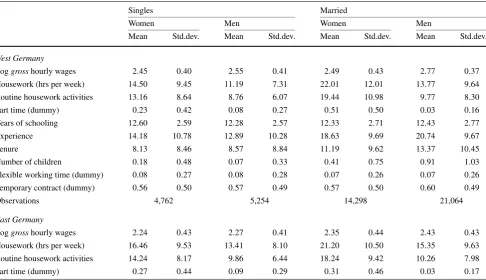
Log gross hourly wages 2.45 0.40 2.55 0.41 2.49 0.43 2.77 0.37 Housework (hrs per week) 14.50 9.45 11.19 7.31 22.01 12.01 13.77 9.64 Routine housework activities 13.16 8.64 8.76 6.07 19.44 10.98 9.77 8.30
Part time (dummy) 0.23 0.42 0.08 0.27 0.51 0.50 0.03 0.16
Years of schooling 12.60 2.59 12.28 2.57 12.33 2.71 12.43 2.77
Experience 14.18 10.78 12.89 10.28 18.63 9.69 20.74 9.67
Tenure 8.13 8.46 8.57 8.84 11.19 9.62 13.37 10.45
Number of children 0.18 0.48 0.07 0.33 0.41 0.75 0.91 1.03
Flexible working time (dummy) 0.08 0.27 0.08 0.28 0.07 0.26 0.07 0.26 Temporary contract (dummy) 0.56 0.50 0.57 0.49 0.57 0.50 0.60 0.49
Observations 4,762 5,254 14,298 21,064
East Germany
Log gross hourly wages 2.24 0.43 2.27 0.41 2.35 0.44 2.43 0.43 Housework (hrs per week) 16.46 9.53 13.41 8.10 21.20 10.50 15.35 9.63 Routine housework activities 14.24 8.17 9.86 6.44 18.24 9.42 10.26 7.98
Table 7 (Continued)
Singles Married
Women Men Women Men
Mean Std.dev. Mean Std.dev. Mean Std.dev. Mean Std.dev.
Years of schooling 13.14 2.31 12.66 2.40 13.18 2.40 12.99 2.58
Experience 16.05 11.75 12.91 10.18 20.85 9.66 21.72 9.59
Tenure 9.37 9.93 7.07 7.48 11.28 9.16 10.50 9.17
Number of children 0.19 0.48 0.07 0.32 0.40 0.68 0.61 0.86
Flexible working time (dummy) 0.07 0.25 0.08 0.28 0.03 0.17 0.07 0.26 Temporary contract (dummy) 0.55 0.50 0.57 0.50 0.61 0.49 0.60 0.49
Observations 1,461 1,782 6,206 6,569
Notes: The data set used is the GSOEP, waves 2000–2009
Table 8 Descriptive statistics for West Germany and East Germany by marital status and gender (GTUS sample)
Singles Married
Women Men Women Men
Mean Std.dev. Mean Std.dev. Mean Std.dev. Mean Std.dev.
West Germany
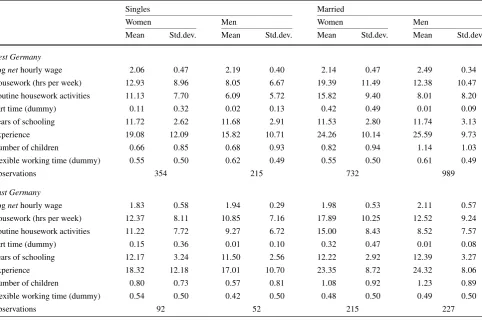
Log net hourly wage 2.06 0.47 2.19 0.40 2.14 0.47 2.49 0.34
Housework (hrs per week) 12.93 8.96 8.05 6.67 19.39 11.49 12.38 10.47 Routine housework activities 11.13 7.70 6.09 5.72 15.82 9.40 8.01 8.20
Part time (dummy) 0.11 0.32 0.02 0.13 0.42 0.49 0.01 0.09
Years of schooling 11.72 2.62 11.68 2.91 11.53 2.80 11.74 3.13
Experience 19.08 12.09 15.82 10.71 24.26 10.14 25.59 9.73
Number of children 0.66 0.85 0.68 0.93 0.82 0.94 1.14 1.03
Flexible working time (dummy) 0.55 0.50 0.62 0.49 0.55 0.50 0.61 0.49
Observations 354 215 732 989
East Germany
Log net hourly wage 1.83 0.58 1.94 0.29 1.98 0.53 2.11 0.57
Housework (hrs per week) 12.37 8.11 10.85 7.16 17.89 10.25 12.52 9.24 Routine housework activities 11.22 7.72 9.27 6.72 15.00 8.43 8.52 7.57
Part time (dummy) 0.15 0.36 0.01 0.10 0.32 0.47 0.01 0.08
Years of schooling 12.17 3.24 11.50 2.56 12.22 2.92 12.39 3.27
Experience 18.32 12.18 17.01 10.70 23.35 8.72 24.32 8.06
Number of children 0.80 0.73 0.57 0.81 1.08 0.92 1.23 0.89
Flexible working time (dummy) 0.54 0.50 0.42 0.50 0.48 0.50 0.49 0.50
Observations 92 52 215 227
Notes: The data set used is the GTUS 2001/2002
References
Adler, M.A., Brayfield, A.: Women’s work values in unified Germany: regional differences as remnants of the past. Work Occup. 24(2), 245–265 (1997)
Alesina, A., Ichino, A., Karabarbounis, L.: Gender-based taxation and the division of family chores. Am. Econ. J. Econ. Policy 3(2), 1– 40 (2011)
Altonji, J.G., Blank, R.M.: Race and gender in the labor market. In: Ashenfelter, O.C., Card, D.E. (eds.) Handbook of Labor Eco-nomics, vol. 3C, pp. 3143–3259. Elsevier, Amsterdam (1999) Anger, S., Kottwitz, A.: Mehr Hausarbeit, weniger Verdienst.
Wochen-ber. - Dtsch. Wirtschaftsforsch. 2009(6), 102–109 (2009) Bauer, F., Groß, H., Schilling, G.: Zur Geschlechtsspezifik der