O R I G I N A L A R T I C L E
Open Access
A decade of labour market reforms in the
EU: insights from the LABREF database
Alessandro Turrini
1,2,3*, Gabor Koltay
1, Fabiana Pierini
1, Clarisse Goffard
1and Aron Kiss
1* Correspondence:
[email protected] 1European Commission, Directorate General for Economic and Financial Affairs (DG ECFIN), Rue de la Loi 170, 1000 Brussels, Belgium 2CEPR, London, UK
Full list of author information is available at the end of the article
Abstract
This paper analyses the main features and determinants of labour market reforms in the EU over the period of 2000–2011 using the European Commission LABREF database. The data suggests that the timing, focus, and geographical distribution of reforms reflect the interplay between economic shocks and existing institutions. The 2008 crisis was followed by increased policy activity in most policy domains in a large number of EU countries, initially to cushion the impact of the crisis on employment and incomes, subsequently to improve the adjustment capacity of labour markets. Regression analysis indicates that reform activism is stronger in countries with lower GDP per capita and long-standing EU membership, under critical economic and labour market conditions, and where political costs are low. The direction of reforms is affected by economic and labour market conditions, available fiscal space, and by initial policy settings.
JEL classification:J20, J38, J48, J58, J68
Keywords:Labour market; Labour market reform; Unemployment; Financial crisis; European Union
1 Introduction
This paper analyses the main trends, features and determinants of labour market re-forms in the European Union over the period of 2000–2011. To that purpose, use is made of the information provided in the European Commission LABREF database, which collects characteristics of policy measures in a wide range of labour market fields.
Since the onset of EMU, there was clear awareness that a successful monetary union would require reforming labour markets where needed in such a way as to ease adjustment in the face of asymmetric shocks and to permit the correction of macroeconomic imbalances. The need for such reforms has become urgent after the crisis in light of the highly asymmetrical impact on the financial sector, public finances, and the real economy of EU countries and as a consequence of the sud-den unwinding of large external imbalances accumulated over the 2000s. After the financial crisis, most EU countries have stepped up their reform agenda by review-ing existreview-ing interventions to support employment and by takreview-ing action to reform labour market institutions to foster adjustment to the major shocks materialised since the Great Recession.
This increased reform activism calls for a proportionately increased effort to track the record of past reforms and assess their features, determinants and effects. Although relevant progress has been made in recent decades in measuring the impact of different policy settings on aggregate labour market outcomes (e.g., Nickell and Layard, 1999; Blanchard and Wolfers 2000), the assessment of reforms remains a challenging task. The first and most important condition for an effective assessment of reforms is ad-equate information on the reform features and characteristics.
The aim of this paper is to describe recent reforms carried out in EU countries mak-ing use of the LABREF database that was set up by DG ECFIN of the European Commission in cooperation with the Economic Policy Committee of the ECOFIN Council. This database contains information on a large set of policy measures carried out between 2000 and 2011. As compared with other similar existing databases, it con-tains information on a larger set of reform characteristics.
Despite limitations of count data on reform events, the evidence permits a number of interesting insights. Countries with similar institutional settings have followed broadly analogous reform patterns throughout the 2000s. The 2008 crisis triggered increased policy activism in most policy domains in a large number of EU countries. In a first phase, reforms were mainly aimed at supporting labour demand during at the start of the recession and adapting social safety nets. In a second phase, reforms became more intense in domains with relevance for labour market adjustment, including employment protection legislation (EPL) and wage setting frameworks, while tax wedge and welfare reforms became increasingly constrained by the available fiscal space in a number of countries.
By analysing labour market reform drivers across the EU, the paper contributes to the literature on the determinants of structural reforms and, thanks to the high degree of detail of the LABREF database, helps digging deeper to understanding what drives different types of reforms. Two reform indicators are considered. First, the simple count of policy measures introduced overall and by specific policy domains. Second, a measure of reform stance by policy domain, which takes into account in which direc-tion the underlying policy variables are moving as a result of reforms. Despite the rela-tively short time series available, the sample permits the carrying out of regression analysis, which offers interesting insights.
The evidence shows that reforms were more numerous in countries with a lower GDP per-capita at the start of the sample, suggesting that the evolution of labour mar-ket institutions was faster in EU countries at earlier stages of economic development. The evidence also shows that, other things being equal, reform activism was more in-tense in countries with a longer record of EU membership.
The findings give some support to the hypothesis that crises and harsh economic and labour market conditions are associated with an increased number of structural reforms (Drazen and Easterly, 2001; Høj et al., 2006). A higher unemployment rate and the presence of a large negative output gap are associated with a higher frequency of reforms, although results depend on the specific policy domain, the relation being strong especially for active labour market policies, EPL, early retirement and retirement age reforms, and wage setting reforms.
for governments. Reforms appear less likely in election years, while the likelihood is higher immediately after elections. The evidence also moderately suggests that the frac-tion of parliamentary seats held by the government is positively associated with re-forms. Fiscal variables have instead a non-systematic relation with reform activism, results depending on specific reform domains.
The reform stance variable, in line with previous evidence (Høj et al., 2006), ex-hibits a clear relation with initial policy conditions. Reforms raising the tax burden are less likely the higher the tax wedge on labour; those increasing the generosity of unemployment benefits occur less often the higher are net replacement rates for unemployment insurance; reforms increasing the degree of stringency of EPL re-forms are less numerous if EPL is rigid to start with. Regarding EPL, it appears that the strictness of regulation for permanent contracts makes reforms easing EPL restrictions more likely, while the initial degree of regulation for temporary contracts has no association either with EPL reforms in general or with reforms targeted to temporary contracts.
The reform stance depends on labour market conditions in the expected way, with high unemployment being associated with reforms lowering the tax burden on labour, raising the generosity of unemployment benefits and that of active labour market pol-icies. The LABREF database permits digging deeper into such findings and uncovers that, over the crisis period, unemployment generosity was increased especially in terms of entitlement conditions, while benefit duration was not increased and was actually made tighter in a majority of cases starting from 2010.
The direction of reforms depends also on the initial fiscal position, in line with find-ings of previous literature (e.g., Duval, 2008; Høj et al., 2006), with the relation depending on the specific policy domain considered. With lower government deficits, reforms tend to lower the tax burden of labour and to increase the generosity of un-employment benefits. The data also provide some support to the view that reforms, notably those reducing the extent of employment and wage setting regulations, are trig-gered by financial market pressure, as measured by the interest rate spreads on govern-ment bonds.
The remainder of the paper is organised as follows. Section 2 discusses the measure-ment of economic reforms and describes the LABREF database. Section 3 presents the main trends of labour market reforms in the EU since 2000 by broad policy domains and country groups. Section 4 studies the economic determinants of reforms, in par-ticular by a detailed regression analysis of how the economic, political and fiscal con-text influences the emergence of specific reforms. Section 5 concludes.
2 Measuring labour market reforms 2.1 Databases tracking labour market reforms
Indicator-based databases aim at quantifying the level or stringency associated with existing regulations and institutions. These indicators provide a synthetic measure of the implications of the existing stock of regulations and institutions. Reforms can only be measured indirectly by means of time differences in these indicators. While indicator-based databases permit a very effective synthesis of information for compari-sons over time and across countries, which make them suited for statistical analysis on macro data, they do not provide information at the level of the specific policy mea-sures.
2.1.1 Descriptive databases
The International Labour Organisation (ILO) provides synthetic information on measures adopted in the fields of minimum wages, maternity protection and working time along with referrals to relevant regulations. The ILO also compiles the NATLEX database, providing a comprehensive record of abstracts of legislation and relevant information of national labour, social security and related human rights laws for over 190 countries.
The inventory of labour market reforms developed by the OECD in the framework of the evaluation of the OECD Jobs Strategy contains information on reforms in seven main policy areas grouped in two sub-periods (1995–1999 and 2000–2004).
The“Social Reforms Database”, developed by the Fondazione Rodolfo Debenedetti in cooperation with IZA (FRDB-IZA), provides information on reform measures adopted in the EU countries starting from the eighties. The database collects information on the main qualitative features of reforms in four broad policy areas: EPL; public pension systems; non-employment benefits; and migration policies.
2.1.2 Indicator-based databases
Structural indicators are increasingly used in policy analysis. While providing a very useful proxy for the extent of government intervention in the labour market, these indi-cators raise a number of measurement issues: (i) the choice of the weight attributed to the various aspects of regulation is somewhat arbitrary; (ii) only a subset of regulatory aspects is taken into account, and relevant country-specific features in the design of the regulations are not considered; (iii) the degree of enforcement of specific regulations is often not captured.
Indicators measuring the stringency of EPL have been developed by the OECD, which capture the most important features of regulation, both for regular and temporary con-tracts and for collective dismissals, for most OECD countries since the eighties.
Indicators for labour market regulations are developed also in the framework of the Fraser Institute’s “Economic Freedom around the World” database. Indices scoring the absence of anti-competitive restrictions in a number of domains are produced for a large number of countries across the world, starting from the seventies. The economic freedom index for the labour market is the combination of separate indicators on mini-mum wage, flexibility in hiring and firing, level of collective bargaining, unemployment insurance, and the use of military conscription.
Botero et al. (2004). While the country coverage is large, the database spans a relatively short time series (it starts in 2003).
The Global Labor Survey (GLS) database (Chor and Freeman, 2005) conducted in 2004 at the Harvard Law School seeks to measurede factolabour practices around the world, covering aspects of labour institutions such as employment regulations, em-ployee benefits, and wage setting, and builds indices of labour practices in ten broad areas for 33 countries.
2.2 The LABREF database
The aim of the LABREF database is to improve the information basis for surveillance of labour market policies in the framework of the EU economic policy coordination processes. The database was developed upon initiative of the European Commission’s Directorate General for Economic and Financial Affairs (DG ECFIN) and the Labour Market Working Group (LMWG) attached to the Economic Policy Committee (EPC) of the ECOFIN Council in 2005.
LABREF is a descriptive database that records labour market and welfare policy measures introduced in EU member states. Compared with other similar databases, LABREF provides more information on the features and characteristics of the policy measures. The compilation of the database for each year is carried out in two steps. In the first step, information is collected by DG ECFIN using publicly available national and international sources and classified according to the criteria agreed with the EPC1. In the second step, the information collected is sent for validation to national author-ities via the EPC.
Currently, LABREF covers policy measures for the EU-27 over the 2000–2011 period (for Romania and Bulgaria, data start in 2003; the addition of Croatia is in progress). Information up to 2011 has been validated by the Members of the Economic Policy Committee of the ECOFIN Council. The database is accessible online2. The extension to cover reforms up to 2013 is under way at the time of writing.
The measures reported in the database refer to information on enacted legislation (approved by Parliament) as well as executive or administrative acts, court rulings, or agreements likely to have an impact on labour market performance, including measures entailing changes in the implementation framework of a previously adopted reform3. Recurrent decisions by the government concerning wages, according to standard rules and practice (notably, on the level of minimum wages or government wages), are not included among the LABREF reform measures, while derogations to current rules and practice as well as changes in wage setting modalities by the government are. The data-base does not record information on discussions of planned reforms or draft bills not yet passed4.
2.2.1 Scope and classification of reform measures
regulation, and extends to a wide typology of active labour market policies (ALMP), welfare benefits, early withdrawal schemes, labour mobility, and migration policies.
2.2.2 Information on reform measures
For each policy measure, the database provides the following information:
General description: the aim and main features of the reform are described. Reference to the text establishing the measure is reported (budget law, decree…). The specific information source used to fill the database is indicated.
Year of adoption:the date when a reform measure is approved (by parliament if legislation, by government if decree or administrative measure, by social partners if framework agreement…).
Timing of implementation: this corresponds to the scheduled or expected timing of the implementation (i.e., entry into force, phasing-in…). Reforms in the planning phase are not recorded.
Effect on incumbents and new entrants: it is specified if the measure applies to new entrants only or to current incumbents as well.
Socio-economic group targeted: young people. The database identifies whether policy initiatives target specifically the young.
Reform packages, policy programmes: it is specified if the measure is embedded in a long-term policy programme or part of a formal reform package.
2.2.3 Direction of reform measures
Reform measures can have different implications on the underlying policy setting. For analytical purposes, reforms are distinguished according to their effect on the under-lying policy setting. The classification of reform direction is kept neutral, with no a priori judgement on their implications on labour market functioning (e.g., whether the labour market becomes more or less “flexible”). Reform measures are classified as “ in-creasing”(resp.,“decreasing“) if they have an increasing (resp., decreasing) effect on the associated underlying policy setting, namely:
the tax burden on labour;
the generosity of unemployment and other benefits;
the stringency of regulation on employment protection, wage setting, and working time; the availability, generosity, or effectiveness of ALMPs.
No aggregate reform stance indicator is computed, as it would be meaningless if obtained as the sum of reforms stance indicators by domain. Appendix B details the criteria used in defining the direction of reform measures by domain.
2.2.4 Reform measures vs. reform packages
affect two different policy domains. Further, if the reform affects both the replacement rate of the unemployment benefit and its duration, these will also be recorded as separ-ate reform measures because they affect two different policy fields in the same domain. Finally, if the same reform package contains multiple elements, some of which have an increasing, while others a decreasing effect in the same policy field, these elements are also recorded separately, with opposite directions5.
2.3 Creating a count database
For the purposes of the present analysis, the descriptive LABREF database is turned into a panel count database. For each country, in each year, and each field and domain, the total number of reforms is recorded, and the count is performed separately for re-forms increasing and decreasing the underlying policy settings.
In the present paper, only reforms with a relevant direct impact on labour market outcomes are considered. Immigration and mobility policies are not examined.
It is important to highlight a number of limitations of reform count data in deriving conclusions and making judgements. First, recording a larger number of reforms in a given country, in a given period, does not necessarily imply that more extensive or ef-fective policy actions have been put in place. Second, some of the problems are linked to the inevitable risk of missing information and non-obvious classification for the pol-icy field or direction. More fundamentally, reform measures are far from being homogenous objects. In LABREF, a reform corresponds to: (i) a change taking place in one policy field; (ii) as a result of an autonomous legislative, executive, or administra-tive act, or agreement, or court ruling. It follows that, while that database takes into ac-count the possible presence of multiple measures in a single policy act (e.g.,‘umbrella laws’, reform packages), no account is taken of the fact that reform counting can create a bias in favour of gradual reform strategies (spread over time, in different formal acts).
3 EU labour market reforms 2000–2011: stylized facts
This section looks at the evolution of reforms and their characteristics, as well as their distribution across different policy domains and country groups, with a view to distil a number of stylised facts.
In the remainder of the paper, information on countries is sometimes provided in ag-gregate form, making reference to country groups that are selected in such a way to isolate groups of countries characterised by relatively homogenous labour market institutions6.
3.1 The number of reform measures: broad patterns
In most policy domains, the number of reforms exhibits an increasing trend. This ap-pears to be to a large extent linked to theincreased number of reforms during the crisis, as policy activism seems to peek in 2008–2009. Two policy domains are exceptions to this trend: early withdrawal and working time reforms. In these domains there are sig-nificantly less reforms during the crisis period.
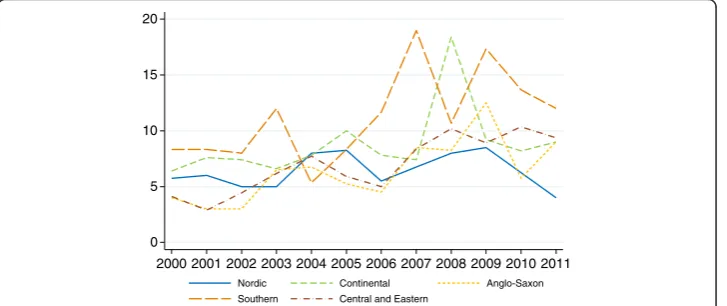
When looking at the distribution of reforms across country groups, two observations stand out. First, although reform activity is relatively broad-based and takes place to some extent in all country groups, reforms do not always occur simultaneously in all country groups: in some periods some country groups are more concerned than others (Fig. 2). In particular, Southern and Continental countries had a more intense reform activity starting from the middle of the decade.
Fig. 1Average number of reforms adopted by EU countries, by policy domain, year, and country group
0 5 10 15 20
2000 2001 2002 2003 2004 2005 2006 2007 2008 2009 2010 2011
Nordic Continental Anglo-Saxon
Southern Central and Eastern
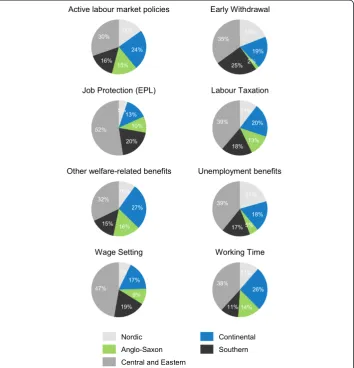
Second, the distribution of reforms across domains is not the same for the different country groups (Fig. 3). Continental countries were the most active in the domains of working time and other welfare benefits. In all other remaining domains, the group of Southern countries recorded the highest frequency of reforms, most notably in the EPL domain. Some country groups do not undertake reforms in some policy domains for a large part of the observed period. For example, there are very few reforms concerning early withdrawal instruments by Anglo-Saxon countries or concerning job protection by Nordic countries. Given that country groups are defined on the basis of similar labour market institutions, these differences reflect the fact that the distribution of reforms in time and across domains and country groups reflects the interplay between shocks and the main features of existing institutions.
Across the whole sample, thedistribution of reforms across policy domainsappears to be broadlystable, especially until 2008, as Fig. 4 shows. Until 2008, the only trend that can be observed is the gradual decline in the incidence of working time and early with-drawal reforms and a parallel increase in labour taxation and other welfare-related benefit reforms. The latter also include short-time working schemes, which were imple-mented simultaneously by a number of EU countries as a response to the crisis in 2008
and 2009 (as revealed by the sudden increase in these years of policy measures in the
“Other welfare benefits”domain, Fig. 1).
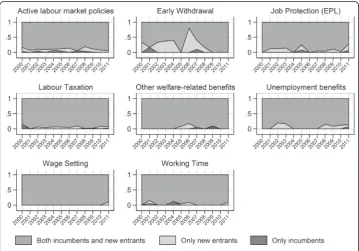
No general trend is apparent concerning the fraction of reforms targeted to the whole population, incumbents, or new entrants only(Fig. 5): most reforms extend to the whole population over the whole decade. Nevertheless, some specific patterns emerge: during the mid-2000s measures were targeted mostly at new entrants in the Early Withdrawal
Fig. 4Distribution of reforms across policy domains over the years (all EU)
domain, while after the crisis reforms increasingly concerned new entrants in the Job Protection and Unemployment Benefit domains.
3.2 The direction of reforms
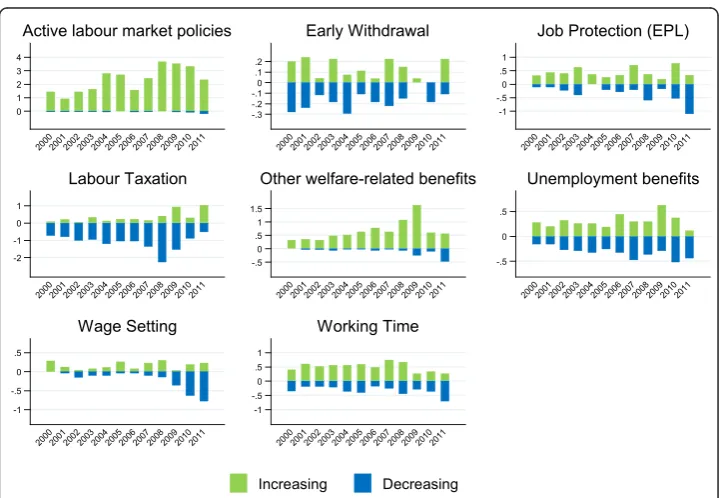
Information on the direction of the policy measures provides additional insight into the nature and purpose of labour market reforms during the last decade. Figure 6 shows the evolution of the average number of reforms in each domain, distinguishing by dir-ection. The bars shaded in light (green) refer to the average number of reforms in the various domains in a given year that took place in a representative EU country and that contributed to increasing the underlying policy settings (e.g., increasing the tax burden, the generosity of benefits or the stringency of regulation; for a more detailed definition of the direction of reforms, see Appendix B). Correspondingly, the bars in dark (blue) report, on the negative portion of the vertical axis, the number of reforms decreasing underlying policy settings that took place in a given domain and year.
A first message from Fig. 6 is that there are considerable differences across policy do-mains regarding the direction of measures. In some policy domains, reforms normally take place in one direction only. For instance, while most reforms strengthened ALMPs, a large majority of reforms contributed to the reduction of labour taxation or the stringency of regulations concerning working time. In contrast, in other domains (job protection, unemployment benefits, wage setting) there is a more balanced distri-bution of reforms in terms of direction of their effects on underlying policy settings over the period.
A second observation is that areversion in the direction of a number of reforms took place over the crisis period. Reforms concerning labour taxes and unemployment and other welfare benefits were generally aimed at raising generosity at the start of the crisis, but the direction changed since 2010: the tightening of government budgets
translated into a higher frequency of reforms raising the tax wedge or reducing benefits generosity. In this same period, reforms reducing the extent of regulations concerning EPL, wage setting, and working time became more frequent, confirming the evolution of reform priorities as the consequences of the crisis unfolded and the need to enhance the capacity of labour market adjustment became more pressing.
3.3 The two phases of the reform response after the crisis
Overall, the descriptive evidence suggests thatfollowing the crisis, the reform response was characterised by two distinct phases reflecting the evolution of priorities and constraints.
▪At the end of the post-crisis recession(the 2008–2009 period), reforms becamemore frequent in the domains of active labour market policies, labour taxation, other welfare-related benefits, and unemployment benefits. The broad aim of the measures put in place in this first phase was that of cushioning the labour market impact of the recession, notably by preventing excessive job shedding in the face of a shock
perceived as mostly temporary and by strengthening social safety nets. Labour taxes were most often reduced and benefits made more generous. Including following the recommendations in EU Economic Recovery Package, a number of countries put in place or beefed up existing short-time working schemes (recorded among“Other welfare-related benefits”) with the purpose of cushioning the impact of the crisis on firms' labour costs while containing job shedding.
▪In a second phase after the crisis (the 2010–2011 period), a different composition of reforms by domain becomes visible.As the crisis dragged on, labour market reforms becamemore frequent in the domain of job protection, wage setting, and working time, notably in Southern European countries. Reforms in these fields were more often leading in the direction of reducing regulations. Benefits were made more generous overall, while labour taxation was raised in a number of countries. On the one hand, the perception that the crisis involved a persistent aggregate demand contraction, especially in countries concerned by current account reversals and debt crises, prompted reforms aimed at improving the adjustment capacity of the labour market, including within the framework of financial assistance programmes. On the other hand, the perception of tightening fiscal constraints implied a reduced frequency of measures aimed at cushioning the labour market impact of the crisis via the budget (tax wedge reductions, active and passive labour market policies).
3.4 Taking a closer look: policy fields, cross-country comparisons
To obtain a more detailed picture of patterns and trends in reforms, it is worthwhile to look at policy fieldswith the most relevant macro-structural impact: those in the un-employment benefit, job protection, and wage setting policy domains.
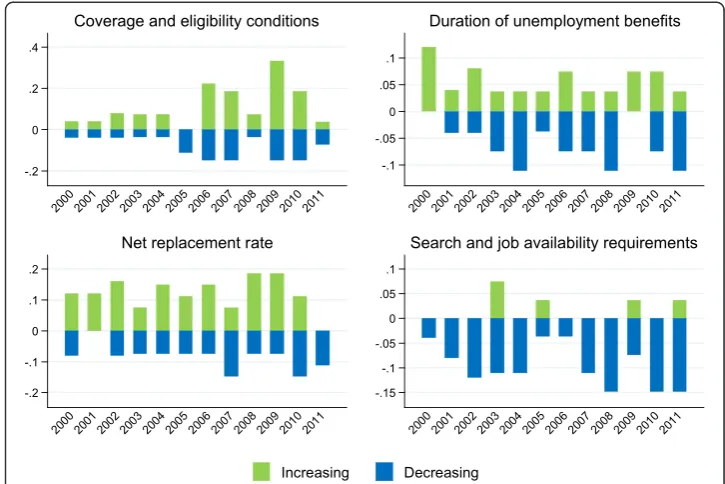
after the crisis, with a view to expand social safety nets to the growing mass of jobless workers. The balance between measures raising and reducing replacement rates shifted as the crisis unfolded: initially a higher number of measures raised benefits; as the crisis dragged on, measures reducing benefits became relatively more frequent, partially as a result of tightening public budgets.
Figure 8 shows the frequency and direction of reforms within the job protection (EPL) domain. It reveals an increased frequency of reforms addressing the EPL regime for permanent contracts since 2006, with measures pointing in both directions. How-ever, starting from 2009, the incidence of measures reducing EPL clearly overtook that of measures raising EPL restrictiveness, consistently with the increasing need to tackle labour market adjustment. Regarding fixed-term contracts, in the past decade the
Fig. 7Direction of reforms in the unemployment benefit domain (average number of reforms across the EU)
frequency of measures relaxing conditions was almost systematically below that of mea-sures tightening conditions, which may reflect, in a number of cases, a gradual adjust-ment to past reforms relaxing conditions for fixed term contracts with the implication of raising employment while at the same time creating segmentation.
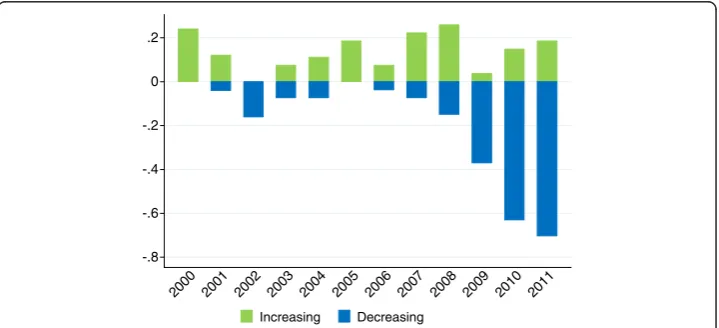
The time evolution of measures affecting wage setting, previously highlighted for the whole domain of wage setting frameworks (including also social pacts and tripartite agreements), is even clearer when focusing exclusively on government intervention aimed at reforming the wage setting system (Fig. 9). This evidence suggests a shift in the positioning of governments on the wage-employment trade-off during periods of high unemployment (crisis years).
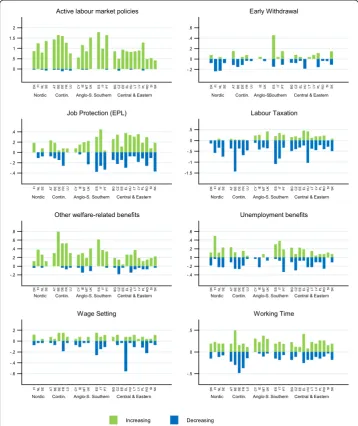
Figure 10 compares reform directions across countries within each policy domain. The comparison of reform patterns within homogenous country groups reveal some similarities, thus confirming that institutional factors play a role in driving reform pat-terns. However, even within country groups, the direction of reforms is quite heteroge-neous for unemployment benefit and wage setting reforms. Anglo-Saxon countries barely reduced job protection, while Southern countries frequently carried out such types of reforms. Eastern and Continental countries quite frequently put in place generosity-decreasing welfare benefit reforms. In Continental countries, measures aimed at easing working time regulation were comparatively more frequent.
3.5 Comparing LABREF to other databases
To benchmark the information from LABREF, a comparison was performed with the only analogous database, namely, the Social Reforms Database compiled by the Fondazione Rodolfo Debenedetti and IZA (henceforth, FRDB-IZA database)7. The coverage of LABREF and FRDB-IZA data overlap only partially. The FRDB-IZA data-base contains information for 14 EU countries over the period 1980–2007 (the 15 EU countries before the 2004 enlargement bar Luxemburg); LABREF covers EU-27 coun-tries (all but Croatia) over the period 2000–2011. Hence, the comparison is made for the 14 EU countries contained in the FRDB-IZA database for the 2000–2007 period.
To make the comparison possible, five comparable policy ‘subdomains’were created as follows: active labour market policies (ALMP); employment protection legislation (EPL); unemployment benefits; other welfare-related benefits; and early withdrawal
-.8 -.6 -.4 -.2 0 .2
2000 2001 2002 2003 2004 2005 2006 2007 2008 2009 2010 2011
Increasing Decreasing
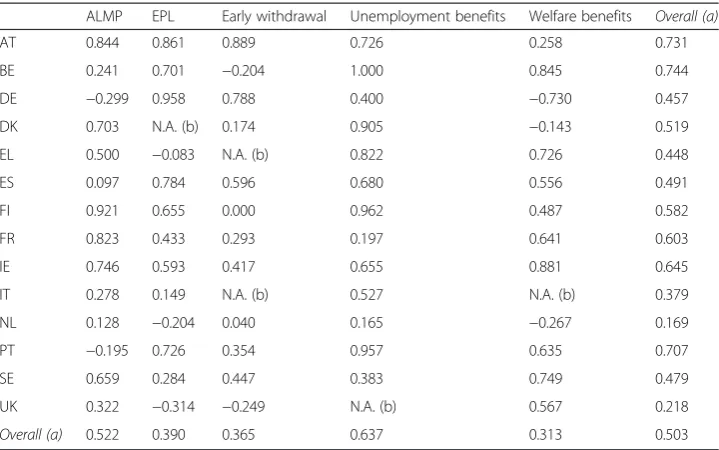
(see Additional file 1). Table 1 reports correlation coefficients between reform count data from the two databases. The overall correlation between the number of reforms recorded in both databases is 0.5. Correlation coefficients across subdomains vary between 0.31 (Other Welfare Benefits) and 0.64 (Unemployment Benefits), correl-ation coefficients across countries vary between 0.22 (UK) and 0.74 (Belgium). While these coefficients indicate a fair degree of correlation between the number of reforms recorded in both databases, the fact that the correlation is not perfect could be linked to differences in the criteria followed to identify reforms as separ-ate units8.
The information from the LABREF database has also been compared to information obtained from quantitative indicators of labour market policy, namely, the tax wedge, the net replacement rate of unemployment benefits, the EPL indicator for regular
workers compiled by the OECD, as well as spending on ALMPs (as a percentage of GDP). To take into account the fact that in a given year, in a given country, different reforms may coexist with different directions, a “reform stance”variable is generated as the number of reforms with increasingdirection net of the number of reforms with de-creasing direction in a given policy domain. (For an exact definition of increasing and decreasing reforms by policy domain, see Appendix B).
In Table 2, simple correlations have been calculated across the whole available panel between the change of the policy indicators and the LABREF reform stance in the relevant policy domain. The correlations are calculated so as to see whether reform measures adopted in a given year have an effect on policy indicators in the next calendar year. Table 2 shows that the LABREF reform stance variables are positively correlated to changes in the related policy indicators. The correlations are modest but reasonable (ranging between 0.1 and 0.3) and are statistically significant with the exception of the EPL indicator for regular workers.
Table 1Correlation between reform numbers in LABREF and FRDB-IZA databases (14 EU countries, 2000–2007)
ALMP EPL Early withdrawal Unemployment benefits Welfare benefits Overall (a)
AT 0.844 0.861 0.889 0.726 0.258 0.731
BE 0.241 0.701 −0.204 1.000 0.845 0.744
DE −0.299 0.958 0.788 0.400 −0.730 0.457
DK 0.703 N.A. (b) 0.174 0.905 −0.143 0.519
EL 0.500 −0.083 N.A. (b) 0.822 0.726 0.448
ES 0.097 0.784 0.596 0.680 0.556 0.491
FI 0.921 0.655 0.000 0.962 0.487 0.582
FR 0.823 0.433 0.293 0.197 0.641 0.603
IE 0.746 0.593 0.417 0.655 0.881 0.645
IT 0.278 0.149 N.A. (b) 0.527 N.A. (b) 0.379
NL 0.128 −0.204 0.040 0.165 −0.267 0.169
PT −0.195 0.726 0.354 0.957 0.635 0.707
SE 0.659 0.284 0.447 0.383 0.749 0.479
UK 0.322 −0.314 −0.249 N.A. (b) 0.567 0.218
Overall (a) 0.522 0.390 0.365 0.637 0.313 0.503
Notes.(a)Overall correlations are run across the number of reforms as reported by different sources, with reform domains‘stacked’in a single vector, and differ from the averages of correlations by domain
(b)The correlation is missing whenever at least one of the datasets records zero reforms over the whole period.
Table 2Correlation of LABREF reform stance in relevant domain with change in policy indicator (2000–2011)
Policy Indicator Reform stance in policy domain Correlation P-value of test of no corr.
No. of countries
Tax wedge Labour taxation 0.26 0.00 27
Net replacement rate of UB Unemployment benefits 0.12 0.06 27
ALMP spending (% GDP) ALMP 0.25 0.00 20
EPL indicator (regular contracts) EPL 0.10 0.14 21
Source:LABREF reform stance: number of reforms in“increasing”directionminusnumber of reforms in the“decreasing”
There may be many reasons why a very high correlation between the LABREF reform stance and changes in policy indicators may not be expected. First, the reforms stance indicator does not differentiate between measures with different scope and degree of ambition. Second, some aspects of labour market reforms are not taken into account in quantitative policy indicators (e.g., coverage and condi-tionality of unemployment benefits are not taken into account in the net replace-ment rate indicator). Finally, the time of recording of measures in the LABREF classification may not always coincide with the one used to update synthetic quanti-tative policy indicators.
4 Searching for the determinants of labour market reforms
The degree of specification of the measures collected in LABREF permits deepen-ing insights into reform determinants. Before movdeepen-ing to multivariate regression analysis, bivariate correlations help provide prima facie evidence on a number of questions as follows. When and where are labour market reforms more likely to take place? What are the characteristics of countries exhibiting higher reform in-tensity? During which periods are reforms more frequent? What factors trigger re-forms? Before a systematic regression analysis, some pieces of bivariate analysis are offered.
4.1 Some basic bivariate correlations
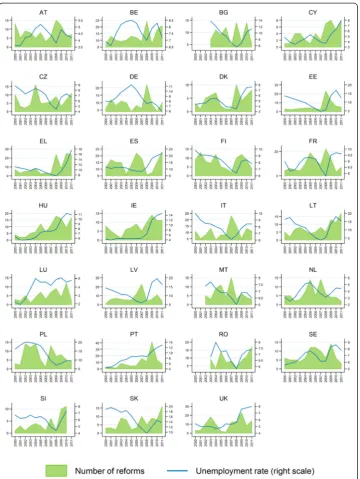
The co-movement between the number of reforms and unemployment suggests that reforms tend to be more frequent in periods when joblessness is high or on the rise (Fig. 11). This is particularly evident after the 2008 recession in most countries. The graph shows, however, that the timing of the policy response differs somewhat across countries, with some cases increased reform action takes place with some lag after the increase in unemployment (e.g., Ireland, Portugal), and in other cases reform activism was intense already before the occurrence of periods on unemployment growth (e.g., Spain, France).
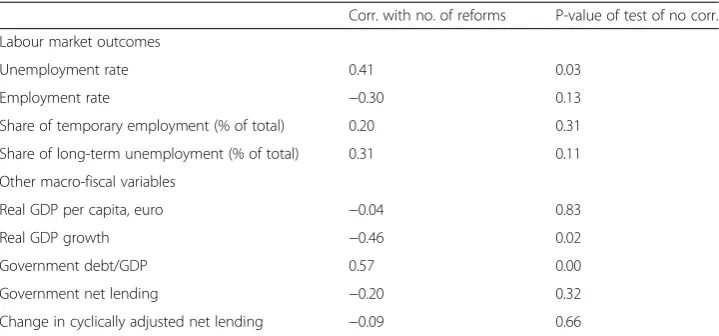
The longer-term relation between unemployment and reforms can be captured by a cross-country scatterplot. Figure 12 confirms the expected relation. The average reform intensity over the sample period tends to be higher in countries characterized, on average, by a higher unemployment rate. The cross-country positive relation between reforms and unemployment is quite strong, post-transition Poland and Slovakia being outliers in light of the high unemployment rates in early 2000s.
the decade and the number of labour market reforms is close to zero (thus not sup-porting the often claimed trade-off between fiscal consolidation and reforms)9.
4.2 Regression analysis
4.2.1 Empirical strategy
We analyse the determinants of both the number and direction of reforms. In the spirit of previous studies on the determinants of labour market reforms (e.g., Duval, 2008), explanatory variables include controls for structural country characteristics, the eco-nomic situation, the political context, and the fiscal situation.
Structural country characteristics are captured by GDP per capita at the start of the sample period, a dummy taking the value one for countries that acceded the EU in 2004 or later and a fixed exchange rate dummy taking value one in cases (countries and years) where the exchange rate arrangement is either a monetary union or a cur-rency board. The first two variables aim at capturing, respectively, the link between institutional and economic development and that between the transformation of do-mestic institutions and EU accession. The exchange rate regime is expected to matter as well. According to the standard expectation, in the absence of the exchange rate as a shock absorber, reforms, including in the labour market field, need to substitute by en-hancing the responsiveness of wages and prices to shocks (e.g., Bean, 1998). It has also been argued, however, that incentives for reforms in a monetary union could be ambiguous, as the reduction in the inflation bias of monetary policy linked to mon-etary union participation can reduce the urgency of reforms reducing structural un-employment (Calmfors, 2001).
Controls for the economic situation include the unemployment rate and a dummy variable for deep recessions which, following Duval (2008), takes the value of one if the
AT BE BG CY CZ DE DK EE EL ES FI FR HU IE IT LT LU LV MT NL PL PT RO SE SI SK UK 4 6 8 10 12 14
0 5 10 15
Average unemployment rate, 2000-2011
Fig. 12Average number of reforms and unemployment, 2000–2011
Table 3Reform intensity and country characteristics: cross-country correlations (EU27, 2000–2011)
Corr. with no. of reforms P-value of test of no corr. Labour market outcomes
Unemployment rate 0.41 0.03
Employment rate −0.30 0.13
Share of temporary employment (% of total) 0.20 0.31
Share of long-term unemployment (% of total) 0.31 0.11
Other macro-fiscal variables
Real GDP per capita, euro −0.04 0.83
Real GDP growth −0.46 0.02
Government debt/GDP 0.57 0.00
Government net lending −0.20 0.32
Change in cyclically adjusted net lending −0.09 0.66
Notes:(1)Spearman rank correlations of averages over the period 2000–2011.(2)Number of observations (countries): 27
output gap is less than minus 4% of GDP. A widely explored hypothesis is that reform activity is more intense in countries that experience bad economic outcomes. However, it needs to be acknowledged that the number and direction of reforms can be affected in different ways by the economic context depending on the specific policy field. For in-stance, it could be expected that in bad times reforms tend to reduce the tax wedge and the stringency of regulations to boost job creation, while increasing the generosity of unemployment benefits to adapt social safety nets to a situation of protracted labour demand slack.
Variables capturing political costs include controls for the election cycle (an election year dummy and a dummy equal to 1 if elections took place in the previous year) and the fraction of parliamentary seats controlled by the government10. It is expected that there are fewer reforms in election years and more reforms in the year after the elec-tion when a new government starts implementing its policies. A large parliamentary majority for the government may facilitate reform activity.
Fiscal conditions are controlled for by means of the general government budget balance. The expectation is that, in the case of reforms that are costly to the budget, a larger fiscal space favours reforms. The spread with respect to Germany of real interest rates on 10 year government bonds is also included as a measure of markets’ percep-tion of fiscal condipercep-tions11. The expected effect of such a variable is not obvious. On the one hand, higher spreads may signal stronger market pressure to reform. On the other hand, they are associated with a reduced fiscal space to accommodate reforms with an impact on the budget. Another hypothesis that has often been put to the test is that fis-cal consolidation makes reforms less likely by reducing the politifis-cal capital available to governments. We have not pursued that route as, in our sample, fiscal consolidation measures raise a strong suspicion of endogeneity, especially with reform measures with an impact on the budget, but also with those reforms that were triggered during the crisis in a context of capital flight, revenue losses linked to deep recessions, and bond market tensions, where governments had to respond simultaneously by tightening the budget and stepping up the reform agenda.
Time-specific factors are captured by year fixed effects. The variation in the regres-sion analysis takes place especially across countries, although variation along the time dimension is also present to the extent that year effects only account for intercept het-erogeneity. In light of the short time series dimension of the dataset, explanatory vari-ables are not instrumented, and possible endogeneity issues (likely to be present especially for the unemployment variable) are addressed by taking lagged values of the explanatory variables.
4.2.2 Assessing the determinants of the number of reform measures
years, reforms tend to be less numerous, while the fact that elections took place in the previous year has a positive effect on reforms, albeit not significantly. The fraction of seats in the parliament held by the government is also positively and significantly linked to reform activity. Fiscal variables have a weak effect on overall reform activity: larger deficits and higher interest rate spreads are associated with more reform measures, although the latter is not statistically significant.
The specification reported in Column 2 of Table 4 includes a dummy variable taking the value 1 after year 2007 (i.e., after the financial crisis triggered by the bankruptcy of Lehman Brothers) as an alternative to the dummy variable based on a negative output gap. The post-2007 crisis dummy is highly significant, suggesting that the increase in reform intensity observed after the burst in the financial crisis could be partly linked to the tendency of reforms to be more numerous in coun-tries affected by deep crises.
Table 4Determinants of the total number of labour market reforms
(1) (2) (3) (4)
Dependent variable: Overall number of reforms
Per-capita GDP in 2000 −0.188*** −0.181*** −0.157***
(0.053) (0.050) (0.046)
New Member State (dummy) −5.497*** −5.966*** −5.761***
(1.264) (1.221) (1.180)
Unemployment rate (1st lag) 0.034 0.179* 0.186** 0.178
(0.090) (0.091) (0.086) (0.171)
Output gap <−4 (dummy) 4.343*** 2.943* 3.275
(1.175) (1.709) (2.018)
Year > 2007 (dummy) 3.389***
(0.708)
Parliamentary election year (dummy) −1.858*** −2.165*** −2.167*** −2.116***
(0.673) (0.648) (0.682) (0.653)
1 year after parl. elections (dummy) 0.969 0.720 0.632 0.702
(0.784) (0.759) (0.740) (0.732)
Fraction of seats held by the government in Parliament 9.867*** 7.758** 6.506* 2.812
(3.728) (3.503) (3.483) (3.773)
Fixed exchange rate (dummy) 0.413 −0.184 0.045 0.340
(0.609) (0.602) (0.580) (1.367)
Real interest rate spread (1st lag) 0.070 0.030 0.066 0.098
(0.116) (0.115) (0.139) (0.143)
Net lending general government (1st lag) −0.129* −0.050 −0.123 −0.109
(0.070) (0.077) (0.079) (0.094)
Year dummies No No Yes Yes
Country dummies No No No Yes
Observations 302 302 302 302
R-squared 0.225 0.258 0.322 0.383
The baseline specification is presented in Column 3 of Table 4. In this specification, year dummies are introduced to control for common trends in reform activity across countries, including the simultaneous increase in reforms observed after the financial crisis. The inclusion of year effects is strongly supported by the F-test. Results are somewhat affected as compared with the specification estimated on pooled data in column 1. The unemployment variable becomes clearly significant, and the output gap dummy variable shows a drop in the coefficient, remaining however significant. Elec-tions remain highly significant, while the effect of fiscal variables turns out insignificant after the inclusion of year dummies.
Column 4 displays an alternative specification including also a full set of country effects, on top of year effects, which imply the dropping of time-invariant variables. All coefficients (except that of parliamentary seats held by the government) remain very close to the ones estimated without country effects, but the precision of the estimation decreases in light of reduced degrees of freedom. All in all, we interpret the results of this alternative specification as support for the robustness of our results and proceed by estimating the rest of the results in specifications including year effects but not country effects.
Table 5 reports determinants of the number of reform measures separately by policy domain. The specification is the same as that in column (3) of Table 4, which includes year dummies.
It is confirmed that countries at an early stage of development and with a longer rec-ord or EU membership have been more active in reforming, with the evidence holding especially for tax and benefit systems. Fixed exchange rate regimes have a generally weak and insignificant effect on reform activity, except for the Wage Setting domain, which is associated with a higher number of reform measures.
Unemployment has a positive effect on the number of reforms in all policy areas but one, and is statistically significant for Early Withdrawal and ALMP reforms. Deep crises are generally associated with a higher number of reforms, statistically significant in the EPL and Wage Setting domains, but significantly fewer reforms of Other Welfare Benefits.
Election years are associated with fewer reforms in all domains, significantly for the majority of domains. The fact that elections took place in the previous year generally is linked with increased reform activity, significantly so for Early Withdrawal schemes and reforms in the Wage Setting system, while a significant negative relation is found for Labour Taxation. The fraction of seats held by the government has a positive rela-tion with reform activity in most domains, but statistical significance is only reached in the Labour Taxation domain.
The effect of fiscal variables is not uniform across policy domains. Budget deficits are associated with more reform measures in the majority of domains (statistically signifi-cantly for Other Welfare Benefits and Wage Setting) but fewer measures in the domain of Early Withdrawal. High interest rate spreads are associated with more reforms on ALMP’s but fewer measures in Wage Setting.
Table 5Determinants of the number of reform measures, by policy domain
(1) (2) (3) (4) (5) (6) (7) (8)
Dependent variable: number of reforms by domain Labour Taxation Unemp. Benefits Other Welfare Benefits ALMP EPL Early Withdrawal Wage Setting Working Time
Per-capita GDP in 2000 −0.050** −0.030*** 0.005 −0.022 −0.028** −0.013** −0.014 −0.006
(0.020) (0.009) (0.012) (0.019) (0.012) (0.005) (0.010) (0.012)
New Member State (dummy) −1.386*** −0.680*** −0.279 −1.709*** −0.594** −0.431*** −0.384* −0.297
(0.421) (0.218) (0.254) (0.492) (0.281) (0.127) (0.219) (0.274)
Unemployment rate (1st lag) 0.004 −0.008 0.031 0.067* 0.032 0.035** 0.008 0.017
(0.031) (0.021) (0.023) (0.039) (0.029) (0.015) (0.018) (0.019)
Output gap <−4 (dummy) 0.979 0.229 −1.105*** 1.008 0.916* −0.050 1.050** −0.084
(0.685) (0.348) (0.299) (0.796) (0.546) (0.169) (0.517) (0.363)
Parliamentary election year −0.532** −0.284** −0.260* −0.563* −0.204 −0.018 −0.064 −0.242*
(0.237) (0.136) (0.148) (0.334) (0.172) (0.083) (0.118) (0.142)
1 year after parl. elections −0.508** 0.195 −0.053 −0.024 0.341 0.176* 0.299** 0.206
(0.258) (0.190) (0.172) (0.303) (0.223) (0.103) (0.130) (0.174)
Fraction of seats held by the government in Parliament 2.129* −0.249 1.357 1.714 0.700 −0.357 0.054 1.157
(1.236) (0.723) (0.905) (1.553) (0.918) (0.461) (0.442) (0.841)
Fixed exchange rate dummy −0.268 0.056 0.142 −0.178 0.015 −0.036 0.185* 0.131
(0.232) (0.144) (0.130) (0.267) (0.181) (0.074) (0.100) (0.130)
Real interest rate spread (1st lag) 0.024 −0.017 0.018 0.091* −0.017 −0.007 −0.044* 0.018
(0.040) (0.031) (0.024) (0.055) (0.041) (0.015) (0.026) (0.026)
Net lending of general government (1st lag) 0.005 0.033 −0.057** −0.014 −0.045 0.019* −0.035* −0.030
(0.030) (0.023) (0.027) (0.035) (0.029) (0.010) (0.021) (0.025)
Observations 302 302 302 302 302 302 302 302
R-squared 0.180 0.090 0.214 0.230 0.189 0.147 0.239 0.086
Notes:(1)OLS regressions with year dummies.(2)The sample includes EU-27 countries for the period 2000–2011.(3)Robust standard errors in parentheses. Asterisks indicate estimated coefficients that are statistically significant at the 1% (***), 5% (**), or 10% (*) level.(4)SeeAppendix Bfor the definition of the dependent variable. SeeAppendix Cfor the definition and the source of explanatory variables.
Journal
of
Labor
Policy
(2015) 4:12
Page
23
of
4.2.3 Assessing the determinants of the direction of reform measures
The previous analysis helps understanding the drivers of reform activism in labour pol-icy domains but does not shed light on the determinants of the direction of reforms. With a view to fill this gap, Table 6 analyses the determinants of the reform stance indi-cator for each policy domain. The same specification as in Table 5 is maintained. This permits the checking of whether the same factors that explain reform activism also imply a certain direction for the reform process.
GDP per capita at the start of the period is generally not significant as an explanatory variable. Member States acceded in 2004 or later have recorded a lower pace of in-crease in the generosity of ALMPs and Other Welfare Benefits, possibly because these policies require establishing governance frameworks that were in some cases not equally available in some New Members States as in other EU countries. The evidence appears consistent with the hypothesis that fixed exchange rates make flexicurity-type reforms more necessary: the fixed exchange rate dummy is associated with reforms making benefits more generous and regulations regarding EPL, wage setting, and work-ing time less strwork-ingent (albeit with a non-significant coefficient).
As expected, higher unemployment is associated with a reform stance leaning towards an increased generosity of unemployment benefits and extensions of ALMPs. The reform stance in Labour Taxation is instead strongly negatively re-lated to the unemployment rate. Quite intuitively, deep crises are linked to reforms towards less regulated Wage Setting systems and more generous Active Labour Market Policies. Episodes of large and negative output gaps are associated with an increased need to improve the responsiveness of wage setting to the labour market slack and to re-train and re-qualify the long-term unemployed and re-integrate into the labour force those that have dropped out of the labour force. Deep crises are also associated to less generous Other Welfare Benefits. Episodes of output gaps below minus 4% are often associated with situations of protractedly high unemployment. In those conditions, benefit generosity (particularly Short-Time Working Schemes) is often brought back to its previous level to prevent benefit dependency after having been increased during the years where unemployment has been building up.
Interestingly, election variables are generally non-significant, with the exception of the case of EPL reforms: the evidence suggests that reforms reducing the stringency of EPL reforms are more likely to be carried just after elections. Also the fraction of seats in the Parliament held by the government seldom achieves statistical significance, except for reforms reducing the generosity of Early Withdrawal schemes.
The interest rate spread is generally non-significant, but high spreads appear signifi-cantly associated with reforms extending ALMPs and reducing the generosity of Early Withdrawal Schemes. Interest spreads also appear associated with reforms reducing regulations in wage setting and working time, although not significantly. The coefficient for EPL reforms is instead positive, meaning that higher spreads are linked with re-forms making EPL more stringent.
Table 6Determinants of reform stance, by policy domain
(1) (2) (3) (4) (5) (6) (7) (8)
Dependent variable: reform stance by domain Labour Taxation Unemp. Benefits Other Welfare Benefits ALMP EPL Early Withdrawal Wage Setting Working Time
Per-capita GDP in 2000 −0.001 −0.005 −0.006 −0.030 0.006 −0.006 0.012 −0.005
(0.018) (0.008) (0.009) (0.020) (0.009) (0.005) (0.008) (0.009)
New Member State (dummy) 0.333 −0.094 −0.512** −1.784*** 0.233 −0.133 0.293 −0.030
(0.371) (0.215) (0.222) (0.493) (0.213) (0.125) (0.188) (0.220)
Unemployment rate (1st lag) −0.084*** 0.030* 0.029 0.067* −0.003 0.008 0.020 −0.007
(0.030) (0.016) (0.018) (0.038) (0.027) (0.015) (0.016) (0.019)
Output gap <−4 (dummy) 1.017 −0.349 −1.062*** 1.295* −0.042 0.238** −1.029** −0.239
(0.704) (0.298) (0.328) (0.760) (0.354) (0.111) (0.468) (0.296)
Parliamentary election year (dummy) 0.004 0.099 −0.171 −0.512 −0.056 0.005 0.028 0.011
(0.213) (0.121) (0.140) (0.326) (0.135) (0.077) (0.091) (0.123)
1 year after parl. elections (dummy) 0.023 −0.239 −0.040 0.019 −0.324* 0.006 −0.005 −0.123
(0.226) (0.173) (0.167) (0.293) (0.174) (0.107) (0.133) (0.166)
Fraction of seats held by the government in Parliament −1.362 0.055 1.116 1.678 0.509 −1.053** 0.131 −0.562
(1.072) (0.693) (0.881) (1.502) (0.614) (0.425) (0.521) (0.772)
Fixed exchange rate (dummy) 0.058 0.228* 0.250** −0.124 −0.061 0.039 −0.033 −0.104
(0.201) (0.134) (0.125) (0.260) (0.139) (0.069) (0.090) (0.120)
Real interest rate spread (1st lag) −0.004 −0.029 0.023 0.103** 0.015 −0.035*** −0.001 −0.010
(0.041) (0.026) (0.025) (0.051) (0.030) (0.013) (0.024) (0.024)
Net lending of general government (1st lag) −0.104*** 0.039** 0.008 0.008 0.007 0.004 0.031 0.016
(0.035) (0.017) (0.020) (0.039) (0.016) (0.010) (0.019) (0.020)
Observations 302 302 302 302 302 302 302 302
R-squared 0.186 0.091 0.201 0.246 0.115 0.077 0.223 0.078
Notes:(1)OLS regressions with year dummies.(2)The sample includes EU-27 countries for the period 2000–2011.(3)Robust standard errors in parentheses. Asterisks indicate estimated coefficients that are statistically significant at the 1% (***), 5% (**), or 10% (*) level.(4)SeeAppendix Bfor the definition of the dependent variable. SeeAppendix Cfor the definition and the source of explanatory variables.
Journal
of
Labor
Policy
(2015) 4:12
Page
25
of
The direction of the reform process most likely depends on the state of existing pol-icies and institutions. Existing analyses have shown that institutional settings exhibit a certain degree of stability. By regressing the change in labour market policy indicators on their initial levels, negative coefficients are generally obtained (e.g., Høj et al., 2006). This means that a certain domain is less likely to become more regulated if regulations are already very stringent.
Table 6 omits the initial state of policies and institutions among the explanatory variables, the reason being that a similar indicator is not available for most of the policy domains considered. It is possible however to recover this indicator for selected domains.
Table 7 presents results for the determinants of the direction of reforms in the do-mains of Labour Taxation, Unemployment Benefits, and EPL taking into account initial policy levels. Initial policy levels are summarised by the level of the tax wedge, the net replacement rate of unemployment benefits, and the summary indicator of the strict-ness of regulation in the EPL domain (all collected by the OECD). Since the OECD indicators are not available for all countries and years, the number of observations decreases in these specifications.
Table 7 shows that the reform stance is affected negatively, and significantly, by the initial policy level in all three domains. This means that there are more reform measures reducing the tax burden on labour the higher the starting level of the tax wedge; there are more reform measures reducing the generosity of unemployment benefits if the net replacement rate is already high; and there are more reforms reducing employment protection legislation when the protection of regular workers is high (while the effect of the protection of temporary workers is close to zero and is not statistically significant). Other results are in line with those in the baseline specification displayed in Table 6, except for what concerns the interest rate spread. This variable exhibits a negative and statistically signifi-cant coefficient in the EPL equation, meaning that market pressure is linked to reforms reducing the extent of EPL regulation. This result, however, is driven to a large extent by the shrinking of the sample when including the lagged EPL index in the specification.
The LABREF database permits digging deeper into the terms of reform typologies and to investigate the determinants of certain types of reforms within a given domain. The last column of Table 7 considers EPL reforms affecting temporary contacts only. It is shown that, for this policy field, the initial policy level has no relevance for the direc-tion of reform. Since the sample includes time periods with excepdirec-tionally high and ris-ing unemployment in many countries, a possible interpretation of this result is that, in an environment characterised by high unemployment and low job creation, reforms ad-dressing segmentation are less likely to take place via more stringent regulation for the use of temporary contracts, even in countries with particularly loose protection of tem-porary labour.
5 Conclusions
The data suggests that labour market reform patterns reflect the interplay between economic shocks and existing labour market institutions. The 2008 crisis triggered reforms in most policy domains in a large number of EU countries. In a first phase, reforms were mostly aimed at cushioning the impact of the crisis on employment; in a second phase, reforms aimed at increasing the adjustment capacity of labour markets (EPL, working time, wage setting) became more frequent, while reforms reducing the labour taxation or raising entitlements became less frequent in light of tightening budget constraints.
Table 7Determinants of reform stance, selected domains, with controls for initial policy levels
(1) (2) (3) (4)
Dependent variable: reform stance by domain
Labour Taxation Unempl. Benefits EPL EPL (temp. contracts)
Per-capita GDP in 2000 −0.036 −0.004 −0.005 −0.005
(0.022) (0.011) (0.014) (0.009)
New Member State (dummy) −0.538 −0.359 0.194 −0.169
(0.495) (0.292) (0.368) (0.190)
Unemployment rate (1st lag) −0.105** 0.019 −0.030 0.011
(0.043) (0.021) (0.035) (0.022)
Output gap <−4 (dummy) 1.203 −0.420 0.104 0.109
(0.738) (0.324) (0.385) (0.230)
Parliamentary election year (dummy) 0.022 0.105 0.047 0.001
(0.249) (0.154) (0.159) (0.113)
1 year after parl. elections (dummy) 0.126 −0.334 −0.253 −0.040
(0.266) (0.221) (0.211) (0.121)
Fraction of seats held by the
government in Parliament −
0.878 −0.764 1.375 0.617
(1.199) (1.089) (0.886) (0.515)
Fixed exchange rate (dummy) −0.129 0.237 −0.082 −0.103
(0.223) (0.179) (0.210) (0.096)
Real interest rate spread (1st lag) 0.011 −0.012 −0.096** −0.083***
(0.046) (0.032) (0.038) (0.026)
Net lending of general government
(1st lag) −
0.091** 0.043** 0.012 −0.004
(0.041) (0.019) (0.020) (0.013)
Tax wedge (1st lag) −0.032**
(0.014) Net replacement rate of
unemployment benefits, (1st lag)
−0.014*** (0.005) Employment protection index,
regular contracts (1st lag) −
0.194* (0.113) Employment protection index,
temporary contracts (1st lag)
0.030 −0.015 (0.088) (0.052)
Observations 241 229 222 222
R-squared 0.229 0.113 0.179 0.110
The paper empirically analyses both the determinants of reform activism (the number of labour market reforms carried out in a given year) and of the reform stance (the dir-ection taken by policy settings as a result of reform activity). When analysing reform determinants by means of panel regressions including year effects, a number of results stand out:
The evolution of labour market institutions was faster in EU countries at earlier stages of economic development. No significant relation between GDP per capita and reform direction is found instead. Reform activism was more intense in countries with a longer record of EU membership; ALMPs and other benefits where made more generous especially in these countries. A fixed exchange rate has generally no significant relation with reform activism, but there is mild evidence in favour of a direction of reforms consistent with the flexicurity principle.
Harsh economic and labour market conditions are associated with an increased number of structural reforms, especially for active labour market policies, EPL, early retirement and retirement age reforms, and wage setting reforms. The reform stance also depends on labour market conditions in the expected way, with high unemployment being associated with reforms lowering the tax burden on labour and raising the generosity of unemployment benefits and that of active labour market policies.
Reforms appear significantly less numerous in election years, while the relation of political variables with the reform stance is generally weak. This suggests that reform activism per se is perceived as imprudent in election years.
Fiscal variables have a non-systematic relation with reform activism; results depend on specific reform domains. The reform stance instead depends on labour market conditions in the expected way: with lower government deficits, reforms tend to lower the tax wedge and to raise unemployment benefits. The data also provide some mild support to the view that reforms, notably those reducing the extent of employment and wage setting regulations, are triggered by financial market pressure, as measured by the change in interest rate spreads on government bonds.
The reform stance variable, in line with previous evidence, shows a strong link with initial policy conditions. Reforms raising the tax burden are less likely the higher the tax wedge on labour; those increasing the generosity of unemployment benefits occur less often the higher are net replacement rates for unemployment insurance; reforms increasing the degree of stringency of EPL reforms are less numerous if EPL for regular contracts is rigid. However, EPL reforms targeted to temporary contracts are not linked to the initial degree of regulation for temporary contracts.
Endnotes 1
Sources used to compile LABREF include the ILO databases, information published by EIRO (European Industrial Relations Observatory of the Dublin Foundation for the Improvement of Working and Living Conditions), information published by the European Labour Law Network, reports by the European Employment Observatory, country reports by the OECD and IMF, National Ac-tion Plans for Employment annually set-up in the framework of the Employment Strategy, National Reform Programmes under the Lisbon Strategy, national legis-lation and other information available from the websites of the EU Ministries for Employment and Social Affairs.
2
The link is: http://ec.europa.eu/social/main.jsp?catId=1143&intPageId=3193& langId=en.
3
In particular, reported reforms also encompass framework agreements among social partners, social pacts and tripartite agreements involving government, trade unions, and employers’federations.
4
A single piece of legislation may cover several policy areas and may consequently include several‘reforms’to be recorded in LABREF.
5
An example could be a complex tax reform which includes both significant cuts (e.g., rate cuts) and increases (e.g., elimination of tax credits) in the Personal Income Tax system.
6
The analysis is based on the country taxonomy proposed by Esping-Andersen (1990), where countries are classified into five groups on the basis of socio-economic systems. This classification covers 22 EU countries which are classified into five groups on the basis of principal component analysis. The five remaining EU countries were allocated as follows: Malta and Cyprus were allocated to the Anglo-Saxon group of countries, Luxembourg to the Continental group; Romania and Latvia to the Central, Eastern group of countries. Note that in the Esping-Andersen taxonomy, the Netherlands is classified as a Nordic country, while Greece is classified as an Eastern country.
7
The data base is available under link http://www.frdb.org/language/eng/topic/data-sources/dataset/international-data/doc_pk/9027.
8
For instance, composite reforms may be broken down to a different number of reform measures by different databases depending on their systems of classification. It is possible that the same reform is recorded in different years in different databases. It appears that generally LABREF records more reforms measures than the FRDB-IZA database.
9
See, e.g., Deroose and Turrini (2005), Duval (2008), and Buti et al. (2009) for a re-view of arguments for a possible trade-off between fiscal consolidation and structural reforms and for empirical evidence.
10
Political control variables are derived from the Database of Political Institutions by the World Bank (Beck et al. 2001). Other variables, including government ideol-ogy and the number of years since the last election, were tested and not selected as generally exhibiting non-significant coefficients.
11
Appendix A: Classification of policies in the LABREF database
The database covers 52 labour market and welfare policy fields which are grouped in 9 broad policy domains as follows:
1. Labour taxation
1. Employers’social security contributions
2. Employees’social security contributions
3. Social security contributions of the self-employed
4. Income tax
5. Labour taxation - Other
2. Unemployment benefits
6. Net replacement rate
7. Duration of unemployment benefits
8. Coverage and eligibility
9. Search and job availability requirements
10.Unemployment benefits - Other
3. Other welfare-related benefits
11.Short-time working schemes
12.In-work benefits (employment conditional benefit or tax credit)
13.Social assistance (housing, means-tested benefits)
14.Sickness schemes
15.Family-related benefits
4. Active labour market programmes
16.Public Employment Services (job assistance, job-counselling etc.)
17.Training
18.Direct job creation and employment subsidies
19.Employment subsidies
20.Special schemes for the disabled
21.Special schemes for youth
22.Active labour market policies - Other
5. Job protection
a) Permanent contracts
23.Procedural requirements
24.Notice and severance payments
25.Definition of fair dismissal
26.Permanent contracts - Other
b)Temporary contracts
27.Maximum number of renewals of fixed-term contracts
28.Maximum duration of fixed-term contracts
29.Temporary agency work
30.Definition of valid reasons for fixed-term contracts
31.Temporary contracts - Other
c) Collective dismissals
32.Collective dismissals
6. Early Withdrawal
34.Disability schemes
7. Wage Setting
35.Statutory minima (only derogations from existing rules and practice or changes in minimum wage setting modalities).
36.Social pacts, bipartite or tripartite framework agreements on wage setting
37.Regulation by the government of the wage bargaining framework (e.g. extension of collective agreements, representativeness of social partners, etc.)
38. Public wages (only derogations from existing rules and practice affecting large parts of the public sector or changes in wage setting modalities in substantial shares in general government or SOEs)
39.Wage setting - Other
8. Working time
40.Working hours management
41.Part-time work
42.Family-related working-time organisation
43.Sabbatical and other special leave schemes
44.Working time - Other
9. Immigration and mobility
a) Immigration
45.Immigration control
46.Selective Immigration policies
47.Measure to facilitate labour market integration of immigrants
b)Mobility
48.Internal mobility
49.Mobility–Other
Appendix B: Definition of reform direction
Reforms with an increasing direction are defined as follows (a symmetric definition ap-plies to“decreasing”reforms):
▪Labour taxation: measures increasing the tax burden on labour.
▪ Unemployment benefits: measures increasing the generosity of unemployment benefits (replacement rates, duration, coverage) or easing entitlement conditions. ▪ Other welfare-related benefits: measures increasing the generosity of benefits or
easing entitlement conditions.
▪ Active labour market programmes: measures aiming at increasing the availability, generosity, or effectiveness of ALMPs.
▪ Job protection (EPL): measures increasing protection against job dismissals: strengthening procedural requirements, increasing notice and severance payments, strengthening the definition of fair dismissal, or restricting the conditions for the use of temporary contracts and temporary agency work—but also, measures increasing rights and working conditions of workers.
▪ Early withdrawal schemes: measures increasing the generosity of early withdrawal schemes (early retirement or disability benefits) or easing eligibility conditions. ▪ Wage setting: legislation or agreements tightening framework conditions for wage