SHORT REPORT
Evolution of changes in cognitive
function after the initiation of antiretroviral
therapy
Borja Mora‑Peris
1,2*, Elizabeth Stevens
3, Francesca Ferretti
4, Jonathan Underwood
1, Stephen Taylor
3,5and Alan Winston
1,2Abstract
Background: Cognitive function is reported to improve after the initiation of combination antiretroviral therapy (cART). Data on the evolution of such changes are limited. We assessed the dynamics of changes in cognitive param‑ eters, in HIV‑positive subjects initiating cART.
Methods: Cognitive function in seven domains was evaluated for HIV‑infected patients without clinically significant cognitive impairment prior to the initiation of cART, and 24 and 48 weeks after. Cognitive scores were transformed using standardised z‑scores according to the pooled baseline standard deviation. Global, speed, and accuracy com‑ posite z‑scores were calculated with changes calculated using a paired t test.
Results: In 14 subjects, change in global cognitive z‑scores from baseline was by 0.08 at week 24 (p = 0.59) and 0.15 at week 48 (p = 0.43). Change in composite speed and accuracy z‑scores from baseline at weeks 24/48 were 0.07/0.05 (p = 0.45/0.82) and 0.13/0.23 (p = 0.47/0.45), respectively. In two of the cognitive domains assessing speed (learn‑ ing and monitoring time), a continued improvement from baseline to weeks 24 and 48 was observed (changes of 0.06–0.08 and 0.10–0.19, respectively), whereas in two domains (detection and identification) an initial improvement at week 24 (changes of −0.10 and 0.04 from baseline, respectively) was followed by a deterioration in score at week 48 (changes of −0.12 and −0.08 from baseline, respectively). None of these changes were statistically significant. Conclusions: A trend for improvement in cognitive function was observed in naïve HIV‑positive patients starting cART. The dynamics of this improvement differed both between cognitive domains and the time‑points assessed. Keywords: Cognitive function, cART, Naïve, HIV, Nevirapine
© 2016 Mora‑Peris et al. This article is distributed under the terms of the Creative Commons Attribution 4.0 International License (http://creativecommons.org/licenses/by/4.0/), which permits unrestricted use, distribution, and reproduction in any medium, provided you give appropriate credit to the original author(s) and the source, provide a link to the Creative Commons license, and indicate if changes were made. The Creative Commons Public Domain Dedication waiver (http://creativecommons.org/ publicdomain/zero/1.0/) applies to the data made available in this article, unless otherwise stated.
Background
Cognitive impairment is a frequently reported complica-tion in otherwise effectively treated HIV-positive indi-viduals [1, 2]. The presence of HIV-associated cognitive impairment has been associated with reduced quality of life and higher mortality [3, 4].
In general, improvements in cognitive function have been reported in patients initiating antiretroviral ther-apy [5–7]. Data describing the dynamics of changes in
cognitive function after the initiation of cART are sparse [8, 9]. An understanding of the dynamics of these changes is crucial to assist in the design of future research pro-grammes assessing cognitive function within longitu-dinal cohorts and to assist in diagnostic algorithms for cognitive impairment in treated HIV-disease.
The aim of this study was to assess changes in cognitive parameters and the dynamics of these changes within individual cognitive domains in people living with HIV (PLWH) commencing antiretroviral therapy.
Open Access
*Correspondence: b.mora‑[email protected]
1 Clinical Trials, Faculty of Medicine, Winston Churchill Wing, St. Mary’s
Methods
Study design and procedures
This analysis was undertaken as part of an open-labelled, randomised, prospective clinical trial conducted at Impe-rial College Healthcare NHS Trust (St Mary’s Hospital, London, UK) and the Heart of England NHS Foundation Trust (Birmingham, UK) between February 2008 and October 2012.
Within the study protocol, subjects were randomised on a 1:1 basis to emtricitabine (200 mg once daily) +
ten-ofovir disoproxil fumarate (245 mg once daily) plus either atazanavir (300 mg once daily) + ritonavir (100 mg once
daily) or nevirapine 400 mg (once daily).
Subject selection
ART-naïve, HIV-positive patients aged over 18, with no clinically overt cognitive impairment or abnormalities on screening laboratory testing were eligible to participate. In line with national prescribing guidelines for the use of nevirapine as an antiretroviral agent, CD4+
lympho-cyte count <400 cells/μL and <250 cells/μL were required for males and females, respectively. Exclusion criteria included current history of major psychiatric disorders, significant co-morbidities, use of concomitant medica-tion with potential drug–drug interacmedica-tions, or evidence of HIV-1 genotypic resistance mutations.
This study was registered in the European Clinical Tri-als Database (EudraCT number 2007-002405-47) and national human ethics committee approval was granted prior to recruitment. All patients gave informed consent before screening.
Cognitive testing
A computerised cognitive test battery (CogState™) [10,
11] was performed at baseline, weeks 24 and 48. This battery comprised of seven tasks and required approxi-mately 10–15 min to complete. The tasks were in the form of card games and specifically assessed the follow-ing domains: detection, identification, monitorfollow-ing and matched learning (all assessed via speed of test); asso-ciate learning, one card learning and working memory (assessed via accuracy of test). All study participants completed one full practise test prior to study examina-tion to optimize performance at baseline.
Statistical methods
We initially aimed to recruit 40. Given only 14 subjects completed our study, this analysis is descriptive with no formal comparisons across treatment arms..
All statistical calculations were performed using SPSS (version 22.0; SPSS Inc., Chicago, IL, USA) and analysis was conducted according to CogState™ recommenda-tions. Reaction times were log10-transformed because of
a positive skew of the distribution, and accuracy meas-ures were transformed using arcsine-root transforma-tion. For each subject, results were standardized as z-scores according to the pooled baseline standard devia-tion (SD) for each domain.
Composite z-scores were calculated overall (global) and for the speed and accuracy domains based on the average of standardized z-scores. Changes from baseline scores to weeks 24 and 48 were calculated for each individual and composite domain. For the calculation of composite scores and changes, z-scores involving speed domains were multiplied by −1. This transformation allowed for all parameters a positive change to represent an improve-ment in function whereas a negative change from base-line represented deterioration in function. Statistical significance of changes in scores from baseline to weeks 24 and 48 was assessed for every parameter accordingly using a paired t test.
Only validated cognitive results were incorporated into the analysis.
Results
Patient characteristics
24 subjects were screened, 20 were enrolled and 14 completed all study procedures. Among those six who did not complete study procedures, four dropped out and two lacked complete cognitive data. Patient charac-teristics are summarised in Table 1. Plasma HIV RNA was <50 copies/mL at weeks 36 and 48 (Table 1) in all subjects.
Cognitive function changes over 48 weeks
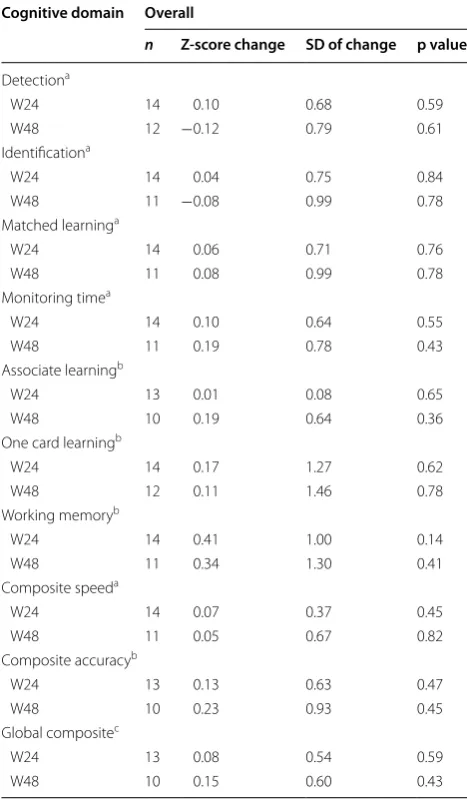
Overall, there were improvements in cognitive function over the study period but these changes were not statisti-cally significant. For instance, global composite changes in z-scores (SD) increased from 0.08 (0.54) at week 24 (p = 0.59) to 0.15 (0.60) at week 48 (p = 0.43) (Table 2). Likewise, the changes from baseline in composite accu-racy speed z-scores (SD) increased from 0.13 (0.63) at week 24 to 0.23 (0.93) at week 48. Such improvements in z-scores were also observed in the composite speed z-scores: 0.07 (0.37) at week 24 and remained stable by 0.05 (0.67) at week 48.
All three accuracy domains (associate learning, one card learning and working memory) showed an improve-ment from baseline to week 24 (z-score changes of 0.01, 0.17 and 0.41, respectively). At week 48, such improve-ments were sustained for one card learning and working memory (z-score changes of 0.11 and 0.34 from baseline, respectively) and increased for associate learning (z-score change of 0.19 from baseline).
to week 24 and then to week 48 (changes of 0.06 to 0.08 and 0.10 to 0.19, respectively), whereas others such as detection and identification showed an initial improve-ment at week 24 (changes of 0.10 and 0.04 from base-line, respectively) followed by a small decline at week 48 (changes of −0.12 and −0.08 from baseline, respectively) (Table 2).
Discussion
We assessed changes in cognitive parameters in HIV-positive subjects at 24 and 48 weeks after commencing cART for the first time.
We observed general trends suggesting an initial improvement in composite speed and accuracy cognitive domains at week 24, which continued to week 48 after starting cART. However, none of these trends were of sta-tistical significance, which may be due to the small num-ber of subjects studied.
Previous studies have reported overall neuropsy-chological function improvement to peak around 24–36 weeks after cART initiation with these improve-ments prolonged up to week 48 [6]. Similarly, in the ALTAIR study speed and accuracy domains improved over the first year after cART initiation with no indi-vidual domain showing deterioration from baseline at week 48 [7]. However, in the long term follow up of this study a decline in global cognitive function score was observed over 144 weeks and the authors hypothesised this could be related to antiretroviral toxicities [12]. In our study, domains critically affected in HIV-associated cognitive impairment such as detection and identifica-tion times [13] deteriorated slightly at week 48 after an
initial improvement at week 24 (Table 2). This highlights that different dynamics of change are observed in differ-ent cognitive domains including potdiffer-ential fluctuations over time suggesting that different domains should be explored independently as well as a part of global cog-nitive assessments. Some limitations to consider while interpreting these data are the likelihood of a learning
Table 1 Patient demographics and clinical characteristics throughout the study
a Mean (SD) unless otherwise stated. No statistically significant differences
(p > 0.1) for any parameters between study arms
Parametera (n=14)
Age (years; range) 37.4 (23–48) Male, n (%) 14 (100 %) Ethnicity (%)
White 9 (64.3 %)
Black 3 (21.4 %)
Asian 2 (14.3 %)
Baseline CD4+ count (cells/μL) 280 (129) Baseline HIV RNA (log copies/μL) 4.42 (0.58) HIV‑1 clade B, n (%) 10 (71.4 %) Patients with HIV RNA <50 copies/μL, n (%)
Week 24 11 (78.6 %) Week 36 14 (100 %) Week 48 14 (100 %)
Table 2 Changes in Z-score neurocognitive testing param-eters at weeks 24 and 48 from baseline
All change estimates are based on pooled‑standard‑deviation standardized z‑score changes
N number of subjects, SD standard deviation of the change, CI confidence interval. Shaded areas, z‑score changes
a Used to determine speed (sp); a positive change in z‑score represents an
improved response
b Used to determine accuracy (acc) of response; a positive change in z‑score
represents an improved response
c A positive change in z‑score represents an improved response. Global
composite = composite accuracy + speed Cognitive domain Overall
n Z-score change SD of change p value
Detectiona
W24 14 0.10 0.68 0.59 W48 12 −0.12 0.79 0.61 Identificationa
W24 14 0.04 0.75 0.84 W48 11 −0.08 0.99 0.78 Matched learninga
W24 14 0.06 0.71 0.76 W48 11 0.08 0.99 0.78 Monitoring timea
W24 14 0.10 0.64 0.55 W48 11 0.19 0.78 0.43 Associate learningb
W24 13 0.01 0.08 0.65 W48 10 0.19 0.64 0.36 One card learningb
W24 14 0.17 1.27 0.62 W48 12 0.11 1.46 0.78 Working memoryb
W24 14 0.41 1.00 0.14 W48 11 0.34 1.30 0.41 Composite speeda
W24 14 0.07 0.37 0.45 W48 11 0.05 0.67 0.82 Composite accuracyb
W24 13 0.13 0.63 0.47 W48 10 0.23 0.93 0.45 Global compositec
effect despite a practice neurocognitive test at screening and the open-label nature of the study. Additionally, the lack of clinically significant cognitive impairment in the study population may have reduced the power to detect significant improvements. We recruited subjects without overt cognitive impairment based on clinical judgement. Given we do not have an appropriate control dataset we are unable to classify subjects into cognitively impaired and non-impaired based on the cognitive testing results in our study, which would be of interest after the initia-tion of cART [8].
We had initially planned to undertake a comparative study of two different antiretroviral treatment regimens. However, recruitment was challenging. We believe the use of nevirapine was one of the factors underlying these recruitment difficulties. Firstly, nevirapine was not rec-ommended as preferred first line treatment for naïve patients in the UK by the time the study commenced in 2008 [14]. Secondly, only patients with low CD4 counts (<400 cells/μL and <250 cells/μL for males and females, respectively) were eligible to enter this study due to the reported increased risk of toxicity for patients with higher CD4 counts commencing nevirapine-containing cART regimens [14]. This limited the eligible population for our study. The HIV-therapeutic field continues to be a rap-idly changing arena. Recent guidelines changes include recommending treatment for all PLWH, irrespective of CD4+ lymphocyte count, in view of the results from the INSIGHT-START study [15]. Therefore studies stipulat-ing CD4+ count criteria at entry are no longer feasible or ethical. Recent treatment guidelines are swaying towards commencing therapy with an integrase-inhibitor contain-ing regimen [16, 17]. Such changes make recruitment to studies using regimens containing non-nucleoside reverse transcriptase inhibitors such as efavirenz, which have been standard of care for almost a decade, challenging.
In summary, a general trend of improvement in cogni-tive function parameters was observed in naïve HIV-pos-itive participants initiating antiretroviral therapy with the dynamics of these changes differing between cognitive parameters over 48 weeks of follow-up.
Authors’ contributions
AW and ST conceived the design of the study. BMP drafted this manuscript and performed the analysis for this report. All authors contributed to the writing of the final manuscript. All authors read and approved the final manuscript.
Author details
1 Clinical Trials, Faculty of Medicine, Winston Churchill Wing, St. Mary’s Hospital,
Imperial College, Praed Street, London W2 1NY, UK. 2 Department of HIV
and Genitourinary Medicine, Imperial College Healthcare NHS Trust St Mary’s Hospital, London, UK. 3 Birmingham Heartlands HIV Service, Heart of England
NHS Foundation Trust, Birmingham, UK. 4 Department of Infectious Diseases,
San Raffaele Scientific Institute, Milan, Italy. 5 Division of Immunity and Infec‑
tion, University of Birmingham, Birmingham, UK.
Acknowledgements
We are grateful to the NIHR Biomedical Facility at Imperial College London for infrastructure support. We would like to thank all the study participants, the staff at the Department of Clinical and Molecular Pharmacology of the Univer‑ sity of Liverpool, the nursing and pharmacy staff and the Clinical Trials Centre, Imperial College London (St Mary’s Campus), UK (Ken Legg, Scott Mullaney, Kristin Kuldanek and Nadia Naous). The nursing, pharmacy and occupational therapy team of the Birmingham Heartlands HIV Service and the staff at the MIDRU research facility, Birmingham Heartlands Hospital, UK (Gerry Gilleran and Cathy Stretton).
Funding
This study was funded by an Investigator Initiated Grant from Boehringer Ingelheim (UK) to Alan Winston at Imperial College London.
Transparency declarations
AW and ST have received honoraria or research grants from or been a consult‑ ant or investigator in clinical trials sponsored by Abbott, Boehringer Ingelheim, Bristol‑Myers Squibb, Gilead Sciences, GlaxoSmithKline, Janssen‑Cilag, Roche, Pfizer and ViiV Healthcare. All other authors: none to declare.
Competing interests
The authors declare that they have no competing interests.
Received: 18 December 2015 Accepted: 7 April 2016
References
1. Report of a Working Group of the American Academy of Neurology AIDS Task Force. Nomenclature and research case definitions for neurologic manifestations of human immunodeficiency virus‑type 1 (HIV‑1) infec‑ tion. Neurology. 1991;41:778–85.
2. Sacktor N, Lyles RH, Skolasky R, Kleeberger C, Selnes OA, Miller EN, et al. HIV‑ associated neurologic disease incidence changes: multicenter AIDS Cohort Study, 1990–1998. Neurology. 2001;56:257–60.
3. Lescure F‑X, Omland LH, Engsig FN, Roed C, Gerstoft J, Pialoux G, et al. Incidence and impact on mortality of severe neurocognitive disorders in persons with and without HIV infection: a Danish nationwide cohort study. Clin Infect Dis. 2011;52:235–43.
4. Hinkin CH, Castellon SA, Durvasula RS, Hardy DJ, Lam MN, Mason KI, et al. Medication adherence among HIV+ adults: effects of cognitive dysfunc‑ tion and regimen complexity. Neurology. 2002;59:1944–50.
5. Al‑Khindi T, Zakzanis KK, van Gorp WG. Does antiretroviral therapy improve HIV‑associated cognitive impairment? A quantitative review of the literature. J Int Neuropsychol Soc. 2011;17:1–14.
6. Cysique LA, Vaida F, Letendre S, et al. Dynamics of cognitive change in impaired HIV‑positive patients initiating antiretroviral therapy. Neurology. 2009;73:342–8.
7. Winston A, Puls R, Kerr SJ, et al. Dynamics of cognitive change in HIV‑ infected individuals commencing three different initial antiretroviral regimens: a randomized, controlled study. HIV Med. 2012;13:245–51. 8. Nightingale S, Winston a, Letendre S, et al. Controversies in HIV‑associated
neurocognitive disorders. Lancet Neurol. 2014;13(11):1139–51. 9. Chan P, Brew BJ. HIV associated neurocognitive disorders in the modern
antiviral treatment era: prevalence, characteristics, biomarkers, and effects of treatment. Curr HIV/AIDS Rep. 2014;11(3):317–24.
10. Lezac M. Neuropsychological Assessment. 3rd ed ed. New York: Oxford University Press; 1995.
11. Cysique LA, Maruff P, Darby D, Brew BJ. The assessment of cognitive function in advanced HIV‑1 infection and AIDS dementia complex using a new computerised cognitive test battery. Arch Clin Neuropsychol. 2006;21:185–94.
• We accept pre-submission inquiries
• Our selector tool helps you to find the most relevant journal
• We provide round the clock customer support
• Convenient online submission
• Thorough peer review
• Inclusion in PubMed and all major indexing services
• Maximum visibility for your research
Submit your manuscript at www.biomedcentral.com/submit
Submit your next manuscript to BioMed Central
and we will help you at every step:
13. Hardy DJ, Hinkin CH. Reaction time performance in adults with HIV/AIDS. J Clin Exp Neuropsychol. 2002;24(7):912–29.
14. Gazzard BG, Anderson J, Babiker A, Boffito M, Brook G, Brough G, Churchill D, Cromarty B, Das S, Fisher M, Freedman A, Geretti AM, Johnson M, Khoo S, Leen C, Nair D, Peters B, Phillips A, Pillay D, Pozniak A, Walsh J, Wilkins E, Williams I, Williams M, Youle M. BHIVA treatment guidelines writing group. British HIV association guidelines for the treatment of HIV‑1‑infected adults with antiretroviral therapy 2008. HIV Med. 2008;9(8):563–608. 15. INSIGHT START Study Group, Lundgren JD, Babiker AG, Gordin F, Emery
S, Grund B, Sharma S, Avihingsanon A, Cooper DA, Fätkenheuer G, Llibre JM, Molina JM, Munderi P, Schechter M, Wood R, Klingman KL, Collins S, Lane HC, Phillips AN, Neaton JD. Initiation of antiretroviral therapy in early asymptomatic hiv infection. N Engl J Med. 2015;373(9):795–807.
16. Panel on Antiretroviral Guidelines for Adults and Adolescents. Guidelines for the use of antiretroviral agents in HIV‑1‑infected adults and adoles‑ cents. Department of Health and Human Services. http://www.aidsinfo. nih.gov/ContentFiles/AdultandAdolescentGL.pdf. Accessed 14 Oct 2015. 17. Churchill D, Waters L, Ahmed N, Angus B, Boffito M, Bower M, Dunn D,