R E S E A R C H A R T I C L E
Open Access
Flight feather development: its early
specialization during embryogenesis
Mao Kondo
1, Tomoe Sekine
1, Taku Miyakoshi
1, Keiichi Kitajima
1, Shiro Egawa
1, Ryohei Seki
1,2, Gembu Abe
1and Koji Tamura
1*Abstract
Background:Flight feathers, a type of feather that is unique to extant/extinct birds and some non-avian dinosaurs, are the most evolutionally advanced type of feather. In general, feather types are formed in the second or later generation of feathers at the first and following molting, and the first molting begins at around two weeks post hatching in chicken. However, it has been stated in some previous reports that the first molting from the natal down feathers to the flight feathers is much earlier than that for other feather types, suggesting that flight feather formation starts as an embryonic event. The aim of this study was to determine the inception of flight feather morphogenesis and to identify embryological processes specific to flight feathers in contrast to those of down feathers.
Results:We found that the second generation of feather that shows a flight feather-type arrangement has already started developing by chick embryonic day 18, deep in the skin of the flight feather-forming region. This was confirmed byshhgene expression that shows barb pattern, and the expression pattern revealed that the second generation of feather development in the flight feather-forming region seems to start by embryonic day 14. The first stage at which we detected a specific morphology of the feather bud in the flight feather-forming region was embryonic day 11, when internal invagination of the feather bud starts, while the external morphology of the feather bud is radial down-type.
Conclusion:The morphogenesis for the flight feather, the most advanced type of feather, has been drastically modified from the beginning of feather morphogenesis, suggesting that early modification of the embryonic morphogenetic process may have played a crucial role in the morphological evolution of this key innovation. Co-optation of molecular cues for axial morphogenesis in limb skeletal development may be able to modify morphogenesis of the feather bud, giving rise to flight feather-specific morphogenesis of traits.
Keywords: Flight feather, Feather development, Chick embryo, Invagination
Background
Feathers are specialized skin derivatives (integument ap-pendages) that are unique to extant/extinct birds and some non-avian dinosaurs; in living birds, most of the body is covered with some kinds of feathers. Feathers in birds, which serve more than 20 different functions [1], including thermoregulation, physical protection, tactile sensation, various types of visual signaling such as dis-play in courtship, and flight, are functionally refined in-tegument appendages. Bird feathers can be classified
into many types, such as down, bristle, and contour feathers (including flight feathers), and the evolution of various feather types has enabled feathers to exert a var-iety of functions. The flight feather is the most evolu-tionarily advanced type of feather [2, 3]. Flight feather evolution was one of the keys for bird evolution because powerful flight of birds is made possible by flight feathers, which have asymmetric shapes of the vanes along the rachis [4] (see also Fig. 1) that aero-mechanically enable birds to fly [1]. There are mainly two body regions where flight feathers grow; one region (for remiges) is the posterior margin of the wing (forelimb) and the other (for rectrices) is the lateral margin of the tail. A feather is an exterior structure on * Correspondence:[email protected]
1Department of Developmental Biology and Neurosciences, Graduate School
of Life Sciences, Tohoku University, Sendai 980-8578, Japan Full list of author information is available at the end of the article
the skin in general, but the shaft (quill) of the remex-type flight feather is anchored to the bone (ulna and metacarpal/phalanges of digit 2) with extra muscles and neural networks for motor control [5]. These bones have protrusions on the surface (quill knob) that directly at-taches to the proximal end of the flight feather calamus (calamus; the short, tubular base of the quill), which functions as mechanics of flight [6, 7].
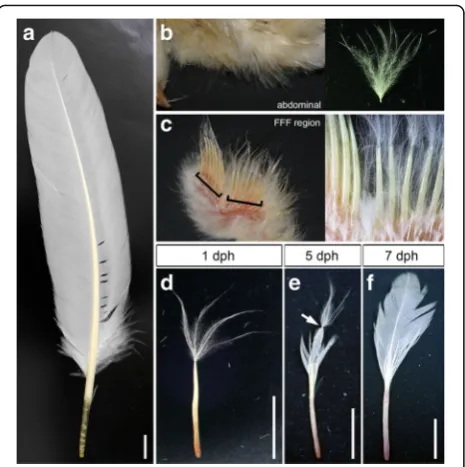
During embryogenesis and molting, all feathers de-velop from primordial feather buds with follicles (feather follicles) at the base of it, and repetition of feather devel-opment enables cyclic molting. A chick after hatching appears to be covered with fluffy downy feathers (natal down feathers), and diversification of feather types emerges in the second or later feathers that form at the first and following molting. In the chicken, the first molting generally begins at around two weeks post hatching [4], and it is therefore possible that complex features of the flight feather would be provided at molt-ing after hatchmolt-ing. However, it has been stated in some previous reports that the first molting from the natal down feather to the remex-type flight feathers is much earlier than that for other feather types [4, 8, 9] (see also Fig. 1b-f ). Moreover, Hosker [8] reported that the
feather follicles for the remiges reach the wing bone by the time of hatching, although details remain obscure. In order to clarify the early origin of flight feathers, we speculated that flight feather development may start much earlier as an embryonic event in mid-development in chicken. If this is the case, it is possible that the mechanism for morphogenesis of evolutionally advanced features of the flight feather has not simply added to the mechanism for the morphogenesis of the primitive types of feathers but is instead a modified/peculiar morpho-genetic process.
Considering the evolutionary and functional peculiar-ities of the flight feather, when and how flight feathers develop are important issues for feather biology in gen-eral. The aim of this study was to determine the incipi-ent morphogenesis of the flight feather, focusing on when morphological traits of the remex-type feather start developing and how special morphologies of remi-ges (e.g., attachment between the flight feather calamus and the bone) are established. There are already many descriptions of the morphology, morphogenesis and mo-lecular characters of the flight feather. Using such infor-mation, we present here morphological, histological, and molecular marker observations of the flight feather bud, and describe its developmental sequence. Integrating such descriptive information will also serve as the basis of feather diversification. Our results suggest that flight feather morphogenesis in the chicken is an embryonic event starting from the middle of chick development and that the first down feathers in the flight feather-forming region, the follicles of which have already reached the bone, are special feathers that are different from other natal down feathers.
Methods
Animals
Chicken eggs (Gallus gallus) were purchased from a local chicken ranch (Iwaya poultry farm) and incubated at 38 °C, and embryos were staged according to Hamburger and Hamilton (1951) [10] (HHstage). White Leghorn chicks and adult chickens after hatching were supplied by the National BioResource Project (NBRP) Chicken/Quail of the MEXT, Japan, and the age of the chicks was ascertained by the NBRP supplier.
Histology
Hematoxylin and eosin (HE) staining
Forelimb buds and a square area of abdominal skin, in-cluding feather follicles, from staged chicken embryos were used for histology. Samples for HE staining were fixed with Bouin’s fixative (9% formaldehyde, 5% acetic acid and 75% saturated picric acid) at room temperature (RT) overnight with shaking. The samples were washed with 70% ethanol (with saturated lithium carbonate) for Fig. 1Development of remex-type flight feathers after hatching.
5–7 days followed by dehydrating with 80%, 90% and 100% ethanol (twice for 100%). Then the samples were permeated with xylene at RT once, 1:1 xylene/paraffin (paraplast, Leica) at 45 °C once, and paraffin at 60 °C three times and embedded in paraffin at RT. The paraf-fin blocks were sectioned at 10μm in thickness on slide glasses (MAS-coated, MATSUNAMI). The sectioned samples were immersed in xylene for 20 min and then quickly immersed in 100% (twice), 90% and 70% ethanol and then rinsed in water. The sections were stained with hematoxylin solution (Muto Pure Chemicals) at RT for 1 min and washed with water followed by eosin staining for 30 s and water washing. The samples were dehy-drated with a series of ethanol (70%, 90% and 100% ethanol) and xylene and were mounted with Eukitt (ASONE).
Elastica van Gieson (EVG) and Alcian blue (AB) staining
The method for EVG + AB staining was essentially the same as that for HE staining except for the thickness of a section (15 μm). See Hayashi et al. [11] for de-tails of EVG + AB staining. We made some modifica-tions for staining: coloring times for Weigert’s hematoxylin solution, alcian blue solution and van Gieson’s solution were for 3 min, 10 min and 3 min, respectively, in this study.
In situ hybridization
Forelimb buds and a square of abdominal skin with hypodermal tissues were excised from staged chicken embryos and processed for whole-mount in situ hybridization as described previously [12] using anti-sense RNA probes for chickshh(see [12, 13] for detailed information of shh RNA probes). In the later stages of feather morphogenesis,shhis expressed in the marginal plate epithelium that will undergo cell death, providing spaces between the barbs [14–16].
In situ hybridization of frozen sections was performed essentially by the same method as that described by Yoshida et al. [17] using antisense RNA probes for chick shh.
Results
Flight feather morphology and development after hatching
In all experiments described below, we used flight feathers in the zeugopod for specimens of flight feathers (Fig. 1a) and their primordia, and compared them with abdominal feathers (Fig. 1b). In this study, we defined the place where remex-type flight feathers (remiges) are formed as the“flight feather-forming region (FFF region, see Fig. 1c)”, which is the posterior margin of the zeugo-pod and autozeugo-pod in the wing. In the FFF region, the first generation of feathers is down-type and the second
generation is remex-type. An old textbook (Figs. 138– 141 in [4]) showed bar charts representing the history of feathers on several body tracts of the chicken, in which the first molting in the FFF region was shown to be very early in the chick, but no definite data were shown in that report. An old report by Hosker [8] showed a fea-ther from the wing of a one-day-old chick (Fig. 27 in [8]) that has clear two parts arranged linearly, but there is no mention about whether that specimen is a flight feather in the FFF region in that report. Therefore, we decided to repeat these observations and confirm how early the first molting occurs in the FFF region in the chicken. In contrast to the morphology of natal down feathers on the abdominal surface at one day post hatch-ing (dph) (Fig. 1b), feathers in the FFF region are com-posed of two different parts: a distal part resembling down feathers and a proximal part of a shaft without barbs visible at 1 dph (Fig. 1c, d) as described by Hosker [8]. Developing barbs here seem to be still inside the sheath of this proximal part of the developing feather and are therefore not visible yet as described by Alibardi [18]. The root of the proximal part is deeply embedded in the wing. At 5 dph, the distal portion of the proximal part begins to open, and barbs with a bilateral shape along the rachis can be seen (Fig. 1e, showing that the down feather is still on the distal end of the opening bi-lateral barbs). The remex-type asymmetric barbs further open at 7 dph, and the distal down part has dropped from this specimen (Fig. 1f ). A series of observations (Fig. 1) confirmed that the distal part at 1 dph is the first down feather that connects with the second remex-type feather, although the remiges have not been opened yet at that time (Fig. 1d), suggesting that the first molting starts at around the hatching stage. It seems that the remex-type feather has already started developing at em-bryonic stages before hatching.
Flight feather morphology and development before hatching
shallow level (Fig. 2c), radially symmetric barb primordia on the circumference could be seen in the feather fol-licle, and this configuration resembles that of a prim-ordial natal down feather in which all barb ridges are parallel to the long axis [4, 19]. At the middle level (Fig. 2d), there was a layer where no barb primordia were visible. At a deeper level (Fig. 2e) of the same feather follicle as that shown in Fig. 2c and d, there was a bilateral barb arrangement on the circumfer-ence, and this configuration indicates a typical flight feather primordium [20]. These observations revealed that the second generation of feather that shows a remex-type feather arrangement has already started developing by E18 deeply in the skin of the FFF re-gion. In addition, the position of the rachis primor-dium in each feather bud (indicated by asterisks in Fig. 2f ) was biased to the dorsal side of the wing.
Second generation of feather development in the FFF region
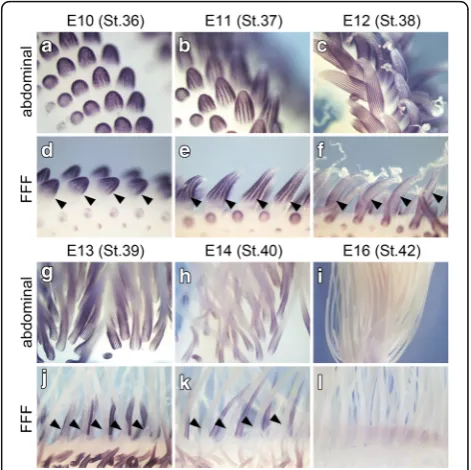
To further investigate when the remex-type feather de-velopment starts, we analyzed the expression pattern of a gene, sonic hedgehog (shh). Expression of shh starts early in the feather placode and then remains in the epi-dermal marginal plate (presumptive inter-barb region) of the feather bud [14–16], and we therefore thought that we could estimate feather types by the shh expression pattern. At E10, many feather buds protuberated on the abdominal surface of the body trunk (Fig. 3a), and shh was expressed in the epidermis of the protrusion, with the pattern of expression becoming obvious at E11 (Fig. 3b) and E12 (Fig. 3c). In the abdominal feather buds,shh ex-pression showed a radially symmetric pattern that corre-sponds to the barb arrangement of a natal down feather. In the FFF region, a line of feather buds (arrowheads in Fig. 3d–3f, 3j, 3k) were much larger than those in the sur-rounding area of the wing skin surface. Expression ofshh in feather buds in the FFF region showed a radially sym-metric pattern similar to that in abdominal feather buds. We never observed a bilateral pattern of shhexpression (indicating the pattern for contour feathers) by whole-mount in situ hybridization on the embryonic days we conducted observations. Thus, it appears that the elongat-ing feather bud in the FFF region gives rise to down Fig. 2Development of remex-type flight feathers before hatching.
a, bVentral view of the FFF region at E18 (a) and E19 (b). Scale bars: 1 mm. Arrowheads indicate joints between distal and proximal parts of the elongated feather bud in the FFF region.c–e, Sections of the feather bud under the skin at E 18; (c), a shallow level, (d), an intermediate level and (e), a deep level. Scale bars: 100μm. Asterisk in (e) indicates the position of the prospective rachis that exhibits an irregular pattern of barb ridges.fRows of feather buds in the posterior wing, including the FFF region, at E18. Distal to the right and dorsal to the bottom. U: ulna. Asterisks indicate the position of prospective rachis, showing that the position is biased to the dorsal. Scale bar: 100μm
feather during this developmental period of E10-E12. The expression ofshhin the abdominal feather buds continues to E13–15 (Fig. 3g, h and not shown), and signals forshh expression could not be detected at E16 (Fig. 3i). On the other hand, shhexpression in the FFF region had disap-peared by E13 (black arrowheads in Fig. 3j), although in surrounding feather buds shhcontinued to be expressed (Fig. 3j and k) and theshhexpression disappeared by E16 (Fig. 3l), indicating that the first generation of feather de-velopment in the FFF region ceases much earlier than that in other feather buds. Thus, feather development of the first generation in the FFF region may proceed more rap-idly. We found such heterochronic modification ofshh ex-pression, but did not detect a second generation of remex-type feather formation by whole-mount observa-tion of theshhexpression pattern.
As can be seen in histological images shown in Fig. 2, it remained possible that the second generation of feathers was developing in a deep area under the skin, and we thus examined shh expression by in situ hybridization for sections of feather buds in the FFF re-gion (Fig. 4). At E13, when a natal feather pattern could
not be detected by whole-mount observation (Fig. 3j), clear expression of shh was detected by section in situ hybridization at a relatively shallow level under the skin (Fig. 4a, see Fig. 4j, an illustrated image showing pos-itional relation of sections along depth direction). The expression of shh was circumferentially spotted with a radially symmetric pattern, typical for a natal down fea-ther [21]. The feafea-ther development generally proceeds in a proximal-to-distal direction, and the more distal region of a feather bud develops to be more mature. This could account for the continued expression ofshhin the prox-imal region of the feather bud retains (Fig. 4a), whileshh expression ceases in the distal external region (Fig. 3j). Faint expression of shh at a shallow level was detected until E15 (Fig. 4b and c). At a middle level, clearshh ex-pression was not detected in the period we examined (E13-E15, Fig. 4d, e and f ). Interestingly, at a deep level of the feather bud in the FFF region (slightly upper from the bottom), we detected a clear signal ofshhat E14 and later (compare Fig. 4g and Fig. 4h, i). The expression pattern ofshhat this depth became not radially symmet-ric but bilateral (Fig. 4i, a prospective rachis is indicated by an asterisk), resembling the barb arrangement in the feather follicle of the molting flight feather in the adult [20]. We found that the second generation of feather de-velopment in the FFF region, which gives rise to remex-type feathers, appears to start by E14 at latest, a week before hatching.
A unique morphogenetic process for first generation of feathers in the FFF region
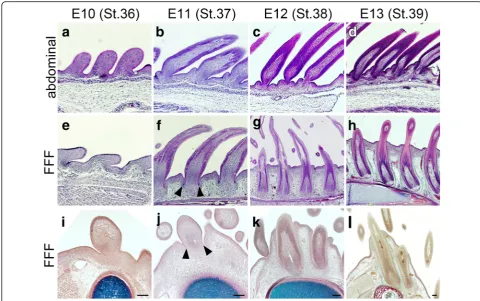
In the above-described observations of section in situ hybridization, we realized that feather buds in the FFF region extend the base of the calamus in a deep layer under the skin of the wing. This surprised us, as feather buds are generally external structures on the skin surface (Fig. 5d) (see also panels with histological sections of de-veloping chick skin in [16, 22]) and drove us to further observe histologically the process of feather bud forma-tion in the FFF region. Feather buds in the abdominal region develop on the skin surface with underlying mes-enchyme (Fig. 5a). The buds grow toward the outside and make a sheath-like structure (Fig. 5b and c). The sheath-like elongated feather bud was a surface structure (Fig. 5d). Although the base of the epidermal sheet made a slight invagination to create a cavity-like bend (follicu-lar cavity, see [3]) and the surrounding dermal layer be-came thicker, embedding the follicle in the dermis, the feather follicles did not enter the hypodermal layer but remained external to it. On the other hand, in the FFF region, the feather bud showed a peculiar process of de-velopment different from that of the abdominal feather bud. At E10 (Fig. 5e), the feather bud in the FFF region looks similar to the abdominal feather bud. External Fig. 4Shhexpression detected by section in situ hybridization in
morphology of the feather bud in the FFF region still looks similar at E11 (Fig. 5f, compare to 5b and see also Fig. 4b and e), but there was a slit-like bend of the epi-thelium surrounding the base of the protruding feather bud (arrowheads in Fig. 5f and j). At E12, the epithelial bend became deeper, and the feather bud created cylin-drical invagination into the hypodermal layer (Fig. 5g and k). The proximal end of the feather bud sank into the deep limb mesenchyme and reached the bone (ulna) by E13 (Fig. 5h and l). Observation of a series of trans-verse sections of the developing wing with bone (in red) and cartilage (in blue) (Fig. 5i–5l) revealed that the base of the feather bud reaches the ulna before ossification of the bone collar is completely finished (Fig. 5k and l, showing the ossifying bone collar in red). We never ob-served such invagination of the feather bud in the ab-dominal region (Fig. 5a–5d). These observations strongly suggest that the initial feather bud in the FFF region has a unique morphogenetic process for flight feather-specific traits, deep invagination and direct attachment to the bone, although the first generation of feathers in the FFF region shows an external down feather-like morphology, as seen in Fig. 3.
Discussion
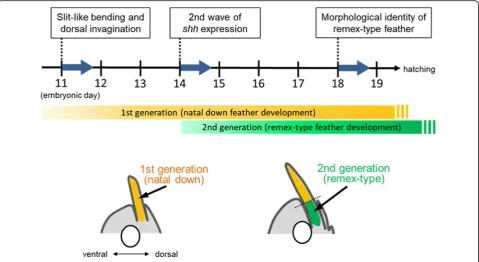
In this study, we traced the morphogenesis of the flight feather back until embryonic stages and revealed some specialties of its process. In Fig. 6, the morphogenesis from initiation of feather bud formation to later embryo-genesis is shown.
region at this stage can be divided into several parts from proximal to distal:shh-positive (bilateral),shh-negative (as a joint), and shh-positive (radial). The proximal bilateral pattern ofshhexpression results in the remex-type feather pattern that is visible externally at around five days post hatching. The remex-type feather with a joint to the first generation of the down-type feather can be seen internally at E18 and externally at E19.
Invagination of the feather bud in the FFF region and formation of the quill knob
Invagination is a morphogenetic process of epithelial tis-sue that changes a flat epithelial sheet to complex struc-tures such as tubes, furrows, and capsules. The skin epithelium creates many kinds of structures, such as secretory glands, nails/claws/hoofs, and scales/feathers/ hairs, by interacting with the underlying mesenchyme [2, 9, 14, 23, 24]. Morphogenesis of skin derivatives is preceded by epithelial invagination. In the developing feather bud, invagination gives rise to a collar-like bend, the bottom of which serves as a feather follicle, the cellular source of the feather. The feather follicle reaches the dermal tissue, but the invagination is generally not so deep, retaining the follicle in the hypodermal layers of the skin. In contrast, the feather follicle in the FFF re-gion deeply sinks to the posterior-dorsal surface of the bone. Although the mechanism of epithelial invagination of a feather bud in the FFF region is largely unknown, an
interesting report by Lin et al. [13] suggested that tubular invagination is achieved through loosening of the bud mesenchyme. Epithelial cell proliferation and elongation in the bud may lead to the formation of a sprout that in-vades the surrounding loosened mesenchyme, and epithelial-mesenchymal interaction may contribute to the epithelium organization as seen in the morphogenesis of other types of epithelial tissues such as mammary glands [25]. Rows of feather buds more dorsal to the FFF region, which give rise to wing coverts, also make deep invagin-ation into the wing bud mesenchyme (Fig. 5l). Since the feather buds at the ventral side of the wing do not show such deep invagination (Fig. 5k, and not shown), the dor-sal property of the limb that is provided by dordor-sal determi-nants such as lmx1 might participate in the deep invagination.
with secondary modification of the developmental process of the feather pattern, but it does not necessarily mean that the modification was added subsequently to morpho-genesis of primitive type. Our results suggest that at least some characteristics of the flight feather are provided by modification of processes in its early development.
Remex-type feather formation
Our observation ofshhexpression in the feather bud of the FFF region revealed that its expression in the FFF re-gion has a non-radial but bilateral pattern at E14 and E15. This suggests that there is the second generation of feather formation, the morphology of which is different from that of natal down in the first generation, already at the embryonic stage before hatching in the FFF re-gion. The molecular mechanism for transition ofshh ex-pression from radial to bilateral remains unknown. Gradient signaling such as Wnt3a [26] and retinoic acid (RA) [27] are thought to provide the bilateral and asym-metric shape of the feather with a rachis since modifica-tion of Wnt3a and RA gradients in the feather bud transforms feather morphology. In these experiments, young adult chickens at the molting stage were focused on, but also in the embryonic stage, change in these signaling pathways from a homogenous pattern to a lo-calized pattern in the feather bud might occur before es-tablishment of bilateralshhexpression at E14.
Vanes in remiges are bilaterally asymmetric to the ra-chis, and this asymmetry is more distinguishable in the distal wing (primary remiges). Feo and Prum [28] exam-ined the developmental process of the asymmetric barb shape of rectrices in the tail of adult parrots, and they found that the developing feather germ of rectrices has asymmetry of barb ridges to the rachis in a cross section. We did not detect clear asymmetry of the feather bud in the FFF region, but the shh-expressing region shown in Fig. 4i seems to be asymmetric to the hinge of expres-sion (a prospective rachis, indicated by an asterisk), cor-responding to the discussion of the origin of asymmetric feathers [18, 29]. It would be interesting to investigate the relationship between asymmetry of the feather pat-tern and axis formation of the limb. The feather bud in the FFF region and its invagination are biased to the dorsal side of the limb, and the position of the future ra-chis (asterisk in Fig. 4i) is also biased to the dorsal side of the limb (Fig. 2f ). The axis formation of the limb re-garding dorsal-ventral, proximal-distal and anterior-posterior may play a role in the axis formation of the feather. We would like to discuss this point further in the next section.
Hypotheses on specification of the FFF region
The FFF region can be defined as a region satisfying four criteria of topological identity in the bird body. The first
criterion is“the forelimb”. The second one is“the zeugo-pod and autozeugo-pod”. The third one is“the posterior mar-gin”. The last criterion is “the dorsal side”. The position where the above four criteria meet, “the dorsal side of the posterior margin in the zeugopod and autopod of the forelimb”, is the position for the FFF region. In the process of limb development, each of the four criteria can be specified by specific gene expression patterns and functions, and it is possible that these molecular net-works for specifying the four criteria in the limb bud may also be applied to specifying the FFF region and providing peculiar morphogenesis of the feather follicle in the FFF region. We hypothesize that feather forma-tion in the FFF region is special from the beginning, and this enables us to discuss relationships between molecu-lar mechanisms for establishing the above four criteria and feather formation in the FFF region.
Criterion 1 for the FFF region: forelimb
The remex-type flight feather in the extant bird is forelimb-specific, although some modern birds such as some species of raptors bear feathers in the hindlimb zeugopod that seem to be important in flight when catching and carrying prey [30]. A reliable marker for the tetrapod forelimb bud is tbx5, which has essential functions in initiation of development and morphology of the forelimb [31, 32].tbx5deficiency results in a limb-less phenotype, and evidence for the direct function of tbx5 in flight feather morphology is therefore sparse. Nevertheless, recent findings on avian genetics and em-bryology have revealed crucial functions oftbx5in flight feather formation. There are some mutants (strains) of domestic chickens and pigeons that have flight feather-like asymmetrical feathers in the hindlimb. Domyan et al. [33] found that this intriguing phenotype is associated withcis-regulatory changes in thetbx5locus that give rise to ectopic expression oftbx5in the hindlimb bud, suggest-ing a role of this gene in flight feather formation.
Criterion 2 for the FFF region: zeugopod and autopod
(reviewed in [42, 43]), although the direct functions of these Hox genes in flight feather formation remain un-determined. Functional studies should be carried out to determine their role in the establishment of regional dif-ferences of feather type. Li et al. [27] reported that retin-oic acid signaling mediates a continuum of asymmetric vanes of flight feathers along the proximo-distal axis of the wing, and they discussed the possibility that the limb RA gradient that is used for the proximo-distal limb pat-terning is somehow imprinted within remex pulp cells and that the limb RA gradient is also used to establish asymmetry levels in remiges along the wing. It is possible that information of the proximo-distal axis in the wing mediated by retinoic acid signaling is embedded into the developing feather bud at the zeugopod and autopod through different expression patterns of Hox genes.
Criterion 3 for the FFF region: posterior margin
Flight feather buds appear at the posterior margin of the forelimb bud. The posterior margin is the region where the feather primordia develop earliest in the chick forelimb bud [34]. The posterior margin of the limb bud includes a special mesenchymal region, so-called zone of polarizing activity (ZPA). Anterior implantation of ZPA tissue induces a set of digits with mirror-image duplication, in which large feather buds develop at the anterior margin (with newly-acquired posterior identity) of the duplicated limb [44], suggesting that the zone con-tributes to the FFF region. Shh, a secretory molecule re-sponsible for polarizing activity of the zone, also induces posterior feather buds when applied to the anterior mar-gin [44]. Furthermore, ectopic flight feathers in pigeon and chicken mutants are biased to the posterior foot, and ectopic expression of tbx5in the hindlimb in these mu-tants is also posterior-biased [33, 45]. Taken together with the fact that flight feathers in the raptor hindlimbs are also posterior-biased [30], it is thought that molecular networks for forelimb identity and posterior identity of the limb morphology coordinate formation of the FFF re-gion. Since shh expression in the forelimb ZPA disap-pears at around HHstage 29 [46] before the feather bud-initiating stage, shh-experienced posterior mesenchyme (descendants of mesenchymal cells that had expressed shhgene in the early stages) might contribute to the in-duction of the flight feather bud in the FFF region.
Criterion 4 for the FFF region: dorsal side
Quill knobs are formed on the dorsal surface of the bone [7]. This would be because invagination of the FFF fea-ther bud proceeds to the dorsal side (see Fig. 5l), and the proximal end of the feather bud reaches to the dorsal surface of the bone. It is known that dorsal-ventral re-orientation of developing chick limb ectoderm makes a bi-dorsal feather pattern, including a double row of flight
feather buds [47]. It is also noteworthy that limbless mu-tants of the chicken, which have no dorsal-ventral boundary due to the complete dorsalization of the early limb field, resulting in no outgrowth of the limb bud, do not form wing (thus no flight feathers) [48]. Interest-ingly, when the mutant phenotype was partially rescued by application of FGF, double lines of feathers that looked like flight feathers in the sheath appeared at the posterior margin of the developed forelimb [48]. These results strongly suggest a correlation between the dorsal-ventral organization of the limb and flight feather formation, although the molecular mechanism remains unknown. lmx1, a determinant of limb dorsal morph-ology, is expressed in the dorsal part of the developing wing bud [46], and feather placodes in the FFF region are included in the lmx1-positive dorsal territory (unpublished observations by TS, TM, KK and KT). However, miss-expressedlmx1does not change the ven-tral feather pattern when it is ectopically expressed in the ventral side of limb bud [46], suggesting that the molecule is not sufficient to provide the FFF region.
The FFF region that satisfies the above four criteria may develop special traits of the feather bud from the beginning of feather development, and one of the first visible specialties in feather development in the FFF re-gion is the formation of a slit-like bend surrounding the feather bud at E11, followed by deep invagination. We recently reported that the geneSim1is expressed in the posterior margin of the zeugopod and autopod in the developing wing of the avian embryo, nicely correspond-ing to the FFF region [45]. Sim1expression that is spe-cific to the region where the above four criteria meet starts at around E7 and ceases at around E14 ([45] and our unpublished observations). Although investigation of the functions ofSim1and the other molecules described above in the feather formation are necessary, we suggest thatSim1expression in the FFF region is not necessarily too early to contribute to flight feather formation.
Conclusion
Our results indicated that the second generation for the remex-type flight feather has already started developing before hatching as an embryonic event. The morphogen-esis in the FFF region is modified from the beginning of feather morphogenesis as the first generation of the fea-ther also has a unique morphogenetic process.
of the feather bud, giving rise to flight feather-specific morphogenesis of traits. Such early modification would enable the feather bud to make at least some of the flight feather-specific traits, including direct connection with the bonny structure, quill knobs. Flight feathers in the wing connect with specific muscles for coordinating wing/feather movements and changing the wing to an airfoil shape [5], and the connection between the muscle and flight feather calamus, which is an important trait of the flight feather, is probably established during feather morphogenesis in the embryo.
Quill knobs are evident not only in extant bird species but also in basal taxa such asIchthyornis and non-avian theropod dinosaurs such asVelociraptor [7]. Some non-avian theropod dinosaurs and basal taxa of birds are equipped with remex-type flight feathers with asymmet-ric shapes in their forelimb [45]. Analyses of juvenile specimens referable to the oviraptorosaur have suggested that morphological changes in remiges occurred during feather development [49]. Ancestors of birds might have already experienced the modification of early embryonic morphogenesis in the FFF region. This is a good ex-ample of how early modification of the embryonic mor-phogenetic process may have played a crucial role in the morphological evolution of key innovation.
Acknowledgements
A series of post-hatching chicks were kindly provided by NBRP Chicken/Quail of the MEXT, Japan.
Funding
This research was supported by the following grants; JSPS KAKENHI Grant number 15H04374, Naito, Novartis foundations to KT. RS and SE are JSPS Research Fellows (JSPS KAKENHI Grant Numbers JP14J07050 for RS and JP15J06859 for SE).
Availability of data and materials
The datasets generated and/or analyzed during the current study are available from the corresponding author on reasonable request.
Authors’contributions
MK conceived of the study, and MK and KT designed the experiments. MK carried out morphological, histological and gene expression analysis. TS, TM, KK, SE helped the experiments and participated in section in situ hybridization and histology. KT prepared the draft manuscript, and SE, RS and GA revised it. All authors read and approved the final manuscript.
Ethics approval
All animal experiments were properly performed in accordance with guidelines provided by Tohoku University.
Consent for publication Not applicable.
Competing interests
The authors declare that they have no competing interests.
Publisher’s Note
Springer Nature remains neutral with regard to jurisdictional claims in published maps and institutional affiliations.
Author details
1Department of Developmental Biology and Neurosciences, Graduate School
of Life Sciences, Tohoku University, Sendai 980-8578, Japan.2Mammalian Genetics Laboratory, Genetic Strains Research Center, National Institute of Genetics, 1111 Yata, Mishima, Shizuoka 411-8540, Japan.
Received: 4 September 2017 Accepted: 29 December 2017
References
1. Stettenheim PR. The integumentary morphology of modern birds - an overview. Am Zool. 2000;40:461–77.
2. Chuong CM, Chodankar R, Widelitz RB, Jiang TX. Evo-devo of feathers and scales: building complex epithelial appendages - commentary. Curr Opin Genet Dev. 2000;10:449–56.
3. Prum RO. Development and evolutionary origin of feathers. J Exp Zool. 1999;285:291–306.
4. Lucas A, Stettenheim P. Avian anatomy: integument (agricultural handbook 362) Washington, DC. US Department of Agriculture. 1972.
5. Hieronymus TL. Flight feather attachment in rock pigeons (Columba Livia): covert feathers and smooth muscle coordinate a morphing wing. J Anat. 2016;229:631–56.
6. Hieronymus TL. Qualitative skeletal correlates of wing shape in extant birds (Aves: Neoaves). BMC Evol Biol. 2015;15:30.
7. Turner AH, Makovicky PJ, Norell MA. Feather quill knobs in the dinosaur velociraptor. Science. 2007; 317:1721–1721.
8. Hosker A. Studies on the epidermal structures of birds. Philosophical Transactions of the Royal Society of London Series B-Biological Sciences. 1936;226:143–U64.
9. Yu MK, Yue ZC, Wu P, Wu DY, Mayer JA, Medina M, Widelitz RB, Jiang TX, Chuong CM. The developmental biology of feather follicles. Int J Dev Biol. 2004;48:181–91.
10. Hamburger V, Hamilton HL. A series of normal stages in the development of the chick embryo. J Morphol. 1951;88:49–92.
11. Hayashi S, Kobayashi T, Yano T, Kamiyama N, Egawa S, Seki R, Takizawa K, Okabe M, Yokoyama H, Tamura K. Evidence for an amphibian sixth digit. Zoological Lett. 2015;1:17.
12. Yonei S, Tamura K, Ohsugi K, Ide H. Mrc-5 cells induce the Aer prior to the duplicated pattern-formation in Chick limb bud. Dev Biol. 1995;170:542–52. 13. Matsubara H, Saito D, Abe G, Yokoyama H, Suzuki T, Tamura K. Upstream
regulation for initiation of restricted Shh expression in the chick limb bud. Dev Dyn. 2017;246:417–30.
14. Lin CM, Jiang TX, Widelitz RB, Chuong CM. Molecular signaling in feather morphogenesis. Curr Opin Cell Biol. 2006;18:730–41.
15. Nohno T, Kawakami Y, Ohuchi H, Fujiwara A, Yoshioka H, Noji S. Involvement of the sonic hedgehog gene in chick feather formation. Biochem Biophys Res Commun. 1995;206:33–9.
16. TingBerreth SA, Chuong CM. Sonic hedgehog in feather morphogenesis: induction of mesenchymal condensation and association with cell death. Dev Dyn. 1996;207:157–70.
17. Yoshida N, Urase K, Takahashi J, Ishii Y, Yasugi S. Mucus-associated antigen in epithelial cells of the chicken digestive tract: developmental change in expression and implications for morphogenesis-function relationships. Develop Growth Differ. 1996;38:185–92.
18. Alibardi L. Review: cornification, morphogenesis and evolution of feathers. Protoplasma. 2017;254:1259–81.
19. Rawles ME. Tissue Interactions in Scale and Feather Development as Studied in Dermal-Epidermal Recombinations. J Embryol Exp Morphol. 1963;11:765–89.
20. Yu MK, Wu P, Widelitz RB, Chuong CM. The morphogenesis of feathers. Nature. 2002;420:308–12.
21. Harris MP, Fallon JF, Prum RO. Shh-Bmp2 signaling module and the evolutionary origin and diversification of feathers. J Exp Zool. 2002;294:160–76. 22. Widelitz RB, Jiang TX, Lu JF, Chuong CM. Beta-catenin in epithelial
morphogenesis: conversion of part of avian foot scales into feather buds with a mutated beta-catenin. Dev Biol. 2000;219:98–114.
23. Dhouailly D. A new scenario for the evolutionary origin of hair, feather, and avian scales. J Anat. 2009;214:587–606.
25. Inman JL, Robertson C, Mott JD, Bissell MJ. Mammary gland development: cell fate specification, stem cells and the microenvironment. Development. 2015;142:1028–42.
26. Yue ZC, Jiang TX, Widelitz RB, Chuong CM. Wnt3a gradient converts radial to bilateral feather symmetry via topological arrangement of epithelia. Proc Natl Acad Sci U S A. 2006;103:951–5.
27. Li A, Figueroa S, Jiang TX, Wu P, Widelitz R, Nie Q, Chuong CM. Diverse feather shape evolution enabled by coupling anisotropic signalling modules with self-organizing branching programme. Nat Commun. 2017;8:ncomms14139. 28. Feo TJ, Prum RO. Theoretical morphology and development of flight
feather vane asymmetry with experimental tests in parrots. J Exp Zool B Mol Dev Evol. 2014;322:240–55.
29. Alibardi L. Follicular patterns during feather morphogenesis in relation to the formation of asymmetric feathers, filoplumes and bristles. Italian Journal of Zoology. 2009;76:279–90.
30. Chatterjee S, Templin RJ. Biplane wing planform and flight performance of the feathered dinosaur microraptor gui. Proc Natl Acad Sci U S A. 2007;104:1576–80. 31. Rodriguez-Esteban C, Tsukui T, Yonei S, Magallon J, Tamura K, Belmonte JCI.
The T-box genes Tbx4 and Tbx5 regulate limb outgrowth and identity. Nature. 1999;398:814–8.
32. Takeuchi JK, Koshiba-Takeuchi K, Matsumoto K, Vogel-Hopker A, Naitoh-Matsuo M, Ogura K, Takahashi N, Yasuda K, Ogura T. Tbx5 and Tbx4 genes determine the wing/leg identity of limb buds. Nature. 1999;398:810–4.
33. Domyan ET, Kronenberg Z, Infante CR, Vickrey AI, Stringham SA, Bruders R, Guernsey MW, Park S, Payne J, Beckstead RB, et al. Molecular shifts in limb identity underlie development of feathered feet in two domestic avian species. elife. 2016;5:e12115.
34. Mayerson PL, Fallon JF. The spatial pattern and temporal sequence in which feather germs Arise in the white leghorn Chick-embryo. Dev Biol. 1985;109:259–67.
35. Johansson JA, Headon DJ. Regionalisation of the skin. Semin Cell Dev Biol. 2014;25:3–10.
36. Chuong CM, Oliver G, Ting SA, Jegalian BG, Chen HM, De Robertis EM. Gradients of homeoproteins in developing feather buds. Development. 1990;110:1021–30.
37. Hughes MW, Wu P, Jiang TX, Lin SJ, Dong CY, Li A, Hsieh FJ, Widelitz RB, Chuong CM. In search of the golden fleece: unraveling principles of morphogenesis by studying the integrative biology of skin appendages. Integr Biol. 2011;3:388–407.
38. Reid AI, Gaunt SJ. Colinearity and non-colinearity in the expression of Hox genes in developing chick skin. Int J Dev Biol. 2002;46:209–15.
39. Nelson CE, Morgan BA, Burke AC, Laufer E, DiMambro E, Murtaugh LC, Gonzales E, Tessarollo L, Parada LF, Tabin C. Analysis of Hox gene expression in the chick limb bud. Development. 1996;122:1449–66. 40. Sato K, Koizumi Y, Takahashi M, Kuroiwa A, Tamura K. Specification of cell
fate along the proximal-distal axis in the developing chick limb bud. Development. 2007;134:1397–406.
41. Yokouchi Y, Nakazato S, Yamamoto M, Goto Y, Kameda T, Iba H, Kuroiwa A. Misexpression of Hoxa-13 induces cartilage homeotic transformation and changes cell adhesiveness in Chick limb buds. Genes Dev. 1995;9:2509–22. 42. Tabin C, Wolpert L. Rethinking the proximodistal axis of the vertebrate limb
in the molecular era. Genes Dev. 2007;21:1433–42.
43. Tamura K, Yonei-Tamura S, Yano T, Yokoyama H, Ide H. The autopod: its formation during limb development. Develop Growth Differ. 2008;50:S177–87. 44. Riddle RD, Johnson RL, Laufer E, Tabin C. Sonic-hedgehog mediates the
polarizing activity of the Zpa. Cell. 1993;75:1401–16.
45. Seki R, Li C, Fang Q, Hayashi S, Egawa S, Hu J, Xu L, Pan H, Kondo M, Sato T, et al. Functional roles of Aves class-specific cis-regulatory elements on macroevolution of bird-specific features. Nat Commun. 2017;8:14229. 46. Riddle RD, Ensini M, Nelson C, Tsuchida T, Jessell TM, Tabin C. Induction of
the Lim Homeobox gene Lmx1 by Wnt7a establishes Dorsoventral pattern in the vertebrate limb. Cell. 1995;83:631–40.
47. Geduspan JS, MacCabe JA. The ectodermal control of mesodermal patterns of differentiation in the developing chick wing. Dev Biol. 1987;124:398–408. 48. Grieshammer U, Minowada G, Pisenti JM, Abbott UK, Martin GR. The chick
limbless mutation causes abnormalities in limb bud dorsal-ventral patterning: implications for the mechanism of apical ridge formation. Development. 1996;122:3851–61.
49. Xu X, Zheng XT, You HL. Exceptional dinosaur fossils show ontogenetic development of early feathers. Nature. 2010;464:1338–41.
• We accept pre-submission inquiries
• Our selector tool helps you to find the most relevant journal
• We provide round the clock customer support
• Convenient online submission
• Thorough peer review
• Inclusion in PubMed and all major indexing services
• Maximum visibility for your research
Submit your manuscript at www.biomedcentral.com/submit