C O M M E N T A R Y
Open Access
Promiscuous words
Mark A Elgar
1*, Therésa M Jones
1and Kathryn B McNamara
2Abstract
Promiscuity is frequently used to describe animal mating behaviour, and especially to describe multiple mating by females. Yet this use of the term is incorrect, perhaps reflecting an erroneous adoption of common language to pique reader interest. We evaluated the patterns of use and misuse of the word‘promiscuity’in a representative journal of animal behaviour. This survey highlights how inappropriately the term is used, and how it can conceal critical features of animal mating strategies with intriguing evolutionary significance. Further analysis of the scientific impact of papers identified by the term promiscuous or polyandrous revealed that the former were cited less frequently. We argue that using promiscuity to describe animal mating strategies is anthropomorphic, inaccurate, and potentially misleading. Consistent with other biological disciplines, the word promiscuity should be used to describe indiscriminate mating behaviour only, and that polygyny and polyandry should be used to describe male and female mating frequency respectively.
Introduction
Promiscuity is frequently, but largely incorrectly used to describe animal mating behaviour, perhaps reflecting an erroneous adoption of common language to pique reader interest. According toThe Oxford English Dictionary, pro-miscuous originally referred to repeated, indiscriminate actions: “That is without discrimination or method: con-fusedly mingled, indiscriminate (1605) … Of an agent or agency: making no distinctions: undiscriminating (1633)… casual, carelessly irregular (1837)”[1]. Promiscuity was used to describe human sexual activity in the 19thCentury, the essence (and costs) of which are colourfully observed in George Sala’s bawdy pantomimeHarlequin Prince Cherry-top (1879): “Better frig, howe'er the mind it shocks, than from promiscuous…[fornication]…catch the pox”[2].
The term‘promiscuity’sneaked into the lexicon of evo-lutionary biology last century, particularly to describe mat-ing behaviour e.g. [3-6] and is now widely entrenched (a
Web of Knowledge (Thomson Reuters) search for ‘
pro-miscu*’, limited to the fields of ‘Evolutionary Biology’, ‘Zo-ology’,‘Behavioural Sciences’, and ‘Ecology’ returned over 700 publications). It is currently typically, although not ex-clusively [7], applied to describefemalemultiple mating or polyandry–the latter taking precedent [8].
Science often borrows words from common language: very early uses of the word promiscuous referred to surgi-cal procedures [9], the use of barbiturates [10] and land-scape management [11], and more recently molecular biologists use promiscuous to describe certain enzymes [12], gene regulators [13] and receptors [14] as promiscu-ous, precisely due to their non-specific nature. The use of these terms as scientific jargon draws on the general mean-ing of the word to highlight indiscriminatmean-ing processes. This contrasts with its use as a descriptor for multiple mat-ing behaviour, because the implied indiscriminatmat-ing mate selection process is broadly wrong.
Females are rarely promiscuous, in the general meaning noted in theOxford English Dictionary: the overwhelming evidence from diverse taxa confirms Darwin’s suggestion [15] that females are typically circumspect about their mates [16], accruing a variety of benefits from their discrim-inate mating [17,18], including with multiple partners [19]. In general, we expect females to remain choosy, irrespective of the number of mating partners, the exception being spe-cies in which there is cryptic female choice e.g. [20].
Promiscuous has been used as an umbrella term to in-clude polyandry, polygyny, and polygynandry [21]. While it may be useful to use a single term to describe mating strategies in which males and females mate multiply (ar-guably, the modal animal mating behaviour), promiscuous is unhelpful because it conflates both thenature (discrim-inating or not) and frequency of mating. In contrast, the terms monogamy, polygyny, polyandry and polygynandry * Correspondence:[email protected]
1
Department of Zoology, University of Melbourne, Melbourne, VIC 3010, Australia
Full list of author information is available at the end of the article
© 2013 Elgar et al.; licensee BioMed Central Ltd. This is an Open Access article distributed under the terms of the Creative Commons Attribution License (http://creativecommons.org/licenses/by/2.0), which permits unrestricted use, distribution, and reproduction in any medium, provided the original work is properly cited. The Creative Commons Public Domain Dedication waiver (http://creativecommons.org/publicdomain/zero/1.0/) applies to the data made available in this article, unless otherwise
Elgaret al. Frontiers in Zoology2013,10:66
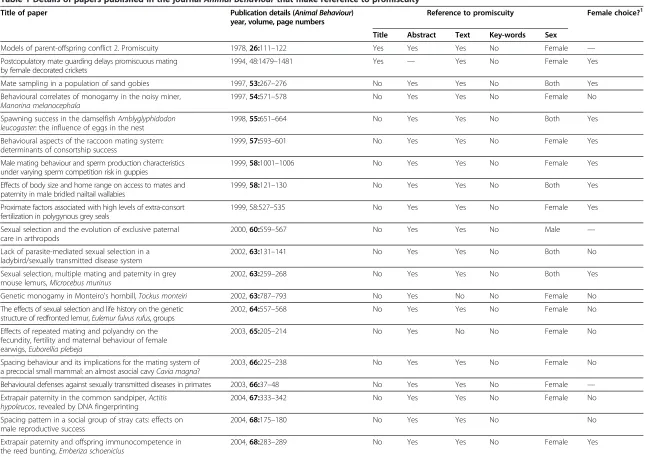
Table 1 Details of papers published in the journalAnimal Behaviourthat make reference to promiscuity
Title of paper Publication details (Animal Behaviour)
year, volume, page numbers
Reference to promiscuity Female choice?1
Title Abstract Text Key-words Sex
Models of parent-offspring conflict 2. Promiscuity 1978,26:111–122 Yes Yes Yes No Female —
Postcopulatory mate guarding delays promiscuous mating by female decorated crickets
1994, 48:1479–1481 Yes — Yes No Female Yes
Mate sampling in a population of sand gobies 1997,53:267–276 No Yes Yes No Both Yes
Behavioural correlates of monogamy in the noisy miner,
Manorina melanocephala
1997,54:571–578 No Yes Yes No Female No
Spawning success in the damselfishAmblyglyphidodon leucogaster: the influence of eggs in the nest
1998,55:651–664 No Yes Yes No Both Yes
Behavioural aspects of the raccoon mating system: determinants of consortship success
1999,57:593–601 No Yes Yes No Female Yes
Male mating behaviour and sperm production characteristics under varying sperm competition risk in guppies
1999,58:1001–1006 No Yes Yes No Female Yes
Effects of body size and home range on access to mates and paternity in male bridled nailtail wallabies
1999,58:121–130 No Yes Yes No Both Yes
Proximate factors associated with high levels of extra-consort fertilization in polygynous grey seals
1999, 58:527–535 No Yes Yes No Female Yes
Sexual selection and the evolution of exclusive paternal care in arthropods
2000,60:559–567 No Yes Yes No Male —
Lack of parasite-mediated sexual selection in a ladybird/sexually transmitted disease system
2002,63:131–141 No Yes Yes No Both No
Sexual selection, multiple mating and paternity in grey mouse lemurs,Microcebus murinus
2002,63:259–268 No Yes Yes No Both Yes
Genetic monogamy in Monteiro's hornbill,Tockus monteiri 2002,63:787–793 No Yes No No Female No The effects of sexual selection and life history on the genetic
structure of redfronted lemur,Eulemur fulvus rufus, groups
2002,64:557–568 No Yes Yes No Female No
Effects of repeated mating and polyandry on the fecundity, fertility and maternal behaviour of female earwigs,Euborellia plebeja
2003,65:205–214 No Yes No No Female No
Spacing behaviour and its implications for the mating system of a precocial small mammal: an almost asocial cavyCavia magna?
2003,66:225–238 No Yes Yes No Female No
Behavioural defenses against sexually transmitted diseases in primates 2003,66:37–48 No Yes Yes No Female —
Extrapair paternity in the common sandpiper,Actitis hypoleucos, revealed by DNA fingerprinting
2004,67:333–342 No Yes Yes No Female No
Spacing pattern in a social group of stray cats: effects on male reproductive success
2004,68:175–180 No Yes Yes No No
Extrapair paternity and offspring immunocompetence in the reed bunting,Emberiza schoeniclus
2004,68:283–289 No Yes Yes No Female Yes
Elgar
et
al.
Frontiers
in
Zoology
2013,
10
:66
Page
2
o
f
6
http://ww
w.frontiersi
nzoology.com
/content
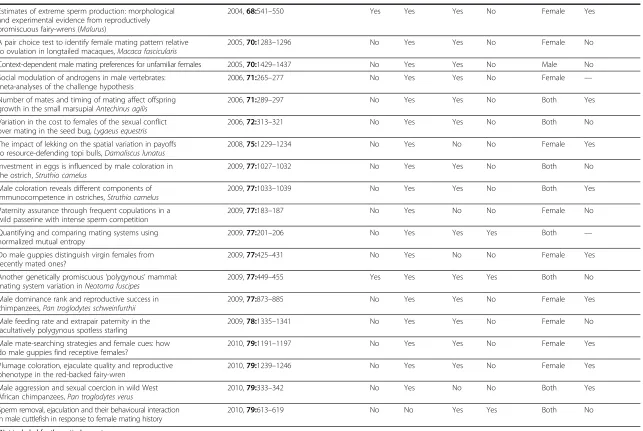
Table 1 Details of papers published in the journalAnimal Behaviourthat make reference to promiscuity(Continued)
Estimates of extreme sperm production: morphological and experimental evidence from reproductively promiscuous fairy-wrens (Malurus)
2004,68:541–550 Yes Yes Yes No Female Yes
A pair choice test to identify female mating pattern relative to ovulation in longtailed macaques,Macaca fascicularis
2005,70:1283–1296 No Yes Yes No Female No
Context-dependent male mating preferences for unfamiliar females 2005,70:1429–1437 No Yes Yes No Male No
Social modulation of androgens in male vertebrates: meta-analyses of the challenge hypothesis
2006,71:265–277 No Yes Yes No Female —
Number of mates and timing of mating affect offspring growth in the small marsupialAntechinus agilis
2006,71:289–297 No Yes Yes No Both Yes
Variation in the cost to females of the sexual conflict over mating in the seed bug,Lygaeus equestris
2006,72:313–321 No Yes Yes No Both No
The impact of lekking on the spatial variation in payoffs to resource-defending topi bulls,Damaliscus lunatus
2008,75:1229–1234 No Yes No No Female Yes
Investment in eggs is influenced by male coloration in the ostrich,Struthio camelus
2009,77:1027–1032 No Yes Yes No Both No
Male coloration reveals different components of immunocompetence in ostriches,Struthio camelus
2009,77:1033–1039 No Yes Yes No Both Yes
Paternity assurance through frequent copulations in a wild passerine with intense sperm competition
2009,77:183–187 No Yes No No Female No
Quantifying and comparing mating systems using normalized mutual entropy
2009,77:201–206 No Yes Yes Yes Both —
Do male guppies distinguish virgin females from recently mated ones?
2009,77:425–431 No Yes No No Female Yes
Another genetically promiscuous‘polygynous’mammal: mating system variation inNeotoma fuscipes
2009,77:449–455 Yes Yes Yes Yes Both No
Male dominance rank and reproductive success in chimpanzees,Pan troglodytes schweinfurthii
2009,77:873–885 No Yes Yes No Female Yes
Male feeding rate and extrapair paternity in the facultatively polygynous spotless starling
2009,78:1335–1341 No Yes Yes No Female No
Male mate-searching strategies and female cues: how do male guppies find receptive females?
2010,79:1191–1197 No Yes Yes No Female Yes
Plumage coloration, ejaculate quality and reproductive phenotype in the red-backed fairy-wren
2010,79:1239–1246 No Yes Yes No Female Yes
Male aggression and sexual coercion in wild West African chimpanzees,Pan troglodytes verus
2010,79:333–342 No Yes No No Both Yes
Sperm removal, ejaculation and their behavioural interaction in male cuttlefish in response to female mating history
2010,79:613–619 No No Yes Yes Both No
1
Not included for theoretical or review papers.
Elgar
et
al.
Frontiers
in
Zoology
2013,
10
:66
Page
3
o
f
http://ww
w.frontiersi
nzoology.com
/content
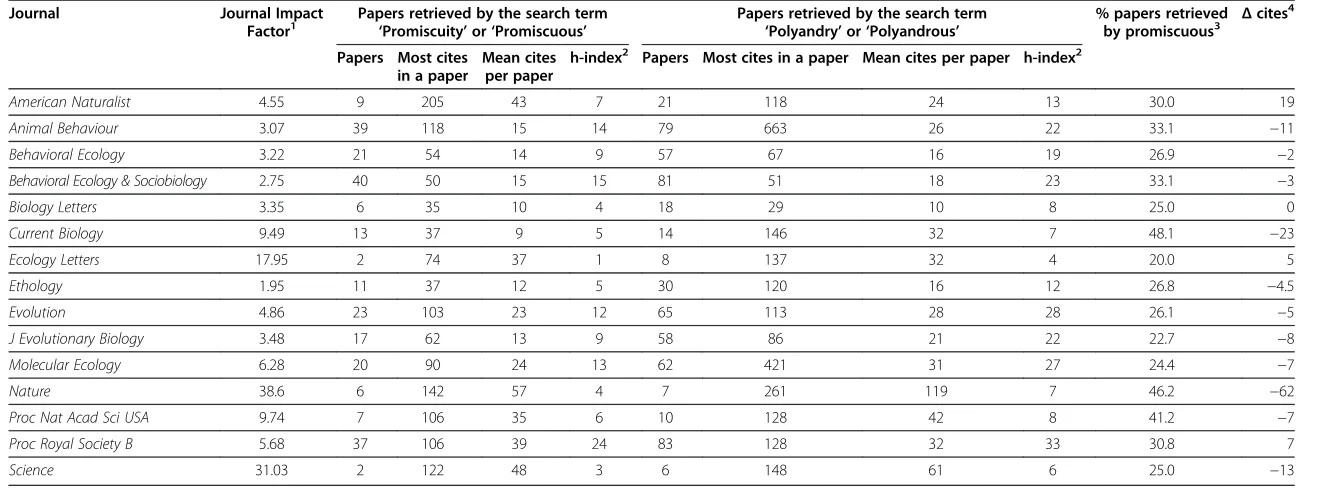
Table 2 Characteristics of papers retrieved by the search term‘promiscuity’or‘promiscuous’and‘polyandry’and‘polyandrous’in 13 journals from 2000 to 31st July 2013
Journal Journal Impact
Factor1
Papers retrieved by the search term ‘Promiscuity’or‘Promiscuous’
Papers retrieved by the search term ‘Polyandry’or‘Polyandrous’
% papers retrieved by promiscuous3 Δ
cites4
Papers Most cites in a paper
Mean cites per paper
h-index2 Papers Most cites in a paper Mean cites per paper h-index2
American Naturalist 4.55 9 205 43 7 21 118 24 13 30.0 19
Animal Behaviour 3.07 39 118 15 14 79 663 26 22 33.1 −11
Behavioral Ecology 3.22 21 54 14 9 57 67 16 19 26.9 −2
Behavioral Ecology & Sociobiology 2.75 40 50 15 15 81 51 18 23 33.1 −3
Biology Letters 3.35 6 35 10 4 18 29 10 8 25.0 0
Current Biology 9.49 13 37 9 5 14 146 32 7 48.1 −23
Ecology Letters 17.95 2 74 37 1 8 137 32 4 20.0 5
Ethology 1.95 11 37 12 5 30 120 16 12 26.8 −4.5
Evolution 4.86 23 103 23 12 65 113 28 28 26.1 −5
J Evolutionary Biology 3.48 17 62 13 9 58 86 21 22 22.7 −8
Molecular Ecology 6.28 20 90 24 13 62 421 31 27 24.4 −7
Nature 38.6 6 142 57 4 7 261 119 7 46.2 −62
Proc Nat Acad Sci USA 9.74 7 106 35 6 10 128 42 8 41.2 −7
Proc Royal Society B 5.68 37 106 39 24 83 128 32 33 30.8 7
Science 31.03 2 122 48 3 6 148 61 6 25.0 −13
(Note,Frontiers in Zoologyis not included in the survey because no papers are retrieved by the search terms promiscuity or promiscuous, and only two papers were retrieved by the search terms polyandry or polyandrous).
1
2012 Journal Citation Report®, ISI Web of Knowledge™.
2
h-index calculated according to J.E. Hirsch in ISI Web of Knowledge™.
3
Calculated as the number of papers retrieved by the search terms promiscuity or promiscuous, divided by the sum of the number of papers retrieved by the search terms promiscuity, promiscuous and polyandry or polyandrous.
4
The mean cites per paper retrieved by the search terms promiscuity or promiscuous less the mean cites per paper retrieved by the search terms polyandry or polyandrous.
Elgar
et
al.
Frontiers
in
Zoology
2013,
10
:66
Page
4
o
f
6
http://ww
w.frontiersi
nzoology.com
/content
refer to frequency only. We highlight this issue by evaluat-ing the patterns of use and misuse in the scientific litera-ture of the word ‘promiscuity’ to describe female mating strategies.
Use and misuse of promiscuous
We investigated whether polyandrous females were sim-ultaneously described as promiscuous and exhibiting discriminating mate choice in papers published in a rep-resentative journal, Animal Behaviour. Drawing on pa-pers published in the period 2000–2010, we identified those that contained ‘promiscuous’ (and its associated derivations) in either the abstract or main text. For each paper, we asked to which sex the term was applied (male, female or both), and whether the term was applied in a species in which pre-copulatory female choice had been experimentally demonstrated (either in the article itself or other published papers), or whether the authors inferred or suggested its presence in that species. Female mate choice is typically understood to mean a mating prefer-ence for different kinds of males [7,15,16], and is inferred from experiments or field observations showing that fe-males prefer fe-males according to the degree of exagger-ation of secondary sexual characteristics e.g. [16-18]. We reduced the likelihood of misinterpretation of each paper by ensuring it was assessed independently by at least two readers. We confined our analysis to the term promiscu-ous because other descriptors of animal mating behaviour (such as polygynous, polyandrous and polygynandrous) do not make inferences about the nature of mating–whether either sex is discriminating or not – and thus are not at issue.
In total, 39 papers were evaluated (see Table 1). ‘Pro-miscuous’was applied to females in 23 cases, males in 2, and in 14 cases the term was either applied to both sexes or the focal sex was ambiguous (significantly, such ambi-guity is impossible with precise language, such as poly-andry and polygyny). For papers in which‘promiscuous’ was applied to females or both sexes (37 papers), female choice was demonstrated or suggested by the authors themselves in 18 instances, while in 15 cases there was no published evidence of female choice (four cases were excluded as the papers were theoretical reviews or meta-analyses). So, in over half of the instances, promiscuous is evidently used incorrectly, a proportion that is likely to be substantially underestimated: the absence of dence of female choice in the remaining cases is not evi-dence that female preferences are absent.
Using promiscuity to titillate the reader?
Promiscuity as a term to describe animal mating behav-iour is undoubtedly anthropomorphic, probably account-ing for the frequency of its use, especially amongst the primate literature. The discipline does not tolerate other
anthropomorphisms in biological science; for example, the term forced copulation is preferred over rape [22], and infanticide preferred over murder [23]. Promiscuity has pejorative and androcentric connotations [20] and is likely to be emotionally evocative [24], typically saved for the females of the species (Table 1): while polygynous males maximise their fitness by mating at the highest rate, females are described as promiscuous. Perhaps pro-miscuous is used in titles and abstracts precisely because it is titillating, the notion of indiscriminate mating tap-ping into latent social taboos.
We explored the potential motivation for and conse-quences of using the term promiscuous by evaluating the citation metrics for papers retrieved by searches in
Web of Knowledge (Thomson Reuters). We selected 15
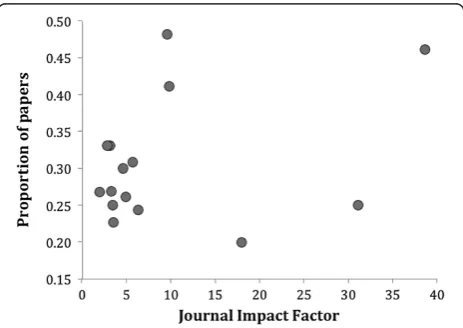
journals and conducted two searches for each journal, using the terms (i) promiscuous OR promiscuity, and (ii) polyandrous OR polyandry (summarised in Table 2). We make the comparison with polyandry only because our previous analysis indicated that, in the vast majority of cases, promiscuity is used to describe female mating fre-quency (Table 1). Polygyny is widely understood to mean, based on the Greek etymology, multiple mating bymales [24] and thus refers to an entirely different behaviour. Roughly a third of the papers included in the sample were identified by the term promiscuous or promiscuity in the title, abstract or key words. While this proportion ranged from 20–50% between journals, it was not correlated with the journal’s Impact Factor (Figure 1). Nevertheless, the mean number of citations of ‘polyandry’ papers (34 ± 7) per journal was marginally greater than that of ‘promiscu-ity’papers (26 ± 4; Wilcoxon Sign-Rank test: p = 0.07), and the single-publication h-index of ‘polyandry’papers (16 ± 2) was significantly higher than that of ‘promiscuity’ pa-pers (9 ± 2; Wilcoxon Sign-Rank test: p < 0.0001) (Table 2). It is not clear whether this reflects an author’s publishing
Figure 1The proportion of‘promiscuity’papers in a journal was not associated with its Impact Factor (2012 Journal Citation
Reports, Thomson Reuters) (Spearman’sρ= 0.03, p > 0.9).
Elgaret al. Frontiers in Zoology2013,10:66 Page 5 of 6
strategy, or that literature searches typically use the term polyandry over promiscuity.
Conclusions
Arguments over definitions can be tedious, but a cavalier use of borrowed words is unhelpful. Our surveys reveal a tendency to describe female rather than male mating strat-egies as promiscuous, despite the inherent contradiction in meaning. There was no evidence that journals of differ-ent standing publish more or fewer papers that use the term promiscuous, but authors searching for papers using the term promiscuous will generally retrieve lower impact publications.
Promiscuity has become so firmly entrenched in the literature as a synonym for polyandry that its accuracy is no longer questioned. But indiscriminately describing multiple-mating strategies as promiscuous conceals crit-ical features of intriguing evolutionary significance. In-deed, records of truly promiscuous mating strategies, in which females (or males) mated indiscriminately would be remarkable, and predicted, for example, when the costs of mate choice are exorbitant. Like other emotionally evocative terms used to describe sexual behavior [25], promiscuity can be replaced with polyandry, polygyny and polygynandry, as appropriate–descriptive terms that are si-lent about the nature of mating, and devoid of sociological, psychological and moralistic connotations. Convention is no justification for imprecision, as our survey revealed: without evidence of indiscriminate mating behaviour,‘ pro-miscuity’in evolutionary biology should be left well alone.
Competing interests
The authors declare that they have no competing interests.
Authors’contributions
MAE, TMJ and KBM collated and prepared the data; MAE, TMJ and KBM analysed the data; MAE, TMJ and KBM drafted the manuscript. All authors read and approved the final manuscript.
Acknowledgements
We thank Malin Ah-King, Cordelia Fine, Root Gorelick and an anonymous referee for their insights. The Australian Research Council (DP0558265 to MAE and TMJ; DP0987360 to MAE; and DP110101163 to KBM) and the University of Melbourne (Career Interruption Research Fellowship to TMJ) support our research on the mating behavior of animals.
Author details
1Department of Zoology, University of Melbourne, Melbourne, VIC 3010, Australia.2Centre for Evolutionary Biology, The University of Western Australia, Crawley 6009, Australia.
Received: 22 October 2013 Accepted: 5 November 2013 Published: 8 November 2013
References
1. The Shorter Oxford English Dictionary.Oxford: Oxford University Press; 1983. 2. Sala GA:New and Gorgeous Pantomime Entitled Harlequin Prince Cherrytop,
etc; 1905. Printed for private distribution.
3. Birdsall DA, Nash D:Occurrence of promiscuity among females in natural
populations of deer mice (Peromyscus-maniculatus).Can J Genet Cytol
1972,14:721.
4. Kushlan JA:Promiscuous mating behavior in white-ibis.Wilson Bulletin
1973,85:331–332.
5. Merritt RB, Wu BJ:On the Quantification of Promiscuity (Or‘Promyscus’ Maniculatus?).Evolution1975,29:575–578.
6. Harris MP:Promiscuity in the shag as shown by time-lapse photography.
Bird Study1982,29:149–154.
7. Shuster SM, Wade MJ:Mating Systems and Strategies.New Jersey: Princeton University Press; 2003.
8. Nabours RK:Polyandry in the grouse locust,Paratettix texanusHancock, with notes on inheritance of acquired characters and telegony.
Am Nat1927,61:531–538.
9. Bovvee JW:A warning against promiscuous uterine curettage.
Surg Gynecol Obstet1920,30:618–620.
10. Hambourger WE:A study of the promiscuous use of the barbiturates–
their use in suicides.JAMA1939,112:1340–1343.
11. Pickford GD:The influence of continued heavy grazing and of promiscuous burning on spring-fall ranges in Utah.Ecology1932,13:159–171.
12. Khersonsky O, Tawfik DS:Enzyme Promiscuity: A Mechanistic and
Evolutionary Perspective.Annu Rev Plant Physiol Plant Mol Biol2010,
79:471–505.
13. Raab JR, Kamakaka RT:Insulators and promoters: closer than we think.
Nat Rev Genet2010,11:439–446.
14. Bird MK, Lawrence AJ:The promiscuous mGlu5 receptor - a range of
part-ners for therapeutic possibilities?Trends Pharmacol Sci2009,30:617–623.
15. Darwin C:The Descent of Man, and Selection in relation to Sex.London: John Murray; 1874.
16. Andersson M:Sexual Selection.New Jersey: Princeton University Press; 1994. 17. Kirkpatrick M:Good genes and direct selection in evolution of mating
preferences.Evolution1996,50:2125–2140.
18. Jennions MD, Petrie M:Variation in mate choice and mating preferences:
a review of causes and consequences.Biol Rev1997,72:283–327.
19. Arnqvist G, Nilsson T:The evolution of polyandry: multiple mating and female fitness in insects.Anim Behav2000,60:145–164.
20. Olsson M, Shine R, Madsen T, Gullberg A, Tegelström H:Sperm selection by
females.Nature1996,383:585.
21. Bertram SM, Gorelick R:Quantifying and comparing mating systems using
normalized mutual entropy.Anim Behav2009,77:201–206.
22. Hilton DFJ:Is it really rape or forced copulation?Bioscience1982,32:641. 23. Packer C, Pusey AE:Adaptations of female lions to infanticide by
incoming males.Am Nat1983,121:716–728.
24. Emlen ST, Oring LW:Ecology, sexual selection, and the evolution of
mating systems.Science1977,197:215–223.
25. Gowaty P:Sexual terms in sociobiology: emotionally evocative and,
paradoxically, jargon.Anim Behav1982,30:630–631.
doi:10.1186/1742-9994-10-66
Cite this article as:Elgaret al.:Promiscuous words.Frontiers in Zoology 201310:66.
Submit your next manuscript to BioMed Central and take full advantage of:
• Convenient online submission
• Thorough peer review
• No space constraints or color figure charges
• Immediate publication on acceptance
• Inclusion in PubMed, CAS, Scopus and Google Scholar
• Research which is freely available for redistribution
Submit your manuscript at www.biomedcentral.com/submit
Elgaret al. Frontiers in Zoology2013,10:66 Page 6 of 6