VLSI Architecture of a Cellular Automata based
One-Way Function
D. Mukhopadhyay, P. Joshi* and D. RoyChowdhury*
Department of Computer Science, Dept of Computer Science and Engg, Madras, India Email: [email protected]
*Department of Computer Science, Dept of Computer Science and Engg, Kharagpur, India Email: [email protected], [email protected]
Abstract— In this paper, a technique to generate expander graphs using Cellular Automata (CA) has been presented. The special class of CA, known as the Two Predecessor Single Attractor Cellular Automata (TPSA CA) has been characterized. It has been shown that the expander graphs built using the TPSA-CA are promising and lead to the development of strong one-way functions. The paper pro-poses an efficient architecture for the one-way function and implements it on an FPGA platform. Most of the widely used key establishment algorithms employ one-way functions based on modular exponentiation that are computationally very expensive. However, the implementation of the pro-posed architecture shows that the TPSA based one-way algorithm can be implemented very efficiently with very less consumption of computational resources like area and clock cycles. Such a one-way function can be an ideal replacement of modular exponentiation based one-way functions and thus help to develop fast and secure key establishment protocols.
Index Terms— One Way Function, Cellular Automata, Ex-pander Graphs, FPGA Implementations, Area-Delay Prod-uct
I. INTRODUCTION
Expander Graphs have been a significant tool both in theory and practice. It has been used in solving problems in communication and construction of error correcting codes as well as a tool for proving results in number theory and computational complexity. The combinatorial properties of the expander graphs can also lead to the construction of one-way functions [1]. Informally, the one-way functions are a class of functions in which the forward computation is easy, but the inverse is hard to find. The one-way functions form an important core of all key agreement algorithms which are an important step in secure electronic communication. The well known Diffie-Hellman key exchange algorithm [2] provides a ground-breaking solution to the problem of secured key distribution. However the security of the algorithm de-pends on the one-wayness of the modular exponentiation, which is a costly process in terms of computational resources. Since the seminal paper of Diffie-Helmann,
This paper is based on “An Efficient Design of Cellular Automata based Cryptographically Robust One-Way Function” by D. Mukhopad-hyay, P. Joshi and D. RoyChowdhury, which appeared in the Proceedings of the 20th IEEE Conference on VLSI Design (VLSID), Bangalore, India, January 2007. c°2007 IEEE.
there has been efforts in developing key exchange pro-tocols whose security lies on one-way functions which are computationally efficient. However designing a strong one-way function which is computationally strong and yet hardware efficient is a challenging task.
The present work characterizes a special class of Cel-lular Automata (CA) [3], known as the Two Predecessor Single Attractor Cellular Automata (TPSA-CA) to gen-erate expander graphs on the fly. The elegance of the scheme is that it uses regular, cascadable and modular structures of CA to generate random dregular graphs of good expansion property with very less storage. The state transitions of each TPSA is captured in a single state, which is known as the graveyard of the CA. Finally, the expander graphs have been used to construct the one-way function according to the proposal of [1]. The entire algorithm has been prototyped on a Vertex Xilinx XCV-1000 platform. Results show that the scheme is very elegant in the fact that very high throughputs are achievable with a minimal cost of hardware and power. The performance has been compared with that of efficient implementations of modular exponentiation in GF(2m) and results show that the proposed one-way function has a much superior VLSI implementation than a conventional one-way function.
The outline of the paper is as follows: Section II describes some of the preliminaries of expander graphs. The TPSA-CA is characterized in section IIIand is used to generate expander graphs. Subsequently, section IV presents the construction of the CA based one-way func-tion which is implemented on Xilinx XCV-1000 platform insection V. The chapter is concluded insection VI.
II. PRELIMINARIES ONEXPANDERGRAPHS Informally expander graphs are a class of graphs G= (V, E)in which every subsetS of vertices expands quickly, in the sense that it is connected to many vertices in the set S of complementary vertices. It may be noted that the graph may have self loops and multiple edges. The following definition states formally the expansion property of these class of graphs [11].
as:
h(G) = minS:|S|≤n/2 |δ(S)|
|S|
where|S| denotes the size of a setS.
There are other notions of expansion, the most popular being counting the number of neighbouring vertices of any small set, rather than the number of outgoing edges. Following are some examples of expander graphs [12]. Example 1: LetG be a complete graph onn vertices i.e, the graph in which every vertex is connected to every other vertex. Then for any vertex in S, each vertex is connected to all the vertices in S, and thus|δS|=|S| × |S|=|S|(n−|S|). Thus the expansion factor is given by:
h(G) = minS:|S|≤n/2(n− |S|) =dn 2e Example 2: Let G be a random d-regular graph, in which each of nvertices is connected todother vertices chosen at random. Let S be a subset of atmost n/2 vertices. Then a typical vertex in S will be connected to roughly d× |S|/n vertices in S, and thus |δS| ≈
d× |S||S|/n, and so
|δ(S)|
|S| ≈ d |S|
n
Since, |S| has its minimum at approximately n/2 it follows that h(G)≈d/2, independently of the size n.
Definition 2: Afamily of expander graphs(Giwhere i ∈ n) is a collection of graphs with the following properties:
• The graph Gi is ad-regular graph of size ni (d is the same constant for the whole family). {ni} is a monotone growing series that does not grow too fast (e.gni+1≤n2i)).
• For alli,h(Gi)≥²≥0.
Although d-regular graph random graphs on n vertices define an expander, for real life applications it is necessary to have more explicit constructions on O(2n) vertices, wherenis the parameter defining the problem size. This is because to store a description of a random graph on so many vertices requires exponentially much time and space.
The properties of the eigenvalue spectrum of the ad-jacency matrix A(G) can also be used to understand properties of the graph G.
The adjacency matrix of a graph G, denoted by A(G) is an n×n matrix such that each element(u, v) denotes the number of edges inGbetween vertex uand vertex v [11]. For a d-regular graph, the sum of each row and column in A(G) is d. By definition the matrix A(G) is symmetric and therefore has an orthonormal basev0, v1, . . . , vn−1, with eigenvaluesµ0, µ1, . . . , µn−1
such that for all i we have Avi =µivi. Without loss of generality we assume the eigenvalues sorted in descending orderµ0 ≥µ1≥. . .≥µn−1. The eigenvalues ofA(G)
are called the spectrum of G. The following two results are important in estimating the expansion properties of the graph.
1) µ0=d
2) d−µ1
2 ≤h(G)≤
p
2d(d−µ1)
Thus, the parameterd−µ1, also known as theSpectral Gapgives a good estimate on the expansion of the graph G. The graph is an expander if the spectral gap has a lower bound ²0 such that d−µ
1> ²0.
In the next section we present the construction of a family of randomdregular graph using the properties of a special class of CA, known as the Two Predecessor Singe Attractor Cellular Automaton (TPSA CA). It has been shown that the graph has good expansion properties. The merit of the construction lies in the fact that the generation is extremely simple and leads to an efficient design as developed in subsequent sections.
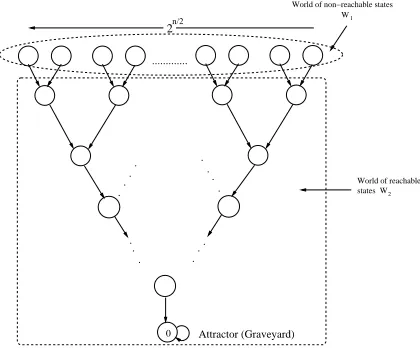
III. EXPANDERGRAPHS USINGTPSA CA TPSA CA are a special class of non-group CA in which the state transition graph forms a single inverted binary routed tree at all zero state (Fig. 1). Every reachable state in the state transition graph has exactly two predecessors. The only cyclic state is the all zero state (for a non-complemented TPSA CA), which is an attractor (or graveyard). IfTn is the characteristic matrix of anncell automaton then the necessary and sufficient conditions to be satisfied by the Transition matrix for the CA to be TPSA CA is [3]:
1) Rank(Tn)=n−1
2) Rank(Tn + In)=n, In being an n × n identity matrix
3) Characteristic Polynomial = xn 4) Minimal Polynomial =xn
The following results [3] characterize the state transition of the non-complemented TPSA CA.
Lemma 1: [3] For an n cell TPSA CA with charac-teristic polynomial xn and minimal polynomial xn, (i) the number of attractors is 1, the all zero state, (ii) the number of states in the tree is 2n.
Lemma 2: For anncell TPSA CA havingm(x) =xn the depth of the tree isn.
World of non−reachable states
. . .
. . .
. .
. . .
. ...
. .
Attractor (Graveyard)
0
2n/2
World of reachable W1
states W2
Following is an example of a 4 cell non-complemented TPSA CA.
Example 3: The state transition matrix for a4cell CA is denoted by:
T4=
1 1 0 0 1 1 0 0 0 1 1 1 0 0 1 1
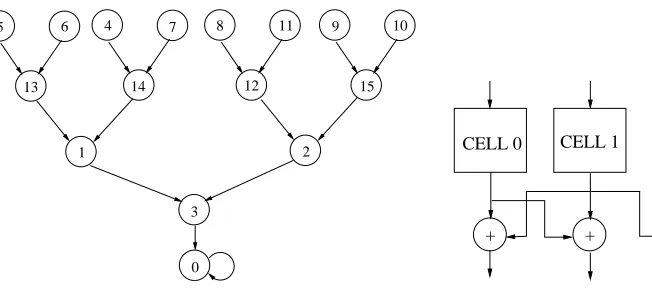
The state transition diagram of the TPSA CA is shown inFig. 2(a). As an example let us compute the next state of 14, which in binary form isX = (1110)T. Thus the
next state is obtained as Y = T4
1 1 1 0 = 0 0 0 1 = 1 Thus the next state of14is1, which may be observed in
Fig. 2(a). Here{0}is theattractororgraveyardstate. The states {5, 6, 4, 7, 8, 11, 9, 10} make the non-reachable world, while the states{13, 14, 12, 15, 1, 2, 3, 0} make thereachableworld. The corresponding interconnection is given inFig. 2(b). As may be observed that the structure comprises of local interconnections leading to efficient designs.
Next, we present an method to recursively synthesize an n cell TPSA. The state transition matrix of the n cell TPSA is denoted by Tn and is generated from ann−1 cell TPSA CA characterized by the matrix Tn−1. The
following theorem describes the property exploited in the construction.
Theorem 1: Given that Tn−1 is the characteristic
ma-trix of an(n−1) cell TPSA, the matrixTn denoted by:
Tn= | 0 Tn−1 | ... | 0
− − − − − −
0 . . . 0 1 | 0
represents the characteristic matrix of an ncell TPSA. Proof: It is evident that since the element at thenth row and (n−1)th column is 1 and by the construction methodology all the rows have0in the(n−1)thcolumns the row added is linearly independent from the other rows of Tn. Hence it adds by 1 to the rank of Tn−1. Thus,
rank(Tn) =rank(Tn−1) + 1 =n−1 + 1 =n
Similarly, using the fact thatrank(Tn−1⊕In−1) =n−1
(whereIn−1is the identity matrix of ordern−1), we have
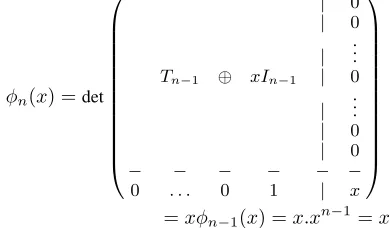
rank(Tn⊕In) =n. The characteristic polynomial of the matrix Tn, denoted by φn(x) is evaluated as det(Tn⊕ xIn), where detdenotes the determinant. Thus we have,
φn(x) =det | 0 | 0 | ...
Tn−1 ⊕ xIn−1 | 0
| ... | 0 | 0
− − − − − −
0 . . . 0 1 | x
=xφn−1(x) =x.xn−1=xn (φn−1(x)denotes the characteristic polynomial ofTn−1)
In order to evaluate the minimal polynomial we make use of the following proposition.
Lemma 3: Letφn(x) andψn(x) be the characteristic polynomial and the minimal polynomial of the matrixTn, respectively. Let the greatest common divisor (gcd) of the matrix (Tn⊕Inx)∨ that is the matrix of algebraic complements of the elements of the matrix (Tn⊕Inx) be d(x). Then,φn(x) =d(x)ψn(x).
From the matrix(Tn⊕Inx)∨it may be observed that the element at the position (0, n)is1 and thus the gcdd(x) is also 1. Thus the minimal polynomial is equal to the characteristic polynomial which is xn. Thus, we observe that the construction follows all the four necessary and sufficient requirements of a TPSA CA. This completes the proof.
Example 4: Given the fact that T2=
µ
1 1 1 1

is the characteristic matrix of a 2 cell TPSA CA. Thus, using the above theorem it is evident that:
T3=
1 1 01 1 0
0 1 0
is the characteristic matrix of a 3 cell TPSA CA. We have seen above that the state transition in the above class of TPSA CA is governed solely by the char-acteristic matrix. This class of CA is known as the non-complemented TPSA CA. On the contrary when the next state is obtained by the application of the characteristic matrix and then xoring with a vectorF, the CA is known as the complemented TPSA-CA.
The following results show how complementing the state transition function of the non-complemented CA generates a class of automaton with the same properties as the original TPSA CA.
Lemma 4: Corresponding to a non-complemented TPSA CAM1and a stateZ, there exists a complemented
CA M2 with state Z as an attractor. If the characteristic
matrix M1 be indicated by Tn and it is required to build a complemented TPSA CA such that Z is the graveyard (attractor) then the characteristic matrix of the complemented CA,Tn is related toTn by
Tn(X) =Tn(X)⊕(In⊕Tn)Z
where X is the seed to the CA and In is the identity matrix of order n.
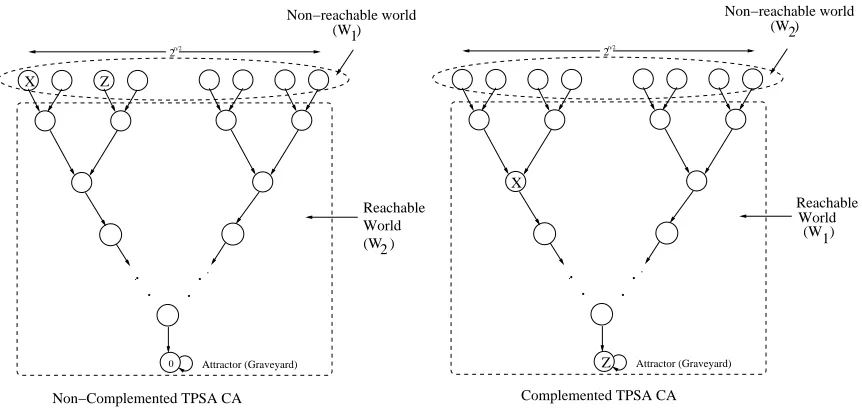
Lemma 5: A complemented TPSA CA has the same structure as a non-complemented TPSA CA. To empha-size
• Number of attractors in the complemented CA is the same as that in the original non-complemented CA. • Number of reachable states and non-reachable states are same as that in the original non-complemented CA.
5 6
13
4 7
14
1
8 11
12
2 15
0 3
9 10
(a) The state transition graph of a4 cell non-complemented TPSA CA
+ + +
+
CELL 0 CELL 1 CELL 2 CELL 3
(b) The interconnection of a4cell non-complemented TPSA CA
Figure 2. A4cell non-complemented TPSA CA
become elements of the reachable world in the comple-mented CA and viceversa. Thus the reachable world (W1)
and the non-reachable world (W2) exchange themselves
(Fig. 3).
Proof: LetX andZ be two non-reachable elements in the n cell non-complemented CA with characteristic matrixTn. LetX be thelthlevel sister ofZ. In all cases l < n. Thus, we have:
Tl
n(X) = Tnl(Z)
Let us consider the state transition diagram of the complemented CA with Z as the graveyard. The state transition of the complemented CA is indicated by Tn. We shall prove that in this state transition graph X is a reachable state. Let, the depth of X in the graph of the complemented CA be t. Ift is less than n then X is a reachable state. Since, Z is the graveyard of this graph we have:
Ttn(X) = Z Tnt(X)⊕(In⊕Tnt)Z = Z
Tt
n(X) = Tnt(Z)
Thus,XandZaretthlevel sisters in the state transition graph of the non-complemented CA. But we know that they arelthlevel sisters. Thust=l < n. Thus, the depth ofX is lesser thannand henceX is a reachable state in the state transition graph of the complemented CA.
A. Construction of expander graph using the TPSA CA The TPSA CA can be effectively used to generate a randomdregular graph on the fly. It may be noted that the entire nature of the graph is stored in the graveyard state, thus leading to a very compact storage of the graph. This is because given the graveyard state, the entire transition graph can be obtained.
In order to construct the d regular graph we proceed as follows: Let Z1 ∈ W1 (non-reachable world in the
non-complemented TPSA CA) and Z2 ∈W2 (reachable
world in the non-complemented TPSA CA). Let,G1and
G2 be the state transition graphs withZ1 andZ2 as the
graveyards respectively.
Clearly, in G1 if X ∈ W1, degree(X) = 3 and if
X ∈W2,degree(X) = 1. Similarly, inG2 if X ∈W1,
degree(X) = 1 and ifX ∈ W2, degree(X) = 3. Here
degree is defined as the sum of the indegree and the outdegreein the corresponding graph.
Thus, in the graph G obtained by a union operation in the graphs G1 and G2, allowing multiple edges and
self loops, we have for X ∈ G, degree(X) = 4. If we continue the union operation in the above method we have degree(X) = 2(t+ 1), where t is the number of union operations. Table I shows the result of an experimen-tation performed with the TPSA based regular graph. It measures the value of the two largest eigen values for random TPSA based graphs for degree 4,8,12 and 16. The difference between the largest two eigen values is known as the spectral gap and should be large for good expansion of the graph. Results show that the spectral gap and hence the expansion increases proportionately with the number of union operations (t).
B. Setting parameters of thedregular TPSA based graph for good Expansion Properties
In the present section we compute the expansion ob-tained in thedregular TPSA based graph in terms of the parameters of the graph G. Let the number of nodes in the graph be nand the degree of each node is d. Let us consider a randomdregular graph (Fig. 4) the subset A withαnvertices (0< α <1).
For the graphGto have good expansion properties the setAshould have more thanβn(0< β <1) neighbours outside A. The probability of such an event should be high.
Equivalently, we may state that the probability that the number of neighbours of the vertices of A outside A is less than βnis negligible. Let us fix AandB such that
|A|= αnand|B|=βn.
. .
Attractor (Graveyard) Non−reachable world
(W1)
Non−reachable world (W2)
. .
. .
. .
. .
2n/2 2n/2
0
. .
Attractor (Graveyard)
Reachable World
(W )2
Reachable World
(W )1
X Z
Z
Non−Complemented TPSA CA Complemented TPSA CA
X
Figure 3. The exchange of the worlds in a complemented TPSA CA
TABLE I.
Spectrum of a4cell TPSA based regular graph
No. of Graveyards Degree First Second Spectral g/t
Union (t) Eigen Eigen Gap (g)
Value Value
1 {0},{4} 4 4 3.2361 0.76 0.76
3 {0,15},{4,8} 8 8 4.899 3.10 1.03
5 {0,15,3},{4,8,10} 12 12 6.3440 5.66 1.14 7 {0,15,3,2},{4,8,10,9} 16 16 5.2263 10.77 1.54
A
B N(A) G:
Figure 4. Computing the expansion of the randomdregular graph
we first consider a single matching,αnvertices can have maximum αnneighbours inN(A). The probability that the neighbours ofA are inB is :
p = no. of ways in which N(A) can lie inside B no. of ways in which N(A) may be chosen outside A
=
µ βn αn
¶ µ
n−αn αn

Hence, if we consider a d-matching, assuming all the edges to be independent we have
Pr[N(A)⊂B] =
µ βn αn
¶ µ
n−αn αn
¶ d
≈ (1−βα)αnd
Thus, we have the following probability: Pr[∃A∈Gs.t|A|=αn,|N(A)| ≤βn]
≤ X
|A|=αn X
|B|=βn
(1−βα)αnd
≤
µ n αn
¶ µ n βn

(1−βα)αnd
Next, we use the following approximations:µ n
αn 
= 2nH(α),
µ n βn

= 2nH(β).
Here,H(α) =−αlog2α−(1−α) log2(1−α). Thus, settingα= 1
m and β = 12 and some simplifications we
have:
Pr[∃A∈Gs.t|A|=αn,|N(A)| ≤βn] ≤2n[log2m−(1−m1) log2(m−1)+1+mdlog2(mm−1)]≈2−cn
The value of d gives us an estimate of the number of union operationst to be performed.
C. Mathematical Formulation of adjacency in the TPSA based Graph
The graph G(V, E) can thus be described as a union operation between the graphsG1andG2whereZ1∈W1
and Z2 ∈ W2 are the respective graveyard states. The
following algorithm computes the four neighbours of a given state in the graphG.
Algorithm 1: Computing neighbourhood of a vertex
X in G
Input: Z1, Z2, a state X ∈ G. Any state X is an
n-tuple,(x1, x2, . . . , xn)
Output: The four neighbours ofX (U, V, W, Y)
Step 1: Computation of neighbours U andV,
U = Tn(X)⊕(In⊕Tn)Z1
V = Tn(X)⊕(In⊕Tn)Z2
Computation of neighbours W and Y
Step 2:
Compute,X⊕(In⊕Tn)Z1= (x1, x2, . . . , xn)T
Step 3:
If(x1=x2){/∗X ∈G1∗/
from the matrix defined intheorem 1
setwn= 0, Computewn−1=xn, wn−2=xn−1, . . . , w2=x3, w1=w2⊕x1
setyn= 1, Computeyn−1=xn, yn−2=xn−1, . . . , y2=x3, y1=y2⊕x1}
else{/∗X ∈G2∗/
repeat Step 2 withZ2 replacingZ1 }
It is evident that the distribution of the neighbourhood is identical to that of Z1 orZ2 which are randomly
cho-sen. Thus, we have a four regular pseudo-random graph when we have only one union operation. The degree may be increased with the number of union operations. The advantage lies in the fact that in general the description of a random graph grows exponentially with the number of vertices. However, using the TPSA based construction one may generate graphs which exhibit randomness and also may be described using polynomial space, as we require to store only the graveyard state. For an N cell TPSA, in order to compute the neighbourhood of any state, Algorithm 1 is applied in constant time, as each of the steps 1,2 and 3 may be applied in constant time parallely on theNbit input vector. Herein lies the efficacy of the TPSA based expander graphs.
IV. APPLICATION OFTPSABASEDEXPANDER GRAPHS INCONSTRUCTINGONE-WAY FUNCTIONS The one-way function using thed-regular graph gener-ated by the TPSA is based on the construction proposed in [1]. The one-way function maps a string in {0,1}n to another in{0,1}n. The algorithm is based on adregular graph generated by the TPSA. As already mentioned the graveyard states are fromW1andW2. LetZ1denotes the
graveyard states from W1 andZ2 denotes the graveyard
states fromW2. If there areielements inZ1andZ2then
the number of union operations required to generate thed regular graph is2i−1and so we haved= 2(2i−1 + 1). Thus we arrive at the number of graveyard states required as i= d
4.
The evaluation of the one-way function is as follows: Algorithm 2: One-way function (f) using the state transitions of a TPSA
Input:Z1∈W1,Z2∈W2, a stateX ∈ {0,1}n. Thus
the TPSA based regular graph has degree 4.
Output: The one-way output Y ∈ {0,1}n such that Y =f(X)
Step 1Consider anN cell TPSA, whereN = log2(n).
Generate a collection C, which constitutes of the neigh-bours of each node in the regular graph generated by the state transitions of the TPSA using Algorithm 1. Mathematically, C = {Si, ifv ∈ Si, E(v, i) = 1, i ∈
{1, . . . , n}}.
Step 2 For i = 1ton, project X onto each of the subsetsSi. IfSi ={i1, i2, . . . , id}, then the projection of X onSidenoted byXSi, is a string of lengthdindicated by {Xi1, Xi2, . . . , Xid}.
Step 3 Evaluates a non-linear boolean function Π on each of the n projections thus giving an n bit output,
{Π(XS1),Π(XS2), . . . ,Π(XSn)}. The non-linear
func-tion Πis Π(z1, z2, . . . , zd) = ( d/2
X i=1
zizi+d/2)mod2.
The forward transformation is very efficient as the total time required is O(n). This may be observed as the time required to perform Step 1 is due to that required to apply Algorithm 1 at all the 2N vertices. Hence the total time is also proportional to 2N = n. The time required to apply Step 2 and Step 3 is also proportional with n and hence the total time required. However computing the inverse seems to be intractable even when the collection C is known. As proved in [1] the complexity of a proposed inverting algorithm is atleast exponential in minπ{maxi{| ∪ij=1Sπ(j)| −i}}.
We have shown in section III-B that the probability that the size of the neighbourhood of any subset S is proportional tonis very high. Thus for all cases the value ofminπ{maxi{|∪ij=1Sπ(j)|−i}}isO(n)and hence the
complexity of a possible inverting algorithm proposed in is atleast exponential in O(n) [1]. Thus the problem of inverting the one-way function seems to be intractable.
In the following section we present the implementa-tion of the proposed architecture on a Xilinx XCV-1000 platform.
V. IMPLEMENTATION OF THETPSABASEDONE-WAY FUNCTION
In this section, we propose the architecture for n = 128 bit one-way function. The size of the TPSA CA is thus N =log2n=log2128 = 7. Using the 7-bit TPSA CA,
graph has good expansion properties which in turn make the one-way function strong [1].
clk
X
N
.
C.
P
d Q
Gen
Neighbours Projection reset
DEMUX COUNTER
1:n
.
..
.
enb n enb 1 enb 2 LOW
N C
.
. . . . .
OUT OUT2 OUTn
1
.
enb 1 enb 2 enb n O
O1 O2 n
clk
Z
Q
Figure 5. Top-level view of the architecture
Fig. 5shows the top-level view of the architecture. The N = 7bit up-counter counts from 0 to 127 (n= 128) and for each of these values the block Gen-Neighbours calculates the d = 16 neighbours in the TPSA based d-regular graph. Each neighbour selects a particular bit from the input X. The 16 bit output of the block Gen-Neighbours is thus the16bits selected from the inputX. These 16 bits are taken by the block Projection which calculates the Boolean function Π on those bits. Finally the output bit of the Projection block (Q) is clocked into the proper flip-flop of the output register (OU T1 to
OU Tn). The output of the counter(c)determines which of the flip-flops (OU T1toOU Tn) in the output register is to be enabled (enb1toenbn) and consequently the output of the Projection block (Q) gets clocked into that enabled flip-flop. TheZ input to Gen-Neighbours is the set of the N-bit graveyards of all those TPSA CA whose union is to be carried out.
A. Details of the proposed architecture
The block Gen-Neighbours (Fig 6) is based on Algorithm-1. It can be seen that it has i = 16/4 = 4 pairs of the two types of graveyard states (Z1 andZ2).
Each of these pairs generates4neighbours, each of which is then used to select a bit from the inputX (Pj), where j varies from 1 to 4i = 16. Each GNj block (j varies from 1 toi) is elaborated inFig 7. It has aM U L−Tn unit which computes the multiplication of the matrix Tn with its inputY. TheM U L XOR In Tn carries out the multiplication ofIn⊕Tn with its inputZ. The first two neighbours (N1 and N2) are determined using the first
step of Algorithm 1. ThusN1 = Tn(X)(In⊕Tn)Z1and
N2=Tn(X)(In⊕Tn)Z2. The other two neighbours are
computed using the rest two steps of the algorithm. Here A[N : 1] =X⊕(In⊕Tn)Z1 and B[N : 1] =
X ⊕(In⊕Tn)Z2. Thus if A[1] = A[2] the bits of N3
Figure 6. Architecture of Gen-neighbours
Figure 7. Architecture of the GN Block
andN4are determined using theAj values, else they are decided using the Bj values (j varies from1 toN). The block MUX logic depicts this process inFig 7.
The Projection block computes the non-linear transfor-mation Π on the 16 chosen bits of X. It calculates the XOR of the d/2 = 8 products to obtain the result of the transformation Π.
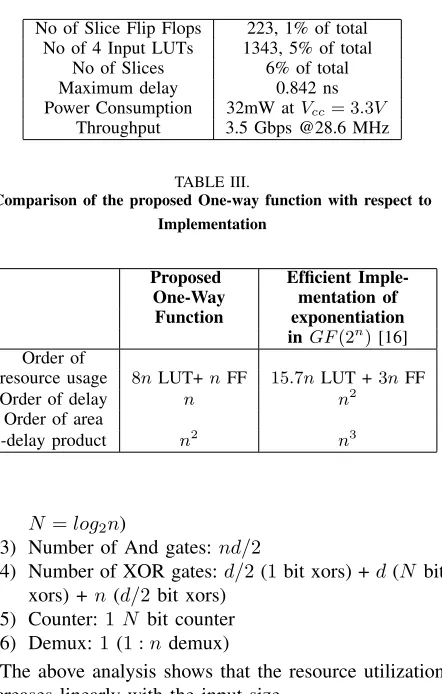
The proposed architecture has been implemented in Verilog HDL and has been verified using RTL simulations using Mentor Graphics ModelSim SE. The Verilog RTL has been prototyped on a Xilinx Virtex XCV1000 FPGA (pkg bg560). The characteristics of the design have been summarized in table II.
The resources of the design of the one-way function operating onn bits are as follows:
1) Number of Flip-Flops:n
TABLE II.
Performance of the Design on Xilinx XCV-1000 platform
No of Slice Flip Flops 223, 1% of total No of 4 Input LUTs 1343, 5% of total
No of Slices 6% of total Maximum delay 0.842 ns Power Consumption 32mW atVcc= 3.3V
Throughput 3.5 Gbps @28.6 MHz
TABLE III.
Comparison of the proposed One-way function with respect to Implementation
Proposed Efficient
Imple-One-Way mentation of
Function exponentiation inGF(2n)[16] Order of
resource usage 8nLUT+nFF 15.7nLUT +3nFF
Order of delay n n2
Order of area
-delay product n2 n3
N=log2n)
3) Number of And gates: nd/2
4) Number of XOR gates:d/2(1bit xors) +d(N bit xors) +n(d/2bit xors)
5) Counter:1 N bit counter 6) Demux:1 (1 :ndemux)
The above analysis shows that the resource utilization increases linearly with the input size.
Table IIIgives a comparison of the resources used, the delay and the area-delay product of the proposed one-way function with those of an efficient implementation of the exponentiation operation inGF(2n)[16]. In the table,n denotes the number of bits in the input and output.
VI. CONCLUSION
The paper proposes a method to generate expander graphs with good expansion properties based on the state transitions of a special class of Cellular Automata, known as the Two Predecessor Single Attractor CA (TPSA-CA). The expander graph has been finally used to compose a one-way function whose security lies on the combinatorial properties of the expander graphs. The design has been implemented on a Xilinx XCV-1000 platform and the performance of the design has been compared with that of efficient designs of the popular modular exponentiation based one-way function. Results have been furnished to prove that the design is superior in terms of area delay product and power consumption. The one-way function can be used to design key agreement protocols which provide authentication
REFERENCES
[1] Oded Goldreich, “Candidate One-Way Functions Based on Expander Graphs,” Cryptology ePrint Archive, Report 2000/063, 2000. [Online]. Available: http://eprint.iacr.org/
[2] W.Diffie and M.Hellman, “New Directions in Cryptogra-phy,” in IEEE Transactions on Information Theory (22). IEEE, 1976, pp. 644–654.
[3] P. P. Chaudhuri, D. Chowdhury, S. Nandi, and S. Chat-topadhyay, Additive Cellular Automata Theory and its Application. IEEE Computer Society Press, 1997, vol. 1. [4] A.Menezes, P. Van. Oorschot and S. Vanstone,Handbook of Applied Cryptography. CRC Press, 1996, ch. 12, pp. 489–541.
[5] C. Boyd and A. Mathuria,Protocols for Authentication and Key Establishment. Springer, 2003, ch. 5, pp. 138–199. [6] Y. Yacobi and Z. Shmuely, “On key distribution systems,”
in In the Proceedings of Advances in Cryptology-Crypto ’89, LNCS 435, December 1989, pp. 344–355.
[7] D. S. Wong and A. H. Chan, “Efficient and mutually authenticated key exchange for low power computing devices,” inIn the Proceedings of Advances in Cryptology-Asiacrypt ’2001, LNCS 2248, 2001, pp. 272–289. [8] C.-S. Park, “On certificate-based security protocols for
wireless mobile communication systems,”IEEE Network, vol. 11, no. 5, pp. 50–55, September/ October 1997. [9] M. Jakobssen and D. Pointcheval, “Mutually authentication
for low power mobile devices,” inFinancial Cryptography, LNCS 2339, 2001, pp. 178–195.
[10] K. M. Gunther Horn and C. J. Mitchell, “Authentication protocols for mobile network environment value-added services,” IEEE Transactions on Vehicular Technology, vol. 51, no. 2, pp. 383–392, March 2002.
[11] Nati Linial and Avi Wigderson, “Expander graphs and their applications,” http://www.math.ias.edu/ boaz/ExpanderCourse/,
2003. [Online]. Available:
http://www.math.ias.edu/ boaz/ExpanderCourse/
[12] Michael A. Nielsen, “Introduction to expander graphs,” http://www.qinfo.org/people/nielsen/, 2005. [Online]. Available: http://www.qinfo.org/people/nielsen/
[13] A. Lubotzky, R. Phillips, and P. Sarnak, “Ramanujan graphs,”Combinatorica, vol. 8, no. 3, pp. 261–277, 1988. [14] G. A. Margulis, “Explicit constructions of expanders,”
Problemy Peredaˇci Informacii, vol. 9, no. 4, pp. 71–80, 1973.
[15] ——, “Explicit group-theoretic constructions of combina-torial schemes and their applications in the construction of expanders and concentrators,” Problemy Peredachi Infor-matsii, vol. 24, no. 1, pp. 51–60, 1988.
[16] Guido Bertoni, Jorge Guajardo, Sandeep Kumar, Gerardo Orlando, Christof Paar and Thomas Wollinger, “Efficient