A Forensic Analysis Method for Redis Database
Based on RDB and AOF File
Ming Xu*
College of Computer, Hangzhou Dianzi University, Hangzhou, China Email: [email protected]
Xiaowei Xu, Jian Xu, Yizhi Ren, Haiping Zhang, Ning Zheng College of Computer, Hangzhou Dianzi University, Hangzhou, China Email: [email protected], { jian.xu, renyz, zhanghp, nzheng }@hdu.edu.cn
Abstract—Redis is a widely used non-relational and in-memory database system. It holds a large amount of information both in memory and file system, which is of great significance to forensic analysis. This paper mainly proposes a forensic analysis method for Redis based on RDB and AOF file. A method of extracting useful information from RDB backup file is proposed based on the data storage mechanism described in this paper. A method of reconstructing the write operation statements from AOF file is also provided. Finally, the method of directly analyzing data from memory is shown. The experimental results demonstrate the effectiveness of our method. Most of the data could be extracted from RDB and AOF file, which provides important information for forensic investigators.
Index Terms—Redis, NoSQL, database forensics, digital forensics
I. INTRODUCTION
Database systems play an important role in every aspect of our life. They typically hold massive amount of data and form the basis for various applications [1-2]. Relational databases work quite well when the data stored in them is highly structured with strict relations between them [3]. However, a lot of applications today use data structures like lists, sets, hashes, and graphs. Storing these less structured data into traditional relational databases would require complex mapping algorithm and often lead to poor performance. In addition to this, if the data set is too large to fit into one server, the database should be partitioned into multiple servers, which is a weak point of many relational databases due to their complex deployment and bad performance. In general, if we are dealing with large amounts of data or the data is less structured, we might have better options than relational databases.
NoSQL databases provide an alternative way to store data other than relational databases [4]. NoSQL databases are most useful when working with a huge quantity of data that does not require a relational model. Aside from being non-relational, most NoSQL databases are also distributed, open-source and horizontally scalable. There are approximately 150 different NoSQL databases. They
could be roughly divided into four categories: document store databases, key-value store databases, graph databases and BigTable Column Family Store databases. Among them, key-value store databases have the simplest form for storing data. Each key is mapped to a value containing arbitrary data. Redis is the most widely used key-value store database and is rapidly gaining popularity all across the globe [5].
Redis forensics is of great importance in many aspects. First, Redis is widely used in many companies to store large amount of data and would thus be a primary target in a forensic investigation. Second, some data in Redis might be mistakenly removed by database users. Redis forensics provides a way to recover these deleted data. Third, Redis is a potential target of database intrusions that involves stealing or tampering the database data. The data recovered in Redis could be used to prove a database security breach and determine the scope of a database intrusion. Finally, the study on Redis forensics could help the study on some other NoSQL databases with similar key-value storage mechanism like Riak and Cassandra. The study on Redis forensics also provides insight into the forensic techniques of some other memory databases. We could analyze the disk backup file instead of the memory to extract the database data.
Both the RDB file and AOF file are of great forensic value in Redis forensics. First, while extracting and analyzing data from memory directly is very difficult, it is relatively easy to parse the RDB file and AOF file instead and extract the data. Second, some deleted data in memory might still be found in RDB file. Third, the RDB file and AOF file could be used to recover important data when the Redis server crashes and the data in memory is lost. Last but not least, by examining the data extracted from AOF file, we could learn what write operations are performed in Redis.
The goal of this paper is to show how to extract data from the Redis RDB backup file. A method to parse the AOF log file and reconstruct write operation statements is also proposed. We also briefly explain how the data is stored in memory.
describe the structure of Redis RDB and AOF file. Section 4 shows our algorithms to extract data from these files and Section 5 discusses the corresponding experiment. We also briefly cover the topic of Redis memory forensics in Section 6. We conclude our work in Section 7.
II. RELATED WORK
Database forensics is a very important research field that has received little research attentions these years. Martin S Olivier [6] believed the lack of research is due to the inherent complexity of databases that is not fully understood in a forensic context. Harmeet Kaur Khanuja [7] discussed various methodologies for tamper detection in databases and outlined challenges and opportunities in database forensics. He [8] also proposed a framework that builds the expert system for database analysis in two stages. Patrick Stahlberg [9] demonstrated that existing database systems fail to securely remove deleted data and remnants of past operations, making the recovery of deleted data possible.
Peter Frühwirt [10-12] described the file format of the MySQL Database with InnoDB Storage Engine and proposed methods for recovering basic SQL statements by analyzing InnoDB’s redo logs. Paul M. Wright [13] introduced advanced Oracle forensics techniques, which could ensure the safety and security of Oracle data. David Litchfield [14-19] performed forensic analysis of a compromised Oracle database server and discussed every aspect of Oracle forensics in his series of papers. Kevvie Fowler [20] defined, established, and documented SQL server forensic methods and techniques in his book.
Josiah L. Carlson [21] introduces Redis and explains how to use Redis effectively in his book. Tiago Macedo and Fred Oliveira [22] provide recipes for a variety of issues a Redis user will face in their book.
III. REDIS INTERNALS
In this section, we explain in great details the structure of Redis RDB file and AOF file, which forms the basis of our algorithms to extract useful data from these files. A. RDB File Format
By default, the whole Redis dataset resides in volatile memory. But Redis would also save the snapshots of all the data in memory to a RDB file on disk. When a Redis server starts, the RDB file would be loaded into memory. RDB file is useful for purposes like backup and disaster recovery. Database users can copy RDB files to other machines and data centers even when the database is still running. By analyzing the RDB backup file, forensic investigators could extract the Redis data without the need to analyze the data in memory, which is fairly difficult.
1). Overall File Structure
We will first look at the overall structure of a RDB file. Table 1 shows the RDB file after two strings are inserted. Table 2 explains the meaning of the bytes.
TABLE I.
HEXADECIMAL STRUCTURE OF RDB FILE
0x00000000 52 45 44 49 53 30 30 30 36 FE
00 FC 9C 45 6D 60 REDIS0006……. 0x00000010 3F 01 00 00 00 03 61 67 65 C0
14 00 04 6E 61 6D ……age….nam 0x00000020 65 04 4A 6F 68 6E FF 43 70
8B 5D AB 68 4A 84 e.John……… TABLE II.
MEANING OF THE HEXADECIMAL VALUE OF THE RDB FILE
Offset Length Value Meaning
0 5 52 45 44 49 53 Magic number: Redis 5 4 30 30 30 36 Redis RDB Version: 6 9 2 FE 00 Database number:0 11 27 FC 9C 45 6D 60 3F
01 00 00 00 03 61 67 65 C0 14 00 04 6E 61 6D 65 04 4A 6F 68 6E
Database data, stored as key-value pairs
38 1 FF End of File marker 39 8 43 70 8B 5D AB 68
4A 84 Checksum
Figure 1. Overall Structure of a RDB File
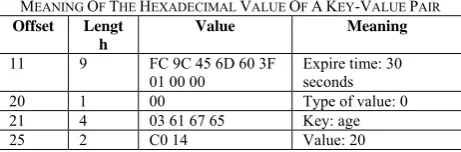
Redis stores data in a database in the form of key-value pairs. Table 3 shows the meaning of the bytes in a key-value pair in Table 1.
TABLE IIII.
MEANING OF THE HEXADECIMAL VALUE OF AKEY-VALUE PAIR
Offset Lengt h
Value Meaning
11 9 FC 9C 45 6D 60 3F
01 00 00 Expire time: 30 seconds 20 1 00 Type of value: 0 21 4 03 61 67 65 Key: age
25 2 C0 14 Value: 20
In Redis, each key could be associated to an expire time field, and will be removed automatically by Redis server when the specified amount of time has elapsed. The expire time is stored as an absolute Unix timestamps in milliseconds. The type of value field tells us which encoding method Redis uses in order to store the value field. The key field is a Redis string, and the value field is stored based on the encoding method described in the type of value field.
Redis is known for its rich support of various data structures. The value field in a key-value pair could be one of five data structures in Redis, which greatly facilitate the work of programmers. In the next few subsections, we will discuss how these data structures are stored in a RDB file.
2). String
would be compressed before being stored. In other cases, it would be stored simply as a byte array.
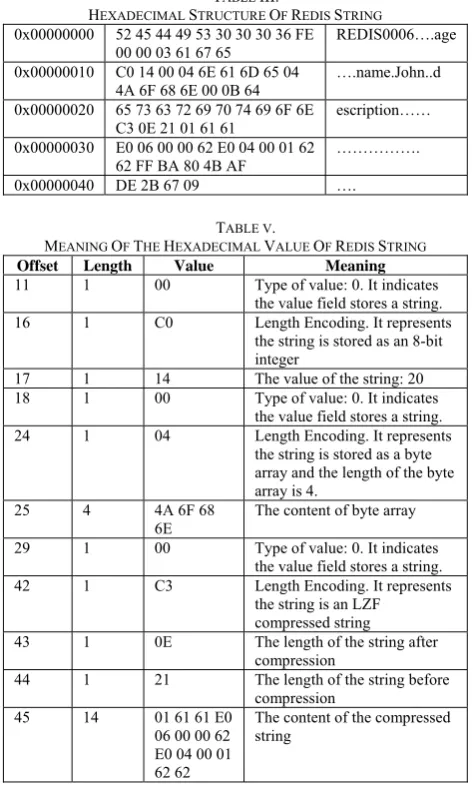
Table 4 shows the RDB file after three strings are inserted. They are stored in three different ways. Table 5 explains the meaning of the bytes.
TABLE III.
HEXADECIMAL STRUCTURE OF REDIS STRING
0x00000000 52 45 44 49 53 30 30 30 36 FE
00 00 03 61 67 65 REDIS0006….age 0x00000010 C0 14 00 04 6E 61 6D 65 04
4A 6F 68 6E 00 0B 64 ….name.John..d 0x00000020 65 73 63 72 69 70 74 69 6F 6E
C3 0E 21 01 61 61 escription…… 0x00000030 E0 06 00 00 62 E0 04 00 01 62
62 FF BA 80 4B AF ………. 0x00000040 DE 2B 67 09 ….
TABLE V.
MEANING OF THE HEXADECIMAL VALUE OF REDIS STRING
Offset Length Value Meaning
11 1 00 Type of value: 0. It indicates the value field stores a string. 16 1 C0 Length Encoding. It represents
the string is stored as an 8-bit integer
17 1 14 The value of the string: 20 18 1 00 Type of value: 0. It indicates
the value field stores a string. 24 1 04 Length Encoding. It represents
the string is stored as a byte array and the length of the byte array is 4.
25 4 4A 6F 68
6E The content of byte array 29 1 00 Type of value: 0. It indicates
the value field stores a string. 42 1 C3 Length Encoding. It represents
the string is an LZF compressed string
43 1 0E The length of the string after compression
44 1 21 The length of the string before compression
45 14 01 61 61 E0 06 00 00 62 E0 04 00 01 62 62
The content of the compressed string
The aim of the length encoding field is to indicate how Redis stores the following string structure [23]. In default, length encoding field is one byte long and the two most significant bits show the way the string is stored. If the two bits are 00, 01 or 10, then the string is stored as a byte array. The length of the array is indicated in the following 6 bits if the starting two bits are 00. If the starting two bits are 01, the length of the array depends on the following 6 bits and the next byte combined, which is 14 bits in total. If the starting two bits are 10, the next 4 bytes represent the length. If the starting two bits are 11 and the value of the remaining 6 bits is 0, 1 or 2, it represents the string is stored as an 8-bit, 16-bit or 32-bit integer, respectively. If the starting two bits are 11 and the value of the remaining 6 bits is 4, it means the string is compressed. Redis adopts LZF compression algorithm to store a long string.
3) List
In Redis, list is a collection of strings sorted by insertion order. Lists are widely used in various situations,
including modeling a timeline and passing messages [24]. By default, Redis stores a list as a ziplist. But when the number of elements in a list exceeds server.list_max_ziplist_entries or the length of any of these elements exceeds server.list_max_ziplist_value, the list would be stored as a linkedlist alternatively.
server.list_max_ziplist_entries and server.list_max_ziplist_value are predefined and
configurable values in Redis.
Table 6 shows the RDB file after two lists are inserted, one with two elements stored as a ziplist and one with one element stored as a linkedlist. Table 7 explains the meaning of the bytes.
TABLE VI.
HEXADECIMAL STRUCTURE OF REDIS LIST
0x00000000 52 45 44 49 53 30 30 30 36 FE
00 0A 0A 70 61 72 REDIS0006….par 0x00000010 61 6D 65 74 65 72 73 13 13 00
00 00 0D 00 00 00 ammeters……… 0x00000020 02 00 00 FE 14 03 03 63 61 72
FF 01 07 73 74 72 …….car...str 0x00000030 69 6E 67 73 01 C3 1D 40 C6
01 61 61 E0 19 00 00 ings………… 0x00000040 62 E0 24 00 00 63 E0 22 00 00
64 E0 1E 00 00 65 ………. 0x00000050 E0 14 00 01 65 65 FF 80 9B
C2 3E 59 11 38 12 ……… TABLE VII.
MEANING OF THE HEXADECIMAL VALUE OF REDIS LIST
Offset Length Value Meaning
11 1 0A Type of value: 10. It indicates the value field is a ziplist.
24 4 13 00 00 00 The number of bytes the ziplist occupies : 19. 28 4 0D 00 00 00 Offset to the last element
in the ziplist: 13. 32 2 02 00 The number of elements in
the ziplist: 2.
34 1 00 The number of bytes the previous element occupies: 0. 35 1 FE Length Encoding. It
represents the element is stored as an integer 36 1 14 The value of the first
element: 20.
37 1 03 The number of bytes the previous element occupies: 3. 38 1 03 Length Encoding. It
represents the element is stored as a byte array and the length of the array is 3 39 3 63 61 72 The value of the second
element.
42 1 FF End of ziplist marker 43 1 01 Type of value: 1. It
indicates the value field is a linkedlist.
52 1 01 The number of elements in the linkedlist:1
53 33 C3 1D 40 C6 01 61 61 E0 19 00 00 62 E0 24 00 00 63 E0 22 00 00 64 E0 1E 00 00 65 E0 14 00 01 65 65
Figure 2. Structure of a Ziplist
Figure 3. Structure of a Ziplist Element
Figure 4. Structure of a Linkedlist
4). Set
Set in Redis is a collection of unordered strings. Sets have the property of not allowing repeated elements, which makes set an ideal structure for tracking unique things and representing relations. When all the elements in a set are integers and the number of elements does not exceed server.set_max_intset_entries, the set would be stored as an intset. If either of these two conditions is not met, Redis would use a hash table to store the set.
Table 8 shows the RDB file after two sets are inserted, each with two elements. The first set is stored as a hash table and the second is stored as an intset. Table 9 explains the meaning of the bytes.
TABLE VIII.
HEXADECIMAL STRUCTURE OF REDIS SET
0x00000000 52 45 44 49 53 30 30 30 36 FE
00 02 06 61 6E 69 REDIS0006….ani 0x00000010 6D 61 6C 02 05 73 6E 61 6B
65 05 74 69 67 65 72 mal..snake.tiger 0x00000020 0B 05 73 63 6F 72 65 0C 02 00
00 00 02 00 00 00 ..score……… 0x00000030 50 00 5F 00 FF F4 9B 09 2D
DD 38 FC 61 ………….
TABLE IX.
MEANING OF THE HEXADECIMAL VALUE OF REDIS SET
Offset Length Value Meaning
11 1 02 Type of value: 2. It indicates the value field is a hash table. 19 1 02 The number of elements in the
hash table:2
20 1 05 The number of bytes the first element occupies.
21 5 73 6E 61
6B 65 The content of the first element 26 1 05 The number of bytes the
second element occupies. 27 5 74 69 67 65
72 The content of the second element 32 1 0B Type of value: 11. It indicates
the value field is an intset. 39 1 0C The number of bytes the intset
occupies: 12.
40 4 02 00 00 00 Encoding of element in the intset: 2. It means each element is stored as a 2-byte integer 44 4 02 00 00 00 The number of elements in the
intset
48 2 50 00 The content of the first element 50 2 5F 00 The content of the second
element
Figure 5. Structure of an Intset
Figure 6. Structure of a Hash Table 5) Sorted Set
In addition to sets, Redis also provides sorted sets. The main difference between these two data structures is that each element in a sorted set has two parts: member and score. The sorted set is ordered based on the score field and the member field stores the actual data. You can do a lot of tasks with sorted sets, like indexing data and making a leader board. If the number of elements in a sorted set is smaller than server.zset_max_ziplist_entries and there is no element with a member whose length exceeds server.zset_max_ziplist_value, it would be stored using ziplist. Otherwise, a skiplist is used to store the sorted list.
Table 10 shows the RDB file after two sorted sets are inserted, one with two elements stored as a skiplist and one with three elements stored as a ziplist. Table 11 explains the meaning of the bytes.
TABLE X.
HEXADECIMAL STRUCTURE OF REDIS SORTED SET
0x00000000 52 45 44 49 53 30 30 30 36
FE 00 03 04 77 6F 72 REDIS0006….wor 0x00000010 64 02 C3 13 40 BF 01 66 66
E0 38 00 00 67 E0 3B ………. 0x00000020 00 00 6A E0 2B 00 01 6A 6A
01 32 C3 13 40 A0 01 ………. 0x00000030 63 63 E0 2C 00 00 64 E0 30
00 00 65 E0 23 00 01 ………. 0x00000040 65 65 01 31 0C 05 63 6F 6C
6F 72 23 23 00 00 00 ………. 0x00000050 20 00 00 00 06 00 00 04 62
6C 75 65 06 F2 02 05 ……..blue…. 0x00000060 67 72 65 65 6E 07 F3 02 03
72 65 64 05 F4 FF FF green….red…. 0x00000070 80 98 1B CB 8B 4C 05 32 ……..
TABLE XI.
MEANING OF THE HEXADECIMAL VALUE OF REDIS SORTED SET
Offset Length Value Meaning 11 1 03 Type of value: 3. It
indicates the value field is a skiplist
17 1 02 The number of elements in the skiplist: 2.
18 23 C3 13 40 BF 01 66 66 E0 38 00 00 67 E0 3B 00 00 6A E0 2B 00 01 6A 6A
The member field of the first element
41 2 01 32 The score field of the first element
43 23 C3 13 40 A0 01 63 63 E0 2C 00 00 64 E0 30 00 00 65 E0 23 00 01 65 65
The member field of the second element
66 2 01 31 The score field of the second element 68 1 0C Type of value: 12. It
Figure 7. Structure of a Skiplist
6) Hash
Hash in Redis is a collection of key-value pairs. They are primarily used to represent objects. If the number of element in a hash is less than server.hash_max_ziplist_entries and all the keys and values are of smaller length than server.hash_max_ziplist_value, it would be stored as a ziplist. In all other cases, a hash table will be used to store the hash.
Table 12 shows the RDB file after two hashes are inserted, one with two key-value pairs stored as a ziplist and one with one key-value pair stored as a hash table. Table 13 explains the meaning of the bytes.
TABLEXII.
HEXADECIMAL STRUCTURE OF REDIS HASH
0x00000000 52 45 44 49 53 30 30 30 36 FE
00 04 07 61 72 74 REDIS0006….art 0x00000010 69 63 6C 65 01 05 74 69 74 6C
65 C3 13 40 9C 01 Icle..title….. 0x00000020 68 68 E0 33 00 00 69 E0 28 00
00 6A E0 20 00 01 ………. 0x00000030 6A 6A 0D 06 70 65 6F 70 6C
65 1F 1F 00 00 00 1B ….people…… 0x00000040 00 00 00 04 00 00 04 6E 61 6D
65 06 04 4A 61 63 …….name..Jac 0x00000050 6B 06 03 61 67 65 05 FE 1E
FF FF AA 08 88 C2 DF …age……….
0x00000060 68 6F 8C …
TABLEXIII.
MEANING OF THE HEXADECIMAL VALUE OF REDIS HASH
Offset Length Value Meaning
11 1 04 Type of value: 4. It indicates the value field is a hash table
20 1 01 The number of key-value pairs in the hash table: 1. 21 6 05 74 69 74 6C
65 Key of the first key-value pair 27 23 C3 13 40 9C 01
68 68 E0 33 00 00 69 E0 28 00 00 6A E0 20 00 01 6A 6A
Value of the first key-value pair
50 1 0D Type of value: 13. It indicates the value field is a ziplist. It stores 2 key-value pairs. The structure of ziplist has been discussed above. We won’t go into details here.
B. AOF File Format
Apart from RDB, Redis also provides AOF as another data persistence strategy. Instead of writing all the data in the memory to the disk, AOF simply logs every write operation. To prevent the AOF file from getting too big, Redis supports the feature of rebuilding the whole AOF file by writing the shortest sequence of statements needed to build the current database in memory. As a result, the AOF file may not show all the write operations performed by the database user, but it is still a good source from which to reconstruct the write operation statements.
The AOF file is a text file and features a relatively simple data format. Every write operation in Redis would be recorded in the AOF file as a single record. Figure 8 describes the format of a record.
Figure 8. Structure of a record in an AOF file
IV. THE PROPOSED METHOD A. Extract Data from RDB File
Data is extracted from RDB file based on Algorithm 1. After extracting the magic number and RDB file version, we extract the data in each database. Extracting the Redis key is simple because the key is normally stored as a string. But since the Redis value is of various data structures and storing methods, it requires different methods to extract them. For some simple structures like linkedlist and hash table, we could simply iterate through all the elements; while for structures like ziplist, we could iterate through all the elements in reverse order. To extract data from intset, we need to first determine the encoding method of the elements.
ALGORITHM I Extract data from RDB file
Algorithm 1:Extract data from RDB file
Input:file: a Redis RDB backup file
Output:data structures: a list of Redis data structures extracted from the RDB file
01 i = 0
02 extract the magic number and RDB version 03 while i < file.lengthdo // scan the entire file
04 Casefile[i] of
05 Case FE:
06 extract the database number 07 Case 0: // the value is a string
08 extract the key
09 extract the value based on length encoding
10 Case 10: // the value is a list stored as a ziplist
11 extract the key
12 extract all the elements in the ziplist based on the offset and number of elements fields
13 Case 11: // the value is a set stored as an intset
14 extract the key
15 extract all the elements in the intset based on the encoding of elements and number of elements fields
16 Case 2: // the value is a set stored as a hash table
17 extract the key
18 extract all the elements in the hash table based on the number of elements field
19 Case 12: // the value is a sorted set stored as a ziplist
20 extract the key
21 extract all the elements in the ziplist based on the offset and number of elements fields
22 Case 13: // the value is a hash stored as a ziplist
23 extract the key
24 extract all the elements in the ziplist based on the offset and number of elements fields
25 endcase
26 endwhile
Write operation statements are extracted and reconstructed from AOF file based on algorithm 2. For each write operation statement, we extract its statement content and all the statement parameters successively.
ALGORITHM II
Reconstruct write operation statements from AOF file
Algorithm 2:Reconstruct write operation statements from AOF file
Input:file: a Redis AOF file
Output:statements: a list of Redis write operation statements extracted from the AOF file
01 read a text line from file 02 while not EOF do
03 ifline[0] = ‘*’ then
04 mark the end of the last statement 05 output a line break
06 mark the end of a new statement 07 elsifline[0] = ‘$’ then
08 ignore this line, continue the loop 09 else
10 output the line 11 endif
12 read the next line 13 endwhile
V. EXPERIMENT AND EVALUATION
We implement an analysis tool using Java. The tool could analyze the input RDB and AOF file based on the algorithms described in section 4 and output the results to a text file.
To validate our method, we conduct experiments on a Linux machine. We first execute 100 write operation statements which insert 100 Redis data structures of various kinds with different data types into two empty Redis databases. After this, we run our analysis tool using the RDB file and AOF file extracted from the disk as input. We then analyze the output file.
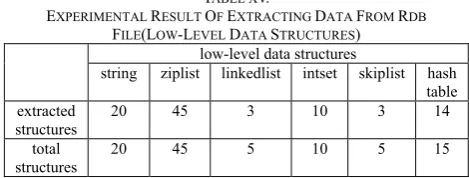
Table 14 and Table 15 show the experimental result of extracting data from RDB file. High-level data structures are the structures that programmers could use when coding with Redis as underlying database. Redis server stores these high-level data structures in the disk using low-level data structures. For each data structure, we compare the number of total structures and the number of extracted structures. The experimental result shows that most of the data structures in the RDB file could be extracted using our method. The five structures that we fail to extract are all stored using LZF compression algorithm because the length of at least one of the elements in the structure exceeds a predefined threshold, which is not common in a real situation. Our method does not consider this situation.
TABLE XIV.
EXPERIMENTAL RESULT OF EXTRACTING DATA FROM RDB
FILE(HIGH-LEVEL DATA STRUCTURES) high-level data structures
string list set sorted set hash extracted
structures 20 18 20 18 19
total
structures 20 20 20 20 20
TABLE XV.
EXPERIMENTAL RESULT OF EXTRACTING DATA FROM RDB
FILE(LOW-LEVEL DATA STRUCTURES) low-level data structures
string ziplist linkedlist intset skiplist hash table extracted
structures 20 45 3 10 3 14
total
structures 20 45 5 10 5 15
Out of the 100 write operation statements we execute, our tool succeeds in extracting and reconstructing all of these statements from Redis AOF file.
These experimental results demonstrate that our method is effective in extracting data from the disk file, which is of great value both to forensic investigators and database users. Currently, our method cannot extract structure with compressed string in it. And our tool could not work when the file is corrupted.
VI. REDIS MEMORY FORENSICS
Redis is an in-memory database. All the data resides in volatile memory while disk only stores backup and log files. This feature gives Redis a huge advantage in performance compared to traditional disk databases. Redis can perform over 110000 write operations and 81000 read operations each second.
Although analyzing and extracting data directly from memory is no easy task, we will give a brief overview of how data in Redis is distributed in memory.
We use the fmem module to obtain a Linux volatile memory image. Fmem is a tool which could gain directly access to Linux physical memory and copy the whole memory image to the disk. After examining the memory image, we discover that some data structures have the same format both in memory and in RDB file, while others have different format. We also find multiple copies of write operation statements we executed all across the memory image, which is of some forensic value as well.
VII. CONCLUSION
In this paper, we discussed the file format of Redis RDB backup file and AOF file, which makes it possible to extract data from these files. A prototype tool was implemented to verify our approach. Most of the data in the RDB and AOF file could be extracted using our tool. We further explained how data is distributed in memory.
This paper is among the first to explore the field of NoSQL database forensics and will prove to be valuable both in understanding the Redis internal architecture and recovering information from the database. Furthermore, our findings would also be helpful in understanding other memory databases and applications using similar data structures to store data.
ACKNOWLEDGMENT
This work is supported by the Natural Science Foundation of China under Grant No.61070212 and 61003195, the Zhejiang Province Natural Science Foundation of China under Grant No.Y1090114 and LY12F02006, the Zhejiang Province key industrial projects in the priority themes of China under Grant No 2010C11050, the science and technology search planned projects of Zhejiang Province (No.2012C21040), the soft science research project of Hangzhou (No. 20130834M15).
REFERENCES
[1] Jin Z, Xu Q. The Realization of Decision Support System for Cross-border Transportation based on the Multidimensional Database[J]. Journal of Software (1796217X), 2012, 7(5).
[2] Jin C, Liu N, Qi L. Research and Application of Data
Archiving based on Oracle Dual Database Structure[J]. Journal of Software (1796217X), 2012, 7(4).
[3] Yang S, Shi L. Results Clustering for Keyword Search
over Relational Database[J]. Journal of Software, 2013, 8(12): 3188-3193.
[4] Wikipedia NoSQL. http://en.wikipedia.org/wiki/NoSQL [5] Wikipedia Redis http://en.wikipedia.org/wiki/Redis [6] Olivier M S. On metadata context in Database Forensics[J].
digital investigation, 2009, 5(3): 115-123.
[7] Khanuja H K, Adane D D S. Database Security Threats
and challenges in Database Forensic: A survey[C]//Proceedings of 2011 International Conference on Advancements in Information Technology (AIT 2011),
available at http://www. ipcsit. com/vol20/33-ICAIT2011-A4072. pdf. 2011.
[8] Khanuja H K, Adane D D S. A Framework For Database
Forensic Analysis[J]. Published in Computer Science & Engineering: An International Journal (CSEIJ), 2012, 2(3). [9] Stahlberg P, Miklau G, Levine B N. Threats to privacy in the forensic analysis of database systems[C]//Proceedings of the 2007 ACM SIGMOD international conference on Management of data. ACM, 2007: 91-102.
[10]Fruhwirt P, Huber M, Mulazzani M, et al. InnoDB
database forensics[C]//Advanced Information Networking and Applications (AINA), 2010 24th IEEE International Conference on. IEEE, 2010: 1028-1036.
[11]Fruhwirt, P., Kieseberg, P., Schrittwieser, S., Huber, M., & Weippl, E. (2012, August). InnoDB database forensics: reconstructing data manipulation queries from redo logs. In Availability, Reliability and Security (ARES), 2012 Seventh International Conference on (pp. 625-633). IEEE. [12]Fruhwirt, P., Huber, M., Mulazzani, M., & Weippl, E. R.
(2010, April). InnoDB database forensics. In Advanced Information Networking and Applications (AINA), 2010 24th IEEE International Conference on (pp. 1028-1036). IEEE.
[13]Wright P M, Burleson D. Oracle Forensics: Oracle
Security Best Practices[M]. Rampant TechPress, 2008. [14]Litchfield D. Oracle Forensics Part 1: Dissecting the Redo
Logs[J]. NGSSoftware Insight Security Research (NISR), Next Generation Security Software Ltd., Sutton, 2007.
[15]Litchfield D. Oracle forensics part 2: Locating dropped objects[J]. NGSSoftware Insight Security Research (NISR), 2007.
[16]Litchfield D. Oracle Forensics: Part 3 Isolating Evidence of Attacks Against the Authentication Mechanism[J]. NGSSoftware Insight Security Research (NISR), 2007. [17]Litchfield D. Oracle Forensics Part 4: Live Response[J].
NGSSoftware Insight Security Research (NISR), Next Generation Security Software Ltd., Sutton, 2007.
[18]Litchfield D. Oracle Forensics Part 5: Finding Evidence of Data Theft in the Absence of Auditing[J]. NGSSoftware Insight Security Research (NISR), Next Generation Security Software Ltd., Sutton, 2007.
[19]Litchfield D. Oracle Forensics Part 6: Examining Undo Segments, Flashback and the Oracle Recycle Bin[J]. NGSSoftware Insight Security Research (NISR), Next Generation Security Software Ltd., Sutton, 2007.
[20]Fowler K. SQL Server Forensic Analysis[M]. Pearson
Education, 2008.
[21]Carlson J L. Redis in Action[M]. Manning Publications Co., 2013.
[22]Macedo T, Oliveira F. Redis Cookbook[M]. O'Reilly
Media, Inc., 2011.
[23]Redis RDB Dump File Format https://github.com
/sripathikrishnan/redis-rdb-tools/wiki/Redis-RDB-Dump-F ile-Format
[24]Data types http://redis.io/topics/data-types
Ming Xu is a Professor in the college of Computer, Hangzhou
Dianzi University, P. R. China. He received the doctor degree in computer science and technology from the Zhejiang University in 2004. His research interests include Digital Forensics, Network Security, Social Network and Data Mining.
Xiaowei Xu received the B.S. degree in Computer Science from
the Zhejiang University City College in 2011. He is currently a master candidate in computer application technology from the Hangzhou Dianzi University, P. R. China. His research interest includes database forensics.
Jian Xu is a Professor in the college of Computer, Hangzhou
Dianzi University, P. R. China. He received the doctor degree in computer science and technology from the Zhejiang University in 2004. His research interests include Location-based Services, Mobile Computing, Distributed Database and Network Security.
Yizhi Ren is a Lecturer in the college of Computer, Hangzhou
Dianzi University, P. R. China. He received the doctor degree in computer science and technology from the Dalian University of Technology in 2011. His research interests include Network Security, Social Computing and Evolutionary game.
Haiping Zhang is an Associate Professor in the college of
Computer, Hangzhou Dianzi University, P. R. China. He received the master degree in Computer Software and Theory from the Hangzhou Dianzi University in 2005. His research interests include Digital Forensics, Network Security, Social Network and Corporate Information Technology.
Ning Zheng is a Professor in the college of Computer,